


Revelation 16:13
Bible text: King James Version (1769 Blayney text) · Public domain
Bible text: King James Version with Strong's numbers · Public domain
Bible text: Berean Standard Bible · Public domain
Bible text: American Standard Version (1901) · Public domain
Bible text: World English Bible, Messianic edition · Public domain
Bible text: Geneva Bible (1599) · Public domain
Bible text: Young's Literal Translation · Public domain
- ΚαὶKaiAndG2532CONJConjunction
- εἶδονeidonI saw [coming]G1492V-2AAI-1SVerb 2nd Aorist Active Indicative 1st Singular
- ἐκekout ofG1537PREPPreposition
- τοῦtoutheG3588T-GSNDefinite article Genitive Singular Neuter
- στόματοςstomatosmouthG4750N-GSNNoun Genitive Singular Neuter
- τοῦtouof theG3588T-GSMDefinite article Genitive Singular Masculine
- δράκοντοςdrakontosdragonG1404N-GSMNoun Genitive Singular Masculine
- καὶkaiandG2532CONJConjunction
- ἐκekout ofG1537PREPPreposition
- τοῦtoutheG3588T-GSNDefinite article Genitive Singular Neuter
- στόματοςstomatosmouthG4750N-GSNNoun Genitive Singular Neuter
- τοῦtouof theG3588T-GSNDefinite article Genitive Singular Neuter
- θηρίουthērioubeastG2342N-GSNNoun Genitive Singular Neuter
- καὶkaiandG2532CONJConjunction
- ἐκekout ofG1537PREPPreposition
- τοῦtoutheG3588T-GSNDefinite article Genitive Singular Neuter
- στόματοςstomatosmouthG4750N-GSNNoun Genitive Singular Neuter
- τοῦtouof theG3588T-GSMDefinite article Genitive Singular Masculine
- ψευδοπροφήτουpseudoprophētoufalse prophetG5578N-GSMNoun Genitive Singular Masculine
- πνεύματαpneumataspiritsG4151N-APNNoun Accusative Plural Neuter
- τρίαtriathreeG5140A-APNAdjective Accusative Plural Neuter
- ἀκάθαρταakathartauncleanG169A-APNAdjective Accusative Plural Neuter
- ὡςhōsasG5613PRTParticle or Disjunctive
- βάτραχοιbatrachoifrogsG944N-NPMNoun Nominative Plural Masculine
English is a literal word-by-word gloss of the Greek, not the KJV's wording. Why?
This is the original text the KJV's translators worked from — each Greek word with its own literal English meaning in this verse, prepared by scholars at Tyndale House, Cambridge. The KJV translates whole sentences, not word by word, so its wording differs: one Greek word can become several English words, and the KJV may choose “charity” where the gloss reads “love”. Both are faithful — they answer different questions. For the KJV's own rendering, switch to the KJV text.
Details
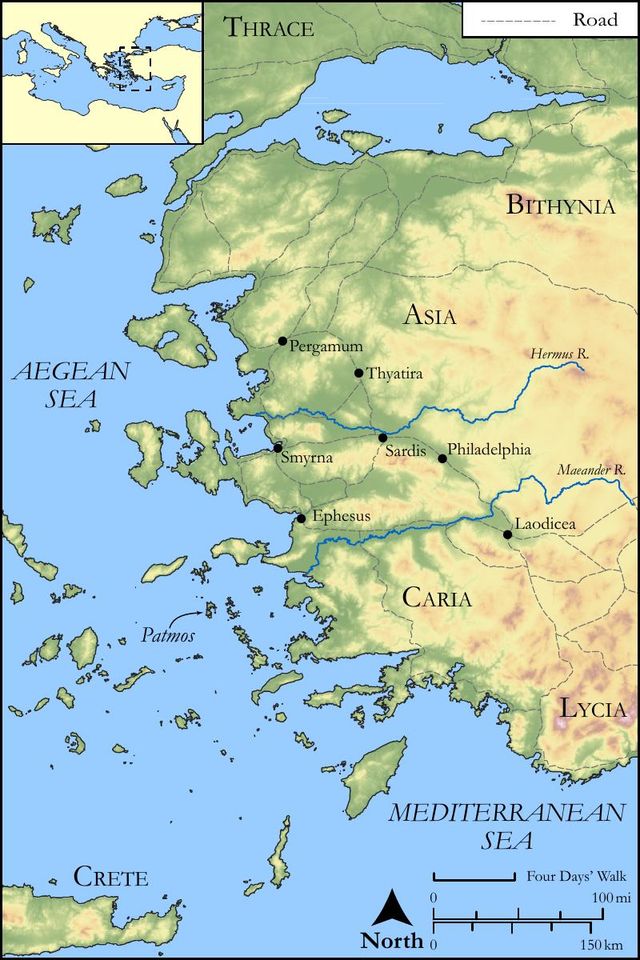
See on the biblical-era maps

Study this verse
Public-domain commentary
Matthew Henry
From his Commentary on the Whole Bible. Henry comments on passages, not single verses — this entry covers Revelation 16:12–16. His three-level outline is real structure in the source text, so it is rendered as structure.
The sixth angel poured out his vial; and observe,
I.Where it fell - upon the great river Euphrates.
Some take it literally, for the place where the Turkish power and empire began; and they think this is a prophecy of the destruction of the Turkish monarchy and of idolatry, which they suppose will be effected about the same time with that of the papacy, as another antichrist, and that thereby a way shall be made for the conveniency of the Jews, those princes of the east. Others take it for the river Tiber; for, as Rome is mystical Babylon, Tiber is mystical Euphrates. And when Rome shall be destroyed her river and merchandise must suffer with her.
II.What did this vial produce?
1.The drying up of the river, which furnished the city with wealth, provisions, and all sorts of accommodations.
2.A way is hereby prepared for the kings of the east. The idolatry of the church of Rome had been a great hindrance both to the conversion of the Jews, who have been long cured of their inclination to idols, and of the Gentiles, who are hardened in their idolatry by seeing that which so much symbolizes with it among those called Christians. It is therefore very probable that the downfall of popery, removing these obstructions, will open a way for both the Jews and other eastern nations to come into the church of Christ. And, if we suppose that Mahomedism shall fall at the same time, there will be still a more open communication between the western and eastern nations, which may facilitate the conversion of the Jews, and of the fulness of the Gentiles. And when this work of God appears, and is about to be accomplished, no wonder if it occasion another consequence, which is,
3.The last effort of the great dragon; he is resolved to have another push for it, that, if possible, he may retrieve the ruinous posture of his affairs in the world. He is now rallying his forces, recollecting all his spirits, to make one desperate sally before all be lost. This is occasioned by the pouring out of the sixth vial. Here observe,
(1.)The instruments he makes use of to engage the powers of the earth in his cause and quarrel: Three unclean spirits like frogs come forth, one out of the mouth of the dragon, another out of the mouth of the beast, and a third out of the mouth of the false prophet. Hell, the secular power of antichrist, and the ecclesiastical power, would combine to send their several instruments, furnished with hellish malice, with worldly policy, and with religious falsehood and deceit; and these would muster up the devil's forces for a decisive battle.
(2.)The means these instruments would use to engage the powers of earth in this war. They would work pretended miracles, the old stratagem of him whose coming is after the working of Satan, with all power, and signs, and lying wonders, and with all deceivableness of unrighteousness, Th2 2:9, Th2 2:10. Some think that a little before the fall of antichrist the popish pretence of power to work miracles will be revived and will very much amuse and deceive the world.
(3.)The field of battle - a place called Armageddon; that is, say some, the mount of Megiddo, near to which, by a stream issuing thence, Barak overcame Sisera, and all the kings in alliance with him, Jdg 5:19. And in the valley of Megiddo Josiah was slain. This place had been famous for two events of a very different nature, the former very happy for the church of God, the latter very unhappy; but it shall now be the field of the last battle in which the church shall be engaged, and she shall be victorious. This battle required time to prepare for it, and therefore the further account of it is suspended till we come to the nineteenth chapter, Rev 19:19, Rev 19:20.
(4.)The warning which God gives of this great and decisive trial, to engage his people to prepare for it, Rev 16:15. It would be sudden and unexpected, and therefore Christians should be clothed, and armed, and ready for it, that they might not be surprised and ashamed. When God's cause comes to be tried, and his battles to be fought, all his people shall be ready to stand up for his interest and be faithful and valiant in his service.
Historical interpretation
Four Centuries of Reception
5 surviving comments on this verse. Each one is dated, so this reads as a timeline rather than a list.
Select a marker to jump to its quote. Markers stagger vertically where authors wrote within a few decades of each other.
In addition to their ugly appearance, frogs are unclean also in their places of habitation. Although they seem to be native to the waters, they cannot endure it when the waters recede or dry up, and they roll around in the waters themselves and in the mud and filth of the waters. The hypocrites likewise do not spend their time in the waters, as they seem to, but in filthy acts that those who believe lay aside in the water. Similar to frogs are such persons who are not ashamed to wallow in sins and vices, which others put aside through penance or baptism. Whenever someone converts to God and repents that he had been arrogant, adulterous, drunken or lustful, such a person imitates these sins that another has relinquished by confessing and thinking to himself says, “I do what I want and later I will do penance as that one has done penance.” But suddenly the last day overtakes him, and any confession is lost and his damnation remains. Such is that person who wishes to imitate others, not in that which is good but in that which is evil, and like frogs cover themselves and roll around in that muck and mire from which others have been liberated. Frogs, therefore, signify the spirits of demons who do signs and wonders.
In view of the various passions in all of the vexations and vices they cause, evil spirits are said to possess a diversity of characteristics. And so, rightly did [Jesus] say somewhere in the Gospel, “deaf and dumb spirit,” and elsewhere, “unclean spirit,” and elsewhere the prophet said, “a spirit of harlotry had led them astray,” for no other reason than that those under its control perform the uncleanliness of its own vice. Here, however, he includes all three unclean spirits, because he indicates that the one body of the devil is made up of its habitual differences, mentioning those [spirits] that possess the greater power, starting with the devil as the dragon; then the beast, which is the antichrist with his followers; and the false prophet, who represents the leaders and teachers of noxious doctrines. Therefore, he sees one spirit but mentions three for the number of the parts of the one body, so that every one of the lost is shown to be led by one malign spirit. Perhaps for this reason he adds the horrible filthiness of frogs as a comparison with their impudence. For like frogs living in the sewers at night, these false prophets make a great noise through the damnable ranting of their error. Just as frogs are loathsome in the places they inhabit, in their appearance and in their annoying croaking, so the devil with his followers is recognized to be abominable to the truth and is deservedly and justly damned to eternal fire. The blessed apostle says something similar when he says, “Do not be mismated with unbelievers. For what partnership have righteousness and iniquity? Or what fellowship has light with darkness? What accord has Christ with Belial? Or what has a believer in common with an unbeliever? What agreement has the temple of God with idols?” And so here, when it says that from their mouths came forth unclean spirits similar to frogs, it is as though it said, why do you compare filth to heaven when it is fitting as a habitation of frogs even as it is of the horrible blasphemies of the false prophets? He is claiming that the teachers of the truth are as far removed [from such persons] as frogs are from holy persons, so that those who are not able to recognize that their frauds must be refuted by the power of discretion, may at least, when confronted by the ugliness of frogs, attempt to avoid such persons who, like frogs, are a hindrance to the ignorant lest they receive the truth in the quiet practice of devotion.
This passage mentions individually the devil as a dragon, the antichrist as a beast, and the false prophet as another figure distinct from the other two. It says that spirits similar to frogs come out from these, for they are characterized by a poisonous and filthy nature, and these evil powers love the mud and creep toward foul and moist pleasures. By the commands of the devil and of the antichrist and of the false prophet, they will use their mouths to show false signs and wonders to humankind.
And I saw from the mouth of the dragon and from the mouth of the beast, etc. The spirit of the devil, and the Antichrist, and the leaders of his body, who are called threefold according to the number of parts of one body, are likened to frogs, which are horrible in place, appearance, and troublesome noise. Though they seem to be inhabitants of the waters, they wallow in filth and mud. Hypocrites, promising the water of life, hide dead in the filth which believers lay down in the water. Thus Pharaoh, who, in order to destroy the people in baptism, dared to enter after them, was killed there.
And he says they came out from the mouth of the Dragon and from the mouth of the False Prophet. The Dragon, the author of evil, he calls the Devil, and the False Prophet is someone else acting by the power of the Devil, as if it were prophesying, or the Antichrist.
But if he is speaking in general of the Antichrist, whom in the earlier passages he introduced as one deprived by the Spirit of the Lord, but now as though still living he vents demons through his mouth, let the hearer not be astonished.
For what is seen is a vision, and the first things are often shown to the evangelist later, and conversely the later things first, and he says, I saw three spirits like frogs. For there are spirits of demons performing signs, which go forth unto the kings. The demons are compared to frogs because they delight in the filthy, muddy life of men and in the slime. But the damp and windless life seems to them more like the life of sinners rather than the steadfast and hardened life of the righteous, whom they greatly envy and rejoice in the destruction of the living.
Continue studying Revelation 16:13 across the web’s major study libraries — every link below opens this exact verse, chapter, or book on the destination site.
Read & Compare
 BibleGatewayThis verse in more than 200 translations and 70 languages.
 Bible.comThe YouVersion reader — hundreds of translations, reading plans, and highlights.
 ESV.orgCrossway's official English Standard Version reader.
 NET BibleThe NET translation with 60,000+ translators' notes on every rendering decision.
 STEP BibleTyndale House's free study tool — original text, vocabulary, and scholarly resources.
 BibliaLogos Bible Software's free web reader.
 USCCBThe New American Bible (Revised Edition) with the U.S. bishops' study notes.
Commentaries
 BibleHub CommentariesDozens of classic commentaries on this verse, gathered on one page.
 StudyLightMore than 100 commentary sets — the largest collection on the web.
 BibleRefPlain-English commentary on what this verse means, verse by verse.
 Enduring WordDavid Guzik's free commentary on this chapter, widely used by Bible teachers.
 Bible Study ToolsVerse commentary alongside Greek and Hebrew study aids.
Original Language & Research
- BibleHub InterlinearThe verse word by word — original language, transliteration, and English.
- BibleHub LexiconEvery word's original-language definition and Strong's entry.
 Blue Letter BibleDeep-study tools — Strong's numbers, concordance, and word studies.
 CNTR CollationThe earliest Greek manuscripts of this verse, collated letter by letter.
Sermons, Hymns & Audio


TrulyRandomVerse is not affiliated with these sites and doesn’t control their content. They’re linked because they’re genuinely useful.
Summary
Revelation 16:13 vividly portrays the satanic forces at work during the pouring out of the sixth bowl of God's wrath, preceding the climactic battle of Armageddon. It describes three demonic, frog-like spirits emanating from the unholy trinity—the dragon, the beast, and the false prophet—signifying their deceptive and pervasive influence, which aims to gather the kings of the earth for a final, futile rebellion against God.
Context
ShowHideLiterary Context
This verse is strategically placed within the narrative of the seven bowl judgments, specifically following the drying up of the Euphrates River under the sixth bowl in Revelation 16:12. The drying of the river prepares the way for the "kings from the East," signaling an imminent global conflict. Verse 13 then immediately reveals the spiritual orchestrators behind this gathering, providing insight into the deceptive propaganda that will compel the world's rulers to assemble for the final battle against God, culminating in Revelation 16:16. It acts as a crucial interlude, explaining the supernatural influence driving the earthly preparations for war.
Historical & Cultural Context
The imagery of frogs and "unclean spirits" would have resonated deeply with John's original audience. Frogs were associated with the plague in Egypt (Exodus 8), symbolizing divine judgment, pervasive annoyance, and ritual impurity (Leviticus 11:10-11). The concept of "unclean spirits" was well-understood in that day, referring to demonic entities that possessed and defiled individuals, often associated with false prophecy and idolatry. The "dragon" is a clear reference to Satan (Revelation 12:9), while the "beast" and "false prophet" represent the political and religious manifestations of evil that would arise in the end times, drawing on Old Testament prophetic traditions of oppressive empires and deceptive religious leaders.
Key Themes
ShowHideRevelation 16:13 contributes significantly to several overarching themes in the book of Revelation. It underscores the theme of Spiritual Warfare, revealing the unseen demonic forces that instigate human rebellion against God. The presence of the "dragon, beast, and false prophet" highlights the Unholy Trinity, a counterfeit of the Divine Trinity, working in concert to deceive the nations. This verse also emphasizes Deception as a Primary Weapon of the enemy, as these spirits emanate "out of the mouth," symbolizing the power of false words, propaganda, and lying signs and wonders, a theme also found in 2 Thessalonians 2:9-10. Finally, it sets the stage for the Climax of Human Rebellion, demonstrating how demonic influence will gather the world's armies for their ultimate confrontation with God, fulfilling prophecies of a final, global conflict.
Exposition and Analysis
ShowHideKey Word Analysis
ShowHideFrom a negative particle and a presumed derivative of kathairō (meaning cleansed), this term denotes something impure, defiled, or morally corrupt. In this context, it specifically refers to the demonic nature of these spirits, highlighting their spiritual pollution and opposition to all that is holy and pure.
Derived from pneō (to blow or breathe), pneûma refers to a current of air, breath, or, by extension, a spirit. Here, it signifies non-physical, intelligent beings, specifically malevolent demonic entities. The use of pneûma in conjunction with akáthartos clearly identifies them as agents of evil, distinct from the Holy Spirit.
This word refers to the physical opening of the mouth, but figuratively, it signifies language, speech, and the source of communication or emanation. In Revelation 16:13, the spirits coming "out of the mouth" of the unholy trinity emphasizes that their power and influence are primarily through deceptive words, false doctrines, and persuasive propaganda, rather than direct physical force.
Verse Breakdown
ShowHide"And I saw three unclean spirits like frogs"
John's vision reveals the nature and number of these entities. "Three" signifies a complete, unified force, mirroring the unholy trinity from which they originate. "Unclean spirits" unequivocally identifies them as demonic, morally defiled agents of evil. The comparison "like frogs" is highly symbolic, evoking images of the Egyptian plague of frogs (pervasive, annoying, defiling) and highlighting their repulsive, impure nature under Old Testament law. It also suggests their loud, persistent, and irritating "croaking" propaganda.
"[come] out of the mouth of the dragon, and out of the mouth of the beast, and out of the mouth of the false prophet"
This clause specifies the origin and source of these spirits' power and authority. The "dragon" is Satan (Revelation 12:9), the ultimate orchestrator of evil. The "beast" is the Antichrist, the political embodiment of evil (Revelation 13:1). The "false prophet" is the religious deceiver, the beast from the earth (Revelation 13:11). Their "mouths" indicate that the spirits are not merely sent, but are an emanation of their very words, doctrines, lies, and deceptive power. This signifies that the primary weapon of this unholy alliance is propaganda and spiritual deception, designed to manipulate global leaders.
Literary Devices
ShowHideRevelation 16:13 employs several potent literary devices. Symbolism is paramount, with the "three unclean spirits" representing demonic forces, and their appearance "like frogs" symbolizing their repulsive, pervasive, and defiling nature, reminiscent of the Egyptian plague. The "dragon," "beast," and "false prophet" are themselves powerful allegorical figures representing the satanic, political, and religious manifestations of evil in the end times. The phrase "out of the mouth" functions as metonymy, where "mouth" stands for the deceptive words, propaganda, and persuasive power emanating from these entities. The entire scene is a vivid example of apocalyptic imagery, using grotesque and symbolic figures to convey profound spiritual truths about the nature of evil and its final, desperate attempts to thwart God's plan.
Theological and Thematic Connections
ShowHideThis verse profoundly reveals the spiritual dimension behind end-time events, emphasizing that human conflicts are often orchestrated by unseen demonic forces. It highlights the coordinated effort of the unholy trinity—Satan, the Antichrist, and the False Prophet—to deceive and gather the nations against God. This deception, emanating as "unclean spirits like frogs," underscores the pervasive and insidious nature of spiritual warfare, where lies and false signs are used to manipulate human will. Theologically, it affirms God's ultimate sovereignty even amidst the chaos of judgment, as these demonic activities serve His purpose in bringing about the final confrontation and the ultimate triumph of Christ.
Reflection and Application
ShowHideRevelation 16:13, though depicting future apocalyptic events, offers profound insights for believers today. It serves as a stark reminder that spiritual warfare is not a distant concept but an active reality, with deceptive forces constantly at work in the world. The "unclean spirits" emanating from the mouths of the unholy trinity underscore that the enemy's primary weapon is often not brute force, but persuasive, lying words and ideologies designed to mislead and manipulate. This calls for an urgent and consistent commitment to spiritual discernment, enabling us to test every spirit and every message against the unchanging truth of God's Word. It compels us to be vigilant against false teachings, deceptive narratives, and the subtle influences that seek to draw individuals and nations away from God. Furthermore, understanding the demonic orchestration behind global events should drive us to fervent prayer for world leaders and for the Church, that we may stand firm in truth and resist the pervasive tide of deception.
Questions for Reflection
ShowHideFAQ
ShowHideWhat is the significance of the "three unclean spirits" coming from the "mouths" of the dragon, beast, and false prophet?
ShowHideThe "three unclean spirits" represent a unified, demonic force, mirroring the unholy trinity (Satan, Antichrist, False Prophet) from whom they originate. Their emanation "out of the mouth" is highly significant. It symbolizes that their power and influence are primarily through deceptive words, false doctrines, and persuasive propaganda, rather than direct physical force. It highlights that the enemy's strategy is to manipulate minds and wills through lies and spiritual deception, rather than overt coercion. This is consistent with how the "false prophet" in Revelation 13:14 deceives those on earth through "signs" and words.
Why are these spirits described "like frogs"?
ShowHideThe "like frogs" imagery carries multiple layers of symbolic meaning. First, frogs were considered unclean animals under Old Testament law (Leviticus 11:10-11), immediately signaling the impure and defiling nature of these spirits. Second, it evokes the plague of frogs in Egypt (Exodus 8:6), which was pervasive, annoying, and brought widespread defilement, suggesting the irritating and inescapable nature of these spirits' influence. Third, frogs are known for their loud, persistent croaking, which can symbolize the noisy, insistent, and deceptive propaganda that emanates from the unholy trinity, attempting to persuade and gather the world's leaders for the final battle.
Christ-Centered Fulfillment
ShowHideWhile Revelation 16:13 details the culmination of satanic deception and human rebellion, it ultimately serves to magnify the sovereign power and ultimate victory of Jesus Christ. The very gathering of the kings of the earth, incited by these unclean spirits, sets the stage for Christ's glorious return as the King of Kings and Lord of Lords, as prophesied in Revelation 19:11-16. The futile efforts of the dragon, beast, and false prophet, despite their pervasive deception, will ultimately be crushed by the Lamb of God, who triumphs not by human armies or deceptive words, but by the "sharp sword" of His mouth (Revelation 19:15), signifying the power of His divine word and judgment. This passage, therefore, highlights the stark contrast between the deceptive, impure emanations of evil and the pure, powerful, and truth-filled Word of Christ, who alone is worthy to open the scrolls and execute God's righteous judgments, leading to the establishment of His eternal kingdom (Revelation 11:15). The deception of the "unclean spirits" ultimately serves to demonstrate the absolute necessity and glory of Christ's decisive intervention to redeem His people and establish His righteous reign.