


2 Chronicles 18:3
- וַיֹּאמֶרvai·Yo·merand he saidH559Conj-w ¦ V-Qal-ConsecImperf-3msVerb Qal Consecutive Imperfect 3rd Singular Masculineוַandיֹּאמֶרhe said
- אַחְאָב'ach·'AvAhabH256N-proper-mNoun Proper Masculine
- מֶלֶךְMe·lekh[the] king ofH4428N-mscNoun Singular Masculine Construct
- יִשְׂרָאֵלYis·ra·'ElIsraelH3478N-properNoun Proper Location
- אֶל'eltoH413PrepPreposition
- יְהוֹשָׁפָטye·ho·sha·FatJehoshaphatH3092N-proper-mNoun Proper Masculine
- מֶלֶךְMe·lekh[the] king ofH4428N-mscNoun Singular Masculine Construct
- יְהוּדָהye·hu·DahJudahH3063N-properNoun Proper Location
- הֲתֵלֵךְha·te·Lekh¿ will you goH1980Interrog ¦ V-Qal-Imperf-2msVerb Qal Imperfect 2nd Singular Masculineהֲ¿תֵלֵךְwill you go
- עִמִּי'i·Miwith meH5973Prep ¦ 1csPrepositionעִמִּwithיme
- רָמֹתra·MotRamothH7418N-properNoun Proper Location
- גִּלְעָדgil·'AdGileadH1568N-properNoun Proper Location
- וַיֹּאמֶרvai·Yo·merand he saidH559Conj-w ¦ V-Qal-ConsecImperf-3msVerb Qal Consecutive Imperfect 3rd Singular Masculineוַandיֹּאמֶרhe said
- לוֹloto <the> himPrep-l ¦ 3msSuffix Personal 3rd Singular Masculineלto <the>וֹhim
- כָּמוֹנִיka·Mo·nias meH3644Prep ¦ 1csPreposition Definiteכָּמוֹasנִיme
- כָמוֹךָkha·Mo·khaas youH3644Prep ¦ 2msPrepositionכָמוֹasךָyou
- וּכְעַמְּךָu·khe·'a·me·Khaand [will be] as your peopleH5971Conj-w ¦ Prep-k ¦ N-msc ¦ 2msNoun Singular Masculine Constructוּandכְ[will be] asעַמְּpeopleךָyour
- עַמִּי'a·Mimy peopleH5971N-msc ¦ 1csNoun Singular Masculine Constructעַמִּpeopleיmy
- וְעִמְּךָve·'i·me·Khaand with youH5973Conj-w ¦ Prep ¦ 2msPrepositionוְandעִמְּwithךָyou
- בַּמִּלְחָמָהba·mil·cha·Mahin the battleH4421Prep-b ¦ N-fsNoun Singular Feminine Absoluteבַּin theמִּלְחָמָהbattle
English is a literal word-by-word gloss of the Hebrew, not the KJV's wording. Why?
This is the original text the KJV's translators worked from — each Hebrew word with its own literal English meaning in this verse, prepared by scholars at Tyndale House, Cambridge. The KJV translates whole sentences, not word by word, so its wording differs: one Hebrew word can become several English words, and the KJV may choose “the LORD” where the gloss reads “Yahweh”. Both are faithful — they answer different questions. For the KJV's own rendering, switch to the KJV text.
Details
See on the biblical-era map
Study this verse
Public-domain commentary
Matthew Henry
From his Commentary on the Whole Bible. Henry comments on passages, not single verses — this entry covers 2 Chronicles 18:1–3. His three-level outline is real structure in the source text, so it is rendered as structure.
Here is, I. Jehoshaphat growing greater. It was said before (Ch2 17:5) that he had riches and honour in abundance; and here it is said again that his wealth and honour increased upon him by piety and good management.
II.Not growing wiser, else he would not have joined with Ahab, that degenerate Israelite, who had sold himself to work wickedness.
What good could he get by a man that was so bad? What good could he do to a man that was so obstinately wicked - an idolater, a persecutor? With him he joined in affinity, that is, married his son Jehoram to Ahab's daughter Athaliah.
1.This was the worst match that ever was made by any of the house of David. I wonder what Jehoshaphat could promise himself by it.
(1.)Perhaps pride made the match, as it does many a one, which speeds accordingly. His religion forbade him to marry his son to a daughter of any of the heathen princes that were about him - Thou shalt not take their daughters to thy sons; and, having riches and honour in abundance, he thought it a disparagement to marry him to a subject. A king's daughter it must be, and therefore Ahab's, little considering that Jezebel was her mother.
(2.)Some think he did it in policy, hoping by this expedient to unite the kingdoms in his son, Ahab perhaps flattering him with hopes that he would make him his heir, when he intended no such thing.
2.This match drew Jehoshaphat,
(1.)Into an intimate familiarity with Ahab. He paid him a visit at Samaria, and Ahab, proud of the honour which Jehoshaphat did him, gave him a very splendid entertainment, according to the splendour of those times: He killed sheep and oxen for him, plain meat, in abundance, Ch2 18:2. In this Jehoshaphat did not walk so closely as he should have done in the ways of his father David, who hated the congregation of evil-doers and would not sit with the wicked (Psa 26:5), nor desired to eat of their dainties, Psa 141:4.
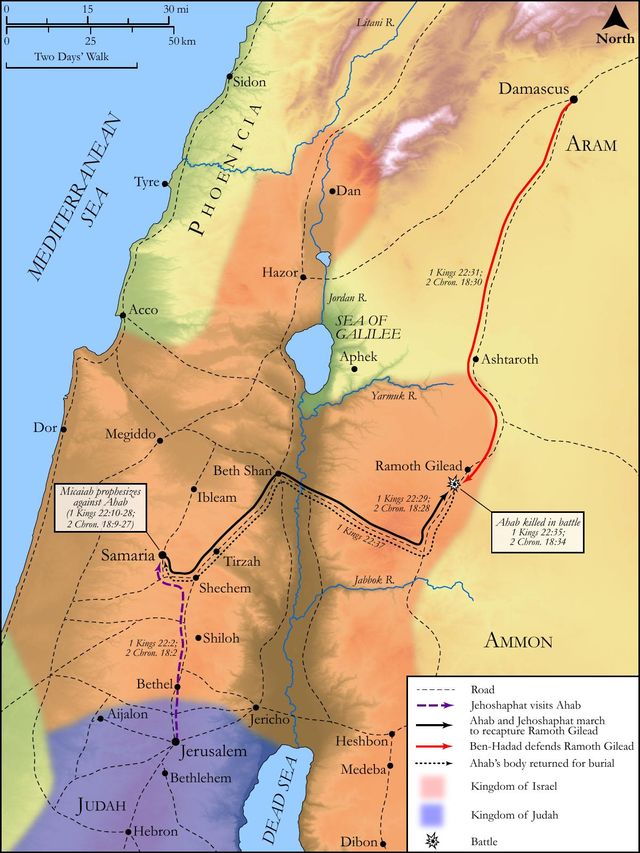
(2.)Into a league with Ahab against the Syrians. Ahab persuaded him to join forces with him in an expedition for the recovery of Ramoth-Gilead, a city in the tribe of Gad, on the other side Jordan. Did not Ahab know that that, and all the other cities of Israel, did of right belong to Jehoshaphat, as heir of the house of David? With what face then could he ask Jehoshaphat to assist him in recovering it for himself, whose title to the crown was usurped and precarious? Yet Jehoshaphat, an easy man, yields to go with him: I am as thou art, Ch2 18:3. Some men's kindnesses are dangerous, as well as their society infectious. The feast Ahab made for Jehoshaphat was designed only to wheedle him into the expedition. The kisses of an enemy are deceitful.
Continue studying 2 Chronicles 18:3 across the web’s major study libraries — every link below opens this exact verse, chapter, or book on the destination site.
Read & Compare
 BibleGatewayThis verse in more than 200 translations and 70 languages.
 Bible.comThe YouVersion reader — hundreds of translations, reading plans, and highlights.
 ESV.orgCrossway's official English Standard Version reader.
 NET BibleThe NET translation with 60,000+ translators' notes on every rendering decision.
 STEP BibleTyndale House's free study tool — original text, vocabulary, and scholarly resources.
 BibliaLogos Bible Software's free web reader.
 USCCBThe New American Bible (Revised Edition) with the U.S. bishops' study notes.
Commentaries
 BibleHub CommentariesDozens of classic commentaries on this verse, gathered on one page.
 StudyLightMore than 100 commentary sets — the largest collection on the web.
 BibleRefPlain-English commentary on what this verse means, verse by verse.
 Enduring WordDavid Guzik's free commentary on this chapter, widely used by Bible teachers.
 Bible Study ToolsVerse commentary alongside Greek and Hebrew study aids.
Original Language & Research
- BibleHub InterlinearThe verse word by word — original language, transliteration, and English.
- BibleHub LexiconEvery word's original-language definition and Strong's entry.
 Blue Letter BibleDeep-study tools — Strong's numbers, concordance, and word studies.
 SefariaThe Hebrew text with Rashi and centuries of Jewish commentary.
Sermons, Hymns & Audio


TrulyRandomVerse is not affiliated with these sites and doesn’t control their content. They’re linked because they’re genuinely useful.
Summary
This verse records the pivotal moment when King Ahab of Israel, seeking to reclaim the strategic city of Ramoth-gilead, proposes a military alliance to King Jehoshaphat of Judah. Jehoshaphat's immediate and unequivocal agreement—declaring full solidarity with Ahab and his people in the impending war—sets the stage for a critical narrative of spiritual compromise and its severe consequences for a generally righteous king.
Context
ShowHideLiterary Context
This verse serves as the inciting incident for the dramatic events of 2 Chronicles 18, which parallels 1 Kings 22. It immediately follows a period of Jehoshaphat's prosperity and religious reforms, as detailed in 2 Chronicles 17, where he strengthened Judah and sought the Lord. The alliance with Ahab, a notoriously wicked king, represents a sharp departure from Jehoshaphat's usual reliance on God, foreshadowing the divine rebuke he receives later in 2 Chronicles 19:2. The subsequent narrative details Jehoshaphat's belated request for prophetic counsel, the confrontation between true and false prophets, and the disastrous battle at Ramoth-gilead, culminating in Ahab's death and Jehoshaphat's miraculous escape.
Historical & Cultural Context
The setting is the divided monarchy, with the northern kingdom of Israel ruled by the idolatrous King Ahab and the southern kingdom of Judah by the more righteous King Jehoshaphat. Ramoth-gilead was a strategically vital city in the Transjordan region, long contested between Israel and the Arameans (Syrians). Its control was crucial for trade routes and regional security, making it a frequent point of contention. Alliances between kingdoms were common in the ancient Near East for military and political stability, often sealed by marriage (Ahab's daughter Athaliah married Jehoshaphat's son Jehoram, 2 Kings 8:18). For a king like Jehoshaphat, who generally sought the Lord, forming such a close military bond with Ahab, a king who had led Israel into deep idolatry and opposed God's prophets, represented a significant spiritual compromise, particularly given the stark contrast in their spiritual commitments.
Key Themes
ShowHideThe most prominent theme introduced by this verse is the danger of unwise alliances and the consequences of spiritual compromise. Jehoshaphat's immediate and enthusiastic agreement to join forces with Ahab, despite Ahab's well-known wickedness, illustrates the temptation to prioritize political or military expediency over spiritual discernment. This decision sets the stage for a narrative that underscores the principle of the "unequal yoke," where aligning with those who do not share one's core values or spiritual commitment can lead to peril and divine displeasure, as seen in the prophet Jehu's rebuke in 2 Chronicles 19:2. Furthermore, the verse highlights the theme of discernment, or rather, the initial lack thereof, as Jehoshaphat commits to the alliance before seeking the Lord's counsel, a crucial lesson for all who lead and a stark contrast to his earlier reign described in 2 Chronicles 17.
Exposition and Analysis
ShowHideKey Word Analysis
ShowHideFrom a root meaning "brother of (his) father," this name belongs to the king of Israel mentioned here. Ahab was notorious for his wickedness, particularly his promotion of Baal worship and his persecution of God's prophets, making Jehoshaphat's alliance with him a profound spiritual misstep.
From a root meaning "Jehovah-judged," this name signifies the king of Judah. Jehoshaphat was generally considered a righteous king who sought the Lord and implemented religious reforms, making his decision to ally with Ahab particularly perplexing and a key point of narrative tension.
This term refers to a "congregated unit," specifically a tribe or nation, and collectively, troops or attendants. When Jehoshaphat declares "my people as thy people," he is not merely offering personal support but pledging the full military and national resources of Judah, signifying a complete and dangerous identification with Ahab's cause.
This word specifically denotes a "battle" or "warfare." Its inclusion emphasizes the direct, violent nature of the proposed endeavor, highlighting that Jehoshaphat is not merely offering political support but pledging active participation in a potentially deadly confrontation alongside a king who is an enemy of God.
Verse Breakdown
ShowHide"And Ahab king of Israel said unto Jehoshaphat king of Judah, Wilt thou go with me to Ramothgilead?"
This opening clause establishes the initiator of the alliance (Ahab, king of the northern kingdom of Israel) and the proposed military objective (Ramoth-gilead, a strategically vital city). Ahab's direct question to Jehoshaphat, a king known for his piety and rule over the southern kingdom of Judah, reveals a calculated political move, seeking to leverage Judah's strength for his own ends. The invitation itself serves as a test of Jehoshaphat's discernment and commitment to his own spiritual principles.
"And he answered him, I [am] as thou [art], and my people as thy people;"
Jehoshaphat's immediate response is one of astonishing and unqualified agreement. The declaration "I am as thou art" signifies a complete identification and solidarity, indicating that Jehoshaphat sees no distinction between himself and Ahab, or between their respective kingdoms. This phrase implies a total alignment of purpose and destiny, a dangerous spiritual compromise for a king who had previously sought to walk in the ways of the Lord and whose kingdom was meant to be distinct.
"and [we will be] with thee in the war."
This final clause reiterates and seals the commitment, leaving no room for ambiguity. Jehoshaphat pledges not only his personal presence but also the full military might of Judah to Ahab's cause. This decisive statement, made without apparent prior consultation with the Lord, underscores the urgency and depth of Jehoshaphat's spiritual misstep, setting the stage for the dramatic consequences that unfold in the subsequent narrative.
Literary Devices
ShowHideThe verse effectively employs Dialogue to immediately establish the central conflict and character motivations. Ahab's direct question and Jehoshaphat's swift, unequivocal response reveal their respective characters and the nature of their relationship. Jehoshaphat's declaration, "I am as thou art," serves as powerful Foreshadowing, hinting at the deep entanglement and shared fate that will ensue, particularly the near-disaster for Jehoshaphat and the ultimate demise of Ahab. There is also a strong element of Irony in a generally righteous king like Jehoshaphat so readily aligning himself with the notoriously wicked Ahab, a decision that runs contrary to his established character and previous reforms, thereby setting up the narrative tension of the chapter and highlighting the profound spiritual lapse.
Theological and Thematic Connections
ShowHideThis pivotal verse introduces the profound theological theme of the perils of unholy alliances and the insidious nature of spiritual compromise. Jehoshaphat, a king generally commended for his devotion to the Lord and his efforts to reform Judah, makes a critical error in judgment by aligning himself so completely with Ahab, a monarch whose reign was characterized by flagrant idolatry and opposition to God. This partnership highlights the danger of prioritizing political expediency or perceived military advantage over divine principles and spiritual discernment. The narrative serves as a stark reminder that even godly individuals can be tempted to compromise their convictions, leading to entanglement with the world's systems and incurring divine displeasure. It underscores the biblical call for God's people to maintain distinctiveness and avoid partnerships that could corrupt their faith or draw them away from pure devotion to God.
Reflection and Application
ShowHideThe narrative of Jehoshaphat's alliance with Ahab in 2 Chronicles 18:3 offers a timeless and potent warning for believers today. It challenges us to critically examine the nature of our associations and partnerships, whether in personal friendships, professional endeavors, or even within ministry contexts. The ease with which Jehoshaphat, a generally righteous king, declared full solidarity with a wicked one should prompt us to consider the subtle ways in which we might be tempted to compromise our core values for perceived benefits, convenience, or acceptance. This verse urges us to cultivate a posture of constant spiritual discernment, prioritizing God's will and wisdom above all else, and to seek His counsel before making any significant commitments. It reminds us that true strength and security come not from worldly alliances, but from unwavering reliance on the Lord, and that even the most devout among us are susceptible to making grave errors when we stray from this path.
Questions for Reflection
ShowHideFAQ
ShowHideWhy was Ramoth-gilead so important to Ahab?
ShowHideRamoth-gilead was a highly strategic city located in the Transjordan region, specifically in Gilead. Its importance stemmed from its geographical position as a key fortress and its control over vital trade routes. For Ahab, reclaiming it from the Arameans (Syrians) was not only a matter of national pride and territorial integrity but also crucial for economic control and military dominance in the region, as detailed in 1 Kings 22.
Was Jehoshaphat generally considered a good king, despite this alliance?
ShowHideYes, Jehoshaphat is overwhelmingly portrayed as one of Judah's most righteous kings. The book of Chronicles, in particular, highlights his devotion to the Lord, his efforts to remove idolatry, and his initiatives to promote the study of the Law throughout Judah (2 Chronicles 17:3-9). He is commended for walking in the ways of his father David. His alliance with Ahab, while a significant lapse in judgment for which he was later rebuked by the prophet Jehu (2 Chronicles 19:2), stands out as an exception rather than the rule of his otherwise commendable reign.
What was the ultimate outcome of this alliance for Ahab and Jehoshaphat?
ShowHideThe alliance proved disastrous. Despite Micaiah's true prophecy of doom, which Jehoshaphat heard, both kings proceeded to battle at Ramoth-gilead. Ahab, attempting to disguise himself, was fatally wounded by a random arrow (1 Kings 22:34-35). Jehoshaphat himself narrowly escaped death, being mistaken for Ahab and only saved by God's intervention when he cried out (2 Chronicles 18:31-32). Upon his return to Jerusalem, Jehoshaphat was severely rebuked by the prophet Jehu for his unwise alliance with the wicked Ahab (2 Chronicles 19:2), underscoring the severe consequences of compromising spiritual principles.
Christ-Centered Fulfillment
ShowHideThe ill-fated alliance between Jehoshaphat and Ahab in 2 Chronicles 18:3 profoundly foreshadows the absolute necessity of Christ's perfect non-compromise and His distinct kingdom. Unlike Jehoshaphat, who, despite his general righteousness, yielded to the temptation of a worldly alliance with a king steeped in idolatry, Jesus Christ consistently refused to align Himself with the corrupt systems or values of this world. His kingdom is "not of this world" (John 18:36), and He never sought political or military power through earthly means, but rather through humble submission to the Father's will, even unto death (Philippians 2:8). Where Jehoshaphat's compromise led to near-disaster and divine rebuke, Christ's unwavering obedience and perfect discernment demonstrate the true path of righteousness. He is the ultimate King who does not need to form alliances with the wicked to achieve His purposes, for "all authority in heaven and on earth has been given to me" (Matthew 28:18). Believers, as followers of Christ, are called to emulate His separation from the world's corrupting influences, understanding that their true strength and victory come solely through Him, the Lamb of God who takes away the sin of the world, not through unholy yokes with darkness (2 Corinthians 6:14). He is our perfect King, our perfect wisdom, and our perfect Deliverer, requiring no human compromise for His eternal reign.