


2 Chronicles 18:2
- וַיֵּרֶדvai·ye·Redand he went downH3381Conj-w ¦ V-Qal-ConsecImperf-3msVerb Qal Consecutive Imperfect 3rd Singular Masculineוַandיֵּרֶדhe went down
- לְקֵץle·Ketzto [the] end ofH7093Prep-l ¦ N-mscNoun Singular Masculine Constructלְtoקֵץ[the] end of
- שָׁנִיםsha·NimyearsH8141N-mpNoun Plural Masculine Absolute
- אֶל'eltoH413PrepPreposition
- אַחְאָב'ach·'AvAhabH256N-proper-mNoun Proper Masculine
- לְשֹׁמְרוֹןle·Sho·me·Ronto SamariaH8111Prep-l ¦ N-properNoun Proper LocationלְtoשֹׁמְרוֹןSamaria
- וַיִּזְבַּחvai·yiz·bachand he slaughteredH2076Conj-w ¦ V-Qal-ConsecImperf-3msVerb Qal Consecutive Imperfect 3rd Singular Masculineוַandיִּזְבַּחhe slaughtered
- לוֹlofor himPrep-l ¦ 3msSuffix Personal 3rd Singular Masculineלforוֹhim
- אַחְאָב'ach·'AvAhabH256N-proper-mNoun Proper Masculine
- צֹאןtzonsheepH6629N-csNoun Singular common gender Absolute
- וּבָקָרu·va·Karand cattleH1241Conj-w ¦ N-csNoun Singular common gender Absoluteוּandבָקָרcattle
- לָרֹבla·Roto abundanceH7230Prep-l ¦ N-msNoun Singular Masculine Absoluteלָtoרֹבabundance
- וְלָעָםve·la·'Amand for the peopleH5971Conj-w ¦ Prep-l ¦ N-msNoun Singular Masculine Absoluteוְandלָfor theעָםpeople
- אֲשֶׁר'a·SherwhichH834RelParticle Relative
- עִמּוֹi·Mo[was] with himH5973Prep ¦ 3msPrepositionעִמּ[was] withוֹhim
- וַיְסִיתֵהוּvay·si·Te·huand he incited himH5496Conj-w ¦ V-Hiphil-ConsecImperf-3ms ¦ 3msVerb Hiphil Consecutive Imperfect 3rd Singular Masculineוַandיְסִיתֵhe incitedהוּhim
- לַעֲלוֹתla·'a·Lotto go upH5927Prep-l ¦ V-Qal-InfVerb Qal Infinitive Constructלַtoעֲלוֹתgo up
- אֶל'elagainstH413PrepPreposition
- רָמוֹתra·MotRamothH7418N-properNoun Proper Location
- גִּלְעָדgil·'AdGileadH1568N-properNoun Proper Location
English is a literal word-by-word gloss of the Hebrew, not the KJV's wording. Why?
This is the original text the KJV's translators worked from — each Hebrew word with its own literal English meaning in this verse, prepared by scholars at Tyndale House, Cambridge. The KJV translates whole sentences, not word by word, so its wording differs: one Hebrew word can become several English words, and the KJV may choose “the LORD” where the gloss reads “Yahweh”. Both are faithful — they answer different questions. For the KJV's own rendering, switch to the KJV text.
Details
See on the biblical-era map
Study this verse
Public-domain commentary
Matthew Henry
From his Commentary on the Whole Bible. Henry comments on passages, not single verses — this entry covers 2 Chronicles 18:1–3. His three-level outline is real structure in the source text, so it is rendered as structure.
Here is, I. Jehoshaphat growing greater. It was said before (Ch2 17:5) that he had riches and honour in abundance; and here it is said again that his wealth and honour increased upon him by piety and good management.
II.Not growing wiser, else he would not have joined with Ahab, that degenerate Israelite, who had sold himself to work wickedness.
What good could he get by a man that was so bad? What good could he do to a man that was so obstinately wicked - an idolater, a persecutor? With him he joined in affinity, that is, married his son Jehoram to Ahab's daughter Athaliah.
1.This was the worst match that ever was made by any of the house of David. I wonder what Jehoshaphat could promise himself by it.
(1.)Perhaps pride made the match, as it does many a one, which speeds accordingly. His religion forbade him to marry his son to a daughter of any of the heathen princes that were about him - Thou shalt not take their daughters to thy sons; and, having riches and honour in abundance, he thought it a disparagement to marry him to a subject. A king's daughter it must be, and therefore Ahab's, little considering that Jezebel was her mother.
(2.)Some think he did it in policy, hoping by this expedient to unite the kingdoms in his son, Ahab perhaps flattering him with hopes that he would make him his heir, when he intended no such thing.
2.This match drew Jehoshaphat,
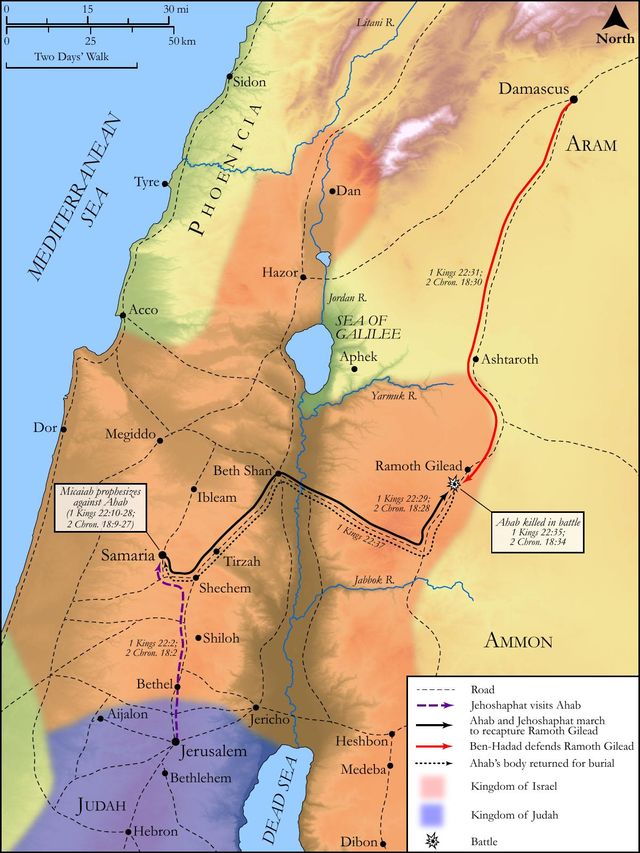
(1.)Into an intimate familiarity with Ahab. He paid him a visit at Samaria, and Ahab, proud of the honour which Jehoshaphat did him, gave him a very splendid entertainment, according to the splendour of those times: He killed sheep and oxen for him, plain meat, in abundance, Ch2 18:2. In this Jehoshaphat did not walk so closely as he should have done in the ways of his father David, who hated the congregation of evil-doers and would not sit with the wicked (Psa 26:5), nor desired to eat of their dainties, Psa 141:4.
(2.)Into a league with Ahab against the Syrians. Ahab persuaded him to join forces with him in an expedition for the recovery of Ramoth-Gilead, a city in the tribe of Gad, on the other side Jordan. Did not Ahab know that that, and all the other cities of Israel, did of right belong to Jehoshaphat, as heir of the house of David? With what face then could he ask Jehoshaphat to assist him in recovering it for himself, whose title to the crown was usurped and precarious? Yet Jehoshaphat, an easy man, yields to go with him: I am as thou art, Ch2 18:3. Some men's kindnesses are dangerous, as well as their society infectious. The feast Ahab made for Jehoshaphat was designed only to wheedle him into the expedition. The kisses of an enemy are deceitful.
Continue studying 2 Chronicles 18:2 across the web’s major study libraries — every link below opens this exact verse, chapter, or book on the destination site.
Read & Compare
 BibleGatewayThis verse in more than 200 translations and 70 languages.
 Bible.comThe YouVersion reader — hundreds of translations, reading plans, and highlights.
 ESV.orgCrossway's official English Standard Version reader.
 NET BibleThe NET translation with 60,000+ translators' notes on every rendering decision.
 STEP BibleTyndale House's free study tool — original text, vocabulary, and scholarly resources.
 BibliaLogos Bible Software's free web reader.
 USCCBThe New American Bible (Revised Edition) with the U.S. bishops' study notes.
Commentaries
 BibleHub CommentariesDozens of classic commentaries on this verse, gathered on one page.
 StudyLightMore than 100 commentary sets — the largest collection on the web.
 BibleRefPlain-English commentary on what this verse means, verse by verse.
 Enduring WordDavid Guzik's free commentary on this chapter, widely used by Bible teachers.
 Bible Study ToolsVerse commentary alongside Greek and Hebrew study aids.
Original Language & Research
- BibleHub InterlinearThe verse word by word — original language, transliteration, and English.
- BibleHub LexiconEvery word's original-language definition and Strong's entry.
 Blue Letter BibleDeep-study tools — Strong's numbers, concordance, and word studies.
 SefariaThe Hebrew text with Rashi and centuries of Jewish commentary.
Sermons, Hymns & Audio


TrulyRandomVerse is not affiliated with these sites and doesn’t control their content. They’re linked because they’re genuinely useful.
Summary
Second Chronicles 18:2 details the ill-fated visit of King Jehoshaphat of Judah to King Ahab of Israel in Samaria, several years after their initial alliance was forged. This verse vividly portrays Ahab's lavish hospitality, marked by an abundant feast of sheep and oxen, which served as a strategic tool to persuade Jehoshaphat to join him in a military campaign to reclaim Ramoth-gilead. This seemingly innocuous social call sets the stage for a dangerous and compromising alliance, highlighting the perils of a righteous leader aligning with an ungodly one.
Context
ShowHideLiterary Context
This verse immediately follows 2 Chronicles 18:1, which establishes Jehoshaphat's immense wealth and honor, and crucially, his marriage alliance with Ahab's house. This familial tie provides the backdrop for Jehoshaphat's visit, making it a logical, albeit spiritually perilous, extension of their relationship. The narrative then flows directly into the prophetic confrontation between Micaiah and the false prophets in 2 Chronicles 18:4-27, culminating in the battle at Ramoth-gilead where Ahab meets his demise, and Jehoshaphat narrowly escapes judgment in 2 Chronicles 18:28-34. The feast described in this verse is the deceptive prelude to this unfolding tragedy, setting the stage for the divine intervention and consequences that follow.
Historical & Cultural Context
The visit takes place in Samaria, the capital of the Northern Kingdom of Israel, a city built by Omri, Ahab's father, and a notorious center of Baal worship under Ahab and Jezebel's rule (see 1 Kings 16:24-33). The "certain years" likely refers to the period after Jehoshaphat's initial reforms in Judah, during which he strengthened his kingdom and sought the Lord, as detailed in 2 Chronicles 17. The practice of lavish feasting was a common diplomatic tool in the ancient Near East, used to solidify alliances, display wealth, and create a sense of obligation. Ahab's "abundance" of slaughtered animals was not merely hospitality but a calculated move to bind Jehoshaphat to his will, particularly concerning the disputed city of Ramoth-gilead, a strategic location in Transjordan frequently contested between Israel and Aram (Syria).
Key Themes
ShowHideThis verse introduces and reinforces several critical themes. The most prominent is the peril of unwise alliances and compromise, as a righteous king like Jehoshaphat, despite his personal piety (2 Chronicles 17:3-4), allows political and familial ties to lead him into a compromising situation with the notoriously wicked King Ahab (1 Kings 21:25). Another key theme is the power of persuasion and manipulation, demonstrated by Ahab's use of lavish hospitality to entice and obligate Jehoshaphat. This highlights how material comforts and perceived friendship can subtly sway judgment and lead to spiritual misalignment. Finally, the verse serves as a catalyst for divine judgment and prophetic confrontation, setting the stage for the dramatic events of the chapter, where God's will is revealed despite human schemes and alliances.
Exposition and Analysis
ShowHideKey Word Analysis
ShowHideA primitive root meaning "to descend (literally, to go downwards; or conventionally to a lower region, as the shore, a boundary, the enemy, etc.; or figuratively, to fall); causatively, to bring down." In this context, Jehoshaphat's physical journey from Jerusalem (typically higher ground) to Samaria is clear. However, the term carries potent theological weight, subtly implying a spiritual descent or a lowering of moral and spiritual standards by aligning with Ahab, foreshadowing the perilous consequences of this compromise.
Meaning "to prick, i.e. (figuratively) stimulate; by implication, to seduce; entice, move, persuade, provoke, remove, set on, stir up, take away." This word is crucial for understanding Ahab's intent. It suggests more than mere convincing; it implies a calculated, even manipulative, effort to entice or seduce Jehoshaphat into the military campaign through lavish hospitality and flattery, leading him astray from God's will.
Verse Breakdown
ShowHide"And after [certain] years he went down to Ahab to Samaria."
This opening clause establishes the critical temporal and geographical setting for the ensuing events. The phrase "after certain years" (H7093 qêts H8141 shâneh) denotes a significant passage of time since the initial alliance mentioned in 2 Chronicles 18:1, indicating a deepened, albeit dangerous, relationship between the two kings. Jehoshaphat's journey "went down" (H3381 yârad) from Jerusalem to Samaria (H8111 Shômᵉrôwn), the idolatrous capital of the Northern Kingdom, signifies not only a physical descent but also subtly foreshadows a spiritual compromise and the lowering of his moral guard.
"And Ahab killed sheep and oxen for him in abundance, and for the people that [he had] with him,"
This vividly describes Ahab's extravagant and calculated hospitality. The act of "killed" (H2076 zâbach) "sheep" (H6629 tsôʼn) and "oxen" (H1241 bâqâr) "in abundance" (H7230 rôb) for Jehoshaphat and his entourage was a grand diplomatic gesture common in the ancient Near East. Far from mere generosity, this lavish feast was a strategic display of wealth and power, designed to impress, honor, and, most importantly, create a profound sense of obligation and indebtedness in Jehoshaphat, setting the stage for Ahab's true agenda.
"and persuaded him to go up [with him] to Ramothgilead."
This concluding clause reveals the manipulative purpose behind Ahab's hospitality and the direct consequence of Jehoshaphat's presence. The verb "persuaded" (H5496 çûwth) highlights Ahab's deliberate and insidious effort to entice Jehoshaphat into a military alliance. His ultimate goal was to secure Judah's military support for the campaign to reclaim Ramoth-gilead (H7433 Râmôth Gilʻâd), a strategically vital city in Transjordan. This moment marks the critical turning point where Jehoshaphat, despite his personal piety, is drawn into a conflict that is clearly outside of God's will for him.
Literary Devices
ShowHideThe verse employs several effective literary devices. Foreshadowing is prominent, as Ahab's lavish feast and persuasive tactics subtly hint at the impending danger and the negative consequences for Jehoshaphat. The "going down" to Samaria, a center of idolatry, also foreshadows a spiritual decline. Irony is present in the contrast between Ahab's seemingly generous hospitality and his manipulative intent; what appears as a gesture of friendship is, in fact, a calculated trap. The Symbolism of the abundant feast itself is significant: it represents worldly enticement and the deceptive allure of power and alliance, which can blind even a righteous king to spiritual dangers.
Theological and Thematic Connections
ShowHide2 Chronicles 18:2 serves as a profound theological warning against the dangers of unholy alliances and the insidious nature of compromise. Jehoshaphat, a king commended for seeking the Lord, allows political expediency and familial ties to override spiritual discernment, leading him into a partnership with one of Israel's most wicked kings. This illustrates that even genuinely godly individuals are susceptible to temptation when they step outside the boundaries of divine wisdom and align themselves too closely with those who oppose God's ways. The narrative underscores the principle that bad company corrupts good character, and that God's people are called to a distinct separation from the values and practices of the world, even in seemingly benign social or political engagements.
Reflection and Application
ShowHideThis verse offers a timeless cautionary tale for believers today, emphasizing the critical importance of discernment in all our relationships and decisions. Jehoshaphat's experience reminds us that compromise, especially with those whose values are antithetical to God's, often begins subtly, cloaked in hospitality, opportunity, or perceived necessity. We must vigilantly guard against situations where our spiritual convictions might be eroded for the sake of social acceptance, financial gain, or political advantage. The challenge is not to withdraw from the world but to engage with it while maintaining a distinct identity and unwavering commitment to God's truth. Our primary allegiance must always be to Christ, seeking His wisdom and counsel above all else, lest we find ourselves persuaded into alliances that lead to spiritual peril and unintended consequences.
Questions for Reflection
ShowHideFAQ
ShowHideWhy did Jehoshaphat, a righteous king, ally himself with Ahab, a wicked king?
ShowHideJehoshaphat's alliance with Ahab, initially sealed through a marriage between their children (2 Chronicles 18:1), was likely driven by political and strategic considerations. Despite his personal piety and efforts to reform Judah (see 2 Chronicles 17), Jehoshaphat sought to strengthen his kingdom through alliances, even with the idolatrous Northern Kingdom. This highlights the tension between political pragmatism and spiritual purity, a common struggle for leaders throughout history. His visit to Samaria, as described in this verse, was a continuation of this ill-advised relationship, demonstrating how even good intentions can lead to dangerous compromises when God's clear commands are overlooked.
What was the significance of Ahab's lavish feast for Jehoshaphat?
ShowHideIn ancient Near Eastern culture, a grand feast like the one Ahab prepared was far more than a simple meal; it was a significant diplomatic gesture. It symbolized honor, welcome, and the forging or strengthening of a covenant or alliance. By "killing sheep and oxen for him in abundance," Ahab was not only displaying his wealth and generosity but also creating a strong sense of obligation and indebtedness in Jehoshaphat. This lavish hospitality was a calculated move, a form of "persuasion" designed to make Jehoshaphat feel compelled to agree to Ahab's request to join the military campaign against Ramoth-gilead. It illustrates how worldly enticements can be used to manipulate and sway even those with good intentions.
Christ-Centered Fulfillment
ShowHideThe narrative of Jehoshaphat's compromise with Ahab in 2 Chronicles 18:2 powerfully foreshadows the ultimate need for a King who never compromises with sin or worldly power. Unlike Jehoshaphat, who "went down" to align with wickedness, Jesus Christ, the true King of kings, "came down" from heaven not to compromise with the world, but to redeem it (John 3:13). His "hospitality" is not a manipulative feast but an open invitation to a spiritual banquet of grace and truth (Matthew 22:1-14). Where Ahab sought to "persuade" Jehoshaphat into a deadly alliance, Christ calls His followers to an uncompromised allegiance to Him alone, warning against being "yoked together with unbelievers" (2 Corinthians 6:14). Our true "going up" is not to a worldly battle like Ramoth-gilead, but through Christ's victory on the cross, we are raised to new life and seated with Him in heavenly places (Ephesians 2:6), free from the enticements and compromises of a fallen world.