


1 Samuel 23:9
Bible text: King James Version (1769 Blayney text) · Public domain
Bible text: Berean Standard Bible · Public domain
Bible text: American Standard Version (1901) · Public domain
Bible text: World English Bible, Messianic edition · Public domain
Bible text: Geneva Bible (1599) · Public domain
Bible text: Young's Literal Translation · Public domain
- וַיֵּדַעvai·Ye·da'and he knewH3045Conj-w ¦ V-Qal-ConsecImperf-3msVerb Qal Consecutive Imperfect 3rd Singular Masculineוַandיֵּדַעhe knew
- דָּוִדda·VidDavidH1732N-proper-mNoun Proper Masculine
- כִּיkithatH3588PrtParticle Conditional
- עָלָיו'a·Lavon himH5921Prep ¦ 3msPreposition Definiteעָלָיonוhim
- שָׁאוּלsha·'UlSaulH7586N-proper-mNoun Proper Masculine
- מַחֲרִישׁma·cha·Rish[was] plottingH2790V-Hiphil-Prtcpl-msVerb Hiphil Participle Singular Masculine Absolute
- הָרָעָהha·ra·'Ah<the> evilH7451Art ¦ N-fsNoun Singular Feminine Absoluteהָ<the>רָעָהevil
- וַיֹּאמֶרvai·Yo·merand he saidH559Conj-w ¦ V-Qal-ConsecImperf-3msVerb Qal Consecutive Imperfect 3rd Singular Masculineוַandיֹּאמֶרhe said
- אֶל'eltoH413PrepPreposition
- אֶבְיָתָר'ev·ya·TarAbiatharH54N-proper-mNoun Proper Masculine
- הַכֹּהֵןha·ko·Henthe priestH3548Art ¦ N-msNoun Singular Masculine Absoluteהַtheכֹּהֵןpriest
- הַגִּישָׁהha·Gi·shahbring near !H5066V-Hiphil-Imp-2ms ¦ SfxVerb Hiphil Imperative 2nd Singular Masculineהַגִּישָׁbring nearה!
- הָאֵפוֹדha·'e·Fodthe ephodH646Art ¦ N-msNoun Singular Masculine Absoluteהָtheאֵפוֹדephod
English is a literal word-by-word gloss of the Hebrew, not the KJV's wording. Why?
This is the original text the KJV's translators worked from — each Hebrew word with its own literal English meaning in this verse, prepared by scholars at Tyndale House, Cambridge. The KJV translates whole sentences, not word by word, so its wording differs: one Hebrew word can become several English words, and the KJV may choose “the LORD” where the gloss reads “Yahweh”. Both are faithful — they answer different questions. For the KJV's own rendering, switch to the KJV text.
Details
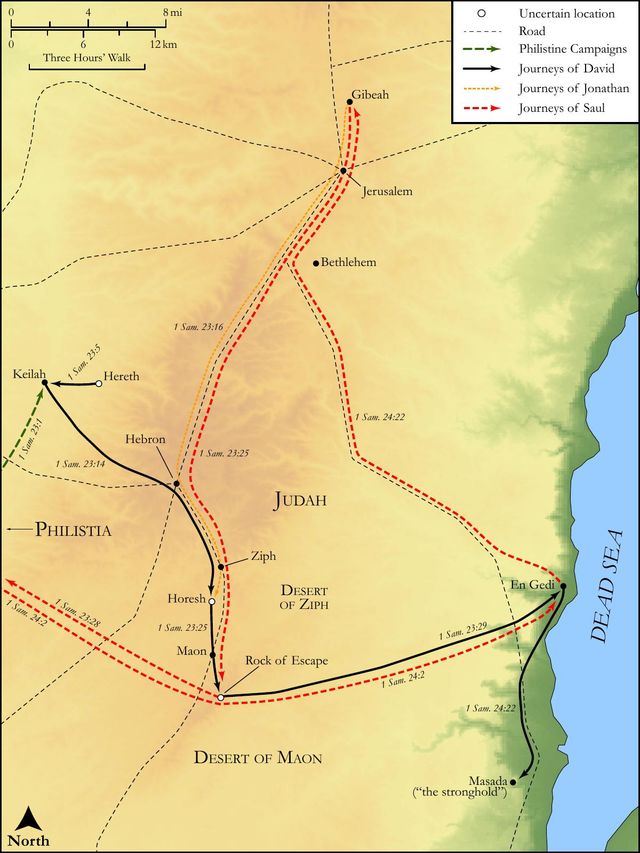
See on the biblical-era map
Study this verse
Public-domain commentary
Matthew Henry
From his Commentary on the Whole Bible. Henry comments on passages, not single verses — this entry covers 1 Samuel 23:7–13. His four-level outline is real structure in the source text, so it is rendered as structure.
Here is, I. Saul contriving within himself the destruction of David (Sa1 23:7, Sa1 23:8): He heard that he had come to Keilah; and did he not hear what brought him thither? Was it not told him that he had bravely relieved Keilah and delivered it out of the hands of the Philistines? This, one would think, should have put Saul upon considering what honour and dignity should be done to David for this. But, instead of that, he catches at it as an opportunity of doing David a mischief. An ungrateful wretch he was, and for ever unworthy to have any service or kindness done him. Well might David complain of his enemies that they rewarded him evil for good, and that for his love they ere his adversaries, Psa 35:12; Psa 109:4. Christ was used thus basely, Joh 10:32. Now observe, 1. How Saul abused the God of Israel, in making his providence to patronise and give countenance to his malicious designs, and thence promising himself success in them: God hath delivered him into my hand; as if he who was rejected of God were in this instance owned and favoured by him, and David infatuated. He vainly triumphs before the victory, forgetting how often he had had fairer advantages against David than he had now and had yet missed his aim. He impiously connects God with his cause, because he thought he had gained one point. Therefore David prays (Psa 140:8), Grant not, O Lord! the desires of the wicked; further not his wicked device, lest they exalt themselves. We must not think that one smiling providence either justifies an unrighteous cause or secures its success. 2. How Saul abused the Israel of God, in making them the servants of his malice against David. He called all the people together to war, and they must with all speed march to Keilah, pretending to oppose the Philistines, but intending to besiege David and his men, though concealing that design; for it is said (Sa1 23:9) that he secretly practised mischief against him. Miserable is that people whose prince is a tyrant, for, while some are sufferers by his tyranny, others (which is worse) are made servants to it and instruments of it.
II.David consulting with God concerning his own preservation.
He knew by the information bought him that Saul was plotting his ruin (Sa1 23:9) and therefore applied to his great protector for direction. No sooner is the ephod brought to him than he makes use of it: Bring hither the ephod. We have the scriptures, those lively oracles, in our hands; let us take advice from them in doubtful cases. "Bring hither the Bible."
1.David's address to God upon this occasion is,
(1.)Very solemn and reverent. Twice he calls God the Lord God of Israel, and thrice calls himself his servant, Sa1 23:10, Sa1 23:11. Those that address God must know their distance, and who they are speaking to.
(2.)Very particular and express. His representation of the case is so (Sa1 23:10): "Thy servant has certainly heard on good authority" (for he would not call for the ephod upon every idle rumour) "that Saul has a design upon Keilah;" he does not say, "to destroy me," but, "to destroy the city" (as he had lately done the city of Nob) "for my sake." He seems more solicitous for their safety than for his own, and will expose himself any where rather than they shall be brought into trouble by his being among them. Generous souls are thus minded. His queries upon the case are likewise very particular. God allows us to be so in our addresses to him: "Lord, direct me in this matter, about which I am now at a loss." He does indeed invert the due order of his queries, but God in his answer puts him into method. That question should have been put first, and was first answered, "Will Saul come down, as thy servant has heard?" "Yea," says the oracle, "he will come down; he has resolved it, is preparing for it, and will do it, unless he hear that thou hast quitted the town." "Well, but if he do come down will the men of Keilah stand by me in holding the city against him, or will they open to him the gates, and deliver me into his hand?" If he had asked the men (the magistrates or elders) of Keilah themselves what they would do in that case, they could not have told him, not knowing their own minds, nor what they should do when it came to the trial, much less which way the superior vote of their council would carry it; or they might have told him they would protect him, and yet afterwards have betrayed him; but God could tell him infallibly: "When Saul besieges their city, and demands of them that they surrender thee into his hands, how fond soever they now seem of thee, as their saviour, they will deliver thee up rather than stand the shock of Saul's fury." Note,
[1.]God knows all men better than they know themselves, knows their length, their strength, what is in them, and what they will do if they come into such and such circumstances.
[2.]He therefore knows not only what will be, but what would be if it were not prevented; and therefore knows how to deliver the godly out of temptation, and how to render to every man according to his works.
2.David, having thus far notice given him of his danger, quitted Keilah, Sa1 23:13. His followers had now increased in number to 600; with these he went out, not knowing whither he went, but resolving to follow Providence and put himself under its protection. This broke Saul's measures. He thought God had delivered David into his hand, but it proved that God delivered him out of his hand, as a bird out of the snare of the fowler. When Saul heard that David had escaped from Keilah, he forbore to go forth with the body of the army, as he intended (Sa1 23:8), and resolved to take only his own guards, and go in quest of his people's enemies and turn their counsels head-long.
Historical interpretation
Historical reception
1 surviving comment on this verse from the historical church.
When David learned that Saul was secretly planning evil against him, etc. After bringing the ephod with Abiathar, David consulted the Lord, asking whether Saul would come to destroy Keilah, and whether the citizens would hand him over. Hence it can be inferred by what order he consulted the Lord before, that is, by putting on the priestly vestment and thus seeking the Lord's response through the mouth of the priest, and that this was the custom of those consulting God at that time, especially those who could not approach the Ark of the Lord. For it is written about this: "There I will speak to you, from above the mercy seat, between the two cherubim" (Exodus 25). But when David discovered both the impending enemy and the unfaithful refuge of the host city, he went out with his about six hundred men and wandered uncertainly here and there. For the holy ones, namely the members of the supreme King, seek through men of great virtue and knowledge of the holy scriptures how the state of the Church will be in the last times; and through the Scriptures, they learn that to its overthrow will come the empire of the Jewish people; and the men of Keilah, that is, of a restless mind and willing to live for themselves, not for the Creator, will quickly betray the faith they have initiated. Christ will depart from such, nor will He make His abode among them. The teachers, too, perfect in hope and work, depart. For six signify works, a hundred hope of eternal things, marking the perfection of men. For they abandon the lukewarm so that by speaking to those who do not preserve it, they do not harm further, in the example of the history which, describing the deeds of David, adds:
Continue studying 1 Samuel 23:9 across the web’s major study libraries — every link below opens this exact verse, chapter, or book on the destination site.
Read & Compare
 BibleGatewayThis verse in more than 200 translations and 70 languages.
 Bible.comThe YouVersion reader — hundreds of translations, reading plans, and highlights.
 ESV.orgCrossway's official English Standard Version reader.
 NET BibleThe NET translation with 60,000+ translators' notes on every rendering decision.
 STEP BibleTyndale House's free study tool — original text, vocabulary, and scholarly resources.
 BibliaLogos Bible Software's free web reader.
 USCCBThe New American Bible (Revised Edition) with the U.S. bishops' study notes.
Commentaries
 BibleHub CommentariesDozens of classic commentaries on this verse, gathered on one page.
 StudyLightMore than 100 commentary sets — the largest collection on the web.
 BibleRefPlain-English commentary on what this verse means, verse by verse.
 Enduring WordDavid Guzik's free commentary on this chapter, widely used by Bible teachers.
 Bible Study ToolsVerse commentary alongside Greek and Hebrew study aids.
Original Language & Research
- BibleHub InterlinearThe verse word by word — original language, transliteration, and English.
- BibleHub LexiconEvery word's original-language definition and Strong's entry.
 Blue Letter BibleDeep-study tools — Strong's numbers, concordance, and word studies.
 SefariaThe Hebrew text with Rashi and centuries of Jewish commentary.
Sermons, Hymns & Audio


TrulyRandomVerse is not affiliated with these sites and doesn’t control their content. They’re linked because they’re genuinely useful.
Summary
In 1 Samuel 23:9, David, having recently delivered the city of Keilah from Philistine oppression, gains certain knowledge that King Saul is actively plotting his capture and harm. Faced with this fresh betrayal and imminent danger, David immediately turns to his trusted priest, Abiathar, requesting the sacred ephod. This pivotal action underscores David's unwavering reliance on divine guidance and direct communication with God, even amidst relentless persecution and life-threatening circumstances, demonstrating a profound spiritual discipline that prioritizes God's wisdom over human strategy or strength alone.
Context
ShowHideLiterary Context
This verse is situated within a tumultuous and precarious period of David's life, characterized by his continuous flight from King Saul, who is consumed by irrational jealousy and a relentless desire to kill him. Immediately preceding this, David, with explicit divine approval, had courageously led a successful military campaign to rescue the city of Keilah from the Philistines. Despite this heroic and selfless act, David receives a direct revelation from God that the ungrateful citizens of Keilah intend to betray him to Saul, who is already en route to besiege the city. Verse 9 captures David's immediate and characteristic response to this new, imminent threat: he acknowledges Saul's persistent malice and instinctively seeks divine counsel, setting the stage for God's clear instruction to depart Keilah, thus averting capture. This episode further highlights the stark contrast between Saul's increasing reliance on human schemes and David's consistent, humble dependence on the Lord for every critical decision.
Historical & Cultural Context
During the early monarchy in Israel, the high priest played a crucial role as an intermediary between God and His people, particularly the king. The ephod, a special priestly garment, was central to this function. It contained the breastplate, which held the Urim and Thummim—sacred lots used by the high priest to ascertain God's will, often providing a "yes" or "no" answer or specific direction to critical questions. This method of divine consultation was a legitimate and recognized means of seeking God's direction in matters of state, warfare, and personal crisis, as seen in various instances throughout the Old Testament. David's request for the ephod thus reflects a deeply ingrained cultural and religious practice of seeking direct divine revelation before making crucial decisions, especially when facing life-or-death situations. His actions stand in stark contrast to Saul's later abandonment of seeking God's counsel, leading him to illicit means like consulting a medium, as graphically described in 1 Samuel 28.
Key Themes
ShowHideThis verse powerfully contributes to several overarching themes in 1 Samuel and the broader biblical narrative. Firstly, it exemplifies the theme of Divine Guidance in Crisis, showcasing David's unwavering commitment to seeking God's specific direction rather than relying solely on his own strategic acumen, even when facing immediate peril. This contrasts sharply with Saul's declining spiritual sensitivity and his eventual abandonment of seeking God's will, as seen in 1 Samuel 13:12-14. Secondly, it reinforces the theme of Saul's Persistent Malice and Persecution, highlighting the depth of Saul's paranoia and his relentless, underhanded pursuit of David, forcing David into a life of constant vigilance and absolute dependence on God's protection. This relentless pursuit is a recurring motif throughout 1 Samuel 20-26. Finally, David's command to "Bring hither the ephod" underscores the theme of Reliance on Priestly Ministry and God's Ordained Means of Revelation. Abiathar, the sole survivor of Saul's massacre of the priests at Nob (1 Samuel 22:20), serves as the legitimate channel for divine communication, emphasizing the importance of utilizing the spiritual resources God provides.
Exposition and Analysis
ShowHideKey Word Analysis
ShowHideThis verb signifies more than mere intellectual awareness; it implies a deep, experiential knowledge, often suggesting divine insight or a confirmed, certain understanding. In this context, David's "knowing" that Saul was plotting mischief against him suggests either a divinely granted discernment (perhaps through prophetic word or an inner conviction from the Spirit) or a keen, accurate assessment based on Saul's consistent pattern of treachery. It highlights David's spiritual sensitivity and his ability to perceive the true nature of the threat, prompting his immediate action to seek God's specific guidance.
This primitive root carries the meaning "to scratch, engrave, plough," but figuratively, it means "to devise (in a bad sense)" or "to practise secretly." This word choice emphasizes the insidious, clandestine nature of Saul's plotting. It wasn't an open confrontation but a hidden, malicious scheme being meticulously "fabricated" or "engraved" against David, highlighting the treacherous and underhanded tactics Saul employed.
In this specific context, the ephod refers to the sacred vestment worn by the high priest, which contained the breastplate with the Urim and Thummim. These were objects used for divine divination, providing clear "yes" or "no" answers or specific directions from God. David's command to "Bring hither the ephod" is a direct request for Abiathar to consult God on his behalf, indicating David's profound reliance on God's direct, unambiguous word to guide his next steps in a perilous situation. It represents the legitimate, divinely ordained means of seeking God's will in the Old Testament.
Verse Breakdown
ShowHide"And David knew that Saul secretly practised mischief against him;"
This clause establishes David's immediate and accurate perception of the danger. The word "knew" (יָדַע, yâdaʻ) suggests a certainty, possibly divinely revealed or born of long experience with Saul's treachery. The phrase "secretly practised mischief" (literally, "was weaving evil against him" or "devising evil") highlights Saul's cunning and underhanded methods, emphasizing the insidious nature of the threat David faced. This awareness is the catalyst for David's subsequent action, demonstrating his vigilance and spiritual discernment.
"and he said to Abiathar the priest, Bring hither the ephod."
This clause reveals David's immediate and decisive response to the perceived danger. Rather than resorting to human strategy, panic, or despair, David instinctively turns to God through the established priestly channel. His command to Abiathar, who had recently joined him after fleeing Saul's massacre of the priests at Nob (1 Samuel 22:20), signifies his trust in God's ordained means of revelation. The request for the "ephod" indicates his desire for direct, authoritative divine guidance regarding his next move, demonstrating his unwavering dependence on the Lord in the face of overwhelming odds.
Literary Devices
ShowHideThe verse employs several powerful literary devices that enrich its meaning and underscore its theological significance. Foreshadowing is evident as Saul's continued "secret mischief" foreshadows his ultimate downfall and the tragic end of his reign, marked by his rejection of divine counsel and reliance on his own devices. This stands in stark contrast with David's consistent seeking of God, which ultimately leads to his establishment as king. There is also a strong element of Irony in the situation: David, the one being unjustly persecuted and hunted, consistently seeks God's will and guidance, while Saul, the reigning king chosen by God, increasingly abandons divine consultation and descends into paranoia and self-reliance. This highlights the spiritual decline of Saul and the spiritual vitality and faithfulness of David, God's chosen king. Furthermore, the verse contributes to a pervasive Dependence Motif throughout David's narrative, where his strength, protection, and success are consistently attributed not to his own prowess or military might but to his humble and persistent reliance on God's guidance and protection. This motif underscores a key theological message about true leadership, faithfulness, and the source of ultimate victory.
Theological and Thematic Connections
ShowHide1 Samuel 23:9 stands as a powerful testament to the principle of seeking God's will in all circumstances, particularly in times of extreme duress and betrayal. David's immediate recourse to the ephod, the divinely ordained means of communication, underscores a profound theological truth: true security, wisdom, and direction come from God alone, not from human cunning, political alliances, or military strength. This episode highlights the stark contrast between David's faithful dependence on the Lord and Saul's increasing spiritual alienation, which ultimately led to his tragic end and rejection by God. It teaches us that even when facing betrayal, relentless opposition, or seemingly insurmountable odds, our first and most effective strategy is to consult the divine source of all wisdom and power. This reliance on God's specific guidance is a hallmark of righteous leadership and a timeless pattern for all believers navigating the complexities of life.
Reflection and Application
ShowHideDavid's immediate turn to God through Abiathar and the ephod in 1 Samuel 23:9 provides a profound and enduring model for navigating the uncertainties, betrayals, and dangers of life. In a world where we often feel compelled to react quickly, strategize independently, or rely solely on our own limited understanding and resources, David's example calls us to pause and prioritize divine consultation. His trust was not in the mechanism of the ephod itself, but in the sovereign God who spoke through it, demonstrating a deep-seated faith that God's word was his ultimate guide. For believers today, while the physical ephod is no longer the means of divine revelation, the principle remains: our primary and most effective response to crisis, confusion, or threat should be to seek God's wisdom through fervent prayer, diligent study and meditation on His infallible Word, and sensitive reliance on the Holy Spirit's indwelling guidance. This posture of humble dependence not only provides clarity and direction in bewildering circumstances but also cultivates a deeper, more intimate relationship with God, reminding us that He is sovereign over all circumstances and intimately concerned with every step of our path.
Questions for Reflection
ShowHideFAQ
ShowHideWhat was the purpose of the ephod in David's time, and how did it function?
ShowHideIn David's time, the ephod referred specifically to the sacred priestly garment worn by the high priest, and it was far more than mere clothing; it was integral to the process of divine consultation. Attached to the ephod was a breastplate containing twelve precious stones, each representing one of the tribes of Israel. Within this breastplate, or perhaps connected to it, were the Urim and Thummim, two objects used by the high priest to discern God's will. While their exact nature and mechanism are not fully detailed in Scripture, they were used to obtain clear, often "yes" or "no," answers to specific questions posed to God, especially concerning matters of national importance, war, or critical decisions. David's request to "Bring hither the ephod" was a direct plea for Abiathar to consult God on his behalf using these sacred objects, seeking unambiguous divine guidance for his next move in the face of Saul's treachery. This method of seeking God's will was a legitimate and divinely sanctioned practice in the Old Testament, as seen in passages like Exodus 28:30 and Numbers 27:21.
Christ-Centered Fulfillment
ShowHideDavid's desperate plea for the ephod in 1 Samuel 23:9, seeking direct divine guidance through the high priest, beautifully foreshadows the ultimate and perfect means of God's revelation and guidance found in Jesus Christ. While David relied on a temporary, symbolic means of communication, believers now have direct and unhindered access to God through the person and work of Jesus, our Great High Priest. Just as Abiathar mediated God's word to David, Christ Himself is the perfect Mediator of a new and better covenant, providing not just answers to specific questions but a complete revelation of God's character and will. We no longer need the Urim and Thummim, for the Holy Spirit, whom Christ sent, indwells believers, guiding us into all truth (John 16:13). Furthermore, the written Word of God, inspired by the Spirit, serves as our lamp and light (Psalm 119:105), providing comprehensive guidance for every aspect of life and revealing the very mind of Christ (1 Corinthians 2:16). Thus, David's act of seeking God's specific will through the ephod finds its ultimate and complete fulfillment in the person of Christ, who is the Word made flesh (John 1:14) and through whom we have full and confident access to the Father (Ephesians 3:12).