


1 Peter 3:22
- ὅςhoswhoG3739R-NSMRelative pronoun Nominative Singular Masculine
- ἐστινestinisG1510V-PAI-3SVerb Present Active Indicative 3rd Singular
- ἐνenatG1722PREPPreposition
- δεξιᾷdexia[the] right handG1188A-DSFAdjective Dative Singular Feminine
- τοῦtou<the>G3588T-GSMDefinite article Genitive Singular Masculine
- θεοῦtheouof GodG2316N-GSM-TNoun Genitive Singular Masculine Title
- πορευθεὶςporeutheishaving goneG4198V-AOP-NSMVerb Aorist Passive Deponent Participle Nominative Singular Masculine
- εἰςeisintoG1519PREPPreposition
- οὐρανόνouranonheavenG3772N-ASMNoun Accusative Singular Masculine
- ὑποταγέντωνhupotagentōnwhen were being subjectedG5293V-2APP-GPMVerb 2nd Aorist Passive Participle Genitive Plural Masculine
- αὐτῷautōto HimG846P-DSMPersonal pronoun Dative Singular Masculine
- ἀγγέλωνangelōnangelsG32N-GPMNoun Genitive Plural Masculine
- καὶkaiandG2532CONJConjunction
- ἐξουσιῶνexousiōnauthoritiesG1849N-GPFNoun Genitive Plural Feminine
- καὶkaiandG2532CONJConjunction
- δυνάμεωνdunameōnpowersG1411N-GPFNoun Genitive Plural Feminine
English is a literal word-by-word gloss of the Greek, not the KJV's wording. Why?
This is the original text the KJV's translators worked from — each Greek word with its own literal English meaning in this verse, prepared by scholars at Tyndale House, Cambridge. The KJV translates whole sentences, not word by word, so its wording differs: one Greek word can become several English words, and the KJV may choose “charity” where the gloss reads “love”. Both are faithful — they answer different questions. For the KJV's own rendering, switch to the KJV text.
Details
See on the biblical-era map

Study this verse
Public-domain commentary
Matthew Henry
From his Commentary on the Whole Bible. Henry comments on passages, not single verses — this entry covers 1 Peter 3:21–22. His two-level outline is real structure in the source text, so it is rendered as structure.
Noah's salvation in the ark upon the water prefigured the salvation of all good Christians in the church by baptism; that temporal salvation by the ark was a type, the antitype whereunto is the eternal salvation of believers by baptism, to prevent mistakes about which the apostle,
I.Declares what he means by saving baptism; not the outward ceremony of washing with water, which, in itself, does no more than put away the filth of the flesh, but it is that baptism wherein there is a faithful answer or restipulation of a resolved good conscience, engaging to believe in, and be entirely devoted to, God, the Father, Son, and Holy Ghost, renouncing at the same time the flesh, the world, and the devil. The baptismal covenant, made and kept, will certainly save us. Washing is the visible sign; this is the thing signified.
II.The apostle shows that the efficacy of baptism to salvation depends not upon the work done, but upon the resurrection of Christ, which supposes his death, and is the foundation of our faith and hope, to which we are rendered conformable by dying to sin, and rising again to holiness and newness of life. Learn, 1. the sacrament of baptism, rightly received, is a means and a pledge of salvation. Baptism now saveth us. God is pleased to convey his blessings to us in and by his ordinances, Act 2:38; Act 22:16. 2. The external participation of baptism will save no man without an answerable good conscience and conversation. There must be the answer of a good conscience towards God. - Obj. Infants cannot make such an answer, and therefore ought not to be baptized. - Answer, the true circumcision was that of the heart and of the spirit (Rom 2:29), which children were no more capable of then than our infants are capable of making this answer now; yet they were allowed circumcision at eight days old. The infants of the Christian church therefore may be admitted to the ordinance with as much reason as the infants of the Jewish, unless they are barred from it by some express prohibition of Christ.
III.The apostle, having mentioned the death and resurrection of Christ, proceeds to speak of his ascension, and sitting at the right hand of the Father, as a subject fit to be considered by these believers for their comfort in their suffering condition, Pe1 3:22. If the advancement of Christ was so glorious after his deep humiliation, let not his followers despair, but expect that after these short distresses they shall be advanced to transcendent joy and glory. Learn,
1.Jesus Christ, after he had finished his labours and his sufferings upon earth, ascended triumphantly into heaven, of which see Act 1:9-11; Mar 16:19. He went to heaven to receive his own acquired crown and glory (Joh 17:5), to finish that part of his mediatorial work which could not be done on earth, and make intercession for his people, to demonstrate the fulness of his satisfaction, to take possession of heaven for his people, to prepare mansions for them, and to send down the Comforter, which was to be the first-fruits of his intercession, Joh 16:7.
2.Upon his ascension into heaven, Christ is enthroned at the right hand of the Father. His being said to sit there imports absolute rest and cessation from all further troubles and sufferings, and an advancement to the highest personal dignity and sovereign power.
3.Angels, authorities, and powers, are all made subject to Christ Jesus: all power in heaven and earth, to command, to give law, issue orders, and pronounce a final sentence, is committed to Jesus, God - man, which his enemies will find to their everlasting sorrow and confusion, but his servants to their eternal joy and satisfaction.
Historical interpretation
Eight Centuries of Reception
7 surviving comments on this verse. Each one is dated, so this reads as a timeline rather than a list.
Select a marker to jump to its quote. Markers stagger vertically where authors wrote within a few decades of each other.
"Wherefore, girding up your loins," "serve the Lord in fear" and truth, as those who have forsaken the vain, empty talk and error of the multitude, and "believed in Him who raised up our Lord Jesus Christ from the dead, and gave Him glory," and a throne at His right hand. To Him all things in heaven and on earth are subject. Him every spirit serves. He comes as the Judge of the living and the dead. His blood will God require of those who do not believe in Him. But He who raised Him up from the dead will raise up us also, if we do His will, and walk in His commandments, and love what He loved, keeping ourselves from all unrighteousness, covetousness, love of money, evil speaking, false witness; "not rendering evil for evil, or railing for railing," or blow for blow, or cursing for cursing, but being mindful of what the Lord said in His teaching: "Judge not, that ye be not judged; forgive, and it shall be forgiven unto you; be merciful, that ye may obtain mercy; with what measure ye mete, it shall be measured to you again;" and once more, "Blessed are the poor, and those that are persecuted for righteousness' sake, for theirs is the kingdom of God."
"For Christ," he says, "has once suffered for our sins, the just for the unjust, that he might present us to God; being put to death in the flesh, but quickened in the spirit." He says these things, reducing them to their faith. That is, He became alive in our spirits.
"Coming," he says, "He preached to those who were once unbelieving." They saw not His form, but they heard His voice.
"When the long-suffering of God" holds out. God is so good, as to work the result by the teaching of salvation.
"By the resurrection," it is said, "of Jesus Christ:" that, namely, which is effected in us by faith.
"Angels being subjected to Him," which are the first order; and "principalities" being subject, who are of the second order; and "powers" being also subject, which are said to belong to the third order.
Just as all rational creatures are made by the Son of God, who is the Word, or Reason, so too is their salvation brought about by him. For those who possess holiness not by nature but by grace, because they are creatures, must be cleansed by him in order to obtain goodness.
While the strength of the angelic legions that waited on Christ was held in check, he drank the cup of sorrow and death, thereby transforming the entire affliction into triumph. Deceptions were overcome, and the powers of evil were suppressed.
Look how clearly the dispensation of grace is set out for us. Peter recalls Christ’s death and resurrection and then goes on to mention his ascension as well, and the fact that he sits at the right hand of the Father, lest you imagine that when he suffered he lost something of his glory.
Having gone up to heaven, etc. There is no doubt that all angels and all powers and authorities of the heavenly homeland have always been subject to the Son of God, whom they praise, tremble before, and adore as one God with the Father and the Holy Spirit without beginning. But blessed Peter necessarily considered it appropriate to note that the assumed humanity is so gloriously exalted by the resurrection that it is preferred by an incomparable summit to the dignity of all angelic power. According to which the Psalmist also said about Him to the Father: You have made Him a little lower than the angels (Psalm 8); immediately adding: You have crowned Him with glory and honor, and have set Him over the works of Your hands; You have put all things under His feet (Ibid.).
In which also he went and preached to the spirits who were in prison, who had formerly been disobedient, when the patience of God waited in the days of Noah, while the ark was being prepared, in which a few, that is, eight souls, were saved through water. Equivalent to this figure, baptism now saves us, not the removal of the filth of the flesh, but the appeal of a good conscience to God, through the resurrection of Jesus Christ, who is at the right hand of God, having gone into heaven, with angels and authorities and powers made subject to Him.
"In which also." Here, ἐν ᾧ is taken causally for "therefore." For when Peter had said that he died for us, the unjust, and from this had shown that he endured death for the salvation of all men, he now says that for this reason also he preached to those who were held in Hades. "O ἄντίτυπον, etc." (The context of the Greek words here is obscure, and therefore rendered in Latin with more words; yet by rendering the Greek expressions literally, it would be arranged thus:) that baptism, corresponding to the figures, now also saves you, which is now not the removal of the filth of the flesh, but the ἐπερώτημα of a good conscience, which is toward God, or according to God. Furthermore, ἐπερώτημα, that is, to the angels, evidently to the united man.
Continue studying 1 Peter 3:22 across the web’s major study libraries — every link below opens this exact verse, chapter, or book on the destination site.
Read & Compare
 BibleGatewayThis verse in more than 200 translations and 70 languages.
 Bible.comThe YouVersion reader — hundreds of translations, reading plans, and highlights.
 ESV.orgCrossway's official English Standard Version reader.
 NET BibleThe NET translation with 60,000+ translators' notes on every rendering decision.
 STEP BibleTyndale House's free study tool — original text, vocabulary, and scholarly resources.
 BibliaLogos Bible Software's free web reader.
 USCCBThe New American Bible (Revised Edition) with the U.S. bishops' study notes.
Commentaries
 BibleHub CommentariesDozens of classic commentaries on this verse, gathered on one page.
 StudyLightMore than 100 commentary sets — the largest collection on the web.
 BibleRefPlain-English commentary on what this verse means, verse by verse.
 Enduring WordDavid Guzik's free commentary on this chapter, widely used by Bible teachers.
 Bible Study ToolsVerse commentary alongside Greek and Hebrew study aids.
Original Language & Research
- BibleHub InterlinearThe verse word by word — original language, transliteration, and English.
- BibleHub LexiconEvery word's original-language definition and Strong's entry.
 Blue Letter BibleDeep-study tools — Strong's numbers, concordance, and word studies.
 CNTR CollationThe earliest Greek manuscripts of this verse, collated letter by letter.
Sermons, Hymns & Audio


TrulyRandomVerse is not affiliated with these sites and doesn’t control their content. They’re linked because they’re genuinely useful.
Summary
First Peter 3:22 serves as the triumphant capstone to Peter's discussion of Christ's suffering, death, and resurrection, emphatically declaring the exalted status of Jesus Christ. It proclaims His physical ascension into heaven, His supreme position of authority at the right hand of God the Father, and His absolute dominion over all spiritual hierarchies, including angels, authorities, and powers, all of whom have been made subject to Him. This verse underscores the completed victory and unparalleled sovereignty of Christ, providing profound assurance and hope to believers, particularly those enduring suffering.
Context
ShowHideLiterary Context
This verse concludes a pivotal theological passage in 1 Peter that begins with Christ's suffering (1 Peter 3:18). Peter contrasts Christ's death in the flesh with His being "quickened by the Spirit," leading to His unique proclamation to "the spirits in prison" (1 Peter 3:19). The narrative then transitions to a profound theological parallel between Noah's salvation through water and the saving power of baptism, not as a physical cleansing, but as "the answer of a good conscience toward God, by the resurrection of Jesus Christ" (1 Peter 3:21). Thus, 1 Peter 3:22 is the culmination of this theological argument, presenting Christ's post-resurrection exaltation as the ultimate guarantee of the believer's salvation and hope, firmly rooting it in His divine authority and completed work.
Historical & Cultural Context
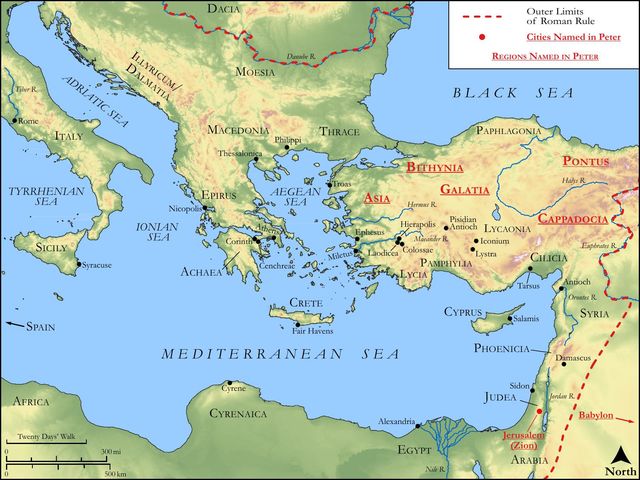
Peter writes to scattered believers in Asia Minor (1 Peter 1:1), who were likely facing various forms of social ostracism and persecution for their faith. The concept of a suffering Messiah who then ascends to ultimate power would have been both challenging and profoundly encouraging. In the ancient Near East, the "right hand" was universally recognized as the position of highest honor, authority, and power, often reserved for the king's chief advisor or heir. For a Jewish audience, this imagery would immediately evoke passages like Psalm 110:1, which speaks of the Messiah sitting at God's right hand, signifying divine appointment to kingship and judicial authority. The mention of "angels, authorities, and powers" reflects a common Jewish and early Christian understanding of a complex spiritual hierarchy, over which Christ's dominion is now asserted.
Key Themes
ShowHideA central theme in 1 Peter is the connection between Christ's suffering and His subsequent glory, which serves as a model and source of hope for suffering believers. 1 Peter 3:22 powerfully articulates the theme of Christ's Exaltation and Sovereignty, demonstrating that His suffering was not an end but a prelude to ultimate triumph. This verse also reinforces the theme of Divine Authority, emphasizing that Christ's resurrection and ascension were not merely events but a transfer of cosmic power, placing Him above all created beings. Furthermore, it contributes to the theme of Security in Christ, assuring believers that their salvation is anchored in the unshakeable reign of a sovereign Savior, as also seen in Ephesians 1:20-22.
Exposition and Analysis
ShowHideKey Word Analysis
ShowHideFrom δέχομαι, meaning the right side or hand, typically associated with taking or receiving. In biblical and ancient Near Eastern contexts, it signifies the position of highest honor, authority, and power. Christ being "on the right hand of God" is a powerful idiom denoting His supreme preeminence and shared divine authority, not a literal physical location.
From ἔξεστι, implying ability, privilege, force, capacity, or freedom. It often refers to delegated power, mastery, or jurisdiction, and can denote concrete magistrates, superhuman potentates, or tokens of control. In this context, it refers to a class of spiritual beings or powers.
From δύναμαι, meaning force, might, or inherent ability. It can refer to miraculous power or a miracle itself. Like "authorities," it signifies a category of spiritual entities, often implying inherent strength or might. The pairing with "angels" and "authorities" indicates a comprehensive range of spiritual beings.
Verse Breakdown
ShowHide"Who is gone into heaven"
This phrase refers to the physical ascension of Jesus Christ from earth to the heavenly realm, an event described in detail in Acts 1:9-11. It signifies the completion of His earthly redemptive work, His physical departure from human sight, and His return to the Father's immediate presence. It is a crucial aspect of His post-resurrection glory.
"and is on the right hand of God;"
This clause describes Christ's exalted position in heaven. As discussed in the key word analysis, "the right hand of God" is a powerful metaphorical expression signifying the highest place of honor, supreme authority, and shared divine power. It indicates Christ's co-regency with the Father and His rightful place as King and Judge over all creation.
"angels and authorities and powers being made subject unto him."
This final clause declares the universal scope of Christ's dominion. "Angels, authorities, and powers" are terms used in the New Testament to categorize various ranks of spiritual beings, both benevolent and malevolent. The phrase "being made subject unto him" (Greek: hypotássō) emphasizes that all these spiritual entities, regardless of their nature or previous standing, are now under the absolute, sovereign control and authority of the ascended Christ. This underscores His ultimate victory over all opposing forces.
Literary Devices
ShowHidePeter employs several powerful literary devices in 1 Peter 3:22 to convey Christ's supreme authority. The phrase "on the right hand of God" is a potent Metaphor and Idiom, universally understood in biblical culture to denote the place of ultimate honor, power, and authority. It is not a literal physical location but a symbolic representation of Christ's supreme status. The listing of "angels and authorities and powers" functions as a Merism or Categorization, encompassing the entirety of spiritual beings, both good and potentially evil. By naming these distinct categories, Peter emphasizes the comprehensive and absolute nature of Christ's dominion, leaving no spiritual entity outside of His sovereign rule. This declaration also serves as the Climax of the preceding narrative of Christ's suffering and resurrection, presenting His exaltation as the triumphant and ultimate outcome of His redemptive work.
Theological and Thematic Connections
ShowHideThe exaltation of Christ to the right hand of God is a foundational truth of Christian theology, affirming His unique divine status and His ongoing sovereign rule. This position signifies not only His completed work of redemption but also His perpetual intercession for believers and His ultimate authority over all creation. It assures believers that the One who suffered for them is now enthroned in glory, fully capable of sustaining them through their own trials and guaranteeing their ultimate salvation. This truth transforms the understanding of suffering, as it is seen through the lens of Christ's ultimate victory and the assurance of His reign.
Reflection and Application
ShowHideThe profound truth of 1 Peter 3:22 offers immense comfort and strength to believers in every age, particularly those undergoing hardship. Knowing that Jesus Christ, who shared in our humanity and suffered for our sins, is now ascended to the highest position of power and authority at God's right hand means that our hope is anchored in an unshakeable reality. His dominion over "angels, authorities, and powers" assures us that no spiritual force, no earthly opposition, and no personal struggle is outside of His ultimate control. This should fill us with confidence, not fear, enabling us to live boldly for Him, knowing that the Victorious One reigns. It empowers us to face suffering with resilience, to resist temptation with divine backing, and to engage in spiritual warfare from a position of Christ's already-won victory. Our security is not in our own strength or circumstances, but in the absolute sovereignty of our enthroned Savior.
Questions for Reflection
ShowHideFAQ
ShowHideWhat is the significance of Jesus being "on the right hand of God"?
ShowHideBeing "on the right hand of God" is a powerful biblical idiom that signifies the highest possible position of honor, authority, and power. It is not a literal physical location but a symbolic representation of Christ's supreme preeminence and His co-regency with God the Father. It means that Jesus, as the resurrected and ascended Lord, possesses all divine authority and power, ruling over all creation. This concept is deeply rooted in Old Testament messianic prophecies, such as Psalm 110:1, which foretold the Messiah's enthronement at God's right hand.
Who are "angels and authorities and powers" that are made subject to Christ?
ShowHideThese terms refer to various categories of spiritual beings. "Angels" are divine messengers and servants of God. "Authorities" (Greek: exousía) and "powers" (Greek: dýnamis) are often used in the New Testament to denote different ranks or classes within the spiritual realm, which can include both good angels and fallen demonic forces (e.g., Ephesians 6:12). The key point is that Christ's ascension and exaltation mean that all these spiritual entities, regardless of their nature or previous influence, are now completely subordinate to His supreme dominion. He reigns over every spiritual hierarchy.
How does this verse relate to Christ's suffering, which Peter discusses earlier in the chapter?
ShowHide1 Peter 3:22 is the triumphant culmination of Peter's argument that begins with Christ's suffering (1 Peter 3:18). Peter emphasizes that Christ's suffering and death were not a defeat but a necessary part of His redemptive work, leading directly to His resurrection, ascension, and ultimate exaltation. The verse highlights that Christ's current position of supreme authority is the glorious outcome of His obedient suffering. For Peter's audience, who were themselves suffering, this connection provided immense comfort: just as Christ's suffering led to His glory and victory over all powers, so too would their faithful endurance in suffering ultimately lead to their participation in His glory and triumph (e.g., 1 Peter 4:13).
Christ-Centered Fulfillment
ShowHide1 Peter 3:22 paints a vivid portrait of Christ's ultimate triumph, serving as a cornerstone of Christ-centered theology. His ascension into heaven and enthronement "on the right hand of God" is not merely a historical event but signifies His ongoing, active reign as the sovereign Lord of the universe. This position of unparalleled authority means that Christ is fully qualified to be our great High Priest, interceding on our behalf before the Father (as seen in Hebrews 4:14-16). His subjection of "angels and authorities and powers" assures us that He has decisively defeated the forces of darkness, providing believers with victory over sin and spiritual opposition (a truth echoed in Colossians 2:15). As the ascended King, He continues to build His church, exercising His headship over all things for its sake (Ephesians 1:22-23). Ultimately, this verse points to the glorious future when Christ will return to fully establish His kingdom, and every knee will bow and every tongue confess that He is Lord, to the glory of God the Father (Philippians 2:9-11).