


1 Peter 3:20
- ἀπειθήσασίνapeithēsasinhaving disobeyedG544V-AAP-DPNVerb Aorist Active Participle Dative Plural Neuter
- ποτεpoteat one timeG4218PRTParticle or Disjunctive
- ὅτεhotewhenG3753CONJConjunction
- ἀπεξεδέχετοapexedechetohe was expectingG553V-INI-3SVerb Imperfect Middle Or Passive Deponent Indicative 3rd Singular
- ἡhētheG3588T-NSFDefinite article Nominative Singular Feminine
- τοῦtou<the>G3588T-GSMDefinite article Genitive Singular Masculine
- θεοῦtheouof GodG2316N-GSM-TNoun Genitive Singular Masculine Title
- μακροθυμίαmakrothumialongsufferingG3115N-NSFNoun Nominative Singular Feminine
- ἐνeninG1722PREPPreposition
- ἡμέραιςhēmerais[the] daysG2250N-DPFNoun Dative Plural Feminine
- ΝῶεNōeof NoahG3575N-GSM-PNoun Genitive Singular Masculine Individual
- κατασκευαζομένηςkataskeuazomenēswhen is being preparedG2680V-PPP-GSFVerb Present Passive Participle Genitive Singular Feminine
- κιβωτοῦkibōtou[the] arkG2787N-GSFNoun Genitive Singular Feminine
- εἰςeisinG1519PREPPreposition
- ἣνhēnwhichG3739R-ASFRelative pronoun Accusative Singular Feminine
- ὀλίγοιoligoifewG3641A-NPMAdjective Nominative Plural Masculine
- τοῦτ᾽tout᾽ThatG3778D-NSNDemonstrative pronoun Nominative Singular Neuter
- ἔστινestinisG1510V-PAI-3SVerb Present Active Indicative 3rd Singular
- ὀκτὼoktōeightG3638A-NUIAdjective
- ψυχαίpsuchaisouls —G5590N-NPFNoun Nominative Plural Feminine
- διεσώθησανdiesōthēsanwere savedG1295V-API-3PVerb Aorist Passive Indicative 3rd Plural
- δι᾽di᾽throughG1223PREPPreposition
- ὕδατος·hudatoswaterG5204N-GSNNoun Genitive Singular Neuter
English is a literal word-by-word gloss of the Greek, not the KJV's wording. Why?
This is the original text the KJV's translators worked from — each Greek word with its own literal English meaning in this verse, prepared by scholars at Tyndale House, Cambridge. The KJV translates whole sentences, not word by word, so its wording differs: one Greek word can become several English words, and the KJV may choose “charity” where the gloss reads “love”. Both are faithful — they answer different questions. For the KJV's own rendering, switch to the KJV text.
Details
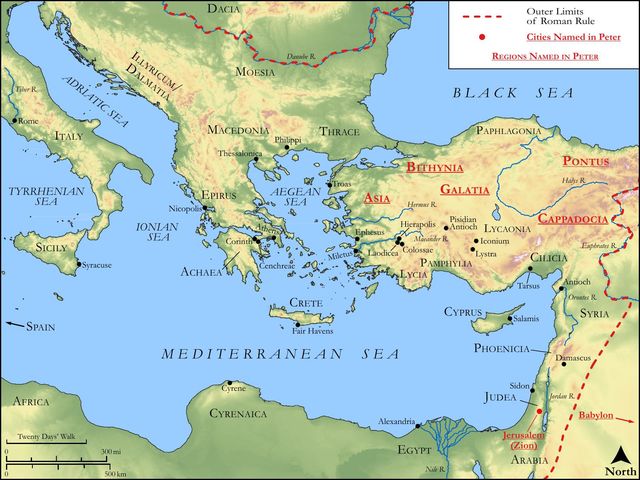
See on the biblical-era map

Study this verse
Public-domain commentary
Matthew Henry
From his Commentary on the Whole Bible. Henry comments on passages, not single verses — this entry covers 1 Peter 3:18–20. His three-level outline is real structure in the source text, so it is rendered as structure.
Here, I. The example of Christ is proposed as an argument for patience under sufferings, the strength of which will be discerned if we consider the several points contained in the words; observe therefore, 1. Jesus Christ himself was not exempted from sufferings in this life, though he had no guilt of his own and could have declined all suffering if he had pleased. 2. The reason or meritorious cause of Christ's suffering was the sins of men: Christ suffered for sins. The sufferings of Christ were a true and proper punishment; this punishment was suffered to expiate and to make an atonement for sin; and it extends to all sin. 3. In the case of our Lord's suffering, it was the just that suffered for the unjust; he substituted himself in our room and stead, and bore our iniquities. He that knew no sin suffered instead of those that knew no righteousness. 4. The merit and perfection of Christ's sacrifice were such that for him to suffer once was enough. The legal sacrifices were repeated from day to day, and from year to year; but the sacrifice of Christ, once offered, purgeth away sin, Heb 7:27; Heb 9:26, Heb 9:28; Heb 10:10, Heb 10:12, Heb 10:14. 5. The blessed end or design of our Lord's sufferings was to bring us to God, to reconcile us to God, to give us access to the Father, to render us and our services acceptable, and to bring us to eternal glory, Eph 2:13, Eph 2:18; Eph 3:12; Heb 10:21, Heb 10:22. 6. The issue and event of Christ's suffering, as to himself, were these, he was put to death in his human nature, but he was quickened and raised again by the Spirit. Now, if Christ was not exempted from sufferings, why should Christians expect it? If he suffered, to expiate sins, why should not we be content when our sufferings are only for trial and correction, but not for expiation? If he, though perfectly just, why should not we, who are all criminals? If he once suffered, and then entered into glory, shall not we be patient under trouble, since it will be but a little time and we shall follow him to glory? If he suffered, to bring us to God, shall not we submit to difficulties, since they are of so much use to quicken us in our return to God, and in the performance of our duty to him?
II.The apostle passes from the example of Christ to that of the old world, and sets before the Jews, to whom he wrote, the different event of those who believed and obeyed Christ preaching by Noah, from those that continued disobedient and unbelieving, intimating to the Jews that they were under a like sentence. God would not wait much longer upon them. They had now an offer of mercy; those that accepted of it should be saved, but those who rejected Christ and the gospel should be as certainly destroyed as ever the disobedient in the times of Noah were.
1.For the explication of this we may notice,
(1.)The preacher - Christ Jesus, who has interested himself in the affairs of the church and of the world ever since he was first promised to Adam, Gen 3:15. He went, not by a local motion, but by special operation, as God is frequently said to move, Gen 11:5; Hos 5:15; Mic 1:3. He went and preached, by his Spirit striving with them, and inspiring and enabling Enoch and Noah to plead with them, and preach righteousness to them, as Pe2 2:5.
(2.)The hearers. Because they were dead and disembodied when the apostle speaks of them, therefore he properly calls them spirits now in prison; not that they were in prison when Christ preached to them, as the vulgar Latin translation and the popish expositors pretend.
(3.)The sin of these people: They were disobedient, that is, rebellious, unpersuadable, and unbelieving, as the word signifies; this their sin is aggravated from the patience and long-suffering of God (which once waited upon them for 120 years together), while Noah was preparing the ark, and by that, as well as by his preaching, giving them fair warning of what was coming upon them.
(4.)The event of all: Their bodies were drowned, and their spirits cast into hell, which is called a prison (Mat 5:25; Pe2 2:4, Pe2 2:5); but Noah and his family, who believed and were obedient, were saved in the ark.
2.From the whole we learn that,
(1.)God takes exact notice of all the means and advantages that people in all ages have had for the salvation of their souls; it is put to the account of the old world that Christ offered them his help, sent his Spirit, gave them fair warning by Noah, and waited a long time for their amendment.
(2.)Though the patience of God wait long upon sinners, yet it will expire at last; it is beneath the majesty of the great God always to wait upon man in vain.
(3.)The spirits of disobedient sinners, as soon as they are out of their bodies, are committed to the prison of hell, whence there is no redemption.
(4.)The way of the most is neither the best, the wisest, nor the safest way to follow: better to follow the eight in the ark than the eight millions drowned by the flood and damned to hell.
Historical interpretation
Twelve Centuries of Reception
16 surviving comments on this verse. Each one is dated, so this reads as a timeline rather than a list.
Select a marker to jump to its quote. Markers stagger vertically where authors wrote within a few decades of each other.
Let us turn to every age that has passed, and learn that, from generation to generation, the Lord has granted a place of repentance to all such as would be converted unto Him. Noah preached repentance, and as many as listened to him were saved. Jonah proclaimed destruction to the Ninevites; [Jonah 3] but they, repenting of their sins, propitiated God by prayer, and obtained salvation, although they were aliens [to the covenant] of God.
For the tower was founded on the word of the almighty and glorious Name and it is kept together by the invisible power of the Lord.
Further, they declare that the arrangement made with respect to the ark in the Deluge, by means of which eight persons were saved.
"For Christ," he says, "has once suffered for our sins, the just for the unjust, that he might present us to God; being put to death in the flesh, but quickened in the spirit." He says these things, reducing them to their faith. That is, He became alive in our spirits.
"Coming," he says, "He preached to those who were once unbelieving." They saw not His form, but they heard His voice.
"When the long-suffering of God" holds out. God is so good, as to work the result by the teaching of salvation.
"By the resurrection," it is said, "of Jesus Christ:" that, namely, which is effected in us by faith.
"Angels being subjected to Him," which are the first order; and "principalities" being subject, who are of the second order; and "powers" being also subject, which are said to belong to the third order.
But (in vain): for they who had originated those of the former seed sent into the ark (secretly and stealthily, and unknown to that Mother-Virtue), together with those "eight souls," the seed likewise of Ham, in order that the seed of evil should not perish, but should, together with the rest, be preserved, and after the deluge be restored to the earth, and, by example of the rest, should grow up and diffuse itself, and fill and occupy the whole orb.
Once more, "two (joined) into one flesh" undertake (the duty of) "growing and multiplying,"-Noah, (namely), and his wife, and their sons, in single marriage. Even in the very animals monogamy is recognised, for fear that even beasts should be born of adultery.
"In the ark "says he, "of Noah, few, that is, eight souls, were saved by water, as also baptism shall in like manner save you.".
Peter also, showing this, set forth that the Church is one, and that only they who are in the Church can be baptized; and said, "In the ark of Noah, few, that is, eight souls, were saved by water; the like figure where-unto even baptism shall save you; "
The question which you put to me about the spirits in hell is one which disturbs me profoundly.… What troubles me most is why only those who were imprisoned in the days of Noah should deserve this benefit. Think of all the others who have died since Noah’s time and whom Jesus could have found in hell. The meaning must be that the ark of Noah is a picture of the church, and so those who were imprisoned in his days represent the entire human race. In hell Christ rebuked the wicked and consoled the good, so that some believed to their salvation and others disbelieved to their damnation.
In which few, that is, eight souls were saved, etc. The form of baptism is likened to the ark and the waters of the flood. And rightly so, because the very construction of the ark from hewn wood signifies the building of the Church, which is done by gathering the faithful souls through the architects of the word. And the fact that while the whole world was perishing, few, that is, eight souls, were saved through water, signifies that in comparison to the perishing Gentiles, Jews, heretics, and false believers, the number of the elect is much smaller. Hence it is said of the narrow gate and the hard road that leads to life: And few are those who find it (Matt. VII). And again: Do not be afraid, little flock, for it is the Father's good pleasure to give you the kingdom (Luke XII). About this little flock also it is aptly added here:
Those who had once been unbelievers, etc. For even the patience of God was a proclamation of His, when Noah, for a hundred years, persisted in the works of the ark, demonstrating daily through the execution of this work what was to come upon the world. Hence Paul says: Do you not know that the patience of God leads you to repentance? (Rom. II). Another translation has this passage as follows: Christ died once for our sins, the just for the unjust, to bring us to God, put to death in the body but made alive in the spirit. In which spirit He also preached to those who were in prison, who once did not believe in those days, when God's patience waited in the days of Noah, etc.
In which also he went and preached to the spirits who were in prison, who had formerly been disobedient, when the patience of God waited in the days of Noah, while the ark was being prepared, in which a few, that is, eight souls, were saved through water. Equivalent to this figure, baptism now saves us, not the removal of the filth of the flesh, but the appeal of a good conscience to God, through the resurrection of Jesus Christ, who is at the right hand of God, having gone into heaven, with angels and authorities and powers made subject to Him.
"In which also." Here, ἐν ᾧ is taken causally for "therefore." For when Peter had said that he died for us, the unjust, and from this had shown that he endured death for the salvation of all men, he now says that for this reason also he preached to those who were held in Hades. "O ἄντίτυπον, etc." (The context of the Greek words here is obscure, and therefore rendered in Latin with more words; yet by rendering the Greek expressions literally, it would be arranged thus:) that baptism, corresponding to the figures, now also saves you, which is now not the removal of the filth of the flesh, but the ἐπερώτημα of a good conscience, which is toward God, or according to God. Furthermore, ἐπερώτημα, that is, to the angels, evidently to the united man.
Someone might easily ask: Who preached salvation before Christ, so that those who did not believe in him should be condemned? The answer to this, which Paul also adopted, is that those who lived before Christ had enough light given to them to enable them to distinguish good from evil. Because of this, if they chose to do evil, they are worthy of condemnation. Therefore Peter reminds us that they were rebellious, not merely from the time of the prophets but long before that, virtually from the creation of the world in fact. As he demonstrates, the way of salvation was proclaimed to them from the beginning, but they spurned it and preferred to go after vanities of one kind or another. The result was that of all the millions of people who lived at that time, only eight were saved, because they alone believed the message which they heard.
These words of Peter [1 Peter 3:19] are referred by some to Christ's descent into hell: and they explain it in this sense: "Christ preached to them who formerly were unbelievers, and who were shut up in prison"—that is, in hell—"in spirit"—that is, by His soul. Hence Damascene says (De Fide Orth. iii): "As He evangelized them who are upon the earth, so did He those who were in hell"; not in order to convert unbelievers unto belief, but to put them to shame for their unbelief, since preaching cannot be understood otherwise than as the open manifesting of His Godhead. which was laid bare before them in the lower regions by His descending in power into hell.
Augustine, however, furnishes a better exposition of the text in his Epistle to Evodius quoted above, namely, that the preaching is not to be referred to Christ's descent into hell, but to the operation of His Godhead, to which He gave effect from the beginning of the world. Consequently, the sense is, that "to those (spirits) that were in prison"—that is, living in the mortal body, which is, as it were, the soul's prison-house—"by the spirit" of His Godhead "He came and preached" by internal inspirations, and from without by the admonitions spoken by the righteous: to those, I say, He preached "which had been some time incredulous," i.e. not believing in the preaching of Noah, "when they waited for the patience of God," whereby the chastisement of the Deluge was put off: accordingly (Peter) adds: "In the days of Noah, when the Ark was being built."
“Wilson blithely asserts that the "Jewish name for Elysium was Abraham's bosom, or Paradise". Where is the evidence for that?”
This is my “quacks like a duck” argument. Hades had two compartments, Tartarus and Elysium. The New Testament uses the names of two of these three, and I infer the third by good and imaginative consequence...
Jesus said He was going to the heart of the earth like Jonah did, and Jonah went down to Sheol, which was in the heart of the earth, and which the New Testament calls Hades, and Jesus told the thief on the cross that He was going to Paradise, and the only subterranean place that could remotely be thought of as a kind of Paradise would be Elysium.
The final place of torment is Gehenna, which I take as the lake of fire. There is an intermediate place of torment, which is located within Hades. We can tell they are distinct because at a certain point, death and Hades are thrown into the lake of fire (Rev. 20:14). And in the Apostles Creed, Jesus descends to Hades, not into Hell.
Aeneas descended into Hades, which was a place divided into two compartments. The bad side was called Tartarus and the good side was called Elysium. Aeneas went to commune with his father, who was a shade, but who was in Elysium, a place of peace. The Jewish name for Elysium was Abraham’s bosom, or Paradise. Lazarus was in Abraham’s bosom, within shouting distance of the rich man, who was in torment in Hades (presumably Tartarus). Jesus descended into Elysium because He told the thief on the cross that he would be with him that day in Paradise (Luke 23:43). That is where He preached (across the chasm) to the spirits who had been disobedient in the time of Noah, announcing to them their final defeat (1 Pet. 3:19-20). The apostle Peter even refers to Tartarus by name (2 Pet. 2:4), using a word in verb form that means to cast into Hell/Tartarus. When Jesus rises from the dead, He holds the keys of death and Hades (Rev. 1:18), and when He ascends He transfers Paradise to the third heaven (2 Cor. 12:2-4). When believers die now, that is where they go (2 Cor. 5:8)...
Jesus tells us where this Paradise was. He says that just as Jonah was three days and three nights in the belly of the fish, so He would be three days and three nights in the heart of the earth (Matt. 12:40). Jonah cried out to God from Sheol, the Hebrew word that is rendered in the New Testament (without redefinition) as Hades. Hades is not the grave — Plato thought he knew where the gates of Hades were. It was the kind of place you could get to if you got lost in Carlsbad Caverns, you and your flashlight.
In the time before the Messiah came, the expectation of the godly was to die and go to Sheol. Jonah (most likely) actually died and cried out to God from the depths of Sheol (Jon. 2:1). The psalmist expected that Sheol would swallow him up (Ps. 18:5; 86:13; 116:3).
In the parable of Lazarus and the rich man, they both died and went down to Hades. In that parable, Hades was divided in two by a vast chasm. The side where Lazarus was had the name of Abraham’s bosom (Luke 16:23), while the rich man was in torment in Hades. Nevertheless, it was possible for communication to occur across the chasm.
In our text [Matt. 12:40], Jesus said that He was going to be three days and nights in the heart of the earth. But He also told the thief on the cross that He would be with him in Paradise that same day (Luke 23:43). So then, Abraham’s bosom was also known as Paradise. To the Greeks, this went by the name of Elysium. This is where Jesus went, and preached across the chasm.
The Greek word for the lowest pit of Hades, the worst part, was Tartarus. This word is used once in the New Testament (without any redefinition, mind). Peter tells us this: “For if God spared not the angels that sinned, but cast them down to hell [Tartarus], and delivered them into chains of darkness, to be reserved unto judgment” (2 Peter 2:4).
While in Hades, the Lord preached. But the preaching was not “second chance” preaching. Rather the word used is one used for heralding or announcing, not the word for preaching the gospel. “By which also he went and preached unto the spirits in prison; Which sometime were disobedient, when once the longsuffering of God waited in the days of Noah, while the ark was a preparing, wherein few, that is, eight souls were saved by water” (1 Pet. 3:19–20). The Lord was announcing their final defeat to the “sons of God” and Nephilim both. And this, incidentally, tells us how momentous the rebellion at the time of the Flood actually was. Thousands of years after their definitive defeat, Jesus went to them to announce their final defeat.
The Bible teaches us that Jesus is the king of all things. The devil is not the ruler of Gehenna—Jesus is. The lake of fire was prepared for the devil and his angels (Matt. 25:41). It is a place of torment for the devil. Furthermore, Jesus holds the keys to Hades as well. “I am he that liveth, and was dead; and, behold, I am alive for evermore, Amen; and have the keys of hell [Hades] and of death.” (Rev. 1:18). Jesus, not the devil, is the King of Hell. Jesus, not the devil, is the Lord of Hades.
When the Lord rose from the dead, He led captivity captive (Eph. 4:8)—all the saints in the Old Testament who had died and gone to Abraham’s bosom were transferred when Paradise was moved (Matt. 27:52). And by the time of Paul, Paradise was up (2 Cor. 12:4). So if you had lived in the Old Testament, you would have died and gone down to Sheol/Hades. But the part of Hades that contained the saints of God has been emptied out, and now when God’s people die, what happens? To be absent from the body is to be present with the Lord (2 Cor. 5:6, 8). We still go to Paradise, but Paradise itself has been moved into the heavens.
Continue studying 1 Peter 3:20 across the web’s major study libraries — every link below opens this exact verse, chapter, or book on the destination site.
Read & Compare
 BibleGatewayThis verse in more than 200 translations and 70 languages.
 Bible.comThe YouVersion reader — hundreds of translations, reading plans, and highlights.
 ESV.orgCrossway's official English Standard Version reader.
 NET BibleThe NET translation with 60,000+ translators' notes on every rendering decision.
 STEP BibleTyndale House's free study tool — original text, vocabulary, and scholarly resources.
 BibliaLogos Bible Software's free web reader.
 USCCBThe New American Bible (Revised Edition) with the U.S. bishops' study notes.
Commentaries
 BibleHub CommentariesDozens of classic commentaries on this verse, gathered on one page.
 StudyLightMore than 100 commentary sets — the largest collection on the web.
 BibleRefPlain-English commentary on what this verse means, verse by verse.
 Enduring WordDavid Guzik's free commentary on this chapter, widely used by Bible teachers.
 Bible Study ToolsVerse commentary alongside Greek and Hebrew study aids.
Original Language & Research
- BibleHub InterlinearThe verse word by word — original language, transliteration, and English.
- BibleHub LexiconEvery word's original-language definition and Strong's entry.
 Blue Letter BibleDeep-study tools — Strong's numbers, concordance, and word studies.
 CNTR CollationThe earliest Greek manuscripts of this verse, collated letter by letter.
Sermons, Hymns & Audio


TrulyRandomVerse is not affiliated with these sites and doesn’t control their content. They’re linked because they’re genuinely useful.
Summary
This verse from 1 Peter serves as a profound historical illustration of God's character, particularly His immense patience and justice, set against the backdrop of human disobedience. It recounts how, during the era of Noah, God's longsuffering extended a period of grace while the ark was being prepared, yet ultimately, only a small remnant of eight souls were preserved through the very waters that brought judgment upon the disobedient world. This narrative forms a crucial link in Peter's theological argument concerning Christ's triumph and the nature of salvation.
Context
ShowHideLiterary Context
This verse is strategically placed within Peter's broader theological argument concerning suffering for righteousness and the triumph of Christ. Immediately preceding it, 1 Peter 3:19 speaks of Christ's proclamation to "the spirits in prison," which Peter then identifies in 1 Peter 3:20 as those who were disobedient in Noah's day. The Noahic flood narrative is not merely a historical anecdote but a profound theological type, setting the stage for Peter's subsequent discussion of baptism in 1 Peter 3:21. Thus, the flood serves as a vivid historical precedent for salvation through judgment, illustrating God's patience, the consequences of rebellion, and the narrow path to deliverance, all of which find their ultimate fulfillment in Christ.
Historical & Cultural Context
The "days of Noah" refer to the period leading up to the Great Flood, as detailed in Genesis 6-9. This era was characterized by profound human wickedness and corruption, where "every intention of the thoughts of his heart was only evil continually" (Genesis 6:5). Despite this pervasive sin, God, in His longsuffering, provided a period of grace—traditionally understood as 120 years (Genesis 6:3)—during which Noah, "a preacher of righteousness" (2 Peter 2:5), built the ark as a visible testament to God's impending judgment and a call to repentance. The act of building such a massive vessel, likely in a world that had never experienced rain, would have been a constant, public warning, met with widespread disbelief and scorn, highlighting the cultural norm of rejecting divine warnings.
Key Themes
ShowHide1 Peter 3:20 contributes significantly to several major themes within 1 Peter and the broader biblical narrative. Firstly, it underscores the theme of God's Longsuffering and Patience, demonstrating His willingness to extend grace and time for repentance even in the face of profound human rebellion, as also seen in Romans 2:4 and 2 Peter 3:9. Secondly, it highlights the Consequences of Disobedience and Unbelief, showing that while God's patience is vast, it is not infinite, and persistent rejection of His warnings ultimately leads to judgment. Thirdly, the verse emphasizes the Narrowness of Salvation, with "few, that is, eight souls" being saved, contrasting with the many who perished. This foreshadows the New Testament concept of the narrow gate (Matthew 7:13-14) and the call to stand apart. Finally, it introduces the paradoxical theme of Water as a Medium of Both Judgment and Salvation, a concept crucial for understanding Peter's subsequent theological connection to baptism in 1 Peter 3:21.
Exposition and Analysis
ShowHideKey Word Analysis
ShowHideThis term (G544) signifies more than mere non-compliance; it denotes a willful and perverse disbelief or refusal to be persuaded. The people in Noah's day were not simply unaware of God's will; they actively resisted and rejected the divine warnings and Noah's preaching, demonstrating a hardened heart and an obstinate refusal to believe.
This word (G3115) describes God's longanimity, His profound patience and forbearance. It means He is slow to anger and retribution, enduring great provocation without immediately retaliating. In the context of Noah, it highlights God's immense grace in waiting for 120 years, providing ample opportunity for humanity to repent before judgment fell.
The preposition diá (G1223) is crucial here. It means "through" or "by means of," indicating the channel or medium of an act, rather than the direct cause. Noah and his family were not saved by the water as a saving agent, but through the water, which served as the means by which they were separated from the perishing world and lifted above the judgment, thus preserving them.
Verse Breakdown
ShowHide"Which sometime were disobedient"
This clause refers to the generation living before the Great Flood, specifically those who, despite God's warnings and Noah's efforts, refused to believe or obey. Their disobedience was a defining characteristic of that era, leading to divine judgment.
"when once the longsuffering of God waited in the days of Noah"
This highlights God's active and patient forbearance. The phrase "waited" (Greek, ekdéchomai, G1551) implies an expectation or anticipation of a response. God's patience was not passive but an intentional extension of grace, providing a window for repentance during Noah's lifetime.
"while the ark was a preparing"
This specifies the duration and visible sign of God's waiting. The construction of the ark (Greek, kataskeuázō, G2680, meaning "to prepare thoroughly" or "construct") was a prolonged process, serving as a constant, tangible warning and a testament to God's impending judgment, yet it was largely ignored.
"wherein few, that is, eight souls were saved by water"
This states the outcome: only Noah, his wife, his three sons, and their wives—eight individuals in total—were preserved. The phrase "saved by water" (Greek, diasṓzō, G1295, "to save thoroughly" or "preserve") paradoxically describes how the very element that brought destruction to the ungodly became the means of salvation for the obedient, lifting them above the judgment.
Literary Devices
ShowHideThe verse employs several significant literary devices. Historical Allusion is central, as Peter directly references the well-known biblical narrative of Noah's flood, leveraging its established meaning for his audience. There is a powerful Paradox or Irony in the phrase "saved by water," as water is typically associated with destruction in the flood narrative, yet here it is the medium of preservation for the few. This sets up a profound Type and Antitype relationship, where the flood and the ark serve as a "type" (a historical event or person foreshadowing a future reality) for Christian baptism, which Peter explicitly develops in the very next verse. Finally, the verse uses Contrast by highlighting the "few" who were saved against the implied multitude who perished, emphasizing the narrowness of the path of salvation through obedience to God.
Theological and Thematic Connections
ShowHideThe account of Noah's flood in 1 Peter 3:20 is a foundational theological touchstone, illustrating God's unwavering character across dispensations. It reveals a God who is both infinitely patient and perfectly just. His longsuffering is not indifference, but a deliberate delay of judgment, offering ample opportunity for repentance. Yet, His patience has a limit, and persistent disobedience invites divine reckoning. The narrative underscores that salvation, while initiated by God's grace, requires a response of faith and obedience, often leading to a separation from the prevailing norms of the world. This historical event thus serves as a timeless warning and a profound encouragement, affirming God's desire for all to come to repentance while also reminding humanity of the seriousness of rejecting His call.
Reflection and Application
ShowHideThe narrative of Noah's ark in 1 Peter 3:20 offers profound lessons for contemporary believers. God's "longsuffering" in Noah's day is a testament to His enduring patience and desire for all to come to repentance, a characteristic that remains unchanged today. This should inspire both hope and urgency: hope in the boundless grace of God who continues to call humanity to Himself, and urgency in responding to His invitation before the window of opportunity closes. Just as Noah's generation faced a clear choice between obedience and destruction, so too are we called to make decisive choices in light of God's truth. Our salvation, like Noah's, involves a separation from the world's destructive patterns and a commitment to God's specific instructions, even when it means standing apart from the majority. This verse challenges us to consider our own response to God's patient warnings and to live lives of faith and obedience, trusting in His provision for salvation.
Questions for Reflection
ShowHideFAQ
ShowHideWho were the "disobedient" mentioned in this verse?
ShowHideThe "disobedient" refer to the vast majority of humanity living in the days leading up to the Great Flood, as described in Genesis 6. These were people whose hearts were continually evil and who willfully rejected God's warnings and Noah's preaching of righteousness (2 Peter 2:5) during the long period that the ark was being built. Despite God's immense patience, they refused to repent, ultimately leading to their destruction by the floodwaters.
How were Noah and his family "saved by water"?
ShowHideThe phrase "saved by water" does not mean the water itself was the saving agent, but rather that the water served as the medium or channel through which Noah and his family were preserved. As the floodwaters rose, they lifted the ark, separating Noah's family from the perishing world below. The water brought judgment upon the disobedient, but for Noah and his family, it was the means by which they passed from the old, condemned world to a new beginning. This paradoxical role of water sets the stage for Peter's discussion of baptism in the following verse, 1 Peter 3:21.
Christ-Centered Fulfillment
ShowHideThe narrative of Noah's ark, as presented in 1 Peter 3:20, finds profound Christ-centered fulfillment. Noah's ark, built by divine command as a vessel of salvation amidst impending judgment, serves as a powerful type of Christ Himself. Just as the ark provided the sole means of escape from the flood, so Christ is the exclusive means of salvation from the judgment of sin and death (John 14:6). The "longsuffering of God" in Noah's day foreshadows God's ongoing patience in the present age, delaying the final judgment to allow more time for repentance through Christ (2 Peter 3:9). Furthermore, the "water" that simultaneously brought judgment and salvation in Noah's day is directly linked by Peter in the very next verse to Christian baptism, which he clarifies is not merely a physical washing but "an appeal to God for a good conscience, through the resurrection of Jesus Christ" (1 Peter 3:21). Thus, the salvation experienced by Noah and his family through the ark and water points forward to the ultimate salvation offered through Christ's death, burial, and resurrection, where believers are spiritually united with Him, passing through judgment to new life.