


2 Chronicles 18:17
- וַיֹּאמֶרvai·Yo·merand he saidH559Conj-w ¦ V-Qal-ConsecImperf-3msVerb Qal Consecutive Imperfect 3rd Singular Masculineוַandיֹּאמֶרhe said
- מֶלֶךְMe·lekh[the] king ofH4428N-mscNoun Singular Masculine Construct
- יִשְׂרָאֵלYis·ra·'ElIsraelH3478N-properNoun Proper Location
- אֶל'eltoH413PrepPreposition
- יְהוֹשָׁפָטye·ho·sha·FatJehoshaphatH3092N-proper-mNoun Proper Masculine
- הֲלֹאha·Lo'¿ notH3808Interrog ¦ NegParticle Negativeהֲ¿לֹאnot
- אָמַרְתִּי'a·Mar·tidid I sayH559V-Qal-Perf-1csVerb Qal Perfect 1st Singular common gender
- אֵלֶיךָ'e·Lei·khato youH413Prep ¦ 2msPrepositionאֵלֶיtoךָyou
- לֹאlo'notH3808NegParticle Negative
- יִתְנַבֵּאyit·na·Be'he prophesiesH5012V-Hithpael-Imperf-3msVerb Hithpael Imperfect 3rd Singular Masculine
- עָלַי'a·Laion meH5921Prep ¦ 1csPrepositionעָלַonיme
- טוֹבTovgoodH2896Adj-msAdjective Singular Masculine Absolute
- כִּיkithatH3588PrtParticle Conditional
- אִם'imexceptH518PrtParticle Conditional
- לְרָעle·Ra'<to> evilH7451Prep-l ¦ Adj-msAdjective Singular Masculine Absoluteלְ<to>רָעevil
English is a literal word-by-word gloss of the Hebrew, not the KJV's wording. Why?
This is the original text the KJV's translators worked from — each Hebrew word with its own literal English meaning in this verse, prepared by scholars at Tyndale House, Cambridge. The KJV translates whole sentences, not word by word, so its wording differs: one Hebrew word can become several English words, and the KJV may choose “the LORD” where the gloss reads “Yahweh”. Both are faithful — they answer different questions. For the KJV's own rendering, switch to the KJV text.
Details
See on the biblical-era map
Study this verse
Public-domain commentary
Matthew Henry
From his Commentary on the Whole Bible. Henry comments on passages, not single verses — this entry covers 2 Chronicles 18:4–27.
This is almost word for word the same with what we had, 1 Kings 22. We will not repeat what was there said, nor have we much to add, but may take occasion to think, 1. Of the great duty of acknowledging God in all our ways and enquiring at his word, whatever we undertake. Jehoshaphat was not willing to proceed till he had done this, Ch2 18:4. By particular believing prayer, by an unbiased consultation of the scripture and our own consciences, and by an observant regard to the hints of providence, we may make such enquiries and very much to our satisfaction. 2. Of the great danger of bad company even to good men. Those that have more wisdom, grace, and resolution, cannot be sure that they can converse familiarly with wicked people and get no hurt by them. Jehoshaphat here, in complaisance to Ahab, sits in his robes, patiently hearing the false prophets speaking lies in the name of the Lord (Ch2 18:9), can scarcely find in his heart to give him a too mild and gentle reproof for hating a prophet of the Lord (Ch2 18:7), and dares not rebuke that false prophet who basely abused the faithful seer nor oppose Ahab who committed him to prison. Those who venture among the seats of the scornful cannot come off without a great deal of the guilt attaching to at least the omission of their duty, unless they have such measures of wisdom and courage as few can pretend to. 3. Of the unhappiness of those who are surrounded with flatterers, especially flattering prophets, who cry peace to them and prophesy nothing but smooth things. Thus was Ahab cheated into his ruin, and justly; for he hearkened to such, and preferred those that humoured him before a good prophet that gave him fair warning of his danger. Those do best for themselves that give their friends leave, and particularly their ministers, to deal plainly and faithfully with them, and take their reproofs not only patiently, but kindly. That counsel is not always best for us that is most pleasing to us. 4. Of the power of Satan, by the divine permission, in the children of disobedience. One lying spirit can make 400 lying prophets and make use of them to deceive Ahab, Ch2 18:21. The devil becomes a murderer by being a liar and destroys men by deceiving them. 5. Of the justice of God in giving those up to strong delusions, to believe a lie, who will not receive the love of the truth, but rebel against it, Ch2 18:21. Let the lying spirit prevail to entice those to their ruin that will not be persuaded to their duty and happiness. 6. Of the hard case of faithful ministers, whose lot it has often been to be hated, and persecuted, and ill-treated, for being true to their God and just and kind to the souls of men. Micaiah, for discharging a good conscience, was buffeted, imprisoned, and condemned to the bread and water of affliction. But he could with assurance appeal to the issue, as all those may do who are persecuted for their faithfulness, Ch2 18:27. The day will declare who is in the right and who in the wrong, when Christ will appear, to the unspeakable consolation of his persecuted people and the everlasting confusion of their persecutors, who will be made to see in that day (Ch2 18:24) what they will not now believe.
Continue studying 2 Chronicles 18:17 across the web’s major study libraries — every link below opens this exact verse, chapter, or book on the destination site.
Read & Compare
 BibleGatewayThis verse in more than 200 translations and 70 languages.
 Bible.comThe YouVersion reader — hundreds of translations, reading plans, and highlights.
 ESV.orgCrossway's official English Standard Version reader.
 NET BibleThe NET translation with 60,000+ translators' notes on every rendering decision.
 STEP BibleTyndale House's free study tool — original text, vocabulary, and scholarly resources.
 BibliaLogos Bible Software's free web reader.
 USCCBThe New American Bible (Revised Edition) with the U.S. bishops' study notes.
Commentaries
 BibleHub CommentariesDozens of classic commentaries on this verse, gathered on one page.
 StudyLightMore than 100 commentary sets — the largest collection on the web.
 BibleRefPlain-English commentary on what this verse means, verse by verse.
 Enduring WordDavid Guzik's free commentary on this chapter, widely used by Bible teachers.
 Bible Study ToolsVerse commentary alongside Greek and Hebrew study aids.
Original Language & Research
- BibleHub InterlinearThe verse word by word — original language, transliteration, and English.
- BibleHub LexiconEvery word's original-language definition and Strong's entry.
 Blue Letter BibleDeep-study tools — Strong's numbers, concordance, and word studies.
 SefariaThe Hebrew text with Rashi and centuries of Jewish commentary.
Sermons, Hymns & Audio


TrulyRandomVerse is not affiliated with these sites and doesn’t control their content. They’re linked because they’re genuinely useful.
Summary
King Ahab of Israel, in a moment of bitter cynicism and self-fulfilling prophecy, declares to King Jehoshaphat of Judah that the prophet Micaiah would only prophesy "evil" (meaning calamity or misfortune) rather than "good" (meaning prosperity or success) concerning his military endeavors. This statement, uttered immediately after Micaiah's stark revelation of Israel's impending defeat and Ahab's demise at Ramoth-gilead, encapsulates Ahab's deep-seated resistance to divine truth when it contradicts his personal desires and ambitions, revealing a profound spiritual blindness and a preference for comforting lies over challenging reality.
Context
ShowHideLiterary Context
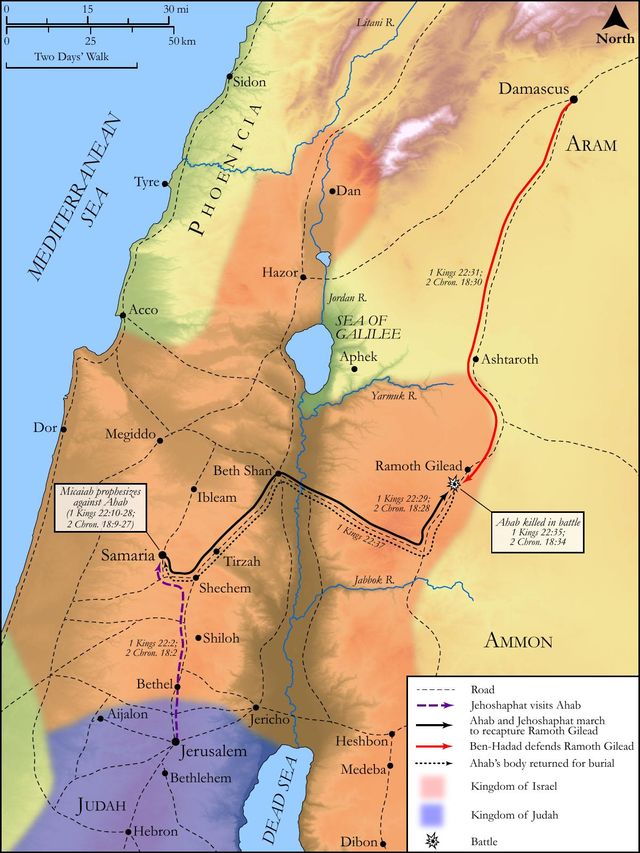
This verse is situated at a pivotal moment within 2 Chronicles 18, which details the ill-fated alliance between King Ahab of Israel and King Jehoshaphat of Judah to reclaim Ramoth-gilead from the Arameans. The chapter meticulously builds tension, beginning with Jehoshaphat's insistence on consulting a prophet of the Lord after Ahab's 400 court prophets deliver uniformly positive, yet false, prophecies. The narrative then introduces Micaiah, a true prophet known for speaking God's unvarnished truth to Ahab, often to the king's displeasure. Micaiah's initial sarcastic affirmation of the false prophets' message, followed by his terrifying vision of Israel scattered like sheep without a shepherd and the heavenly council's decision to deceive Ahab, sets the stage for Ahab's cynical outburst in this verse. It directly follows Micaiah's explicit prophecy of Ahab's death and Israel's defeat, serving as Ahab's immediate, petulant, and predictable response to divine confrontation.
Historical & Cultural Context
The historical backdrop is the mid-9th century BCE, a period of shifting alliances and conflicts between the northern kingdom of Israel (under the Omride dynasty, represented by Ahab) and the southern kingdom of Judah (under Jehoshaphat). Ramoth-gilead was a strategically vital city on the eastern frontier, frequently contested between Israel and Aram (Syria). Culturally, prophecy played a significant role in ancient Near Eastern monarchies, with kings often seeking divine counsel before military campaigns. However, there was a clear distinction between true prophets, who spoke solely for God, often confronting royal authority, and court prophets, who tended to flatter the king and affirm his plans, often for personal gain. Ahab's reign was notoriously marked by the promotion of Baal worship and the persecution of Yahweh's prophets, making his disdain for Micaiah's genuine message particularly pronounced within this context of religious apostasy and political ambition.
Key Themes
ShowHideThis verse powerfully contributes to several overarching themes within 2 Chronicles and the broader historical books. Firstly, it highlights the rejection of uncomfortable truth, illustrating humanity's pervasive tendency to prefer flattering falsehoods over challenging divine warnings. Ahab's statement is the culmination of his consistent refusal to heed God's word when it obstructs his will, a theme seen repeatedly in Israel's history, as when the people grumbled against God in the wilderness (e.g., Numbers 14:1-4). Secondly, it underscores the nature of true prophecy versus false prophecy. Micaiah embodies the authentic prophet, speaking God's word faithfully, even at personal risk, contrasting sharply with the 400 court prophets who prophesied what Ahab wanted to hear, leading him to destruction (compare Jeremiah 23:16-17). Finally, the verse reveals the destructive consequences of stubbornness and self-deception. Ahab's cynical "Did I not tell thee?" suggests a prior awareness of Micaiah's truthful, albeit "evil" (from Ahab's perspective), prophecies, yet he chooses to ignore the warning, demonstrating a profound spiritual blindness that ultimately leads to his demise, as prophesied (2 Chronicles 18:34).
Exposition and Analysis
ShowHideKey Word Analysis
ShowHideThis word (H2896) carries a broad semantic range, encompassing well-being, prosperity, success, favor, and benefit. In Ahab's cynical usage, it refers specifically to a prophecy of a favorable outcome, victory in battle, or personal advantage. He uses it in opposition to "evil," implying that Micaiah's prophecies never align with his desires for success or positive results, thus never bringing "good" to him.
While raʿ (H7451) can denote moral evil, in this context, as Ahab uses it, it primarily signifies calamity, misfortune, adversity, or disaster. It refers to a prophecy of an unfavorable outcome, defeat, or personal harm. Ahab's complaint is not that Micaiah prophesies morally wrong things, but that he consistently predicts events that are detrimental or disastrous from Ahab's self-interested perspective, thus bringing "evil" upon him.
This word (H5012) is a primitive root meaning "to prophesy," which involves speaking or singing by inspiration, whether in prediction or simple discourse. In this context, it refers to Micaiah's act of delivering a divinely inspired message, specifically a prediction of future events concerning the battle and Ahab's fate. Ahab's use of the term highlights his expectation of a prophetic utterance, but his cynicism reveals his desire for a specific type of prophecy—one that aligns with his will, rather than God's.
Verse Breakdown
ShowHide"And the king of Israel said to Jehoshaphat,"
This clause identifies the speaker as Ahab, the king of the northern kingdom of Israel (H4428), and his audience as Jehoshaphat (H3092), the king of Judah. It establishes the immediate conversational context, highlighting Ahab's direct address to his ally, almost as if seeking validation for his long-held prejudice against Micaiah. The verb "said" (H559) indicates a spoken declaration, emphasizing Ahab's immediate and verbal reaction to Micaiah's prophecy.
"Did I not tell thee"
This rhetorical question (using the root "tell" H559) functions as a classic expression of "I told you so." It reveals Ahab's prior knowledge and expectation concerning Micaiah's prophetic character and the nature of his messages. It implies that Ahab had already warned Jehoshaphat about Micaiah's consistent tendency to deliver unwelcome prophecies, thereby attempting to discredit Micaiah's message even before it was fully processed or considered by Jehoshaphat.
"[that] he would not prophesy good unto me, but evil?"
This is the core of Ahab's cynical complaint (using "prophesy" H5012, "good" H2896, and "evil" H7451). It explicitly states his long-standing grievance against Micaiah: that the prophet never delivers a message of "good" (i.e., success or prosperity) but only "evil" (i.e., calamity or misfortune) to Ahab. This statement underscores Ahab's self-centered interpretation of prophecy, viewing it solely through the lens of personal benefit or detriment, rather than as a divine revelation of truth or God's will. It also highlights his profound spiritual blindness, as he perceives God's truthful warning as "evil" simply because it contradicts his desires and ambitions.
Literary Devices
ShowHideThe verse is rich in Irony. Ahab's rhetorical question, "Did I not tell thee [that] he would not prophesy good unto me, but evil?", is deeply ironic because Micaiah's "evil" prophecy is, in fact, the truth and the only message that could have saved Ahab, while the "good" prophecies of the 400 false prophets are lies leading directly to destruction. Ahab, in his stubbornness, rejects the very message that offers genuine insight, ironically sealing his fate by embracing the comforting "good" that is actually "evil" in its outcome. There is also strong Characterization at play; Ahab's words immediately expose his pride, cynicism, and deep-seated resistance to divine authority. His statement reveals a king who is not seeking God's will but rather validation for his own plans, preferring flattery over uncomfortable truth. Furthermore, the verse serves as a powerful instance of Foreshadowing, as Ahab's dismissal of Micaiah's warning directly precedes his death in battle, confirming the "evil" that was prophesied.
Theological and Thematic Connections
ShowHideAhab's cynical dismissal of Micaiah's prophecy in 2 Chronicles 18:17 serves as a stark theological warning against the dangers of selective hearing and the rejection of divine truth when it conflicts with personal desires or ambitions. It illustrates a fundamental human inclination to suppress uncomfortable revelations, preferring instead to surround oneself with voices that affirm one's preconceived notions, even if those voices are deceitful. This spiritual stubbornness, rooted in pride and self-will, inevitably leads to tragic consequences, as seen in Ahab's ultimate demise. The passage underscores God's unwavering commitment to truth, even when it is unwelcome, and the profound responsibility of those who hear it to respond with humility and obedience rather than cynical dismissal.
Reflection and Application
ShowHideAhab's lament in 2 Chronicles 18:17 resonates deeply with the human condition, revealing our innate tendency to resist truth when it challenges our comfort, plans, or self-image. In a world saturated with information and diverse voices, the temptation to seek out only those messages that affirm our biases is ever-present. This passage calls us to a radical humility, urging us to cultivate a posture of openness to God's word, even when it feels like "evil" to our fleshly desires or worldly ambitions. True wisdom lies not in finding voices that echo our preferences, but in diligently seeking and embracing God's unvarnished truth, which often comes through unexpected and uncomfortable channels. It requires discernment to distinguish between the flattering words of those who seek to please us and the challenging, yet ultimately life-giving, words of God's genuine messengers. Embracing difficult truths, repenting where necessary, and aligning our lives with God's revealed will is the path to true flourishing, even if it means abandoning our own "good" plans for God's perfect, sometimes painful, wisdom.
Questions for Reflection
ShowHideFAQ
ShowHideWhy did Ahab insist on going to war against Ramoth-gilead despite Micaiah's dire prophecy?
ShowHideAhab's insistence on proceeding with the war, despite Micaiah's clear and dire prophecy of defeat and his own death, stems from a combination of stubborn pride, political ambition, and profound spiritual blindness. Ramoth-gilead was a strategically important city that Ahab was determined to reclaim, likely for economic and geopolitical reasons. His ego was deeply invested in this campaign. Furthermore, Ahab had a long history of rejecting God's prophets and embracing false religious practices (e.g., Baal worship), which had hardened his heart. He preferred the comforting lies of his 400 court prophets, who affirmed his plans, over the challenging truth from Micaiah. This spiritual callousness prevented him from heeding the divine warning, leading him to believe the deceptive spirit that God allowed to influence his false prophets, ultimately resulting in his demise as prophesied in 2 Chronicles 18:34. He was more committed to his own will than to God's.
Christ-Centered Fulfillment
ShowHideAhab's cynical rejection of Micaiah's prophecy, perceiving God's truth as "evil" because it contradicted his desires, profoundly foreshadows humanity's response to Jesus Christ, the ultimate Prophet and embodiment of divine truth. Just as Micaiah spoke God's unwelcome word to a king who preferred flattery, so too did Jesus confront the comfortable lies and self-righteousness of His generation. His message of repentance, self-denial, and the necessity of the cross was often perceived as "evil" or offensive by those who sought worldly power, status, or an easy path to salvation (Matthew 16:24). The religious leaders, much like Ahab, preferred their own traditions and the praise of men to the unvarnished truth of God incarnate, ultimately leading them to reject and crucify Him (John 1:11). Yet, it is precisely through this "evil" – the suffering and death of the Lamb of God – that true "good" and salvation for all humanity is achieved. Christ, unlike Ahab, fully embraced the "evil" of the cross, not because it was His desire, but because it was the Father's will for the redemption of the world (Luke 22:42). Thus, Ahab's tragic end, brought about by his rejection of truth, stands in stark contrast to Christ's triumphant resurrection, which came through His perfect obedience to the "evil" path of suffering, turning it into the ultimate "good" for all who believe (Philippians 2:8-11).