


2 Chronicles 18:15
- וַיֹּאמֶרvai·Yo·merand he saidH559Conj-w ¦ V-Qal-ConsecImperf-3msVerb Qal Consecutive Imperfect 3rd Singular Masculineוַandיֹּאמֶרhe said
- אֵלָיו'e·Lavto himH413Prep ¦ 3msPrepositionאֵלָיtoוhim
- הַמֶּלֶךְha·Me·lekhthe kingH4428Art ¦ N-msNoun Singular Masculine Absoluteהַtheמֶּלֶךְking
- עַד'aduntilH5704PrepPreposition
- כַּמֶּהka·Mehhow many?H4100Prep-k ¦ InterrogPronoun Interrogativeכַּhowמֶּהmany?
- פְעָמִיםfe·'a·MimtimesH6471N-mpNoun Plural Masculine Absolute
- אֲנִי'a·Ni[will] IH589Pro-1csPronoun Personal 1st Singular common gender
- מַשְׁבִּיעֶךָmash·bi·'E·khamake swear youH7650V-Hiphil-Prtcpl-ms ¦ 2msVerb Hiphil Participle Singular Masculine Constructמַשְׁבִּיעֶmake swearךָyou
- אֲשֶׁר'a·SherthatH834RelParticle Relative
- לֹאlo'notH3808NegParticle Negative
- תְדַבֵּרte·da·Beryou will speakH1696V-Piel-Imperf-2msVerb Piel Imperfect 2nd Singular Masculine
- אֵלַי'e·Laito meH413Prep ¦ 1csPrepositionאֵלַtoיme
- רַקrakonlyH7535AdvAdverb
- אֱמֶת'e·MettruthH571N-fsNoun Singular Feminine Absolute
- בְּשֵׁםbe·Shemin [the] name ofH8034Prep-b ¦ N-mscNoun Singular Masculine Constructבְּinשֵׁם[the] name of
- יְהוָהYah·wehYahwehH3068N-properNoun Proper Title
English is a literal word-by-word gloss of the Hebrew, not the KJV's wording. Why?
This is the original text the KJV's translators worked from — each Hebrew word with its own literal English meaning in this verse, prepared by scholars at Tyndale House, Cambridge. The KJV translates whole sentences, not word by word, so its wording differs: one Hebrew word can become several English words, and the KJV may choose “the LORD” where the gloss reads “Yahweh”. Both are faithful — they answer different questions. For the KJV's own rendering, switch to the KJV text.
Details
See on the biblical-era map
Study this verse
Public-domain commentary
Matthew Henry
From his Commentary on the Whole Bible. Henry comments on passages, not single verses — this entry covers 2 Chronicles 18:4–27.
This is almost word for word the same with what we had, 1 Kings 22. We will not repeat what was there said, nor have we much to add, but may take occasion to think, 1. Of the great duty of acknowledging God in all our ways and enquiring at his word, whatever we undertake. Jehoshaphat was not willing to proceed till he had done this, Ch2 18:4. By particular believing prayer, by an unbiased consultation of the scripture and our own consciences, and by an observant regard to the hints of providence, we may make such enquiries and very much to our satisfaction. 2. Of the great danger of bad company even to good men. Those that have more wisdom, grace, and resolution, cannot be sure that they can converse familiarly with wicked people and get no hurt by them. Jehoshaphat here, in complaisance to Ahab, sits in his robes, patiently hearing the false prophets speaking lies in the name of the Lord (Ch2 18:9), can scarcely find in his heart to give him a too mild and gentle reproof for hating a prophet of the Lord (Ch2 18:7), and dares not rebuke that false prophet who basely abused the faithful seer nor oppose Ahab who committed him to prison. Those who venture among the seats of the scornful cannot come off without a great deal of the guilt attaching to at least the omission of their duty, unless they have such measures of wisdom and courage as few can pretend to. 3. Of the unhappiness of those who are surrounded with flatterers, especially flattering prophets, who cry peace to them and prophesy nothing but smooth things. Thus was Ahab cheated into his ruin, and justly; for he hearkened to such, and preferred those that humoured him before a good prophet that gave him fair warning of his danger. Those do best for themselves that give their friends leave, and particularly their ministers, to deal plainly and faithfully with them, and take their reproofs not only patiently, but kindly. That counsel is not always best for us that is most pleasing to us. 4. Of the power of Satan, by the divine permission, in the children of disobedience. One lying spirit can make 400 lying prophets and make use of them to deceive Ahab, Ch2 18:21. The devil becomes a murderer by being a liar and destroys men by deceiving them. 5. Of the justice of God in giving those up to strong delusions, to believe a lie, who will not receive the love of the truth, but rebel against it, Ch2 18:21. Let the lying spirit prevail to entice those to their ruin that will not be persuaded to their duty and happiness. 6. Of the hard case of faithful ministers, whose lot it has often been to be hated, and persecuted, and ill-treated, for being true to their God and just and kind to the souls of men. Micaiah, for discharging a good conscience, was buffeted, imprisoned, and condemned to the bread and water of affliction. But he could with assurance appeal to the issue, as all those may do who are persecuted for their faithfulness, Ch2 18:27. The day will declare who is in the right and who in the wrong, when Christ will appear, to the unspeakable consolation of his persecuted people and the everlasting confusion of their persecutors, who will be made to see in that day (Ch2 18:24) what they will not now believe.
Continue studying 2 Chronicles 18:15 across the web’s major study libraries — every link below opens this exact verse, chapter, or book on the destination site.
Read & Compare
 BibleGatewayThis verse in more than 200 translations and 70 languages.
 Bible.comThe YouVersion reader — hundreds of translations, reading plans, and highlights.
 ESV.orgCrossway's official English Standard Version reader.
 NET BibleThe NET translation with 60,000+ translators' notes on every rendering decision.
 STEP BibleTyndale House's free study tool — original text, vocabulary, and scholarly resources.
 BibliaLogos Bible Software's free web reader.
 USCCBThe New American Bible (Revised Edition) with the U.S. bishops' study notes.
Commentaries
 BibleHub CommentariesDozens of classic commentaries on this verse, gathered on one page.
 StudyLightMore than 100 commentary sets — the largest collection on the web.
 BibleRefPlain-English commentary on what this verse means, verse by verse.
 Enduring WordDavid Guzik's free commentary on this chapter, widely used by Bible teachers.
 Bible Study ToolsVerse commentary alongside Greek and Hebrew study aids.
Original Language & Research
- BibleHub InterlinearThe verse word by word — original language, transliteration, and English.
- BibleHub LexiconEvery word's original-language definition and Strong's entry.
 Blue Letter BibleDeep-study tools — Strong's numbers, concordance, and word studies.
 SefariaThe Hebrew text with Rashi and centuries of Jewish commentary.
Sermons, Hymns & Audio


TrulyRandomVerse is not affiliated with these sites and doesn’t control their content. They’re linked because they’re genuinely useful.
Summary
King Ahab's frustrated and solemn demand compels the prophet Micaiah to speak unvarnished truth under a binding oath, marking a crucial moment of confrontation. This pivotal verse encapsulates the profound tension between human desire for favorable outcomes and the divine imperative for uncompromised truth, setting the stage for Micaiah's unpopular but accurate prophecy concerning Ahab's impending demise.
Context
ShowHideLiterary Context
This verse is deeply embedded within a critical narrative found in 2 Chronicles 18, which has a parallel account in 1 Kings 22. The immediate preceding verses detail the alliance between King Jehoshaphat of Judah, a generally righteous monarch, and the notoriously wicked King Ahab of Israel, for the purpose of reclaiming Ramoth-gilead from the Arameans. Jehoshaphat, demonstrating his spiritual discernment, insists on seeking divine counsel before battle (2 Chronicles 18:4-6). Ahab, in response, gathers 400 of his own court prophets who, in unison, prophesy victory and success (2 Chronicles 18:5). Unsatisfied by their uniform and seemingly self-serving pronouncements, Jehoshaphat presses for a genuine prophet of the LORD (2 Chronicles 18:6). Ahab reluctantly points to Micaiah, whom he openly despises because Micaiah consistently prophesies ill concerning him (2 Chronicles 18:7). When Micaiah is finally brought before the kings, he initially offers a sarcastic affirmation of the false prophets' message, echoing their words of "Go up, and prosper" (2 Chronicles 18:14). This deliberate irony prompts Ahab's exasperated and forceful demand for honesty under solemn oath in 2 Chronicles 18:15, thereby clearing the path for Micaiah's true, albeit unwelcome, prophecy.
Historical & Cultural Context
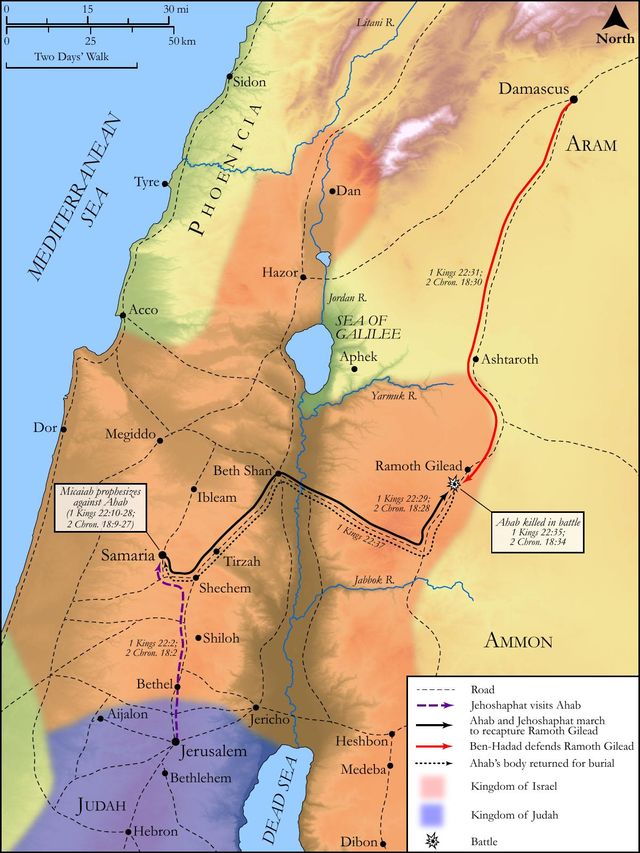
The narrative unfolds during the period of the divided monarchy in ancient Israel, with Ahab reigning over the northern kingdom of Israel and Jehoshaphat over the southern kingdom of Judah. Ahab's reign was characterized by rampant idolatry, particularly the promotion of Baal worship, and the persecution of Yahweh's prophets. In stark contrast, Jehoshaphat was largely committed to the worship of the LORD and initiated religious reforms in Judah. The alliance between these two kings, while politically pragmatic, underscores the spiritual chasm between their respective kingdoms. Prophets in ancient Israel functioned as vital intermediaries, delivering divine messages to kings, leaders, and the populace, often influencing political and military decisions. The act of "adjuring" someone "in the name of the LORD" was the most profound and legally binding oath one could take, invoking the authority and potential judgment of the covenant God of Israel upon any falsehood. It represented an appeal to the highest spiritual authority, emphasizing the extreme gravity of the expected truth. Ramoth-gilead, the contested city, was a strategically crucial location in Transjordan, frequently a point of contention between Israel and the Aramean kingdom (Syria).
Key Themes
ShowHideThis narrative profoundly illustrates several enduring theological and narrative themes. Firstly, it highlights The Inescapable Pursuit of Truth, even by those who habitually reject it. Ahab's desperate demand, despite his deep-seated wickedness, reveals an inherent human need for genuine truth, particularly when facing momentous, life-or-death decisions, even if that truth directly contradicts his desired outcomes. Secondly, Prophetic Integrity and Courage are central to Micaiah's character. He stands as a singular figure of unwavering conviction against 400 compliant false prophets and immense royal pressure, choosing to deliver God's unadulterated message regardless of personal cost or popular opinion. His courage to speak divine truth to earthly power serves as an exemplary model for all who would faithfully represent God. Thirdly, the passage underscores The Sacredness and Authority of God's Name. By adjuring Micaiah "in the name of the LORD," Ahab invokes the most solemn oath available, emphasizing the gravity and divine authority expected from a true prophet of Yahweh. This act highlights the profound seriousness of invoking the divine name for truth-telling and the expectation that a true prophet would speak only what God commanded, not what humans desired. Finally, the narrative serves as a stark and timeless lesson in Discerning True vs. False Prophecy. The 400 false prophets offered comforting flattery that aligned with the king's desires, while Micaiah delivered a challenging, yet ultimately true, word from God. This stark contrast vividly demonstrates the profound difference between genuine divine revelation and self-serving or politically motivated pronouncements, a theme echoed in passages like Jeremiah 14:14 and Jeremiah 23:28-32.
Exposition and Analysis
ShowHideKey Word Analysis
ShowHideThis verb (H7650, שָׁבַע, shâbaʻ') means "to swear (as if by repeating a declaration seven times); to take an oath, to cause to swear." In this context, it signifies a solemn and binding appeal, akin to placing someone under the most serious spiritual obligation. Ahab is not merely asking for information; he is demanding a truthful response under the weight of divine authority, compelling Micaiah to speak with full, unreserved honesty, as if bound by an unbreakable oath.
The Hebrew word for "truth" (H571, אֱמֶת, ʼemeth') denotes more than mere factual accuracy; it encompasses stability, certainty, trustworthiness, and reality. It refers to a word that is consistent with God's character and will, a message that can be relied upon because it originates from the ultimate source of faithfulness. Ahab is not just seeking a correct prediction, but a divinely authoritative word, one that stands in stark contrast to the deceptive words of his 400 prophets.
This term (H3068, יְהוָה, Yᵉhôvâh') refers to the self-Existent or Eternal God, Jehovah, the Jewish national name of God. When invoked "in the name of the LORD" (which includes H8034, שֵׁם, shêm', for "name"), it is a powerful invocation of God's personal, covenantal name. To speak or swear "in the name of the LORD" meant to do so under His supreme authority, with His backing, and with the understanding that He would hold the speaker accountable. It was the highest form of oath, signifying that the words spoken were not merely human opinion but divine revelation. Ahab's use of this phrase, despite his idolatry, highlights his desperate recognition of the unique authority associated with the true God's name, especially in prophetic utterance.
Verse Breakdown
ShowHide"And the king said to him"
This opening clause immediately establishes the direct interaction between King Ahab and the prophet Micaiah. It sets the scene for a pivotal confrontation, emphasizing the power dynamic at play—royal authority confronting prophetic integrity. Ahab's tone, implied by the subsequent rhetorical question, is one of mounting frustration and a desperate desire to elicit a straightforward answer from Micaiah.
"How many times shall I adjure thee"
This rhetorical question powerfully conveys Ahab's exasperation and the repeated nature of his attempts to compel Micaiah to speak plainly. It suggests a history of Micaiah's evasiveness or Ahab's persistent efforts to extract a desired prophecy, highlighting the king's growing impatience and his determination to receive a "real" answer. It underscores the king's recognition that Micaiah's previous responses were not genuine.
"that thou say nothing but the truth to me"
This clause articulates the core of Ahab's demand: unvarnished, unmanipulated truth. He is weary of Micaiah's sarcasm or veiled responses and desires a clear, unambiguous prophetic word that is not influenced by political expediency or personal feelings, but is genuinely from God. This demand for "nothing but the truth" stands in stark contrast to the flattering falsehoods delivered by the 400 court prophets.
"in the name of the LORD?"
This concluding phrase is the most critical element of the verse. It signifies the profound solemnity and binding nature of Ahab's adjuration. By invoking the divine name, Ahab places Micaiah under the highest possible spiritual obligation, demanding that he speak as a true messenger of Yahweh, with all the authority and accountability that entails. It is a desperate appeal to a divine standard that Ahab himself largely ignored in his life, revealing a fleeting recognition of the true God's ultimate authority.
Literary Devices
ShowHideThe verse is rich with several potent literary devices that amplify its meaning and impact. Irony is profoundly evident, as Ahab, a king notorious for his consistent idolatry and rejection of Yahweh, now desperately demands truth "in the name of the LORD." This highlights his hypocrisy and the inherent, perhaps subconscious, human need for divine truth, even when one actively suppresses or denies it. Dramatic Tension is palpable, skillfully built through Ahab's exasperated rhetorical question ("How many times shall I adjure thee?") and Micaiah's preceding sarcastic response, which necessitates this solemn adjuration. The scene functions as a verbal duel, a clash between royal power seeking control and prophetic authority submitting only to God. The verse also employs powerful Contrast, setting Ahab's desperate demand for divine truth against the backdrop of the 400 false prophets who had just delivered a message of human-pleasing lies. This contrast underscores the unique nature, authority, and often uncomfortable reality of true prophecy. Furthermore, the scene subtly Foreshadows the dire consequences of rejecting God's truth, as Micaiah's subsequent, divinely revealed prophecy will directly lead to Ahab's death in battle.
Theological and Thematic Connections
ShowHideThis verse powerfully illuminates the nature of divine truth and the complex human response to it. God, as the ultimate source of all reality, faithfulness, and unwavering truth, desires His truth to be spoken, heard, and received. Ahab's desperate plea, even from a heart steeped in idolatry and rebellion, reveals an inherent human recognition of the profound weight and necessity of genuine divine revelation, especially in moments of existential crisis. It underscores that truth from God is often uncomfortable, challenging human desires, exposing sin, and overturning meticulously crafted plans, yet it is ultimately the path to true understanding and, potentially, salvation. The narrative serves as a timeless reminder that God's word, faithfully delivered through His true messengers, stands in stark contrast to human flattery, self-serving pronouncements, or politically motivated lies, always demanding a response of faith, obedience, or outright rejection.
Reflection and Application
ShowHideThe intense scene in 2 Chronicles 18:15 offers profound and enduring lessons for contemporary believers. Like King Ahab, we are often tempted to seek God's truth only when it aligns with our preconceived plans, offers comfort, or validates our desires. Yet, genuine spiritual growth, profound discernment, and true freedom come from humbly embracing God's unvarnished word, even—and especially—when it challenges our assumptions, exposes our sin, or calls us to difficult, counter-cultural paths. This verse compels us to cultivate a deep hunger for authentic divine revelation, rather than settling for palatable platitudes or self-affirming messages. It also calls us to exercise rigorous discernment in the spiritual counsel we receive, critically asking whether it genuinely aligns with God's revealed will or merely caters to our desires, biases, or the prevailing cultural winds. Furthermore, Micaiah's unwavering courage in the face of immense pressure serves as a powerful and timeless model. In a world that often pressures conformity and compromise, believers are called to speak God's truth with integrity, conviction, and love, even when it is unpopular, carries personal risk, or invites opposition. This requires a profound reliance on the Holy Spirit's empowerment and an unshakeable commitment to God's word above all human opinions, political pressures, or personal fears.
Questions for Reflection
ShowHideFAQ
ShowHideWhy did Ahab demand truth "in the name of the LORD" if he was a wicked king?
ShowHideAhab's demand for truth "in the name of the LORD" is deeply ironic and paradoxical, given his consistent idolatry and rebellion against Yahweh throughout his reign. However, it highlights several significant possibilities. First, even a wicked king like Ahab understood the profound weight, authority, and binding nature associated with invoking the name of the covenant God of Israel. In a moment of existential crisis, facing a life-or-death decision, he instinctively turned to the highest known authority for a reliable word, recognizing that the 400 false prophets, while pleasing, ultimately lacked true divine backing or accountability. Second, it could reflect a cultural formality; swearing by a deity was a common practice in the ancient Near East, and even if he rejected Yahweh personally, he knew that a prophet of Yahweh would be bound by this specific, most solemn oath. Third, it might reveal a desperate, albeit fleeting, moment of spiritual honesty or a subconscious acknowledgment of God's ultimate sovereignty, where he truly wanted to know the divine will, even if he ultimately intended to disregard it. This moment powerfully underscores the inescapable reality of God's authority and the inherent human need for divine truth, even for those who actively reject Him.
What was Micaiah's initial sarcastic response that prompted Ahab's demand?
ShowHideWhen first brought before the kings, Micaiah was asked if they should proceed to battle against Ramoth-gilead. He initially responded, "Go ye up, and prosper; for the LORD shall deliver it into the hand of the king" (2 Chronicles 18:14). This statement was a direct, word-for-word echo of the unanimous message delivered by the 400 false prophets (2 Chronicles 18:5). However, Micaiah's tone, manner, and perhaps a subtle smirk, must have conveyed profound sarcasm or irony, indicating that he was not speaking genuinely. He was effectively mocking the false prophets and, more importantly, forcing Ahab to acknowledge that he knew Micaiah possessed a different, true word to deliver. Ahab's subsequent exasperated adjuration confirms that he recognized Micaiah's initial statement as disingenuous and was pressing for the actual, divinely revealed truth, regardless of how unwelcome it might be.
Christ-Centered Fulfillment
ShowHideThe desperate plea of King Ahab for "nothing but the truth... in the name of the LORD" in 2 Chronicles 18:15 finds its ultimate fulfillment and resolution in the person and work of Jesus Christ. Humanity, in its fallen state, often seeks comfort in lies, partial truths, or self-serving narratives, much like Ahab preferred the flattering words of the 400 false prophets. Yet, deep within the human spirit, there remains an innate, albeit often suppressed, longing for genuine, unadulterated truth. Jesus declares, "I am the way, the truth, and the life" (John 14:6). He is not merely a prophet who speaks truth on God's behalf; He is the very embodiment of truth, the eternal Word made flesh (John 1:14). Unlike Micaiah, who had to be adjured to speak the truth, Jesus always spoke the Father's words perfectly, without reservation, and with absolute authority, because He and the Father are one (John 10:30). He is the ultimate Prophet, delivering God's final and complete revelation to humanity (Hebrews 1:1-2). The truth He brings is not just information about the future, but a liberating reality that sets us free from the bondage of sin and spiritual blindness (John 8:32). In Christ, the desperate human search for truth "in the name of the LORD" is fully and eternally satisfied, for He is the faithful and true witness (Revelation 3:14), through whom God's ultimate truth, salvation, and eternal life are revealed.