


2 Samuel 15:11
Bible text: King James Version (1769 Blayney text) · Public domain
Bible text: Berean Standard Bible · Public domain
Bible text: American Standard Version (1901) · Public domain
Bible text: World English Bible, Messianic edition · Public domain
Bible text: Geneva Bible (1599) · Public domain
Bible text: Young's Literal Translation · Public domain
- וְאֶתve·'Etand withH854Conj-w ¦ PrepPrepositionוְandאֶתwith
- אַבְשָׁלוֹם'av·sha·LomAbsalomH53N-proper-mNoun Proper Masculine
- הָלְכוּha·le·Khuthey wentH1980V-Qal-Perf-3cpVerb Qal Perfect 3rd Plural common gender
- מָאתַיִםma·Ta·yimtwo hundredH3967N-fdNoun Dual Feminine Absolute
- אִישׁ'ishmanH376N-msNoun Singular Masculine Absolute
- מִירוּשָׁלִַםmi·Ru·sha·Limfrom JerusalemH3389Prep-m ¦ N-properNoun Proper LocationמִfromירוּשָׁלִַםJerusalem
- קְרֻאִיםke·ru·'Im[those who] were invitedH7121V-Qal-PassPrtcpl-mpVerb Qal Participle Passive Plural Masculine Absolute
- וְהֹלְכִיםve·ho·le·Khimand [those who] were goingH1980Conj-w ¦ V-Qal-Prtcpl-mpVerb Qal Participle Plural Masculine Absoluteוְandהֹלְכִים[those who] were going
- לְתֻמָּםle·tu·Mamto their innocenceH8537Prep-l ¦ N-msc ¦ 3mpNoun Singular Masculine Constructלְtoתֻמָּinnocenceםtheir
- וְלֹאve·Lo'and notH3808Conj-w ¦ NegParticle Negativeוְandלֹאnot
- יָדְעוּya·de·'Uthey knewH3045V-Qal-Perf-3cpVerb Qal Perfect 3rd Plural common gender
- כָּלkolanyH3605N-mscNoun Singular Masculine Construct
- דָּבָרda·VarthingH1697N-msNoun Singular Masculine Absolute
English is a literal word-by-word gloss of the Hebrew, not the KJV's wording. Why?
This is the original text the KJV's translators worked from — each Hebrew word with its own literal English meaning in this verse, prepared by scholars at Tyndale House, Cambridge. The KJV translates whole sentences, not word by word, so its wording differs: one Hebrew word can become several English words, and the KJV may choose “the LORD” where the gloss reads “Yahweh”. Both are faithful — they answer different questions. For the KJV's own rendering, switch to the KJV text.
Details
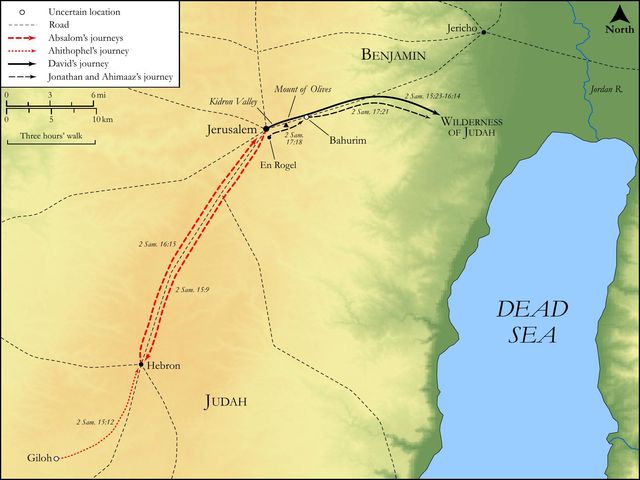
See on the biblical-era maps

Study this verse
Public-domain commentary
Matthew Henry
From his Commentary on the Whole Bible. Henry comments on passages, not single verses — this entry covers 2 Samuel 15:7–12. His two-level outline is real structure in the source text, so it is rendered as structure.
We have here the breaking out of Absalom's rebellion, which he had long been contriving. It is said to be after forty years, Sa2 15:7. But whence it is to be dated we are not told; not from David's beginning his reign, for then it would fall in the last year of his life, which is not probable; but either from his first anointing by Samuel seven years before, or rather (I think) from the people's desiring a king, and the first change of the government into a monarchy, which might be about ten years before David began to reign; it is fitly dated thence, to show that the same restless spirit was still working, and still they were given to change: as fond now of a new man as then of a new model. So it fell about the thirtieth year of David's reign. Absalom's plot being now ripe for execution,
I.The place he chose for the rendezvous of his party was Hebron, the place where he was born and where his father began his reign and continued it several years, which would give some advantage to his pretensions. Every one knew Hebron to be a royal city; and it lay in the heart of Judah's lot, in which tribe, probably, he thought his interest strong.
II.The pretence he had both to go thither and to invite his friends to him there was to offer a sacrifice to God, in performance of a vow he had made during his banishment, Sa2 15:7, Sa2 15:8. We have cause enough to suspect that he had not made any such vow; it does not appear that he was so religiously inclined. But he that stuck not at murder and treason would not make conscience of a lie to serve his purpose. If he said he had made such a vow, nobody could disprove him. Under this pretence,
1.He got leave of his father to go to Hebron. David would be well pleased to hear that his son, in his exile, was so desirous to return to Jerusalem, not only his father's city, but the city of the living God, - that he looked up to God, to bring him back, - that he had vowed, if he were brought back, to serve the Lord, whose service he had hitherto neglected, - and that now, being brought back, he remembered his vow, and resolved to perform it. If he think fit to do it in Hebron, rather than in Sion or Gibeon, the good king is so well pleased with the thing itself that he will not object against his choice of the place. See how willing tender parents are to believe the best concerning their children, and, upon the least indication of good, to hope, even concerning those that have been untoward, that they will repent and reform. But how easy is it for children to take advantage of their good parents' credulity, and to impose upon them with the show of religion, while still they are what they were! David was overjoyed to hear that Absalom inclined to serve the Lord, and therefore readily gave him leave to go to Hebron, and to go thither with solemnity.
2.He got a good number of sober substantial citizens to go along with him, Sa2 15:11. There went 200 men, probably of the principal men of Jerusalem, whom he invited to join with him in his feast upon his sacrifice; and they went in their simplicity, not in the least suspecting that Absalom had any bad design in this journey. He knew that it was to no purpose to tempt them into his plot: they were inviolably firm to David. But he drew them in to accompany him, that the common people might think that they were in his interest, and that David was deserted by some of his best friends. Note, It is no new thing for very good men, and very good things, to be made use of by designing men to put a colour upon bad practices. When religion is made a stalking-horse, and sacrifice a shoeing-horn, to sedition and usurpation it is not to be wondered at if some that were well affected to religion, as these followers of Absalom here, are imposed upon by the fallacy, and drawn in to give countenance to that, with their names, which in their heart they abhor, not having known the depths of Satan.
III.The project he laid was to get himself proclaimed king throughout all the tribes of Israel upon a signal given, Sa2 15:10.
Spies were sent abroad, to be ready in every country to receive the notice with satisfaction and acclamations of joy, and to make the people believe that the news was both very true and very good, and that they were all concerned to take up arms for their new king. Upon the sudden spreading of this proclamation, "Absalom reigns in Hebron," some would conclude that David was dead, others that he had resigned: and thus those that were in the secret would draw in many to appear for Absalom, and to come into his assistance, who, if they had rightly understood the matter, would have abhorred the thought of it, but, being drawn in, would adhere to him. See what artifices ambitious men use for the compassing of their ends; and in matters of state, as well as in matters of religion, let us not be forward to believe every spirit, but try the spirits.
IV.The person he especially courted and relied upon in this affair was Ahithophel, a politic thinking man, and one that had a clear head and a great compass of thought, that had been David's counsellor, his guide and his acquaintance (Psa 55:13), his familiar friend, in whom he trusted, who did eat of his bread, Psa 41:9. But, upon some disgust of David's against him, or his against David, he was banished, or retired from public business, and lived privately in the country. How should a man of such good principles as David, and a man of such corrupt principles as Ahithophel, long agree? A fitter tool Absalom could not find in all the kingdom than one that was so great a statesman, and yet was disaffected to the present ministry. While Absalom was offering his sacrifices, in performance of his pretended vow, he sent for this man. So much was his heart on the projects of his ambition that he could not stay to make an end of his devotion, which showed what his eye was upon in all, and that it was but for a pretence that he made long offerings.
V.The party that joined with him proved at last very considerable.
The people increased continually with Absalom, which made the conspiracy strong and formidable. Every one whom he had complimented and caressed (pronouncing his matters right and good, especially if afterwards the cause went against him) not only came himself, but made all the interest he could for him, so that he wanted not for numbers. The majority is no certain rule to judge of equity by. All the world wondered after the beast. Whether Absalom formed this design merely in the height of his ambition and fondness to rule, or whether there was not in it also malice against his father and revenge for his banishment and confinement, though this punishment was so much less than he deserved, does not appear. But, generally, that which aims at the crown aims at the head that wears it.
Continue studying 2 Samuel 15:11 across the web’s major study libraries — every link below opens this exact verse, chapter, or book on the destination site.
Read & Compare
 BibleGatewayThis verse in more than 200 translations and 70 languages.
 Bible.comThe YouVersion reader — hundreds of translations, reading plans, and highlights.
 ESV.orgCrossway's official English Standard Version reader.
 NET BibleThe NET translation with 60,000+ translators' notes on every rendering decision.
 STEP BibleTyndale House's free study tool — original text, vocabulary, and scholarly resources.
 BibliaLogos Bible Software's free web reader.
 USCCBThe New American Bible (Revised Edition) with the U.S. bishops' study notes.
Commentaries
 BibleHub CommentariesDozens of classic commentaries on this verse, gathered on one page.
 StudyLightMore than 100 commentary sets — the largest collection on the web.
 BibleRefPlain-English commentary on what this verse means, verse by verse.
 Enduring WordDavid Guzik's free commentary on this chapter, widely used by Bible teachers.
 Bible Study ToolsVerse commentary alongside Greek and Hebrew study aids.
Original Language & Research
- BibleHub InterlinearThe verse word by word — original language, transliteration, and English.
- BibleHub LexiconEvery word's original-language definition and Strong's entry.
 Blue Letter BibleDeep-study tools — Strong's numbers, concordance, and word studies.
 SefariaThe Hebrew text with Rashi and centuries of Jewish commentary.
Sermons, Hymns & Audio


TrulyRandomVerse is not affiliated with these sites and doesn’t control their content. They’re linked because they’re genuinely useful.
Summary
2 Samuel 15:11 offers a poignant glimpse into the initial stages of Absalom's rebellion against his father, King David. It highlights the cunning deception employed by Absalom, who, under the guise of fulfilling a religious vow, gathered two hundred men from Jerusalem. These men, invited to what they believed was a legitimate and pious event, are explicitly described as having gone "in their simplicity" and knowing "not any thing" of Absalom's true, treacherous intentions to usurp the throne. The verse underscores the vulnerability of the innocent to manipulation and the insidious nature of deceit, even when cloaked in religious pretense.
Context
ShowHideLiterary Context
This verse is situated at a critical juncture in the narrative of Absalom's rebellion, marking the transition from his years of subtle political maneuvering to overt insurrection. Preceding chapters detail Absalom's calculated strategy to "steal the hearts of the men of Israel," as seen in 2 Samuel 15:1-6, where he positioned himself as a more accessible and just alternative to David. Verse 11 immediately follows Absalom's feigned request to go to Hebron to fulfill a vow to the Lord, a deceptive maneuver described in 2 Samuel 15:7-9. The departure of these 200 unwitting men with Absalom to Hebron, David's former capital, lends an air of legitimacy to his actions, setting the stage for the public declaration of his kingship and the subsequent flight of David from Jerusalem, as recounted in 2 Samuel 15:13-14. The verse thus serves as a crucial narrative device, illustrating the depth of Absalom's deception and the initial, unsuspecting support he garnered.
Historical & Cultural Context
Absalom's rebellion unfolds within the complex political landscape of ancient Israelite monarchy. Kingship, particularly during David's reign, was understood to be divinely ordained, with the king serving as God's anointed representative. A rebellion against the king was therefore not merely a political act but an act of treason against God's chosen leader. Hebron held significant historical weight as David's first capital, as noted in 2 Samuel 2:1-4, making it a symbolically potent location for Absalom to declare his kingship, aiming to evoke loyalty from those who remembered David's humble beginnings there. The cultural practice of making vows and offering sacrifices was deeply ingrained in Israelite society, often serving as a legitimate reason for travel and assembly. Absalom expertly exploited this religious custom as a deceptive cover for his true rebellious intentions, leveraging the people's piety for his own political gain. This manipulation highlights the ease with which sacred traditions could be perverted for secular, self-serving ends in a culture where religious and political life were inextricably linked.
Key Themes
ShowHideThe verse profoundly contributes to several overarching themes within 2 Samuel and the broader biblical narrative. Deception and Manipulation are central, as Absalom masterfully orchestrates his coup through cunning rather than overt force, exemplified by his "stealing the hearts" of the people, a strategy detailed in 2 Samuel 15:6. The Naiveté and Unknowing Involvement of the 200 men underscore the vulnerability of the innocent to charismatic but corrupt leadership, highlighting the dangers of blind allegiance. This leads to the theme of Discernment, emphasizing the critical need to evaluate motives and intentions, a theme echoed in wisdom literature like Proverbs 14:15. Furthermore, the verse subtly introduces the theme of Consequences of Sin, demonstrating how the ripple effects of one person's ambition can ensnare and endanger others, even those who are blameless. It also touches upon the Nature of True Kingship versus illegitimate usurpation, setting a contrast that will be fully explored as David's reign faces this profound challenge.
Exposition and Analysis
ShowHideKey Word Analysis
ShowHideDerived from H7121, this word signifies "to call out to," "summon," or "invite." In this context, it implies a legitimate invitation, not a conscription into a rebellious army. The men were summoned under a pretense that would have appeared entirely normal and perhaps even honorable, likely to participate in a religious sacrifice or a significant gathering, rather than to join a coup. This highlights Absalom's meticulous planning and his ability to cloak his treason in acceptable social and religious customs.
Derived from H8537, this word conveys "completeness," "integrity," "innocence," or "uprightness." It suggests that these men were straightforward, pure in their intentions, and devoid of any guile or malicious intent. They were not co-conspirators but rather acted in good faith, perhaps even with a degree of naiveté, in stark contrast to Absalom's cunning and duplicity. Their "simplicity" underscores their moral blamelessness concerning the rebellion.
This phrase combines H3045 (yâdaʻ), meaning "to know" or "to ascertain by seeing," and H1697 (dâbâr), meaning "a word," "matter," or "thing." Together, they emphatically reinforce the preceding "in their simplicity." It means they were utterly ignorant, completely unaware of Absalom's true agenda or the rebellious nature of the enterprise they were joining. Their lack of knowledge is absolute, distinguishing them from Absalom's inner circle of conspirators and highlighting their unwitting involvement as pawns in his scheme.
Verse Breakdown
ShowHide"And with Absalom went two hundred men out of Jerusalem"
This clause establishes the initial contingent of followers who accompanied Absalom. Their origin from Jerusalem, the capital city and seat of David's power, is significant, suggesting they might have been prominent citizens or at least individuals whose presence would lend credibility to Absalom's movements. Their number, 200, is substantial enough to suggest a growing movement but small enough to be manageable for a deceptive initial phase.
"[that were] called;"
This phrase clarifies the nature of their involvement. They were not coerced or forcibly recruited but invited. This invitation, as discussed, was under false pretenses, likely a religious ceremony or a social gathering, which would have appeared innocuous or even commendable. This detail underscores Absalom's manipulative strategy, using perceived legitimacy to draw unsuspecting individuals into his plot.
"and they went in their simplicity,"
This crucial phrase describes the mental and moral state of these 200 men. They acted with genuine innocence, integrity, and sincerity. They harbored no rebellious thoughts or intentions of their own. Their participation was not driven by disloyalty to David but by a straightforward acceptance of Absalom's invitation, believing it to be for a legitimate purpose.
"and they knew not any thing."
This final clause provides the definitive statement of their complete ignorance. They had no inkling of the true, treasonous nature of Absalom's journey to Hebron. They were utterly unaware that they were participating in the launch of a rebellion against the anointed king, making them innocent bystanders caught in the web of Absalom's deceit.
Literary Devices
ShowHideThe verse effectively employs several literary devices to convey its meaning and impact. Juxtaposition is prominent, contrasting Absalom's calculated cunning and deceit with the profound innocence and naiveté of the 200 men. This stark difference highlights the moral chasm between the manipulator and the manipulated. Irony is also at play, as the men believe they are participating in a pious act (a sacrifice or vow), yet they are unknowingly contributing to an act of profound political and spiritual treason against the divinely appointed king. Their religious devotion is tragically subverted for a nefarious purpose. Furthermore, the verse uses Characterization to reveal Absalom's insidious nature—his willingness to exploit religious piety and human trust for personal ambition. The description of the men as "simple" and "knowing nothing" serves as a form of Foreshadowing, hinting at the broader chaos and unwitting involvement of many others who would be swept up in Absalom's rebellion, often without fully grasping its implications or the true character of its leader.
Theological and Thematic Connections
ShowHideThis verse serves as a powerful theological cautionary tale, illustrating the pervasive nature of sin and its capacity to ensnare even the innocent through deception. It underscores the biblical emphasis on discernment and the critical need for believers to "test the spirits" and not blindly follow charismatic figures or movements without careful evaluation of their motives and alignment with divine truth. The "simplicity" of the 200 men, while morally blameless, highlights a vulnerability that can be exploited by those driven by selfish ambition, reminding us that good intentions alone are not always sufficient protection against manipulation. The narrative implicitly calls for wisdom and vigilance in a world where appearances can be deceiving, and where spiritual and political agendas often intertwine in complex, misleading ways. It also touches on the concept of corporate consequence, where even the unwitting can find themselves associated with the fallout of others' sin.
Reflection and Application
ShowHideThe story of the 200 men accompanying Absalom in their "simplicity" offers a timeless lesson for navigating a world often characterized by hidden agendas and persuasive rhetoric. In an age saturated with information and charismatic voices, both secular and religious, the call to cultivate spiritual discernment is more urgent than ever. We are challenged to move beyond superficial appearances and popular narratives, diligently seeking to understand the true motives and ultimate ends of any cause or leader we might be tempted to follow or support. This requires not just intellectual curiosity but a deep reliance on God's Word as our plumb line and the Holy Spirit as our guide, enabling us to distinguish between genuine truth and deceptive manipulation. It also prompts us to consider our own responsibility: while these men were innocent of rebellious intent, their association with Absalom's treason could have had severe consequences. This reminds us that even unwitting participation can have repercussions, urging us to be proactive in our pursuit of truth and integrity, ensuring that our actions and allegiances are always aligned with righteousness and the kingdom of God.
Questions for Reflection
ShowHideFAQ
ShowHideWhat happened to these 200 men after they joined Absalom?
ShowHideThe biblical text does not explicitly detail the fate of these specific 200 men. Their "simplicity" and complete ignorance of Absalom's true intentions are emphasized, setting them apart from the active conspirators. It is likely that once the rebellion fully unfolded and its true nature became clear, these men, being innocent of treasonous intent, either dispersed, returned to Jerusalem, or were simply absorbed into the broader conflict without active participation in the fighting. Their lack of knowledge may have spared them the severe consequences typically meted out to rebels, as their hearts were not with Absalom's cause.
Why would Absalom invite men who were "simple" and "knew not any thing" of his plan?
ShowHideAbsalom's invitation to these 200 unsuspecting men was a strategic masterstroke designed to lend an air of legitimacy and popular support to his nascent rebellion. By inviting prominent or at least well-regarded men from Jerusalem under the guise of a religious vow or sacrifice in Hebron, he achieved several objectives:
Absalom was a master manipulator, and using these innocent individuals was a key part of his plan to "steal the hearts of the men of Israel," as documented in 2 Samuel 15:6, and present himself as a popular alternative to David.
Christ-Centered Fulfillment
ShowHideThe narrative of Absalom's deceptive kingship and the unwitting involvement of the 200 men finds profound Christ-centered fulfillment in the stark contrast between human ambition and divine sovereignty, and between deceptive leadership and the true Shepherd. Absalom, a charismatic but ultimately self-serving figure, built his kingdom on lies and manipulation, drawing people in under false pretenses. This stands in stark opposition to Jesus Christ, the King of kings and Lord of lords, whose kingdom is founded on truth, humility, and sacrificial love, not on earthly power or deceit, as Jesus Himself declared in John 18:36. While Absalom's followers were "simple" and "knew not any thing," Jesus calls His disciples to follow Him with full knowledge and intentional commitment, inviting them to "take up their cross daily" in Luke 9:23 and to know the truth that sets them free. Furthermore, the suffering of the innocent caught in Absalom's scheme foreshadows the ultimate innocent suffering of Christ, who, though without sin, bore the consequences of humanity's sin, not as an unwitting participant, but as a willing sacrifice, as beautifully described in Philippians 2:5-8. He is the Good Shepherd who leads His flock with integrity and protects them from deception, ensuring that those who follow Him "will never walk in darkness, but will have the light of life," a promise given in John 8:12.