


2 Samuel 15:12
Bible text: King James Version (1769 Blayney text) · Public domain
Bible text: King James Version with Strong's numbers · Public domain
Bible text: Berean Standard Bible · Public domain
Bible text: American Standard Version (1901) · Public domain
Bible text: World English Bible, Messianic edition · Public domain
Bible text: Geneva Bible (1599) · Public domain
Bible text: Young's Literal Translation · Public domain
- וַיִּשְׁלַחvai·yish·Lachand he sentH7971Conj-w ¦ V-Qal-ConsecImperf-3msVerb Qal Consecutive Imperfect 3rd Singular Masculineוַandיִּשְׁלַחhe sent
- אַבְשָׁלוֹם'Av·sha·lomAbsalomH53N-proper-mNoun Proper Masculine
- אֶת'et<obj.>H853DirObjMParticle Object Indicator
- אֲחִיתֹפֶל'a·chi·To·felAhithophelH302N-proper-mNoun Proper Masculine
- הַגִּילֹנִיha·gi·lo·Nithe GiloniteH1526Art ¦ N-msNoun Gentilic Singular Masculine AbsoluteהַtheגִּילֹנִיGilonite
- יוֹעֵץyo·'Etz[the] counselor ofH3289V-Qal-Prtcpl-msVerb Qal Participle Singular Masculine Construct
- דָּוִדda·VidDavidH1732N-proper-mNoun Proper Masculine
- מֵעִירוֹme·'i·Rofrom his cityH5892Prep-m ¦ N-fsc ¦ 3msNoun Singular Feminine Constructמֵfromעִירcityוֹhis
- מִגִּלֹהmi·gi·Lohfrom GilohH1542Prep-m ¦ N-properNoun Proper LocationמִfromגִּלֹהGiloh
- בְּזָבְחוֹbe·za·ve·Chowhen he sacrificedH2076Prep-b ¦ V-Qal-Inf ¦ 3msVerb Qal Infinitive Constructבְּwhenזָבְחsacrificedוֹhe
- אֶת'et<obj.>H853DirObjMParticle Object Indicator
- הַזְּבָחִיםha·ze·va·Chimthe sacrificesH2077Art ¦ N-mpNoun Plural Masculine Absoluteהַtheזְּבָחִיםsacrifices
- וַיְהִיvay·Hiand it wasH1961Conj-w ¦ V-Qal-ConsecImperf-3msVerb Qal Consecutive Imperfect 3rd Singular Masculineוַandיְהִיit was
- הַקֶּשֶׁרha·Ke·sherthe conspiracyH7195Art ¦ N-msNoun Singular Masculine Absoluteהַtheקֶּשֶׁרconspiracy
- אַמִּץ'a·MitzstrongH533Adj-msAdjective Singular Masculine Absolute
- וְהָעָםve·ha·'Amand the peopleH5971Conj-w ¦ Art ¦ N-msNoun Singular Masculine Absoluteוְandהָtheעָםpeople
- הוֹלֵךְho·Lekh[was] goingH1980V-Qal-Prtcpl-msVerb Qal Participle Singular Masculine Absolute
- וָרָבva·Ravand numerousH7227Conj-w ¦ Adj-msAdjective Singular Masculine Absoluteוָandרָבnumerous
- אֶת'etwithH854PrepPreposition
- אַבְשָׁלוֹם'av·sha·LomAbsalomH53N-proper-mNoun Proper Masculine
English is a literal word-by-word gloss of the Hebrew, not the KJV's wording. Why?
This is the original text the KJV's translators worked from — each Hebrew word with its own literal English meaning in this verse, prepared by scholars at Tyndale House, Cambridge. The KJV translates whole sentences, not word by word, so its wording differs: one Hebrew word can become several English words, and the KJV may choose “the LORD” where the gloss reads “Yahweh”. Both are faithful — they answer different questions. For the KJV's own rendering, switch to the KJV text.
Details
See on the biblical-era maps
Study this verse
Public-domain commentary
Matthew Henry
From his Commentary on the Whole Bible. Henry comments on passages, not single verses — this entry covers 2 Samuel 15:7–12. His two-level outline is real structure in the source text, so it is rendered as structure.
We have here the breaking out of Absalom's rebellion, which he had long been contriving. It is said to be after forty years, Sa2 15:7. But whence it is to be dated we are not told; not from David's beginning his reign, for then it would fall in the last year of his life, which is not probable; but either from his first anointing by Samuel seven years before, or rather (I think) from the people's desiring a king, and the first change of the government into a monarchy, which might be about ten years before David began to reign; it is fitly dated thence, to show that the same restless spirit was still working, and still they were given to change: as fond now of a new man as then of a new model. So it fell about the thirtieth year of David's reign. Absalom's plot being now ripe for execution,
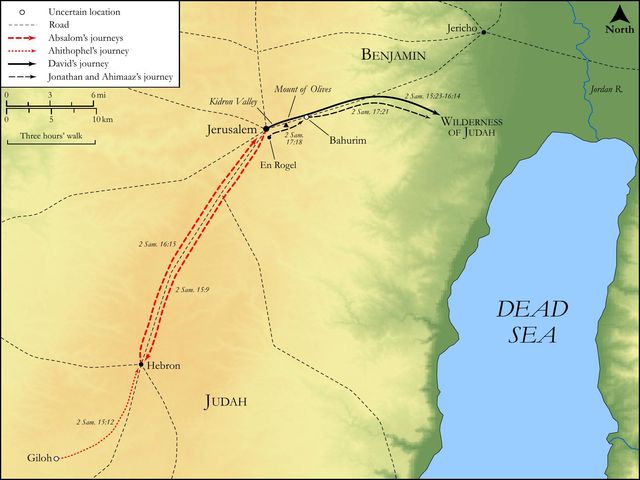
I.The place he chose for the rendezvous of his party was Hebron, the place where he was born and where his father began his reign and continued it several years, which would give some advantage to his pretensions. Every one knew Hebron to be a royal city; and it lay in the heart of Judah's lot, in which tribe, probably, he thought his interest strong.
II.The pretence he had both to go thither and to invite his friends to him there was to offer a sacrifice to God, in performance of a vow he had made during his banishment, Sa2 15:7, Sa2 15:8. We have cause enough to suspect that he had not made any such vow; it does not appear that he was so religiously inclined. But he that stuck not at murder and treason would not make conscience of a lie to serve his purpose. If he said he had made such a vow, nobody could disprove him. Under this pretence,
1.He got leave of his father to go to Hebron. David would be well pleased to hear that his son, in his exile, was so desirous to return to Jerusalem, not only his father's city, but the city of the living God, - that he looked up to God, to bring him back, - that he had vowed, if he were brought back, to serve the Lord, whose service he had hitherto neglected, - and that now, being brought back, he remembered his vow, and resolved to perform it. If he think fit to do it in Hebron, rather than in Sion or Gibeon, the good king is so well pleased with the thing itself that he will not object against his choice of the place. See how willing tender parents are to believe the best concerning their children, and, upon the least indication of good, to hope, even concerning those that have been untoward, that they will repent and reform. But how easy is it for children to take advantage of their good parents' credulity, and to impose upon them with the show of religion, while still they are what they were! David was overjoyed to hear that Absalom inclined to serve the Lord, and therefore readily gave him leave to go to Hebron, and to go thither with solemnity.
2.He got a good number of sober substantial citizens to go along with him, Sa2 15:11. There went 200 men, probably of the principal men of Jerusalem, whom he invited to join with him in his feast upon his sacrifice; and they went in their simplicity, not in the least suspecting that Absalom had any bad design in this journey. He knew that it was to no purpose to tempt them into his plot: they were inviolably firm to David. But he drew them in to accompany him, that the common people might think that they were in his interest, and that David was deserted by some of his best friends. Note, It is no new thing for very good men, and very good things, to be made use of by designing men to put a colour upon bad practices. When religion is made a stalking-horse, and sacrifice a shoeing-horn, to sedition and usurpation it is not to be wondered at if some that were well affected to religion, as these followers of Absalom here, are imposed upon by the fallacy, and drawn in to give countenance to that, with their names, which in their heart they abhor, not having known the depths of Satan.
III.The project he laid was to get himself proclaimed king throughout all the tribes of Israel upon a signal given, Sa2 15:10.
Spies were sent abroad, to be ready in every country to receive the notice with satisfaction and acclamations of joy, and to make the people believe that the news was both very true and very good, and that they were all concerned to take up arms for their new king. Upon the sudden spreading of this proclamation, "Absalom reigns in Hebron," some would conclude that David was dead, others that he had resigned: and thus those that were in the secret would draw in many to appear for Absalom, and to come into his assistance, who, if they had rightly understood the matter, would have abhorred the thought of it, but, being drawn in, would adhere to him. See what artifices ambitious men use for the compassing of their ends; and in matters of state, as well as in matters of religion, let us not be forward to believe every spirit, but try the spirits.
IV.The person he especially courted and relied upon in this affair was Ahithophel, a politic thinking man, and one that had a clear head and a great compass of thought, that had been David's counsellor, his guide and his acquaintance (Psa 55:13), his familiar friend, in whom he trusted, who did eat of his bread, Psa 41:9. But, upon some disgust of David's against him, or his against David, he was banished, or retired from public business, and lived privately in the country. How should a man of such good principles as David, and a man of such corrupt principles as Ahithophel, long agree? A fitter tool Absalom could not find in all the kingdom than one that was so great a statesman, and yet was disaffected to the present ministry. While Absalom was offering his sacrifices, in performance of his pretended vow, he sent for this man. So much was his heart on the projects of his ambition that he could not stay to make an end of his devotion, which showed what his eye was upon in all, and that it was but for a pretence that he made long offerings.
V.The party that joined with him proved at last very considerable.
The people increased continually with Absalom, which made the conspiracy strong and formidable. Every one whom he had complimented and caressed (pronouncing his matters right and good, especially if afterwards the cause went against him) not only came himself, but made all the interest he could for him, so that he wanted not for numbers. The majority is no certain rule to judge of equity by. All the world wondered after the beast. Whether Absalom formed this design merely in the height of his ambition and fondness to rule, or whether there was not in it also malice against his father and revenge for his banishment and confinement, though this punishment was so much less than he deserved, does not appear. But, generally, that which aims at the crown aims at the head that wears it.
Continue studying 2 Samuel 15:12 across the web’s major study libraries — every link below opens this exact verse, chapter, or book on the destination site.
Read & Compare
 BibleGatewayThis verse in more than 200 translations and 70 languages.
 Bible.comThe YouVersion reader — hundreds of translations, reading plans, and highlights.
 ESV.orgCrossway's official English Standard Version reader.
 NET BibleThe NET translation with 60,000+ translators' notes on every rendering decision.
 STEP BibleTyndale House's free study tool — original text, vocabulary, and scholarly resources.
 BibliaLogos Bible Software's free web reader.
 USCCBThe New American Bible (Revised Edition) with the U.S. bishops' study notes.
Commentaries
 BibleHub CommentariesDozens of classic commentaries on this verse, gathered on one page.
 StudyLightMore than 100 commentary sets — the largest collection on the web.
 BibleRefPlain-English commentary on what this verse means, verse by verse.
 Enduring WordDavid Guzik's free commentary on this chapter, widely used by Bible teachers.
 Bible Study ToolsVerse commentary alongside Greek and Hebrew study aids.
Original Language & Research
- BibleHub InterlinearThe verse word by word — original language, transliteration, and English.
- BibleHub LexiconEvery word's original-language definition and Strong's entry.
 Blue Letter BibleDeep-study tools — Strong's numbers, concordance, and word studies.
 SefariaThe Hebrew text with Rashi and centuries of Jewish commentary.
Sermons, Hymns & Audio


TrulyRandomVerse is not affiliated with these sites and doesn’t control their content. They’re linked because they’re genuinely useful.
Summary
This verse marks a critical and ominous turning point in Absalom's rebellion against his father, King David. It vividly portrays Absalom's strategic brilliance in consolidating power by securing the allegiance of Ahithophel, David's most trusted and renowned counselor, even as he cloaked his rebellious intentions in religious ceremony. The text underscores the shocking depth of the conspiracy, revealing its rapid growth and formidable strength as the populace increasingly flocked to Absalom's cause, signaling a profound and immediate threat to David's reign.
Context
ShowHideLiterary Context
This verse is situated at the climax of Absalom's meticulously planned coup, immediately following his overt declaration of kingship in Hebron and preceding David's hasty flight from Jerusalem. Prior to this, Absalom had spent four years subtly undermining David's authority, charming the people, and building a loyal following, as detailed in 2 Samuel 15:1-6. His declaration of kingship in Hebron (2 Samuel 15:7-10) was the overt act of rebellion. Verse 12 serves as a crucial bridge, explaining how Absalom's rebellion gained such immediate and overwhelming momentum, specifically through the defection of Ahithophel, whose counsel was considered divinely inspired (as seen later in 2 Samuel 16:23). The mention of sacrifices adds a layer of religious legitimization to Absalom's political maneuvering, setting the stage for the direct confrontation between father and son that unfolds in the subsequent chapters.
Historical & Cultural Context
The setting is ancient Israel, a monarchy where succession was often contested and loyalty, though paramount, was frequently fluid. Kings relied heavily on trusted advisors, and a counselor like Ahithophel, whose wisdom was legendary, held immense influence. Giloh, Ahithophel's hometown, was in the hill country of Judah, suggesting that Absalom's support was not confined to the northern tribes but extended even into David's own tribal territory and inner circle. The act of offering sacrifices was a deeply significant religious and public ritual, often performed to inaugurate kingship, make covenants, or seek divine favor. Absalom's performance of sacrifices while summoning Ahithophel was a calculated move to imbue his rebellion with a veneer of divine approval, appealing to the religious sensibilities of the populace and legitimizing his usurpation of the throne in the eyes of the people. This strategic use of religious ceremony for political gain was a tactic Adonijah would use after him, when he slew sheep and oxen by the stone of Zoheleth and called his brethren, the king's sons, to the feast.
Key Themes
ShowHideThis verse powerfully contributes to several overarching themes in 2 Samuel. It highlights the theme of profound betrayal, as Ahithophel, a close confidant whose advice was like "the oracle of God" (as seen in 2 Samuel 16:23), turns against David. This betrayal is a significant blow, reflecting the deep-seated nature of the conspiracy. The verse also underscores strategic deception and manipulation, as Absalom skillfully uses religious ritual and political cunning to consolidate power, demonstrating his ruthless ambition and moral ambiguity. Furthermore, it emphasizes the rapid escalation and formidable strength of the rebellion, indicating that this was no minor uprising but a serious, widespread threat to David's reign. Finally, within the broader narrative of 2 Samuel, Absalom's rebellion is often seen as a tragic fulfillment of the prophet Nathan's prophecy concerning the "evil" that would rise against David from within his own household due to his sin, as prophesied in 2 Samuel 12:11.
Exposition and Analysis
ShowHideKey Word Analysis
ShowHideThis verb (H7971) implies a deliberate, purposeful dispatch or summoning. It is not a casual invitation but a strategic command, indicating Absalom's proactive and calculated move to secure Ahithophel's allegiance. The immediacy of the action underscores the urgency and precision of Absalom's plan, highlighting his methodical approach to seizing power.
This term (H3289) denotes someone who gives advice, counsel, or guidance. Ahithophel's reputation as David's counselor was legendary, with his advice being considered as if it came directly from God (as stated in 2 Samuel 16:23). His defection was therefore not merely the loss of an individual but the loss of unparalleled wisdom and strategic insight, signaling a devastating blow to David's inner circle and a significant, almost irreplaceable, gain for Absalom.
Used to describe the conspiracy (H533), this word means firm, established, fortified, or powerful. It conveys a sense of rapid consolidation and momentum, indicating that Absalom's rebellion quickly became a formidable and deeply rooted force, not merely a fleeting or minor uprising. The conspiracy gained strength and stability, posing a grave and immediate threat to David's throne and the stability of the kingdom.
Verse Breakdown
ShowHide"And Absalom sent for Ahithophel the Gilonite, David's counsellor, from his city, [even] from Giloh, while he offered sacrifices."
This clause details Absalom's calculated and strategic move. By summoning Ahithophel, David's most trusted and wise advisor, Absalom aimed to gain an invaluable asset and simultaneously inflict a profound psychological and practical blow to David. The mention of Ahithophel's hometown, Giloh (H1542), emphasizes the breadth of the conspiracy's reach, extending even into Judah, David's own tribal territory. The phrase "while he offered sacrifices" is crucial; it suggests Absalom was performing a public, religiously sanctioned act (H2076, H2077), likely to inaugurate his reign or seek divine blessing, thereby lending an aura of legitimacy and piety to his rebellious actions. This was a masterstroke of political and religious manipulation.
"And the conspiracy was strong;"
This short, declarative statement immediately conveys the formidable nature of Absalom's rebellion. The Hebrew word for "strong" (H533, ʼammîyts) implies not just numerical strength but also firmness, stability, and deep entrenchment. It indicates that the plot (H7195, qesher) had gained significant traction and was well-established, posing a serious and immediate threat to David's kingdom.
"for the people increased continually with Absalom."
This final clause provides the reason for the conspiracy's strength: a continuous and growing influx of popular support. The phrase "increased continually" (H7227, H1980) suggests a snowball effect, where more and more people (H5971) joined Absalom's cause, drawn by his charm, his promises, or perhaps disillusionment with David's reign. This rapid expansion of his following underscores the widespread nature of the disaffection and the gravity of the crisis facing David.
Literary Devices
ShowHideThe verse employs several powerful literary devices. Foreshadowing is evident as Ahithophel's defection, given his reputation, immediately signals the severe danger David faces and hints at the depth of the betrayal to come. There is a strong element of Irony in Absalom's use of religious sacrifices as a backdrop for summoning a key conspirator for an act of rebellion against God's anointed king; he uses a sacred ritual to legitimize a profane act. The narrative also utilizes Juxtaposition by placing the sacred act of sacrifice alongside the treacherous act of conspiracy, highlighting Absalom's manipulative character and the perversion of religious practice. Furthermore, the phrase "the conspiracy was strong; for the people increased continually" employs Cause and Effect, clearly linking the growing popular support directly to the formidable and entrenched nature of the rebellion.
Theological and Thematic Connections
ShowHideThis pivotal verse underscores the painful reality of betrayal, particularly from those in positions of trust, echoing the broader human experience of disloyalty and its devastating consequences. Ahithophel's defection serves as a stark reminder that even the most esteemed and seemingly loyal individuals can turn. Theologically, it highlights the deceptive nature of sin and ambition, as Absalom cloaks his rebellion in religious ceremony, demonstrating how human willfulness can twist sacred practices for unholy ends. Ultimately, while the conspiracy appears overwhelmingly strong, the biblical narrative consistently affirms God's ultimate sovereignty, demonstrating His ability to thwart even the most cunning human schemes for His divine purposes, as seen in the later divine intervention against Ahithophel's counsel.
Reflection and Application
ShowHide2 Samuel 15:12 offers profound insights into the nature of leadership, loyalty, and the insidious power of deception. It reminds us that even those in positions of great authority and divine favor, like David, are not immune to the pain of betrayal from within their closest circles. This should prompt us to cultivate discernment, not just of external threats but also of the subtle shifts in allegiance and motive among those we trust. Absalom's use of religious ritual to legitimize his rebellion serves as a timeless warning against spiritual manipulation and the dangers of allowing outward piety to mask inward corruption or ambition. For believers, this verse calls for vigilance against those who would use the guise of faith to advance personal agendas, urging us to test all spirits and motives against the unvarnished truth of God's Word. It also provides a sobering reminder of the ripple effects of sin, as David's past transgressions contributed to the vulnerability of his kingdom to such a devastating internal threat, highlighting the importance of integrity in leadership and personal life.
Questions for Reflection
ShowHideFAQ
ShowHideWas Ahithophel truly David's most trusted counselor, and why was his defection so significant?
ShowHideYes, Ahithophel was indeed considered David's most trusted and astute counselor. His advice was so highly regarded that it was "as if one consulted the oracle of God" (2 Samuel 16:23). His defection was profoundly significant because it represented a massive loss of strategic wisdom and insight for David, while simultaneously providing Absalom with an invaluable asset. It signaled that the rebellion had penetrated the highest levels of David's government and enjoyed support from a figure whose judgment was almost universally respected, lending immense credibility and strategic advantage to Absalom's cause. His turning against David was a devastating blow, both practically and psychologically, indicating the severe nature of the threat.
Christ-Centered Fulfillment
ShowHideThe betrayal of King David by his trusted counselor Ahithophel, and the subsequent swelling of Absalom's rebellion, profoundly foreshadows the ultimate betrayal faced by a greater King, Jesus Christ. Just as Absalom's conspiracy grew strong through the defection of a close associate, so too was Jesus betrayed by one of His own disciples, Judas Iscariot, for thirty pieces of silver (Matthew 26:14-16). While Absalom sought an earthly kingdom through cunning and violence, Jesus' kingdom is "not of this world" (John 18:36), established not by human strength or political maneuvering, but by divine sacrifice. The apparent strength of Absalom's conspiracy, which seemed insurmountable to David, ultimately failed because God's sovereign plan prevailed, specifically when Ahithophel's wise counsel was providentially thwarted (2 Samuel 17:14). Similarly, the human conspiracy against Christ, culminating in His crucifixion, appeared to be a victory for His enemies, yet it was precisely through this ultimate act of betrayal and suffering that God's redemptive plan was brought to fruition, leading to Christ's resurrection and the establishment of His eternal, unshakable kingdom (Acts 2:23-24). Thus, 2 Samuel 15:12, with its themes of betrayal and the deceptive rise of a false king, ultimately points to the true King, Jesus, who endured betrayal and death to secure a kingdom that will never be overthrown, a kingdom of peace and righteousness for all who believe (Colossians 1:13-14).