


2 Samuel 16:23
Bible text: King James Version (1769 Blayney text) · Public domain
Bible text: King James Version with Strong's numbers · Public domain
Bible text: Berean Standard Bible · Public domain
Bible text: American Standard Version (1901) · Public domain
Bible text: World English Bible, Messianic edition · Public domain
Bible text: Geneva Bible (1599) · Public domain
Bible text: Young's Literal Translation · Public domain
- וַעֲצַתva·'a·Tzatand [the] counsel ofH6098Conj-w ¦ N-fscNoun Singular Feminine Constructוַandעֲצַת[the] counsel of
- אֲחִיתֹפֶל'a·chi·To·felAhithophelH302N-proper-mNoun Proper Masculine
- אֲשֶׁר'a·SherwhichH834RelParticle Relative
- יָעַץya·'Atzhe counseledH3289V-Qal-Perf-3msVerb Qal Perfect 3rd Singular Masculine
- בַּיָּמִיםbai·ya·Mimin the daysH3117Prep-b ¦ N-mpNoun Plural Masculine Absoluteבַּin theיָּמִיםdays
- הָהֵםha·Hem<the> thoseH1992Art ¦ Pro-3mpPronoun Personal 3rd Plural Masculineהָ<the>הֵםthose
- כַּאֲשֶׁרka·'a·Sher[was] just asH834Prep-k ¦ RelParticle Relativeכַּ[was] justאֲשֶׁרas
- יִשְׁאַלאִישׁyish·'al-Ishhe enquires - anyoneH7592V-Qal-Imperf-3ms ¦ N-msVerb Qal Imperfect 3rd Singular Masculineיִשְׁאַלhe enquiresאִישׁanyone
- בִּדְבַרbid·Varby [the] word ofH1697Prep-b ¦ N-mscNoun Singular Masculine Constructבִּbyדְבַר[the] word of
- הָאֱלֹהִיםha·'E·lo·Him<the> GodH430Art ¦ N-mpNoun Plural Masculine Absoluteהָ<the>אֱלֹהִיםGod
- כֵּןken[was] soH3651AdvAdverb
- כָּלkolallH3605N-mscNoun Singular Masculine Construct
- עֲצַת'a·Tzat[the] counsel ofH6098N-fscNoun Singular Feminine Construct
- אֲחִיתֹפֶל'a·chi·To·felAhithophelH302N-proper-mNoun Proper Masculine
- גַּםgambothH1571AdvAdverb
- לְדָוִדle·da·Vidto DavidH1732Prep-l ¦ N-proper-mNoun Proper MasculineלְtoדָוִדDavid
- גַּםgamas well asH1571AdvAdverb
- לְאַבְשָׁלֹםle·'av·sha·Lomto AbsalomH53Prep-l ¦ N-proper-mNoun Proper MasculineלְtoאַבְשָׁלֹםAbsalom
English is a literal word-by-word gloss of the Hebrew, not the KJV's wording. Why?
This is the original text the KJV's translators worked from — each Hebrew word with its own literal English meaning in this verse, prepared by scholars at Tyndale House, Cambridge. The KJV translates whole sentences, not word by word, so its wording differs: one Hebrew word can become several English words, and the KJV may choose “the LORD” where the gloss reads “Yahweh”. Both are faithful — they answer different questions. For the KJV's own rendering, switch to the KJV text.
Details
See on the biblical-era maps
Study this verse
Public-domain commentary
Matthew Henry
From his Commentary on the Whole Bible. Henry comments on passages, not single verses — this entry covers 2 Samuel 16:15–23. His four-level outline is real structure in the source text, so it is rendered as structure.
Absalom had notice sent him speedily by some of his friends at Jerusalem that David had withdrawn, and with what a small retinue he had gone; so that the coasts were clear, Absalom might take possession of Jerusalem when he pleased. The gates were open, and there was none to oppose him. Accordingly he came without delay (Sa2 16:15), extremely elevated, no doubt, with this success at first, and that that in which, when he formed his design, he probably apprehended the greatest difficulty, was so easily and effectually done. Now that he is master of Jerusalem he concludes all his own, the country will follow of course. God suffers wicked men to prosper awhile in their wicked plots, even beyond their expectation, that their disappointment may be the more grievous and disgraceful. The most celebrated politicians of that age were Ahithophel and Hushai. The former Absalom brings with him to Jerusalem (Sa2 16:15), the other meets him there (Sa2 16:16), so that he cannot but think himself sure of success, when he has both these to be his counsellors; on them he relies, and consults not the ark, though he has that with him. But miserable counsellors were they both; for,
I.Hushai would never counsel him to do wisely.
He was really his enemy, and designed to betray him, while he pretended to be in his interest; so that Absalom could not have a more dangerous man about him.
1.Hushai complimented him upon his accession to the throne, as if he had been abundantly satisfied in this title, and well pleased that he had come to the possession, Sa2 16:16. What arts of dissimulation are those tempted to use who govern themselves by fleshly wisdom! and how happy are those who have not known these depths of Satan, but have their conversation in the world with simplicity and godly sincerity!
2.Absalom was surprised to find him for him who was known to be David's intimate friend and confidant. He asks him, Is this thy kindness to thy friend? (Sa2 16:17), pleasing himself with this thought, that all would be his, since Hushai was. He doubts not of his sincerity, but easily believes what he wishes to be true, that David's best friends are so in love with himself as to take the first opportunity to declare for him, though the pride of his heart deceived him, Oba 1:3. Hushai confirmed him in the belief that he was hearty for him. For, though David is his friend, yet he is for the king in possession, Sa2 16:18. Whom the people choose, and Providence smiles upon, he will be faithful to; and he is for the king in succession (Sa2 16:19), the rising sun. It was true, he loved his father; but he had had his day, and it was over; and why should he not love his successor as well? Thus he pretended to give reasons for a resolution he abhorred the thought of.
II.Ahithophel counselled him to do wickedly, and so did as effectually betray him as he did who was designedly false to him; for those that advise men to sin certainly advise them to their hurt; and that government which is founded in sin is founded in the sand.
1.It seems, Ahithophel was noted as a deep politician; his counsel was as if a man had enquired at the oracle of God, Sa2 16:23. Such reputation was he in for subtlety and sagacity in public affairs, such reaches had he beyond other privy-counselors, such reasons would he give for his advice, and such success generally his projects had, that all people, good and bad, both David and Absalom, had a profound regard for his sentiments, too much by far, when they regarded him as an oracle of God; shall the prudence of any mortal compare with him who only is wise? Let us observe from this account of Ahithophel's fame for policy,
(1.)That many excel in worldly wisdom who are utterly destitute of heavenly grace, because those who set up for oracles themselves are apt to despise the oracles of God. God has chosen the foolish things of the world; and the greatest statesmen are seldom the greatest saints.
(2.)That frequently the greatest politicians act most foolishly for themselves. Ahithophel was cried up for an oracle, and yet very unwisely took part with Absalom, who was not only a usurper, but a rash youth, never likely to come to good, whose fall, and the fall of all that adhered to him, any one, with the tenth part of the policy that Ahithophel pretended to, might foresee. Well, after all, honesty is the best policy, and will be found so in the long run. But,
2.His policy in this case defeated its own aim. Observe,
(1.)The wicked counsel Ahithophel gave to Absalom. Finding that David had left his concubines to keep the house, he advised him to lie with them (Sa2 16:21), a very wicked thing. The divine law had made it a capital crime, Lev 20:11. The apostle speaks of it as a piece of villany not so much as named among the Gentiles, Co1 5:1. Reuben lost his birthright for it. But Ahithophel advised Absalom to it as a public thing, because it would give assurance to all Israel,
[1.]That he was in good earnest in his pretensions. No doubt he resolved to make himself master of all that belonged to his predecessor when he began with his concubines.
[2.]That he was resolved never to make peace with his father upon any terms; for by this he would render himself so odious to his father that he would never be reconciled to him, which perhaps the people were jealous of and that they must be sacrificed to the reconciliation. Having drawn the sword, he did, by this provocation, throw away the scabbard, which would strengthen the hands of his party and keep them firmly to him. This was Ahithophel's cursed policy, which bespoke him rather an oracle of devil than of God.
(2.)Absalom's compliance with this counsel. It entirely suited his lewd and wicked mind, and he delayed not to put it in execution, Sa2 16:22. When an unnatural rebellion was the opera, what fitter prologue could there be to it than such unnatural lust? Thus was his wickedness all of a piece, and such as a conscience not quite seared could not entertain the thoughts of without the utmost horror. Nay, the client outdoes what his counsel advises. Ahithophel advised him to do it, that all Israel shall see it. A tent is accordingly spread on the top of the house for the purpose; so impudently does he declare his sin as Sodom. Yet, in this, the word of God was fulfilled in the letter of it: God had threatened, by Nathan, that, for defiling Bath-sheba, David should have his own wives publicly debauched (Sa2 12:11, Sa2 12:12), and some think that Ahithophel, in advising it, designed to be revenged on David for the injury done to Bath-sheba, who was his grand-daughter: for she was the daughter of Eliam (Sa2 11:3), who was the son of Ahithophel, Sa2 23:34. Job speaks of this as the just punishment of adultery (Let my wife grind to another, Job 31:9, Job 31:10), and the prophet, Hos 4:13, Hos 4:14. What to think of these concubines, who submitted to this wickedness, I know not; but how unrighteous soever Absalom and they were, we must say, The Lord is righteous: nor shall any word of his fall to the ground.
Continue studying 2 Samuel 16:23 across the web’s major study libraries — every link below opens this exact verse, chapter, or book on the destination site.
Read & Compare
 BibleGatewayThis verse in more than 200 translations and 70 languages.
 Bible.comThe YouVersion reader — hundreds of translations, reading plans, and highlights.
 ESV.orgCrossway's official English Standard Version reader.
 NET BibleThe NET translation with 60,000+ translators' notes on every rendering decision.
 STEP BibleTyndale House's free study tool — original text, vocabulary, and scholarly resources.
 BibliaLogos Bible Software's free web reader.
 USCCBThe New American Bible (Revised Edition) with the U.S. bishops' study notes.
Commentaries
 BibleHub CommentariesDozens of classic commentaries on this verse, gathered on one page.
 StudyLightMore than 100 commentary sets — the largest collection on the web.
 BibleRefPlain-English commentary on what this verse means, verse by verse.
 Enduring WordDavid Guzik's free commentary on this chapter, widely used by Bible teachers.
 Bible Study ToolsVerse commentary alongside Greek and Hebrew study aids.
Original Language & Research
- BibleHub InterlinearThe verse word by word — original language, transliteration, and English.
- BibleHub LexiconEvery word's original-language definition and Strong's entry.
 Blue Letter BibleDeep-study tools — Strong's numbers, concordance, and word studies.
 SefariaThe Hebrew text with Rashi and centuries of Jewish commentary.
Sermons, Hymns & Audio


TrulyRandomVerse is not affiliated with these sites and doesn’t control their content. They’re linked because they’re genuinely useful.
Summary
Second Samuel 16:23 powerfully describes the unparalleled reputation of Ahithophel's counsel during Absalom's rebellion against King David. This verse highlights the profound impact of Ahithophel's defection by establishing his strategic advice as virtually infallible, akin to a direct divine revelation, thereby underscoring the immense strategic threat he posed to David's throne.
Context
ShowHideLiterary Context
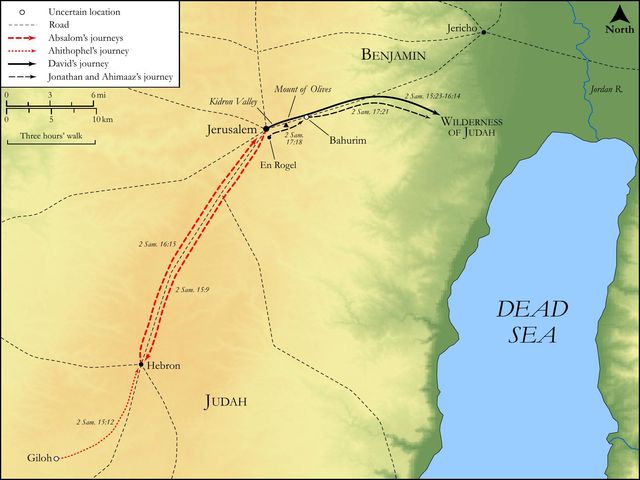
This verse is strategically positioned at a critical juncture in the narrative of Absalom's rebellion, immediately following King David's hurried flight from Jerusalem. Earlier, Absalom had meticulously orchestrated a coup, secretly cultivating support and declaring himself king in Hebron (2 Samuel 15:7-12). David, upon learning the extent of the conspiracy and the widespread support for Absalom, chose to evacuate Jerusalem to prevent bloodshed within the city (2 Samuel 15:13-17). A pivotal moment in this unfolding crisis was the shocking defection of Ahithophel, one of David's most trusted and brilliant advisors, who abandoned David to join Absalom's cause (2 Samuel 15:31). Second Samuel 16:23 serves to amplify the gravity of Ahithophel's betrayal by explaining why his counsel was so highly esteemed and therefore so dangerous to David. It sets the narrative stage for the dramatic clash of counsel between Ahithophel and Hushai, David's loyal spy, in 2 Samuel 17, which ultimately leads to Ahithophel's tragic end.
Historical & Cultural Context
Among the kings of that day, royal advisors were indispensable figures, wielding immense power and influence in matters of state, military strategy, and legal judgments. Kings heavily relied on their sagacity for the successful governance and defense of their realms. The phrase "enquired at the oracle of God" refers to the established means by which divine guidance was sought in ancient Israel, typically through priestly consultation using the Urim and Thummim (e.g., Exodus 28:30) or through prophetic revelation. For Ahithophel's human counsel to be compared to such a divine consultation is the highest possible commendation, indicating his unparalleled reputation for wisdom, foresight, and consistent accuracy. This comparison would have conveyed to the original audience that Ahithophel's advice was not merely sound, but virtually infallible and divinely inspired in its precision. His defection was thus perceived not just as a personal betrayal but as a significant strategic gain for Absalom, lending immense credibility and tactical advantage to the rebellion.
Key Themes
ShowHideThis verse profoundly contributes to several overarching themes within the book of 2 Samuel and the broader biblical narrative. Firstly, it highlights the Power of Human Wisdom, portraying Ahithophel as an individual whose strategic intellect was so profound it was considered almost divine, making him an invaluable asset. Secondly, it underscores the devastating impact of Betrayal, as Ahithophel's abandonment of David, his trusted confidant, immediately escalated Absalom's rebellion into a formidable and credible threat. David himself recognized this immense danger, praying that God would "turn the counsel of Ahithophel into foolishness" (2 Samuel 15:31). Most importantly, this verse establishes a foundational premise for the profound theme of Divine Sovereignty Over Human Plans. Despite Ahithophel's seemingly infallible wisdom, the subsequent narrative reveals that God directly intervened to frustrate his counsel through Hushai's counter-advice (2 Samuel 17:14), powerfully demonstrating that even the most brilliant human schemes are ultimately subject to God's ultimate will and purpose.
Exposition and Analysis
ShowHideKey Word Analysis
ShowHideThis word (H6098) refers to advice, a plan, or prudence. It denotes strategic thinking and deliberate planning, often with significant consequences. In Ahithophel's context, it signifies his highly regarded ability to formulate effective and decisive courses of action, particularly in military and political spheres. The repetition of "counsel" in the verse emphasizes the very essence of his renowned skill and the consistent nature of his wise advice.
This word (H1697) means "word," "matter," or "thing," but in this context, when combined with "God" (H430, ʼĕlôhîym), it forms the phrase "oracle of God." An "oracle" signifies a divine pronouncement or revelation from God, considered infallible and authoritative. The comparison elevates Ahithophel's human advice to the level of divine inspiration, implying that his counsel was consistently accurate, wise, and virtually unquestionable, as if it came directly from God Himself.
Verse Breakdown
ShowHide"And the counsel of Ahithophel, which he counselled in those days"
This opening clause immediately identifies the subject: Ahithophel's advice. The phrase "in those days" situates his renowned wisdom within the immediate context of the ongoing rebellion, emphasizing its contemporary relevance and profound impact on the unfolding events. It highlights that his reputation for sagacity was not new, but consistently proven over time.
"[was] as if a man had enquired at the oracle of God"
This is the core of the verse, employing a powerful simile. It describes the extraordinary quality and perceived infallibility of Ahithophel's advice. To "enquire at the oracle of God" meant to seek direct, authoritative, and infallible guidance from the divine, often through priestly consultation (e.g., Urim and Thummim) or prophetic pronouncements. The comparison suggests that Ahithophel's human wisdom was so consistently accurate and insightful that it was treated with the same reverence and trust as a direct divine word.
"so [was] all the counsel of Ahithophel both with David and with Absalom"
This concluding clause reinforces the preceding statement by extending its scope and confirming its universal acknowledgment. It clarifies that Ahithophel's reputation for infallible counsel was not a recent development or limited to Absalom's court. Rather, it was a long-standing and universally acknowledged fact, having been equally true during his tenure as David's trusted advisor. This emphasizes the magnitude of David's loss and Absalom's gain, as Ahithophel's wisdom was consistently reliable, regardless of whom he served.
Literary Devices
ShowHideThe verse primarily employs Simile, directly comparing Ahithophel's counsel to "as if a man had enquired at the oracle of God." This comparison serves to elevate his human wisdom to a near-divine status, emphasizing its perceived infallibility, authority, and the profound trust placed in it. There is an element of Hyperbole in this comparison, as no human counsel is truly equivalent to a divine oracle; this exaggeration effectively underscores the extraordinary reputation and the profound reliance placed upon Ahithophel's judgment. Furthermore, the verse contains significant Foreshadowing. By establishing Ahithophel's counsel as supremely wise and virtually unassailable, the narrative implicitly creates dramatic tension for its ultimate frustration by divine intervention, as seen in 2 Samuel 17. This also introduces a subtle Irony, as counsel deemed "as if from God" is precisely what God Himself will later choose to nullify, demonstrating His ultimate sovereignty.
Theological and Thematic Connections
ShowHideThis verse profoundly illustrates the inherent tension between human wisdom and divine sovereignty. Ahithophel's counsel, though supremely insightful by human standards and highly esteemed by both kings, ultimately proves fallible and futile when it stands in opposition to God's divine plan. The narrative implicitly teaches that even the most brilliant human strategies are ultimately contingent upon the will of the Almighty. It serves as a powerful reminder that true wisdom originates from God, and reliance on human intellect alone, no matter how impressive, can lead to ruin if it does not align with divine purposes. God's ability to "turn human wisdom into foolishness" is a recurring biblical theme, ensuring that His ultimate will prevails and that His purposes are accomplished, often through unexpected means.
Reflection and Application
ShowHideThe story of Ahithophel's esteemed counsel and its eventual frustration offers profound lessons for believers today. In a world that often prizes human intelligence, strategic acumen, and worldly success, this verse reminds us that even the most brilliant human plans are ultimately contingent upon God's sovereign will. We are called to exercise discernment, recognizing that not all seemingly wise advice, even from highly respected sources, is necessarily aligned with God's perfect will. Our ultimate trust must always be in the Lord, seeking His guidance through prayer, His Word, and the counsel of the Holy Spirit, rather than relying solely on human brilliance or popular opinion. When faced with formidable opposition or seemingly insurmountable challenges, we can find peace and confidence in the knowledge that God is sovereign over all things. He can and does intervene to turn even the wisest human counsel into foolishness when it opposes His divine plan, demonstrating His power to protect His people and advance His purposes. This should encourage us to submit our plans to Him, knowing that His ways are higher than our ways, and His thoughts than our thoughts, and that His wisdom is truly infallible.
Questions for Reflection
ShowHideFAQ
ShowHideWhy was Ahithophel's counsel considered so special?
ShowHideAhithophel's counsel was considered exceptionally special because of its consistent accuracy, foresight, and strategic brilliance. The text explicitly states it was "as if a man had enquired at the oracle of God," which is the highest possible commendation for human wisdom in ancient Israel. This comparison meant that his advice was perceived as virtually infallible and divinely inspired, making it highly trusted and rarely questioned. His reputation was so strong that his counsel was equally valued by both King David and Absalom, indicating a long-standing and universally acknowledged track record of profound insight and reliability.
How was Ahithophel's counsel ultimately frustrated, despite its reputation?
ShowHideDespite its esteemed reputation, Ahithophel's counsel was ultimately frustrated by divine intervention. After Ahithophel advised Absalom to immediately pursue and attack David (2 Samuel 17:1-4), David's loyal friend and spy, Hushai, offered counter-counsel. Hushai's advice, which was more flattering to Absalom's ego and proposed a slower, more elaborate plan (2 Samuel 17:7-13), was ultimately chosen by Absalom. The Bible explicitly states that "the Lord had purposed to defeat the good counsel of Ahithophel, to the intent that the Lord might bring evil upon Absalom" (2 Samuel 17:14). Thus, God directly intervened through Hushai to thwart Ahithophel's seemingly perfect plan, demonstrating His ultimate sovereignty over human wisdom and events.
Christ-Centered Fulfillment
ShowHideThe narrative of Ahithophel's esteemed yet ultimately frustrated counsel points forward to the perfect and unthwartable wisdom of God embodied in Jesus Christ. While Ahithophel's human wisdom was likened to a divine oracle, it remained finite and susceptible to divine intervention and ultimate defeat by God's sovereign will. In stark contrast, Jesus is the very Logos, the "Word of God" made flesh (John 1:1, John 1:14). He is the true and ultimate "oracle of God," not merely offering counsel like God, but being God Himself, the very source of all wisdom and knowledge (Colossians 2:3). The world, in its human wisdom, often rejects Christ and His message, viewing the cross as foolishness (1 Corinthians 1:18). Yet, it is precisely this "foolishness" of God that proves wiser than the greatest human intellect, for through it, God accomplishes salvation (1 Corinthians 1:25). Unlike Ahithophel's counsel, which was thwarted by God, God's eternal plan of redemption through Christ cannot be defeated by any human or demonic scheme (Acts 4:27-28, Ephesians 1:11). Jesus, as the ultimate King, reigns not by human strategy but by divine authority, ensuring that His kingdom will never be overthrown, and His counsel, unlike Ahithophel's, is eternally perfect and unassailable.