


2 Samuel 16:17
Bible text: King James Version (1769 Blayney text) · Public domain
Bible text: Berean Standard Bible · Public domain
Bible text: American Standard Version (1901) · Public domain
Bible text: World English Bible, Messianic edition · Public domain
Bible text: Geneva Bible (1599) · Public domain
Bible text: Young's Literal Translation · Public domain
- וַיֹּאמֶרvai·Yo·merand he saidH559Conj-w ¦ V-Qal-ConsecImperf-3msVerb Qal Consecutive Imperfect 3rd Singular Masculineוַandיֹּאמֶרhe said
- אַבְשָׁלוֹם'av·sha·lOmAbsalomH53N-proper-mNoun Proper Masculine
- אֶל'eltoH413PrepPreposition
- חוּשַׁיchu·ShaiHushaiH2365N-proper-mNoun Proper Masculine
- זֶהzeh[is] thisH2088PrtParticle Demonstrative
- חַסְדְּךָchas·de·Khayour loyaltyH2617N-msc ¦ 2msNoun Singular Masculine Constructחַסְדְּloyaltyךָyour
- אֶת'etwithH854PrepPreposition
- רֵעֶךָre·'E·khayour friendH7453N-msc ¦ 2msNoun Singular Masculine Constructרֵעֶfriendךָyour
- לָמָּהLa·mah<to> why?H4100Prep-l ¦ InterrogPronoun Interrogativeלָ<to>מָּהwhy?
- לֹאlo'notH3808NegParticle Negative
- הָלַכְתָּha·Lakh·tadid you goH1980V-Qal-Perf-2msVerb Qal Perfect 2nd Singular Masculine
- אֶת'etwithH854PrepPreposition
- רֵעֶךָre·'E·khayour friendH7453N-msc ¦ 2msNoun Singular Masculine Constructרֵעֶfriendךָyour
English is a literal word-by-word gloss of the Hebrew, not the KJV's wording. Why?
This is the original text the KJV's translators worked from — each Hebrew word with its own literal English meaning in this verse, prepared by scholars at Tyndale House, Cambridge. The KJV translates whole sentences, not word by word, so its wording differs: one Hebrew word can become several English words, and the KJV may choose “the LORD” where the gloss reads “Yahweh”. Both are faithful — they answer different questions. For the KJV's own rendering, switch to the KJV text.
Details
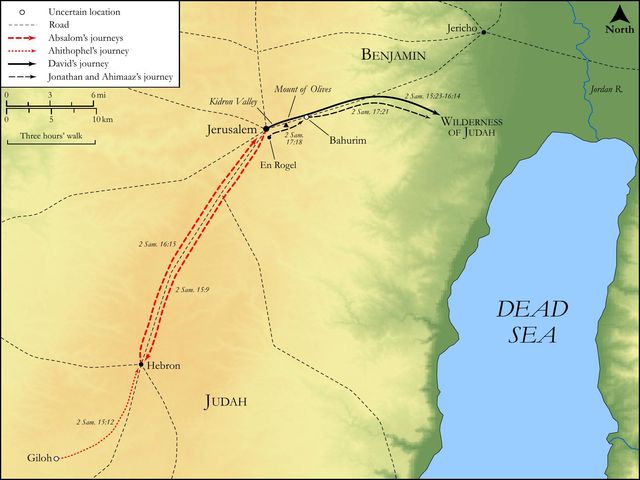
See on the biblical-era maps

Study this verse
Public-domain commentary
Matthew Henry
From his Commentary on the Whole Bible. Henry comments on passages, not single verses — this entry covers 2 Samuel 16:15–23. His four-level outline is real structure in the source text, so it is rendered as structure.
Absalom had notice sent him speedily by some of his friends at Jerusalem that David had withdrawn, and with what a small retinue he had gone; so that the coasts were clear, Absalom might take possession of Jerusalem when he pleased. The gates were open, and there was none to oppose him. Accordingly he came without delay (Sa2 16:15), extremely elevated, no doubt, with this success at first, and that that in which, when he formed his design, he probably apprehended the greatest difficulty, was so easily and effectually done. Now that he is master of Jerusalem he concludes all his own, the country will follow of course. God suffers wicked men to prosper awhile in their wicked plots, even beyond their expectation, that their disappointment may be the more grievous and disgraceful. The most celebrated politicians of that age were Ahithophel and Hushai. The former Absalom brings with him to Jerusalem (Sa2 16:15), the other meets him there (Sa2 16:16), so that he cannot but think himself sure of success, when he has both these to be his counsellors; on them he relies, and consults not the ark, though he has that with him. But miserable counsellors were they both; for,
I.Hushai would never counsel him to do wisely.
He was really his enemy, and designed to betray him, while he pretended to be in his interest; so that Absalom could not have a more dangerous man about him.
1.Hushai complimented him upon his accession to the throne, as if he had been abundantly satisfied in this title, and well pleased that he had come to the possession, Sa2 16:16. What arts of dissimulation are those tempted to use who govern themselves by fleshly wisdom! and how happy are those who have not known these depths of Satan, but have their conversation in the world with simplicity and godly sincerity!
2.Absalom was surprised to find him for him who was known to be David's intimate friend and confidant. He asks him, Is this thy kindness to thy friend? (Sa2 16:17), pleasing himself with this thought, that all would be his, since Hushai was. He doubts not of his sincerity, but easily believes what he wishes to be true, that David's best friends are so in love with himself as to take the first opportunity to declare for him, though the pride of his heart deceived him, Oba 1:3. Hushai confirmed him in the belief that he was hearty for him. For, though David is his friend, yet he is for the king in possession, Sa2 16:18. Whom the people choose, and Providence smiles upon, he will be faithful to; and he is for the king in succession (Sa2 16:19), the rising sun. It was true, he loved his father; but he had had his day, and it was over; and why should he not love his successor as well? Thus he pretended to give reasons for a resolution he abhorred the thought of.
II.Ahithophel counselled him to do wickedly, and so did as effectually betray him as he did who was designedly false to him; for those that advise men to sin certainly advise them to their hurt; and that government which is founded in sin is founded in the sand.
1.It seems, Ahithophel was noted as a deep politician; his counsel was as if a man had enquired at the oracle of God, Sa2 16:23. Such reputation was he in for subtlety and sagacity in public affairs, such reaches had he beyond other privy-counselors, such reasons would he give for his advice, and such success generally his projects had, that all people, good and bad, both David and Absalom, had a profound regard for his sentiments, too much by far, when they regarded him as an oracle of God; shall the prudence of any mortal compare with him who only is wise? Let us observe from this account of Ahithophel's fame for policy,
(1.)That many excel in worldly wisdom who are utterly destitute of heavenly grace, because those who set up for oracles themselves are apt to despise the oracles of God. God has chosen the foolish things of the world; and the greatest statesmen are seldom the greatest saints.
(2.)That frequently the greatest politicians act most foolishly for themselves. Ahithophel was cried up for an oracle, and yet very unwisely took part with Absalom, who was not only a usurper, but a rash youth, never likely to come to good, whose fall, and the fall of all that adhered to him, any one, with the tenth part of the policy that Ahithophel pretended to, might foresee. Well, after all, honesty is the best policy, and will be found so in the long run. But,
2.His policy in this case defeated its own aim. Observe,
(1.)The wicked counsel Ahithophel gave to Absalom. Finding that David had left his concubines to keep the house, he advised him to lie with them (Sa2 16:21), a very wicked thing. The divine law had made it a capital crime, Lev 20:11. The apostle speaks of it as a piece of villany not so much as named among the Gentiles, Co1 5:1. Reuben lost his birthright for it. But Ahithophel advised Absalom to it as a public thing, because it would give assurance to all Israel,
[1.]That he was in good earnest in his pretensions. No doubt he resolved to make himself master of all that belonged to his predecessor when he began with his concubines.
[2.]That he was resolved never to make peace with his father upon any terms; for by this he would render himself so odious to his father that he would never be reconciled to him, which perhaps the people were jealous of and that they must be sacrificed to the reconciliation. Having drawn the sword, he did, by this provocation, throw away the scabbard, which would strengthen the hands of his party and keep them firmly to him. This was Ahithophel's cursed policy, which bespoke him rather an oracle of devil than of God.
(2.)Absalom's compliance with this counsel. It entirely suited his lewd and wicked mind, and he delayed not to put it in execution, Sa2 16:22. When an unnatural rebellion was the opera, what fitter prologue could there be to it than such unnatural lust? Thus was his wickedness all of a piece, and such as a conscience not quite seared could not entertain the thoughts of without the utmost horror. Nay, the client outdoes what his counsel advises. Ahithophel advised him to do it, that all Israel shall see it. A tent is accordingly spread on the top of the house for the purpose; so impudently does he declare his sin as Sodom. Yet, in this, the word of God was fulfilled in the letter of it: God had threatened, by Nathan, that, for defiling Bath-sheba, David should have his own wives publicly debauched (Sa2 12:11, Sa2 12:12), and some think that Ahithophel, in advising it, designed to be revenged on David for the injury done to Bath-sheba, who was his grand-daughter: for she was the daughter of Eliam (Sa2 11:3), who was the son of Ahithophel, Sa2 23:34. Job speaks of this as the just punishment of adultery (Let my wife grind to another, Job 31:9, Job 31:10), and the prophet, Hos 4:13, Hos 4:14. What to think of these concubines, who submitted to this wickedness, I know not; but how unrighteous soever Absalom and they were, we must say, The Lord is righteous: nor shall any word of his fall to the ground.
Continue studying 2 Samuel 16:17 across the web’s major study libraries — every link below opens this exact verse, chapter, or book on the destination site.
Read & Compare
 BibleGatewayThis verse in more than 200 translations and 70 languages.
 Bible.comThe YouVersion reader — hundreds of translations, reading plans, and highlights.
 ESV.orgCrossway's official English Standard Version reader.
 NET BibleThe NET translation with 60,000+ translators' notes on every rendering decision.
 STEP BibleTyndale House's free study tool — original text, vocabulary, and scholarly resources.
 BibliaLogos Bible Software's free web reader.
 USCCBThe New American Bible (Revised Edition) with the U.S. bishops' study notes.
Commentaries
 BibleHub CommentariesDozens of classic commentaries on this verse, gathered on one page.
 StudyLightMore than 100 commentary sets — the largest collection on the web.
 BibleRefPlain-English commentary on what this verse means, verse by verse.
 Enduring WordDavid Guzik's free commentary on this chapter, widely used by Bible teachers.
 Bible Study ToolsVerse commentary alongside Greek and Hebrew study aids.
Original Language & Research
- BibleHub InterlinearThe verse word by word — original language, transliteration, and English.
- BibleHub LexiconEvery word's original-language definition and Strong's entry.
 Blue Letter BibleDeep-study tools — Strong's numbers, concordance, and word studies.
 SefariaThe Hebrew text with Rashi and centuries of Jewish commentary.
Sermons, Hymns & Audio


TrulyRandomVerse is not affiliated with these sites and doesn’t control their content. They’re linked because they’re genuinely useful.
Summary
In 2 Samuel 16:17, Absalom, having seized Jerusalem and declared himself king, directly confronts Hushai the Archite, a renowned and trusted counselor of his father, King David. Absalom's pointed questions convey suspicion and disbelief, challenging Hushai's apparent shift in allegiance and questioning why he, a known confidant and friend, did not accompany the fleeing King David. This pivotal interrogation provides Hushai the crucial opportunity to articulate his carefully constructed, feigned loyalty to Absalom, thereby setting in motion David's strategic counter-plan to undermine the rebellion from within Absalom's own inner circle.
Context
ShowHideLiterary Context
This verse is strategically placed at a critical juncture in the unfolding narrative of Absalom's audacious rebellion against King David. Immediately preceding this encounter, David has been forced into a hasty and sorrowful flight from Jerusalem, a desperate retreat vividly depicted in 2 Samuel 15:13-17. As David departed, he orchestrated a brilliant counter-strategy: he instructed Hushai, his loyal and wise counselor, to remain in Jerusalem and feign allegiance to Absalom. Hushai's perilous mission was to infiltrate Absalom's court and, crucially, to deliberately counteract the shrewd and often devastating counsel of Ahithophel, another of David's former advisors who had treacherously defected to Absalom's side (2 Samuel 15:32-37). Absalom's direct and challenging questions to Hushai in 2 Samuel 16:17 immediately follow Hushai's dramatic and public declaration of loyalty, "Long live the king! Long live the king!" to Absalom upon his arrival in Jerusalem (2 Samuel 16:16). This tense exchange thus serves as the crucial opening for Hushai to begin his pivotal role in subverting Absalom's plans, a role that culminates in the divinely orchestrated thwarting of Ahithophel's counsel, as detailed in 2 Samuel 17:14.
Historical & Cultural Context
In ancient Israel, loyalty to the reigning monarch was a foundational pillar of social and political order, understood within the framework of covenant, as when king David made a league with the elders of Israel in Hebron before the LORD. A king's "friends" or counselors held positions of immense trust, influence, and often, personal intimacy, and their unwavering allegiance was expected, especially during times of crisis or rebellion. Defection from the king was considered an act of profound betrayal, often punishable by death and carrying immense social stigma. The concept of "kindness" (Hebrew: chesed) was not merely a superficial act of benevolence but a deeply significant term denoting steadfast, loyal love, fidelity, and covenant faithfulness, particularly within established relationships. Absalom's question, therefore, is far from a casual inquiry; it is a direct challenge to Hushai's character, integrity, and adherence to the culturally ingrained expectations of fidelity and chesed towards his known friend, King David. Furthermore, the practice of seeking counsel from trusted advisors was a cornerstone of kingship in Israel, making the ensuing battle of wits between Hushai and Ahithophel a matter of strategic national importance, with the fate of the kingdom hanging in the balance.
Key Themes
ShowHideThis verse powerfully encapsulates several overarching themes prevalent throughout the books of Samuel. The most prominent tension revolves around Loyalty and Betrayal, as Absalom directly interrogates Hushai's fidelity, implying a perceived breach of the expected bond of friendship with David. This highlights the complex and often shifting allegiances that characterize periods of political upheaval and civil war, where trust is a fragile and valuable commodity. Closely intertwined is the theme of Deception and Strategic Warfare. Hushai's very presence in Absalom's court is a deliberate, calculated act of strategic deception, part of David's ingenious counter-plan to undermine the rebellion from within. Absalom's questioning inadvertently provides Hushai the perfect opportunity to articulate his feigned loyalty, setting the stage for his eventual success in countering Ahithophel's shrewd advice, which ultimately contributes to Absalom's downfall and the preservation of David's throne, as vividly narrated in 2 Samuel 17. Finally, the verse profoundly underscores the nature of Friendship and Allegiance, emphasizing the deep and known bond between David and Hushai. Absalom's question leverages this public knowledge, highlighting the social expectation that a true friend, especially a trusted counselor, would accompany a king in distress, thereby making Hushai's apparent defection all the more perplexing and suspicious in Absalom's eyes.
Exposition and Analysis
ShowHideKey Word Analysis
ShowHideThe Hebrew term חֶסֶד (chêçêd) is a rich, multifaceted theological word, often translated as "lovingkindness," "mercy," "steadfast love," or "covenant loyalty." It signifies a loyal, enduring, and active love that extends beyond mere sentiment, frequently implying an obligation or commitment within a relationship or covenant. Absalom's use of chêçêd here is highly significant; he is not merely asking about a casual act of kindness but challenging Hushai's perceived failure in a deeper, more enduring form of loyalty and commitment to David. It implies a betrayal of a profound, expected bond of faithfulness.
The Hebrew word רֵעַ (rêaʻ) is a common term for a companion, associate, neighbor, or friend. While it can denote a casual acquaintance, in the context of a king and his counselor, it implies a close, trusted, and often intimate relationship, typically with mutual obligations and shared confidences. Absalom's phrasing, "thy friend," specifically highlights the personal and intimate nature of Hushai's well-known relationship with David, making his apparent abandonment of the king all the more perplexing and suspicious from Absalom's perspective, and culturally scandalous.
The Hebrew verb הָלַךְ (hâlak) is a primitive root meaning "to walk" or "to go," used with a wide variety of literal and figurative applications. In this context, it refers to the act of accompanying or moving with someone. Absalom's question, "why wentest thou not with thy friend?" directly challenges Hushai's physical absence from David's side during his flight. It implies a failure to physically demonstrate the expected loyalty and companionship that a true rêaʻ (friend) would exhibit, especially when the rêaʻ (friend) is in distress and fleeing for his life.
Verse Breakdown
ShowHide"And Absalom said to Hushai"
This opening clause immediately establishes the direct confrontation and the power dynamic. Absalom, now the de facto king and in a position of authority in Jerusalem, initiates the interrogation of Hushai, who has just presented himself. This sets a tense and critical scene, highlighting Absalom's suspicion and the high stakes of the ensuing dialogue.
"Is this thy kindness to thy friend?"
This rhetorical question is laden with suspicion, accusation, and incredulity. Absalom challenges Hushai's apparent disloyalty by appealing to the well-known and expected chêçêd (loyal kindness/steadfast love) that Hushai was known to have for David. The implication is that Hushai's current presence with Absalom, rather than with David, is a direct contradiction of this expected loyalty, making his actions seem perfidious and a profound betrayal of their bond.
"why wentest thou not with thy friend?"
This second, more direct question serves as a concrete accusation, demanding an immediate and specific explanation for Hushai's perceived abandonment of David. It underscores the cultural expectation that a true friend, especially one of Hushai's stature and closeness to the king, would remain by his side during adversity. This question, however, inadvertently provides Hushai the perfect opening to deliver his pre-planned, deceptive response, thereby initiating his crucial role in infiltrating Absalom's inner circle and undermining his rebellion.
Literary Devices
ShowHideThe verse is rich with potent literary devices that enhance its dramatic impact and thematic depth. Dramatic Irony is paramount, as the audience is fully aware of Hushai's true mission as David's loyal double agent (2 Samuel 15:32-37), while Absalom remains completely oblivious, genuinely questioning Hushai's motives. This creates significant tension and anticipation, as the reader knows Hushai's forthcoming response will be a calculated deception. Absalom's skillful use of Rhetorical Questions ("Is this thy kindness...?", "why wentest thou not...?") effectively conveys his skepticism and demands an immediate justification, yet these questions inadvertently provide Hushai with the very platform he needs to establish his feigned loyalty and begin his strategic work. Furthermore, the entire scene serves as a powerful moment of Foreshadowing, as Hushai's successful navigation of this initial interrogation sets the stage for his later, critical intervention in 2 Samuel 17, where he will ultimately undermine Absalom's campaign, leading directly to his demise and the preservation of David's throne.
Theological and Thematic Connections
ShowHideThis seemingly simple exchange between Absalom and Hushai is a microcosm of profound theological truths. It highlights the tension between human agency and divine sovereignty, demonstrating how God can use even human deception and political intrigue to accomplish His overarching purposes. While Absalom seeks to consolidate power through rebellion and suspicion, God is orchestrating events behind the scenes to protect His anointed king, David, and preserve the Davidic covenant. Hushai's loyal (to David) yet deceptive (to Absalom) actions serve as a powerful reminder that God's ways are often mysterious and complex, working through intricate human interactions to bring about His will, even when those interactions involve moral ambiguities. The steadfast love (chesed) that Absalom questions is precisely what God demonstrates to His people—a loyal, covenantal love that transcends human fickleness, betrayal, and the chaos of rebellion, ensuring His ultimate plan prevails.
Reflection and Application
ShowHideThe interrogation of Hushai by Absalom invites us to reflect deeply on the nature of true loyalty, the complexities inherent in human relationships, and the overarching providence of God actively at work amidst chaos and betrayal. In a world often marked by shifting allegiances, self-interest, and the pursuit of power, Hushai's underlying fidelity to David, even when cloaked in necessary deception, challenges us to consider where our ultimate loyalties truly lie. Are we loyal to fleeting circumstances, personal gain, or to God Himself and His eternal purposes? The narrative also powerfully underscores the vital importance of discernment; Absalom, despite his initial suspicions, ultimately fails to see through Hushai's carefully crafted facade, a critical misjudgment that directly contributes to his downfall. This serves as a poignant reminder for us to earnestly pray for wisdom and discernment in our own interactions, especially when trust is at stake and intentions may be veiled. Ultimately, this passage offers profound comfort: even when human plans unravel, when betrayal seems to triumph, and when circumstances appear utterly out of control, God remains sovereign, working through unexpected means and seemingly contradictory actions to bring about His redemptive purposes. Our call is to trust His guiding hand, even when we cannot fully trace His intricate steps.
Questions for Reflection
ShowHideFAQ
ShowHideWhy did Hushai choose to stay with Absalom instead of fleeing with David?
ShowHideHushai did not choose to stay with Absalom out of disloyalty or fear, but rather at the explicit and strategic instruction of King David. As David fled Jerusalem, he encountered Hushai and commanded him to return to the city and feign loyalty to Absalom. David's profound strategic purpose was for Hushai to infiltrate Absalom's inner circle and specifically to counteract the counsel of Ahithophel, who was known for his shrewd and incredibly effective advice (2 Samuel 15:32-37). Hushai's mission was a dangerous but crucial act of loyal service, designed to buy David precious time and ultimately undermine Absalom's rebellion from within.
What was the significance of Ahithophel's counsel, and how did Hushai counter it?
ShowHideAhithophel was renowned throughout Israel for his incredibly wise and effective counsel, which was considered "as if one consulted the oracle of God" (2 Samuel 16:23). His initial advice to Absalom was to immediately pursue David with a swift and decisive strike, which would have likely crushed David's forces before they could regroup. Hushai, acting on David's behalf and with divine inspiration, presented an alternative counsel that appealed directly to Absalom's vanity and desire for a grand, overwhelming, personal victory. Hushai advised Absalom to gather all of Israel's forces for a massive, personal assault, which would take more time, allowing David to escape further and organize his defenses. This crucial delay proved fatal for Absalom and ultimately led to Ahithophel's suicide when his superior counsel was rejected in favor of Hushai's (2 Samuel 17:1-23).
How did this incident contribute to Absalom's downfall?
ShowHideThis incident was absolutely central and indispensable to Absalom's downfall. By successfully convincing Absalom to reject Ahithophel's immediate and strategically sound advice, Hushai bought David precious time—time that was critical for David to cross the Jordan River, gather his loyal forces, and prepare for battle (2 Samuel 17:24). Had Absalom followed Ahithophel's counsel, David's rebellion would likely have been swiftly and brutally suppressed. Hushai's deceptive counsel, divinely orchestrated, directly led to Absalom's eventual defeat and death in the battle that followed (2 Samuel 18), thereby preserving David's kingship and the continuation of the Davidic line.
Christ-Centered Fulfillment
ShowHideThe intricate web of loyalty, betrayal, and strategic deception in 2 Samuel 16:17, though morally complex in its human execution, ultimately points to the greater faithfulness and ultimate triumph of God's redemptive plan in Christ. Just as Hushai, a loyal friend, willingly entered the enemy's camp to secure the king's deliverance, so too did Christ, the ultimate friend of sinners, enter a world hostile to God to secure our salvation. While Hushai's deception was a necessary human strategy for an earthly kingdom, Christ's mission was one of perfect truth, transparency, and self-sacrifice. He did not feign loyalty to an earthly usurper, but rather, in profound humility and obedience, submitted Himself to the will of His Father, even unto death on a cross (Philippians 2:8). Absalom's suspicion of Hushai's "kindness" (chesed) highlights a broken human understanding of loyalty and fidelity, yet in Christ, we see the perfect embodiment of God's unwavering steadfast love, His eternal chesed, demonstrated not by strategic subterfuge but by His willingness to lay down His life for His friends (John 15:13) and even for His enemies (Romans 5:8). The preservation of David's throne through Hushai's divinely assisted actions foreshadows the eternal and unshakable kingdom established by Jesus, the true Son of David, whose victory over sin, death, and all spiritual enemies was achieved not through human cunning but through divine power, perfect obedience, and sacrificial love (Colossians 2:15).