


2 Samuel 19:25
Bible text: King James Version (1769 Blayney text) · Public domain
Bible text: Berean Standard Bible · Public domain
Bible text: American Standard Version (1901) · Public domain
Bible text: World English Bible, Messianic edition · Public domain
Bible text: Geneva Bible (1599) · Public domain
Bible text: Young's Literal Translation · Public domain
- וַיְהִיvay·Hiand it wasH1961Conj-w ¦ V-Qal-ConsecImperf-3msVerb Qal Consecutive Imperfect 3rd Singular Masculineוַandיְהִיit was
- כִּיkithatH3588PrtParticle Conditional
- בָאva'he cameH935V-Qal-Perf-3msVerb Qal Perfect 3rd Singular Masculine
- יְרוּשָׁלִַםye·ru·sha·LimJerusalemH3389N-properNoun Proper Location
- לִקְרַאתlik·Ratto meetH7122Prep-l ¦ V-Qal-InfVerb Qal Infinitive Constructלִtoקְרַאתmeet
- הַמֶּלֶךְha·Me·lekhthe kingH4428Art ¦ N-msNoun Singular Masculine Absoluteהַtheמֶּלֶךְking
- וַיֹּאמֶרvai·Yo·merand he saidH559Conj-w ¦ V-Qal-ConsecImperf-3msVerb Qal Consecutive Imperfect 3rd Singular Masculineוַandיֹּאמֶרhe said
- לוֹloto <the> himPrep-l ¦ 3msSuffix Personal 3rd Singular Masculineלto <the>וֹhim
- הַמֶּלֶךְha·Me·lekhthe kingH4428Art ¦ N-msNoun Singular Masculine Absoluteהַtheמֶּלֶךְking
- לָמָּהLa·mah<to> why?H4100Prep-l ¦ InterrogPronoun Interrogativeלָ<to>מָּהwhy?
- לֹאlo'notH3808NegParticle Negative
- הָלַכְתָּha·Lakh·tadid you goH1980V-Qal-Perf-2msVerb Qal Perfect 2nd Singular Masculine
- עִמִּי'i·Miwith meH5973Prep ¦ 1csPreposition Definiteעִמִּwithיme
- מְפִיבֹשֶׁתme·fi·Vo·shetO MephiboshethH4648N-proper-mNoun Proper Masculine
English is a literal word-by-word gloss of the Hebrew, not the KJV's wording. Why?
This is the original text the KJV's translators worked from — each Hebrew word with its own literal English meaning in this verse, prepared by scholars at Tyndale House, Cambridge. The KJV translates whole sentences, not word by word, so its wording differs: one Hebrew word can become several English words, and the KJV may choose “the LORD” where the gloss reads “Yahweh”. Both are faithful — they answer different questions. For the KJV's own rendering, switch to the KJV text.
Details
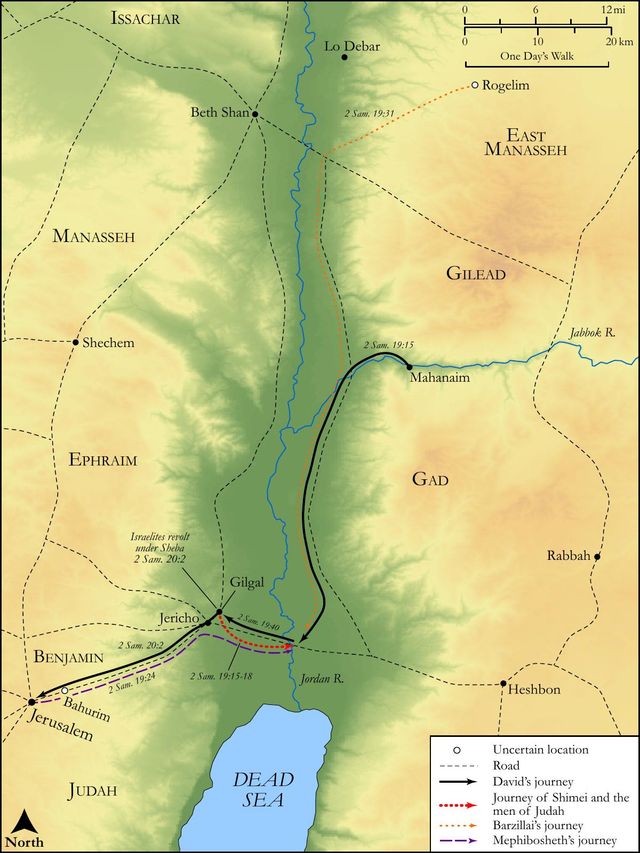
See on the biblical-era maps

Study this verse
Public-domain commentary
Matthew Henry
From his Commentary on the Whole Bible. Henry comments on passages, not single verses — this entry covers 2 Samuel 19:24–30. His two-level outline is real structure in the source text, so it is rendered as structure.
The day of David's return was a day of bringing to remembrance, a day of account, in which what had passed in his flight was called over again; among other things, after the case of Shimei, that of Mephibosheth comes to be enquired into, and he himself brings it on.
I.He went down in the crowd to meet the king (Sa2 19:24), and as a proof of the sincerity of his joy in the king's return, we are here told what a true mourner he was for the king's banishment. During that melancholy time, when one of the greatest glories of Israel had departed, Mephibosheth continued in a very melancholy state. He was never trimmed, nor put on clean linen, but wholly neglected himself, as one abandoned to grief for the king's affliction and the kingdom's misery. In times of public calamity we ought to abridge our enjoyments in the delights of sense, in conformity to the season. There are times when God calls to weeping and mourning, and we must comply with the call.
II.When the king came to Jerusalem (since he could not sooner have an opportunity) he made his appearance before him (Sa2 19:25); and when the king asked him why he, being one of his family, had staid behind, and not accompanied him in his exile, he opened his case fully to the king.
1.He complained of Ziba, his servant who should have been his friend, but had been in two ways his enemy; for, first, he had hindered him from going along with the king, by taking the ass himself which he was ordered to make ready for his master (Sa2 19:26), basely taking advantage of his lameness and his inability to help himself; and, secondly, he had accused him to David of a design to usurp the government, Sa2 19:27. How much mischief is it in the power of a wicked servant to do to the best master!
2.He gratefully acknowledged the king's great kindness to him when he and all his father's house lay at the king's mercy, Sa2 19:28. When he might justly have been dealt with as a rebel, he was treated as a friend, as a child: Thou didst set thy servant among those that did eat at thy own table. This shows that Ziba's suggestion was improbable; for could Mephibosheth be so foolish as to aim higher when he lived so easily, so happily as he did? And could he be so very disingenuous as to design any harm to David, of whose great kindness to him he was thus sensible? (3.) He referred his cause to the king's pleasure (Do what is good in thy eyes with me and my estate), depending on the king's wisdom, and his ability to discern between truth and falsehood (My lord the king is as an angel from God), and disclaiming all pretensions of his own merit: "So much kindness I have received above what I deserved, and what right have I to cry any more unto the king? Why should I trouble the king with my complaints when I have already been so troublesome to him? Why should I think any thing hard that is put upon me when I hitherto been so kindly treated?" We were all as dead men before God; yet he has not only spared us, but taken us to sit at his table. How little reason then have we to complain of any trouble we are in, and how much reason to take all well that God does!
III.David hereupon recalls the sequestration of Mephibosheth's estate; being deceived in his grant, he revokes it, and confirms his former settlement of it: "I have said, Thou and Ziba divide the land (Sa2 19:29), that is, Let it be as I first ordered it (Sa2 9:10); the property shall still be vested in thee, but Ziba shall have occupancy: he shall till the land, paying thee a rent." Thus Mephibosheth is where he was; no harm is done, only Ziba goes away unpunished for his false and malicious information against his master. David either feared him too much, or loved him too well, to do justice upon him according to that law, Deu 19:18, Deu 19:19; and he was now in the humour of forgiving and resolved to make every body easy.
IV.Mephibosheth drowns all he cares about his estate in his joy for the king's return (Sa2 19:30):
"Yea, let him take all, the presence and favour of the king shall be to me instead of all." A good man can contentedly bear his own private losses and disappointments, while he see Israel in peace, and the throne of the Son of David exalted and established. Let Ziba take all, so that David may be in peace.
Continue studying 2 Samuel 19:25 across the web’s major study libraries — every link below opens this exact verse, chapter, or book on the destination site.
Read & Compare
 BibleGatewayThis verse in more than 200 translations and 70 languages.
 Bible.comThe YouVersion reader — hundreds of translations, reading plans, and highlights.
 ESV.orgCrossway's official English Standard Version reader.
 NET BibleThe NET translation with 60,000+ translators' notes on every rendering decision.
 STEP BibleTyndale House's free study tool — original text, vocabulary, and scholarly resources.
 BibliaLogos Bible Software's free web reader.
 USCCBThe New American Bible (Revised Edition) with the U.S. bishops' study notes.
Commentaries
 BibleHub CommentariesDozens of classic commentaries on this verse, gathered on one page.
 StudyLightMore than 100 commentary sets — the largest collection on the web.
 BibleRefPlain-English commentary on what this verse means, verse by verse.
 Enduring WordDavid Guzik's free commentary on this chapter, widely used by Bible teachers.
 Bible Study ToolsVerse commentary alongside Greek and Hebrew study aids.
Original Language & Research
- BibleHub InterlinearThe verse word by word — original language, transliteration, and English.
- BibleHub LexiconEvery word's original-language definition and Strong's entry.
 Blue Letter BibleDeep-study tools — Strong's numbers, concordance, and word studies.
 SefariaThe Hebrew text with Rashi and centuries of Jewish commentary.
Sermons, Hymns & Audio


TrulyRandomVerse is not affiliated with these sites and doesn’t control their content. They’re linked because they’re genuinely useful.
Summary
This verse encapsulates a pivotal and emotionally charged encounter as King David, having recently returned to Jerusalem after the successful quelling of Absalom's rebellion, directly confronts Mephibosheth. This marks the king's first personal address to Mephibosheth since David's flight from the capital, initiating a moment of reckoning where David seeks an explanation for Mephibosheth's perceived absence, thereby setting the stage for Mephibosheth's earnest defense against the earlier, damaging accusations of disloyalty leveled by his servant, Ziba.
Context
ShowHideLiterary Context
This verse is strategically placed within the larger narrative of King David's arduous journey back to Jerusalem and the re-establishment of his reign after the traumatic Absalom rebellion. Immediately preceding this encounter, the text describes Mephibosheth's visibly unkempt and mourning appearance, a powerful non-verbal testimony to his loyalty and distress during David's absence (2 Samuel 19:24). This visual evidence directly contradicts the earlier false accusations made by his servant Ziba, who had informed David that Mephibosheth had remained in Jerusalem hoping to reclaim the kingdom of his grandfather, Saul (2 Samuel 16:1-4). David, acting on Ziba's deceitful report, had rashly awarded Mephibosheth's entire inheritance to Ziba. Therefore, 2 Samuel 19:25 serves as the dramatic opening to Mephibosheth's long-awaited opportunity to clear his name and reaffirm his steadfast devotion, which he proceeds to do in the subsequent verses (2 Samuel 19:26-28).
Historical & Cultural Context
Ancient Israelite society placed immense value on loyalty to the reigning monarch, viewing disloyalty as a capital offense. Kings wielded absolute authority, and their pronouncements, even if based on incomplete or false information, were binding. The backdrop of a recently quelled rebellion amplifies the gravity of any perceived disloyalty, as the king would be particularly sensitive to threats to his restored authority. Crucially, David's earlier covenant with Jonathan, Mephibosheth's father, to show kindness to his descendants (2 Samuel 9:1-7), forms a significant part of the cultural and ethical framework. Mephibosheth's physical disability (lameness, as mentioned in 2 Samuel 4:4) rendered him particularly vulnerable and dependent on royal favor, making him an easy target for opportunistic individuals like Ziba. The meeting in Jerusalem symbolizes the restoration of order and the king's re-engagement with the unresolved issues that arose during his period of exile.
Key Themes
ShowHideThis verse powerfully contributes to several profound themes woven throughout the book of 2 Samuel and the broader biblical narrative. It starkly highlights the theme of false accusation and the perils of hasty judgment, as David's initial punitive action against Mephibosheth was predicated entirely on Ziba's cunning deception. This scenario underscores the critical biblical principle of thoroughly investigating matters before rendering a verdict, a wisdom echoed in Proverbs 18:17. The exchange also vividly portrays the enduring contrast between unwavering loyalty and opportunistic betrayal, with Mephibosheth's genuine devotion to David standing in stark opposition to Ziba's self-serving treachery. Furthermore, the king's direct question initiates a process that speaks to the theme of restoration and justice, as David, now firmly back on his throne, begins to address the injustices that occurred during his absence, seeking clarity and ultimately aiming to right the wrongs. This moment sets the stage for a truth-telling process and the potential for a just resolution.
Exposition and Analysis
ShowHideKey Word Analysis
ShowHideThis is the proper name of the individual being addressed, derived from the Hebrew H4648. The name itself, meaning "dispeller of shame" or "from the mouth of shame" (often seen as a euphemism for "Baal" or "idols" in Hebrew, as in Ish-bosheth), subtly reminds the reader of his vulnerable lineage as the grandson of Saul. David's direct address by name underscores the personal nature of this confrontation and the king's specific concern regarding this individual, to whom he had previously shown immense covenant kindness for Jonathan's sake.
This term (H4428) refers to David, emphasizing his royal authority and restored position. The repetition of "the king" in the verse highlights David's re-established sovereignty and his prerogative to demand an explanation from his subjects. His status as "king" imbues his question with the weight of judicial inquiry, demanding a full account from Mephibosheth.
Derived from the primitive root H1980, meaning "to walk" or "to go" (in a wide variety of applications, literally and figuratively). In this context, combined with the negative particle "not," it forms the core of David's accusation: "Why did you not go with me?" This verb points directly to the perceived dereliction of duty and the failure to accompany the king during his flight, which formed the basis of Ziba's slander and David's subsequent judgment. It signifies the expected action that Mephibosheth allegedly failed to perform.
Verse Breakdown
ShowHide"And it came to pass, when he was come to Jerusalem to meet the king"
This opening clause establishes the setting and the primary action. "He" refers to Mephibosheth, highlighting his proactive and deliberate decision to journey to Jerusalem to encounter King David. This act of coming to "meet" (H7125, qirʼâh) the king, particularly given Mephibosheth's lameness, signifies his deep respect, loyalty, and eagerness to present himself before his sovereign, directly contradicting the narrative of disloyalty. It underscores the significance of David's return to the capital, symbolizing the restoration of his reign.
"that the king said unto him"
This simple, declarative statement signifies the direct and personal nature of the ensuing interaction. David, now re-established in his full authority, immediately addresses the unresolved matter concerning Mephibosheth. The phrase indicates that this is a formal, yet personal, inquiry from the highest authority to a subject who has been implicated in disloyalty.
"Wherefore wentest not thou with me, Mephibosheth?"
This is the climactic moment of the verse—David's direct, pointed, and implicitly accusatory question. "Wherefore" (Hebrew: lammah, "why?") conveys a tone of expectation, disappointment, or even an implicit accusation, demanding an explanation for Mephibosheth's perceived failure to accompany him during the flight. The question reveals David's prior assumption that Mephibosheth had deliberately chosen not to join him, based on Ziba's false testimony. It is a demand for an account, opening the crucial door for Mephibosheth to present his side of the story and refute the damaging slander.
Literary Devices
ShowHideThe verse employs several effective literary devices to convey its meaning and heighten the dramatic tension. Dialogue is central, as David's direct and probing question immediately plunges the reader into the heart of the conflict, setting the stage for Mephibosheth's subsequent defense. There is a powerful use of Juxtaposition between Mephibosheth's visibly unkempt and mourning appearance (described in the preceding verse, 2 Samuel 19:24) and David's accusatory question. This stark contrast creates dramatic irony, prompting the reader (and implicitly David, upon seeing Mephibosheth) to question the earlier narrative of disloyalty and Ziba's veracity. The question itself functions as a form of Interrogation, demanding an explanation and initiating a process of truth-seeking. This pivotal moment also serves as Foreshadowing, as David's direct inquiry signals that the truth about Ziba's deception and Mephibosheth's unwavering loyalty is about to be revealed, leading to a potential resolution of the injustice.
Theological and Thematic Connections
ShowHideThis pivotal exchange between David and Mephibosheth underscores the profound theological truth regarding the critical importance of seeking truth and exercising careful discernment before rendering judgment. David's initial rash decision to punish Mephibosheth, based solely on Ziba's self-serving testimony, serves as a powerful cautionary tale against acting on partial information or hearsay. The narrative implicitly highlights God's ultimate concern for truth and justice, even when human leaders err or are misled. It also showcases the enduring power of covenant faithfulness, as Mephibosheth's profound loyalty to David, rooted in David's earlier covenant with Jonathan, remained steadfast despite the king's misunderstanding and the servant's betrayal. God often orchestrates such human interactions to reveal hidden motives, expose deception, and ultimately vindicate the innocent, demonstrating His sovereignty over human affairs and His unwavering commitment to righteousness.
Reflection and Application
ShowHideThe poignant scene in 2 Samuel 19:25 offers profound and enduring lessons for contemporary life and our spiritual walk. David's initial error in judgment, fueled by Ziba's cunning deception, serves as a powerful cautionary tale against the dangers of acting on partial information, unverified reports, or mere hearsay. It compels us, as believers, to cultivate a posture of humility, patience, and diligent inquiry, always seeking the full story from all perspectives before forming opinions, making decisions, or passing judgment that could significantly impact others. Mephibosheth's response, characterized by his visible mourning and his subsequent earnest and detailed explanation, models integrity, unwavering loyalty, and a steadfast commitment to truth even in the face of false accusation and profound misunderstanding. His example challenges us to maintain our character and devotion, even when slandered or unjustly treated, trusting that truth will ultimately prevail and that God, who sees all, will bring hidden things to light. This narrative encourages us to be discerning, to guard against those who manipulate for personal gain, and to extend grace and the benefit of the doubt, remembering that true justice often requires a patient and thorough investigation of the facts, guided by compassion and a desire for righteousness.
Questions for Reflection
ShowHideFAQ
ShowHideWhy did David ask this question, given his previous judgment against Mephibosheth?
ShowHideDavid had indeed previously acted on Ziba's false report, rashly awarding Mephibosheth's entire inheritance to Ziba (2 Samuel 16:3-4). However, upon David's triumphant return to Jerusalem, Mephibosheth came to meet him in a state of profound mourning and dishevelment, indicating he had not cared for himself since David's departure (2 Samuel 19:24). This striking visual demonstration of loyalty and grief likely prompted David to reconsider his hasty judgment or at least to seek direct clarification from Mephibosheth himself. The question, therefore, represents a crucial opportunity for David to re-evaluate the situation in light of new evidence and for Mephibosheth to present his long-awaited defense.
What was Mephibosheth's condition when he met David, and what did it signify?
ShowHideAccording to 2 Samuel 19:24, Mephibosheth had not "dressed his feet, nor trimmed his beard, nor washed his clothes" from the day David left Jerusalem until his return. This profoundly unkempt appearance was a clear, powerful, and culturally significant sign of his deep mourning for the king's absence and his profound, unwavering loyalty. In Israel, such a sustained state of personal neglect was a customary and unmistakable expression of grief, distress, and solidarity, directly contradicting Ziba's malicious claim that Mephibosheth was celebrating David's downfall and hoping for a return to Saulide rule. It served as a compelling visual testimony to his true devotion and suffering.
Christ-Centered Fulfillment
ShowHideThe poignant encounter between King David and Mephibosheth in 2 Samuel 19:25 beautifully foreshadows the perfect King, Jesus Christ, and His redemptive relationship with His people. Just as Mephibosheth, physically lame and unjustly accused, was brought into the presence of an earthly king, so too are we, spiritually lame and under the condemnation of sin, graciously brought before the King of Kings. Our spiritual "lameness" represents our inherent inability to come to God on our own merit or to fulfill His righteous requirements, a fallen condition from which only divine grace can deliver us (Ephesians 2:1-5). While David, a flawed earthly monarch, initially judged Mephibosheth based on false testimony, Jesus, the ultimate and perfectly righteous King, perfectly discerns the truth of every heart and knows all things (John 2:25). He is never swayed by the false accusations of the accuser of the brethren (Revelation 12:10) but stands eternally as our faithful Advocate before the Father (1 John 2:1). Through His atoning sacrifice on the cross, Christ takes away the sin of the world (John 1:29), removing the "shame" of our sin and rebellion. He invites us, the spiritually disabled and outcast, not merely to meet Him, but to be permanently seated at His table in the kingdom of God, fulfilling the ultimate covenant of grace and welcoming us into His eternal fellowship (Luke 14:15-24).