


2 Samuel 19:24
Bible text: King James Version (1769 Blayney text) · Public domain
Bible text: King James Version with Strong's numbers · Public domain
Bible text: Berean Standard Bible · Public domain
Bible text: American Standard Version (1901) · Public domain
Bible text: World English Bible, Messianic edition · Public domain
Bible text: Geneva Bible (1599) · Public domain
Bible text: Young's Literal Translation · Public domain
- וּמְפִבֹשֶׁתu·me·fi·Vo·shetand MephiboshethH4648Conj-w ¦ N-proper-mNoun Proper MasculineוּandמְפִבֹשֶׁתMephibosheth
- בֶּןben[the] son ofH1121N-mscNoun Singular Masculine Construct
- שָׁאוּלsha·'UlSaulH7586N-proper-mNoun Proper Masculine
- יָרַדya·Radhe went downH3381V-Qal-Perf-3msVerb Qal Perfect 3rd Singular Masculine
- לִקְרַאתlik·Ratto meetH7122Prep-l ¦ V-Qal-InfVerb Qal Infinitive Constructלִtoקְרַאתmeet
- הַמֶּלֶךְha·Me·lekhthe kingH4428Art ¦ N-msNoun Singular Masculine Absoluteהַtheמֶּלֶךְking
- וְלֹאve·lo'and notH3808Conj-w ¦ NegParticle Negativeוְandלֹאnot
- עָשָׂה'a·Sahhe had doneH6213V-Qal-Perf-3msVerb Qal Perfect 3rd Singular Masculine
- רַגְלָיוrag·Lavhis feetH7272N-fdc ¦ 3msNoun Dual Feminine Constructרַגְלָיfeetוhis
- וְלֹאve·lo'and notH3808Conj-w ¦ NegParticle Negativeוְandלֹאnot
- עָשָׂה'a·Sahhe had doneH6213V-Qal-Perf-3msVerb Qal Perfect 3rd Singular Masculine
- שְׂפָמוֹse·fa·Mohis moustacheH8222N-msc ¦ 3msNoun Singular Masculine Constructשְׂפָמmoustacheוֹhis
- וְאֶתve·'Etand <obj.>H853Conj-w ¦ DirObjMParticle Object Indicatorוְandאֶת<obj.>
- בְּגָדָיוbe·ga·Davhis clothesH899N-mpc ¦ 3msNoun Plural Masculine Constructבְּגָדָיclothesוhis
- לֹאlo'notH3808NegParticle Negative
- כִבֵּסkhi·Beshe had washedH3526V-Piel-Perf-3msVerb Piel Perfect 3rd Singular Masculine
- לְמִןle·min<to> fromH4480Prep-l ¦ PrepPrepositionלְ<to>מִןfrom
- הַיּוֹםhai·yOmthe dayH3117Art ¦ N-msNoun Singular Masculine Absoluteהַtheיּוֹםday
- לֶכֶתLe·khetwentH1980V-Qal-InfVerb Qal Infinitive Construct
- הַמֶּלֶךְha·Me·lekhthe kingH4428Art ¦ N-msNoun Singular Masculine Absoluteהַtheמֶּלֶךְking
- עַד'aduntilH5704PrepPreposition
- הַיּוֹםhai·Yomthe dayH3117Art ¦ N-msNoun Singular Masculine Absoluteהַtheיּוֹםday
- אֲשֶׁר'a·SherwhenH834RelParticle Relative
- בָּאba'he cameH935V-Qal-Perf-3msVerb Qal Perfect 3rd Singular Masculine
- בְשָׁלוֹםve·sha·Lomin peaceH7965Prep-b ¦ N-msNoun Singular Masculine Absoluteבְinשָׁלוֹםpeace
English is a literal word-by-word gloss of the Hebrew, not the KJV's wording. Why?
This is the original text the KJV's translators worked from — each Hebrew word with its own literal English meaning in this verse, prepared by scholars at Tyndale House, Cambridge. The KJV translates whole sentences, not word by word, so its wording differs: one Hebrew word can become several English words, and the KJV may choose “the LORD” where the gloss reads “Yahweh”. Both are faithful — they answer different questions. For the KJV's own rendering, switch to the KJV text.
Details
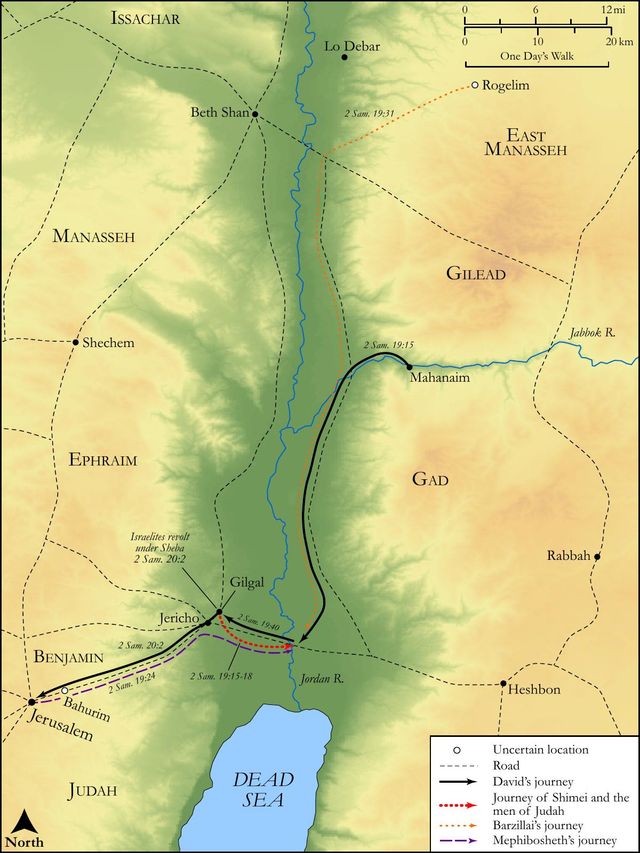
See on the biblical-era maps

Study this verse
Public-domain commentary
Matthew Henry
From his Commentary on the Whole Bible. Henry comments on passages, not single verses — this entry covers 2 Samuel 19:24–30. His two-level outline is real structure in the source text, so it is rendered as structure.
The day of David's return was a day of bringing to remembrance, a day of account, in which what had passed in his flight was called over again; among other things, after the case of Shimei, that of Mephibosheth comes to be enquired into, and he himself brings it on.
I.He went down in the crowd to meet the king (Sa2 19:24), and as a proof of the sincerity of his joy in the king's return, we are here told what a true mourner he was for the king's banishment. During that melancholy time, when one of the greatest glories of Israel had departed, Mephibosheth continued in a very melancholy state. He was never trimmed, nor put on clean linen, but wholly neglected himself, as one abandoned to grief for the king's affliction and the kingdom's misery. In times of public calamity we ought to abridge our enjoyments in the delights of sense, in conformity to the season. There are times when God calls to weeping and mourning, and we must comply with the call.
II.When the king came to Jerusalem (since he could not sooner have an opportunity) he made his appearance before him (Sa2 19:25); and when the king asked him why he, being one of his family, had staid behind, and not accompanied him in his exile, he opened his case fully to the king.
1.He complained of Ziba, his servant who should have been his friend, but had been in two ways his enemy; for, first, he had hindered him from going along with the king, by taking the ass himself which he was ordered to make ready for his master (Sa2 19:26), basely taking advantage of his lameness and his inability to help himself; and, secondly, he had accused him to David of a design to usurp the government, Sa2 19:27. How much mischief is it in the power of a wicked servant to do to the best master!
2.He gratefully acknowledged the king's great kindness to him when he and all his father's house lay at the king's mercy, Sa2 19:28. When he might justly have been dealt with as a rebel, he was treated as a friend, as a child: Thou didst set thy servant among those that did eat at thy own table. This shows that Ziba's suggestion was improbable; for could Mephibosheth be so foolish as to aim higher when he lived so easily, so happily as he did? And could he be so very disingenuous as to design any harm to David, of whose great kindness to him he was thus sensible? (3.) He referred his cause to the king's pleasure (Do what is good in thy eyes with me and my estate), depending on the king's wisdom, and his ability to discern between truth and falsehood (My lord the king is as an angel from God), and disclaiming all pretensions of his own merit: "So much kindness I have received above what I deserved, and what right have I to cry any more unto the king? Why should I trouble the king with my complaints when I have already been so troublesome to him? Why should I think any thing hard that is put upon me when I hitherto been so kindly treated?" We were all as dead men before God; yet he has not only spared us, but taken us to sit at his table. How little reason then have we to complain of any trouble we are in, and how much reason to take all well that God does!
III.David hereupon recalls the sequestration of Mephibosheth's estate; being deceived in his grant, he revokes it, and confirms his former settlement of it: "I have said, Thou and Ziba divide the land (Sa2 19:29), that is, Let it be as I first ordered it (Sa2 9:10); the property shall still be vested in thee, but Ziba shall have occupancy: he shall till the land, paying thee a rent." Thus Mephibosheth is where he was; no harm is done, only Ziba goes away unpunished for his false and malicious information against his master. David either feared him too much, or loved him too well, to do justice upon him according to that law, Deu 19:18, Deu 19:19; and he was now in the humour of forgiving and resolved to make every body easy.
IV.Mephibosheth drowns all he cares about his estate in his joy for the king's return (Sa2 19:30):
"Yea, let him take all, the presence and favour of the king shall be to me instead of all." A good man can contentedly bear his own private losses and disappointments, while he see Israel in peace, and the throne of the Son of David exalted and established. Let Ziba take all, so that David may be in peace.
Continue studying 2 Samuel 19:24 across the web’s major study libraries — every link below opens this exact verse, chapter, or book on the destination site.
Read & Compare
 BibleGatewayThis verse in more than 200 translations and 70 languages.
 Bible.comThe YouVersion reader — hundreds of translations, reading plans, and highlights.
 ESV.orgCrossway's official English Standard Version reader.
 NET BibleThe NET translation with 60,000+ translators' notes on every rendering decision.
 STEP BibleTyndale House's free study tool — original text, vocabulary, and scholarly resources.
 BibliaLogos Bible Software's free web reader.
 USCCBThe New American Bible (Revised Edition) with the U.S. bishops' study notes.
Commentaries
 BibleHub CommentariesDozens of classic commentaries on this verse, gathered on one page.
 StudyLightMore than 100 commentary sets — the largest collection on the web.
 BibleRefPlain-English commentary on what this verse means, verse by verse.
 Enduring WordDavid Guzik's free commentary on this chapter, widely used by Bible teachers.
 Bible Study ToolsVerse commentary alongside Greek and Hebrew study aids.
Original Language & Research
- BibleHub InterlinearThe verse word by word — original language, transliteration, and English.
- BibleHub LexiconEvery word's original-language definition and Strong's entry.
 Blue Letter BibleDeep-study tools — Strong's numbers, concordance, and word studies.
 SefariaThe Hebrew text with Rashi and centuries of Jewish commentary.
Sermons, Hymns & Audio


TrulyRandomVerse is not affiliated with these sites and doesn’t control their content. They’re linked because they’re genuinely useful.
Summary
Second Samuel 19:24 offers a profound and poignant portrayal of Mephibosheth's unwavering loyalty to King David, vividly demonstrated through his deliberately unkempt appearance upon the king's return to Jerusalem after Absalom's rebellion. His sustained neglect of personal grooming—forsaking foot care, beard trimming, and clothes washing for the entire duration of David's exile—served as a powerful, non-verbal testament to his genuine grief, profound solidarity with the king's plight, and a silent refutation of the false accusations leveled against him by Ziba. This deeply moving scene sets the stage for his subsequent vindication and powerfully underscores the enduring nature of true devotion and covenant fidelity.
Context
ShowHideLiterary Context
This pivotal verse is strategically positioned within the broader narrative of King David's tumultuous return to Jerusalem following the devastating defeat of Absalom's rebellion. It immediately follows David's crossing of the Jordan River and his complex negotiations with various factions, including the contentious reunion with the tribes of Judah and Israel. Mephibosheth's appearance here is not incidental; it directly addresses the unresolved issue of his alleged disloyalty, first introduced by Ziba's deceitful accusations in 2 Samuel 16:1-4. His dramatic, unkempt state serves as a compelling visual argument, preparing both David and the reader for his direct appeal and explanation in the subsequent verses (2 Samuel 19:25-30). This encounter is crucial for resolving a lingering injustice, restoring a relationship founded on David's earlier covenant kindness to Jonathan's house in 2 Samuel 9, and reaffirming the theme of loyalty amidst widespread defection.
Historical & Cultural Context
In Israel, meticulous personal grooming was not merely a matter of hygiene but a significant indicator of social status, honor, and one's public presentation. Conversely, the deliberate neglect of basic care—such as washing feet, trimming the beard, or changing clothes—was a universally recognized and profound sign of deep mourning, intense sorrow, or extreme distress. Individuals would adopt such a state during periods of national calamity, personal tragedy, or profound grief, as evidenced in numerous biblical accounts (e.g., Job 1:20, Isaiah 15:2, Jeremiah 41:5). Mephibosheth, as a prominent member of the royal household and a direct beneficiary of David's favor, would typically maintain an impeccable appearance. His prolonged dishevelment, therefore, was a conscious and powerful public statement of his solidarity with David's suffering during the king's exile and his refusal to engage in normal life or present himself honorably until the king's peaceful and rightful return. It was a silent, yet eloquent, protest against the injustice and a declaration of his unwavering fealty.
Key Themes
ShowHideThis verse contributes significantly to several overarching themes within the book of 2 Samuel. Firstly, it powerfully underscores the theme of Loyalty and Betrayal. Mephibosheth's unwavering faithfulness stands in stark contrast to the calculated treachery of Ziba (2 Samuel 16:3) and the widespread rebellion instigated by Absalom (2 Samuel 15:1-12). Secondly, it highlights the Vindication of Truth and Justice. Mephibosheth's appearance, coupled with his subsequent explanation, compels David to reconsider his hasty judgment and ultimately leads to a partial, albeit imperfect, restoration of justice. This serves as a reminder that truth, though sometimes obscured, ultimately comes to light. Finally, it reinforces the theme of Covenant Faithfulness, recalling David's earlier solemn promise to Jonathan to show kindness to his descendants (2 Samuel 9:1-7). Mephibosheth's actions here implicitly appeal to and uphold this sacred covenant, demonstrating that genuine faithfulness is a two-way street, requiring both the giver and receiver of grace to act with integrity.
Exposition and Analysis
ShowHideKey Word Analysis
ShowHideThis versatile Hebrew verb, translated here as "dressed" (feet) and "trimmed" (beard), carries the broad meaning "to do or make, in the broadest sense and widest application." In this context, it refers to the act of performing routine care or maintenance. Mephibosheth's deliberate neglect of this "doing" or "making" of his personal appearance signifies a profound cessation of normal life and a refusal to engage in self-care, indicative of deep mourning and distress.
Translated as "washed" (clothes), this primitive root means "to trample; hence, to wash (properly, by stamping with the feet), whether literal (including the fulling process) or figurative." The act of washing clothes was a fundamental aspect of daily hygiene and ritual purity in ancient Israel. Mephibosheth's failure to wash his garments for an extended period underscored his state of lament, signifying a refusal to present himself as clean or ritually prepared, thereby aligning himself with the impurity and distress of David's exile.
This noun, translated as "day," refers to a period of time, whether literal (from sunrise to sunset) or figurative (a space of time defined by an associated term). Its repetition in the phrase "from the day the king departed until the day he came [again] in peace" emphasizes the duration and continuity of Mephibosheth's self-neglect. It was not a momentary lapse but a sustained, deliberate act spanning the entire period of David's absence, powerfully conveying the depth and constancy of his loyalty and grief.
Verse Breakdown
ShowHide"And Mephibosheth the son of Saul came down to meet the king"
This opening clause immediately establishes the identity of the individual and his proactive stance. Mephibosheth, explicitly identified by his lineage to Saul, takes the initiative to approach David. The phrase "came down" suggests he traveled from his residence—likely Jerusalem or a nearby location—to meet David as the king entered the city or its environs. His eagerness to meet David, despite his physical disability and the potential danger, underscores his deep personal loyalty and his desperate desire for vindication.
"and had neither dressed his feet, nor trimmed his beard, nor washed his clothes"
This tripartite description meticulously details Mephibosheth's profoundly unkempt appearance. Each element—the neglect of foot care (which would involve washing and anointing), the untrimmed beard (a symbol of honor), and unwashed clothing—is a specific, culturally understood sign of deep mourning, intense distress, or a deliberate refusal to engage in normal societal life. The cumulative effect of these three neglected actions powerfully emphasizes the severity and totality of his self-imposed state of lament and solidarity with the exiled king.
"from the day the king departed until the day he came [again] in peace"
This crucial temporal clause specifies the precise duration of Mephibosheth's self-neglect. It was not a temporary oversight but a sustained, deliberate act spanning the entire period of David's forced exile and the subsequent rebellion. This detail powerfully communicates the depth and constancy of his solidarity, his continuous state of grief, and his unwavering anticipation for David's safe and peaceful return, serving as an undeniable, visible refutation of any claims of disloyalty.
Literary Devices
ShowHideThe passage employs several potent Literary Devices to convey Mephibosheth's profound state and loyalty. The most prominent is Symbolism, where Mephibosheth's unkempt appearance—his unwashed feet, untrimmed beard, and soiled clothes—serves as a powerful non-verbal symbol of his deep sorrow, loyalty, and unwavering solidarity with King David during his exile. This vivid visual imagery functions as a form of Pathos, designed to evoke profound sympathy and understanding from David and the reader, sharply contrasting with Ziba's earlier, calculated deception. The Tripartite Structure of the neglected actions ("dressed his feet," "trimmed his beard," "washed his clothes") emphasizes the totality and completeness of his self-imposed lament, creating a memorable and emphatic description. Furthermore, the entire scene functions as Dramatic Irony, as David had previously believed Ziba's false report and condemned Mephibosheth; Mephibosheth's appearance now silently, yet powerfully, contradicts that earlier judgment, setting the stage for the dramatic revelation of truth and a partial reversal of fortune.
Theological and Thematic Connections
ShowHideMephibosheth's profound demonstration of loyalty in 2 Samuel 19:24 speaks to the theological truth that true devotion is often evidenced not merely by verbal affirmations, but by costly, sustained actions and a willingness to share in the suffering of another. His self-imposed state of mourning reflects a heart genuinely grieved by the king's distress and eagerly anticipating his restoration. This unwavering faithfulness, enduring through slander, personal hardship, and the temptation to align with the usurper, serves as a powerful testament to the nature of steadfast love and covenant fidelity, mirroring God's own enduring faithfulness despite human failings. It highlights the importance of discerning truth beyond initial appearances and the ultimate, though sometimes delayed, vindication of the righteous.
Reflection and Application
ShowHideMephibosheth's silent witness in 2 Samuel 19:24 offers a profound challenge for contemporary believers. In a world often driven by self-preservation, superficiality, and the pursuit of comfort, his deliberate choice to share in David's humiliation and distress, even when falsely accused and personally vulnerable, exemplifies a radical form of loyalty and empathy. It compels us to consider how deeply we identify with those we claim to love, especially when they are suffering, unjustly treated, or in a season of "exile." Are our expressions of solidarity merely verbal, or do they involve tangible, even costly, actions that demonstrate our genuine commitment? This passage calls us to cultivate a discerning heart, not to be swayed by initial impressions, convenient narratives, or the accusations of others, but to diligently seek out the truth and seek justice. It reminds us that true character is often revealed not in prosperity, but in adversity, and through humble, steadfast devotion to those to whom we are bound by love and covenant.
Questions for Reflection
ShowHideFAQ
ShowHideWhy did Mephibosheth choose to appear so unkempt, rather than simply stating his loyalty verbally?
ShowHideMephibosheth's unkempt appearance was a powerful, culturally understood non-verbal communication of his profound grief, distress, and unwavering solidarity with King David. In Israel, deliberately neglecting personal grooming—such as washing feet, trimming the beard, or changing clothes—was a common and unmistakable sign of deep mourning, intense sorrow, or a refusal to participate in normal life. By maintaining this state from the day David fled Jerusalem until his peaceful return, Mephibosheth was making a public, undeniable statement that he had been in a constant state of lament over the king's exile and had refused to engage in any semblance of normalcy until David was restored. This visual testimony served as a potent, silent refutation of Ziba's earlier false accusations (2 Samuel 16:3) and vividly demonstrated his unwavering loyalty, speaking volumes beyond any mere verbal declaration. It was a tangible, visible sacrifice that underscored the depth of his devotion.
Christ-Centered Fulfillment
ShowHideMephibosheth's unwavering loyalty and self-abasement in solidarity with David, even unto personal neglect and potential misunderstanding, powerfully foreshadows the ultimate example of solidarity and identification found in Jesus Christ. Just as Mephibosheth bore the mark of his grief for the exiled king, so Christ, the true Son of David, willingly "emptied himself, by taking the form of a servant, being born in the likeness of men" (Philippians 2:7). He did not merely lament humanity's exile from God due to sin but entered into it, bearing our sorrows and griefs, and was "pierced for our transgressions; he was crushed for our iniquities" (Isaiah 53:3-5). His physical appearance, often described as unremarkable and bearing the marks of suffering (Isaiah 53:2), was a testament to his profound identification with a broken world. Mephibosheth's partial vindication by David points to the complete vindication and glorious exaltation of Christ after His suffering, and through Him, the ultimate vindication of all who, like Mephibosheth, humbly cast themselves upon the mercy of the King, trusting in His perfect covenant faithfulness (Romans 8:33-34). Our "unwashed clothes" of sin and unrighteousness are exchanged for the robes of Christ's righteousness through His atoning work, making us clean and presentable before God (Revelation 7:14), demonstrating His ultimate and perfect solidarity with us.