


2 Samuel 19:30
- וַיֹּאמֶרvai·Yo·merand he saidH559Conj-w ¦ V-Qal-ConsecImperf-3msVerb Qal Consecutive Imperfect 3rd Singular Masculineוַandיֹּאמֶרhe said
- מְפִיבֹשֶׁתme·fi·Vo·shetMephiboshethH4648N-proper-mNoun Proper Masculine
- אֶל'eltoH413PrepPreposition
- הַמֶּלֶךְha·Me·lekhthe kingH4428Art ¦ N-msNoun Singular Masculine Absoluteהַtheמֶּלֶךְking
- גַּםgamalsoH1571AdvAdverb
- אֶת'et<obj.>H853DirObjMParticle Object Indicator
- הַכֹּלha·Kol<the> everythingH3605Art ¦ N-msNoun Singular Masculine Absoluteהַ<the>כֹּלeverything
- יִקָּחyi·Kachlet him takeH3947V-Qal-Imperf-3msVerb Qal Imperfect 3rd Singular Masculine
- אַחֲרֵי'A·cha·reiafterH310Adj-mpcAdjective Numerical Plural Masculine Construct
- אֲשֶׁר'a·SherthatH834RelParticle Relative
- בָּאba'he has comeH935V-Qal-Perf-3msVerb Qal Perfect 3rd Singular Masculine
- אֲדֹנִי'a·do·Nimy lordH113N-msc ¦ 1csNoun Singular Masculine Constructאֲדֹנִlordיmy
- הַמֶּלֶךha·Me·lekhthe kingH4428Art ¦ N-msNoun Singular Masculine Absoluteהַtheמֶּלֶךking
- בְּשָׁלוֹםbe·sha·Lomin peaceH7965Prep-b ¦ N-msNoun Singular Masculine Absoluteבְּinשָׁלוֹםpeace
- אֶל'eltoH413PrepPreposition
- בֵּיתוֹbei·Tohis houseH1004N-msc ¦ 3msNoun Singular Masculine Constructבֵּיתhouseוֹhis
English is a literal word-by-word gloss of the Hebrew, not the KJV's wording. Why?
This is the original text the KJV's translators worked from — each Hebrew word with its own literal English meaning in this verse, prepared by scholars at Tyndale House, Cambridge. The KJV translates whole sentences, not word by word, so its wording differs: one Hebrew word can become several English words, and the KJV may choose “the LORD” where the gloss reads “Yahweh”. Both are faithful — they answer different questions. For the KJV's own rendering, switch to the KJV text.
Details
See on the biblical-era maps
Study this verse
Public-domain commentary
Matthew Henry
From his Commentary on the Whole Bible. Henry comments on passages, not single verses — this entry covers 2 Samuel 19:24–30. His two-level outline is real structure in the source text, so it is rendered as structure.
The day of David's return was a day of bringing to remembrance, a day of account, in which what had passed in his flight was called over again; among other things, after the case of Shimei, that of Mephibosheth comes to be enquired into, and he himself brings it on.
I.He went down in the crowd to meet the king (Sa2 19:24), and as a proof of the sincerity of his joy in the king's return, we are here told what a true mourner he was for the king's banishment. During that melancholy time, when one of the greatest glories of Israel had departed, Mephibosheth continued in a very melancholy state. He was never trimmed, nor put on clean linen, but wholly neglected himself, as one abandoned to grief for the king's affliction and the kingdom's misery. In times of public calamity we ought to abridge our enjoyments in the delights of sense, in conformity to the season. There are times when God calls to weeping and mourning, and we must comply with the call.
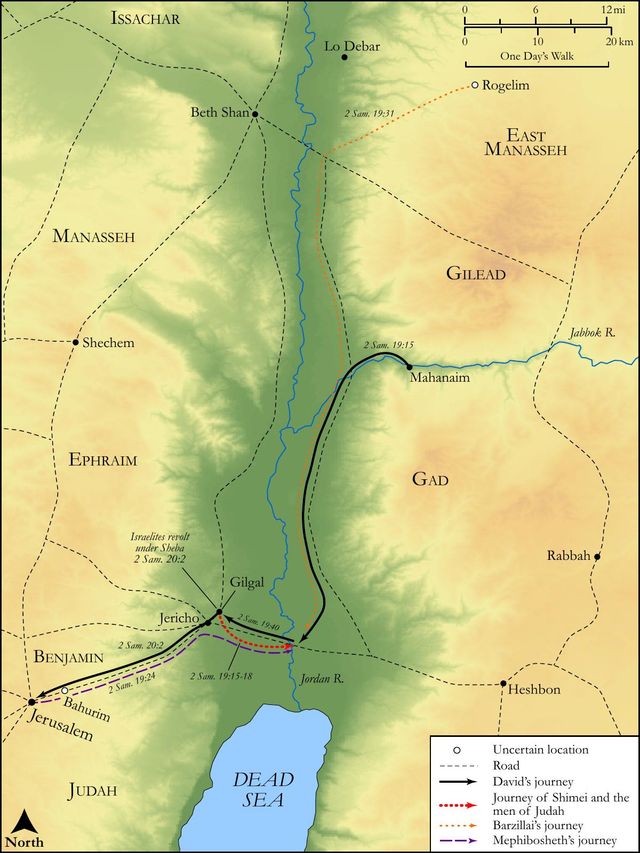
II.When the king came to Jerusalem (since he could not sooner have an opportunity) he made his appearance before him (Sa2 19:25); and when the king asked him why he, being one of his family, had staid behind, and not accompanied him in his exile, he opened his case fully to the king.
1.He complained of Ziba, his servant who should have been his friend, but had been in two ways his enemy; for, first, he had hindered him from going along with the king, by taking the ass himself which he was ordered to make ready for his master (Sa2 19:26), basely taking advantage of his lameness and his inability to help himself; and, secondly, he had accused him to David of a design to usurp the government, Sa2 19:27. How much mischief is it in the power of a wicked servant to do to the best master!
2.He gratefully acknowledged the king's great kindness to him when he and all his father's house lay at the king's mercy, Sa2 19:28. When he might justly have been dealt with as a rebel, he was treated as a friend, as a child: Thou didst set thy servant among those that did eat at thy own table. This shows that Ziba's suggestion was improbable; for could Mephibosheth be so foolish as to aim higher when he lived so easily, so happily as he did? And could he be so very disingenuous as to design any harm to David, of whose great kindness to him he was thus sensible? (3.) He referred his cause to the king's pleasure (Do what is good in thy eyes with me and my estate), depending on the king's wisdom, and his ability to discern between truth and falsehood (My lord the king is as an angel from God), and disclaiming all pretensions of his own merit: "So much kindness I have received above what I deserved, and what right have I to cry any more unto the king? Why should I trouble the king with my complaints when I have already been so troublesome to him? Why should I think any thing hard that is put upon me when I hitherto been so kindly treated?" We were all as dead men before God; yet he has not only spared us, but taken us to sit at his table. How little reason then have we to complain of any trouble we are in, and how much reason to take all well that God does!
III.David hereupon recalls the sequestration of Mephibosheth's estate; being deceived in his grant, he revokes it, and confirms his former settlement of it: "I have said, Thou and Ziba divide the land (Sa2 19:29), that is, Let it be as I first ordered it (Sa2 9:10); the property shall still be vested in thee, but Ziba shall have occupancy: he shall till the land, paying thee a rent." Thus Mephibosheth is where he was; no harm is done, only Ziba goes away unpunished for his false and malicious information against his master. David either feared him too much, or loved him too well, to do justice upon him according to that law, Deu 19:18, Deu 19:19; and he was now in the humour of forgiving and resolved to make every body easy.
IV.Mephibosheth drowns all he cares about his estate in his joy for the king's return (Sa2 19:30):
"Yea, let him take all, the presence and favour of the king shall be to me instead of all." A good man can contentedly bear his own private losses and disappointments, while he see Israel in peace, and the throne of the Son of David exalted and established. Let Ziba take all, so that David may be in peace.
Continue studying 2 Samuel 19:30 across the web’s major study libraries — every link below opens this exact verse, chapter, or book on the destination site.
Read & Compare
 BibleGatewayThis verse in more than 200 translations and 70 languages.
 Bible.comThe YouVersion reader — hundreds of translations, reading plans, and highlights.
 ESV.orgCrossway's official English Standard Version reader.
 NET BibleThe NET translation with 60,000+ translators' notes on every rendering decision.
 STEP BibleTyndale House's free study tool — original text, vocabulary, and scholarly resources.
 BibliaLogos Bible Software's free web reader.
 USCCBThe New American Bible (Revised Edition) with the U.S. bishops' study notes.
Commentaries
 BibleHub CommentariesDozens of classic commentaries on this verse, gathered on one page.
 StudyLightMore than 100 commentary sets — the largest collection on the web.
 BibleRefPlain-English commentary on what this verse means, verse by verse.
 Enduring WordDavid Guzik's free commentary on this chapter, widely used by Bible teachers.
 Bible Study ToolsVerse commentary alongside Greek and Hebrew study aids.
Original Language & Research
- BibleHub InterlinearThe verse word by word — original language, transliteration, and English.
- BibleHub LexiconEvery word's original-language definition and Strong's entry.
 Blue Letter BibleDeep-study tools — Strong's numbers, concordance, and word studies.
 SefariaThe Hebrew text with Rashi and centuries of Jewish commentary.
Sermons, Hymns & Audio


TrulyRandomVerse is not affiliated with these sites and doesn’t control their content. They’re linked because they’re genuinely useful.
Summary
Mephibosheth's declaration serves as the poignant climax of his encounter with King David, who has just returned to Jerusalem after Absalom's rebellion. Despite being unjustly deprived of half his inheritance due to Ziba's deceit, Mephibosheth expresses profound loyalty and humility by willingly relinquishing all claims to property. His statement underscores that the safe and peaceful return of King David to his throne is of paramount importance, far outweighing any personal material gain or grievance, thereby revealing a character deeply devoted to the king's well-being and the nation's stability.
Context
ShowHideLiterary Context
This verse provides the powerful culmination of Mephibosheth's interaction with David upon the king's triumphant return to Jerusalem after the defeat of Absalom's rebellion. The narrative immediately preceding 2 Samuel 19:30 is found in 2 Samuel 19:24-29, where Mephibosheth appears before David in a state of dishevelment—unwashed, unshaven, and unkempt—a visible sign of his deep mourning and unwavering loyalty during David's exile. David confronts him about his failure to accompany the royal party, to which Mephibosheth offers a detailed explanation of Ziba's treachery and his own physical inability to travel due to his lameness. David's subsequent decision in 2 Samuel 19:29 to divide the land between Mephibosheth and Ziba is a compromise that still leaves Mephibosheth with less than what was originally promised. Verse 30 is Mephibosheth's immediate, heartfelt, and ultimately selfless reply to this judgment, which sharply contrasts with Ziba's self-serving actions and profoundly illustrates Mephibosheth's true priorities and character.
Historical & Cultural Context
The historical backdrop for 2 Samuel 19:30 is the immediate aftermath of a devastating civil war—Absalom's rebellion—which had severely fractured the kingdom and forced King David into exile from his capital. David's return to Jerusalem signifies not merely a personal homecoming but the restoration of legitimate authority, the re-establishment of the monarchy, and a crucial step towards national peace and order. In ancient Israelite society, land was not merely property; it was intricately tied to identity, tribal inheritance, and covenantal blessing, making Mephibosheth's willingness to forgo a significant portion of his inheritance particularly profound. Loyalty to the king was a paramount virtue, especially in times of crisis and political instability. Mephibosheth, as the last surviving son of Jonathan and grandson of King Saul, theoretically posed a potential dynastic threat to David's throne. However, David had previously shown him extraordinary kindness by bringing him to his own table 2 Samuel 9:7. This context of a recently quelled rebellion and the fragile peace underscores the immense weight and significance of Mephibosheth's declaration, which clearly prioritizes the king's stability and the kingdom's well-being over any personal property dispute or perceived injustice.
Key Themes
ShowHide2 Samuel 19:30 powerfully illuminates several central themes woven throughout the book of 2 Samuel. Firstly, it highlights loyalty and covenant faithfulness, echoing the profound and enduring bond established between David and Jonathan, which is detailed in passages like 1 Samuel 20. Mephibosheth's actions demonstrate a commitment that transcends personal loss, reflecting the spirit of the covenant David made with Jonathan to show kindness to his descendants 2 Samuel 9:1. Secondly, the verse touches upon the complex themes of justice and injustice, as Mephibosheth is undeniably a victim of Ziba's slander and David's seemingly incomplete restoration of his rights. Yet, Mephibosheth's remarkable response elevates humility and contentment above material gain, showing that his ultimate satisfaction is rooted in the king's return and the restoration of order. Finally, the verse powerfully underscores the priority of relationships and peace over possessions, a recurring wisdom theme found throughout Scripture, emphasizing that true well-being is not found in accumulation of wealth but in right relationships and the re-establishment of order under righteous leadership.
Exposition and Analysis
ShowHideKey Word Analysis
ShowHideThis primitive root signifies "to take" in a wide variety of applications, including to accept, bring, carry away, or seize. In Mephibosheth's statement, "let him take all," it conveys a deliberate act of relinquishment and concession. It is not merely a passive acceptance of David's ruling, but an active, willing surrender of his own claim, emphasizing his complete detachment from material possessions in favor of a higher priority.
This term refers to a sovereign, master, or controller, whether human or divine. When Mephibosheth refers to David as "my lord the king," it is a profound expression of deference, submission, and recognition of David's authority and rightful position. It underscores the hierarchical relationship and Mephibosheth's deep respect and loyalty, placing David's well-being above his own material concerns.
More than simply the absence of conflict, shalom is a comprehensive concept encompassing wholeness, well-being, prosperity, security, health, and restoration. David's return "in peace" signifies the re-establishment of order, the cessation of civil strife, divine favor, and the comprehensive well-being of the kingdom after the chaos of rebellion. Mephibosheth's joy is rooted in this holistic shalom of the king and his household, demonstrating his alignment with the kingdom's welfare.
Verse Breakdown
ShowHide"And Mephibosheth said unto the king"
This opening phrase immediately establishes the setting and the direct, personal nature of Mephibosheth's address to King David. It highlights the significance of his words as a direct response to David's judgment and his own opportunity to clarify his loyalty.
"Yea, let him take all"
This is a powerful and emphatic declaration of relinquishment. "Him" refers to Ziba, Mephibosheth's servant. Mephibosheth is not merely accepting David's compromise of dividing the land; he is actively and willingly giving up his claim to even the half that David had allotted him. This phrase underscores his profound selflessness and indicates that material possessions are entirely secondary to his primary concern.
"forasmuch as my lord the king is come again in peace unto his own house"
This clause provides the profound and selfless reason for Mephibosheth's astonishing generosity and contentment. His joy and satisfaction are entirely bound up in David's safe and peaceful return to his rightful place on the throne and in his home. It signifies the re-establishment of order, the end of the rebellion, and the restoration of the legitimate king. This demonstrates a loyalty that transcends personal grievance or material loss, placing the king's well-being and the nation's stability as his highest priorities.
Literary Devices
ShowHideThe verse employs significant Irony, as Mephibosheth, the physically disabled descendant of a deposed king, demonstrates far greater loyalty, humility, and selfless devotion than Ziba, his able-bodied servant, who actively slandered him for personal gain. There is also a strong Contrast between Mephibosheth's genuine concern for David's welfare and Ziba's opportunistic betrayal and self-interest. The phrase "let him take all" functions as Hyperbole to emphasize Mephibosheth's absolute and unreserved surrender of his rights, powerfully highlighting his profound humility and the depth of his devotion to the king. The repeated use of "my lord the king" is a form of Appellation, reinforcing Mephibosheth's deep deference, respect, and submission to David's authority and person, even in a moment where he has suffered personal injustice.
Theological and Thematic Connections
ShowHideMephibosheth's response transcends a simple act of generosity; it embodies a profound theological truth about the nature of true devotion and the prioritization of spiritual realities over temporal possessions. His joy in the king's peaceful return, even at significant personal cost, reflects a heart that understands where true security and blessing ultimately lie. This echoes the biblical principle that the presence and peace of God (or His anointed representative) are far more valuable than any earthly inheritance or material gain. It challenges believers to consider their ultimate allegiance and what truly brings them contentment: personal gain, perceived rights, or the flourishing of God's kingdom and the well-being of His anointed. Mephibosheth's selflessness serves as a powerful counter-narrative to the prevailing human tendency towards self-interest and materialism, pointing to a higher value system rooted in loyalty and peace.
Reflection and Application
ShowHideMephibosheth's profound statement in 2 Samuel 19:30 offers a timeless and challenging lesson for contemporary believers navigating a world often consumed by the pursuit of material wealth, the assertion of personal rights, and the perceived injustices of life. Mephibosheth exemplifies a radical reorientation of priorities: his willingness to forgo half his inheritance, despite being the wronged party and David's own compromise, demonstrates that true contentment and joy are found not in what we possess or what is "owed" to us, but in the peace, stability, and well-being of the one we serve—ultimately, God Himself. His example calls us to examine our own hearts: are we quick to defend our entitlements, or are we willing to surrender them for the sake of a greater good, for peace, or for the flourishing of God's kingdom and the spiritual well-being of others? This verse encourages a spirit of humility, selfless devotion, and a profound trust that God's ultimate justice and provision far outweigh any temporary earthly loss. It reminds us that our greatest treasure is found not in accumulation, but in the presence and reign of our true King, Jesus Christ.
Questions for Reflection
ShowHideFAQ
ShowHideWhy did David not fully restore Mephibosheth's property?
ShowHideDavid's decision to divide the land between Mephibosheth and Ziba in 2 Samuel 19:29 remains a point of scholarly discussion. Some interpretations suggest that David, weary and perhaps emotionally drained from the recent rebellion, sought a quick and pragmatic resolution to a complex dispute. He may have found it difficult to fully discern the truth between Mephibosheth's and Ziba's conflicting accounts, especially given Ziba's apparent loyalty and provision of supplies to David during his flight from Absalom 2 Samuel 16:1-4. Others propose it was a political compromise aimed at maintaining stability and not alienating Ziba, who may have represented a significant faction or had proven useful during the crisis. Regardless of David's precise motivation, Mephibosheth's selfless and loyal response in 2 Samuel 19:30 stands in stark contrast to the king's imperfect justice, highlighting Mephibosheth's exemplary character.
What does Mephibosheth's statement "let him take all" reveal about his character?
ShowHideMephibosheth's declaration "let him take all" reveals profound humility, unwavering loyalty, and a remarkable sense of contentment that transcends material possessions. Despite being unjustly slandered by Ziba and deprived of half his inheritance, his primary concern is not his personal gain or grievance, but the safe return and restoration of King David to his throne. This demonstrates that his devotion to the king and his desire for the kingdom's peace far outweighed any material possessions or personal rights. It underscores a spirit of selflessness, echoing the deep covenant loyalty between David and Jonathan, and portrays Mephibosheth as a man whose heart was truly aligned with the well-being of his sovereign and the stability of the kingdom.
Christ-Centered Fulfillment
ShowHideMephibosheth's selfless declaration, "Yea, let him take all, forasmuch as my lord the king is come again in peace unto his own house," serves as a profound Old Testament foreshadowing of Christ's kingdom and the believer's response to Him. Just as Mephibosheth, a descendant of a deposed king and physically lame, was shown undeserved kindness by David, being brought to eat at the king's table 2 Samuel 9:7, so too are we, spiritually lame and alienated by sin Romans 5:8, recipients of God's boundless grace through Jesus Christ. Mephibosheth's willingness to relinquish all earthly claims for the sake of his king's peace beautifully mirrors the believer's call to count everything as loss for the surpassing worth of knowing Christ Jesus our Lord Philippians 3:8. Our ultimate joy and peace are not found in earthly possessions, perceived rights, or the fleeting gains of this world, but in the glorious reality that our true "Lord the King is come again in peace unto his own house"—that Christ has triumphed over sin and death, established His eternal kingdom, and reigns in glory Colossians 1:13-14. Our response, like Mephibosheth's, should be one of complete surrender and joyful contentment in His sovereign rule, recognizing that His return and reign are our greatest treasure and the source of all true shalom Matthew 6:33.