


2 Samuel 19:31
- וּבַרְזִלַּיu·var·zi·Laiand BarzillaiH1271Conj-w ¦ N-proper-mNoun Proper MasculineוּandבַרְזִלַּיBarzillai
- הַגִּלְעָדִיha·gil·'a·Dithe GileaditeH1569Art ¦ N-msNoun Gentilic Singular Masculine AbsoluteהַtheגִּלְעָדִיGileadite
- יָרַדya·Radhe had come downH3381V-Qal-Perf-3msVerb Qal Perfect 3rd Singular Masculine
- מֵרֹגְלִיםme·ro·ge·Limfrom RogelimH7274Prep-m ¦ N-properNoun Proper LocationמֵfromרֹגְלִיםRogelim
- וַיַּעֲבֹרvai·ya·'a·Vorand he passed overH5674Conj-w ¦ V-Qal-ConsecImperf-3msVerb Qal Consecutive Imperfect 3rd Singular Masculineוַandיַּעֲבֹרhe passed over
- אֶת'etwithH854PrepPreposition
- הַמֶּלֶךְha·Me·lekhthe kingH4428Art ¦ N-msNoun Singular Masculine Absoluteהַtheמֶּלֶךְking
- הַיַּרְדֵּןhai·yar·Denthe JordanH3383Art ¦ N-properNoun Proper LocationהַtheיַּרְדֵּןJordan
- לְשַׁלְּחוֹle·sha·le·Choto send off himH7971Prep-l ¦ V-Piel-Inf ¦ 3msVerb Piel Infinitive Constructלְtoשַׁלְּחsend offוֹhim
- אֶת'et<obj.>H853DirObjMParticle Object Indicator
- הַיַּרְדֵּןha·vai·yar·denthe JordanH3383Art ¦ N-properNoun Proper LocationהַtheיַּרְדֵּןJordan
English is a literal word-by-word gloss of the Hebrew, not the KJV's wording. Why?
This is the original text the KJV's translators worked from — each Hebrew word with its own literal English meaning in this verse, prepared by scholars at Tyndale House, Cambridge. The KJV translates whole sentences, not word by word, so its wording differs: one Hebrew word can become several English words, and the KJV may choose “the LORD” where the gloss reads “Yahweh”. Both are faithful — they answer different questions. For the KJV's own rendering, switch to the KJV text.
Details
See on the biblical-era maps
Study this verse
Public-domain commentary
Matthew Henry
From his Commentary on the Whole Bible. Henry comments on passages, not single verses — this entry covers 2 Samuel 19:31–39. His three-level outline is real structure in the source text, so it is rendered as structure.
David had already graced the triumphs of his restoration with the generous remission of the injuries that had been done to him; we have him here gracing them with a no less generous reward of the kindnesses that had been shown to him. Barzillai, the Gileadite, who had a noble seat at Rogelim, not far from Mahanaim, was the man who, of all the nobility and gentry of that country, had been most kind to David in his distress. If Absalom had prevailed, it is likely he would have suffered for his loyalty; but now he and his shall be no losers by it. Here is,
I.Barzillai's great respect to David, not only as a good man, but as his righteous sovereign:
He provided him with much sustenance, for himself and his family, while he lay at Mahanaim, Sa2 19:32. God had given him a large estate, for he was a very great man, and, it seems, he had a large heart to do good with it: what else but that is a large estate good for? To reduced greatness generosity obliges us, and to oppressed goodness piety obliges us, to be in a particular manner kind, to the utmost of our power. Barzillai, to show that he was not weary of David, though he was so great a charge to him, attended him to Jordan, and went over with him, Sa2 19:31. Let subjects learn hence to render tribute to whom tribute is due and honour to whom honour, Rom 13:7.
II.The kind invitation David gave to him to court (Sa2 19:33): Come thou over with me. He invited him,
1.That he might have the pleasure of his company and the benefit of his counsel; for we may suppose that he was very wise and good, as well as very rich, otherwise he would not have been called here a very great man; for it is what a man is, more than what he has, that renders him truly great.
2.That he might have an opportunity of returning his kindness: "I will feed thee with me; thou shalt fare as sumptuously as I fare, and this at Jerusalem, the royal and holy city." David did not take Barzillai's kindness to him as a debt (he was not one of those arbitrary princes who think that whatever their subjects have is theirs when they please), but accepted it and rewarded it as a favour. We must always study to be grateful to our friends, especially to those who have helped us in distress.
III.Barzillai's reply to this invitation, wherein,
1.He admires the king's generosity in making him this offer, lessening his service, and magnifying the king's return for it: Why should the king recompense it with such a reward? Sa2 19:36. Will the master thank that servant who only does what was his duty to do? He though he had done himself honour enough in doing the king any service. Thus, when the saints shall be called to inherit the kingdom in consideration of what they have done for Christ in this world, they will be amazed at the disproportion between the service and the recompence. Mat 25:37, Lord, when saw we thee hungry, and fed thee?
2.He declines accepting the invitation. He begs his majesty's pardon for refusing so generous an offer: he should think himself very happy in being near the king, but,
(1.)He is old, and unfit to remove at all, especially to court. He is old, and unfit for the business of the court: "Why should I go up with the king to Jerusalem? I can do him no service there, in the council, the camp, the treasury, or the courts of justice; for how long have I to live? Sa2 19:34. Shall I think of going into business, now that I am going out of this world?" He is old and unfit for the diversions of the court, which will be ill-bestowed, and even thrown away, upon one that can relish them so little, Sa2 19:35. As it was in Moses's time, so it was in barzillai's and it is not worse now, that, if men be so strong that they come to fourscore years, their strength then is labour and sorrow, Psa 90:10. These were then, and are still, years of which men say they have no pleasure in them, Ecc 12:1. Dainties are insipid when desire fails, and songs to the aged ear are little better than those sung to a heavy heart, very disagreeable: how should they be otherwise when the daughters of music are brought low? Let those that are old learn of Barzillai to be dead to the delights of sense; let grace second nature, and make a virtue of the necessity. Nay, Barzillai, being old, thinks he shall be a burden to the king, rather than any credit to him; and a good man would not go any where to be burdensome, or, if he must be so, will rather be so to his own house than to another's.
(2.)He is dying, and must begin to think of his long journey, his removal out of the world, Sa2 19:37. It is good for us all, but it especially becomes old people to think and speak much of dying. "Talk of going to court!" says Barzillai; "Let me go home and die in my own city, the place of my father's sepulchre; let me die by the grave of my father, that my bones may be quietly carried to the place of their rest. The grave is ready for me, let me go and get ready for it, go and die in my nest."
3.He desires the king to be kind to his son Chimham: Let him go over with my lord the king, and have preferment at court. What favour is done to him Barzillai will take as done to himself. Those that are old must not grudge young people those delights which they themselves are past the enjoyment of, nor confine them to their retirements. Barzillai will go back himself, but he will not make Chimham go back with him; though he could ill spare Chimham, yet, thinking it would gratify and advance him, he is willing to do it.
IV.David's farewell to Barzillai.
1.He sends him back into his country with a kiss and a blessing (Sa2 19:39), signifying that in gratitude for his kindnesses he would love him and pray for him, and with a promise that whatever request he should at any time make to him he would be ready to oblige him (Sa2 19:38): Whatsoever thou shalt think of, when thou comest home, to ask of me, that will I do for thee. What is the chief excellency of power but this, that it gives men a capacity of doing the more good?
2.He takes Chimham forward with him, and leaves it to Barzillai to choose him his preferment. I will do to him what shall seem good to thee, Sa2 19:38. And, it should seem, Barzillai, who had experienced the innocency and safety of retirement, begged a country seat for him near Jerusalem, but not in it; for, long after, we read of a place near Beth-lehem, David's city, which is called the habitation of Chimham, allotted to him, probably, not out of the crown-lands or the forfeited estates, but out of David's paternal estate.
Continue studying 2 Samuel 19:31 across the web’s major study libraries — every link below opens this exact verse, chapter, or book on the destination site.
Read & Compare
 BibleGatewayThis verse in more than 200 translations and 70 languages.
 Bible.comThe YouVersion reader — hundreds of translations, reading plans, and highlights.
 ESV.orgCrossway's official English Standard Version reader.
 NET BibleThe NET translation with 60,000+ translators' notes on every rendering decision.
 STEP BibleTyndale House's free study tool — original text, vocabulary, and scholarly resources.
 BibliaLogos Bible Software's free web reader.
 USCCBThe New American Bible (Revised Edition) with the U.S. bishops' study notes.
Commentaries
 BibleHub CommentariesDozens of classic commentaries on this verse, gathered on one page.
 StudyLightMore than 100 commentary sets — the largest collection on the web.
 BibleRefPlain-English commentary on what this verse means, verse by verse.
 Enduring WordDavid Guzik's free commentary on this chapter, widely used by Bible teachers.
 Bible Study ToolsVerse commentary alongside Greek and Hebrew study aids.
Original Language & Research
- BibleHub InterlinearThe verse word by word — original language, transliteration, and English.
- BibleHub LexiconEvery word's original-language definition and Strong's entry.
 Blue Letter BibleDeep-study tools — Strong's numbers, concordance, and word studies.
 SefariaThe Hebrew text with Rashi and centuries of Jewish commentary.
Sermons, Hymns & Audio


TrulyRandomVerse is not affiliated with these sites and doesn’t control their content. They’re linked because they’re genuinely useful.
Summary
2 Samuel 19:31 vividly portrays the unwavering loyalty and profound respect demonstrated by Barzillai the Gileadite towards King David during a critical juncture of his reign. As David made his triumphant return to Jerusalem following the decisive defeat of Absalom's rebellion, Barzillai, who had previously extended crucial aid to the king during his exile, journeyed from his home in Rogelim to personally escort David across the strategic Jordan River. This act of selfless devotion, devoid of any apparent desire for personal gain, underscored Barzillai's deep fidelity to the restored monarch, thereby setting the stage for David's enduring gratitude and subsequent commendation.
Context
ShowHideLiterary Context
This verse is intricately woven into the dramatic tapestry of King David's restoration to the throne after the traumatic rebellion led by his son, Absalom. The preceding chapters meticulously detail Absalom's audacious coup, David's hasty flight from Jerusalem, his period of exile east of the Jordan, and the climactic battle that resulted in Absalom's demise. With the rebellion quelled, David's immediate focus shifts to the complex task of reclaiming his authority and reuniting a fractured kingdom. The broader literary context of 2 Samuel 19 describes David's journey back, punctuated by various significant encounters: Joab's sharp rebuke regarding David's prolonged mourning, the contentious reconciliation with Shimei, and the arrival of numerous individuals, including Barzillai, who converge at the Jordan River to greet the returning king. Barzillai's appearance here is a direct continuation of his earlier, vital support for David when the king was a fugitive in Mahanaim, where Barzillai, alongside others, provided essential provisions for David and his weary entourage, as recorded in 2 Samuel 17:27-29. His presence at the Jordan River thus symbolizes a formal and deeply respectful send-off from the Transjordanian region, signifying the culmination of David's exile and his ceremonial re-entry into the heartland of Israel.
Historical & Cultural Context
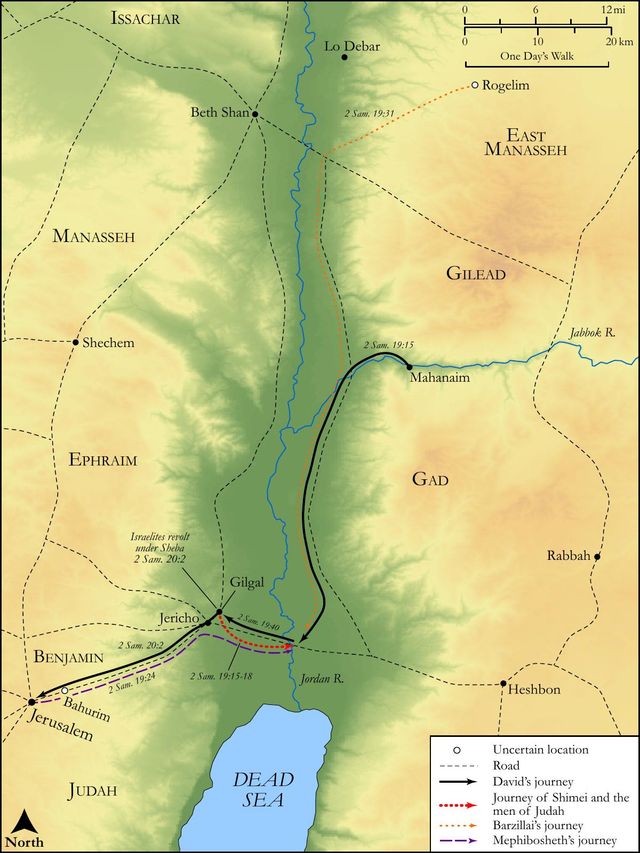
Geographically, Rogelim was situated in Gilead, a rugged and often independent region located east of the Jordan River. The Jordan River itself functioned as a significant natural and symbolic boundary, with its crossing frequently representing a profound transition or a return to the Promised Land. For a reigning king to be "conducted over Jordan" by a prominent and respected local figure like Barzillai was an act of immense honor and a public declaration of allegiance. In the cultural milieu of the ancient Near East, hospitality and unwavering loyalty to a monarch, particularly during periods of vulnerability and distress, were esteemed virtues. Barzillai's earlier act of providing aid to a fleeing king in Mahanaim was a perilous display of loyalty that could have invited severe retribution had Absalom's rebellion succeeded. His subsequent, personal escort of David across the Jordan publicly reaffirmed his steadfast commitment and solidified his reputation as an unshakeable supporter, demonstrating a bond that transcended mere political opportunism. This also underscores the crucial role of influential regional leaders in validating and strengthening the legitimacy of the central monarchy.
Key Themes
ShowHideThis verse profoundly contributes to several overarching themes present within 2 Samuel and the broader Deuteronomistic History. The theme of Loyalty and Devotion is paramount, powerfully exemplified by Barzillai's unwavering support for David, first through providing sustenance during his flight and now by offering a personal escort for his return. This stands in stark contrast to the shifting allegiances and opportunistic maneuvering of many others during Absalom's rebellion. Another significant theme is Gratitude and Honor, as David profoundly acknowledges Barzillai's selfless service, immediately offering him a place at court, as seen in 2 Samuel 19:33. This gratitude extends even further, culminating in David's solemn command to his son Solomon to perpetually care for Barzillai's descendants, a directive recorded in 1 Kings 2:7. This illustrates David's character as a just king who remembers and rewards faithfulness. Finally, the theme of Selfless Service is vividly evident in Barzillai's actions. His advanced age and his eventual humble refusal of David's offer to reside in Jerusalem, as detailed in 2 Samuel 19:35-37, powerfully underscore that his service was not motivated by a desire for personal gain or political advancement, but by genuine respect and care for his king.
Exposition and Analysis
ShowHideKey Word Analysis
ShowHideThe name Barzillai (H1271) is derived from the Hebrew word for "iron" (בַּרְזֶל, barzel), suggesting a meaning like "iron-hearted" or "man of iron." This etymology is remarkably fitting for his character, symbolizing his strength, steadfastness, and unwavering loyalty to King David during a period of immense instability and personal danger. His actions throughout the narrative demonstrate a resolve as strong as iron, providing a stable and reliable presence when many others faltered or sought their own advantage.
This patronymic term (H1569) identifies Barzillai as an inhabitant or descendant from Gilead, a fertile and strategically important region located east of the Jordan River. Being a Gileadite often implied a certain rugged independence and resilience. Barzillai's status as a wealthy and influential figure in this region highlights the broad support David commanded, extending even beyond the traditional borders of Judah and Israel, and underscores the significance of his personal journey to meet and escort the king.
The Hebrew verb "שָׁלַח" (H7971, shalach), used here in its Piel stem (לְשַׁלְּחוֹ, l'shall'cho'), means "to send away," "to dismiss," or "to escort." In this specific context, "to conduct him over Jordan" implies much more than a casual farewell. It suggests a formal, respectful, and perhaps even protective escort, accompanying the king to ensure his safe and honorable passage across a significant geographical and symbolic boundary. It signifies a profound personal commitment to see David safely on his way, rather than merely waving him off from a distance.
Verse Breakdown
ShowHide"And Barzillai the Gileadite came down from Rogelim"
This opening clause immediately introduces the central figure and establishes his origin and initial movement. Barzillai, a man of considerable stature and wealth, is identified both by his personal name and his regional affiliation, "the Gileadite." His action of coming "down from Rogelim" indicates a deliberate journey from his home, likely situated in the higher elevations of Gilead, to the lower Jordan Valley where King David was located. This physical descent signifies a purposeful and intentional effort on his part to meet the king, demonstrating his active commitment and loyalty.
"and went over Jordan with the king"
This phrase describes Barzillai's direct and active participation in King David's crucial crossing. He did not merely meet David at the riverbank; he physically accompanied him across the geographical and symbolic barrier of the Jordan River. This act of personally crossing with the king powerfully underscores Barzillai's solidarity and his willingness to be publicly identified with David's restoration to power, even though his primary residence and influence lay on the eastern side of the river.
"to conduct him over Jordan"
This concluding clause clarifies the precise purpose of Barzillai's journey and his accompanying David. The verb "to conduct" (as previously analyzed) implies a formal escort, a respectful send-off, or a ceremonial farewell. It highlights Barzillai's role as a loyal subject ensuring the king's safe, honored, and legitimate passage back into the heartland of his kingdom. It represents a final, significant act of service and homage rendered in the Transjordanian region before David fully re-established himself in Jerusalem.
Literary Devices
ShowHideThe verse effectively employs several literary devices to deepen its meaning and convey its emotional and thematic weight. Characterization is prominently featured, as Barzillai is depicted through his actions as a man of profound loyalty, humility, and unwavering integrity. His deliberate journey from Rogelim and his personal escort of David across the Jordan River speak volumes about his steadfast character, contrasting sharply with the shifting allegiances and self-serving motivations of other figures in the narrative. Symbolism is also powerfully at play, with the Jordan River representing a significant geographical boundary and, more profoundly, a pivotal point of transition. Crossing the Jordan symbolizes David's re-entry into his kingdom and the restoration of his legitimate rule after a period of exile and profound turmoil. Barzillai's act of "conducting" David across this symbolic threshold underscores his crucial role in facilitating this restoration. Furthermore, there is an element of Foreshadowing embedded in this verse, as Barzillai's selfless act of loyalty sets the stage for David's profound and lasting gratitude, which will manifest in the subsequent commendation of Barzillai and his descendants to Solomon, thereby ensuring their future well-being and honor. This demonstrates the long-lasting impact and divine recognition of true faithfulness.
Theological and Thematic Connections
ShowHideThe unwavering loyalty of Barzillai in 2 Samuel 19:31 resonates deeply with foundational biblical themes of faithfulness, covenant, and the divine recognition of selfless service. Barzillai's actions embody a steadfastness that profoundly mirrors God's own unshakeable faithfulness to His covenant promises, even when His people demonstrate unfaithfulness. His steadfast commitment to King David, particularly during the king's lowest and most vulnerable point, illustrates the kind of unreserved devotion that is highly valued and honored in God's economy. This commitment is not driven by a desire for personal gain or political expediency, but flows from a genuine respect and love for the king, reflecting a principle seen throughout the entirety of Scripture: those who serve faithfully, often without seeking immediate reward or public acclaim, are ultimately honored and remembered, not only by human leaders but, more significantly, by God Himself. This verse serves as a powerful and enduring reminder that acts of kindness, consistent support, and unwavering loyalty, particularly towards those in distress or legitimate authority, are seen, valued, and often lead to lasting blessings, both temporal and eternal.
Reflection and Application
ShowHideBarzillai's exemplary conduct in 2 Samuel 19:31 offers profound and timeless lessons for contemporary believers on the authentic nature of true loyalty, selfless service, and the enduring value of genuine, sacrificial relationships. In a world frequently characterized by transactional interactions, fleeting allegiances, and self-serving motivations, Barzillai stands as a radiant beacon of steadfastness and integrity. His willingness to go significantly out of his way, despite his advanced age, to honor and support King David—not for any personal gain, but purely out of sincere devotion—challenges us to deeply examine the depth and purity of our own commitments to others. We are called to be individuals who faithfully stand by others, especially during their times of vulnerability, transition, or distress, offering practical support, heartfelt encouragement, and unwavering presence without any expectation of immediate reward. This verse profoundly encourages us to cultivate a spirit of humility and generosity, recognizing that true service often involves quiet, consistent acts of faithfulness that may not garner immediate public acclaim but are profoundly valued by those they serve and, ultimately, by God Himself. It also serves as a crucial reminder for leaders and those in positions of influence to cultivate a grateful heart, actively remembering and honoring those who have supported them faithfully, just as King David remembered and honored Barzillai.
Questions for Reflection
ShowHideFAQ
ShowHideWho was Barzillai, and why was his act of "conducting" David so significant?
ShowHideBarzillai was a wealthy, influential, and highly respected Gileadite from Rogelim, a region located east of the Jordan River. His significance lies in his unwavering and selfless loyalty to King David during the tumultuous period of Absalom's rebellion. He had previously demonstrated this loyalty by providing crucial provisions and support for David and his weary men when they were fugitives in Mahanaim, as recorded in 2 Samuel 17:27-29. His act of "conducting" David over the Jordan in 2 Samuel 19:31 was a final, deeply respectful gesture of escort and farewell from the Transjordanian region, marking David's safe and honored return to his kingdom. This personal commitment and public display of honor for the king distinguished him from many who sought to reconcile with David purely for political advantage. This selfless act earned him David's lasting gratitude and a solemn promise of care and provision for his descendants, a charge given to Solomon in 1 Kings 2:7.
What does "Rogelim" signify in this context?
ShowHideRogelim was Barzillai's hometown, situated in Gilead, a region east of the Jordan River. While the name itself might carry connotations related to "foot-runners" or "spies" in some interpretations, in this specific context, it primarily serves as a precise geographical marker, indicating Barzillai's place of origin. His journey "down from Rogelim" highlights the deliberate and considerable effort he made to meet King David at the Jordan River. This emphasizes the depth of his personal commitment and the non-casual nature of his loyalty. It underscores that this was not a chance encounter but a purposeful and respectful journey undertaken to honor the returning king and ensure his safe passage.
Christ-Centered Fulfillment
ShowHideBarzillai's selfless loyalty and devoted service to King David, particularly in personally escorting him across the Jordan River and thereby facilitating his return to power, beautifully foreshadow the ultimate service and perfect faithfulness of Jesus Christ. Just as Barzillai went significantly out of his way to support a king in distress and exile, Christ, our true and eternal King, came to earth with the very purpose that He "did not come to be served, but to serve, and to give his life as a ransom for many" (Matthew 20:28). Barzillai's act of accompanying David across the Jordan, a symbolic transition from exile to restoration, profoundly points to Christ's unparalleled role as our faithful High Priest and compassionate Shepherd. He is the one who "conducts" us through the metaphorical "Jordan" of sin, death, and separation, leading us into the promised land of eternal life and reconciliation with God. Our Lord "made himself nothing by taking the very nature of a servant, being made in human likeness" (Philippians 2:7), and through His perfect obedience and ultimate, sacrificial death on the cross, He secured our passage from spiritual exile to glorious reconciliation with the Father. Like Barzillai, who sought no personal gain but only to honor the king, Christ's service was born of pure, unadulterated love and absolute devotion to the Father's will, ensuring that we, through Him, can come to the Father's presence (John 14:6). In Jesus Christ, we find the ultimate and perfect example of loyalty, selfless service, and the one who truly escorts us home to God.