


2 Samuel 19:33
- וַיֹּאמֶרvai·Yo·merand he saidH559Conj-w ¦ V-Qal-ConsecImperf-3msVerb Qal Consecutive Imperfect 3rd Singular Masculineוַandיֹּאמֶרhe said
- הַמֶּלֶךְha·Me·lekhthe kingH4428Art ¦ N-msNoun Singular Masculine Absoluteהַtheמֶּלֶךְking
- אֶל'eltoH413PrepPreposition
- בַּרְזִלָּיbar·zi·LaiBarzillaiH1271N-proper-mNoun Proper Masculine
- אַתָּה'a·TahyouH859Pro-2msPronoun Personal 2nd Singular Masculine
- עֲבֹר'a·Vorpass overH5674V-Qal-Imp-2msVerb Qal Imperative 2nd Singular Masculine
- אִתִּי'i·Tiwith meH854Prep ¦ 1csPreposition Definiteאִתִּwithיme
- וְכִלְכַּלְתִּיve·khil·kal·Tiand I will supplyH3557Conj-w ¦ V-Piel-ConsecPerf-1csVerb Piel Consecutive Perfect 1st Singular common genderוְandכִלְכַּלְתִּיI will supply
- אֹתְךָ'o·te·Kha<obj.> youH853DirObjM ¦ 2msParticle Object Indicatorאֹתְ<obj.>ךָyou
- עִמָּדִי'i·ma·Diwith meH5978Prep ¦ 1csPrepositionעִמָּדִwithיme
- בִּירוּשָׁלִָםbi·ru·sha·Limin JerusalemH3389Prep-b ¦ N-properNoun Proper LocationבִּinירוּשָׁלִָםJerusalem
English is a literal word-by-word gloss of the Hebrew, not the KJV's wording. Why?
This is the original text the KJV's translators worked from — each Hebrew word with its own literal English meaning in this verse, prepared by scholars at Tyndale House, Cambridge. The KJV translates whole sentences, not word by word, so its wording differs: one Hebrew word can become several English words, and the KJV may choose “the LORD” where the gloss reads “Yahweh”. Both are faithful — they answer different questions. For the KJV's own rendering, switch to the KJV text.
Details
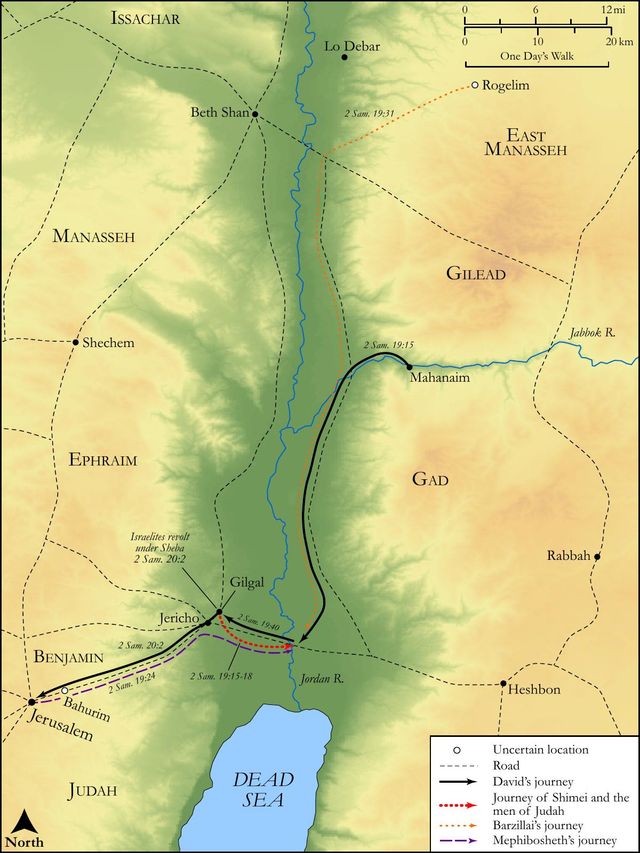
See on the biblical-era maps

Study this verse
Public-domain commentary
Matthew Henry
From his Commentary on the Whole Bible. Henry comments on passages, not single verses — this entry covers 2 Samuel 19:31–39. His three-level outline is real structure in the source text, so it is rendered as structure.
David had already graced the triumphs of his restoration with the generous remission of the injuries that had been done to him; we have him here gracing them with a no less generous reward of the kindnesses that had been shown to him. Barzillai, the Gileadite, who had a noble seat at Rogelim, not far from Mahanaim, was the man who, of all the nobility and gentry of that country, had been most kind to David in his distress. If Absalom had prevailed, it is likely he would have suffered for his loyalty; but now he and his shall be no losers by it. Here is,
I.Barzillai's great respect to David, not only as a good man, but as his righteous sovereign:
He provided him with much sustenance, for himself and his family, while he lay at Mahanaim, Sa2 19:32. God had given him a large estate, for he was a very great man, and, it seems, he had a large heart to do good with it: what else but that is a large estate good for? To reduced greatness generosity obliges us, and to oppressed goodness piety obliges us, to be in a particular manner kind, to the utmost of our power. Barzillai, to show that he was not weary of David, though he was so great a charge to him, attended him to Jordan, and went over with him, Sa2 19:31. Let subjects learn hence to render tribute to whom tribute is due and honour to whom honour, Rom 13:7.
II.The kind invitation David gave to him to court (Sa2 19:33): Come thou over with me. He invited him,
1.That he might have the pleasure of his company and the benefit of his counsel; for we may suppose that he was very wise and good, as well as very rich, otherwise he would not have been called here a very great man; for it is what a man is, more than what he has, that renders him truly great.
2.That he might have an opportunity of returning his kindness: "I will feed thee with me; thou shalt fare as sumptuously as I fare, and this at Jerusalem, the royal and holy city." David did not take Barzillai's kindness to him as a debt (he was not one of those arbitrary princes who think that whatever their subjects have is theirs when they please), but accepted it and rewarded it as a favour. We must always study to be grateful to our friends, especially to those who have helped us in distress.
III.Barzillai's reply to this invitation, wherein,
1.He admires the king's generosity in making him this offer, lessening his service, and magnifying the king's return for it: Why should the king recompense it with such a reward? Sa2 19:36. Will the master thank that servant who only does what was his duty to do? He though he had done himself honour enough in doing the king any service. Thus, when the saints shall be called to inherit the kingdom in consideration of what they have done for Christ in this world, they will be amazed at the disproportion between the service and the recompence. Mat 25:37, Lord, when saw we thee hungry, and fed thee?
2.He declines accepting the invitation. He begs his majesty's pardon for refusing so generous an offer: he should think himself very happy in being near the king, but,
(1.)He is old, and unfit to remove at all, especially to court. He is old, and unfit for the business of the court: "Why should I go up with the king to Jerusalem? I can do him no service there, in the council, the camp, the treasury, or the courts of justice; for how long have I to live? Sa2 19:34. Shall I think of going into business, now that I am going out of this world?" He is old and unfit for the diversions of the court, which will be ill-bestowed, and even thrown away, upon one that can relish them so little, Sa2 19:35. As it was in Moses's time, so it was in barzillai's and it is not worse now, that, if men be so strong that they come to fourscore years, their strength then is labour and sorrow, Psa 90:10. These were then, and are still, years of which men say they have no pleasure in them, Ecc 12:1. Dainties are insipid when desire fails, and songs to the aged ear are little better than those sung to a heavy heart, very disagreeable: how should they be otherwise when the daughters of music are brought low? Let those that are old learn of Barzillai to be dead to the delights of sense; let grace second nature, and make a virtue of the necessity. Nay, Barzillai, being old, thinks he shall be a burden to the king, rather than any credit to him; and a good man would not go any where to be burdensome, or, if he must be so, will rather be so to his own house than to another's.
(2.)He is dying, and must begin to think of his long journey, his removal out of the world, Sa2 19:37. It is good for us all, but it especially becomes old people to think and speak much of dying. "Talk of going to court!" says Barzillai; "Let me go home and die in my own city, the place of my father's sepulchre; let me die by the grave of my father, that my bones may be quietly carried to the place of their rest. The grave is ready for me, let me go and get ready for it, go and die in my nest."
3.He desires the king to be kind to his son Chimham: Let him go over with my lord the king, and have preferment at court. What favour is done to him Barzillai will take as done to himself. Those that are old must not grudge young people those delights which they themselves are past the enjoyment of, nor confine them to their retirements. Barzillai will go back himself, but he will not make Chimham go back with him; though he could ill spare Chimham, yet, thinking it would gratify and advance him, he is willing to do it.
IV.David's farewell to Barzillai.
1.He sends him back into his country with a kiss and a blessing (Sa2 19:39), signifying that in gratitude for his kindnesses he would love him and pray for him, and with a promise that whatever request he should at any time make to him he would be ready to oblige him (Sa2 19:38): Whatsoever thou shalt think of, when thou comest home, to ask of me, that will I do for thee. What is the chief excellency of power but this, that it gives men a capacity of doing the more good?
2.He takes Chimham forward with him, and leaves it to Barzillai to choose him his preferment. I will do to him what shall seem good to thee, Sa2 19:38. And, it should seem, Barzillai, who had experienced the innocency and safety of retirement, begged a country seat for him near Jerusalem, but not in it; for, long after, we read of a place near Beth-lehem, David's city, which is called the habitation of Chimham, allotted to him, probably, not out of the crown-lands or the forfeited estates, but out of David's paternal estate.
Continue studying 2 Samuel 19:33 across the web’s major study libraries — every link below opens this exact verse, chapter, or book on the destination site.
Read & Compare
 BibleGatewayThis verse in more than 200 translations and 70 languages.
 Bible.comThe YouVersion reader — hundreds of translations, reading plans, and highlights.
 ESV.orgCrossway's official English Standard Version reader.
 NET BibleThe NET translation with 60,000+ translators' notes on every rendering decision.
 STEP BibleTyndale House's free study tool — original text, vocabulary, and scholarly resources.
 BibliaLogos Bible Software's free web reader.
 USCCBThe New American Bible (Revised Edition) with the U.S. bishops' study notes.
Commentaries
 BibleHub CommentariesDozens of classic commentaries on this verse, gathered on one page.
 StudyLightMore than 100 commentary sets — the largest collection on the web.
 BibleRefPlain-English commentary on what this verse means, verse by verse.
 Enduring WordDavid Guzik's free commentary on this chapter, widely used by Bible teachers.
 Bible Study ToolsVerse commentary alongside Greek and Hebrew study aids.
Original Language & Research
- BibleHub InterlinearThe verse word by word — original language, transliteration, and English.
- BibleHub LexiconEvery word's original-language definition and Strong's entry.
 Blue Letter BibleDeep-study tools — Strong's numbers, concordance, and word studies.
 SefariaThe Hebrew text with Rashi and centuries of Jewish commentary.
Sermons, Hymns & Audio


TrulyRandomVerse is not affiliated with these sites and doesn’t control their content. They’re linked because they’re genuinely useful.
Summary
Following the devastating rebellion led by his son Absalom, King David, now returning to Jerusalem, extends a profound and personal invitation to Barzillai, a wealthy and loyal Gileadite. This verse captures David's heartfelt desire to bring Barzillai into the royal court in Jerusalem, promising to provide for him directly from the king's own table. This gesture serves as David's reciprocal act of honor and gratitude for the vital provisions and steadfast support Barzillai had offered during the king's perilous exile, underscoring David's recognition of faithful service and deep personal esteem.
Context
ShowHideLiterary Context
This verse is strategically placed at a critical juncture in David's reign, marking his triumphal yet emotionally complex return to Jerusalem after the traumatic flight from Absalom's rebellion. The preceding chapters meticulously detail David's desperate escape across the Jordan River and the ensuing civil war, a period of immense vulnerability for the king. As David makes his way back to his capital, he encounters various figures—some, like Shimei, seeking reconciliation and pardon (2 Samuel 19:16-23), and others, like Barzillai, who had demonstrated unwavering loyalty during David's darkest hour. David's interaction with Barzillai immediately follows his crossing of the Jordan and precedes his full re-establishment in Jerusalem, highlighting the king's immediate priority to acknowledge and reward those who stood by him. This episode serves as a powerful testament to David's character and his commitment to justice and gratitude.
Historical & Cultural Context
In the ancient Near Eastern world, an invitation to "eat with the king" or "be fed by the king" was among the highest honors a monarch could bestow. It signified far more than mere material provision; it implied royal patronage, security, and a permanent, esteemed place within the royal household. Such an offer guaranteed a lifetime provision, often extending to the individual's family, and served as a public declaration of the king's profound favor and trust. For a wealthy man like Barzillai from Gilead, who had no material need, David's offer was primarily an act of immense prestige, a symbol of their deep personal bond, and a public acknowledgment of his unwavering loyalty. This gesture mirrors David's earlier provision for Mephibosheth, Jonathan's son, who was also given a permanent place at the king's table, demonstrating a consistent royal practice of honoring those connected to the throne.
Key Themes
ShowHideThe passage powerfully articulates several core themes. Foremost is Gratitude and Reciprocity, as David actively seeks to repay Barzillai's extraordinary kindness and provision during his time of dire need (2 Samuel 17:27-29). It also profoundly highlights Loyalty and Faithful Service, exemplified by Barzillai's steadfast support for the legitimate king even when David's throne seemed lost and his life was in danger. David's offer underscores the immense value placed on such unwavering devotion within the kingdom. Furthermore, the passage speaks to Royal Provision and Honor, demonstrating the king's prerogative and responsibility to care for and elevate those who have served him faithfully, ensuring their well-being and acknowledging their esteemed place within the royal sphere. This act reinforces the idea of a covenantal relationship between king and loyal subject.
Exposition and Analysis
ShowHideKey Word Analysis
ShowHideThis term emphasizes David's restored authority and position. Despite his recent humiliation and flight from Absalom's rebellion, he is now firmly re-establishing his kingship. His offer to Barzillai is an exercise of his royal prerogative and generosity, demonstrating his capacity to reward and honor those who remained loyal, thereby solidifying his legitimate rule.
A primitive root meaning "to keep in; hence, to measure; figuratively, to maintain (in various senses)." While literally meaning "to sustain" or "to nourish," in this royal context, kûwl carries significant weight. It implies not just the provision of food but comprehensive care, maintenance, and support. To be "fed by the king" meant to be provided for from the royal treasury, ensuring a life of security and honor, free from want, signifying a permanent and privileged relationship.
Probably meaning "founded peaceful." More than just a geographical location, Jerusalem was David's capital, the city of the king, and soon to be the spiritual center of Israel. Bringing Barzillai to Jerusalem meant integrating him into the very heart of the kingdom, granting him access to the royal court, its resources, and its social and political life, a stark contrast to Barzillai's home in Gilead. It symbolized full inclusion and highest honor.
Verse Breakdown
ShowHide"And the king said unto Barzillai"
This opening clause immediately establishes the speaker and the recipient, emphasizing David's initiative and the personal, direct nature of the address. It highlights David's intentional engagement with Barzillai, signaling the importance and sincerity of the ensuing offer, coming directly from the highest authority in the land.
"Come thou over with me"
This is a direct, personal invitation from the king. "Over with me" refers to crossing the Jordan River back into the western territory of Israel and continuing with David to Jerusalem. It signifies a call to companionship, proximity, and shared journey with the king, a privilege reserved for those in high favor and trust, marking Barzillai's transition from supporter in exile to honored companion in the restored kingdom.
"and I will feed thee with me in Jerusalem"
This is the core of David's offer, a promise of permanent sustenance and inclusion within the royal household. The phrase "with me" underscores the personal nature of the provision – Barzillai would not merely be provided for by the king, but would share in the king's own provisions, perhaps even dining at the royal table. This was the ultimate expression of royal honor and gratitude, ensuring Barzillai's comfort, security, and elevated status in the capital, symbolizing full integration into the king's inner circle.
Literary Devices
ShowHideThe passage employs Direct Discourse to convey David's personal and heartfelt invitation, making the exchange immediate and impactful, allowing the reader to experience the king's sincere gratitude firsthand. The specific offer to "feed thee with me in Jerusalem" serves as powerful Symbolism for royal patronage, honor, and enduring gratitude. The act of sharing the king's table was a profound gesture of inclusion and a public declaration of favor, signifying a bond that transcended mere material provision, speaking to a deeper relationship of trust and belonging. Furthermore, the narrative uses Contrast between David's recent state of vulnerability and flight, where Barzillai provided for him, and his current position of restored authority, where he now offers provision, highlighting the principle of Reciprocity in action and demonstrating David's character as a just and grateful ruler.
Theological and Thematic Connections
ShowHideThis verse beautifully illustrates the biblical principle of honoring those who have served faithfully and the profound importance of expressing genuine gratitude. David's immediate desire to reward Barzillai reflects a divine pattern of remembering and recompensing acts of kindness and loyalty, especially those offered in times of distress and vulnerability. It demonstrates that true leadership, even in a fallen world, should be marked by a deep appreciation for loyal service and a commitment to care for those who have blessed others. This act of royal provision foreshadows God's own generous provision for His faithful servants, often through human instruments, and His ultimate promise of eternal sustenance and fellowship in His presence. It underscores that God, who sees all, will never forget the work and labor of love shown for His name.
Reflection and Application
ShowHideDavid's gracious offer to Barzillai serves as a powerful reminder for believers today to cultivate a spirit of genuine gratitude and to actively seek opportunities to honor and bless those who have shown us kindness, loyalty, or support, especially during difficult times. It challenges us to move beyond mere verbal thanks to tangible expressions of appreciation, whether through practical help, recognition, or simply by being present for others in their moments of need. Just as David remembered Barzillai's provision when he was vulnerable and then reciprocated from his position of strength, we are called to remember and reciprocate the love and service we receive, reflecting God's own character of faithfulness and generosity. This passage also encourages us to be willing instruments of God's provision for others, recognizing that our resources and abilities, no matter how great or small, can be used to sustain and uplift those in need, just as Barzillai faithfully served David, and David, in turn, sought to honor Barzillai.
Questions for Reflection
ShowHideFAQ
ShowHideWho was Barzillai, and what was his significance to King David?
ShowHideBarzillai was a very wealthy and elderly Gileadite from Rogelim who demonstrated extraordinary loyalty and generosity to King David during the most vulnerable period of his reign. When David fled Jerusalem during Absalom's rebellion, he and his followers were in dire straits, lacking basic provisions. Barzillai, along with others, provided vital supplies, including food, bedding, and utensils, for David's weary army and household in Mahanaim (2 Samuel 17:27-29). His actions were crucial for sustaining David's forces and showed unwavering support for the legitimate king when many others had abandoned him or joined the rebellion, making him a true hero of loyalty.
Why was David's offer to "feed thee with me in Jerusalem" such a significant gesture?
ShowHideIn ancient Israel, an invitation to be fed by the king, especially to "eat with me" (meaning at the royal table), was the highest form of honor and royal patronage. It signified a lifetime provision, security, and a permanent, esteemed place within the royal court. It was a public declaration of the king's favor and a guarantee of sustenance and protection. For Barzillai, who was already wealthy, this offer was less about material need and more about the immense prestige, recognition, and personal fellowship with the king it implied. It solidified his status as a trusted and honored friend of the crown, akin to the honor shown to Mephibosheth, who was given a permanent place at David's table.
Did Barzillai accept David's offer to come to Jerusalem?
ShowHideNo, Barzillai respectfully declined David's offer, as recorded in the verses immediately following 2 Samuel 19:33. In 2 Samuel 19:34-37, Barzillai explains that he is too old (80 years old) to fully enjoy the pleasures and demands of court life in Jerusalem and would prefer to die in his own city. However, he graciously suggested that David take his servant (or son, depending on interpretation) Chimham in his place, ensuring that David's generosity would still benefit his household. David honored this request and took Chimham with him, promising to care for him. This demonstrates Barzillai's humility and wisdom, and David's enduring gratitude, which extended to Barzillai's descendants, as seen in David's final instructions to Solomon in 1 Kings 2:7.
Christ-Centered Fulfillment
ShowHideDavid's gracious and reciprocal offer to Barzillai, promising him a place at the royal table and lifelong provision in Jerusalem, beautifully foreshadows the ultimate invitation extended by the King of Kings, Jesus Christ. Just as David, the earthly king, remembered and rewarded the faithful service of one who provided for him in his time of need, so too does our heavenly King remember every act of kindness shown to Him and to His "least of these." Christ, the true Son of David, invites all who have faithfully served Him and His kingdom into His eternal presence, promising not merely earthly provision but everlasting life and a place at the heavenly banquet. The imagery of being "fed with me in Jerusalem" finds its ultimate fulfillment in the New Covenant, where believers are invited to the Marriage Supper of the Lamb and to partake of the Bread of Life, Jesus Himself. He provides eternal sustenance, perfect fellowship, and a secure dwelling, ensuring that those who have been loyal and faithful to Him will dwell forever in His presence in the New Jerusalem, where every need is met and every act of love is eternally rewarded, as promised in Matthew 25:34.