


2 Samuel 9:11
Bible text: King James Version (1769 Blayney text) · Public domain
Bible text: King James Version with Strong's numbers · Public domain
Bible text: Berean Standard Bible · Public domain
Bible text: American Standard Version (1901) · Public domain
Bible text: World English Bible, Messianic edition · Public domain
Bible text: Geneva Bible (1599) · Public domain
Bible text: Young's Literal Translation · Public domain
- וַיֹּאמֶרvai·Yo·merand he saidH559Conj-w ¦ V-Qal-ConsecImperf-3msVerb Qal Consecutive Imperfect 3rd Singular Masculineוַandיֹּאמֶרhe said
- צִיבָאtzi·Va'ZibaH6717N-proper-mNoun Proper Masculine
- אֶל'eltoH413PrepPreposition
- הַמֶּלֶךְha·Me·lekhthe kingH4428Art ¦ N-msNoun Singular Masculine Absoluteהַtheמֶּלֶךְking
- כְּכֹלke·Kholaccording to allH3605Prep-k ¦ N-msNoun Singular Masculine Absoluteכְּaccording toכֹלall
- אֲשֶׁר'a·SherthatH834RelParticle Relative
- יְצַוֶּהye·tza·Vehhe will commandH6680V-Piel-Imperf-3msVerb Piel Imperfect 3rd Singular Masculine
- אֲדֹנִי'a·do·Nimy lordH113N-msc ¦ 1csNoun Singular Masculine Constructאֲדֹנִlordיmy
- הַמֶּלֶךְha·Me·lekhthe kingH4428Art ¦ N-msNoun Singular Masculine Absoluteהַtheמֶּלֶךְking
- אֶת'et<obj.>H853DirObjMParticle Object Indicator
- עַבְדּוֹav·Dohis servantH5650N-msc ¦ 3msNoun Singular Masculine Constructעַבְדּservantוֹhis
- כֵּןkensoH3651AdvAdverb
- יַעֲשֶׂהya·'a·Sehhe will doH6213V-Qal-Imperf-3msVerb Qal Imperfect 3rd Singular Masculine
- עַבְדֶּךָ'av·De·khayour servantH5650N-msc ¦ 2msNoun Singular Masculine Constructעַבְדֶּservantךָyour
- וּמְפִיבֹשֶׁתu·me·fi·Vo·shetand MephiboshethH4648Conj-w ¦ N-proper-mNoun Proper MasculineוּandמְפִיבֹשֶׁתMephibosheth
- אֹכֵל'o·Khel[was] eatingH398V-Qal-Prtcpl-msVerb Qal Participle Singular Masculine Absolute
- עַל'alonH5921PrepPreposition
- שֻׁלְחָנִיshul·cha·Nimy tableH7979N-msc ¦ 1csNoun Singular Masculine Constructשֻׁלְחָנִtableיmy
- כְּאַחַדke·'a·Chadlike oneH259Prep-k ¦ N-fsNoun Singular Feminine Absoluteכְּlikeאַחַדone
- מִבְּנֵיmi·be·Neifrom [the] children ofH1121Prep-m ¦ N-mpcNoun Plural Masculine Constructמִfromבְּנֵי[the] children of
- הַמֶּלֶךְha·Me·lekhthe kingH4428Art ¦ N-msNoun Singular Masculine Absoluteהַtheמֶּלֶךְking
English is a literal word-by-word gloss of the Hebrew, not the KJV's wording. Why?
This is the original text the KJV's translators worked from — each Hebrew word with its own literal English meaning in this verse, prepared by scholars at Tyndale House, Cambridge. The KJV translates whole sentences, not word by word, so its wording differs: one Hebrew word can become several English words, and the KJV may choose “the LORD” where the gloss reads “Yahweh”. Both are faithful — they answer different questions. For the KJV's own rendering, switch to the KJV text.
Details
See on the biblical-era maps
Study this verse
Public-domain commentary
Matthew Henry
From his Commentary on the Whole Bible. Henry comments on passages, not single verses — this entry covers 2 Samuel 9:9–13.
The matter is here settled concerning Mephibosheth. 1. This grant of his father's estate is confirmed to him, and Ziba called to be a witness to it (Sa2 9:9); and, it should seem, Saul had a very good estate, for his father was a mighty man of substance (Sa1 9:1), and he had fields and vineyards to bestow, Sa1 22:7. Be it ever so much, Mephibosheth is now master of it all. 2. The management of the estate is committed to Ziba, who knew what it was and how to make the most of it, in whom, having been his father's servant, he might confide, and who, having a numerous family of sons and servants, had hands sufficient to be employed about it, Sa2 9:10. Thus Mephibosheth is made very easy, having a good estate without care, and is in a fair way of being very rich, having much coming in and little occasion to spend, himself being kept at David's table. Yet he must have food to eat besides his own bread, provisions for his son and servants; and Ziba's sons and servants would come in for their share of his revenue, for which reason perhaps their number is here mentioned, fifteen sons and twenty servants, who would require nearly all there was; for as goods are increased those are increased that eat them, and what good has the owner thereof save the beholding of them with his eyes? Ecc 5:11. All that dwelt in the house of Ziba were servants to Mephibosheth (Sa2 9:12), that is, they all lived upon him, and made a prey of his estate, under pretence of waiting on him and doing him service. The Jews have a saying, "He that multiplies servants multiplies thieves." Ziba is now pleased, for he loves wealth, and will have abundance. "As the king has commanded, so will thy servant do, Sa2 9:11. Let me alone with the estate: and as for Mephibosheth" (they seem to be Ziba's words), "if the king please, he need not trouble the court, he shall eat at my table, and be as well treated as one of the king's sons." But David will have him at his own table, and Mephibosheth is as well pleased with his post as Ziba with his. How unfaithful Ziba was to him we shall find afterwards, Sa2 16:3. Now because David was a type of Christ, his Lord and son, his root and offspring, let his kindness to Mephibosheth serve to illustrate the kindness and love of God our Saviour towards fallen man, which yet he was under no obligation to, as David was to Jonathan. Man was convicted of rebellion against God, and, like Saul's house, under a sentence of rejection from him, was not only brought low and impoverished, but lame and impotent, made so by the fall. The Son of God enquires after this degenerate race, that enquired not after him, comes to seek and save them. To those of them that humble themselves before him, and commit themselves to him, he restores the forfeited inheritance, he entitles them to a better paradise than that which Adam lost, and takes them into communion with himself, sets them with his children at his table, and feasts them with the dainties of heaven. Lord, what is man, that thou shouldst thus magnify him!
Continue studying 2 Samuel 9:11 across the web’s major study libraries — every link below opens this exact verse, chapter, or book on the destination site.
Read & Compare
 BibleGatewayThis verse in more than 200 translations and 70 languages.
 Bible.comThe YouVersion reader — hundreds of translations, reading plans, and highlights.
 ESV.orgCrossway's official English Standard Version reader.
 NET BibleThe NET translation with 60,000+ translators' notes on every rendering decision.
 STEP BibleTyndale House's free study tool — original text, vocabulary, and scholarly resources.
 BibliaLogos Bible Software's free web reader.
 USCCBThe New American Bible (Revised Edition) with the U.S. bishops' study notes.
Commentaries
 BibleHub CommentariesDozens of classic commentaries on this verse, gathered on one page.
 StudyLightMore than 100 commentary sets — the largest collection on the web.
 BibleRefPlain-English commentary on what this verse means, verse by verse.
 Enduring WordDavid Guzik's free commentary on this chapter, widely used by Bible teachers.
 Bible Study ToolsVerse commentary alongside Greek and Hebrew study aids.
Original Language & Research
- BibleHub InterlinearThe verse word by word — original language, transliteration, and English.
- BibleHub LexiconEvery word's original-language definition and Strong's entry.
 Blue Letter BibleDeep-study tools — Strong's numbers, concordance, and word studies.
 SefariaThe Hebrew text with Rashi and centuries of Jewish commentary.
Sermons, Hymns & Audio


TrulyRandomVerse is not affiliated with these sites and doesn’t control their content. They’re linked because they’re genuinely useful.
Summary
2 Samuel 9:11 records Ziba's dutiful response to King David's decree concerning Mephibosheth, Jonathan's son. The verse confirms David's profound commitment to his covenant with Jonathan, not only by restoring Mephibosheth's ancestral lands but, more significantly, by granting him a perpetual place at the royal table, affording him the honor and intimate fellowship reserved for the king's own children. This extraordinary act of grace elevates Mephibosheth from a state of neglect and fear to one of full acceptance, provision, and privileged belonging within the royal household.
Context
ShowHideLiterary Context
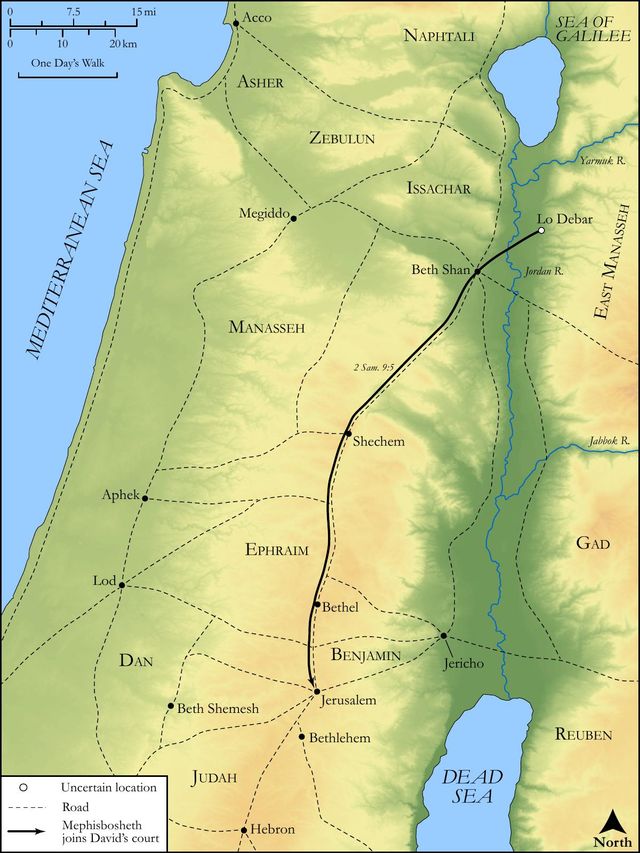
This verse is a pivotal moment within 2 Samuel 9, a chapter that beautifully illustrates David's chesed (steadfast love/kindness). The narrative immediately follows David's consolidation of power and the establishment of Jerusalem as his capital, marking a period of relative peace and stability. David, remembering his covenant with Jonathan, proactively seeks out any surviving member of Saul's house, not to eliminate them as was customary for new dynasties, but "that I may show him kindness for Jonathan's sake" (2 Samuel 9:1). This search leads him to Mephibosheth, Jonathan's son, who was lame in both feet from a childhood accident (2 Samuel 4:4). David's initial decree, outlined in 2 Samuel 9:7, restores all of Saul's land to Mephibosheth and commands Ziba, Saul's former servant, and his household, to cultivate it for Mephibosheth's sustenance. Verse 11 functions as Ziba's formal and obedient affirmation of David's command, specifically reiterating the unparalleled privilege of Mephibosheth's permanent place at the king's table, thereby solidifying his newly elevated status within the royal family.
Historical & Cultural Context
Among the kings of that day, the practice of a newly established dynasty was typically to eliminate all potential rivals from the previous ruling house to prevent future insurrections. David's actions, therefore, represent a radical departure from this brutal norm, showcasing an exceptional act of grace, mercy, and covenant fidelity. The concept of "eating at the king's table" held immense cultural significance, transcending mere physical nourishment. It was a profound symbol of royal favor, protection, and complete inclusion into the monarch's inner circle. Such an invitation signified an unbreakable bond, shared life, and a permanent, secure place within the most powerful and protected household in the land. For Mephibosheth, a descendant of the former rival king and a physically disabled individual (a condition that often carried social stigma and could lead to neglect), this invitation was an unparalleled act of honor, acceptance, and security, transforming his status from obscurity and potential danger to the highest echelon of society.
Key Themes
ShowHideThis verse profoundly contributes to several overarching themes within the book of 2 Samuel and the broader biblical narrative. Firstly, it powerfully exemplifies Covenant Faithfulness, highlighting David's unwavering commitment to the solemn oath he had made with Jonathan, his beloved friend, to extend kindness to his descendants (1 Samuel 20:14-17 and 1 Samuel 20:42). This loyalty transcends political expediency and personal gain, demonstrating the sanctity of a sworn oath. Secondly, the narrative underscores the theme of Unmerited Grace and Mercy (Hebrew: chesed). Mephibosheth had no inherent claim on David's kindness; as a surviving member of the former dynasty, he could have been viewed as a threat. Instead, David extended extraordinary kindness, demonstrating a love that goes beyond what is deserved or expected, flowing purely from the king's gracious heart. Thirdly, the story showcases Radical Restoration and Inclusion. Mephibosheth, living in fear and obscurity in Lo-Debar ("no pasture" or "no word"), is sought out and brought into the very presence of the king, receiving full provision, honor, and security. He is elevated from a state of exile and neglect to intimate fellowship. Finally, the Symbolism of the King's Table is paramount. Eating at the king's table signifies not just physical provision but deep fellowship, acceptance, protection, and a shared identity. It represents a permanent place within the royal family, regardless of one's past or physical condition, embodying complete belonging and security.
Exposition and Analysis
ShowHideKey Word Analysis
ShowHideA primitive root meaning "to eat (literally or figuratively)." In this context, it refers to the literal act of consuming food, but its significance is amplified by the location – "at my table." This act of eating together symbolizes fellowship, shared life, and the provision of the king. For Mephibosheth, it meant not only sustenance but also a permanent place of honor and security.
Meaning "a table (as spread out); by implication, a meal." The table, especially a king's table, was more than just furniture; it was a central symbol of hospitality, covenant, and intimate fellowship. To be invited to the king's table meant a permanent welcome into his inner circle, sharing in his abundance, protection, and daily life. It signifies a profound shift in Mephibosheth's status from an outsider to an insider.
Meaning "a son (as a builder of the family name), in the widest sense (of literal and figurative relationship, including grandson, subject, nation, quality or condition, etc.)." The phrase "as one of the king's sons" is crucial. It indicates that Mephibosheth was not merely a guest or a recipient of charity, but was granted a status akin to adoption. He would enjoy the same privileges, security, and honor as David's own biological children, signifying complete integration into the royal family and an unbreakable bond of belonging.
Verse Breakdown
ShowHide"Then said Ziba unto the king, According to all that my lord the king hath commanded his servant, so shall thy servant do."
This opening clause establishes Ziba's immediate and unequivocal acceptance of David's command. It highlights the absolute authority of the king's word and the servant's faithful, obedient submission. This affirmation sets the stage for the confirmation of Mephibosheth's elevated status, emphasizing that the king's decree will be fully implemented.
"As for Mephibosheth, [said the king],"
This parenthetical insertion clarifies that the subsequent, pivotal declaration originates directly from King David himself. It re-emphasizes David's personal initiative and specific command regarding Mephibosheth, underscoring the personal and intentional nature of his grace and the king's direct involvement in securing Mephibosheth's future.
"he shall eat at my table, as one of the king's sons."
This is the central and most profound declaration of the verse. It elevates Mephibosheth's status beyond the mere restoration of land to full and permanent inclusion within the royal family. "Eating at my table" signifies continuous fellowship, provision, and protection, while "as one of the king's sons" denotes an adopted status, granting him all the privileges, security, and dignity afforded to David's own children, regardless of his lineage or physical condition. It is the ultimate expression of David's chesed.
Literary Devices
ShowHideThe verse employs several powerful literary devices to convey its profound message. Repetition is evident in the reiteration of David's command concerning Mephibosheth's dining at the king's table, first implied by David's earlier decree and then explicitly affirmed by Ziba in this verse. This repetition emphasizes the importance, permanence, and non-negotiable nature of the king's gracious decree. Symbolism is profoundly present in the image of "eating at the king's table," which transcends a simple meal to represent complete acceptance, abundant provision, unwavering protection, and intimate fellowship within the royal household. This symbolic act transforms Mephibosheth's identity and status from an overlooked figure to a privileged insider. Furthermore, there is a strong sense of Contrast between Mephibosheth's former state of fear, lameness, and obscurity in Lo-Debar ("no pasture") and his new reality of honor, security, and intimacy at the royal table, highlighting the radical and transformative nature of David's unmerited grace.
Theological and Thematic Connections
ShowHideThe narrative of David and Mephibosheth serves as a profound Old Testament illustration of God's unmerited grace towards humanity. Like Mephibosheth, who was "lame" and from a "rival" house, humanity is spiritually broken by sin and alienated from God, with no inherent claim to His favor or presence. Yet, through His boundless kindness and chesed, God initiates a search for us, not to condemn, but to redeem and restore. He brings us into His presence, not merely as servants, but as adopted children, granting us a permanent place at His table of fellowship and abundant provision. This concept resonates deeply with the New Testament teaching on salvation by grace through faith and our adoption into God's family, where our worth and security come not from our own abilities, lineage, or merit, but entirely from the King's gracious invitation and steadfast covenant love.
Reflection and Application
ShowHideThe story of Mephibosheth at David's table offers a compelling mirror for our own spiritual journey. We, too, are often spiritually "lame," disabled by sin, and deserving of nothing but judgment and separation from a holy God. Yet, in His magnificent grace, God seeks us out, not to punish, but to restore and reconcile. He invites us to His table, a place of intimate fellowship, abundant provision, and unwavering security, treating us "as one of His own sons and daughters." This profound truth should evoke deep gratitude, humility, and worship within us, reminding us that our standing before God is entirely dependent on His unmerited favor and covenant faithfulness, not our performance or inherent worth. Furthermore, David's radical act of grace challenges us to extend similar kindness and inclusion to others, especially those who are despised, overlooked, or even perceived as "enemies." It calls us to embody the chesed of God in our relationships, seeking opportunities to restore, include, and honor those whom society might otherwise cast aside, thereby reflecting the very heart of our gracious King.
Questions for Reflection
ShowHideFAQ
ShowHideWhat does "eating at the king's table" signify in Scripture?
ShowHideIn Scripture, eating at the king's table was a profound symbol of royal favor, protection, and complete inclusion. It was far more than a mere meal; it represented a permanent, secure, and honored place within the royal household. Those who dined regularly with the king were considered part of his inner circle, enjoying his personal protection, provision, and intimate fellowship. For Mephibosheth, it signified a complete reversal of fortune, elevating him from a state of fear and obscurity to a position of immense privilege and security, treated "as one of the king's sons."
Why was Mephibosheth lame, and how did this affect his status?
ShowHideMephibosheth became lame as a child at the age of five. When news of Saul's and Jonathan's deaths reached his nurse, she fled in panic, and in her haste, Mephibosheth fell and became crippled in both feet (2 Samuel 4:4). Physical disabilities often carried significant social stigma and could lead to neglect or exclusion from public life and positions of honor. His lameness, combined with his lineage from the former king, made his invitation to David's table an even more extraordinary and counter-cultural act of grace and inclusion, demonstrating David's profound compassion.
Why did David show such kindness to a descendant of Saul, his former rival?
ShowHideDavid's extraordinary kindness to Mephibosheth was primarily motivated by his unwavering covenant loyalty to Jonathan, Mephibosheth's father. Years prior, David and Jonathan had made a solemn covenant before the Lord to show kindness to each other's descendants, even after their deaths (1 Samuel 20:14-17 and 1 Samuel 20:42). David's actions in 2 Samuel 9 are a direct and faithful fulfillment of this sacred oath, demonstrating his integrity and faithfulness to his word. It also powerfully showcased David's character as a king who ruled with grace and mercy, contrasting sharply with the typical ruthless practices of eliminating rival dynasties among the kings of that day.
Christ-Centered Fulfillment
ShowHideThe story of David and Mephibosheth serves as a profound and beautiful foreshadowing of God's redemptive grace revealed supremely in Jesus Christ. Just as Mephibosheth was "lame" and helpless, estranged from the king's presence by circumstance and his lineage from a rival house, humanity is spiritually "lame" and utterly incapable of approaching a holy God due to the crippling effects of sin. Yet, the true King, Jesus, initiates the search for us, not to condemn, but to reconcile and bring us into His eternal kingdom. He is the ultimate Lamb of God, who takes away the sin of the world!, who demonstrated His love for us by dying for us while we were still sinners and enemies (Romans 5:6-8). Through His atoning sacrifice, Christ has brought us near, reconciling us to God in His own body (Colossians 1:21-22). We are no longer strangers and aliens but fellow citizens with the saints and cherished members of the household of God (Ephesians 2:19-20). We are adopted as sons and daughters, granted full access to the Father, and invited to an eternal feast at the King's table—the glorious Marriage Supper of the Lamb. Mephibosheth's story is a tangible, historical picture of the spiritual reality of our redemption, adoption, and inclusion into God's eternal family through the unparalleled grace of Christ.