


2 Samuel 9:12
Bible text: King James Version (1769 Blayney text) · Public domain
Bible text: Berean Standard Bible · Public domain
Bible text: American Standard Version (1901) · Public domain
Bible text: World English Bible, Messianic edition · Public domain
Bible text: Geneva Bible (1599) · Public domain
Bible text: Young's Literal Translation · Public domain
- וְלִמְפִיבֹשֶׁתve·lim·fi·Vo·shetand [belonged] to MephiboshethH4648Conj-w ¦ Prep-l ¦ N-proper-mNoun Proper Masculineוְandלִ[belonged] toמְפִיבֹשֶׁתMephibosheth
- בֵּןbena sonH1121N-msNoun Singular Masculine Absolute
- קָטָןka·TanyoungH6996Adj-msAdjective Singular Masculine Absolute
- וּשְׁמוֹu·she·Moand his nameH8034Conj-w ¦ N-msc ¦ 3msNoun Singular Masculine Constructוּandשְׁמnameוֹhis
- מִיכָאmi·Kha'[was] MicaH4316N-proper-mNoun Proper Masculine
- וְכֹלve·Kholand everyH3605Conj-w ¦ N-mscNoun Singular Masculine Constructוְandכֹלevery
- מוֹשַׁבmo·Shav<the> resident ofH4186N-mscNoun Singular Masculine Construct
- בֵּיתbeit[the] house ofH1004N-mscNoun Singular Masculine Construct
- צִיבָאtzi·Va'ZibaH6717N-proper-mNoun Proper Masculine
- עֲבָדִים'a·va·Dim[were] servantsH5650N-mpNoun Plural Masculine Absolute
- לִמְפִיבֹשֶׁתlim·fi·Vo·shetof MephiboshethH4648Prep-l ¦ N-proper-mNoun Proper MasculineלִofמְפִיבֹשֶׁתMephibosheth
English is a literal word-by-word gloss of the Hebrew, not the KJV's wording. Why?
This is the original text the KJV's translators worked from — each Hebrew word with its own literal English meaning in this verse, prepared by scholars at Tyndale House, Cambridge. The KJV translates whole sentences, not word by word, so its wording differs: one Hebrew word can become several English words, and the KJV may choose “the LORD” where the gloss reads “Yahweh”. Both are faithful — they answer different questions. For the KJV's own rendering, switch to the KJV text.
Details
See on the biblical-era maps

Study this verse
Public-domain commentary
Matthew Henry
From his Commentary on the Whole Bible. Henry comments on passages, not single verses — this entry covers 2 Samuel 9:9–13.
The matter is here settled concerning Mephibosheth. 1. This grant of his father's estate is confirmed to him, and Ziba called to be a witness to it (Sa2 9:9); and, it should seem, Saul had a very good estate, for his father was a mighty man of substance (Sa1 9:1), and he had fields and vineyards to bestow, Sa1 22:7. Be it ever so much, Mephibosheth is now master of it all. 2. The management of the estate is committed to Ziba, who knew what it was and how to make the most of it, in whom, having been his father's servant, he might confide, and who, having a numerous family of sons and servants, had hands sufficient to be employed about it, Sa2 9:10. Thus Mephibosheth is made very easy, having a good estate without care, and is in a fair way of being very rich, having much coming in and little occasion to spend, himself being kept at David's table. Yet he must have food to eat besides his own bread, provisions for his son and servants; and Ziba's sons and servants would come in for their share of his revenue, for which reason perhaps their number is here mentioned, fifteen sons and twenty servants, who would require nearly all there was; for as goods are increased those are increased that eat them, and what good has the owner thereof save the beholding of them with his eyes? Ecc 5:11. All that dwelt in the house of Ziba were servants to Mephibosheth (Sa2 9:12), that is, they all lived upon him, and made a prey of his estate, under pretence of waiting on him and doing him service. The Jews have a saying, "He that multiplies servants multiplies thieves." Ziba is now pleased, for he loves wealth, and will have abundance. "As the king has commanded, so will thy servant do, Sa2 9:11. Let me alone with the estate: and as for Mephibosheth" (they seem to be Ziba's words), "if the king please, he need not trouble the court, he shall eat at my table, and be as well treated as one of the king's sons." But David will have him at his own table, and Mephibosheth is as well pleased with his post as Ziba with his. How unfaithful Ziba was to him we shall find afterwards, Sa2 16:3. Now because David was a type of Christ, his Lord and son, his root and offspring, let his kindness to Mephibosheth serve to illustrate the kindness and love of God our Saviour towards fallen man, which yet he was under no obligation to, as David was to Jonathan. Man was convicted of rebellion against God, and, like Saul's house, under a sentence of rejection from him, was not only brought low and impoverished, but lame and impotent, made so by the fall. The Son of God enquires after this degenerate race, that enquired not after him, comes to seek and save them. To those of them that humble themselves before him, and commit themselves to him, he restores the forfeited inheritance, he entitles them to a better paradise than that which Adam lost, and takes them into communion with himself, sets them with his children at his table, and feasts them with the dainties of heaven. Lord, what is man, that thou shouldst thus magnify him!
Continue studying 2 Samuel 9:12 across the web’s major study libraries — every link below opens this exact verse, chapter, or book on the destination site.
Read & Compare
 BibleGatewayThis verse in more than 200 translations and 70 languages.
 Bible.comThe YouVersion reader — hundreds of translations, reading plans, and highlights.
 ESV.orgCrossway's official English Standard Version reader.
 NET BibleThe NET translation with 60,000+ translators' notes on every rendering decision.
 STEP BibleTyndale House's free study tool — original text, vocabulary, and scholarly resources.
 BibliaLogos Bible Software's free web reader.
 USCCBThe New American Bible (Revised Edition) with the U.S. bishops' study notes.
Commentaries
 BibleHub CommentariesDozens of classic commentaries on this verse, gathered on one page.
 StudyLightMore than 100 commentary sets — the largest collection on the web.
 BibleRefPlain-English commentary on what this verse means, verse by verse.
 Enduring WordDavid Guzik's free commentary on this chapter, widely used by Bible teachers.
 Bible Study ToolsVerse commentary alongside Greek and Hebrew study aids.
Original Language & Research
- BibleHub InterlinearThe verse word by word — original language, transliteration, and English.
- BibleHub LexiconEvery word's original-language definition and Strong's entry.
 Blue Letter BibleDeep-study tools — Strong's numbers, concordance, and word studies.
 SefariaThe Hebrew text with Rashi and centuries of Jewish commentary.
Sermons, Hymns & Audio


TrulyRandomVerse is not affiliated with these sites and doesn’t control their content. They’re linked because they’re genuinely useful.
Summary
2 Samuel 9:12 serves as the concluding affirmation of King David's profound grace toward Mephibosheth, Jonathan's son. This verse solidifies Mephibosheth's full restoration by detailing the continuation of his lineage through his young son, Micha, and by establishing his authority over Ziba's entire household, who are now designated as his servants. It powerfully illustrates the complete reversal of Mephibosheth's circumstances, transforming him from a vulnerable and fearful individual into a man of honor, influence, and secure provision under the benevolent care of the Davidic monarchy.
Context
ShowHideLiterary Context
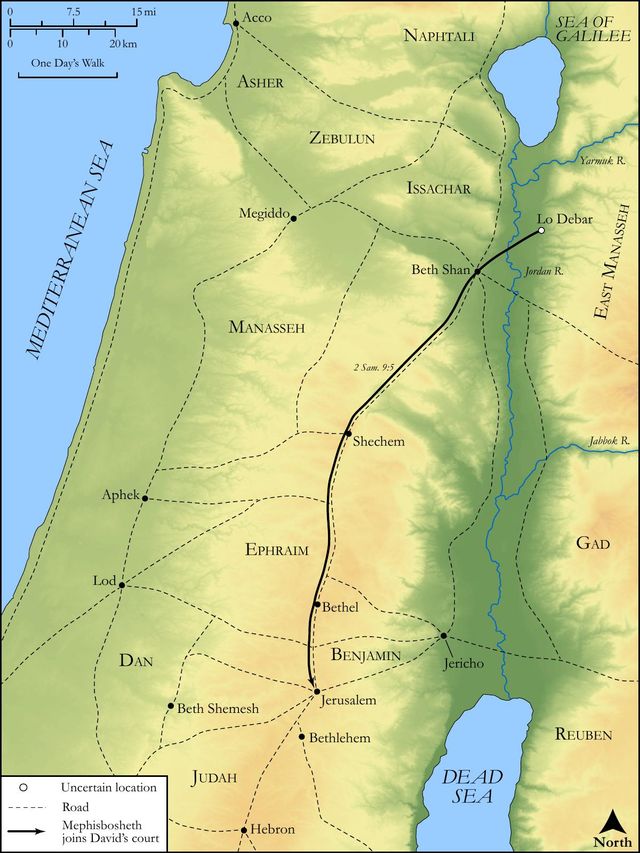
This verse provides the practical culmination of the narrative initiated in 2 Samuel 9:1, where King David, driven by his covenant loyalty to Jonathan, sought out any surviving members of Saul's house. After Ziba, a former servant of Saul, revealed Mephibosheth's existence and location in Lo-debar (2 Samuel 9:3-5), David immediately summoned him. Mephibosheth, expecting death as a remnant of the previous dynasty, approached David with profound humility and fear (2 Samuel 9:6). Instead, David not only restored all of Saul's land to him but also commanded Ziba and his sons to cultivate it for Mephibosheth's benefit. Crucially, Mephibosheth was granted the extraordinary privilege of eating continually at the king's table, treating him as one of David's own sons. 2 Samuel 9:12 therefore acts as the final, concrete declaration of Mephibosheth's re-established status, demonstrating the full extent of his restored dignity and authority, not merely in terms of land and royal favor, but also through the establishment of his own household and control over servants.
Historical & Cultural Context
Among the kings of that day, it was a common and often ruthless practice for newly established dynasties to eliminate all potential claimants or surviving members of the previous ruling house to prevent future rebellions and consolidate power. Saul's remaining descendants, particularly a grandson like Mephibosheth, would typically face execution. David's actions, therefore, represent an exceptional departure from this norm, deeply rooted in his solemn covenant with Jonathan (1 Samuel 20:14-17). The act of eating at the king's table was a profound symbol of acceptance, honor, and inclusion into the royal family, granting the recipient protection, provision, and a secure place within the kingdom. The transfer of Ziba's household, which included his sons and servants, to Mephibosheth's service was not a minor detail but a significant cultural marker of wealth, status, and authority. It meant Mephibosheth was now a master with a functioning estate, fully integrated into the economic and social fabric of the kingdom, operating under David's direct patronage. This also underscored the importance of loyal stewardship, as Ziba was now tasked with managing Mephibosheth's affairs.
Key Themes
ShowHideThe overarching theme in this chapter, culminating in 2 Samuel 9:12, is Extraordinary Grace and Kindness. David's actions are not based on Mephibosheth's merit, power, or even his ability to contribute, but solely on David's benevolent will and unwavering covenant commitment. This grace is extended to the undeserving and the vulnerable, transforming a fearful, lame man into a prince. Closely related is Covenant Faithfulness, as David meticulously fulfills his oath to Jonathan, demonstrating the sanctity and enduring nature of sacred promises, mirroring God's own faithfulness to His covenants with humanity. The mention of Micha signifies Dynastic Continuity, ensuring that the line of Jonathan, and by extension Saul, would not be extinguished. However, this continuity is now firmly established under the benevolent umbrella of David's reign, symbolizing a unified kingdom rather than a divided one. Finally, the transfer of Ziba's household to Mephibosheth's service highlights Restoration of Status and Authority, indicating a complete reversal of fortune and the conferral of significant responsibilities and resources upon one who was previously destitute. This restoration is not just symbolic but profoundly practical, establishing Mephibosheth as a true master of his own household.
Exposition and Analysis
ShowHideKey Word Analysis
ShowHideH4316 - This name, meaning "who is like God?" or "who is like Yahweh?", signifies the continuation of Mephibosheth's lineage. The mention of a son, particularly one with such a theophoric name, ensures that Jonathan's line, though diminished, would not be cut off. In a culture where family continuity and the preservation of a family name were paramount, this detail solidifies the complete nature of David's restoration, extending beyond Mephibosheth himself to his posterity. It hints at future hope and stability for the once-threatened house of Saul, now securely integrated into David's kingdom.
H1121 - This term refers to a male offspring, but in its broader sense, it encompasses the idea of a "builder of the family name." The presence of a "young son" for Mephibosheth is crucial for dynastic purposes. It confirms that the line of Jonathan, and thus Saul, would not be completely eradicated, a common fate for defeated royal families. This detail underscores the depth of David's grace, as he not only restores Mephibosheth personally but also ensures the continuation and future of his family within the established Davidic kingdom.
H5650 - This term, though singular in its Strong's root, is used here in its plural form ('avadim) to refer to the household staff, including Ziba's sons and his own servants, who were now placed under Mephibosheth's authority. The designation of Ziba's entire household as "servants unto Mephibosheth" underscores the profound reversal of roles and the complete transfer of resources and social standing. Mephibosheth, who was previously dependent and living in obscurity, is now a master, possessing the means and personnel to manage his restored lands and household, reflecting his elevated status and dignity.
Verse Breakdown
ShowHide"And Mephibosheth had a young son, whose name [was] Micha."
This clause provides a crucial detail about Mephibosheth's family, emphasizing the continuation of his lineage. The existence of a son, Micha, ensures that Jonathan's line would not be extinguished, a significant aspect in ancient Israelite culture where the preservation of a family name and inheritance was vital. It signifies not just Mephibosheth's personal restoration but also the future security and continuity of his lineage under the protective wing of David's kingdom, contrasting sharply with the typical fate of vanquished royal houses.
"And all that dwelt in the house of Ziba [were] servants unto Mephibosheth."
This second clause highlights the practical and comprehensive nature of Mephibosheth's restoration. Ziba, who was Saul's former servant and had been charged by David with managing all of Saul's former property for Mephibosheth, along with his entire household (sons and servants), are now explicitly designated as Mephibosheth's servants. This signifies a complete transfer of authority, resources, and labor. Mephibosheth is no longer merely a recipient of charity but is fully reinstated as a landowner and master, with a substantial household to manage his affairs and cultivate his restored lands. This illustrates the full extent of David's grace, not only providing for Mephibosheth but empowering him with the means to live honorably and independently.
Literary Devices
ShowHideThe verse employs several literary devices to convey its profound message. Juxtaposition is evident in the stark contrast between Mephibosheth's initial state—lame, fearful, and living in obscurity in Lo-debar—and his final, restored position as a master with a son and a household of servants. This highlights the magnitude of David's grace. The mention of Micha serves as Symbolism, representing the hope of continuity and the future of a lineage that was once threatened with extinction, now secured under David's benevolent rule. The transfer of Ziba's entire household to Mephibosheth's service also functions as Symbolism, signifying the complete restoration of wealth, status, and authority, transforming Mephibosheth from a dependent to a dignitary. The concise nature of the verse, following the detailed account of David's decree, provides a sense of Resolution, indicating the successful and complete implementation of David's compassionate intentions.
Theological and Thematic Connections
ShowHideThe story of Mephibosheth, culminating in the details of 2 Samuel 9:12, serves as a powerful Old Testament illustration of God's unmerited grace and transformative mercy. Just as Mephibosheth, a descendant of a rival king and physically impaired, was utterly undeserving of David's favor yet received lavish kindness, so too does God extend His profound grace to humanity. We, who are spiritually "lame" and estranged from God due to sin, are not only spared from judgment but are brought into His family, given a place at His table, and restored to a position of dignity and purpose. David's covenant faithfulness to Jonathan mirrors God's unwavering faithfulness to His promises, even when humanity proves faithless. This narrative foreshadows the ultimate divine restoration, where God, through Christ, reconciles His enemies and transforms them into His beloved children, granting them an inheritance and a place in His eternal household.
Reflection and Application
ShowHideThe narrative of Mephibosheth's restoration is a profound testament to the nature of true grace—unearned, undeserved, and utterly transformative. It challenges us to consider the depth of God's kindness towards us, who were once spiritually crippled and alienated, yet have been brought into His royal family and given a place at His table. This story calls us to humility, recognizing that our standing before God is not based on our merit but on His boundless mercy. It also compels us to emulate David's grace in our own lives, seeking out those who are despised, overlooked, or even considered "enemies," and extending kindness, reconciliation, and restoration. As recipients of such incredible grace, we are also entrusted with resources and responsibilities, much like Mephibosheth was given a household and lands to manage. Our lives should reflect faithful stewardship and a generous spirit, mirroring the King who has so lavishly blessed us.
Questions for Reflection
ShowHideFAQ
ShowHideWho was Micha, and why is his mention significant?
ShowHideMicha was Mephibosheth's young son. His mention is profoundly significant because it confirms the continuation of Jonathan's lineage, and by extension, Saul's house. In a culture where the cutting off of a family line was a severe curse and a common practice for new kings dealing with former dynasties, the fact that Mephibosheth had a son who would carry on the family name signifies the completeness of David's benevolent restoration. It represents hope and dynastic stability, as this continuation is now secured under the protective and gracious rule of King David, rather than in opposition to it.
What was the significance of Ziba's household serving Mephibosheth?
ShowHideThe fact that "all that dwelt in the house of Ziba were servants unto Mephibosheth" is profoundly significant. Ziba was Saul's former servant and had been charged by David with managing all of Saul's former property for Mephibosheth. This statement in 2 Samuel 9:12 signifies a complete reversal of fortune and a full, practical restoration of Mephibosheth's status, wealth, and authority. Mephibosheth, who was once a dependent and a refugee, was now a master with a substantial household, including Ziba and his sons, to cultivate his lands and serve him. This demonstrated that David's grace was not merely symbolic but translated into tangible power, provision, and dignity for Mephibosheth, fully reinstating him as a respected figure in the kingdom.
Christ-Centered Fulfillment
ShowHideThe story of Mephibosheth finds its ultimate and most glorious fulfillment in the person and work of Jesus Christ. Just as David, the king, sought out the "lame" and "undeserving" Mephibosheth out of pure grace and covenant faithfulness, so too does God, in Christ, seek out humanity, who are spiritually crippled by sin and alienated from Him (Ephesians 2:1-5). We, like Mephibosheth, deserved nothing but judgment, yet through Christ, we receive not only forgiveness but adoption into God's own family (Romans 8:15). We are invited to eat continually at the King's table, a powerful image of intimate fellowship, provision, and security that foreshadows the Lord's Supper and the great marriage supper of the Lamb in eternity (Revelation 19:9). Furthermore, just as Mephibosheth received an inheritance and servants, believers in Christ are made "heirs of God and fellow heirs with Christ" (Romans 8:17), receiving the Holy Spirit as a down payment of our glorious inheritance. The continuity of Mephibosheth's line under David's grace points to the eternal, unbreakable covenant established through the ultimate Davidic King, Jesus, who brings all who believe into His everlasting kingdom, transforming enemies into beloved children and granting them a place of honor and purpose forever (Colossians 1:13-14).