


2 Samuel 9:13
Bible text: King James Version (1769 Blayney text) · Public domain
Bible text: Berean Standard Bible · Public domain
Bible text: American Standard Version (1901) · Public domain
Bible text: World English Bible, Messianic edition · Public domain
Bible text: Geneva Bible (1599) · Public domain
Bible text: Young's Literal Translation · Public domain
- וּמְפִיבֹשֶׁתu·me·fi·Vo·shetand MephiboshethH4648Conj-w ¦ N-proper-mNoun Proper MasculineוּandמְפִיבֹשֶׁתMephibosheth
- יֹשֵׁבyo·Shev[was] dwellingH3427V-Qal-Prtcpl-msVerb Qal Participle Singular Masculine Absolute
- בִּירוּשָׁלִַםbi·Ru·sha·Limin JerusalemH3389Prep-b ¦ N-properNoun Proper LocationבִּinירוּשָׁלִַםJerusalem
- כִּיkiforH3588PrtParticle Conditional
- עַל'alonH5921PrepPreposition
- שֻׁלְחַןshul·Chan[the] table ofH7979N-mscNoun Singular Masculine Construct
- הַמֶּלֶךְha·Me·lekhthe kingH4428Art ¦ N-msNoun Singular Masculine Absoluteהַtheמֶּלֶךְking
- תָּמִידta·MidcontinuallyH8548N-msNoun Singular Masculine Absolute
- הוּאhu'heH1931Pro-3msPronoun Personal 3rd Singular Masculine
- אֹכֵל'o·Khel[was] eatingH398V-Qal-Prtcpl-msVerb Qal Participle Singular Masculine Absolute
- וְהוּאve·Hu'and heH1931Conj-w ¦ Pro-3msPronoun Personal 3rd Singular Masculineוְandהוּאhe
- פִסֵּחַpi·Se·ach[was] lameH6455Adj-msAdjective Singular Masculine Absolute
- שְׁתֵּיshe·Tei[the] twoH8147N-fdcNoun Dual Feminine Construct
- רַגְלָיוrag·Lavhis feetH7272N-fdc ¦ 3msNoun Dual Feminine Constructרַגְלָיfeetוhis
English is a literal word-by-word gloss of the Hebrew, not the KJV's wording. Why?
This is the original text the KJV's translators worked from — each Hebrew word with its own literal English meaning in this verse, prepared by scholars at Tyndale House, Cambridge. The KJV translates whole sentences, not word by word, so its wording differs: one Hebrew word can become several English words, and the KJV may choose “the LORD” where the gloss reads “Yahweh”. Both are faithful — they answer different questions. For the KJV's own rendering, switch to the KJV text.
Details
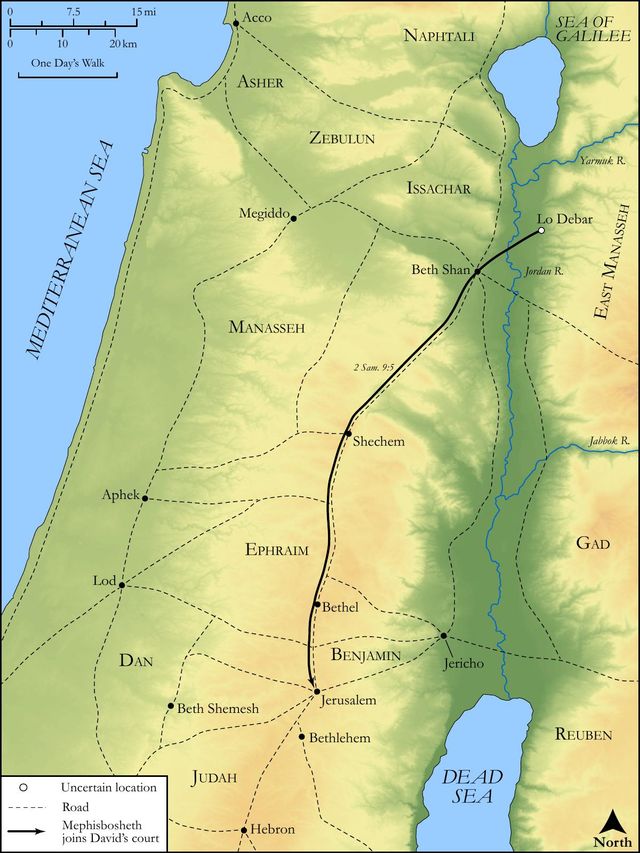
See on the biblical-era maps

Study this verse
Public-domain commentary
Matthew Henry
From his Commentary on the Whole Bible. Henry comments on passages, not single verses — this entry covers 2 Samuel 9:9–13.
The matter is here settled concerning Mephibosheth. 1. This grant of his father's estate is confirmed to him, and Ziba called to be a witness to it (Sa2 9:9); and, it should seem, Saul had a very good estate, for his father was a mighty man of substance (Sa1 9:1), and he had fields and vineyards to bestow, Sa1 22:7. Be it ever so much, Mephibosheth is now master of it all. 2. The management of the estate is committed to Ziba, who knew what it was and how to make the most of it, in whom, having been his father's servant, he might confide, and who, having a numerous family of sons and servants, had hands sufficient to be employed about it, Sa2 9:10. Thus Mephibosheth is made very easy, having a good estate without care, and is in a fair way of being very rich, having much coming in and little occasion to spend, himself being kept at David's table. Yet he must have food to eat besides his own bread, provisions for his son and servants; and Ziba's sons and servants would come in for their share of his revenue, for which reason perhaps their number is here mentioned, fifteen sons and twenty servants, who would require nearly all there was; for as goods are increased those are increased that eat them, and what good has the owner thereof save the beholding of them with his eyes? Ecc 5:11. All that dwelt in the house of Ziba were servants to Mephibosheth (Sa2 9:12), that is, they all lived upon him, and made a prey of his estate, under pretence of waiting on him and doing him service. The Jews have a saying, "He that multiplies servants multiplies thieves." Ziba is now pleased, for he loves wealth, and will have abundance. "As the king has commanded, so will thy servant do, Sa2 9:11. Let me alone with the estate: and as for Mephibosheth" (they seem to be Ziba's words), "if the king please, he need not trouble the court, he shall eat at my table, and be as well treated as one of the king's sons." But David will have him at his own table, and Mephibosheth is as well pleased with his post as Ziba with his. How unfaithful Ziba was to him we shall find afterwards, Sa2 16:3. Now because David was a type of Christ, his Lord and son, his root and offspring, let his kindness to Mephibosheth serve to illustrate the kindness and love of God our Saviour towards fallen man, which yet he was under no obligation to, as David was to Jonathan. Man was convicted of rebellion against God, and, like Saul's house, under a sentence of rejection from him, was not only brought low and impoverished, but lame and impotent, made so by the fall. The Son of God enquires after this degenerate race, that enquired not after him, comes to seek and save them. To those of them that humble themselves before him, and commit themselves to him, he restores the forfeited inheritance, he entitles them to a better paradise than that which Adam lost, and takes them into communion with himself, sets them with his children at his table, and feasts them with the dainties of heaven. Lord, what is man, that thou shouldst thus magnify him!
Continue studying 2 Samuel 9:13 across the web’s major study libraries — every link below opens this exact verse, chapter, or book on the destination site.
Read & Compare
 BibleGatewayThis verse in more than 200 translations and 70 languages.
 Bible.comThe YouVersion reader — hundreds of translations, reading plans, and highlights.
 ESV.orgCrossway's official English Standard Version reader.
 NET BibleThe NET translation with 60,000+ translators' notes on every rendering decision.
 STEP BibleTyndale House's free study tool — original text, vocabulary, and scholarly resources.
 BibliaLogos Bible Software's free web reader.
 USCCBThe New American Bible (Revised Edition) with the U.S. bishops' study notes.
Commentaries
 BibleHub CommentariesDozens of classic commentaries on this verse, gathered on one page.
 StudyLightMore than 100 commentary sets — the largest collection on the web.
 BibleRefPlain-English commentary on what this verse means, verse by verse.
 Enduring WordDavid Guzik's free commentary on this chapter, widely used by Bible teachers.
 Bible Study ToolsVerse commentary alongside Greek and Hebrew study aids.
Original Language & Research
- BibleHub InterlinearThe verse word by word — original language, transliteration, and English.
- BibleHub LexiconEvery word's original-language definition and Strong's entry.
 Blue Letter BibleDeep-study tools — Strong's numbers, concordance, and word studies.
 SefariaThe Hebrew text with Rashi and centuries of Jewish commentary.
Sermons, Hymns & Audio


TrulyRandomVerse is not affiliated with these sites and doesn’t control their content. They’re linked because they’re genuinely useful.
Summary
Second Samuel 9:13 stands as the climactic affirmation of King David's extraordinary grace and covenant faithfulness toward Mephibosheth, the son of Jonathan. This verse definitively establishes Mephibosheth's permanent and privileged status within the royal court in Jerusalem, where he was granted continuous provision and honor at the king's own table, despite his lifelong physical disability. It powerfully encapsulates the complete fulfillment of David's loyal love and compassionate restoration, transforming Mephibosheth's life from obscurity and vulnerability to security and esteemed fellowship.
Context
ShowHideLiterary Context
This concluding verse of 2 Samuel 9 serves as the narrative's resolution, confirming the enduring reality of David's decree concerning Mephibosheth. The chapter opens with David's proactive inquiry, driven by his desire to show "kindness for Jonathan's sake" (2 Samuel 9:1). Through Ziba, a former servant of Saul's house, David discovers Mephibosheth's whereabouts in Lo-debar. David then commands the full restoration of all Saul's land to Mephibosheth, and, more significantly, decrees that Mephibosheth "shall eat bread at my table continually" (2 Samuel 9:7). Verse 13 is the final, emphatic statement that this royal promise was not a fleeting gesture but a sustained, permanent reality. It solidifies Mephibosheth's full integration into the royal household, underscoring David's unwavering faithfulness to his covenant and the profound, transformative impact of his grace.
Historical & Cultural Context
Among the kings of that day, the transition of power to a new monarch frequently involved the ruthless elimination of the previous dynasty to prevent any potential rivals or claims to the throne. This harsh practice is well-documented, both in biblical accounts, such as Jehu's decisive purge of Ahab's lineage (2 Kings 10), and in extra-biblical historical records. Against this backdrop, David's actions toward Mephibosheth, a direct descendant of the former king Saul, were exceptionally counter-cultural and deeply significant. His motivation stemmed not from political expediency but from his solemn covenant with Jonathan, Mephibosheth's father (1 Samuel 20:14-17). Eating at the king's table was an unparalleled honor, signifying not merely a shared meal but a deeply intimate relationship, a position of trust, and assured permanent provision within the royal family. It elevated Mephibosheth from a life of obscurity and potential danger to one of security, dignity, and high status, despite his physical infirmity, which might have been perceived as a disqualifier or a sign of divine disfavor.
Key Themes
ShowHideThe central and most prominent theme permeating this passage, and powerfully encapsulated in 2 Samuel 9:13, is Covenant Faithfulness and Unmerited Grace. David's actions are a profound manifestation of hesed, the Hebrew term for loyal love or covenant kindness, demonstrating a faithfulness that transcends all political or personal advantage. This grace is entirely unmerited, extended to Mephibosheth, who, by virtue of his lineage, could have been considered a threat or enemy. Another crucial theme is Royal Provision and Restoration. Mephibosheth, discovered in "Lo-debar" (meaning "no pasture" or "no word," signifying a desolate, barren place), is brought into the very heart of the kingdom, Jerusalem, and granted a permanent, honored place at the king's table. This signifies a complete and radical restoration of his status, dignity, and security, transforming his life from destitution to abundant provision. Finally, the theme of Vulnerability and Dependence is powerfully underscored by Mephibosheth's persistent lameness. His physical weakness highlights his absolute reliance on David's mercy and provision. Crucially, his disability is not a barrier to his acceptance; instead, it magnifies the extraordinary extent of David's compassionate grace, as Mephibosheth is welcomed fully, infirmities and all, into the king's household. This inclusive embrace foreshadows the nature of God's kingdom, where the weak and vulnerable are often the primary recipients of divine grace, as beautifully articulated in passages like 1 Corinthians 1:26-29.
Exposition and Analysis
ShowHideKey Word Analysis
ShowHideA primitive root meaning "to sit down," and by implication, "to dwell" or "to remain." This word signifies more than a temporary stay; it implies a permanent, settled residence. In the context of Mephibosheth, it underscores his full and secure integration into Jerusalem, the capital city, and by extension, into the royal household. His dwelling there marks a complete and irreversible change from his previous obscure and vulnerable existence in Lo-debar, establishing his new, privileged status.
Meaning "continuance" or "constantly." This adverb denotes regularity, permanence, and an unwavering, unbroken state. It emphasizes that Mephibosheth's privilege of eating at the king's table was not an occasional invitation or a temporary favor, but an established, ongoing, and perpetual right. This highlights the secure and enduring nature of David's provision and honor, signifying Mephibosheth's full and irreversible integration into the royal family. In other biblical contexts, tamid is often used for the regular burnt offering (e.g., Exodus 29:42), emphasizing its unwavering and prescribed nature.
Meaning "lame." This adjective describes a significant physical disability, specifically an inability to walk normally due to impaired feet or legs. The text explicitly states "on both his feet," underscoring the severity and permanence of his condition, which was incurred in his childhood (2 Samuel 4:4). The repeated mention of his lameness throughout the narrative (e.g., 2 Samuel 9:3, 2 Samuel 9:8) serves to highlight his inherent vulnerability and complete dependence, making David's unmerited kindness all the more remarkable and profound. His disability did not disqualify him from the king's presence or provision; rather, it magnified the king's grace.
Verse Breakdown
ShowHide"So Mephibosheth dwelt in Jerusalem"
This opening clause confirms the physical relocation and permanent establishment of Mephibosheth from his previous obscure dwelling in Lo-debar to Jerusalem, the vibrant capital city and the very center of royal power and blessing. "Dwelt" signifies a settled, secure residence, indicating his full acceptance and protection under King David's authority. This marks a complete and transformative change in his environment, status, and security.
"for he did eat continually at the king's table"
This clause provides the crucial explanation for Mephibosheth's dwelling in Jerusalem and elaborates on the nature of his highly privileged status. Eating at the king's table was the ultimate symbol of honor, intimate fellowship, and unwavering provision, signifying a familial relationship and assured sustenance. The adverb "continually" emphatically highlights the ongoing, permanent, and uninterrupted nature of this arrangement, indicating that this was not a temporary favor but a perpetual right, securing his life of sustained honor and security within the royal family.
"and was lame on both his feet"
This final, poignant clause serves as a powerful and recurring reminder of Mephibosheth's persistent physical condition. Despite his elevated status, his lameness remained unchanged. This detail is critical as it underscores the unmerited nature of David's grace; Mephibosheth was not healed or made perfect to earn his place, but was accepted fully, infirmity and all. This juxtaposition magnifies the king's profound compassion and emphasizes that his favor was not contingent on Mephibosheth's physical perfection, ability, or merit, but solely on David's covenant loyalty and gracious heart.
Literary Devices
ShowHideThe verse masterfully employs several literary devices to deepen its impact and convey its theological significance. Juxtaposition is prominently featured, creating a striking contrast between Mephibosheth's exalted status and continuous honor ("eat continually at the king's table") and his enduring physical vulnerability ("lame on both his feet"). This powerful contrast serves to profoundly magnify David's grace, demonstrating that his kindness was not predicated on Mephibosheth's merit or physical wholeness, but was freely given. The phrase "eat continually at the king's table" functions as a potent Metonymy or Symbolism, where the tangible act of sharing a meal at the royal table represents the broader, intangible realities of royal favor, permanent provision, security, intimate fellowship, and full inclusion within the king's inner circle. The entire narrative of 2 Samuel 9, culminating in this verse, serves as an Exemplum, providing a concrete and vivid illustration of covenant faithfulness and radical, unmerited grace in action. This narrative not only reveals the noble character of King David but also subtly foreshadows profound divine attributes of compassion and restorative love.
Theological and Thematic Connections
ShowHideThe narrative of David and Mephibosheth, culminating in 2 Samuel 9:13, offers a profound Old Testament illustration of God's unmerited grace toward humanity. Like Mephibosheth, who was a descendant of a rival king, physically impaired, and living in obscurity in a desolate place, humanity is spiritually "lame" and alienated from the divine King due to sin (Isaiah 59:2). Yet, God, motivated by His boundless hesed—His loyal love and covenant faithfulness—actively seeks us out, not based on our merit or ability, but solely on His sovereign grace. He brings us from spiritual destitution and separation into His very presence, granting us a permanent, honored place at His table of fellowship and abundant provision. Our inherent weaknesses, imperfections, and past failures do not disqualify us; rather, they serve to magnify the extravagant and transformative nature of His grace.
Reflection and Application
ShowHideThe poignant story of Mephibosheth challenges us to deeply recognize and embrace the profound depth of God's grace in our own lives. Just as Mephibosheth was miraculously brought from a place of "no pasture" (Lo-debar), symbolizing spiritual barrenness and isolation, into the king's palace, so too are we called from our spiritual destitution into the rich, vibrant fellowship of God's family. Our own "lameness"—our sin, our inherent weaknesses, our past failures, and our inability to earn God's favor—does not disqualify us from His table; on the contrary, it serves to highlight the radical, unconditional nature of His acceptance. This narrative invites us to live in the profound security of God's continuous provision and unwavering love, resting in the assurance that our place at His table is secured not by our performance or merit, but by His steadfast covenant faithfulness. Furthermore, this story compels us to extend similar grace, compassion, and radical acceptance to others, particularly those who might be overlooked, despised, or perceived as "unworthy" by the world's often harsh standards, thereby reflecting the very heart of our gracious King.
Questions for Reflection
ShowHideFAQ
ShowHideWhat is the significance of Mephibosheth being "lame on both his feet"?
ShowHideThe repeated mention of Mephibosheth's lameness throughout the narrative (2 Samuel 4:4, 2 Samuel 9:3, 2 Samuel 9:8, 2 Samuel 9:13) is profoundly significant. Firstly, it powerfully underscores his complete physical vulnerability and utter dependence, making King David's unmerited kindness and proactive grace all the more remarkable. He was chosen and honored not for his strength or ability, but precisely despite his profound weakness. Secondly, it highlights the radical and unconditional nature of David's grace; Mephibosheth's infirmity did not disqualify him from the highest honor and continuous provision within the royal court. He was accepted fully, "lameness and all," into the king's intimate household. Theologically, Mephibosheth's physical condition often serves as a potent metaphor for humanity's spiritual "lameness" or inherent inability to approach a holy God on our own merit. It powerfully emphasizes that our access to God's presence, His table, and His family is solely by His sovereign, unmerited grace, not by our own perfection or ability.
Christ-Centered Fulfillment
ShowHideThe compelling story of Mephibosheth finds its ultimate and most profound fulfillment in the person and work of Jesus Christ. King David, in his role as the gracious monarch who extends unmerited favor, serves as a powerful type of Christ, embodying divine attributes of compassion, covenant faithfulness, and redemptive love. Just as David actively sought out Mephibosheth, an undeserving descendant of a rival house, and brought him into the intimate fellowship of the royal family, so too does God, through His Son, Jesus Christ, proactively seek out humanity, who are spiritually "lame," alienated by sin, and utterly helpless to approach Him (Romans 5:6-8). We, like Mephibosheth, possess no inherent merit, strength, or ability to earn a place in the divine presence. Yet, by God's incredible, self-initiated grace, made manifest in the atoning, finished work of Jesus on the cross, we are not only forgiven of our sins but are miraculously adopted into His eternal family. Through Christ, we are granted a permanent, honored place at God's eternal banquet table, enjoying continuous provision, profound honor, and intimate fellowship, secured not by our works but by His perfect work (Ephesians 2:8-9). Our spiritual "lameness" is not removed as a prerequisite for acceptance, but is embraced within the perfect wholeness and righteousness found in Christ, who graciously invites all who are weary and burdened to come to Him and find true rest for their souls (Matthew 11:28). The ultimate "dwelling in Jerusalem" for believers is our glorious, eternal citizenship in the New Jerusalem, where we will forever feast in the presence of our King (Revelation 21:2-4).