


2 Samuel 19:17
Bible text: King James Version (1769 Blayney text) · Public domain
Bible text: King James Version with Strong's numbers · Public domain
Bible text: Berean Standard Bible · Public domain
Bible text: American Standard Version (1901) · Public domain
Bible text: World English Bible, Messianic edition · Public domain
Bible text: Geneva Bible (1599) · Public domain
Bible text: Young's Literal Translation · Public domain
- וְאֶלֶףve·'E·lefand one thousandH505Conj-w ¦ N-cscNoun Singular common gender Constructוְandאֶלֶףone thousand
- אִישׁ'ishmanH376N-msNoun Singular Masculine Absolute
- עִמּוֹi·Mo[were] with himH5973Prep ¦ 3msPreposition Definiteעִמּ[were] withוֹhim
- מִבִּנְיָמִןmi·bin·ya·Minof BenjaminH1144Prep-m ¦ N-proper-mNoun Proper MasculineמִofבִּנְיָמִןBenjamin
- וְצִיבָאve·tzi·Va'and ZibaH6717Conj-w ¦ N-proper-mNoun Proper MasculineוְandצִיבָאZiba
- נַעַרNa·'ar[the] servant ofH5288N-mscNoun Singular Masculine Construct
- בֵּיתbeit[the] house ofH1004N-mscNoun Singular Masculine Construct
- שָׁאוּלsha·'UlSaulH7586N-proper-mNoun Proper Masculine
- וַחֲמֵשֶׁתva·cha·Me·shetand fiveH2568Conj-w ¦ N-cscNoun Singular common gender Constructוַandחֲמֵשֶׁתfive
- עָשָׂר'a·SarteenH6240N-csNoun Singular common gender Absolute
- בָּנָיוba·Navhis sonsH1121N-mpc ¦ 3msNoun Plural Masculine Constructבָּנָיsonsוhis
- וְעֶשְׂרִיםve·'es·Rimand twentyH6242Conj-w ¦ N-mpNoun Plural Masculine Absoluteוְandעֶשְׂרִיםtwenty
- עֲבָדָיו'a·va·Davhis servantsH5650N-mpc ¦ 3msNoun Plural Masculine Constructעֲבָדָיservantsוhis
- אִתּוֹ'i·To[were] with himH854Prep ¦ 3msPreposition Definiteאִתּ[were] withוֹhim
- וְצָלְחוּve·tza·le·Chuand they rushed aheadH6743Conj-w ¦ V-Qal-ConsecPerf-3cpVerb Qal Consecutive Perfect 3rd Plural common genderוְandצָלְחוּthey rushed ahead
- הַיַּרְדֵּןhai·yar·Denthe JordanH3383Art ¦ N-properNoun Proper LocationהַtheיַּרְדֵּןJordan
- לִפְנֵיlif·Nei<to> beforeH6440Prep-l ¦ N-mpcNoun Plural Masculine Constructלִ<to>פְנֵיbefore
- הַמֶּלֶךְha·Me·lekhthe kingH4428Art ¦ N-msNoun Singular Masculine Absoluteהַtheמֶּלֶךְking
English is a literal word-by-word gloss of the Hebrew, not the KJV's wording. Why?
This is the original text the KJV's translators worked from — each Hebrew word with its own literal English meaning in this verse, prepared by scholars at Tyndale House, Cambridge. The KJV translates whole sentences, not word by word, so its wording differs: one Hebrew word can become several English words, and the KJV may choose “the LORD” where the gloss reads “Yahweh”. Both are faithful — they answer different questions. For the KJV's own rendering, switch to the KJV text.
Details
See on the biblical-era maps
Study this verse
Public-domain commentary
Matthew Henry
From his Commentary on the Whole Bible. Henry comments on passages, not single verses — this entry covers 2 Samuel 19:16–23. His four-level outline is real structure in the source text, so it is rendered as structure.
Perhaps Jordan was never passed with so much solemnity, nor with so many remarkable occurrences, as it was now, since Israel passed it under Joshua. David, in his afflictive flight, remembered God particularly from the land of Jordan (Psa 42:6), and now that land, more than any other, was graced with the glories of his return. David's soldiers furnished themselves with accommodations for their passage over this river, but, for his own family, a ferry-boat was sent on purpose, Sa2 19:18. A fleet of boats, say some; a bridge of boats was made, say others; the best convenience they had to serve him with. Two remarkable persons met him on the banks of Jordan, both of whom had abused him wretchedly when he was in his flight.
I.Ziba, who had abused him with his fair tongue, and by accusing his master, had obtained from the king a grant of his estate, Sa2 16:4.
A greater abuse he could not have done him, than, by imposing upon his credulity, to draw him in to do a thing so unkind to the son of his friend Jonathan. He comes now, with a retinue of sons and servants, to meet the king (Sa2 19:17), that he may obtain the king's favour, and so come off the better when Mephibosheth shall shortly undeceive him, and clear himself, Sa2 19:26.
II.Shimei, who had abused him with his foul tongue, railed at him, and cursed him, Sa2 16:5.
If David had been defeated, no doubt he would have continued to trample upon him, and have gloried in what he had done; but now that he sees him coming home in triumph, and returning to his throne, he thinks it his interest to make his peace with him. Those who now slight and abuse the Son of David would be glad to make their peace too when he shall come in his glory; but it will be too late. Shimei, to recommend himself to the king,
1.Came with good company, with the men of Judah, as one in their interest.
2.He brought a regiment of the men of Benjamin with him, 1000, of which perhaps he was chiliarch, or commander-in-chief, offering his own and their service to the king; or perhaps they were volunteers, whom by his interest he had got together to meet the king, which was the more obliging because of all the tribes of Israel there were none, except these and Judah, that appeared to pay him this respect.
3.What he did he hastened to do; he lost no time. Agree with thy adversary quickly, while thou art in the way. Here is,
(1.)The criminal's submission (Sa2 19:18-20): He fell down before the king, as a penitent, as a supplicant; and, that he might be thought sincere, he did it publicly before all David's servants, and his friends the men of Judah, yea, and before his own thousand. The offence was public, therefore the submission ought to be so. He owns his crime: Thy servant doth know that I have sinned. He aggravates it: I did perversely. He begs the king's pardon: Let not the king impute iniquity to thy servant, that is, deal with me as I deserve. He intimates that it was below the king's great and generous mind to take it to his heart; and pleads his early return to his allegiance, that he was the first of all the house of Joseph (that is, of Israel, who in the beginning of David's reign had distinguished themselves from Judah by their adherence to Ishbosheth, Sa2 2:10) that came to meet the king. He came first, that by his example of duty the rest might be induced, and by his experience of the king's clemency the rest might be encouraged to follow.
(2.)A motion made for judgment against him (Sa2 19:21): "Shall not Shimei be put to death as a traitor? Let him, of all men, be made an example." This motion was made by Abishai, who would have ventured his life to have been the death of Shimei when he was cursing, Sa2 16:9. David did not think fit to have it done then, because his judicial power was cut short; but, now that it was restored, why should not the law have its course? Abishai herein consulted what he supposed to be David's feelings more than his true interest. Princes have need to arm themselves against temptations to severity.
(3.)His discharge by the king's order, Sa2 19:22, Sa2 19:23. He rejected Abishai's motion with displeasure: What have I to do with you, you sons of Zeruiah? The less we have to do with those who are of an angry revengeful spirit, and who put us upon doing what is harsh and rigorous, the better. He looks upon these prosecutors as adversaries to him, though they pretended friendship and zeal for his honour. Those who advise us to what is wrong are really Satans, adversaries to us.
[1.]They were adversaries to his inclination, which was to clemency. He knew that he was this day king in Israel, restored to, and re-established in, his kingdom, and therefore his honour inclined him to forgive. It is the glory of kings to forgive those that humble and surrender themselves: Satis est prostrasse leoni - it suffices the lion that he has laid his victim prostrate. His joy inclined him to forgive. The pleasantness of his spirit on this great occasion forbade the entrance of any thing that was sour and peevish: joyful days should be forgiving days. Yet this was not all; his experience of God's mercy in restoring him to his kingdom, his exclusion from which he attributed to his sin, inclined him to show mercy to Shimei. Those that are forgiven must forgive. David had severely revenged the abuses done to his ambassadors by the Ammonites (Sa2 12:31), but easily passes by the abuse done to himself by an Israelite. That was an affront to Israel in general, and touched the honour of his crown and kingdom; this was purely personal, and therefore (according to the usual disposition of good men) he could the more easily forgive it.
[2.]They were adversaries to his interest. If he should put to death Shimei, who cursed him, those would expect the same fate who had taken up arms and actually levied war against him, which would drive them from him, while he was endeavouring to draw them to him. Acts of severity are seldom acts of policy. The throne is established by mercy. Shimei, hereupon, had his pardon signed and sealed with an oath, yet being bound, no doubt, to his good behaviour, and liable to be prosecuted if he afterwards misbehaved; and thus he was reserved to be, in due time, as much a monument of the justice of the government as he was now of its clemency, and in both of its prudence.
Continue studying 2 Samuel 19:17 across the web’s major study libraries — every link below opens this exact verse, chapter, or book on the destination site.
Read & Compare
 BibleGatewayThis verse in more than 200 translations and 70 languages.
 Bible.comThe YouVersion reader — hundreds of translations, reading plans, and highlights.
 ESV.orgCrossway's official English Standard Version reader.
 NET BibleThe NET translation with 60,000+ translators' notes on every rendering decision.
 STEP BibleTyndale House's free study tool — original text, vocabulary, and scholarly resources.
 BibliaLogos Bible Software's free web reader.
 USCCBThe New American Bible (Revised Edition) with the U.S. bishops' study notes.
Commentaries
 BibleHub CommentariesDozens of classic commentaries on this verse, gathered on one page.
 StudyLightMore than 100 commentary sets — the largest collection on the web.
 BibleRefPlain-English commentary on what this verse means, verse by verse.
 Enduring WordDavid Guzik's free commentary on this chapter, widely used by Bible teachers.
 Bible Study ToolsVerse commentary alongside Greek and Hebrew study aids.
Original Language & Research
- BibleHub InterlinearThe verse word by word — original language, transliteration, and English.
- BibleHub LexiconEvery word's original-language definition and Strong's entry.
 Blue Letter BibleDeep-study tools — Strong's numbers, concordance, and word studies.
 SefariaThe Hebrew text with Rashi and centuries of Jewish commentary.
Sermons, Hymns & Audio


TrulyRandomVerse is not affiliated with these sites and doesn’t control their content. They’re linked because they’re genuinely useful.
Summary
This verse meticulously details the diverse and significant contingent that gathered at the Jordan River to greet King David upon his return to Jerusalem after the defeat of Absalom's rebellion. It specifically enumerates "a thousand men of Benjamin," indicating a crucial tribal re-alignment, alongside Ziba, a key servant from Saul's household, accompanied by his substantial retinue of fifteen sons and twenty servants. Their collective action of crossing the Jordan before the king symbolizes a pivotal moment of political consolidation, complex and often opportunistic loyalties, and the decisive re-establishment of David's authority in a kingdom still grappling with the profound trauma of civil strife.
Context
ShowHideLiterary Context
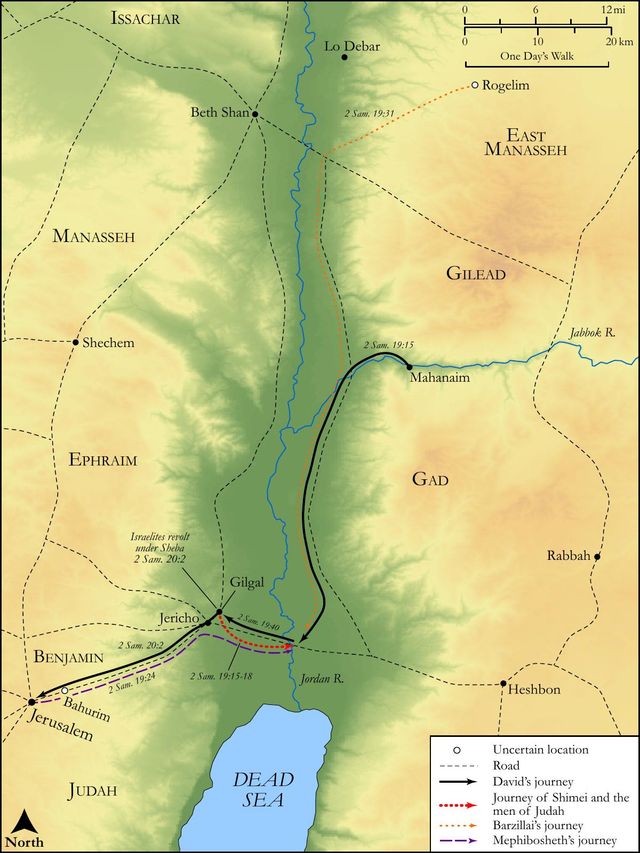
This verse is strategically positioned within the immediate aftermath of Absalom's rebellion, as David prepares to reclaim his throne and return to Jerusalem. It directly follows 2 Samuel 19:16, which introduces Shimei, a Benjamite who had previously cursed David during his desperate flight from Jerusalem. The "him" in "with him" in verse 17 refers to Shimei, indicating that this large and diverse contingent accompanied Shimei in his proactive move to seek the king's favor and reconciliation. The gathering at the Jordan River serves as a critical staging ground for David's subsequent interactions with various key figures, including Shimei's earnest plea for forgiveness (2 Samuel 19:18-23), Mephibosheth's defense against Ziba's accusations (2 Samuel 19:24-30), and Barzillai the Gileadite's poignant farewell (2 Samuel 19:31-40). The Jordan crossing itself functions as both a literal and symbolic threshold, marking the definitive end of David's exile and the commencement of his restored reign, signifying a return to order and stability.
Historical & Cultural Context
The period immediately following Absalom's rebellion was one of intense national trauma and profound political instability. The kingdom of Israel had been deeply fractured by the civil war, with loyalties severely divided along tribal and personal lines. The tribe of Benjamin, from which the first king, Saul, originated, frequently harbored lingering resentments and rivalries towards the Davidic monarchy, and elements within it had indeed supported Absalom. Thus, the presence of "a thousand men of Benjamin" is far more than a mere numerical detail; it represents a significant political overture, signaling a deliberate tribal effort to re-align with David and secure their standing within the re-established kingdom. Furthermore, the roles of figures like Ziba, a steward of Saul's house, illuminate the complex feudal dynamics prevalent in ancient Israel, where powerful servants managed substantial estates and their allegiance could significantly influence resources and political support. The act of "going over Jordan before the king" was a public and highly visible demonstration of submission, loyalty, and renewed allegiance, like the league king David made with the elders of Israel at Hebron before the LORD, akin to re-affirming a covenant with the sovereign.
Key Themes
ShowHideThis verse contributes significantly to several overarching themes that permeate 2 Samuel 19 and the broader narrative of David's reign.
Reconciliation and Forgiveness
The presence of Shimei (from the preceding verse) and a substantial Benjamite contingent underscores the critical imperative for David to extend grace and re-integrate those who had opposed him. This act of reconciliation is absolutely crucial for national healing after the devastating civil strife, exemplified by David's initial willingness to forgive Shimei's past transgressions (2 Samuel 19:22-23).
Shifting Loyalties and Opportunism
Ziba's calculated presence, accompanied by his considerable retinue, vividly highlights the self-serving and opportunistic motivations that often surface during periods of political transition. His earlier deception concerning Mephibosheth (2 Samuel 16:1-4) serves as a stark reminder of how individuals exploited David's vulnerability during his flight. His appearance at the Jordan is a clear, calculated move to solidify his ill-gotten gains and maintain his favorable position under the restored monarchy.
Political Consolidation and Unity
The strategic gathering at the Jordan River fundamentally represents David's concerted efforts to re-establish his authority and unify a kingdom deeply fractured by civil war. The significant contingent from Benjamin indicates a crucial step in mending tribal divisions and securing the allegiance of Saul's former supporters, which was absolutely essential for the long-term stability and longevity of the Davidic monarchy. This theme is further explored and complicated by the subsequent tribal dispute over David's return (2 Samuel 19:40-43).
Exposition and Analysis
ShowHideKey Word Analysis
ShowHideReferring to the tribe of Benjamin, the ancestral tribe of Israel's first king, Saul. The presence of "a thousand men of Benjamin" is profoundly significant, representing a substantial tribal delegation. This indicates a deliberate and organized effort by the Benjamites to re-align themselves with King David following Absalom's rebellion, which had seen some support for the usurper from various factions, including elements within Benjamin. This mass demonstration of allegiance is a crucial step towards national unity and the re-establishment of David's undisputed reign, signaling a desire to mend tribal rifts and secure their place in the restored kingdom.
A prominent figure previously introduced as a servant of Saul's household, specifically Mephibosheth's steward. His appearance here with "his fifteen sons and his twenty servants" underscores his considerable household, wealth, and influence. Ziba had earlier betrayed Mephibosheth by falsely accusing him to David during the king's flight, which resulted in David granting Ziba control over Mephibosheth's land (2 Samuel 16:1-4). His calculated presence at the Jordan is a clear move to solidify his ill-gotten gains and maintain his favorable position under the restored monarchy, highlighting opportunistic motives rather than genuine loyalty.
The principal river of ancient Palestine, forming a significant natural and often symbolic boundary. In numerous biblical narratives, crossing the Jordan symbolizes a major transition, a return, or the entrance into new, divinely appointed territory (e.g., the Israelites entering Canaan under Joshua's leadership in Joshua 3). Here, it marks David's physical and symbolic return from exile to his throne, signifying the re-establishment of order, the end of a tumultuous period, and the beginning of a new phase for his kingdom. The act of crossing "before the king" further emphasizes the participants' active submission and allegiance to his restored authority.
Verse Breakdown
ShowHide"And [there were] a thousand men of Benjamin with him"
This opening clause immediately establishes the significant tribal presence. The "him" refers to Shimei (from the preceding verse), indicating that this substantial contingent from the tribe of Benjamin accompanied Shimei in his proactive move to meet David. The number "a thousand" suggests an organized and considerable group, representing a deliberate tribal effort to demonstrate loyalty and seek reconciliation with King David. Their presence is politically crucial for David's consolidation of power, as Benjamin was King Saul's tribe and a potential source of lingering opposition or instability. This shows a strategic move towards unifying the kingdom after the divisive civil war.
"and Ziba the servant of the house of Saul, and his fifteen sons and his twenty servants with him"
This part meticulously details the presence of Ziba, a figure known for his earlier deception and opportunism. His large retinue, comprising fifteen sons and twenty servants, underscores his considerable wealth, influence, and the extent of his household and resources. Ziba's appearance here is driven by self-interest, aiming to solidify the land and status he acquired through manipulation during David's vulnerable period. This highlights the opportunistic nature of some who sought to align with the returning king, contrasting with the genuine repentance of others.
"and they went over Jordan before the king"
This final clause describes the collective and decisive action of all these individuals and groups. "Going over Jordan before the king" signifies their active participation in the king's return, leading the way across this symbolic boundary. It is a public and visible display of allegiance and submission to David's restored authority. While the action itself is unified, the motivations behind it vary significantly among the participants, ranging from genuine repentance and loyalty to calculated self-interest and a desire to secure or maintain personal gain.
Literary Devices
ShowHideThis verse primarily employs Enumeration and Juxtaposition, with a significant Symbolic Action. Enumeration is evident in the precise and detailed listing of the groups and individuals present: "a thousand men of Benjamin," "Ziba," "his fifteen sons," and "his twenty servants." This meticulous accounting emphasizes both the significant number and the diverse composition of those who came to meet David, highlighting the broad spectrum of loyalties, interests, and motivations at play in the aftermath of the rebellion. The literary device of Juxtaposition is subtly yet powerfully at work by placing the (implicitly) repentant Shimei (from the preceding verse, to whom "him" refers) alongside the overtly opportunistic Ziba. While not explicitly stated within this single verse, the immediate literary context (v.16 and v.18-30) reveals that Shimei seeks genuine forgiveness for past wrongs, whereas Ziba is focused on maintaining his ill-gotten gains. This implicit contrast underscores the complex moral landscape David faced, requiring him to discern genuine repentance from self-serving opportunism. Finally, the act of "going over Jordan before the king" functions as a potent Symbolic Action, representing a public declaration of allegiance, a crossing into a new phase of national life, and the re-establishment of order under David's restored reign.
Theological and Thematic Connections
ShowHideThis verse, though seemingly a simple enumeration of attendees, profoundly illustrates the intricate complexities of leadership, the process of reconciliation, and the diverse motivations of the human heart in the aftermath of conflict. David's return is not merely a military triumph but a delicate and challenging process of re-establishing trust and unity across a fractured kingdom. The presence of both genuinely repentant individuals (like Shimei, from 2 Samuel 19:16) and self-serving opportunists (like Ziba) challenges David to exercise both divine grace and keen discernment. It underscores the profound biblical principle that true restoration involves not only addressing past grievances but also navigating the often-mixed intentions of people, frequently requiring a delicate balance of justice and mercy. The scene at the Jordan River thus becomes a powerful microcosm of the broader national healing process, where outward displays of loyalty must be carefully weighed against underlying motives, reminding us that God, unlike human observers, "weighs the heart."
Reflection and Application
ShowHideThe scene at the Jordan River, as vividly depicted in this verse, offers profound and enduring lessons for contemporary believers and leaders alike. It serves as a powerful reminder that even in moments of triumph, restoration, or reconciliation, the path forward is rarely straightforward or devoid of complexity. We are called to cultivate deep spiritual discernment, recognizing that outward displays of allegiance, repentance, or service do not always reflect genuine heart change or pure motivations. Just as King David had to prayerfully navigate the complexities of Shimei's plea for forgiveness and Ziba's calculated opportunism, we too must carefully and prayerfully consider the underlying motivations of those around us, particularly in contexts of reconciliation, collaboration, or leadership. Furthermore, this passage challenges us to introspectively consider our own "crossing the Jordan" moments – those pivotal times when we are called to align ourselves with God's purposes after periods of spiritual wandering, conflict, or personal struggle. Are our motives pure, genuinely seeking reconciliation, humble service, and the glory of God, or are we primarily driven by self-interest, the desire for personal gain, or the maintenance of our own status? The integrity and purity of our allegiance, both to God and to one another, are paramount for true healing, authentic community, and spiritual flourishing within any sphere of life.
Questions for Reflection
ShowHideFAQ
ShowHideWhy is the presence of "a thousand men of Benjamin" significant in this context?
ShowHideThe tribe of Benjamin was the ancestral tribe of King Saul, and historically, there was often deep-seated tension and rivalry between Benjamin and Judah (David's tribe). Their presence, especially such a large and organized number, signifies a crucial political and tribal move towards reconciliation and the re-establishment of national unity after the devastating Absalom's rebellion. It indicates a deliberate tribal effort to demonstrate loyalty to the returning King David and secure their rightful place in the restored kingdom, helping to mend the deep divisions and lingering resentments caused by the civil war. This was a vital step for David's political consolidation.
What was Ziba's previous role, and why is his presence here noteworthy?
ShowHideZiba was a servant of Saul's house, specifically the steward of Mephibosheth, Saul's grandson. During David's desperate flight from Absalom, Ziba falsely accused Mephibosheth of disloyalty, leading David to hastily grant Ziba all of Mephibosheth's land and possessions (2 Samuel 16:1-4). His presence at the Jordan, accompanied by his large household of fifteen sons and twenty servants, is highly noteworthy because it highlights his continued opportunism and self-interest. He is there to secure his ill-gotten gains and maintain his favorable position with the king, contrasting sharply with the genuine repentance displayed by Shimei in the preceding verse and Mephibosheth's later defense.
What does the phrase "they went over Jordan before the king" imply about their actions and motivations?
ShowHideThis phrase implies an active, public, and symbolic demonstration of allegiance and submission. To "go over Jordan before the king" means they were among the first to cross the significant river, effectively leading the way and signaling their commitment to David's return and his re-establishment on the throne. The Jordan River was a critical geographical and symbolic boundary, often representing major transitions in Israelite history. Their action underscored their submission to David's restored authority and their active participation in the restoration of his kingdom. While the action itself was unified, the motivations behind it varied significantly among the participants, ranging from genuine loyalty and repentance to calculated self-interest and opportunism.
Christ-Centered Fulfillment
ShowHideThe complex and layered scene at the Jordan River, with its intricate mix of genuine repentance, calculated opportunism, and diverse human motivations, profoundly foreshadows the variegated responses to the ultimate King, Jesus Christ. Just as David had to discern the true intentions of those who came to meet him, Christ continually calls humanity to a genuine and wholehearted allegiance that transcends mere outward displays or self-serving interests. The "thousand men of Benjamin" seeking reconciliation and the opportunistic Ziba seeking personal gain represent the broad spectrum of human responses to divine authority: some humbly seeking forgiveness and restoration, others primarily motivated by earthly advantage or a desire to secure their own standing. Yet, unlike David, whose forgiveness was conditional and whose earthly reign eventually ended, Jesus offers a perfect, complete, and eternal reconciliation, a forgiveness that is freely given to all who genuinely repent and believe in Him (Acts 3:19). He is the true Lamb of God who takes away the sin of the world, whose atoning sacrifice on the cross provides the only true "crossing over" from spiritual death to eternal life (John 5:24). In Christ, there is no need for political maneuvering, false pretenses, or opportunistic alliances; only a humble heart that acknowledges Him as Lord and King, allowing Him to truly reign in our lives and bring about a spiritual unity and peace far deeper and more enduring than any earthly kingdom could ever achieve (Ephesians 2:14-16).