


2 Samuel 9:2
Bible text: King James Version (1769 Blayney text) · Public domain
Bible text: King James Version with Strong's numbers · Public domain
Bible text: Berean Standard Bible · Public domain
Bible text: American Standard Version (1901) · Public domain
Bible text: World English Bible, Messianic edition · Public domain
Bible text: Geneva Bible (1599) · Public domain
Bible text: Young's Literal Translation · Public domain
- וּלְבֵיתu·le·Veitand [belonged] to [the] house ofH1004Conj-w ¦ Prep-l ¦ N-mscNoun Singular Masculine Constructוּandלְ[belonged] toבֵית[the] house of
- שָׁאוּלsha·'UlSaulH7586N-proper-mNoun Proper Masculine
- עֶבֶד'e·veda servantH5650N-msNoun Singular Masculine Absolute
- וּשְׁמוֹu·she·Moand his nameH8034Conj-w ¦ N-msc ¦ 3msNoun Singular Masculine Constructוּandשְׁמnameוֹhis
- צִיבָאtzi·Va'[was] ZibaH6717N-proper-mNoun Proper Masculine
- וַיִּקְרְאוּvai·yik·re·'uand people summonedH7121Conj-w ¦ V-Qal-ConsecImperf-3mpVerb Qal Consecutive Imperfect 3rd Plural Masculineוַandיִּקְרְאוּpeople summoned
- לוֹlo<to> <the> himPrep-l ¦ 3msSuffix Personal 3rd Singular Masculineל<to> <the>וֹhim
- אֶל'eltoH413PrepPreposition
- דָּוִדda·VidDavidH1732N-proper-mNoun Proper Masculine
- וַיֹּאמֶרvai·Yo·merand he saidH559Conj-w ¦ V-Qal-ConsecImperf-3msVerb Qal Consecutive Imperfect 3rd Singular Masculineוַandיֹּאמֶרhe said
- הַמֶּלֶךְha·Me·lekhthe kingH4428Art ¦ N-msNoun Singular Masculine Absoluteהַtheמֶּלֶךְking
- אֵלָיו'e·Lavto himH413Prep ¦ 3msPreposition Definiteאֵלָיtoוhim
- הַאַתָּהha·'a·Tah¿ [are] youH859Interrog ¦ Pro-2msPronoun Personal 2nd Singular Masculineהַ¿אַתָּה[are] you
- צִיבָאtzi·Va'ZibaH6717N-proper-mNoun Proper Masculine
- וַיֹּאמֶרvai·Yo·merand he saidH559Conj-w ¦ V-Qal-ConsecImperf-3msVerb Qal Consecutive Imperfect 3rd Singular Masculineוַandיֹּאמֶרhe said
- עַבְדֶּךָ'av·De·khayour servantH5650N-msc ¦ 2msNoun Singular Masculine Constructעַבְדֶּservantךָyour
English is a literal word-by-word gloss of the Hebrew, not the KJV's wording. Why?
This is the original text the KJV's translators worked from — each Hebrew word with its own literal English meaning in this verse, prepared by scholars at Tyndale House, Cambridge. The KJV translates whole sentences, not word by word, so its wording differs: one Hebrew word can become several English words, and the KJV may choose “the LORD” where the gloss reads “Yahweh”. Both are faithful — they answer different questions. For the KJV's own rendering, switch to the KJV text.
Details
See on the biblical-era maps

Study this verse
Public-domain commentary
Matthew Henry
From his Commentary on the Whole Bible. Henry comments on passages, not single verses — this entry covers 2 Samuel 9:1–8. His three-level outline is real structure in the source text, so it is rendered as structure.
Here is, I. David's enquiry after the remains of the ruined house of Saul, Sa2 9:1. This was a great while after his accession to the throne, for it should seem that Mephibosheth, who was but five years old when Saul died, had now a son born, Sa2 9:12. David had too long forgotten his obligations to Jonathan, but now, at length, they are brought to his mind. It is good sometimes to bethink ourselves whether there be any promises or engagements that we have neglected to make good; better do it late than never. The compendium which Paul gives us of the life of David is this (Act 13:36), that he served his generation according to the will of God, that is, he was a man that made it his business to do good; witness this instance, where we may observe,
1.That he sought an opportunity to do good. He might perhaps have satisfied his conscience with the performance of his promise to Jonathan if he had been only ready, upon request or application made to him by any of his seed, to help and succour them. But he does more, he enquires of those about him first (Sa2 9:1), and, when he met with a person that was likely to inform him, asked him particularly, Is there any yet left of the house of Saul, that I may show him kindness? Sa2 9:3. "Is there any, not only to whom I may do justice (Num 5:8), but to whom I may show kindness?" Note, Good men should seek opportunities of doing good. The liberal deviseth liberal things, Isa 32:8. For, the most proper objects of our kindness and charity are such as will not be frequently met with without enquiry. The most necessitous are the least clamorous.
2.Those he enquired after were the remains of the house of Saul, to whom he would show kindness for Jonathan's sake: Is there any left of the house of Saul? Saul had a very numerous family (Ch1 8:33), enough to replenish a country, and was yet so emptied that none of it appeared; but it was a matter of enquiry, Is there any left? See how the providence of God can empty full families; see how the sin of man will do it. Saul's was a bloody house, no marvel it was thus reduced, Sa2 21:1. But, though God visited the iniquity of the father upon the children, David would not. "Is there any left that I can show kindness to, not for Saul's own sake, but for Jonathan's?" (1.) Saul was David's sworn enemy, and yet he would show kindness to his house with all his heart and was forward to do it. He does not say, "Is there any left of the house of Saul, that I may find some way to take them off, and prevent their giving disturbance to me or my successor?" It was against Abimelech's mind that any one was left of the house of Gideon (Jdg 9:5), and against Athaliah's mind that any one was left of the seed royal, Ch2 22:10, Ch2 22:11. Those were usurped governments. David's needed no such vile supports. He was desirous to show kindness to the house of Saul, not only because he trusted in God and feared not what they could do unto him, but because he was of a charitable disposition and forgave what they had done to him. Note, We must evince the sincerity of our forgiving those that have been any way unjust or injurious to us by being ready, as we have opportunity, to show kindness both to them and theirs. We must not only not avenge ourselves upon them, but we must love them, and do them good (Mat 5:44), and not be backward to do any office of love and good-will to those that have done us many an injury. Pe1 3:9, - but, contrari-wise, blessing. This is the way to overcome evil, and to find mercy for ourselves and ours, when we or they need it. (2.) Jonathan was David's sworn friend, and therefore he would show kindness to his house. This teaches us, [1.] To be mindful of our covenant. The kindness we have promised we must conscientiously perform, though it should not be claimed. God is faithful to us; let us not be unfaithful to one another. [2.] To be mindful of our friendships, our old friendships. Note, Kindness to our friends, even to them and theirs, is one of the laws of our holy religion. He that has friends must show himself friendly, Pro 18:24. If Providence has raised us, and our friends and their families are brought low, yet we must not forget former acquaintance, but rather look upon that as giving us so much the fairer opportunity of being kind to them: then our friends have most need of us and we are in the best capacity to help them. Though there be not a solemn league of friendship tying us to this constancy of love, yet there is a sacred law of friendship no less obliging, that to him that is in misery pity should be shown by his friend, Job 6:14. A brother is born for adversity. Friendship obliges us to take cognizance of the families and surviving relations of those we have loved, who, when they left us, left behind them their bodies, their names, and their posterity, to be kind to.
3.The kindness he promised to show them he calls the kindness of God; not only great kindness, but,
(1.)Kindness in pursuance of the covenant that was between him and Jonathan, to which God was a witness. See Sa1 20:42.
(2.)Kindness after God's example; for we must be merciful as he is. He spares those whom he has advantage against, and so must we. Jonathan's request to David was (Sa1 20:14, Sa1 20:15), "Show me the kindness of the Lord, that I die not, and the same to my seed." The kindness of God is some greater instance of kindness than one can ordinarily expect from men.
(3.)It is kindness done after a godly sort, and with an eye to God, and his honour and favour.
II.Information given him concerning Mephibosheth, the son of Jonathan.
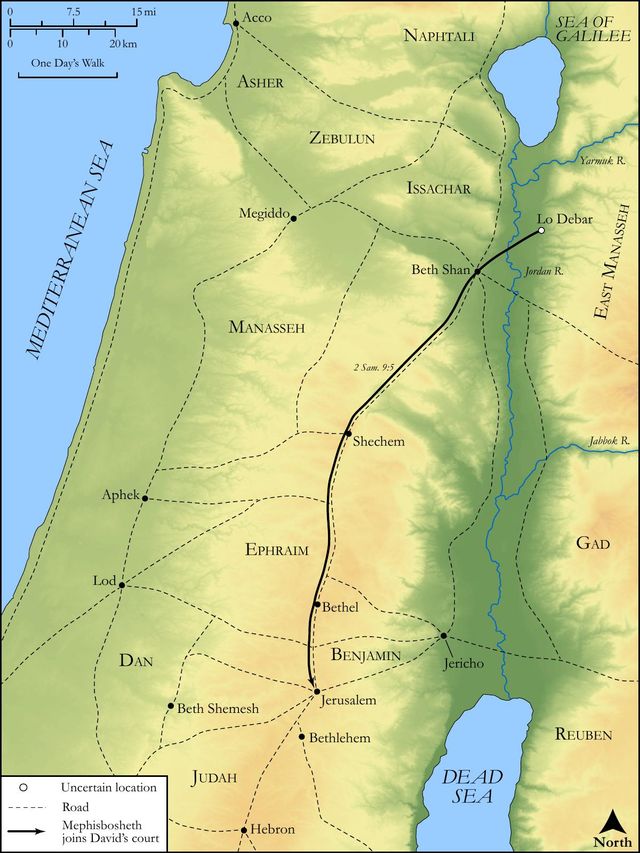
Ziba was an old retainer to Saul's family, and knew the state of it. He was sent for and examined, and informed the king that Jonathan's son was living, but lame (how he came to be so we read before, Sa2 4:4), and that he lived in obscurity, probably among his mother's relations in Lo-debar in Gilead, on the other side Jordan, where he was forgotten, as a dead man out of mind, but bore this obscurity the more easily because he could remember little of the honour he fell from.
III.The bringing of him to court.
The king sent (Ziba, it is likely) to bring him up to Jerusalem with all convenient speed, Sa2 9:5. Thus he eased Machir of his trouble, and perhaps recompensed him for what he had laid out on Mephibosheth's account. This Machir appears to have been a very generous free-hearted man, and to have entertained Mephibosheth, not out of any disaffection to David or his government, but in compassion to the reduced son of a prince, for afterwards we find him kind to David himself when he fled from Absalom. He is named (Sa2 17:27) among those that furnished the king with what he wanted at Mahanaim, though David, when he sent for Mephibosheth from him, little thought that the time would come when he himself would gladly be beholden to him: and perhaps Machir was then the more ready to help David in recompence for his kindness to Mephibosheth. Therefore we should be forward to give, because we know not but we ourselves may some time be in want, Ecc 11:2. And he that watereth shall be watered also himself, Pro 11:25. Now,
1.Mephibosheth presented himself to David with all the respect that was due to his character. Lame as he was, he fell on his face, and did homage, Sa2 9:6. David had thus made his honours to Mephibosheth's father, Jonathan, when he was next to the throne (Sa1 20:41, he bowed himself to him three times), and now Mephibosheth, in like manner, addresses him, when affairs are so completely reversed. Those who, when they are in inferior relations, show respect, shall, when they come to be advanced, have respect shown to them.
2.David received him with all the kindness that could be.
(1.)He spoke to him as one surprised, but pleased to see him. "Mephibosheth! Why, is there such a man living?" He remembered his name, for it is probable that he was born about the time of the intimacy between him and Jonathan.
(2.)He bade him not be afraid: Fear not, Sa2 9:7. It is probable that the sight of David put him into some confusion, to free him from which he assures him that he sent for him, not out of any jealousy he had of him, nor with any bad design upon him, but to show him kindness. Great men should not take a pleasure in the timorous approaches of their inferiors (for the great God does not), but should encourage them.
(3.)He gives him, by grant from the crown, all the land of Saul his father, that is, his paternal estate, which was forfeited by Ishbosheth's rebellion and added to his own revenue. This was a real favour, and more than giving him a kind word. True friendship will be generous.
(4.)Though he had thus given him a good estate, sufficient to maintain him, yet for Jonathan's sake (whom perhaps he saw some resemblance of in Mephibosheth's face), he will take him to be a constant guest at his own table, where he will not only be comfortably fed, but have company and attendance suitable to his birth and quality. Though Mephibosheth was lame and unsightly, and does not appear to have had any great fitness for business, yet, for his good father's sake, David took him to be one of his family.
3.Mephibosheth accepts this kindness with great humility and self-abasement. He was not one of those that take every favour as a debt, and think every thing too little that their friends do for them; but, on the contrary, speaks as one amazed at the grants David made him (Sa2 9:8): What is thy servant, that thou shouldst look upon such a dead dog as I am? How does he vilify himself! Though the son of a prince, and the grandson of a king, yet his family being under guilt and wrath, and himself poor and lame, he calls himself a dead dog before David. Note, It is good to have the heart humble under humbling providences. If, when divine Providence brings our condition down, divine grace brings our spirits down with it, we shall be easy. And those who thus humble themselves shall be exalted. How does he magnify David's kindness! It would have been easy to lessen it if he had been so disposed. Had David restored him his father's estate? It was but giving him his own. Did he take him to his table? This was policy, that he might have an eye upon him. But Mephibosheth considered all that David said and did as very kind, and himself as less than the least of all his favours. See Sa1 18:18.
Continue studying 2 Samuel 9:2 across the web’s major study libraries — every link below opens this exact verse, chapter, or book on the destination site.
Read & Compare
 BibleGatewayThis verse in more than 200 translations and 70 languages.
 Bible.comThe YouVersion reader — hundreds of translations, reading plans, and highlights.
 ESV.orgCrossway's official English Standard Version reader.
 NET BibleThe NET translation with 60,000+ translators' notes on every rendering decision.
 STEP BibleTyndale House's free study tool — original text, vocabulary, and scholarly resources.
 BibliaLogos Bible Software's free web reader.
 USCCBThe New American Bible (Revised Edition) with the U.S. bishops' study notes.
Commentaries
 BibleHub CommentariesDozens of classic commentaries on this verse, gathered on one page.
 StudyLightMore than 100 commentary sets — the largest collection on the web.
 BibleRefPlain-English commentary on what this verse means, verse by verse.
 Enduring WordDavid Guzik's free commentary on this chapter, widely used by Bible teachers.
 Bible Study ToolsVerse commentary alongside Greek and Hebrew study aids.
Original Language & Research
- BibleHub InterlinearThe verse word by word — original language, transliteration, and English.
- BibleHub LexiconEvery word's original-language definition and Strong's entry.
 Blue Letter BibleDeep-study tools — Strong's numbers, concordance, and word studies.
 SefariaThe Hebrew text with Rashi and centuries of Jewish commentary.
Sermons, Hymns & Audio


TrulyRandomVerse is not affiliated with these sites and doesn’t control their content. They’re linked because they’re genuinely useful.
Summary
2 Samuel 9:2 introduces Ziba, a former servant of King Saul's household, whom David summons as he initiates a profound search for any surviving members of Saul's family. This verse is pivotal, serving as the immediate answer to David's heartfelt inquiry in the preceding verse, setting the stage for the king's remarkable demonstration of covenant faithfulness and grace towards Mephibosheth, Jonathan's son. It highlights David's character as a king who remembers and honors his solemn oaths, thereby laying the groundwork for one of the Old Testament's most moving narratives of redemption and restoration.
Context
ShowHideLiterary Context
This verse immediately follows David's poignant question in 2 Samuel 9:1: "Is there yet any that is left of the house of Saul, that I may show him kindness for Jonathan's sake?" This inquiry marks a significant thematic and narrative shift in 2 Samuel. Chapters 1-8 meticulously detail David's consolidation of power, his anointing as king over all Israel, and his military victories, establishing his kingdom and securing peace. With the kingdom firmly established, David now turns his attention from matters of state and war to matters of covenant and personal integrity. His question and the subsequent introduction of Ziba are the direct outworking of the deep, unconditional covenant David made with Jonathan, Saul's son, as recounted in 1 Samuel 20:12-17. The narrative flow here is deliberately crafted to showcase David's righteous character and his unwavering commitment to promises, even when the beneficiary (Jonathan) is long deceased and political expediency might suggest otherwise.
Historical & Cultural Context
Among the kings of that day, it was a common and brutal practice for a new dynasty to utterly exterminate the previous ruling family to prevent any future claims to the throne or rebellions. David's inquiry, therefore, is highly unusual and counter-cultural, demonstrating a radical departure from typical royal behavior. His motivation is not political calculation but covenant loyalty, often termed hesed. Servants like Ziba often held significant positions within royal households, acting as stewards or administrators, and would possess intimate knowledge of the family's affairs and whereabouts, including any surviving members. The act of "calling him unto David" signifies the king's absolute authority and the expectation of immediate obedience from any subject, especially a former servant of the deposed house. Ziba's humble and immediate response, "Thy servant is he," reflects the deferential protocol expected when addressing a monarch, acknowledging the immense power disparity.
Key Themes
ShowHideThe introduction of Ziba in 2 Samuel 9:2 immediately brings several key themes to the forefront. Foremost is Covenant Faithfulness, particularly David's unwavering commitment to the oath he made with Jonathan, which transcends death and political advantage. This exemplifies the concept of hesed, a steadfast love and loyalty that is often associated with God's own character, as seen in Psalm 89:28. Another significant theme is Royal Grace and Kindness. David's proactive search for Saul's descendants is not born of obligation but of a genuine desire to extend kindness, mirroring the divine initiative in extending grace to humanity. This act sets David apart as a king who rules not just with power but with compassion, a quality that resonates throughout the Davidic covenant. Finally, the verse subtly introduces the theme of Remnants and Restoration. The very existence of a "servant of the house of Saul" and the subsequent discovery of Mephibosheth hint at the preservation of a remnant and the potential for the restoration of what was lost or broken, a recurring motif throughout biblical history, from the preservation of Noah's family to the return from exile, and ultimately culminating in the new creation.
Exposition and Analysis
ShowHideKey Word Analysis
ShowHideThis term (H1004) refers not merely to a physical dwelling but to a dynasty, a lineage, or a family entity. "The house of Saul" signifies his entire extended family and descendants, not just his immediate household. David's inquiry is about the survival of Saul's dynastic line, and Ziba's connection to this "house" makes him the key to locating any remaining members.
This term (H5650) is rich in meaning, ranging from a literal slave or bond-servant to a high-ranking official or devoted attendant. In Ziba's case, it indicates his long-standing allegiance and integration into Saul's royal household, suggesting he was a trusted steward or administrator with intimate knowledge of the family's affairs. His identity as an 'ebed of Saul's house is crucial, as it is precisely this connection that makes him valuable to David's inquiry.
David is explicitly referred to as "the king" (H4428), emphasizing his supreme authority and the formal nature of the summons. His position as melek grants him the right to summon anyone and expect an immediate and truthful response, underscoring the power dynamic at play in this encounter.
Verse Breakdown
ShowHide"And [there was] of the house of Saul a servant whose name [was] Ziba."
This opening clause introduces the character Ziba, establishing his identity and his crucial connection to the former royal family. The passive construction "there was" suggests he was discovered or brought forward, implying David's proactive search. His name is explicitly stated, marking him as an individual of significance for the unfolding narrative, the one who holds the key to David's inquiry.
"And when they had called him unto David,"
This indicates that Ziba was not merely found but formally summoned into the king's presence. The use of "they" (likely David's servants or officials) highlights the formal royal procedure involved in such an important inquiry, emphasizing the king's initiative and the thoroughness of the search for any remaining members of Saul's household.
"the king said unto him, [Art] thou Ziba?"
David's direct question serves as an immediate identification and confirmation. It is a concise, authoritative inquiry, cutting straight to the purpose of the summons. It also implies that Ziba's name had been brought to David's attention as the one who could provide the necessary information, confirming his reputation as a knowledgeable figure from Saul's past.
"And he said, Thy servant [is he]."
Ziba's response is a model of humble submission and immediate affirmation. "Thy servant is he" is a deferential acknowledgment of David's kingship and his own subordinate position. It signifies his readiness to obey and provide whatever information the king requires, without hesitation or evasion, setting the stage for the revelation of Mephibosheth.
Literary Devices
ShowHideThe brevity and directness of 2 Samuel 9:2 are themselves a literary choice, creating a sense of immediate action and purpose. The verse employs Dialogue as its primary literary device, with the concise exchange between David and Ziba. This dialogue is highly functional, serving to establish Ziba's identity and his immediate submission to the king's authority. There is also an element of Foreshadowing, as Ziba's introduction hints at the imminent revelation of Mephibosheth and the subsequent unfolding of David's extraordinary kindness. The very act of summoning Ziba, a servant of the former house, creates a subtle Contrast between the typical brutal transition of power among the kings of that day and David's unique, covenant-driven approach. The scene is set with a sense of quiet anticipation, building suspense for the revelation of Saul's surviving heir.
Theological and Thematic Connections
ShowHideThis seemingly simple verse is deeply imbued with theological significance, primarily revolving around the themes of covenant, grace, and divine faithfulness. David's proactive search for Saul's descendants, motivated by his oath to Jonathan, powerfully mirrors God's own initiative in remembering and upholding His covenants with humanity. Just as David seeks out the forgotten and vulnerable, God consistently demonstrates His hesed—His steadfast love and covenant loyalty—towards His people, even when they are undeserving or seemingly beyond hope. This act of seeking out and extending kindness to a member of a defeated house, rather than exterminating them, reflects a divine principle of restorative grace that transcends human justice or political expediency. It underscores that true kingship, as exemplified by David's actions, is not merely about power, but about righteousness, compassion, and the keeping of sacred promises, echoing the very character of God.
Reflection and Application
ShowHide2 Samuel 9:2, though brief, provides a powerful model for how we, as followers of Christ, are called to live out our faith in practical ways. David's unwavering commitment to his oath, even years after Jonathan's death and when there was no political benefit, challenges us to reflect on the integrity of our own promises and commitments. Are we people of our word, even when circumstances change or when fulfilling a promise is inconvenient or costly? Furthermore, David's proactive search for someone to show kindness to compels us to move beyond passive benevolence. Instead of waiting for needs to come to us, are we actively seeking out opportunities to extend grace, compassion, and practical help to those who are despised, forgotten, or in need, especially those who might be overlooked by society? Ziba's humble and immediate response also serves as a poignant reminder of the value of humility and a willingness to serve, recognizing legitimate authority and responding with a spirit of cooperation and readiness. This passage ultimately calls us to embody the hesed of God in our daily lives, transforming our communities through acts of intentional kindness and faithfulness.
Questions for Reflection
ShowHideFAQ
ShowHideWho was Ziba before this verse, and why was he important?
ShowHideZiba was a servant, likely a steward or administrator, in the household of King Saul. His importance stems from his intimate knowledge of Saul's family and their whereabouts. As a long-standing member of the royal household, he would have been privy to information about surviving descendants, making him the key individual David's servants sought out to answer the king's inquiry about Saul's lineage. His existence was crucial for the unfolding narrative of David's covenant faithfulness.
Why did David need to ask "Art thou Ziba?" if his servants had already called him?
ShowHideDavid's direct question, "Art thou Ziba?", serves multiple purposes in a royal court setting. Firstly, it is a formal and authoritative confirmation of identity, essential where impersonation or misidentification could have serious consequences. Secondly, it establishes the king's direct engagement and personal authority in the matter, signaling the gravity of the inquiry. It also ensures that the person standing before him is indeed the one capable of providing the crucial information David seeks regarding the house of Saul, fulfilling his covenant with Jonathan (see 2 Samuel 9:1).
What is the significance of Ziba's immediate response, "Thy servant is he"?
ShowHideZiba's response, "Thy servant is he," is a profound expression of humility, submission, and immediate recognition of David's absolute authority as king. This deferential language was customary when addressing a monarch and indicates Ziba's readiness to serve and provide information without question or hesitation. It signifies his acknowledgment of David's kingship and his own subordinate position, setting the stage for his pivotal role in revealing Mephibosheth's existence and location (as seen in 2 Samuel 9:3).
Christ-Centered Fulfillment
ShowHideThe narrative initiated by 2 Samuel 9:2, where David actively seeks out a remnant of Saul's house to show kindness for Jonathan's sake, powerfully foreshadows the redemptive work of Jesus Christ. David's hesed (covenant love and loyalty) in remembering his oath and extending grace to Mephibosheth, a lame and forgotten descendant of a rival house, beautifully mirrors God's own divine initiative in seeking out humanity. We, like Mephibosheth, were spiritually lame and alienated from the King, deserving of judgment due to our sin, part of a "house" (humanity) that rebelled against God. Yet, God, in His boundless hesed, did not exterminate us but, in Christ, sought us out. Romans 5:8 declares that "God demonstrates his own love for us in this: While we were still sinners, Christ died for us." Through Christ, we are brought into the King's presence, not as enemies or strangers, but as adopted children, invited to sit at His table forever. This act of grace transforms our status, bringing us from a place of fear and destitution into a position of honor and inheritance, reflecting the spiritual adoption we receive through faith in Jesus, as highlighted in Ephesians 1:5 and Galatians 4:4-7. David's kindness to Mephibosheth is a tangible Old Testament picture of the ultimate reconciliation and restoration offered through the Lamb of God who takes away the sin of the world, inviting all who believe to the eternal banquet at the King's table.