


2 Samuel 19:27
- וַיְרַגֵּלvay·ra·Geland he has slanderedH7270Conj-w ¦ V-Piel-ConsecImperf-3msVerb Piel Consecutive Imperfect 3rd Singular Masculineוַandיְרַגֵּלhe has slandered
- בְּעַבְדְּךָbe·'av·de·Kha<in> your servantH5650Prep-b ¦ N-msc ¦ 2msNoun Singular Masculine Constructבְּ<in>עַבְדְּservantךָyour
- אֶל'eltoH413PrepPreposition
- אֲדֹנִי'a·do·Nimy lordH113N-msc ¦ 1csNoun Singular Masculine Constructאֲדֹנִlordיmy
- הַמֶּלֶךְha·Me·lekhthe kingH4428Art ¦ N-msNoun Singular Masculine Absoluteהַtheמֶּלֶךְking
- וַאדֹנִיva·do·Niand my lordH113Conj-w ¦ N-msc ¦ 1csNoun Singular Masculine Constructוַandאדֹנִlordיmy
- הַמֶּלֶךְha·Me·lekhthe kingH4428Art ¦ N-msNoun Singular Masculine Absoluteהַtheמֶּלֶךְking
- כְּמַלְאַךְke·mal·'Akh[is] like [the] angel ofH4397Prep-k ¦ N-mscNoun Singular Masculine Constructכְּ[is] likeמַלְאַךְ[the] angel of
- הָאֱלֹהִיםha·'E·lo·Him<the> GodH430Art ¦ N-mpNoun Plural Masculine Absoluteהָ<the>אֱלֹהִיםGod
- וַעֲשֵׂהva·'a·Sehand doH6213Conj-w ¦ V-Qal-Imp-2msVerb Qal Imperative 2nd Singular Masculineוַandעֲשֵׂהdo
- הַטּוֹבha·Tovthe goodH2896Art ¦ Adj-msAdjective Singular Masculine Absoluteהַtheטּוֹבgood
- בְּעֵינֶיךָbe·'ei·Nei·khain your viewH5869Prep-b ¦ N-fdc ¦ 2msNoun Dual Feminine Constructבְּinעֵינֶיviewךָyour
English is a literal word-by-word gloss of the Hebrew, not the KJV's wording. Why?
This is the original text the KJV's translators worked from — each Hebrew word with its own literal English meaning in this verse, prepared by scholars at Tyndale House, Cambridge. The KJV translates whole sentences, not word by word, so its wording differs: one Hebrew word can become several English words, and the KJV may choose “the LORD” where the gloss reads “Yahweh”. Both are faithful — they answer different questions. For the KJV's own rendering, switch to the KJV text.
Details
See on the biblical-era map
Study this verse
Public-domain commentary
Matthew Henry
From his Commentary on the Whole Bible. Henry comments on passages, not single verses — this entry covers 2 Samuel 19:24–30. His two-level outline is real structure in the source text, so it is rendered as structure.
The day of David's return was a day of bringing to remembrance, a day of account, in which what had passed in his flight was called over again; among other things, after the case of Shimei, that of Mephibosheth comes to be enquired into, and he himself brings it on.
I.He went down in the crowd to meet the king (Sa2 19:24), and as a proof of the sincerity of his joy in the king's return, we are here told what a true mourner he was for the king's banishment. During that melancholy time, when one of the greatest glories of Israel had departed, Mephibosheth continued in a very melancholy state. He was never trimmed, nor put on clean linen, but wholly neglected himself, as one abandoned to grief for the king's affliction and the kingdom's misery. In times of public calamity we ought to abridge our enjoyments in the delights of sense, in conformity to the season. There are times when God calls to weeping and mourning, and we must comply with the call.
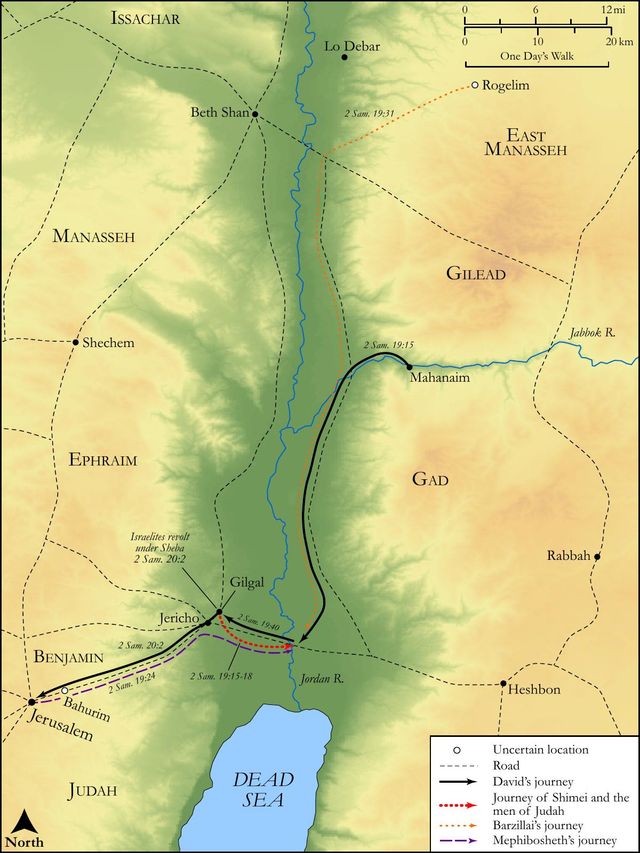
II.When the king came to Jerusalem (since he could not sooner have an opportunity) he made his appearance before him (Sa2 19:25); and when the king asked him why he, being one of his family, had staid behind, and not accompanied him in his exile, he opened his case fully to the king.
1.He complained of Ziba, his servant who should have been his friend, but had been in two ways his enemy; for, first, he had hindered him from going along with the king, by taking the ass himself which he was ordered to make ready for his master (Sa2 19:26), basely taking advantage of his lameness and his inability to help himself; and, secondly, he had accused him to David of a design to usurp the government, Sa2 19:27. How much mischief is it in the power of a wicked servant to do to the best master!
2.He gratefully acknowledged the king's great kindness to him when he and all his father's house lay at the king's mercy, Sa2 19:28. When he might justly have been dealt with as a rebel, he was treated as a friend, as a child: Thou didst set thy servant among those that did eat at thy own table. This shows that Ziba's suggestion was improbable; for could Mephibosheth be so foolish as to aim higher when he lived so easily, so happily as he did? And could he be so very disingenuous as to design any harm to David, of whose great kindness to him he was thus sensible? (3.) He referred his cause to the king's pleasure (Do what is good in thy eyes with me and my estate), depending on the king's wisdom, and his ability to discern between truth and falsehood (My lord the king is as an angel from God), and disclaiming all pretensions of his own merit: "So much kindness I have received above what I deserved, and what right have I to cry any more unto the king? Why should I trouble the king with my complaints when I have already been so troublesome to him? Why should I think any thing hard that is put upon me when I hitherto been so kindly treated?" We were all as dead men before God; yet he has not only spared us, but taken us to sit at his table. How little reason then have we to complain of any trouble we are in, and how much reason to take all well that God does!
III.David hereupon recalls the sequestration of Mephibosheth's estate; being deceived in his grant, he revokes it, and confirms his former settlement of it: "I have said, Thou and Ziba divide the land (Sa2 19:29), that is, Let it be as I first ordered it (Sa2 9:10); the property shall still be vested in thee, but Ziba shall have occupancy: he shall till the land, paying thee a rent." Thus Mephibosheth is where he was; no harm is done, only Ziba goes away unpunished for his false and malicious information against his master. David either feared him too much, or loved him too well, to do justice upon him according to that law, Deu 19:18, Deu 19:19; and he was now in the humour of forgiving and resolved to make every body easy.
IV.Mephibosheth drowns all he cares about his estate in his joy for the king's return (Sa2 19:30):
"Yea, let him take all, the presence and favour of the king shall be to me instead of all." A good man can contentedly bear his own private losses and disappointments, while he see Israel in peace, and the throne of the Son of David exalted and established. Let Ziba take all, so that David may be in peace.
Historical interpretation
Historical reception
1 surviving comment on this verse from the historical church.
Why are you surprised, Peter, that we who are but human make mistakes? Have you forgotten that it was David’s reliance on the untruthful words of a servant that caused him to pronounce sentence against the innocent son of Jonathan? And David had the spirit of prophecy. But, since David did this, we can be sure that in God’s secret judgment he acted justly, even though we cannot see the justice of it with our human reason. Why should we be surprised, then, if we who are not prophets are sometimes led astray by deceitful people? An important point to consider is that the mind of a superior is distracted by a world of cares, and once the attention is preoccupied with a variety of matters it becomes less observant of details. One who is occupied with a multitude of affairs is all the more liable to be misled in regard to any one of them.
Continue studying 2 Samuel 19:27 across the web’s major study libraries — every link below opens this exact verse, chapter, or book on the destination site.
Read & Compare
 BibleGatewayThis verse in more than 200 translations and 70 languages.
 Bible.comThe YouVersion reader — hundreds of translations, reading plans, and highlights.
 ESV.orgCrossway's official English Standard Version reader.
 NET BibleThe NET translation with 60,000+ translators' notes on every rendering decision.
 STEP BibleTyndale House's free study tool — original text, vocabulary, and scholarly resources.
 BibliaLogos Bible Software's free web reader.
 USCCBThe New American Bible (Revised Edition) with the U.S. bishops' study notes.
Commentaries
 BibleHub CommentariesDozens of classic commentaries on this verse, gathered on one page.
 StudyLightMore than 100 commentary sets — the largest collection on the web.
 BibleRefPlain-English commentary on what this verse means, verse by verse.
 Enduring WordDavid Guzik's free commentary on this chapter, widely used by Bible teachers.
 Bible Study ToolsVerse commentary alongside Greek and Hebrew study aids.
Original Language & Research
- BibleHub InterlinearThe verse word by word — original language, transliteration, and English.
- BibleHub LexiconEvery word's original-language definition and Strong's entry.
 Blue Letter BibleDeep-study tools — Strong's numbers, concordance, and word studies.
 SefariaThe Hebrew text with Rashi and centuries of Jewish commentary.
Sermons, Hymns & Audio


TrulyRandomVerse is not affiliated with these sites and doesn’t control their content. They’re linked because they’re genuinely useful.
Summary
In 2 Samuel 19:27, Mephibosheth, the grandson of Saul, presents a fervent defense before King David upon the king's return to Jerusalem after Absalom's rebellion. He vehemently refutes the malicious accusations of his servant Ziba, who had slandered him during David's flight. Mephibosheth humbly asserts Ziba's treachery and expresses profound trust in David's exceptional wisdom, likening the king's discernment to that of an "angel of God," culminating in a complete and humble submission to David's ultimate judgment. This verse powerfully encapsulates his plea for justice, his unwavering loyalty, and his willingness to accept whatever decision the king renders despite the severe personal consequences he had endured.
Context
ShowHideLiterary Context
This verse is strategically placed within the narrative of King David's return to Jerusalem following the defeat of Absalom's rebellion. It immediately follows Mephibosheth's dramatic appearance before David (2 Samuel 19:24-26), where he is described as unkempt and mourning, clearly indicating his distress and refuting Ziba's earlier claims of disloyalty. David's direct question to Mephibosheth in 2 Samuel 19:25, "Why wentest not thou with me, Mephibosheth?", directly prompts this passionate defense. Mephibosheth's plea here is his opportunity to clear his name and re-establish his true loyalty in the king's eyes. The narrative then moves to David's somewhat ambiguous ruling in 2 Samuel 19:29-30, which divides the property between Mephibosheth and Ziba, highlighting the lasting impact of Ziba's deceit and the complexity of David's judgment.
Historical & Cultural Context
The period immediately following a civil war, such as Absalom's rebellion, was a volatile time in ancient Israel, demanding the re-establishment of royal authority and the swift identification and punishment of traitors. Loyalty to the reigning monarch was paramount, and any perceived disloyalty, especially from a descendant of the previous king (Saul), could lead to severe repercussions, including confiscation of property or even death. The social structure often involved wealthy landowners entrusting their estates to trusted servants or stewards, like Ziba, which unfortunately created opportunities for abuse of power, manipulation, and slander. In ancient Near Eastern cultures, kings were frequently regarded as possessing extraordinary wisdom, sometimes even divine insight, due to their role as God's chosen representatives. Addressing a king with titles like "angel of God" was a profound expression of respect, flattery, and acknowledgment of their perceived discernment and authority to administer justice. David, as God's anointed king over Israel, was expected to embody these qualities of divine justice and wisdom.
Key Themes
ShowHideMephibosheth's defense in this verse powerfully reinforces several key themes prevalent throughout the books of Samuel. The pervasive theme of slander and false accusation is central, as Ziba's deceitful report directly led to Mephibosheth's disinheritance and public disgrace. This highlights the destructive power of misinformation and malicious gossip, a theme also evident in the accusations leveled against David by Saul's court in 1 Samuel 24:9. Another prominent theme is loyalty versus treachery. Mephibosheth's unkempt appearance, his earnest plea, and his willingness to accept David's judgment underscore his unwavering devotion to the king, standing in stark contrast to Ziba's opportunistic betrayal. This narrative serves as a poignant reminder of the covenant loyalty David had previously extended to Mephibosheth for Jonathan's sake in 2 Samuel 9:7. Finally, the verse emphasizes the king's divine wisdom and discernment. Mephibosheth's declaration that David is "as an angel of God" speaks to the expectation of righteous judgment from a divinely appointed leader, a quality that David was often praised for, as seen in the wise woman of Tekoa's words in 2 Samuel 14:17.
Exposition and Analysis
ShowHideKey Word Analysis
ShowHideThis verb (H7270) means "to walk along," but specifically in this context, it takes on the meaning "to reconnoiter," "to be a tale-bearer," or "to slander." It implies a deliberate and malicious act of spreading false or damaging reports about someone, often with the intent to deceive, undermine, or gain personal advantage. Here, it precisely describes Ziba's treacherous misrepresentation of Mephibosheth's loyalty and actions to King David, which had severe and immediate consequences for Mephibosheth.
This phrase combines mălʼâk (H4397), meaning "a messenger" or "an angel," and ʼĕlôhîym (H430), referring to "God" or "gods." When used together, as here, it signifies not that David is a divine being, but that he possesses extraordinary, almost supernatural, wisdom, insight, and discernment. It suggests an ability to see through deception, understand the truth of a matter, and judge righteously, as if inspired or guided by divine understanding. It is a profound compliment, acknowledging David's exceptional capacity for just governance and his role as God's anointed.
This idiomatic expression combines ṭôwb (H2896), meaning "good" in the widest sense (including pleasant, agreeable, right), and ʻayin (H5869), meaning "eye" (literally or figuratively, often representing perception, judgment, or opinion). The phrase signifies complete submission to the king's will and judgment. Mephibosheth is essentially saying, "Whatever you, my lord, deem right, just, or pleasing, that I will accept." It demonstrates profound humility, trust in David's ultimate decision-making, and a relinquishing of his own right to demand a specific outcome, placing his fate entirely in the king's hands.
Verse Breakdown
ShowHide"And he hath slandered thy servant unto my lord the king;"
Mephibosheth begins his defense by directly and unequivocally accusing Ziba of lying and defaming his character. By referring to himself as "thy servant," he emphasizes his loyal subservience and devotion to David, thereby contrasting it sharply with the disloyalty Ziba falsely attributed to him. This clause is the core of his defense, asserting the malicious and deceitful nature of Ziba's actions, which had led to his disinheritance.
"but my lord the king [is] as an angel of God:"
This is a powerful and strategic declaration of Mephibosheth's profound faith in David's wisdom and his ability to discern truth from falsehood. It is a high and sincere compliment, appealing to David's reputation for righteous judgment and divine insight. By likening David to an "angel of God," Mephibosheth expresses confidence that David will see through Ziba's deception and recognize his true loyalty, implying that David possesses a divine-like capacity for understanding and administering justice.
"do therefore [what is] good in thine eyes."
This concluding phrase signifies Mephibosheth's ultimate humility, submission, and trust in David's authority. Despite having been wronged and slandered, he does not demand restitution or a specific outcome for himself. Instead, he places his fate entirely in David's hands, trusting that whatever decision David makes, it will be the right one, reflecting a deep respect for the king's sovereign authority and a willingness to accept his final judgment, whatever it may be.
Literary Devices
ShowHideMephibosheth's fervent plea in 2 Samuel 19:27 employs several potent literary devices to convey his message and appeal to King David. The most striking is Simile, evident in the phrase "my lord the king [is] as an angel of God." This comparison, using "as," does not literally suggest David is a celestial being, but rather serves to magnify David's perceived wisdom, discernment, and capacity for righteous judgment, appealing to his ego and his divinely appointed role. There is also a clear Contrast established between Ziba's malicious slander and Mephibosheth's humble, truthful, and submissive defense. This highlights the moral opposition between treachery and loyalty, deceit and integrity. Furthermore, the entire verse functions as a powerful Supplication or Plea, a fervent and respectful appeal to a higher authority for justice and understanding. Mephibosheth's carefully chosen words, particularly his final declaration of submission, create a sense of pathos and underscore his vulnerable position, relying solely on the king's mercy and discernment to restore his honor and standing.
Theological and Thematic Connections
ShowHideThis verse profoundly speaks to fundamental biblical themes of truth, justice, and the nature of righteous authority. Mephibosheth's predicament highlights the vulnerability of the innocent to slander and the critical need for discernment in leadership. His profound trust in David's "angel of God" wisdom points to the expectation that earthly rulers, especially those appointed by God, should strive to reflect divine attributes of justice, insight, and integrity. Ultimately, Mephibosheth's humble submission and trust remind us that while human justice may often be imperfect, delayed, or even miscarried, there is a higher, divine court that sees all, knows all truth, and will ultimately bring all hidden things to light, administering perfect and unassailable justice.
Reflection and Application
ShowHideMephibosheth's unwavering loyalty, humble submission, and earnest defense in the face of grave injustice offer a powerful and enduring model for believers navigating similar challenges today. When we are falsely accused, slandered, or misunderstood, our natural inclination might be to react with anger, defensiveness, or a desperate need for self-vindication. However, Mephibosheth's example teaches us the profound value of patiently and truthfully presenting our case to those in authority, while ultimately entrusting the outcome to a higher, sovereign power. His profound trust in David's wisdom, even after David's initial rash judgment, reflects a deeper spiritual truth: that God is the ultimate arbiter of justice, and His discernment is perfect and unfailing. This narrative encourages us to cultivate a spirit of humility, to steadfastly pursue truth, and to trust in God's sovereign plan and perfect timing, even when circumstances seem overwhelmingly unfair or when earthly justice falls short. It also serves as a poignant reminder for those in positions of influence—whether in the church, family, or workplace—to exercise profound discernment, to listen carefully and impartially to all sides of a story, and to diligently seek divine wisdom before rendering judgment, lest they inadvertently perpetuate injustice through hasty or biased decisions.
Questions for Reflection
ShowHideFAQ
ShowHideWhat was the nature of Ziba's slander against Mephibosheth?
ShowHideZiba maliciously slandered Mephibosheth by falsely accusing him of disloyalty and treason against King David during Absalom's rebellion. Ziba claimed that Mephibosheth had deliberately stayed behind in Jerusalem, hoping that the chaos of the rebellion would lead to the restoration of Saul's kingdom to him (see 2 Samuel 16:3). This grave accusation implied a desire to usurp David's throne and directly led David to rashly grant all of Mephibosheth's property to Ziba (see 2 Samuel 16:4), highlighting the devastating impact of Ziba's deceit.
Why did Mephibosheth refer to King David as "an angel of God"?
ShowHideMephibosheth used the phrase "as an angel of God" to express his profound respect for David's exceptional wisdom, discernment, and ability to judge righteously. It was a high and sincere compliment, suggesting that David possessed a divine-like insight to see through deception and understand the truth of a matter, beyond ordinary human capacity. This phrase was also famously used by the wise woman of Tekoa in 2 Samuel 14:17 to describe David's exceptional wisdom in resolving disputes. Mephibosheth's use of this phrase was both a genuine acknowledgment of David's perceived sagacity and a strategic appeal to the king's sense of justice, hoping David would apply his divine-like wisdom to discern Mephibosheth's true loyalty.
Christ-Centered Fulfillment
ShowHideMephibosheth's experience in 2 Samuel 19:27, marked by unjust slander, profound betrayal, and humble submission, finds deep and resonant Christ-centered fulfillment. Like Mephibosheth, Jesus, the true Son of David and the ultimate "servant" of God, was relentlessly slandered and betrayed by those He came to serve. He endured false accusations of treason against Caesar and blasphemy against God, facing numerous false testimonies (e.g., Matthew 26:59-61). Yet, in the face of such profound injustice, Jesus did not retaliate or defend Himself with human might, but humbly submitted to the will of His Father, trusting in divine justice (e.g., 1 Peter 2:23). He is the true King who possesses perfect discernment, far beyond that of any "angel of God," for He is God incarnate, the very Word through whom all things were made (e.g., John 1:1-3). His judgment is always "good in [His Father's] eyes" because He perfectly executes the Father's will, seeking only His glory (e.g., John 5:30). Ultimately, Jesus, the Lamb of God, was slandered, crucified, and sacrificed, not for His own sin, but to take away the sin of the world, thereby establishing perfect justice and offering true restoration and a place at His table to all who, like Mephibosheth, humbly submit to His sovereign reign (e.g., John 1:29).