


2 Samuel 19:26
Bible text: King James Version (1769 Blayney text) · Public domain
Bible text: King James Version with Strong's numbers · Public domain
Bible text: Berean Standard Bible · Public domain
Bible text: American Standard Version (1901) · Public domain
Bible text: World English Bible, Messianic edition · Public domain
Bible text: Geneva Bible (1599) · Public domain
Bible text: Young's Literal Translation · Public domain
- וַיֹּאמַרvai·yo·Marand he saidH559Conj-w ¦ V-Qal-ConsecImperf-3msVerb Qal Consecutive Imperfect 3rd Singular Masculineוַandיֹּאמַרhe said
- אֲדֹנִי'a·do·Nimy O lordH113N-msc ¦ 1csNoun Singular Masculine ConstructאֲדֹנִO lordיmy
- הַמֶּלֶךְha·Me·lekhthe kingH4428Art ¦ N-msNoun Singular Masculine Absoluteהַtheמֶּלֶךְking
- עַבְדִּי'av·Dimy servantH5650N-msc ¦ 1csNoun Singular Masculine Constructעַבְדִּservantיmy
- רִמָּנִיri·Ma·nihe betrayed meH7411V-Piel-Perf-3ms ¦ 1csVerb Piel Perfect 3rd Singular Masculineרִמָּhe betrayedנִיme
- כִּיkiforH3588PrtParticle Conditional
- אָמַר'a·Marhe saidH559V-Qal-Perf-3msVerb Qal Perfect 3rd Singular Masculine
- עַבְדְּךָ'av·de·Khayour servantH5650N-msc ¦ 2msNoun Singular Masculine Constructעַבְדְּservantךָyour
- אֶחְבְּשָׁה'ech·be·shahlet me saddleH2280V-Qal-Imperf-1csVerb Qal Imperfect 1st Singular common gender
- לִּיlifor <the> myselfPrep-l ¦ 1csSuffix Personal 1st Singular common genderלִּfor <the>יmyself
- הַחֲמוֹרha·cha·Morthe donkeyH2543Art ¦ N-csNoun Singular common gender Absoluteהַtheחֲמוֹרdonkey
- וְאֶרְכַּבve·'er·Kavso I may rideH7392Conj-w ¦ V-Qal-ConjImperf-1csVerb Qal Conjunction+Imperfect 1st Singular common genderוְsoאֶרְכַּבI may ride
- עָלֶיהָ'a·Lei·haon itH5921Prep ¦ 3fsPreposition Definiteעָלֶיonהָit
- וְאֵלֵךְve·'e·Lekhso I may goH1980Conj-w ¦ V-Qal-ConjImperf-1csVerb Qal Conjunction+Imperfect 1st Singular common genderוְsoאֵלֵךְI may go
- אֶת'etwithH854PrepPreposition
- הַמֶּלֶךְha·Me·lekhthe kingH4428Art ¦ N-msNoun Singular Masculine Absoluteהַtheמֶּלֶךְking
- כִּיkiforH3588PrtParticle Conditional
- פִסֵּחַfi·Se·ach[is] lameH6455Adj-msAdjective Singular Masculine Absolute
- עַבְדֶּךָ'av·De·khayour servantH5650N-msc ¦ 2msNoun Singular Masculine Constructעַבְדֶּservantךָyour
English is a literal word-by-word gloss of the Hebrew, not the KJV's wording. Why?
This is the original text the KJV's translators worked from — each Hebrew word with its own literal English meaning in this verse, prepared by scholars at Tyndale House, Cambridge. The KJV translates whole sentences, not word by word, so its wording differs: one Hebrew word can become several English words, and the KJV may choose “the LORD” where the gloss reads “Yahweh”. Both are faithful — they answer different questions. For the KJV's own rendering, switch to the KJV text.
Details
See on the biblical-era maps
Study this verse
Public-domain commentary
Matthew Henry
From his Commentary on the Whole Bible. Henry comments on passages, not single verses — this entry covers 2 Samuel 19:24–30. His two-level outline is real structure in the source text, so it is rendered as structure.
The day of David's return was a day of bringing to remembrance, a day of account, in which what had passed in his flight was called over again; among other things, after the case of Shimei, that of Mephibosheth comes to be enquired into, and he himself brings it on.
I.He went down in the crowd to meet the king (Sa2 19:24), and as a proof of the sincerity of his joy in the king's return, we are here told what a true mourner he was for the king's banishment. During that melancholy time, when one of the greatest glories of Israel had departed, Mephibosheth continued in a very melancholy state. He was never trimmed, nor put on clean linen, but wholly neglected himself, as one abandoned to grief for the king's affliction and the kingdom's misery. In times of public calamity we ought to abridge our enjoyments in the delights of sense, in conformity to the season. There are times when God calls to weeping and mourning, and we must comply with the call.
II.When the king came to Jerusalem (since he could not sooner have an opportunity) he made his appearance before him (Sa2 19:25); and when the king asked him why he, being one of his family, had staid behind, and not accompanied him in his exile, he opened his case fully to the king.
1.He complained of Ziba, his servant who should have been his friend, but had been in two ways his enemy; for, first, he had hindered him from going along with the king, by taking the ass himself which he was ordered to make ready for his master (Sa2 19:26), basely taking advantage of his lameness and his inability to help himself; and, secondly, he had accused him to David of a design to usurp the government, Sa2 19:27. How much mischief is it in the power of a wicked servant to do to the best master!
2.He gratefully acknowledged the king's great kindness to him when he and all his father's house lay at the king's mercy, Sa2 19:28. When he might justly have been dealt with as a rebel, he was treated as a friend, as a child: Thou didst set thy servant among those that did eat at thy own table. This shows that Ziba's suggestion was improbable; for could Mephibosheth be so foolish as to aim higher when he lived so easily, so happily as he did? And could he be so very disingenuous as to design any harm to David, of whose great kindness to him he was thus sensible? (3.) He referred his cause to the king's pleasure (Do what is good in thy eyes with me and my estate), depending on the king's wisdom, and his ability to discern between truth and falsehood (My lord the king is as an angel from God), and disclaiming all pretensions of his own merit: "So much kindness I have received above what I deserved, and what right have I to cry any more unto the king? Why should I trouble the king with my complaints when I have already been so troublesome to him? Why should I think any thing hard that is put upon me when I hitherto been so kindly treated?" We were all as dead men before God; yet he has not only spared us, but taken us to sit at his table. How little reason then have we to complain of any trouble we are in, and how much reason to take all well that God does!
III.David hereupon recalls the sequestration of Mephibosheth's estate; being deceived in his grant, he revokes it, and confirms his former settlement of it: "I have said, Thou and Ziba divide the land (Sa2 19:29), that is, Let it be as I first ordered it (Sa2 9:10); the property shall still be vested in thee, but Ziba shall have occupancy: he shall till the land, paying thee a rent." Thus Mephibosheth is where he was; no harm is done, only Ziba goes away unpunished for his false and malicious information against his master. David either feared him too much, or loved him too well, to do justice upon him according to that law, Deu 19:18, Deu 19:19; and he was now in the humour of forgiving and resolved to make every body easy.
IV.Mephibosheth drowns all he cares about his estate in his joy for the king's return (Sa2 19:30):
"Yea, let him take all, the presence and favour of the king shall be to me instead of all." A good man can contentedly bear his own private losses and disappointments, while he see Israel in peace, and the throne of the Son of David exalted and established. Let Ziba take all, so that David may be in peace.
Continue studying 2 Samuel 19:26 across the web’s major study libraries — every link below opens this exact verse, chapter, or book on the destination site.
Read & Compare
 BibleGatewayThis verse in more than 200 translations and 70 languages.
 Bible.comThe YouVersion reader — hundreds of translations, reading plans, and highlights.
 ESV.orgCrossway's official English Standard Version reader.
 NET BibleThe NET translation with 60,000+ translators' notes on every rendering decision.
 STEP BibleTyndale House's free study tool — original text, vocabulary, and scholarly resources.
 BibliaLogos Bible Software's free web reader.
 USCCBThe New American Bible (Revised Edition) with the U.S. bishops' study notes.
Commentaries
 BibleHub CommentariesDozens of classic commentaries on this verse, gathered on one page.
 StudyLightMore than 100 commentary sets — the largest collection on the web.
 BibleRefPlain-English commentary on what this verse means, verse by verse.
 Enduring WordDavid Guzik's free commentary on this chapter, widely used by Bible teachers.
 Bible Study ToolsVerse commentary alongside Greek and Hebrew study aids.
Original Language & Research
- BibleHub InterlinearThe verse word by word — original language, transliteration, and English.
- BibleHub LexiconEvery word's original-language definition and Strong's entry.
 Blue Letter BibleDeep-study tools — Strong's numbers, concordance, and word studies.
 SefariaThe Hebrew text with Rashi and centuries of Jewish commentary.
Sermons, Hymns & Audio


TrulyRandomVerse is not affiliated with these sites and doesn’t control their content. They’re linked because they’re genuinely useful.
Summary
In 2 Samuel 19:26, Mephibosheth, the grandson of Saul and son of Jonathan, presents a passionate defense to King David upon his return to Jerusalem, directly refuting the earlier accusations made by his servant Ziba. Mephibosheth explains his inability to join David during Absalom's rebellion by asserting that Ziba deliberately deceived him, failing to provide the necessary transport (an ass) due to Mephibosheth's debilitating lameness. This pivotal moment in the narrative underscores Mephibosheth's earnest desire to clear his name, restore his honor, and reaffirm his unwavering loyalty to the king, highlighting themes of betrayal, integrity, and the pursuit of justice amidst political intrigue.
Context
ShowHideLiterary Context
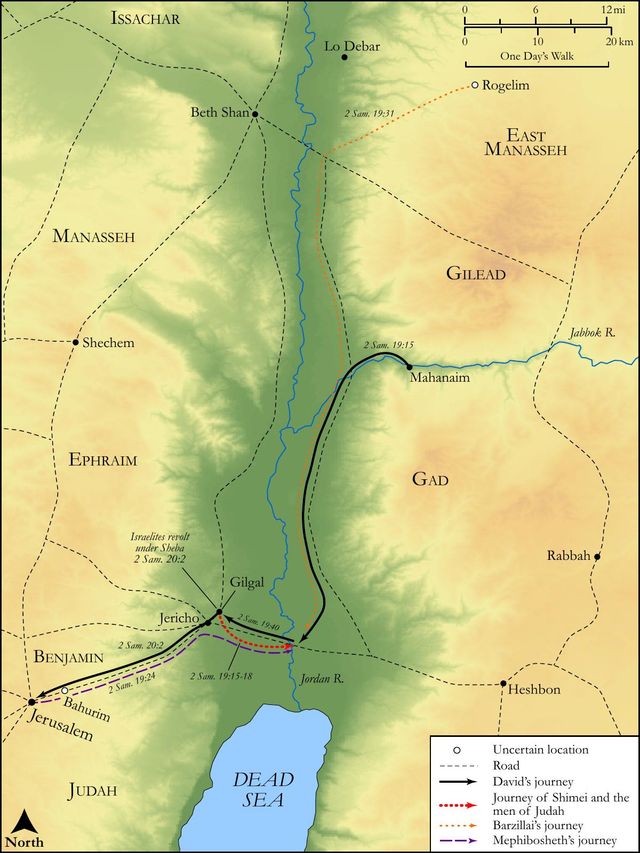
This verse is Mephibosheth's direct and urgent response to King David's pointed question in 2 Samuel 19:25, "Why did you not go with me, Mephibosheth?" It immediately follows Mephibosheth's dramatic appearance before David, characterized by his unkempt and mournful state, indicating deep distress over David's absence and the kingdom's turmoil (2 Samuel 19:24). The broader narrative context is David's tumultuous return to Jerusalem after fleeing Absalom's rebellion. Earlier in the story, David had extended extraordinary covenant kindness to Mephibosheth for the sake of Jonathan, restoring all of Saul's land to him and granting him a permanent place at the royal table (2 Samuel 9:7-13). However, during David's desperate flight, Mephibosheth's servant Ziba intercepted David with provisions and, seizing the opportunity, falsely accused Mephibosheth of remaining in Jerusalem in hopes of reclaiming the throne of Saul (2 Samuel 16:1-4). David, acting under duress and without full investigation, hastily awarded all of Mephibosheth's property to Ziba. Mephibosheth's detailed defense in 2 Samuel 19:26-28 serves as his crucial opportunity to present his side of the story, refute Ziba's slander, and restore his damaged reputation and relationship with the king.
Historical & Cultural Context
Under the kings of that day, unwavering loyalty to the reigning king was paramount, and any perceived disloyalty could result in severe penalties, including confiscation of property, exile, or even death. Servants and stewards, like Ziba, often held significant administrative power over their master's estates, especially if the master was incapacitated or absent. The concept of land inheritance was foundational to Israelite society, deeply intertwined with family identity, economic security, and covenant promises. Mephibosheth's lameness, a permanent physical disability resulting from an accident in his childhood (2 Samuel 4:4), would have rendered independent travel extremely difficult, if not impossible, in that era without dedicated assistance. This physical vulnerability made him particularly susceptible to Ziba's manipulative deceit, as he was entirely dependent on his servant to prepare his means of transport. The king's court was frequently a hotbed of political intrigue, where individuals often vied for favor and influence through various means, including manipulation, false accusations, and slander, making the king's ability to discern truth from falsehood a vital aspect of effective governance.
Key Themes
ShowHideThis verse significantly contributes to several overarching themes woven throughout the book of Samuel. The theme of Deception and Betrayal is central, as Mephibosheth directly accuses Ziba of misleading him, vividly illustrating how truth can be obscured and justice perverted by self-serving individuals. This stands in stark contrast to the theme of Loyalty, which Mephibosheth earnestly asserts through his words and his visible signs of mourning, demonstrating his genuine devotion to David. The narrative also explores the complex theme of Justice and Discernment, as David is compelled to re-evaluate his hasty judgment from 2 Samuel 16:4. Mephibosheth's Physical Limitation is not merely a biographical detail but a crucial narrative element that explains his dependence and vulnerability, reinforcing the broader biblical theme of God's concern for the weak, the lowly, and the vulnerable, even within the intricate dynamics of royal politics. Ultimately, Mephibosheth's impassioned plea is a desperate attempt at Restoration—of his name, his honor, his property, and, most importantly, his relationship with the king, echoing the broader biblical motif of restoration from loss, slander, and injustice.
Exposition and Analysis
ShowHideKey Word Analysis
ShowHideFrom the primitive root H7411, this word signifies to hurl, specifically to shoot, and figuratively, to delude or betray (as if causing to fall). Mephibosheth's use of this strong verb indicates a deliberate and malicious act of misleading by Ziba, not merely a misunderstanding or negligence. It directly counters Ziba's earlier narrative, painting him as a calculating deceiver who intentionally caused Mephibosheth to fall from the king's favor and lose his inheritance.
This term specifically denotes someone who is crippled or has a significant physical disability, particularly in the feet or legs, making walking difficult or impossible without aid. This condition, which Mephibosheth suffered from childhood (2 Samuel 4:4), is presented as the practical, undeniable reason for his inability to travel independently and join David. It underscores his profound vulnerability and dependence on Ziba, making Ziba's alleged betrayal even more egregious and heartless.
This word denotes a servant, bondman, or bond-servant. It is used twice in the verse, first by Mephibosheth referring to Ziba ("my servant deceived me") and then by Mephibosheth referring to himself ("thy servant said... thy servant is lame"). This dual usage highlights the complex power dynamics and social hierarchy inherent in the situation. When Mephibosheth calls himself "thy servant," it is a humble and deferential address to the king, emphasizing his submission and loyalty. When he refers to Ziba as "my servant," it asserts his rightful authority over Ziba, while simultaneously accusing Ziba of failing in his duty and betraying that very relationship of trust.
Verse Breakdown
ShowHide"And he answered, My lord, O king"
This opening establishes Mephibosheth's profound respect and submission to David's authority, despite the king's prior condemnation and the loss of his property. The address is formal and deferential, indicating his humility and earnest desire to be heard and believed by his sovereign. It sets a tone of supplication rather than defiance, emphasizing his continued loyalty.
"my servant deceived me"
This is the core of Mephibosheth's defense—a direct, unequivocal accusation against Ziba. He immediately refutes Ziba's earlier slander, shifting the blame entirely onto the servant who had previously gained David's favor and Mephibosheth's inheritance through falsehood. This statement is a bold counter-narrative to the one David had accepted, demanding a re-evaluation of the situation.
"for thy servant said, I will saddle me an ass, that I may ride thereon, and go to the king"
Mephibosheth here explains his genuine intention and the thwarted plan. The phrase "thy servant said" refers to Mephibosheth himself, indicating his internal resolve and instruction to Ziba. He fully intended to prepare his own transport and accompany the king, thus fulfilling his duty as a loyal subject, but was prevented from doing so by Ziba's actions. This demonstrates his loyalty and proactive desire to join David.
"because thy servant [is] lame"
This clause provides the crucial and undeniable justification for Mephibosheth's dependence on Ziba, and by extension, for his inability to join David independently. His physical disability made it impossible for him to saddle an ass or travel without assistance, rendering him entirely reliant on others. This detail serves as a powerful, verifiable explanation for his absence, lending significant credibility to his claim of Ziba's deliberate deception.
Literary Devices
ShowHideThe passage employs several potent literary devices to convey its meaning and emotional weight. Contrast is vividly evident in the stark difference between Mephibosheth's genuine loyalty (evidenced by his unkempt appearance and earnest plea) and Ziba's calculated treachery and self-serving ambition. There is also a profound Irony in the fact that Ziba, a servant entrusted with his master's care and well-being, exploited his master's physical vulnerability for personal gain, turning a relationship of dependence into one of betrayal. Mephibosheth's address to David is a powerful form of Pleading or Supplication, characterized by deep humility, reverence, and a desperate appeal for the king's understanding and justice. The narrative also presents a clear Moral Dilemma for David, who must now discern the truth between two conflicting accounts, highlighting the inherent challenges of leadership and judgment when faced with competing claims and the insidious potential for Slander to distort reality.
Theological and Thematic Connections
ShowHideThis episode profoundly illustrates the biblical themes of truth versus falsehood, the dangers of hasty judgment, and God's ultimate concern for justice. It serves as a stark reminder that appearances can be deceiving and that those in positions of authority must exercise profound wisdom, patience, and discernment in evaluating claims, as David initially failed to do. The vulnerability of Mephibosheth, due to his physical condition and dependence, underscores the pervasive biblical emphasis on protecting the weak, the lowly, and the dependent from exploitation and injustice. While human justice systems may be imperfect, compromised, or even perverted by deceit, the narrative implicitly points to a divine standard where all hidden things will ultimately be revealed, and true intentions and actions will be justly judged.
Reflection and Application
ShowHideMephibosheth's desperate plea in 2 Samuel 19:26 offers a poignant and enduring lesson for believers today. It vividly highlights the profound pain, injustice, and damage caused by slander and false accusations, reminding us of the critical importance of defending our integrity and seeking truth even when faced with overwhelming odds. David's initial error in judgment serves as a powerful cautionary tale: we must resist the temptation to make hasty decisions based on incomplete information, emotionally charged circumstances, or personal biases. Instead, we are called to cultivate discernment, patiently seeking out all sides of a story and diligently gathering facts before rendering a verdict, especially when others' reputations, livelihoods, or relationships are at stake. Furthermore, Mephibosheth's vulnerability due to his lameness reminds us of our sacred responsibility to the weak, the dependent, and the lowly among us, ensuring they are not exploited, overlooked, or slandered. His courage to face the king and speak his truth, despite the potential for further condemnation, exemplifies a commitment to integrity and justice that should inspire us to stand for truth, even when it is difficult, unpopular, or personally costly.
Questions for Reflection
ShowHideFAQ
ShowHideWas Mephibosheth truly loyal to David, or was there any truth to Ziba's accusation?
ShowHideThe biblical narrative strongly suggests Mephibosheth's loyalty was genuine and unwavering. His unkempt appearance upon David's return, described in 2 Samuel 19:24, indicates he had been in deep mourning, abstaining from personal care as a profound sign of distress over David's absence and the kingdom's turmoil. His immediate appearance before David to plead his case, rather than hiding or attempting to evade the king, further supports his sincerity and desire for vindication. While David's ultimate decision to divide the land between Mephibosheth and Ziba (2 Samuel 19:29) might imply some lingering doubt on David's part or a desire for pragmatic compromise, the overwhelming weight of the evidence presented by Mephibosheth's actions, words, and physical state points to Ziba as the deceiver.
Why did King David believe Ziba's accusation so readily in the first place?
ShowHideKing David was in an extremely vulnerable, desperate, and chaotic state when Ziba approached him in 2 Samuel 16:1-4. He was fleeing for his life from his own son, Absalom, and Ziba arrived with immediate, much-needed provisions (food, wine, and donkeys) for David and his weary company. In such a high-stress, emotionally charged, and life-threatening situation, David was likely operating under immense pressure and duress. Ziba's story provided a plausible (though false) explanation for Mephibosheth's absence and offered David a convenient way to reward Ziba for his timely assistance, without the luxury of time, clear-headedness, or opportunity to investigate further. David's judgment was significantly clouded by the crisis and the immediate perceived benefit Ziba offered.
What does Mephibosheth mean by "thy servant said, I will saddle me an ass"?
ShowHideIn this phrase, Mephibosheth is referring to himself as "thy servant," indicating his personal intention and instruction to his own servant, Ziba. He meant that he had expressed his desire and given the command to Ziba to prepare his own donkey ("saddle me an ass") so that he could ride and join King David during his flight from Jerusalem. The implication is that Ziba, instead of assisting his master as commanded, deliberately prevented Mephibosheth from doing so, likely by withholding the animal or the necessary help. This act of non-compliance and deliberate obstruction constituted the "deception" Mephibosheth refers to, ensuring he could not follow David. Mephibosheth's physical lameness made him entirely dependent on Ziba for such a task, making Ziba's failure to comply a direct and malicious act of betrayal that capitalized on his master's vulnerability.
Christ-Centered Fulfillment
ShowHideThe narrative of Mephibosheth and Ziba, with its poignant themes of false accusation, the vulnerability of the weak, and the pursuit of justice, finds profound Christ-centered fulfillment. Just as Mephibosheth, though innocent and loyal, was slandered and lost his inheritance due to the deceit of another, so too was Christ, the perfectly innocent Son of God, falsely accused and condemned by those who sought their own gain and power (Matthew 26:59-60; John 19:6-7). Yet, unlike David, who initially made a hasty and flawed judgment, Jesus is the ultimate King and righteous Judge who perfectly discerns truth and knows the hearts of all men, seeing beyond outward appearances and deceptive words (John 2:25; Hebrews 4:13). He is the compassionate Champion who actively seeks out and embraces the cause of the weak, the lowly, and the vulnerable, healing the lame, the sick, and the outcast, and restoring them to dignity and wholeness (Matthew 11:5; Luke 4:18). Moreover, through Christ, humanity, once spiritually lame and alienated from God by sin, is not only invited to the King's eternal table but is fully restored to an imperishable inheritance that can never be lost, slandered away, or corrupted (Ephesians 1:11; 1 Peter 1:4). In Him, all deceptions are ultimately exposed, and true justice, boundless mercy, and perfect restoration are eternally realized for all who trust in His redeeming work.