


2 Samuel 19:28
- כִּיkiforH3588PrtParticle Conditional
- לֹאlo'notH3808NegParticle Negative
- הָיָהha·Yahit wasH1961V-Qal-Perf-3msVerb Qal Perfect 3rd Singular Masculine
- כָּלkolallH3605N-mscNoun Singular Masculine Construct
- בֵּיתbeit[the] house ofH1004N-mscNoun Singular Masculine Construct
- אָבִי'a·Vimy fatherH1N-msc ¦ 1csNoun Singular Masculine Constructאָבִfatherיmy
- כִּיkithatH3588PrtParticle Conditional
- אִם'imexceptH518PrtParticle Conditional
- אַנְשֵׁי'an·sheimen ofH582N-mpcNoun Plural Masculine Construct
- מָוֶתma·vetdeathH4194N-msNoun Singular Masculine Absolute
- לַאדֹנִיla·do·Nito my lordH113Prep-l ¦ N-msc ¦ 1csNoun Singular Masculine Constructלַtoאדֹנִlordיmy
- הַמֶּלֶךְha·Me·lekhthe kingH4428Art ¦ N-msNoun Singular Masculine Absoluteהַtheמֶּלֶךְking
- וַתָּשֶׁתva·Ta·shetand you putH7896Conj-w ¦ V-Qal-ConsecImperf-2msVerb Qal Consecutive Imperfect 2nd Singular Masculineוַandתָּשֶׁתyou put
- אֶת'et<obj.>H853DirObjMParticle Object Indicator
- עַבְדְּךָ'av·de·Khayour servantH5650N-msc ¦ 2msNoun Singular Masculine Constructעַבְדְּservantךָyour
- בְּאֹכְלֵיbe·'o·khe·Leiamong [those who] eatH398Prep-b ¦ V-Qal-Prtcpl-mpVerb Qal Participle Plural Masculine Constructבְּamongאֹכְלֵי[those who] eat
- שֻׁלְחָנֶךָshul·cha·Ne·kha<of> your tableH7979N-msc ¦ 2msNoun Singular Masculine Constructשֻׁלְחָנֶ<of> tableךָyour
- וּמַהu·mahand what?H4100Conj-w ¦ InterrogPronoun Interrogativeוּandמַהwhat?
- יֶּשׁyesh[is] thereH3426Adj-csAdjective Numerical Singular common gender Absolute
- לִיlifor <the> mePrep-l ¦ 1csSuffix Personal 1st Singular common genderלִfor <the>יme
- עוֹד'OdstillH5750Adj-msAdjective Numerical Singular Masculine Absolute
- צְדָקָהtze·da·KahrighteousnessH6666N-fsNoun Singular Feminine Absolute
- וְלִזְעֹקve·liz·'Okand to cry outH2199Conj-w ¦ Prep-l ¦ V-Qal-InfVerb Qal Infinitive Constructוְandלִtoזְעֹקcry out
- עוֹדodstillH5750Adj-msAdjective Numerical Singular Masculine Absolute
- אֶל'eltoH413PrepPreposition
- הַמֶּלֶךְha·Me·lekhthe kingH4428Art ¦ N-msNoun Singular Masculine Absoluteהַtheמֶּלֶךְking
English is a literal word-by-word gloss of the Hebrew, not the KJV's wording. Why?
This is the original text the KJV's translators worked from — each Hebrew word with its own literal English meaning in this verse, prepared by scholars at Tyndale House, Cambridge. The KJV translates whole sentences, not word by word, so its wording differs: one Hebrew word can become several English words, and the KJV may choose “the LORD” where the gloss reads “Yahweh”. Both are faithful — they answer different questions. For the KJV's own rendering, switch to the KJV text.
Details
See on the biblical-era maps
Study this verse
Public-domain commentary
Matthew Henry
From his Commentary on the Whole Bible. Henry comments on passages, not single verses — this entry covers 2 Samuel 19:24–30. His two-level outline is real structure in the source text, so it is rendered as structure.
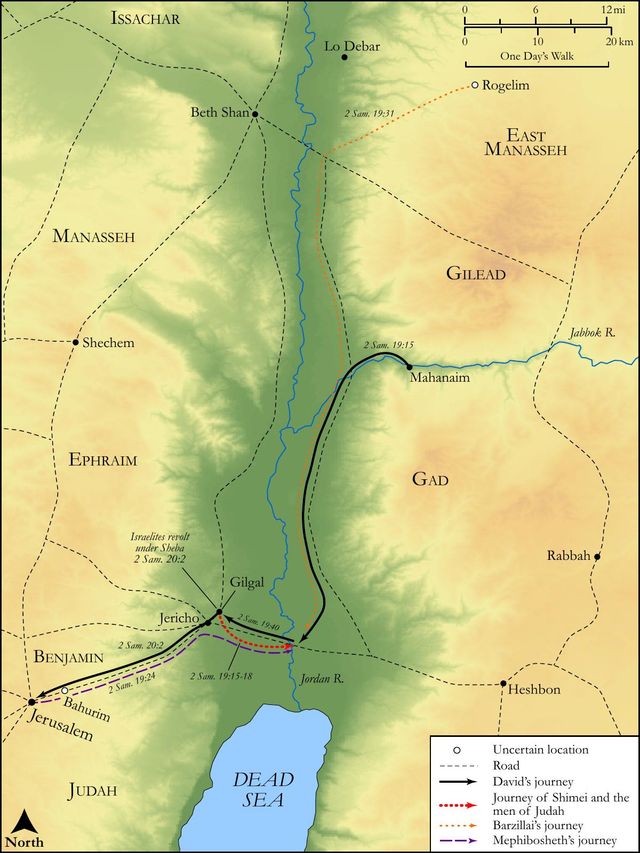
The day of David's return was a day of bringing to remembrance, a day of account, in which what had passed in his flight was called over again; among other things, after the case of Shimei, that of Mephibosheth comes to be enquired into, and he himself brings it on.
I.He went down in the crowd to meet the king (Sa2 19:24), and as a proof of the sincerity of his joy in the king's return, we are here told what a true mourner he was for the king's banishment. During that melancholy time, when one of the greatest glories of Israel had departed, Mephibosheth continued in a very melancholy state. He was never trimmed, nor put on clean linen, but wholly neglected himself, as one abandoned to grief for the king's affliction and the kingdom's misery. In times of public calamity we ought to abridge our enjoyments in the delights of sense, in conformity to the season. There are times when God calls to weeping and mourning, and we must comply with the call.
II.When the king came to Jerusalem (since he could not sooner have an opportunity) he made his appearance before him (Sa2 19:25); and when the king asked him why he, being one of his family, had staid behind, and not accompanied him in his exile, he opened his case fully to the king.
1.He complained of Ziba, his servant who should have been his friend, but had been in two ways his enemy; for, first, he had hindered him from going along with the king, by taking the ass himself which he was ordered to make ready for his master (Sa2 19:26), basely taking advantage of his lameness and his inability to help himself; and, secondly, he had accused him to David of a design to usurp the government, Sa2 19:27. How much mischief is it in the power of a wicked servant to do to the best master!
2.He gratefully acknowledged the king's great kindness to him when he and all his father's house lay at the king's mercy, Sa2 19:28. When he might justly have been dealt with as a rebel, he was treated as a friend, as a child: Thou didst set thy servant among those that did eat at thy own table. This shows that Ziba's suggestion was improbable; for could Mephibosheth be so foolish as to aim higher when he lived so easily, so happily as he did? And could he be so very disingenuous as to design any harm to David, of whose great kindness to him he was thus sensible? (3.) He referred his cause to the king's pleasure (Do what is good in thy eyes with me and my estate), depending on the king's wisdom, and his ability to discern between truth and falsehood (My lord the king is as an angel from God), and disclaiming all pretensions of his own merit: "So much kindness I have received above what I deserved, and what right have I to cry any more unto the king? Why should I trouble the king with my complaints when I have already been so troublesome to him? Why should I think any thing hard that is put upon me when I hitherto been so kindly treated?" We were all as dead men before God; yet he has not only spared us, but taken us to sit at his table. How little reason then have we to complain of any trouble we are in, and how much reason to take all well that God does!
III.David hereupon recalls the sequestration of Mephibosheth's estate; being deceived in his grant, he revokes it, and confirms his former settlement of it: "I have said, Thou and Ziba divide the land (Sa2 19:29), that is, Let it be as I first ordered it (Sa2 9:10); the property shall still be vested in thee, but Ziba shall have occupancy: he shall till the land, paying thee a rent." Thus Mephibosheth is where he was; no harm is done, only Ziba goes away unpunished for his false and malicious information against his master. David either feared him too much, or loved him too well, to do justice upon him according to that law, Deu 19:18, Deu 19:19; and he was now in the humour of forgiving and resolved to make every body easy.
IV.Mephibosheth drowns all he cares about his estate in his joy for the king's return (Sa2 19:30):
"Yea, let him take all, the presence and favour of the king shall be to me instead of all." A good man can contentedly bear his own private losses and disappointments, while he see Israel in peace, and the throne of the Son of David exalted and established. Let Ziba take all, so that David may be in peace.
Continue studying 2 Samuel 19:28 across the web’s major study libraries — every link below opens this exact verse, chapter, or book on the destination site.
Read & Compare
 BibleGatewayThis verse in more than 200 translations and 70 languages.
 Bible.comThe YouVersion reader — hundreds of translations, reading plans, and highlights.
 ESV.orgCrossway's official English Standard Version reader.
 NET BibleThe NET translation with 60,000+ translators' notes on every rendering decision.
 STEP BibleTyndale House's free study tool — original text, vocabulary, and scholarly resources.
 BibliaLogos Bible Software's free web reader.
 USCCBThe New American Bible (Revised Edition) with the U.S. bishops' study notes.
Commentaries
 BibleHub CommentariesDozens of classic commentaries on this verse, gathered on one page.
 StudyLightMore than 100 commentary sets — the largest collection on the web.
 BibleRefPlain-English commentary on what this verse means, verse by verse.
 Enduring WordDavid Guzik's free commentary on this chapter, widely used by Bible teachers.
 Bible Study ToolsVerse commentary alongside Greek and Hebrew study aids.
Original Language & Research
- BibleHub InterlinearThe verse word by word — original language, transliteration, and English.
- BibleHub LexiconEvery word's original-language definition and Strong's entry.
 Blue Letter BibleDeep-study tools — Strong's numbers, concordance, and word studies.
 SefariaThe Hebrew text with Rashi and centuries of Jewish commentary.
Sermons, Hymns & Audio


TrulyRandomVerse is not affiliated with these sites and doesn’t control their content. They’re linked because they’re genuinely useful.
Summary
2 Samuel 19:28 encapsulates Mephibosheth's profound humility and overwhelming gratitude toward King David. Despite having been slandered and suffering a partial loss of his inheritance, Mephibosheth declares that any further plea or complaint is unwarranted. He recognizes that his very existence and privileged position at the royal table were entirely due to the king's unmerited favor, transforming him from one who was effectively "dead" to one who was honored and sustained. This climactic declaration underscores the depth of his loyalty and contentment in David's grace, silencing all personal grievances in the face of such immense benevolence.
Context
ShowHideLiterary Context
This verse serves as the powerful culmination of Mephibosheth's encounter with King David in 2 Samuel 19. As David returns to Jerusalem following Absalom's rebellion, various individuals come out to meet him. Mephibosheth, the grandson of Saul and son of Jonathan, appears unkempt and unwashed, a visible sign of his mourning during David's absence. David confronts him about his failure to join him during the flight, recalling Ziba's accusation that Mephibosheth had hoped to regain his grandfather's kingdom (2 Samuel 16:1-4). Mephibosheth then offers his impassioned explanation, asserting his loyalty and blaming Ziba for deceiving him (2 Samuel 19:24-27). David's response is a partial reversal of his earlier judgment, dividing the land between Mephibosheth and Ziba (2 Samuel 19:29). In this immediate context, 2 Samuel 19:28 is Mephibosheth's emphatic, heartfelt response to David's decision, demonstrating that his gratitude for past grace far outweighs any present grievance, rendering further argument unnecessary.
Historical & Cultural Context
In the ancient Near East, the ascension of a new dynasty often meant the elimination of all potential rivals from the previous ruling house, particularly descendants of the former king. As the grandson of King Saul, Mephibosheth's life was inherently precarious under David's reign. His lameness, a physical disability, would have further overlooked him in a society that often viewed such conditions as a sign of divine displeasure or weakness. David's initial act of kindness in 2 Samuel 9—restoring Saul's land to Mephibosheth and granting him the privilege of eating at the king's table—was an extraordinary display of covenant loyalty and royal grace, defying common practice. Eating at the king's table symbolized not only provision but also intimate fellowship, security, and adoption into the royal family. Mephibosheth's declaration in this verse reflects his profound understanding of his vulnerable position ("dead men") and the immense, undeserved favor extended to him by the sovereign king.
Key Themes
ShowHideThis verse powerfully contributes to several overarching themes within 2 Samuel. Foremost is the theme of Undeserved Grace and Covenant Faithfulness. David's initial kindness to Mephibosheth was an act of grace rooted in his covenant with Jonathan (2 Samuel 9:1). Mephibosheth's response in this verse vindicates David's mercy and highlights the transformative power of such grace. Another key theme is Humility and Contentment. Despite being wronged by Ziba and not having his full inheritance restored, Mephibosheth displays a remarkable lack of self-pity or demand. His past blessings so outweigh his current circumstances that he expresses ultimate contentment in the king's decision. Finally, the verse speaks to Loyalty and True Devotion, contrasting Mephibosheth's genuine fidelity with the treachery of Ziba and the rebellion of Absalom, affirming that true devotion to the king is rooted in a grateful heart. This profound gratitude, as seen in 2 Samuel 19:28, becomes the ultimate expression of his allegiance.
Exposition and Analysis
ShowHideKey Word Analysis
ShowHideThis noun, meaning "death (natural or violent); concretely, the dead, their place or state (hades); figuratively, pestilence, ruin," is used here to describe Mephibosheth and his father's house. It signifies a state of being utterly condemned, without hope, or deserving of death. In the context of ancient Near Eastern monarchies, it refers to the precarious and often doomed status of the descendants of a deposed or deceased rival king. Mephibosheth uses this term to emphasize his and his family's inherent vulnerability and lack of any claim to life or privilege before David, highlighting the stark contrast with the mercy they received.
This primitive root means "to place (in a very wide application); apply, appoint, array, bring, consider, lay (up), let alone, look, make, mark, put (on), regard, set, shew, be stayed, take." Mephibosheth acknowledges that his position at the king's table was not earned or accidental but a sovereign, deliberate, and gracious decision by David. The verb emphasizes the intentionality and power of the king's act in elevating him.
This noun, meaning "a table (as spread out); by implication, a meal," symbolizes an intimate, secure, and privileged relationship. In the ancient world, sharing a meal with a king signified acceptance, provision, and protection. It was a mark of honor, often reserved for family members or trusted advisors. For Mephibosheth, a lame descendant of a rival house, this privilege was the ultimate demonstration of David's extraordinary grace, transforming his status from an outcast to a cherished member of the royal household.
Verse Breakdown
ShowHide"For all [of] my father's house were but dead men before my lord the king:"
Mephibosheth begins by articulating his profound understanding of his family's precarious position. As descendants of Saul, the former king, they had no inherent right to life or favor under the new Davidic dynasty. In the prevailing political customs of the time, they were effectively condemned, their lives forfeit. This statement establishes the baseline of his perceived worthlessness and vulnerability, setting the stage for the king's unparalleled grace.
"yet didst thou set thy servant among them that did eat at thine own table."
This clause introduces a radical contrast ("yet"). Despite their "dead man" status, David, by his own sovereign will and grace, elevated Mephibosheth to a position of immense honor and security. To "eat at the king's table" signified not only provision but also intimate fellowship, adoption into the royal household, and protection. Mephibosheth acknowledges this as an undeserved, deliberate act of the king's benevolence, transforming his destiny from one of obscurity and potential death to one of profound privilege.
"What right therefore have I yet to cry any more unto the king?"
This rhetorical question serves as the powerful climax of Mephibosheth's declaration. In light of the immense, unmerited favor he has already received—being spared, restored, and brought into royal fellowship—he perceives any further complaint or plea, even regarding the recent injustice with Ziba, as utterly unwarranted and ungrateful. His past blessings so overwhelmingly outweigh any present grievance that he declares himself completely satisfied and content with the king's judgment, silencing all personal claims.
Literary Devices
ShowHideThe verse employs several potent literary devices to convey Mephibosheth's profound emotional and spiritual state. Hyperbole is evident in the phrase "dead men," which dramatically emphasizes the utter vulnerability and lack of claim Mephibosheth and his family had before David. This exaggerated statement serves to magnify the king's subsequent grace. A striking Contrast is established between this "dead man" status and the privilege of "eating at the king's table," highlighting the radical transformation wrought by David's mercy. The act of "eating at the king's table" serves as powerful Symbolism for intimate fellowship, security, and adoption into the royal family, conveying the depth of David's favor. Finally, the verse concludes with a poignant Rhetorical Question, "What right therefore have I yet to cry any more unto the king?" This question is not seeking an answer but rather expresses Mephibosheth's firm conviction and profound contentment, indicating that in the face of such overwhelming grace, all complaints are silenced and rendered meaningless.
Theological and Thematic Connections
ShowHideMephibosheth's powerful declaration resonates deeply with core biblical themes of undeserved grace, divine sovereignty, and the appropriate human response to such favor. His recognition of his "dead man" status before the king mirrors humanity's spiritual condition before a holy God: we were "dead in trespasses and sins" Ephesians 2:1, utterly without claim or right to life, let alone fellowship with the Creator. Yet, God, in His boundless mercy, "made us alive together with Christ (by grace you have been saved)" Ephesians 2:5. Like Mephibosheth, who was brought to the king's table, believers are brought into intimate fellowship with God through Christ, receiving adoption as sons and daughters. This profound, unmerited grace should cultivate in us a similar spirit of profound gratitude, humility, and contentment, silencing all complaints and fostering a deep satisfaction in God's sovereign dealings.
Reflection and Application
ShowHideMephibosheth's response in 2 Samuel 19:28 offers a compelling model for our own walk with God. It challenges us to cultivate a radical gratitude that transcends our immediate circumstances and perceived injustices. When we truly grasp the magnitude of God's grace—how He found us spiritually "dead," condemned by our sin, yet chose to bring us into His family and fellowship—our perspective on life's difficulties shifts dramatically. Like Mephibosheth, who recognized that his very life and privileged position were pure gifts, we are called to live with a profound sense of humility and contentment in the King's provision and sovereignty. This doesn't mean ignoring hardship or injustice, but rather approaching them from a foundation of overwhelming gratitude for our ultimate salvation and security in Christ. It means that even when life doesn't go as we expect, or when we feel wronged, our primary response is one of worship and trust, recognizing that God has already given us the greatest gift imaginable, silencing our complaints and fostering deep peace.
Questions for Reflection
ShowHideFAQ
ShowHideWhy did David only restore half the land to Mephibosheth, rather than all of it, after his explanation?
ShowHideDavid's decision to divide the land between Mephibosheth and Ziba (2 Samuel 19:29) has been a point of much discussion among scholars. While Mephibosheth's explanation in 2 Samuel 19:24-27 strongly suggests his innocence and Ziba's treachery, David's judgment is ambiguous. Some suggest David was weary from the rebellion and simply wanted to resolve the matter quickly, perhaps not fully trusting either party or seeking a compromise. Others propose that David, as king, retained the right to dispose of land as he saw fit, and this decision, though seemingly unfair to Mephibosheth, was an exercise of his sovereign authority. Mephibosheth's response in 2 Samuel 19:28, however, indicates his complete acceptance of the king's decision, prioritizing the king's grace and his own privileged status over any material grievance.
Was Mephibosheth truly innocent of Ziba's charges, or was he partially culpable?
ShowHideThe biblical narrative strongly leans towards Mephibosheth's innocence. His appearance upon David's return—unkempt, unwashed, and in mourning—is consistent with someone who genuinely grieved David's absence and was unable to join him. His explanation, blaming Ziba for deceiving him and preventing him from coming, is plausible given Ziba's character as revealed earlier (2 Samuel 16:1-4). Furthermore, Mephibosheth's profound gratitude and lack of complaint in 2 Samuel 19:28, despite losing half his land, speaks to a humble and loyal heart, not one harboring secret ambitions. His character stands in stark contrast to Ziba's opportunistic and self-serving actions throughout the narrative.
Christ-Centered Fulfillment
ShowHideMephibosheth's story, particularly his declaration in 2 Samuel 19:28, serves as a powerful Old Testament shadow pointing to the believer's radical transformation and relationship with Christ. Just as Mephibosheth and his "father's house were but dead men" before King David, so too were all humanity spiritually "dead in trespasses and sins" Ephesians 2:1, alienated from God and deserving of judgment Romans 3:23. Yet, the true King, Jesus Christ, in His boundless grace and covenant faithfulness, sought us out, not because of our merit, but because of His great love Ephesians 2:4-5. He "set His servants" among those who "eat at His own table," bringing us into intimate fellowship and adoption as children of God Galatians 4:4-7. Through Christ's atoning sacrifice, we who were enemies have been reconciled and given access to God's presence Romans 5:10. Therefore, like Mephibosheth, our response to such immeasurable grace should be a profound and abiding gratitude that silences all complaints and renders any further "right to cry" unnecessary. Our ultimate satisfaction and security are found in the King of Kings, who has brought us from death to life, from alienation to adoption, and from condemnation to communion, securing our place at the eternal feast Revelation 19:9.