


1 Samuel 26:16
Bible text: King James Version (1769 Blayney text) · Public domain
Bible text: King James Version with Strong's numbers · Public domain
Bible text: Berean Standard Bible · Public domain
Bible text: American Standard Version (1901) · Public domain
Bible text: World English Bible, Messianic edition · Public domain
Bible text: Geneva Bible (1599) · Public domain
Bible text: Young's Literal Translation · Public domain
- לֹאlo'notH3808NegParticle Negative
- טוֹבTov[is] goodH2896Adj-msAdjective Singular Masculine Absolute
- הַדָּבָרha·da·Varthe thingH1697Art ¦ N-msNoun Singular Masculine Absoluteהַtheדָּבָרthing
- הַזֶּהha·Zeh<the> thisH2088Art ¦ PrtParticle Demonstrativeהַ<the>זֶּהthis
- אֲשֶׁר'a·SherwhichH834RelParticle Relative
- עָשִׂיתָ'a·si·Tayou have doneH6213V-Qal-Perf-2msVerb Qal Perfect 2nd Singular Masculine
- חַיchai[by] [the] lifeH2416Adj-msAdjective Singular Masculine Absolute
- יְהוָהYah·wehof YahwehH3068N-properNoun Proper Title
- כִּיkiforH3588PrtParticle Conditional
- בְנֵיve·nei[are] sons ofH1121N-mpcNoun Plural Masculine Construct
- מָוֶתma·vetdeathH4194N-msNoun Singular Masculine Absolute
- אַתֶּם'a·TemyouH859Pro-2mpPronoun Personal 2nd Plural Masculine
- אֲשֶׁר'a·SherwhoH834RelParticle Relative
- לֹאlo'notH3808NegParticle Negative
- שְׁמַרְתֶּםshe·mar·Temyou watchedH8104V-Qal-Perf-2mpVerb Qal Perfect 2nd Plural Masculine
- עַל'aloverH5921PrepPreposition
- אֲדֹנֵיכֶם'a·do·nei·Khemyour master<s>H113N-mpc ¦ 2mpNoun Plural Masculine Constructאֲדֹנֵיmaster<s>כֶםyour
- עַל'aloverH5921PrepPreposition
- מְשִׁיחַme·Shi·ach[the] [one] anointed ofH4899N-mscNoun Singular Masculine Construct
- יְהוָהYah·wehYahwehH3068N-properNoun Proper Title
- וְעַתָּהve·'a·Tahand nowH6258Conj-w ¦ AdvAdverbוְandעַתָּהnow
- רְאֵהre·'EhseeH7200V-Qal-Imp-2msVerb Qal Imperative 2nd Singular Masculine
- אֵי'eiwhere?H335InterrogParticle Interrogative
- חֲנִיתcha·Nit[is] [the] spear ofH2595N-fscNoun Singular Feminine Construct
- הַמֶּלֶךְha·Me·lekhthe kingH4428Art ¦ N-msNoun Singular Masculine Absoluteהַtheמֶּלֶךְking
- וְאֶתve·'Etand <obj.>H853Conj-w ¦ DirObjMParticle Object Indicatorוְandאֶת<obj.>
- צַפַּחַתtza·Pa·chat[the] jug ofH6835N-fscNoun Singular Feminine Construct
- הַמַּיִםha·Ma·yim<the> waterH4325Art ¦ N-mpNoun Plural Masculine Absoluteהַ<the>מַּיִםwater
- אֲשֶׁר'a·SherwhichH834RelParticle Relative
- מְרַאֲשֹׁתָיוme·ra·'a·sho·tov[was the] his place of headH4763N-fpc ¦ 3msNoun Plural Feminine Constructמְרַאֲשֹׁתָי[was the] place of headוhis
English is a literal word-by-word gloss of the Hebrew, not the KJV's wording. Why?
This is the original text the KJV's translators worked from — each Hebrew word with its own literal English meaning in this verse, prepared by scholars at Tyndale House, Cambridge. The KJV translates whole sentences, not word by word, so its wording differs: one Hebrew word can become several English words, and the KJV may choose “the LORD” where the gloss reads “Yahweh”. Both are faithful — they answer different questions. For the KJV's own rendering, switch to the KJV text.
Details
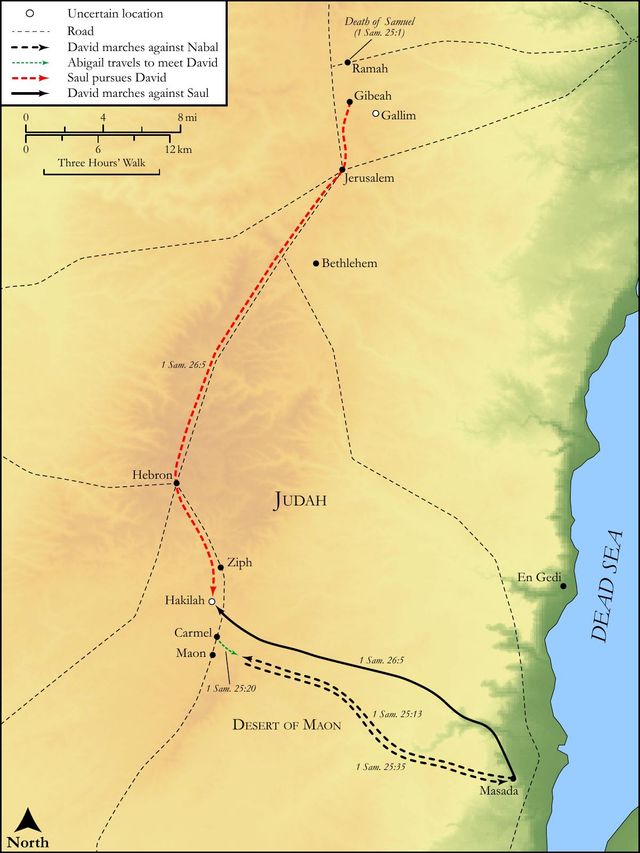
See on the biblical-era map
Study this verse
Public-domain commentary
Matthew Henry
From his Commentary on the Whole Bible. Henry comments on passages, not single verses — this entry covers 1 Samuel 26:13–20. His two-level outline is real structure in the source text, so it is rendered as structure.
David having got safely from Saul's camp himself, and having brought with him proofs sufficient that he had been there, posts himself conveniently, so that they might hear him and yet not reach him (Sa1 26:13), and then begins to reason with them upon what had passed.
I.He reasons ironically with Abner, and keenly banters him.
David knew well that it was from the mighty power of God that Abner and the rest of the guards were cast into so deep a sleep, and that God's immediate hand was in it; but he reproaches Abner as unworthy to be captain of the lifeguards, since he could sleep when the king his master lay so much exposed. By this it appears that the hand of God locked them up in this deep sleep that, as soon as ever David had got out of danger, a very little thing awakened them, even David's voice at a great distance roused them, Sa1 26:14. Abner got up (we may suppose it early in a summer's morning) and enquired who called, and disturbed the king's repose. "It is I," says David, and then he upbraids him with his sleeping when he should have been upon his guard. Perhaps Abner, looking upon David as a despicable enemy and one that there was no danger from, had neglected to set a watch; however, he himself ought to have been more wakeful. David, to put him into confusion, told him, 1. That he had lost his honour (Sa1 26:15): "Art not thou a man? (so the word is), a man in office, that art bound, by the duty of thy place, to inspect the soldiery? Art not thou in reputation for a valiant man? So thou wouldst be esteemed, a man of such courage and conduct that there is none like thee; but now thou art shamed for ever. Thou a general! Thou, a sluggard!" 2. That he deserved to lose his head (Sa1 26:16): "You are all worthy to die, by martial law, for being off your guard, when you had the king himself asleep in the midst of you. Ecce signum - Behold this token. See where the king's spear is, in the hand of him whom the king himself is pleased to count his enemy. Those that took away this might as easily and safely have taken away his life. Now see who are the king's best friends, you that neglected him and left him exposed or I that protected him when he was exposed. You pursue me as worthy to die, and irritate Saul against me; but who is worthy to die now?" Note, Sometimes those that unjustly condemn others are justly left to fall into condemnation themselves.
II.He reasons seriously and affectionately with Saul.
By this time he was so well awake as to hear what was said, and to discern who said it (Sa1 26:17): Is this thy voice, my son David? In the same manner he had expressed his relentings, Sa1 24:16. He had given his wife to another and yet calls him son, thirsted after his blood and yet is glad to hear his voice. Those are bad indeed that have never any convictions of good, nor ever sincerely utter good expressions. And now David has as fair an opportunity of reaching Saul's conscience as he had just now of taking away his life. This he lays hold on, though not of that, and enters into a close argument with him, concerning the trouble he still continued to give him, endeavouring to persuade him to let fall the prosecution and be reconciled.
1.He complains of the very melancholy condition he was brought into by the enmity of Saul against him. Two things he laments: - (1.) That he was driven from his master and from his business: "My lord pursues after his servant, Sa1 26:18. How gladly would I serve thee as formerly if my service might be accepted! but, instead of being owned as a servant, I am pursued as a rebel, and my lord is my enemy, and he whom I would follow with respect compels me to flee from him." (2.) That he was driven from his God and from his religion; and this was a much greater grievance than the former (Sa1 26:19): "They have driven me out from the inheritance of the Lord, have made Canaan too hot for me, at least the inhabited parts of it, have forced me into the deserts and mountains, and will, ere long, oblige me entirely to quit the country." And that which troubled him was not so much that he was driven out from his own inheritance as that he was driven out from the inheritance of the Lord, the holy land. It should be more comfortable to us to think of God's title to our estates and his interest in them then of our own, and that with them we may honour him then that with them we may maintain ourselves. Nor was it so much his trouble that he was constrained to live among strangers as that he was constrained to live among the worshippers of strange gods and was thereby thrust into temptation to join with them in their idolatrous worship. His enemies did, in effect, send him to go and serve other gods, and perhaps he had heard that some of them had spoken to that purport of him. Those that forbid our attendance on God's ordinances do what in them lies to estrange us from God and to make us heathens. If David had not been a man of extraordinary grace, and firmness to his religion, the ill usage he met with from his own prince and people, who were Israelites and worshippers of the true God, would have prejudiced him against the religion they professed and have driven him to communicate with idolaters. "If these be Israelites," he might have said, "let me live and die with Philistines;" and no thanks to them that their conduct had not that effect. We are to reckon that the greatest injury that can be done us which exposes us to sin. Of those who thus led David into temptation he here says, Cursed be they before the Lord. Those fall under a curse that thrust out those whom God receives, and send those to the devil who are dear to God.
2.He insists upon his own innocency: What have I done or what evil is in my hand? Sa1 26:18. He had the testimony of his conscience for him that he had never done nor ever designed any mischief to the person, honour, or government, of his prince, nor to any of the interests of his country. He had lately had Saul's own testimony concerning him (Sa1 24:17): Thou art more righteous than I. It was very unreasonable and wicked for Saul to pursue him as a criminal, when he could not charge him with any crime.
3.He endeavours to convince Saul that his pursuit of him is not only wrong, but mean, and much below him: "The king of Israel, whose dignity is great, and who has so much other work to do, has come out to seek a flea, as when one doth hunt a partridge in the mountains," Sa1 26:20 - a poor game for the king of Israel to pursue. He compares himself to a partridge, a vert innocent harmless bird, which, when attempts are made upon its life, flies if it can, but makes no resistance. And would Saul bring the flower of his army into the field only to hunt one poor partridge? What a disparagement was this to his honour! What a stain would it be on his memory to trample upon so weak and patient as well as so innocent an enemy! Jam 5:6, You have killed the just, and he doth not resist you.
4.He desires that the core of the controversy may be searched into and some proper method taken to bring it to an end, Sa1 26:19. Saul himself could not say that justice put him on thus to persecute David, or that he was obliged to do it for the public safety. David was not willing to say (though it was very true) that Saul's own envy and malice put him on to do it; and therefore he concludes it must be attributed either to the righteous judgment of God or to the unrighteous designs of evil men. Now, (1.) "If the Lord have stirred thee up against me, either in displeasure to me (taking this way to punish me for my sins against him, though, as to thee, I am guiltless) or in displeasure to thee, if it be the effect of that evil spirit from the Lord which troubles thee, let him accept an offering from us both - let us join in making our peace with God, reconciling ourselves to him, which may be done, by sacrifice; and then I hope the sin will be pardoned, whatever it is, and the trouble, which is so great a vexation both to thee and me, will come to an end." See the right method of peace-making; let us first make God our friend by Christ the great Sacrifice, and then all other enmities shall be slain, Eph 2:16; Pro 16:7. But, (2.) "If thou art incited to it by wicked men, that incense thee against me, cursed be they before the Lord," that is, they are very wicked people, and it is fit that they should be abandoned as such, and excluded from the king's court and councils. He decently lays the blame upon the evil counsellors who advised the king to that which was dishonourable and dishonest, and insists upon it that they be removed from about him and forbidden his presence, as men cursed before the Lord, and then he hoped he should gain his petition, which is (Sa1 26:20), "Let not my blood fall to the earth, as thou threatenest, for it is before the face of the Lord, who will take cognizance of the wrong and avenge it." Thus pathetically does David plead with Saul for his life, and, in order to that, for his favourable opinion of him.
Historical interpretation
Four Centuries of Reception
2 surviving comments on this verse. Each one is dated, so this reads as a timeline rather than a list.
Select a marker to jump to its quote. Markers stagger vertically where authors wrote within a few decades of each other.
Envy persecuted David, and jealousy the Son of David. David was blocked up in the depths of the cave, and the Son of David in the depths of the underworld. It was imagined that David was guilty and despised, and that death was conquered and laid low. David cried out, “Where is your spear, O King?” and the Son of David, “Where is your victory, O Death?” Saul hurled his spear against David, and, although it did not strike him, the wall was witness to its blow. The crucifiers struck the Son of David with a lance, and although his power was not injured, his body was a witness to their blow. David was not struck, nor was the Son of David injured.
Now therefore see where the king's spear is, etc. See, they say, now where the scepter of your power is, which you have lost both on earth and ceased to hope for in heaven; where is the shadowy observance of the law, which you have thirsted for with all your heart, in which you boasted that the hands of your deeds could be washed from all stain of sins. All alike, because you have lost Christ, and the temple itself is gone. Indeed, all these things, even if not yet completed in the times of the apostles, were for the most part begun in and before their times and still occurring while they were alive, as anyone who reads the history of old will find. For finally, Herod the Great, and his sons, amid the countless calamities they inflicted on the Jews, also took away the holy garment from the priests, and never allowed them the permission to minister in it; they changed the order of the priesthood at their whim, tearing up the legal order. Pilate defiled the temple by secretly introducing images of Caesar during the night, following the impiety of Herod, who had first profaned it by setting up a golden eagle in it and commanded that the young men who tried to remove it for religious reasons be burned alive. Caius [Caligula] ordered that both the temple and all their synagogues be profaned with the sacrifices of the gentiles and filled with statues and images, and commanded that he himself be worshipped as a god there. As for the degradation of the kingdom, until it perished utterly, there is no end to speaking of it.
Continue studying 1 Samuel 26:16 across the web’s major study libraries — every link below opens this exact verse, chapter, or book on the destination site.
Read & Compare
 BibleGatewayThis verse in more than 200 translations and 70 languages.
 Bible.comThe YouVersion reader — hundreds of translations, reading plans, and highlights.
 ESV.orgCrossway's official English Standard Version reader.
 NET BibleThe NET translation with 60,000+ translators' notes on every rendering decision.
 STEP BibleTyndale House's free study tool — original text, vocabulary, and scholarly resources.
 BibliaLogos Bible Software's free web reader.
 USCCBThe New American Bible (Revised Edition) with the U.S. bishops' study notes.
Commentaries
 BibleHub CommentariesDozens of classic commentaries on this verse, gathered on one page.
 StudyLightMore than 100 commentary sets — the largest collection on the web.
 BibleRefPlain-English commentary on what this verse means, verse by verse.
 Enduring WordDavid Guzik's free commentary on this chapter, widely used by Bible teachers.
 Bible Study ToolsVerse commentary alongside Greek and Hebrew study aids.
Original Language & Research
- BibleHub InterlinearThe verse word by word — original language, transliteration, and English.
- BibleHub LexiconEvery word's original-language definition and Strong's entry.
 Blue Letter BibleDeep-study tools — Strong's numbers, concordance, and word studies.
 SefariaThe Hebrew text with Rashi and centuries of Jewish commentary.
Sermons, Hymns & Audio


TrulyRandomVerse is not affiliated with these sites and doesn’t control their content. They’re linked because they’re genuinely useful.
Summary
In 1 Samuel 26:16, David delivers a scathing rebuke to Abner, King Saul's commander, for his egregious failure to protect the king. Having secretly infiltrated Saul's sleeping camp and taken the king's spear and water cruse from beside his head, David uses these tangible items as irrefutable proof of his presence and, more significantly, his deliberate choice to spare Saul's life, thereby demonstrating his own integrity and profound respect for "the LORD'S anointed" despite Saul's relentless pursuit.
Context
ShowHideLiterary Context
This verse marks a pivotal moment in the escalating conflict between Saul and David, representing the second instance where David has a direct opportunity to kill Saul but chooses instead to spare his life (the first being in the cave at En Gedi). In this narrative, David and his companion Abishai stealthily penetrate Saul's encampment while the king and his men are asleep. Abishai urges David to seize the moment and kill Saul, but David firmly refuses, appealing to Saul's sacred status as "the LORD'S anointed." Rather than taking Saul's life, David takes only his spear and water cruse, items deeply symbolic of the king's person and authority. From a safe distance on a nearby hill, David then shouts down to Abner, using these retrieved items as undeniable evidence of his mercy and Abner's gross dereliction of duty. This public shaming effectively forces Saul to acknowledge David's righteousness, albeit temporarily, and highlights David's consistent character.
Historical & Cultural Context
The historical setting is the tumultuous period of Israel's early monarchy, as the nation transitions from a loose tribal confederacy to a centralized kingdom under Saul, with David divinely appointed as his successor. Saul's increasing paranoia, fueled by jealousy of David's popularity and success, led to a relentless and unjust persecution, forcing David into the wilderness as a fugitive. Culturally, the king's life was considered sacrosanct, particularly because he was "the LORD'S anointed," meaning he had been consecrated by God for his office. To harm the king, even a wicked one, was seen as an offense against God Himself. A military commander like Abner bore the ultimate responsibility for the king's personal security, making his failure in this regard a grave offense, potentially punishable by death. The spear was a common weapon and a potent symbol of royal authority, often kept within arm's reach of the king, while the water cruse represented his vital sustenance, making their removal a profound symbolic act of vulnerability and a clear demonstration of David's proximity and restraint.
Key Themes
ShowHideThis verse powerfully contributes to several overarching themes within the book of 1 Samuel. Foremost is David's unwavering respect for God-ordained authority, even when that authority (Saul) is corrupt and actively seeks his demise. Despite immense provocation, David consistently refuses to take vengeance into his own hands, demonstrating a profound trust in God's sovereign timing and justice, a principle echoed in David's earlier refusal to harm Saul. This highlights David's integrity and righteous character, which stands in stark contrast to Saul's escalating paranoia and ungodly actions. The incident also underscores divine sovereignty and protection over David; his ability to enter and leave the heavily guarded camp undetected, taking the items without waking anyone, points to God's hand in delivering Saul into David's power, yet guiding David's merciful response. Finally, it exposes Abner's negligence and dereliction of duty, a failure so severe it warranted a death sentence in David's estimation, emphasizing the high stakes of protecting God's anointed leader.
Exposition and Analysis
ShowHideKey Word Analysis
ShowHideThis word (H1697) refers to a "word" or, by implication, a "matter" or "thing." In this context, it encompasses Abner's entire action (or inaction) – his failure to guard the king. David uses it to broadly condemn the entire situation as a grave offense, not just a minor oversight, highlighting the weightiness of the matter at hand.
While the KJV translates it as "not good," the Hebrew word (H2896) means "good" in its widest sense, encompassing beauty, favor, prosperity, and moral rectitude. David's statement, "This thing is not good," therefore carries a strong moral condemnation, implying that Abner's action (or lack thereof) is morally reprehensible, inappropriate, and contrary to what is right and proper for a royal guard.
This phrase (H1121, H4194), literally "son of death" or "sons of death" in the plural, is a legal and theological declaration meaning that Abner and his men deserve capital punishment. It is not merely an expression of anger but a statement of the extreme gravity of their negligence. As the king's protectors, their failure to "keep" (guard, protect) "the LORD'S anointed" was a capital offense, emphasizing the sanctity of the king's person and office in ancient Israel.
Verse Breakdown
ShowHide"This thing [is] not good that thou hast done."
David immediately confronts Abner with a direct and severe moral indictment. He is not merely stating a fact but passing judgment on Abner's gross negligence in failing to protect the king, a duty of paramount importance for a military commander. This sets the tone for the rebuke, emphasizing the seriousness of the oversight and Abner's culpability.
"[As] the LORD liveth, ye [are] worthy to die, because ye have not kept your master, the LORD'S anointed."
David invokes a solemn oath, "As the LORD liveth" (H3068, H2416), to underscore the absolute truth and gravity of his accusation. He declares Abner and his men deserving of death, not out of personal vengeance, but because they failed in their sacred duty to protect "your master" (H113, the king) and, more importantly, "the LORD'S anointed" (H3068, H4899). This highlights the divine aspect of the king's office and the severe consequences of failing to guard God's chosen one.
"And now see where the king's spear [is], and the cruse of water that [was] at his bolster."
This final clause provides the irrefutable, tangible evidence of David's presence and his merciful act. The spear (H2595), a symbol of Saul's authority and life, and the water cruse (H6835, H4325), essential for his sustenance, were taken from his immediate vicinity ("at his bolster" - H4763, near his head). Their absence serves as undeniable proof that David could have easily killed Saul but chose not to, simultaneously exposing Abner's negligence and vindicating David's intentions.
Literary Devices
ShowHideThe passage employs several potent literary devices that amplify its dramatic impact and theological depth. Irony is profoundly evident, as the hunted fugitive, David, becomes the unexpected protector of his hunter, King Saul, thereby exposing the king's vulnerability and his commander's abject failure. The Symbolism of the spear and water cruse is crucial; these items represent Saul's life, authority, and the very proximity David had to end it, yet chose mercy. Their removal serves as undeniable, tangible proof of David's presence and his deliberate restraint. There is also a strong element of Contrast between David's integrity, patience, and unwavering respect for God's anointed, and Abner's negligence, and by extension, between David's righteous character and Saul's unrighteous, paranoid persecution. David's bold declaration, coupled with the tangible evidence, creates a dramatic and confrontational scene, designed to elicit shame and recognition of his innocence from Saul and his men.
Theological and Thematic Connections
ShowHideThis verse profoundly illustrates David's commitment to God's sovereignty and his refusal to usurp divine prerogative. Despite being unjustly persecuted by Saul, David consistently demonstrates a deep reverence for the office of "the LORD'S anointed," choosing to trust God's timing for his own ascension rather than taking matters into his own hands. This act of mercy and restraint, even when presented with a clear opportunity for vengeance, highlights a core biblical principle: that justice belongs to God, and believers are called to respond to evil with good, trusting in divine vindication. David's actions serve as a powerful example of waiting patiently for the Lord and not repaying evil for evil, even when it seems humanly justifiable.
Reflection and Application
ShowHideDavid's encounter with Abner and his actions toward Saul offer profound lessons for believers today. In a world often driven by retaliation and self-vindication, David's choice to spare Saul, not once but twice, stands as a powerful testament to the transformative power of mercy and faith in God's ultimate justice. This passage challenges us to examine our own responses to injustice and personal wrongdoings. Do we seek to take matters into our own hands, or do we trust God to be our vindicator? It calls us to cultivate a spirit of respect for authority, even when those in power are flawed or act unjustly, recognizing that all authority is ultimately permitted by God. Furthermore, David's patience in waiting for God's timing to elevate him, rather than seizing the throne by force, encourages us to exercise similar patience in our own lives, trusting that God's plans will unfold perfectly and in His time.
Questions for Reflection
ShowHideFAQ
ShowHideWhy did David take the spear and water cruse, and not something else?
ShowHideDavid specifically took the spear and water cruse because they were highly symbolic and personal items intimately associated with the king's life, authority, and immediate well-being. The spear was his weapon, a symbol of his power and protection, often kept at his side. The water cruse represented his very life source, essential for survival in the wilderness. By taking these items from directly beside Saul's head ("at his bolster"), David provided undeniable proof that he had been close enough to kill the king but chose not to. This act served multiple purposes: it demonstrated his mercy, vindicated his innocence against Saul's false accusations, and most importantly, exposed Abner's gross negligence in failing to protect his master, the king. It was a tangible, irrefutable sign of David's presence and his deliberate restraint, leaving no room for doubt about his actions or intentions, as seen in the broader narrative of David's integrity.
Was Abner truly "worthy to die" for this oversight?
ShowHideFrom a legal, military, and cultural perspective in ancient Israel, Abner's failure was indeed a capital offense. As the commander of Saul's army, Abner's primary duty was the king's security. Allowing a perceived enemy (David) to penetrate the king's inner circle, stand over him, and take his personal effects while he slept was a catastrophic breach of duty. Had David chosen to kill Saul, Abner would have been directly responsible for the king's death. David's declaration that Abner and his men were "worthy to die" was not just an angry outburst but a statement of the severe legal and moral consequences of their dereliction of duty, especially concerning "the LORD'S anointed." It underscored the sacredness of the king's person and the gravity of failing to protect him, reflecting the high standards of accountability expected of those entrusted with the care of God's chosen leaders.
Christ-Centered Fulfillment
ShowHideDavid's profound respect for "the LORD'S anointed" in 1 Samuel 26:16, even when that anointed one (Saul) was his relentless persecutor, powerfully foreshadows the ultimate Anointed One, Jesus Christ. David, though himself divinely chosen and anointed to be king, refused to take the throne by force or through vengeance, trusting God's timing and method. This mirrors Christ, the true King and Messiah, who, though possessing all power and authority in heaven and on earth (Matthew 28:18), did not come to conquer by worldly might but to serve and suffer. When unjustly persecuted and delivered into the hands of His enemies, Jesus did not retaliate (1 Peter 2:23), but willingly laid down His life as a ransom for many (Mark 10:45). His ultimate "spear and cruse" were the cross and the empty tomb, tangible proofs of His self-sacrificial love and His decisive victory over sin and death, achieved not through violence, but through obedience and grace. Just as David spared Saul, the greater Son of David, Jesus, offers mercy and salvation to those who were His enemies (Romans 5:8). He is the true King who protects His people, not by a physical spear, but by His Spirit, and whose authority is established not by human might but by divine appointment and resurrection power, reigning eternally at the right hand of God (Hebrews 1:3).