


1 Samuel 26:15
Bible text: King James Version (1769 Blayney text) · Public domain
Bible text: King James Version with Strong's numbers · Public domain
Bible text: Berean Standard Bible · Public domain
Bible text: American Standard Version (1901) · Public domain
Bible text: World English Bible, Messianic edition · Public domain
Bible text: Geneva Bible (1599) · Public domain
Bible text: Young's Literal Translation · Public domain
- וַיֹּאמֶרvai·yo·Merand he saidH559Conj-w ¦ V-Qal-ConsecImperf-3msVerb Qal Consecutive Imperfect 3rd Singular Masculineוַandיֹּאמֶרhe said
- דָּוִדda·VidDavidH1732N-proper-mNoun Proper Masculine
- אֶל'eltoH413PrepPreposition
- אַבְנֵר'av·NerAbnerH74N-proper-mNoun Proper Masculine
- הֲלוֹאha·lo'¿ notH3808Interrog ¦ NegParticle Negativeהֲ¿לוֹאnot
- אִישׁ'isha manH376N-msNoun Singular Masculine Absolute
- אַתָּה'a·Tah[are] youH859Pro-2msPronoun Personal 2nd Singular Masculine
- וּמִיu·Miand who?H4310Conj-w ¦ InterrogPronoun Interrogativeוּandמִיwho?
- כָמוֹךָkha·Mo·kha[is] like youH3644Prep ¦ 2msPreposition Definiteכָמוֹ[is] likeךָyou
- בְּיִשְׂרָאֵלbe·Yis·ra·'Elin IsraelH3478Prep-b ¦ N-properNoun Proper LocationבְּinיִשְׂרָאֵלIsrael
- וְלָמָּהve·La·mahand <to> why?H4100Conj-w ¦ Prep-l ¦ InterrogPronoun Interrogativeוְandלָ<to>מָּהwhy?
- לֹאlo'notH3808NegParticle Negative
- שָׁמַרְתָּsha·Mar·tadid you guardH8104V-Qal-Perf-2msVerb Qal Perfect 2nd Singular Masculine
- אֶל'el<to>H413PrepPreposition
- אֲדֹנֶיךָ'a·do·Nei·khayour master<s>H113N-mpc ¦ 2msNoun Plural Masculine Constructאֲדֹנֶיmaster<s>ךָyour
- הַמֶּלֶךְha·Me·lekhthe kingH4428Art ¦ N-msNoun Singular Masculine Absoluteהַtheמֶּלֶךְking
- כִּיkiifH3588PrtParticle Conditional
- בָאva'he cameH935V-Qal-Perf-3msVerb Qal Perfect 3rd Singular Masculine
- אַחַד'a·Chadone ofH259N-fscNoun Singular Feminine Construct
- הָעָםha·'Amthe peopleH5971Art ¦ N-msNoun Singular Masculine Absoluteהָtheעָםpeople
- לְהַשְׁחִיתle·hash·Chitto destroyH7843Prep-l ¦ V-Hiphil-InfVerb Hiphil Infinitive Constructלְtoהַשְׁחִיתdestroy
- אֶת'et<obj.>H853DirObjMParticle Object Indicator
- הַמֶּלֶךְha·Me·lekhthe kingH4428Art ¦ N-msNoun Singular Masculine Absoluteהַtheמֶּלֶךְking
- אֲדֹנֶיךָ'a·do·Nei·khayour master<s>H113N-mpc ¦ 2msNoun Plural Masculine Constructאֲדֹנֶיmaster<s>ךָyour
English is a literal word-by-word gloss of the Hebrew, not the KJV's wording. Why?
This is the original text the KJV's translators worked from — each Hebrew word with its own literal English meaning in this verse, prepared by scholars at Tyndale House, Cambridge. The KJV translates whole sentences, not word by word, so its wording differs: one Hebrew word can become several English words, and the KJV may choose “the LORD” where the gloss reads “Yahweh”. Both are faithful — they answer different questions. For the KJV's own rendering, switch to the KJV text.
Details
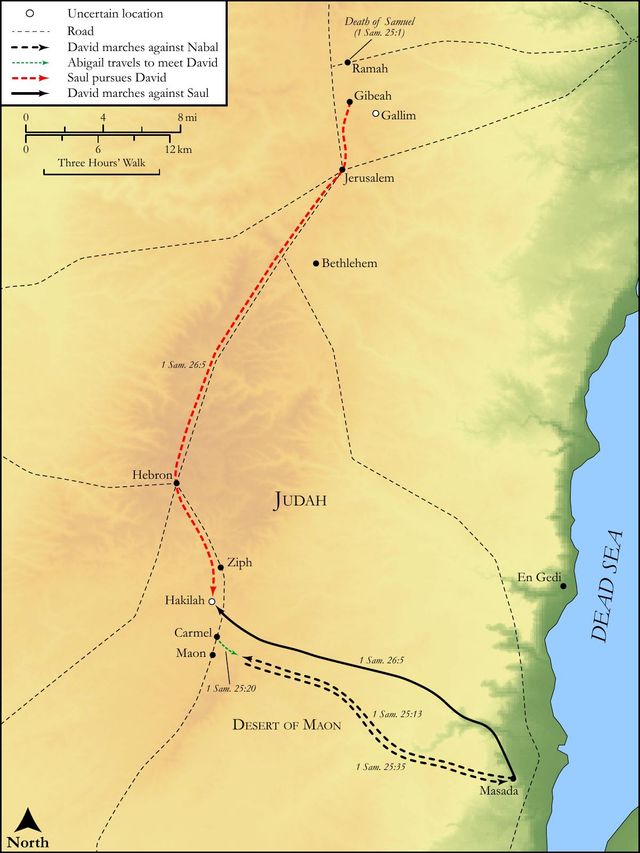
See on the biblical-era map
Study this verse
Public-domain commentary
Matthew Henry
From his Commentary on the Whole Bible. Henry comments on passages, not single verses — this entry covers 1 Samuel 26:13–20. His two-level outline is real structure in the source text, so it is rendered as structure.
David having got safely from Saul's camp himself, and having brought with him proofs sufficient that he had been there, posts himself conveniently, so that they might hear him and yet not reach him (Sa1 26:13), and then begins to reason with them upon what had passed.
I.He reasons ironically with Abner, and keenly banters him.
David knew well that it was from the mighty power of God that Abner and the rest of the guards were cast into so deep a sleep, and that God's immediate hand was in it; but he reproaches Abner as unworthy to be captain of the lifeguards, since he could sleep when the king his master lay so much exposed. By this it appears that the hand of God locked them up in this deep sleep that, as soon as ever David had got out of danger, a very little thing awakened them, even David's voice at a great distance roused them, Sa1 26:14. Abner got up (we may suppose it early in a summer's morning) and enquired who called, and disturbed the king's repose. "It is I," says David, and then he upbraids him with his sleeping when he should have been upon his guard. Perhaps Abner, looking upon David as a despicable enemy and one that there was no danger from, had neglected to set a watch; however, he himself ought to have been more wakeful. David, to put him into confusion, told him, 1. That he had lost his honour (Sa1 26:15): "Art not thou a man? (so the word is), a man in office, that art bound, by the duty of thy place, to inspect the soldiery? Art not thou in reputation for a valiant man? So thou wouldst be esteemed, a man of such courage and conduct that there is none like thee; but now thou art shamed for ever. Thou a general! Thou, a sluggard!" 2. That he deserved to lose his head (Sa1 26:16): "You are all worthy to die, by martial law, for being off your guard, when you had the king himself asleep in the midst of you. Ecce signum - Behold this token. See where the king's spear is, in the hand of him whom the king himself is pleased to count his enemy. Those that took away this might as easily and safely have taken away his life. Now see who are the king's best friends, you that neglected him and left him exposed or I that protected him when he was exposed. You pursue me as worthy to die, and irritate Saul against me; but who is worthy to die now?" Note, Sometimes those that unjustly condemn others are justly left to fall into condemnation themselves.
II.He reasons seriously and affectionately with Saul.
By this time he was so well awake as to hear what was said, and to discern who said it (Sa1 26:17): Is this thy voice, my son David? In the same manner he had expressed his relentings, Sa1 24:16. He had given his wife to another and yet calls him son, thirsted after his blood and yet is glad to hear his voice. Those are bad indeed that have never any convictions of good, nor ever sincerely utter good expressions. And now David has as fair an opportunity of reaching Saul's conscience as he had just now of taking away his life. This he lays hold on, though not of that, and enters into a close argument with him, concerning the trouble he still continued to give him, endeavouring to persuade him to let fall the prosecution and be reconciled.
1.He complains of the very melancholy condition he was brought into by the enmity of Saul against him. Two things he laments: - (1.) That he was driven from his master and from his business: "My lord pursues after his servant, Sa1 26:18. How gladly would I serve thee as formerly if my service might be accepted! but, instead of being owned as a servant, I am pursued as a rebel, and my lord is my enemy, and he whom I would follow with respect compels me to flee from him." (2.) That he was driven from his God and from his religion; and this was a much greater grievance than the former (Sa1 26:19): "They have driven me out from the inheritance of the Lord, have made Canaan too hot for me, at least the inhabited parts of it, have forced me into the deserts and mountains, and will, ere long, oblige me entirely to quit the country." And that which troubled him was not so much that he was driven out from his own inheritance as that he was driven out from the inheritance of the Lord, the holy land. It should be more comfortable to us to think of God's title to our estates and his interest in them then of our own, and that with them we may honour him then that with them we may maintain ourselves. Nor was it so much his trouble that he was constrained to live among strangers as that he was constrained to live among the worshippers of strange gods and was thereby thrust into temptation to join with them in their idolatrous worship. His enemies did, in effect, send him to go and serve other gods, and perhaps he had heard that some of them had spoken to that purport of him. Those that forbid our attendance on God's ordinances do what in them lies to estrange us from God and to make us heathens. If David had not been a man of extraordinary grace, and firmness to his religion, the ill usage he met with from his own prince and people, who were Israelites and worshippers of the true God, would have prejudiced him against the religion they professed and have driven him to communicate with idolaters. "If these be Israelites," he might have said, "let me live and die with Philistines;" and no thanks to them that their conduct had not that effect. We are to reckon that the greatest injury that can be done us which exposes us to sin. Of those who thus led David into temptation he here says, Cursed be they before the Lord. Those fall under a curse that thrust out those whom God receives, and send those to the devil who are dear to God.
2.He insists upon his own innocency: What have I done or what evil is in my hand? Sa1 26:18. He had the testimony of his conscience for him that he had never done nor ever designed any mischief to the person, honour, or government, of his prince, nor to any of the interests of his country. He had lately had Saul's own testimony concerning him (Sa1 24:17): Thou art more righteous than I. It was very unreasonable and wicked for Saul to pursue him as a criminal, when he could not charge him with any crime.
3.He endeavours to convince Saul that his pursuit of him is not only wrong, but mean, and much below him: "The king of Israel, whose dignity is great, and who has so much other work to do, has come out to seek a flea, as when one doth hunt a partridge in the mountains," Sa1 26:20 - a poor game for the king of Israel to pursue. He compares himself to a partridge, a vert innocent harmless bird, which, when attempts are made upon its life, flies if it can, but makes no resistance. And would Saul bring the flower of his army into the field only to hunt one poor partridge? What a disparagement was this to his honour! What a stain would it be on his memory to trample upon so weak and patient as well as so innocent an enemy! Jam 5:6, You have killed the just, and he doth not resist you.
4.He desires that the core of the controversy may be searched into and some proper method taken to bring it to an end, Sa1 26:19. Saul himself could not say that justice put him on thus to persecute David, or that he was obliged to do it for the public safety. David was not willing to say (though it was very true) that Saul's own envy and malice put him on to do it; and therefore he concludes it must be attributed either to the righteous judgment of God or to the unrighteous designs of evil men. Now, (1.) "If the Lord have stirred thee up against me, either in displeasure to me (taking this way to punish me for my sins against him, though, as to thee, I am guiltless) or in displeasure to thee, if it be the effect of that evil spirit from the Lord which troubles thee, let him accept an offering from us both - let us join in making our peace with God, reconciling ourselves to him, which may be done, by sacrifice; and then I hope the sin will be pardoned, whatever it is, and the trouble, which is so great a vexation both to thee and me, will come to an end." See the right method of peace-making; let us first make God our friend by Christ the great Sacrifice, and then all other enmities shall be slain, Eph 2:16; Pro 16:7. But, (2.) "If thou art incited to it by wicked men, that incense thee against me, cursed be they before the Lord," that is, they are very wicked people, and it is fit that they should be abandoned as such, and excluded from the king's court and councils. He decently lays the blame upon the evil counsellors who advised the king to that which was dishonourable and dishonest, and insists upon it that they be removed from about him and forbidden his presence, as men cursed before the Lord, and then he hoped he should gain his petition, which is (Sa1 26:20), "Let not my blood fall to the earth, as thou threatenest, for it is before the face of the Lord, who will take cognizance of the wrong and avenge it." Thus pathetically does David plead with Saul for his life, and, in order to that, for his favourable opinion of him.
Historical interpretation
Historical reception
2 surviving comments on this verse. Each one is dated, so this reads as a timeline rather than a list.
And David said to Abner: Are you not a man? etc. The apostles said: Are you not the scribes, learned in the law, chief priests, and Pharisees, excelling the people equally in rank and knowledge? Why did you not protect the untouched dominion of your people, insisting on the vigilance of perfect work and doctrine?
For someone from the crowd entered to kill the king your lord. Literally, this is said of Abisai, who entered the camp with the intention, if somehow possible, to kill the king. Allegorically, it is understood of the apostles, who with diligent warning predicted the future destruction of the wicked kingdom because of sins.
Continue studying 1 Samuel 26:15 across the web’s major study libraries — every link below opens this exact verse, chapter, or book on the destination site.
Read & Compare
 BibleGatewayThis verse in more than 200 translations and 70 languages.
 Bible.comThe YouVersion reader — hundreds of translations, reading plans, and highlights.
 ESV.orgCrossway's official English Standard Version reader.
 NET BibleThe NET translation with 60,000+ translators' notes on every rendering decision.
 STEP BibleTyndale House's free study tool — original text, vocabulary, and scholarly resources.
 BibliaLogos Bible Software's free web reader.
 USCCBThe New American Bible (Revised Edition) with the U.S. bishops' study notes.
Commentaries
 BibleHub CommentariesDozens of classic commentaries on this verse, gathered on one page.
 StudyLightMore than 100 commentary sets — the largest collection on the web.
 BibleRefPlain-English commentary on what this verse means, verse by verse.
 Enduring WordDavid Guzik's free commentary on this chapter, widely used by Bible teachers.
 Bible Study ToolsVerse commentary alongside Greek and Hebrew study aids.
Original Language & Research
- BibleHub InterlinearThe verse word by word — original language, transliteration, and English.
- BibleHub LexiconEvery word's original-language definition and Strong's entry.
 Blue Letter BibleDeep-study tools — Strong's numbers, concordance, and word studies.
 SefariaThe Hebrew text with Rashi and centuries of Jewish commentary.
Sermons, Hymns & Audio


TrulyRandomVerse is not affiliated with these sites and doesn’t control their content. They’re linked because they’re genuinely useful.
Summary
1 Samuel 26:15 captures David's audacious public shaming of Abner, King Saul's chief commander, for his egregious failure to protect the monarch. After secretly infiltrating Saul's camp and taking the king's spear and water jug as irrefutable proof of his access, David calls out from a distant hilltop. He rhetorically questions Abner's reputation as a "valiant man" and a peerless protector in Israel, given his profound negligence that allowed an intruder to approach the sleeping king with destructive intent. This verse powerfully highlights Abner's dereliction of duty, while simultaneously underscoring David's unwavering integrity and profound respect for God's anointed, even when presented with a clear opportunity to eliminate his relentless pursuer.
Context
ShowHideLiterary Context
This verse is a pivotal moment in the ongoing narrative of David's flight from King Saul, serving as a dramatic parallel to the earlier incident in 1 Samuel 24. In both instances, David has Saul completely at his mercy, yet chooses to spare his life. Here, David, accompanied by Abishai, infiltrates Saul's sleeping camp, a feat made possible by a "deep sleep" sent by the Lord (1 Samuel 26:12). Instead of taking Saul's life, David takes only his spear and water jug, potent symbolic items of royal authority and sustenance. David then retreats to a distant hilltop, from which he shouts down to Abner, using this public confrontation not only to expose Abner's negligence and, by extension, Saul's precarious position, but also to reaffirm his own innocence and profound respect for the Lord's anointed. The profound dramatic irony is palpable: the very man Saul relentlessly seeks to destroy is the one who repeatedly preserves his life.
Historical & Cultural Context
In ancient Israel, the king's safety was paramount, and his chief military commander, such as Abner, bore ultimate, personal responsibility for the monarch's protection. A breach of this duty, especially one that allowed an enemy within striking distance of the sleeping king, was a grave offense, punishable by death. The concept of "the Lord's anointed" (מְשִׁיחַ יְהוָה, meshiach Yahweh) was deeply significant and held sacred; it referred to the king, divinely chosen and consecrated for his office. To harm the king, even a wicked one like Saul who was actively seeking David's life, was considered a violation of divine prerogative and an act that would incur God's wrath. David's actions throughout this narrative consistently reflect this profound theological understanding, sharply distinguishing him from Saul, who repeatedly disregarded divine commands and sought to usurp God's timing. The public challenge from a distance, as employed by David, was also a common form of discourse in Israel, allowing for confrontation and shaming without immediate physical engagement, often used to assert moral superiority or expose a failure of duty.
Key Themes
ShowHideThis verse powerfully illustrates several overarching themes within 1 Samuel and the broader biblical narrative. Firstly, it showcases Divine Protection and Providence over David, as God supernaturally causes a "deep sleep" to fall upon Saul's entire camp, allowing David to enter unimpeded and exit safely (1 Samuel 26:12). This highlights God's active hand in preserving His chosen servant. Secondly, it highlights David's Unwavering Integrity and Respect for God's Anointed, a consistent character trait that contrasts sharply with Saul's escalating paranoia, disobedience, and attempts to harm David. David's steadfast refusal to "stretch out his hand against the Lord's anointed" (1 Samuel 26:11) is a testament to his profound faith and patient trust in God to vindicate him and establish His chosen king in His own perfect timing. Finally, the passage underscores Accountability and Dereliction of Duty, as Abner, a powerful and respected military leader, is publicly shamed for his catastrophic failure to uphold his most fundamental responsibility to protect the king.
Exposition and Analysis
ShowHideKey Word Analysis
ShowHideH376 (אִישׁ) This word refers to a man as an individual or a male person, often used to denote a person of significance or standing. When David rhetorically asks, "Art not thou a valiant man?" (literally, "Are you not a man?"), he is not questioning Abner's gender, but rather his very identity and reputation as a capable, courageous, and responsible individual, especially in his role as chief commander. The implication is that Abner, who is supposed to be the epitome of a strong, vigilant man, has utterly failed in his most critical duty, making his "manliness" or "valiance" a subject of derision.
H8104 (שָׁמַר) This primitive root means "to hedge about (as with thorns), i.e. guard; generally, to protect, attend to, etc." It implies a responsibility to watch over, preserve, and maintain safety. David's direct question, "wherefore then hast thou not kept thy lord the king?" is a pointed accusation of Abner's failure to fulfill his primary and sacred duty. It highlights not just a lapse in physical protection, but a profound breach of trust and a failure to uphold the solemn obligation to safeguard the king's life.
H7843 (שָׁחַת) This primitive root means "to decay, i.e. (causatively) ruin (literally or figuratively); batter, cast off, corrupt, destroy." David uses this potent word to describe the potential action of "one of the people" (himself), emphasizing the extreme gravity of the threat that Abner allowed to approach the king. While David himself chose not to act on this potential, his ability to access the king and take his regalia demonstrated that such destruction was indeed a very real and terrifying possibility due to Abner's gross negligence.
Verse Breakdown
ShowHide"And David said to Abner, [Art] not thou a [valiant] man?"
David initiates the confrontation with a rhetorical question designed to immediately challenge Abner's identity, reputation, and perceived strength. The implied answer is a resounding "Yes, you are supposed to be a valiant man," which then sets up the devastating accusation of his failure, designed to publicly shame him.
"and who [is] like to thee in Israel?"
This continues David's sarcastic line of questioning, further inflating Abner's supposed status and unique position as Saul's chief commander. By acknowledging Abner's high standing and peerless reputation, David makes his subsequent indictment of Abner's failure all the more egregious and humiliating.
"wherefore then hast thou not kept thy lord the king?"
This is the core accusation, a direct and piercing challenge to Abner's dereliction of duty. As the king's primary protector, Abner had one paramount responsibility, and David highlights his catastrophic failure to execute it. This question demands an explanation for a grave breach of trust, responsibility, and professional competence.
"for there came one of the people in to destroy the king thy lord."
David provides the irrefutable evidence of Abner's failure and the dire consequences of his negligence. He refers to himself as "one of the people" to heighten the irony and underscore how easily an ordinary individual—or indeed, a genuine enemy—could have accessed the sleeping king. The chilling phrase "to destroy the king thy lord" emphasizes the mortal danger that Abner's lapse had allowed, even though David himself chose not to act on that potential.
Literary Devices
ShowHideThe passage is masterfully crafted with several powerful literary devices. Rhetorical Question is prominently employed by David, not to seek information, but to shame Abner and highlight his negligence. Questions like "Art not thou a valiant man?" and "who is like to thee in Israel?" are not genuine inquiries but potent, accusatory statements. This is intricately woven with biting Sarcasm and profound Irony, as David uses terms like "valiant man" and "who is like to thee" to mock Abner's celebrated prowess in light of his abject failure to protect the king. The stark Contrast between Abner's renowned reputation and his actual incompetence, as well as the deeper contrast between Saul's relentless pursuit of David and David's consistent self-restraint and respect for God's anointed, further amplifies the dramatic tension and the moral message of the passage. David's actions and words serve to expose the spiritual blindness, hypocrisy, and dereliction of duty within Saul's camp.
Theological and Thematic Connections
ShowHide1 Samuel 26:15 profoundly illustrates the principle of divine sovereignty and the paramount importance of respecting God's established authority, even when that authority is flawed, hostile, or actively persecuting. David's steadfast refusal to harm Saul, despite repeated opportunities and extreme personal provocation, demonstrates a deep theological conviction that vengeance and the removal of God's anointed belong solely to God (1 Samuel 26:10). This passage also highlights the critical theme of accountability, particularly for those entrusted with positions of leadership, trust, and care. Abner's public failure serves as a stark warning about the severe consequences of negligence and a lack of vigilance, especially when the well-being of others, particularly those in authority, is at stake. David's unwavering integrity, sharply contrasted with Abner's catastrophic lapse, becomes a powerful testament to living righteously under immense pressure, trusting God for ultimate vindication rather than resorting to human means or personal vengeance.
Reflection and Application
ShowHideThis dramatic and insightful encounter between David and Abner offers timeless and profound lessons for believers today. Firstly, it challenges us to deeply consider our own vigilance, diligence, and accountability in the responsibilities God has entrusted to us, whether within our families, churches, workplaces, or broader communities. Are we truly "keeping" what has been committed to our care with the integrity, watchfulness, and faithfulness that God expects? Secondly, David's consistent and remarkable restraint in the face of extreme and unjust provocation serves as an enduring model for maintaining our integrity and patiently trusting God's perfect timing and justice, even when we are deeply wronged or unjustly persecuted. It powerfully reminds us that true strength and spiritual maturity are often found not in retaliation, seizing power, or asserting our rights, but in patient endurance, self-control, and unwavering reliance on God's sovereign hand. We are called to live by faith, knowing with certainty that God sees all, God protects His own, and God will ultimately vindicate His righteous servants, often through means we cannot foresee or orchestrate.
Questions for Reflection
ShowHideFAQ
ShowHideWhy didn't David kill Saul, especially since Saul was actively trying to kill him and was completely vulnerable?
ShowHideDavid consistently refused to harm "the Lord's anointed" (1 Samuel 24:6). This was not out of fear of Saul, but out of profound reverence for God's choice and authority. David believed that vengeance and the removal of a divinely appointed king belonged to God alone and that God would remove Saul in His own perfect time and way (1 Samuel 26:10). His actions demonstrated his deep faith, unwavering integrity, and patient submission to God's sovereign plan, trusting God's justice above his own desire for immediate relief or retribution.
What was the significance of David taking Saul's spear and water jug, rather than his life?
ShowHideThe spear was a potent symbol of Saul's royal authority, military power, and personal presence, often seen as an extension of the king himself (1 Samuel 18:10-11). The water jug represented his sustenance, life, and personal provision. By taking these highly personal and symbolic items without harming Saul, David achieved several crucial objectives: he provided undeniable, tangible proof of his access to the king, thereby demonstrating Abner's severe negligence; he dramatically showed Saul his extreme vulnerability, forcing him to confront the reality of his unprotected state; and most importantly, he provided irrefutable evidence of his own restraint and innocence, proving that he had no intention of usurping the throne through violence or personal vengeance.
Christ-Centered Fulfillment
ShowHide1 Samuel 26:15, with David's remarkable restraint and profound respect for the Lord's anointed, powerfully foreshadows the perfect righteousness, unparalleled humility, and ultimate redemptive mission of Jesus Christ. David, though unjustly pursued and repeatedly wronged, refused to take vengeance into his own hands, patiently trusting God's timing and justice. This pales in comparison to Christ, the true and ultimate Anointed One (the Messiah), who, though possessing all power and authority in heaven and on earth (Matthew 28:18), willingly submitted Himself to the Father's will, even unto the ignominious death on a cross (Philippians 2:8). Jesus did not come to destroy His enemies with worldly power or to seize an earthly throne by force, but to save them through radical self-sacrifice (John 3:17). He allowed Himself to be "delivered up" (Acts 2:23) by those who sought His life, trusting His Father for vindication and glorious resurrection (1 Peter 2:23). David's refusal to harm Saul illustrates a faint shadow of the perfect humility, obedience, and self-giving love of Christ, who, by not wielding His divine power for self-preservation, secured the ultimate victory over sin, death, and the grave, establishing an eternal kingdom not of this world (John 18:36).