


1 Samuel 26:14
Bible text: King James Version (1769 Blayney text) · Public domain
Bible text: King James Version with Strong's numbers · Public domain
Bible text: Berean Standard Bible · Public domain
Bible text: American Standard Version (1901) · Public domain
Bible text: World English Bible, Messianic edition · Public domain
Bible text: Geneva Bible (1599) · Public domain
Bible text: Young's Literal Translation · Public domain
- וַיִּקְרָאvai·yik·Ra'and he called outH7121Conj-w ¦ V-Qal-ConsecImperf-3msVerb Qal Consecutive Imperfect 3rd Singular Masculineוַandיִּקְרָאhe called out
- דָוִדda·VidDavidH1732N-proper-mNoun Proper Masculine
- אֶל'eltoH413PrepPreposition
- הָעָםha·'Amthe peopleH5971Art ¦ N-msNoun Singular Masculine Absoluteהָtheעָםpeople
- וְאֶלve·'eland toH413Conj-w ¦ PrepPrepositionוְandאֶלto
- אַבְנֵר'av·NerAbnerH74N-proper-mNoun Proper Masculine
- בֶּןben[the] son ofH1121N-mscNoun Singular Masculine Construct
- נֵרnerNerH5369N-proper-mNoun Proper Masculine
- לֵאמֹרle·Mor<to> sayingH559Prep-l ¦ V-Qal-InfVerb Qal Infinitive Constructלֵ<to>אמֹרsaying
- הֲלוֹאha·Lo'¿ notH3808Interrog ¦ NegParticle Negativeהֲ¿לוֹאnot
- תַעֲנֶהta·'a·Nehwill you answerH6030V-Qal-Imperf-2msVerb Qal Imperfect 2nd Singular Masculine
- אַבְנֵר'av·NerO AbnerH74N-proper-mNoun Proper Masculine
- וַיַּעַןvai·Ya·'anand he answeredH6030Conj-w ¦ V-Qal-ConsecImperf-3msVerb Qal Consecutive Imperfect 3rd Singular Masculineוַandיַּעַןhe answered
- אַבְנֵר'av·NerAbnerH74N-proper-mNoun Proper Masculine
- וַיֹּאמֶרvai·Yo·merand he saidH559Conj-w ¦ V-Qal-ConsecImperf-3msVerb Qal Consecutive Imperfect 3rd Singular Masculineוַandיֹּאמֶרhe said
- מִיmiwho?H4310InterrogPronoun Interrogative
- אַתָּה'a·Tah[are] youH859Pro-2msPronoun Personal 2nd Singular Masculine
- קָרָאתָka·Ra·ta[who] you have called outH7121V-Qal-Perf-2msVerb Qal Perfect 2nd Singular Masculine
- אֶל'eltoH413PrepPreposition
- הַמֶּלֶךְha·Me·lekhthe kingH4428Art ¦ N-msNoun Singular Masculine Absoluteהַtheמֶּלֶךְking
English is a literal word-by-word gloss of the Hebrew, not the KJV's wording. Why?
This is the original text the KJV's translators worked from — each Hebrew word with its own literal English meaning in this verse, prepared by scholars at Tyndale House, Cambridge. The KJV translates whole sentences, not word by word, so its wording differs: one Hebrew word can become several English words, and the KJV may choose “the LORD” where the gloss reads “Yahweh”. Both are faithful — they answer different questions. For the KJV's own rendering, switch to the KJV text.
Details
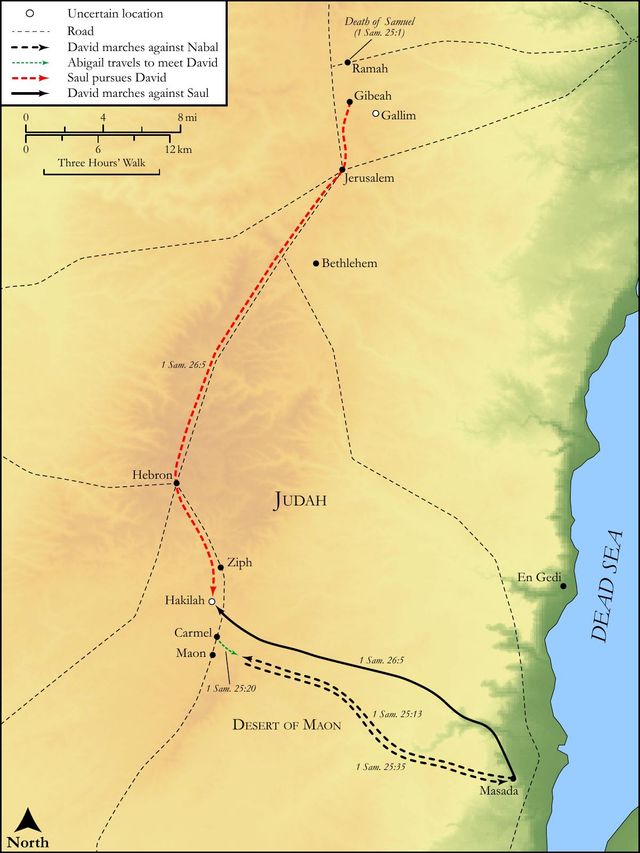
See on the biblical-era map
Study this verse
Public-domain commentary
Matthew Henry
From his Commentary on the Whole Bible. Henry comments on passages, not single verses — this entry covers 1 Samuel 26:13–20. His two-level outline is real structure in the source text, so it is rendered as structure.
David having got safely from Saul's camp himself, and having brought with him proofs sufficient that he had been there, posts himself conveniently, so that they might hear him and yet not reach him (Sa1 26:13), and then begins to reason with them upon what had passed.
I.He reasons ironically with Abner, and keenly banters him.
David knew well that it was from the mighty power of God that Abner and the rest of the guards were cast into so deep a sleep, and that God's immediate hand was in it; but he reproaches Abner as unworthy to be captain of the lifeguards, since he could sleep when the king his master lay so much exposed. By this it appears that the hand of God locked them up in this deep sleep that, as soon as ever David had got out of danger, a very little thing awakened them, even David's voice at a great distance roused them, Sa1 26:14. Abner got up (we may suppose it early in a summer's morning) and enquired who called, and disturbed the king's repose. "It is I," says David, and then he upbraids him with his sleeping when he should have been upon his guard. Perhaps Abner, looking upon David as a despicable enemy and one that there was no danger from, had neglected to set a watch; however, he himself ought to have been more wakeful. David, to put him into confusion, told him, 1. That he had lost his honour (Sa1 26:15): "Art not thou a man? (so the word is), a man in office, that art bound, by the duty of thy place, to inspect the soldiery? Art not thou in reputation for a valiant man? So thou wouldst be esteemed, a man of such courage and conduct that there is none like thee; but now thou art shamed for ever. Thou a general! Thou, a sluggard!" 2. That he deserved to lose his head (Sa1 26:16): "You are all worthy to die, by martial law, for being off your guard, when you had the king himself asleep in the midst of you. Ecce signum - Behold this token. See where the king's spear is, in the hand of him whom the king himself is pleased to count his enemy. Those that took away this might as easily and safely have taken away his life. Now see who are the king's best friends, you that neglected him and left him exposed or I that protected him when he was exposed. You pursue me as worthy to die, and irritate Saul against me; but who is worthy to die now?" Note, Sometimes those that unjustly condemn others are justly left to fall into condemnation themselves.
II.He reasons seriously and affectionately with Saul.
By this time he was so well awake as to hear what was said, and to discern who said it (Sa1 26:17): Is this thy voice, my son David? In the same manner he had expressed his relentings, Sa1 24:16. He had given his wife to another and yet calls him son, thirsted after his blood and yet is glad to hear his voice. Those are bad indeed that have never any convictions of good, nor ever sincerely utter good expressions. And now David has as fair an opportunity of reaching Saul's conscience as he had just now of taking away his life. This he lays hold on, though not of that, and enters into a close argument with him, concerning the trouble he still continued to give him, endeavouring to persuade him to let fall the prosecution and be reconciled.
1.He complains of the very melancholy condition he was brought into by the enmity of Saul against him. Two things he laments: - (1.) That he was driven from his master and from his business: "My lord pursues after his servant, Sa1 26:18. How gladly would I serve thee as formerly if my service might be accepted! but, instead of being owned as a servant, I am pursued as a rebel, and my lord is my enemy, and he whom I would follow with respect compels me to flee from him." (2.) That he was driven from his God and from his religion; and this was a much greater grievance than the former (Sa1 26:19): "They have driven me out from the inheritance of the Lord, have made Canaan too hot for me, at least the inhabited parts of it, have forced me into the deserts and mountains, and will, ere long, oblige me entirely to quit the country." And that which troubled him was not so much that he was driven out from his own inheritance as that he was driven out from the inheritance of the Lord, the holy land. It should be more comfortable to us to think of God's title to our estates and his interest in them then of our own, and that with them we may honour him then that with them we may maintain ourselves. Nor was it so much his trouble that he was constrained to live among strangers as that he was constrained to live among the worshippers of strange gods and was thereby thrust into temptation to join with them in their idolatrous worship. His enemies did, in effect, send him to go and serve other gods, and perhaps he had heard that some of them had spoken to that purport of him. Those that forbid our attendance on God's ordinances do what in them lies to estrange us from God and to make us heathens. If David had not been a man of extraordinary grace, and firmness to his religion, the ill usage he met with from his own prince and people, who were Israelites and worshippers of the true God, would have prejudiced him against the religion they professed and have driven him to communicate with idolaters. "If these be Israelites," he might have said, "let me live and die with Philistines;" and no thanks to them that their conduct had not that effect. We are to reckon that the greatest injury that can be done us which exposes us to sin. Of those who thus led David into temptation he here says, Cursed be they before the Lord. Those fall under a curse that thrust out those whom God receives, and send those to the devil who are dear to God.
2.He insists upon his own innocency: What have I done or what evil is in my hand? Sa1 26:18. He had the testimony of his conscience for him that he had never done nor ever designed any mischief to the person, honour, or government, of his prince, nor to any of the interests of his country. He had lately had Saul's own testimony concerning him (Sa1 24:17): Thou art more righteous than I. It was very unreasonable and wicked for Saul to pursue him as a criminal, when he could not charge him with any crime.
3.He endeavours to convince Saul that his pursuit of him is not only wrong, but mean, and much below him: "The king of Israel, whose dignity is great, and who has so much other work to do, has come out to seek a flea, as when one doth hunt a partridge in the mountains," Sa1 26:20 - a poor game for the king of Israel to pursue. He compares himself to a partridge, a vert innocent harmless bird, which, when attempts are made upon its life, flies if it can, but makes no resistance. And would Saul bring the flower of his army into the field only to hunt one poor partridge? What a disparagement was this to his honour! What a stain would it be on his memory to trample upon so weak and patient as well as so innocent an enemy! Jam 5:6, You have killed the just, and he doth not resist you.
4.He desires that the core of the controversy may be searched into and some proper method taken to bring it to an end, Sa1 26:19. Saul himself could not say that justice put him on thus to persecute David, or that he was obliged to do it for the public safety. David was not willing to say (though it was very true) that Saul's own envy and malice put him on to do it; and therefore he concludes it must be attributed either to the righteous judgment of God or to the unrighteous designs of evil men. Now, (1.) "If the Lord have stirred thee up against me, either in displeasure to me (taking this way to punish me for my sins against him, though, as to thee, I am guiltless) or in displeasure to thee, if it be the effect of that evil spirit from the Lord which troubles thee, let him accept an offering from us both - let us join in making our peace with God, reconciling ourselves to him, which may be done, by sacrifice; and then I hope the sin will be pardoned, whatever it is, and the trouble, which is so great a vexation both to thee and me, will come to an end." See the right method of peace-making; let us first make God our friend by Christ the great Sacrifice, and then all other enmities shall be slain, Eph 2:16; Pro 16:7. But, (2.) "If thou art incited to it by wicked men, that incense thee against me, cursed be they before the Lord," that is, they are very wicked people, and it is fit that they should be abandoned as such, and excluded from the king's court and councils. He decently lays the blame upon the evil counsellors who advised the king to that which was dishonourable and dishonest, and insists upon it that they be removed from about him and forbidden his presence, as men cursed before the Lord, and then he hoped he should gain his petition, which is (Sa1 26:20), "Let not my blood fall to the earth, as thou threatenest, for it is before the face of the Lord, who will take cognizance of the wrong and avenge it." Thus pathetically does David plead with Saul for his life, and, in order to that, for his favourable opinion of him.
Historical interpretation
Historical reception
1 surviving comment on this verse from the historical church.
And Abner answered and said: Who are you that cries out? etc. The Pharisees and scribes responded, not recognizing the disciples of Jesus, who cried out teaching the people, and disturbed the kingdom of the Jews, as if by the shedding of Christ's blood, convicting it. And they said, "Do you want to bring this man's blood upon us?"
Continue studying 1 Samuel 26:14 across the web’s major study libraries — every link below opens this exact verse, chapter, or book on the destination site.
Read & Compare
 BibleGatewayThis verse in more than 200 translations and 70 languages.
 Bible.comThe YouVersion reader — hundreds of translations, reading plans, and highlights.
 ESV.orgCrossway's official English Standard Version reader.
 NET BibleThe NET translation with 60,000+ translators' notes on every rendering decision.
 STEP BibleTyndale House's free study tool — original text, vocabulary, and scholarly resources.
 BibliaLogos Bible Software's free web reader.
 USCCBThe New American Bible (Revised Edition) with the U.S. bishops' study notes.
Commentaries
 BibleHub CommentariesDozens of classic commentaries on this verse, gathered on one page.
 StudyLightMore than 100 commentary sets — the largest collection on the web.
 BibleRefPlain-English commentary on what this verse means, verse by verse.
 Enduring WordDavid Guzik's free commentary on this chapter, widely used by Bible teachers.
 Bible Study ToolsVerse commentary alongside Greek and Hebrew study aids.
Original Language & Research
- BibleHub InterlinearThe verse word by word — original language, transliteration, and English.
- BibleHub LexiconEvery word's original-language definition and Strong's entry.
 Blue Letter BibleDeep-study tools — Strong's numbers, concordance, and word studies.
 SefariaThe Hebrew text with Rashi and centuries of Jewish commentary.
Sermons, Hymns & Audio


TrulyRandomVerse is not affiliated with these sites and doesn’t control their content. They’re linked because they’re genuinely useful.
Summary
1 Samuel 26:14 encapsulates a critical confrontation where David, having once again demonstrated his integrity by sparing King Saul's life, publicly challenges Abner, Saul's chief commander, for his egregious failure to protect the king. David's loud, strategic cry from a distant hilltop serves to expose Abner's negligence and highlight Saul's vulnerability, setting the stage for a dramatic revelation of David's righteous character and God's providential oversight.
Context
ShowHideLiterary Context
This verse is deeply embedded within the ongoing, tumultuous narrative of Saul's relentless and paranoid pursuit of David, whom he perceives as a threat to his throne. Immediately prior to this scene, David, accompanied by Abishai, had, under divine guidance, infiltrated Saul's sleeping encampment. There, they found Saul asleep with his spear and water cruse near his head. Abishai urged David to strike Saul down, but David, demonstrating profound respect for "the Lord's anointed," steadfastly refused to harm him, echoing his earlier act of mercy in the cave at Engedi. Instead, David took Saul's spear and water cruse as incontrovertible proof of his presence within the camp and his deliberate decision to spare the king's life, as meticulously recounted in 1 Samuel 26:7-12. Having withdrawn to a safe distance on an opposing hill, David then uses the moment captured in this verse to initiate a public, vocal challenge to Abner, thereby forcing an unavoidable acknowledgment of the severe security breach.
Historical & Cultural Context
In the societal and political landscape of ancient Israel, the king's personal safety was of paramount importance, and his chief military commander, such as Abner, bore direct and ultimate responsibility for it. A security breach of the magnitude described—an intruder reaching the king's side while the entire camp slept—was an unthinkable dereliction of duty, a profound disgrace that could easily warrant the death penalty. The "spear and water cruse" were not mere personal effects; they were potent symbols of the king's authority, military prowess, and very life, making their removal a profoundly symbolic and damning statement of vulnerability. David's public challenge, shouted from a distance across the valley, was a culturally significant act designed to publicly shame Abner and, by extension, King Saul, in the presence of their own men. This act was calculated to compel them to confront the stark reality of their negligence and the inherent injustice of their relentless pursuit of David.
Key Themes
ShowHideThis verse powerfully contributes to several overarching themes woven throughout the book of 1 Samuel. It unequivocally underscores Divine Protection over David, demonstrating God's sovereign hand in preserving His chosen servant, enabling him to move freely and safely even within the heart of his enemy's camp. This highlights God's unwavering commitment to His purposes. Furthermore, it emphatically emphasizes David's Integrity and Righteousness, contrasting his unwavering respect for God's anointed with Saul's unholy, jealous pursuit. David's steadfast refusal to take vengeance into his own hands, even when presented with a clear and easy opportunity, is central to his righteous character and prophetically points to the nature of the true, coming King. Conversely, the scene starkly highlights Saul's Vulnerability and Abner's Negligence, revealing the disarray, lack of vigilance, and spiritual blindness prevalent within Saul's camp, a stark contrast to David's disciplined, God-fearing conduct. David's actions here constitute a direct appeal for justice and accountability, profoundly demonstrating his trust that God will ultimately vindicate him, a trust explicitly articulated later in 1 Samuel 26:23-24.
Exposition and Analysis
ShowHideKey Word Analysis
ShowHideThis verb signifies "to call out to" or "to proclaim." David's "crying" was not a mere whisper but a loud, public shout designed to be heard across the valley, ensuring that not only Abner but also the entire Israelite camp would be roused and made acutely aware of the security breach and the subsequent confrontation. This implies a deliberate, urgent act to draw widespread attention and demand an immediate, public response.
This verb primarily means "to respond" or "to testify," implying a need to heed or pay attention. David's rhetorical question, "Answerest thou not, Abner?", is a direct, sharp challenge, demanding an explanation for Abner's profound failure in his duty. It implies accountability and a forced reckoning, highlighting Abner's professional and moral dereliction of duty in protecting the king.
This noun simply means "a king." Abner's confused and indignant response, "Who art thou that criest to the king?", underscores the gravity of the perceived offense. To "cry to the king" implies a direct address, possibly a complaint or a challenge, which would typically be handled through established channels, not by an unknown individual shouting from a distance. Abner's immediate concern is the king's safety and the impropriety of the address, rather than the identity of the speaker, revealing his initial shock and disorientation.
Verse Breakdown
ShowHide"And David cried to the people, and to Abner the son of Ner, saying,"
David's action is meticulously planned and executed with public impact in mind. He addresses not only Abner, the direct target of his challenge and the commander responsible for security, but also "the people"—the entire sleeping Israelite army. This strategic choice ensures that his subsequent words will be widely heard, thereby exposing Abner's negligence and Saul's profound vulnerability to the very men who were sworn to protect them. It is a calculated move to establish moral high ground and compel a public reckoning.
"Answerest thou not, Abner?"
This is David's piercing, rhetorical question, designed not to elicit information but to publicly shame and accuse Abner. It pointedly highlights Abner's failure to respond to the critical security breach, implying a profound lack of vigilance, responsibility, and professional competence. David is essentially demanding, "Why are you silent? Why have you so utterly failed in your sacred duty to protect the king?" The question demands an immediate explanation for an inexcusable lapse in military discipline and loyalty.
"Then Abner answered and said, Who [art] thou [that] criest to the king?"
Abner's initial response reveals a mixture of confusion, surprise, and indignation. He does not immediately recognize David's voice, likely due to the significant distance, the pre-dawn darkness, or the unexpected nature of such a bold challenge. His question focuses on the audacity and impropriety of someone daring to call out directly to the king, indicating his immediate concern for royal protocol and the king's safety, even as his own negligence is being dramatically exposed. This sets the stage for David to reveal his identity and present the irrefutable evidence of Abner's catastrophic failure.
Literary Devices
ShowHideThe passage employs several potent literary devices to heighten the drama, intensify the confrontation, and emphasize its profound themes. The most prominent is the Rhetorical Question ("Answerest thou not, Abner?"), which David masterfully uses not to seek information but to deliver a forceful accusation and to publicly shame Abner. This question powerfully underscores Abner's negligence and immediately forces him into a defensive and accountable posture. Dramatic Irony is also profoundly at play, as Abner is completely unaware that the voice belongs to David, the very man he and Saul are relentlessly pursuing, and the one who has just spared Saul's life. The audience, however, is fully aware of David's identity and his recent actions, creating palpable tension and highlighting the profound blindness and spiritual slumber within Saul's camp. Furthermore, a stark Contrast is established between David's unwavering vigilance, impeccable integrity, and profound respect for God's anointed, and Abner's (and by extension, Saul's) laxity, paranoia, and unjust, relentless pursuit. This powerful contrast serves to elevate David's character as a man after God's own heart and underscores the escalating moral and spiritual decay within Saul's kingdom.
Theological and Thematic Connections
ShowHide1 Samuel 26:14, while depicting a moment of intense human confrontation, profoundly reflects God's sovereign hand in protecting His chosen servant and meticulously bringing about His divine purposes. David's remarkable ability to expose Abner's negligence without resorting to harming Saul is a powerful testament to his unwavering faith that God would execute justice and establish His kingdom in His own perfect timing and through His own divine means, rather than through human violence, manipulation, or personal vengeance. This pivotal scene underscores the profound biblical principle that divine vindication often comes through unexpected and counter-intuitive means, revealing the failures of the proud and exalting the humble. It highlights the stark and fundamental difference between those who operate by their own human strength, cunning, or might, and those who place their complete trust in the Lord's providential care and righteous judgment, even in the face of grave injustice and relentless persecution.
Reflection and Application
ShowHideDavid's bold yet profoundly righteous confrontation of Abner in this passage offers enduring and profound lessons for believers today. It serves as a powerful reminder that there are indeed times when rebuking the powerful, even at significant personal risk, is not only necessary but morally imperative to expose injustice, call for accountability, and uphold righteousness. David's actions were not motivated by malice, personal vengeance, or a desire for self-promotion, but rather by a pure desire to highlight the absurdity, unrighteousness, and spiritual blindness of Saul's relentless pursuit, while simultaneously demonstrating his own unimpeachable integrity and trust in God. This narrative challenges us to deeply consider how we, as followers of Christ, respond when we are wronged, persecuted, or unjustly treated. Do we impulsively take matters into our own hands, seeking immediate retribution or personal vindication? Or do we, like David, choose to trust God to be our ultimate vindicator, believing that He will expose the truth and administer perfect justice in His own perfect timing? The passage also serves as a potent reminder for all those in positions of leadership, whether within the church, the family, the workplace, or any sphere of influence, of the critical importance of vigilance, unwavering responsibility, and uncompromised integrity. Negligence in duty, especially when entrusted with the sacred care or protection of others, carries real and often public consequences.
Questions for Reflection
ShowHideFAQ
ShowHideWhy didn't Abner recognize David's voice immediately?
ShowHideAbner likely didn't recognize David's voice immediately due to a confluence of factors. First, David was calling from a significant distance across the valley, making clear vocal identification difficult, especially in the disorienting pre-dawn hours. Second, Abner and the entire camp were deep in sleep and would have been suddenly and jarringly awakened by a loud shout, leading to initial disorientation. Third, the sheer audacity and unexpected nature of someone calling out directly to the king from outside the fortified camp was so unprecedented that Abner's initial reaction was one of profound confusion and indignation at the breach of protocol, rather than an immediate attempt to identify the specific speaker. His primary focus would have been on the security implications and the perceived impropriety of the address.
What was the significance of David taking Saul's spear and water cruse?
ShowHideThe spear and water cruse were profoundly symbolic items, far more than mere personal belongings. The spear represented Saul's royal authority, his military power, and his personal defense. The water cruse, containing water, represented his very life and sustenance. By silently taking these items from directly beside Saul's head while he slept, David demonstrated irrefutably that he had been close enough to easily kill the king but deliberately chose not to. This act served as incontrovertible proof of his presence within the camp, his absolute ability to harm Saul, and his conscious, deliberate decision to spare "the Lord's anointed." It was a powerful, non-violent, and highly symbolic way to expose Abner's gross negligence and to underscore David's own integrity, his respect for divine appointment, and his unwavering trust in God's ultimate vindication, as detailed in 1 Samuel 26:12.
Christ-Centered Fulfillment
ShowHideThe narrative of David's impeccable integrity and his steadfast refusal to harm "the Lord's anointed" in 1 Samuel 26:14, even when Saul was his relentless and unjust persecutor, powerfully foreshadows the perfect integrity and ultimate vindication of Jesus Christ. David, serving as a profound type of the coming King, consistently refused to seize the throne through violence, human manipulation, or self-promotion, instead trusting completely in God's perfect timing and divine method for his ascension. This finds its ultimate and glorious fulfillment in Christ, the true Son of David and the perfect "Lord's Anointed" (Messiah), who, though possessing all power and authority in heaven and on earth, willingly submitted Himself to the Father's will, even unto death on the cross. He chose not to call down legions of angels or to seize an earthly kingdom by force (Matthew 26:53), but rather to accomplish salvation through humility and sacrifice. Just as David was unjustly pursued but ultimately vindicated and exalted by God, so too was Christ, who endured the ultimate injustice, raised triumphantly from the dead, and exalted to the highest place, a name above every name (Philippians 2:8-11). David's public exposure of Abner's negligence, while highlighting Saul's vulnerability, points to Christ's perfect vigilance, His absolute authority over all powers and principalities, and His unfailing protection of His people (Colossians 2:15). Ultimately, David's actions here are a profound shadow of the perfect King who, through His own suffering, submission, and resurrection, secured an eternal kingdom that cannot be shaken, a kingdom founded not on human vengeance or power, but on divine righteousness, grace, and perfect love (Hebrews 12:28).