


1 Samuel 29:9
Bible text: King James Version (1769 Blayney text) · Public domain
Bible text: King James Version with Strong's numbers · Public domain
Bible text: Berean Standard Bible · Public domain
Bible text: American Standard Version (1901) · Public domain
Bible text: World English Bible, Messianic edition · Public domain
Bible text: Geneva Bible (1599) · Public domain
Bible text: Young's Literal Translation · Public domain
- וַיַּעַןvai·Ya·'anand he answeredH6030Conj-w ¦ V-Qal-ConsecImperf-3msVerb Qal Consecutive Imperfect 3rd Singular Masculineוַandיַּעַןhe answered
- אָכִישׁ'a·KhishAchishH397N-proper-mNoun Proper Masculine
- וַיֹּאמֶרvai·Yo·merand he saidH559Conj-w ¦ V-Qal-ConsecImperf-3msVerb Qal Consecutive Imperfect 3rd Singular Masculineוַandיֹּאמֶרhe said
- אֶל'eltoH413PrepPreposition
- דָּוִדda·VidDavidH1732N-proper-mNoun Proper Masculine
- יָדַעְתִּיya·Da'·tiI knowH3045V-Qal-Perf-1csVerb Qal Perfect 1st Singular common gender
- כִּיkithatH3588PrtParticle Conditional
- טוֹבTov[are] goodH2896Adj-msAdjective Singular Masculine Absolute
- אַתָּה'a·TahyouH859Pro-2msPronoun Personal 2nd Singular Masculine
- בְּעֵינַיbe·'ei·Naiin my viewH5869Prep-b ¦ N-fdc ¦ 1csNoun Dual Feminine Constructבְּinעֵינַviewיmy
- כְּמַלְאַךְke·mal·'Akhlike an angel ofH4397Prep-k ¦ N-mscNoun Singular Masculine Constructכְּlikeמַלְאַךְan angel of
- אֱלֹהִים'E·lo·HimGodH430N-mpNoun Plural Masculine Absolute
- אַךְ'akhneverthelessH389AdvAdverb
- שָׂרֵיsa·Rei[the] commanders ofH8269N-mpcNoun Plural Masculine Construct
- פְלִשְׁתִּיםfe·lish·Tim[the] PhilistinesH6430N-mpNoun Gentilic Plural Masculine Absolute
- אָמְרוּ'a·me·Ruthey have saidH559V-Qal-Perf-3cpVerb Qal Perfect 3rd Plural common gender
- לֹאlo'notH3808NegParticle Negative
- יַעֲלֶהya·'a·Lehhe will go upH5927V-Qal-Imperf-3msVerb Qal Imperfect 3rd Singular Masculine
- עִמָּנוּ'i·Ma·nuwith usH5973Prep ¦ 1cpPreposition Definiteעִמָּwithנוּus
- בַּמִּלְחָמָהba·mil·cha·Mahin <the> battleH4421Prep-b ¦ N-fsNoun Singular Feminine Absoluteבַּin <the>מִּלְחָמָהbattle
English is a literal word-by-word gloss of the Hebrew, not the KJV's wording. Why?
This is the original text the KJV's translators worked from — each Hebrew word with its own literal English meaning in this verse, prepared by scholars at Tyndale House, Cambridge. The KJV translates whole sentences, not word by word, so its wording differs: one Hebrew word can become several English words, and the KJV may choose “the LORD” where the gloss reads “Yahweh”. Both are faithful — they answer different questions. For the KJV's own rendering, switch to the KJV text.
Details
See on the biblical-era map
Study this verse
Public-domain commentary
Matthew Henry
From his Commentary on the Whole Bible. Henry comments on passages, not single verses — this entry covers 1 Samuel 29:6–11. His two-level outline is real structure in the source text, so it is rendered as structure.
If the reasons Achish had to trust David were stronger than the reasons which the princes offered why they should distrust him (as I do not see that, in policy, they were, for the princes were certainly in the right), yet Achish was but one of five, though the chief, and the only one that had the title of king; accordingly, in a council of war held on this occasion, he was over-voted, and obliged to dismiss David, though he was extremely fond of him. Kings cannot always do as they would, nor have such as they would about them.
I.The discharge Achish gives him is very honourable, and not a final discharge, but only from the present service.
1.He signifies the great pleasure and satisfaction he had taken in him and in his conversation: Thou art good in my sight as an angel of God, Sa1 29:9. Wise and good men will gain respect, wherever they go, from all that know how to make a right estimate of persons and things, though of different professions in religion. What Achish says of David, God, by the prophet, says of the house of David (Zac 12:8), that it shall be as the angel of the Lord. But the former is a court-compliment; the latter is a divine promise.
2.He gives him a testimonial of his good behaviour, Sa1 29:6. It is very full and in obliging terms: "Thou hast been upright, and thy whole conduct has been good in my sight, and I have not found evil in thee." Saul would not have given him such a testimonial, though he had done far more service to him than Achish. God's people should behave themselves always so inoffensively as if possible to get the good word of all they have dealings with; and it is a debt we owe to those who have acquitted themselves well to give them the praise of it.
3.He lays all the blame of his dismission upon the princes, who would by no means suffer him to continue in the camp. "The king loves thee entirely, and would venture his life in thy hand; but the lords favour thee not, and we must not disoblige them, nor can we oppose them; therefore return and go in peace." He had better part with his favourite than occasion a disgust among his generals and a mutiny in his army. Achish intimates a reason why they were uneasy. It was not so much for David's own sake as for the sake of his soldiers that attended him, whom he calls his master's servants (namely, Saul's), Sa1 29:10. They could trust him, but not them. (4.) He orders him to be gone early, as soon as it was light (Sa1 29:10), to prevent their further resentments, and the jealousies they would have been apt to conceive if he had lingered.
II.His reception of this discourse is very complimental; but, I fear, not without some degree of dissimulation.
"What?" says David, "must I leave my lord the king, whom I am bound by office to protect, just now when he is going to expose himself in the field? Why may not I go and fight against the enemies of my lord the king?" Sa1 29:8. He seemed anxious to serve him when he was at this juncture really anxious to leave him, but he was not willing that Achish should know that he was. No one knows how strong the temptation is to compliment and dissemble which those are in that attend great men, and how hard it is to avoid it.
III.God's providence ordered it wisely and graciously for him.
For, besides that the snare was broken and he was delivered out of the dilemma to which he was first reduced, it proved a happy hastening of him to the relief of his own city, which sorely wanted him, though he did not know it. Thus the disgrace which the lords of the Philistines put upon him prove, in more ways than one, an advantage to him. The steps of a good man ore ordered by the Lord, and he delighteth in his way. What he does with us we know not now, but we shall know hereafter, and shall see it was all for good.
Continue studying 1 Samuel 29:9 across the web’s major study libraries — every link below opens this exact verse, chapter, or book on the destination site.
Read & Compare
 BibleGatewayThis verse in more than 200 translations and 70 languages.
 Bible.comThe YouVersion reader — hundreds of translations, reading plans, and highlights.
 ESV.orgCrossway's official English Standard Version reader.
 NET BibleThe NET translation with 60,000+ translators' notes on every rendering decision.
 STEP BibleTyndale House's free study tool — original text, vocabulary, and scholarly resources.
 BibliaLogos Bible Software's free web reader.
 USCCBThe New American Bible (Revised Edition) with the U.S. bishops' study notes.
Commentaries
 BibleHub CommentariesDozens of classic commentaries on this verse, gathered on one page.
 StudyLightMore than 100 commentary sets — the largest collection on the web.
 BibleRefPlain-English commentary on what this verse means, verse by verse.
 Enduring WordDavid Guzik's free commentary on this chapter, widely used by Bible teachers.
 Bible Study ToolsVerse commentary alongside Greek and Hebrew study aids.
Original Language & Research
- BibleHub InterlinearThe verse word by word — original language, transliteration, and English.
- BibleHub LexiconEvery word's original-language definition and Strong's entry.
 Blue Letter BibleDeep-study tools — Strong's numbers, concordance, and word studies.
 SefariaThe Hebrew text with Rashi and centuries of Jewish commentary.
Sermons, Hymns & Audio


TrulyRandomVerse is not affiliated with these sites and doesn’t control their content. They’re linked because they’re genuinely useful.
Summary
1 Samuel 29:9 captures a pivotal moment in David's tumultuous life as a fugitive, revealing King Achish's profound, albeit misguided, trust in David, whom he regards "as an angel of God." This high esteem, however, is sharply contrasted by the Philistine princes' deep suspicion and rejection of David, based on his past heroic exploits against them. Ironically, this rejection, born of human suspicion and political pragmatism, serves as a divine intervention, preventing David from being forced into the morally compromising position of fighting against his own people, Israel, in the impending battle where King Saul would tragically fall.
Context
ShowHideLiterary Context
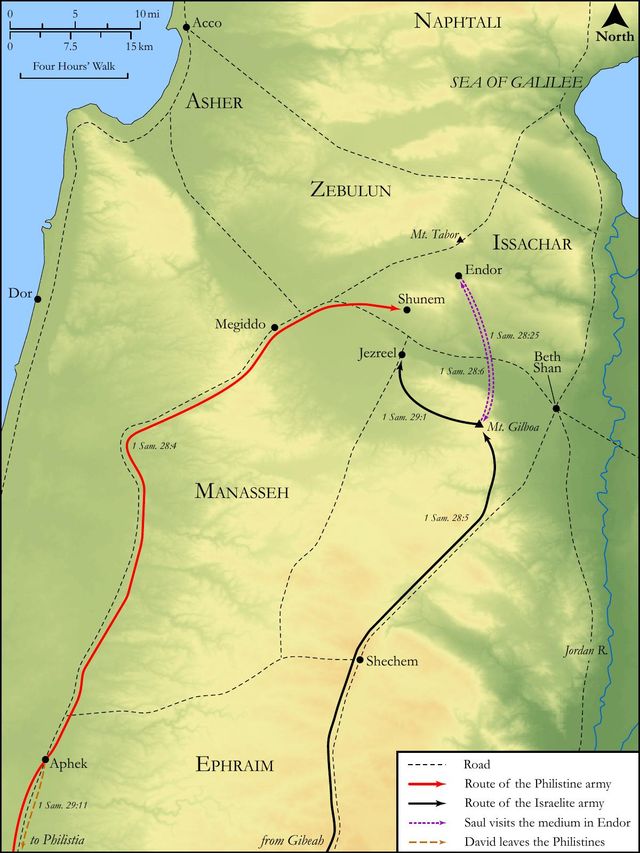
This verse is situated at a critical juncture in David's narrative, following his prolonged flight from King Saul's relentless pursuit. Having sought refuge with the Philistine king Achish in Gath, David had been granted the town of Ziklag, a strategic move by Achish to secure David's loyalty and services (see 1 Samuel 27:6). For over a year, David had maintained a deceptive facade, leading Achish to believe he was raiding Israelite towns, while in reality, he was attacking Amalekites and other enemies of both Israel and the Philistines, ensuring his continued favor with Achish while not harming his own people (as detailed in 1 Samuel 27:8-12). The immediate context is the Philistines' mobilization for a decisive battle against Israel, which will culminate in the tragic deaths of King Saul and his sons on Mount Gilboa, a pivotal event recorded in 1 Samuel 31). Achish's statement in 1 Samuel 29:9 serves as the climax of this tension, where David's precarious position is resolved not by his own cunning, but by external forces.
Historical & Cultural Context
The Philistines, a powerful confederacy of five city-states (Gaza, Ashkelon, Ashdod, Gath, and Ekron), were Israel's primary adversaries during the early monarchy. Their military organization was formidable, often involving their "princes" or "lords" (sarnim) who held significant authority and acted as a council, collectively deciding on matters of war and policy. Achish, as the king of Gath, was a prominent figure among them, but his authority was not absolute, especially when it came to major military campaigns involving the entire confederacy. David's service to a foreign king was a common practice among the nations of that day for those seeking refuge or military employment. The Philistine princes' memory of David's past prowess, specifically his slaying of Goliath and the women's song celebrating his "ten thousands" (recounted in 1 Samuel 18:7), was not merely historical recollection but a pragmatic assessment of a potential threat. Their suspicion was rooted in a realistic understanding of loyalty and national allegiance, overriding Achish's personal trust.
Key Themes
ShowHideThis verse powerfully illustrates several overarching themes within 1 Samuel and the broader biblical narrative. Firstly, Divine Providence is paramount; what appears to be a rejection or setback for David is, in fact, God's sovereign hand orchestrating events to protect His anointed servant from a morally untenable situation. This echoes the truth that "The Lord directs the steps of the godly" (Proverbs 16:9). Secondly, the theme of Trust and Deception is starkly highlighted; Achish's unwavering trust in David stands in sharp contrast to David's ongoing deception regarding his raids, underscoring the ethical complexities of David's refuge among the Philistines. Thirdly, Reputation and Perception play a crucial role; David's heroic past, which brought him fame and favor in Israel, now ironically serves as the very reason for his exclusion from the Philistine army, demonstrating how past actions shape present perceptions and can have unforeseen consequences. Lastly, the verse illuminates David's Dilemma—his tightrope walk between maintaining his refuge and preserving his allegiance to Israel—a dilemma providentially resolved by the Philistine princes' intervention.
Exposition and Analysis
ShowHideKey Word Analysis
ShowHideAchish uses this word to describe David, conveying not just moral uprightness, but also reliability, loyalty, and usefulness in his service. The Hebrew term ṭôwb carries a broad semantic range, encompassing concepts of pleasantness, prosperity, and moral excellence. In this context, it implies that David has proven himself to be a faithful and beneficial servant in Achish's eyes, someone who aligns with his interests and can be trusted implicitly. This goes beyond mere personal affection to a statement of David's perceived professional and political integrity within Achish's court.
When Achish refers to David "as an angel of God" (Hebrew, mălʼâk ʼĕlôhîym H430), it is a hyperbolic expression of the highest praise and admiration, not a theological statement about David's divine nature. The term mălʼâk primarily means "messenger" but is often used for divine messengers or angels. In the Old Testament, being "as an angel of God" often signifies someone possessing extraordinary wisdom, insight, purity, or even a capacity for discerning truth and falsehood (2 Samuel 14:17). Achish's use of this phrase indicates his profound conviction in David's integrity, wisdom, and loyalty, viewing him as a perfectly reliable and upright individual, almost divinely appointed in his service.
This term refers to the five lords or rulers of the Philistine pentapolis (Gaza, Ashkelon, Ashdod, Gath, and Ekron). The Hebrew sar denotes a head person or leader of any rank or class. These sarnim formed a powerful council that often dictated policy and military strategy, especially concerning confederate armies. Their collective decision-making power superseded even that of a single king like Achish, highlighting the decentralized yet collaborative nature of Philistine governance. Their united opposition to David underscores their collective memory of his past exploits against them and their pragmatic assessment of the potential risk he posed.
Verse Breakdown
ShowHide"And Achish answered and said to David,"
This sets the scene for Achish's direct address to David, indicating a response to an unstated concern, likely David's eagerness to join the battle, or perhaps an internal debate among the Philistine leaders that David was aware of. It emphasizes Achish's personal relationship and trust with David, as he directly communicates the decision.
"I know that thou [art] good in my sight, as an angel of God:"
This clause reveals the depth of Achish's personal conviction and trust in David. The phrase "good in my sight" signifies David's perceived loyalty, reliability, and value to Achish, a testament to David's successful deception and his ability to cultivate favor. The hyperbolic comparison to "an angel of God" emphasizes Achish's unwavering belief in David's integrity and trustworthiness, portraying him as an exceptionally reliable and discerning individual.
"notwithstanding the princes of the Philistines have said,"
This introduces the crucial counter-argument and the true decision-makers. Despite Achish's personal endorsement and high regard for David, the collective authority and deep suspicion of the other Philistine lords override his wishes. This highlights the political realities and checks on Achish's power within the Philistine confederacy, demonstrating that even a king's personal will could be superseded by the council of his peers.
"He shall not go up with us to the battle."
This is the decisive statement, the ultimate rejection of David's participation. It signifies David's exclusion from the Philistine army and, by divine providence, from fighting against his own people. This seemingly negative outcome is, in fact, a profound act of preservation, preventing David from a morally and spiritually catastrophic conflict that would have compromised his future kingship over Israel.
Literary Devices
ShowHideThe passage is rich with Irony. Achish's deep trust in David, expressed through the Hyperbole "as an angel of God," is profoundly ironic given David's consistent deception of him regarding his raids. Furthermore, the Philistine princes' suspicion, rooted in their memory of David's past victories against them, becomes the very means by which David is saved from fighting against Israel, his own people. This unexpected turn of events is a clear demonstration of Divine Providence, where God works through the seemingly contradictory actions and perceptions of human agents to achieve His sovereign purposes. The narrative also employs Foreshadowing, as David's exclusion from this battle prevents him from being implicated in Saul's death, thereby preserving his legitimacy and moral standing as Saul's successor and the future king of Israel.
Theological and Thematic Connections
ShowHide1 Samuel 29:9 profoundly illustrates God's sovereign hand at work, even in the midst of human deception, political intrigue, and moral ambiguity. It underscores the biblical truth that God's plans for His chosen servants will prevail, often through unexpected means and even the opposition of others. What appears to be a personal slight or a missed opportunity for David is, in fact, a divine rescue, preventing him from committing an act of national betrayal and preserving his integrity for his future role as king of Israel. This episode serves as a powerful reminder that God is not limited by human schemes or even our own ethical failings, but can orchestrate circumstances to protect His purposes and His people, demonstrating His ultimate control over history and individual lives.
Reflection and Application
ShowHideThe narrative of 1 Samuel 29:9 offers profound lessons for believers navigating the complexities of life in a fallen world. It encourages us to cultivate a deep trust in God's unseen hand, recognizing that even when circumstances appear to be against us, or when doors close, God may be working behind the scenes to protect us, redirect us, or preserve us for His greater purposes. David's morally ambiguous situation reminds us that even godly individuals can find themselves in ethically challenging positions; in such moments, we are called to seek God's wisdom and trust that He can redeem our circumstances and guide our steps. This passage ultimately invites us to surrender our own plans and anxieties to the Lord, confident that His sovereign will is always for our ultimate good and His glory, even when His methods are mysterious or involve the opposition of others. It teaches us that God's ways are higher than our ways, and His wisdom often unfolds in surprising and counter-intuitive fashion, always for the ultimate good of those who love Him and are called according to His purpose.
Questions for Reflection
ShowHideFAQ
ShowHideWas David's deception of Achish justifiable given his circumstances?
ShowHideThe text does not explicitly condemn David's deception, but it also doesn't endorse it as a moral ideal. David was in an extremely difficult position, fleeing for his life from King Saul and seeking refuge with an enemy king. His deception was a survival strategy, allowing him to maintain his cover while secretly fighting Israel's true enemies and avoiding direct conflict with his own people. While God providentially used this situation for David's good, it highlights the moral complexities and compromises that can arise when one is caught between conflicting loyalties and desperate circumstances. It serves as a reminder that even heroes of faith can operate in morally gray areas, and God's grace often works through imperfect vessels, demonstrating His ability to bring about His purposes despite human failings.
What does Achish mean by calling David "as an angel of God"?
ShowHideAchish's statement "as an angel of God" is a hyperbolic compliment, indicating his profound trust, admiration, and belief in David's integrity and loyalty. It does not imply that Achish believed David was literally a divine being or an actual angel. Rather, it suggests that Achish saw David as exceptionally wise, reliable, and upright in his dealings, perhaps even possessing a purity of motive or discernment that seemed almost supernatural. This phrase emphasizes the depth of Achish's personal conviction regarding David's character, making the Philistine princes' subsequent rejection, based on their more pragmatic assessment, even more impactful. It's a testament to David's ability to earn trust, even from an enemy king.
Christ-Centered Fulfillment
ShowHideThe divine providence at work in 1 Samuel 29:9, preserving David from a morally compromising battle, powerfully foreshadows God's ultimate and perfect preservation of His Son, Jesus Christ, for His redemptive mission. Just as David, the anointed king, was protected from a path that would have disqualified him from his future reign, so too was Jesus, the true and eternal King, perfectly preserved in His obedience and purity. Unlike David, who navigated a world of deception and moral ambiguity, Jesus lived a life of flawless integrity, never compromising His allegiance to God, even when facing the most intense temptations in the wilderness (as seen in Matthew 4:1-11). God's sovereign hand, which orchestrated the Philistine princes' suspicion to protect David, perfectly orchestrated every detail of Christ's life, death, and resurrection, ensuring His path led directly to the cross, where He would become the Lamb of God who takes away the sin of the world). The ultimate fulfillment of God's protective and purposeful work is seen in Christ, who, through His perfect obedience and sacrifice, secured an eternal kingdom, demonstrating God's unwavering faithfulness to His covenant promises (Luke 1:32-33). In Christ, we see the perfect King, preserved not from battle, but for the ultimate spiritual battle against sin and death, emerging victorious to reign forever as King of Kings and Lord of Lords.