


1 Samuel 29:10
Bible text: King James Version (1769 Blayney text) · Public domain
Bible text: King James Version with Strong's numbers · Public domain
Bible text: Berean Standard Bible · Public domain
Bible text: American Standard Version (1901) · Public domain
Bible text: World English Bible, Messianic edition · Public domain
Bible text: Geneva Bible (1599) · Public domain
Bible text: Young's Literal Translation · Public domain
- וְעַתָּהve·'a·Tahand thereforeH6258Conj-w ¦ AdvAdverbוְandעַתָּהtherefore
- הַשְׁכֵּםhash·Kemrise earlyH7925V-Hiphil-Imp-2msVerb Hiphil Imperative 2nd Singular Masculine
- בַּבֹּקֶרba·Bo·kerin the morningH1242Prep-b ¦ N-msNoun Singular Masculine Absoluteבַּin theבֹּקֶרmorning
- וְעַבְדֵיve·'av·Deiand [the] servants ofH5650Conj-w ¦ N-mpcNoun Plural Masculine Constructוְandעַבְדֵי[the] servants of
- אֲדֹנֶיךָ'a·do·Nei·khayour master<s>H113N-mpc ¦ 2msNoun Plural Masculine Constructאֲדֹנֶיmaster<s>ךָyour
- אֲשֶׁר'a·SherwhoH834RelParticle Relative
- בָּאוּBa·'uthey have comeH935V-Qal-Perf-3cpVerb Qal Perfect 3rd Plural common gender
- אִתָּךְ'i·Takhwith youH854Prep ¦ 2msPreposition Definiteאִתָּwithךְyou
- וְהִשְׁכַּמְתֶּםve·hish·kam·Temand you will rise earlyH7925Conj-w ¦ V-Hiphil-ConsecPerf-2mpVerb Hiphil Consecutive Perfect 2nd Plural Masculineוְandהִשְׁכַּמְתֶּםyou will rise early
- בַּבֹּקֶרba·Bo·kerin the morningH1242Prep-b ¦ N-msNoun Singular Masculine Absoluteבַּin theבֹּקֶרmorning
- וְאוֹרve·'orand it will be lightH215Conj-w ¦ V-Qal-ConsecPerf-3msVerb Qal Consecutive Perfect 3rd Singular Masculineוְandאוֹרit will be light
- לָכֶםla·Khemfor <the> youPrep-l ¦ 2mpSuffix Personal 2nd Plural Masculineלָfor <the>כֶםyou
- וָלֵכוּva·Le·khuand goH1980Conj-w ¦ V-Qal-Imp-2mpVerb Qal Imperative 2nd Plural Masculineוָandלֵכוּgo
English is a literal word-by-word gloss of the Hebrew, not the KJV's wording. Why?
This is the original text the KJV's translators worked from — each Hebrew word with its own literal English meaning in this verse, prepared by scholars at Tyndale House, Cambridge. The KJV translates whole sentences, not word by word, so its wording differs: one Hebrew word can become several English words, and the KJV may choose “the LORD” where the gloss reads “Yahweh”. Both are faithful — they answer different questions. For the KJV's own rendering, switch to the KJV text.
Details
See on the biblical-era map
Study this verse
Public-domain commentary
Matthew Henry
From his Commentary on the Whole Bible. Henry comments on passages, not single verses — this entry covers 1 Samuel 29:6–11. His two-level outline is real structure in the source text, so it is rendered as structure.
If the reasons Achish had to trust David were stronger than the reasons which the princes offered why they should distrust him (as I do not see that, in policy, they were, for the princes were certainly in the right), yet Achish was but one of five, though the chief, and the only one that had the title of king; accordingly, in a council of war held on this occasion, he was over-voted, and obliged to dismiss David, though he was extremely fond of him. Kings cannot always do as they would, nor have such as they would about them.
I.The discharge Achish gives him is very honourable, and not a final discharge, but only from the present service.
1.He signifies the great pleasure and satisfaction he had taken in him and in his conversation: Thou art good in my sight as an angel of God, Sa1 29:9. Wise and good men will gain respect, wherever they go, from all that know how to make a right estimate of persons and things, though of different professions in religion. What Achish says of David, God, by the prophet, says of the house of David (Zac 12:8), that it shall be as the angel of the Lord. But the former is a court-compliment; the latter is a divine promise.
2.He gives him a testimonial of his good behaviour, Sa1 29:6. It is very full and in obliging terms: "Thou hast been upright, and thy whole conduct has been good in my sight, and I have not found evil in thee." Saul would not have given him such a testimonial, though he had done far more service to him than Achish. God's people should behave themselves always so inoffensively as if possible to get the good word of all they have dealings with; and it is a debt we owe to those who have acquitted themselves well to give them the praise of it.
3.He lays all the blame of his dismission upon the princes, who would by no means suffer him to continue in the camp. "The king loves thee entirely, and would venture his life in thy hand; but the lords favour thee not, and we must not disoblige them, nor can we oppose them; therefore return and go in peace." He had better part with his favourite than occasion a disgust among his generals and a mutiny in his army. Achish intimates a reason why they were uneasy. It was not so much for David's own sake as for the sake of his soldiers that attended him, whom he calls his master's servants (namely, Saul's), Sa1 29:10. They could trust him, but not them. (4.) He orders him to be gone early, as soon as it was light (Sa1 29:10), to prevent their further resentments, and the jealousies they would have been apt to conceive if he had lingered.
II.His reception of this discourse is very complimental; but, I fear, not without some degree of dissimulation.
"What?" says David, "must I leave my lord the king, whom I am bound by office to protect, just now when he is going to expose himself in the field? Why may not I go and fight against the enemies of my lord the king?" Sa1 29:8. He seemed anxious to serve him when he was at this juncture really anxious to leave him, but he was not willing that Achish should know that he was. No one knows how strong the temptation is to compliment and dissemble which those are in that attend great men, and how hard it is to avoid it.
III.God's providence ordered it wisely and graciously for him.
For, besides that the snare was broken and he was delivered out of the dilemma to which he was first reduced, it proved a happy hastening of him to the relief of his own city, which sorely wanted him, though he did not know it. Thus the disgrace which the lords of the Philistines put upon him prove, in more ways than one, an advantage to him. The steps of a good man ore ordered by the Lord, and he delighteth in his way. What he does with us we know not now, but we shall know hereafter, and shall see it was all for good.
Continue studying 1 Samuel 29:10 across the web’s major study libraries — every link below opens this exact verse, chapter, or book on the destination site.
Read & Compare
 BibleGatewayThis verse in more than 200 translations and 70 languages.
 Bible.comThe YouVersion reader — hundreds of translations, reading plans, and highlights.
 ESV.orgCrossway's official English Standard Version reader.
 NET BibleThe NET translation with 60,000+ translators' notes on every rendering decision.
 STEP BibleTyndale House's free study tool — original text, vocabulary, and scholarly resources.
 BibliaLogos Bible Software's free web reader.
 USCCBThe New American Bible (Revised Edition) with the U.S. bishops' study notes.
Commentaries
 BibleHub CommentariesDozens of classic commentaries on this verse, gathered on one page.
 StudyLightMore than 100 commentary sets — the largest collection on the web.
 BibleRefPlain-English commentary on what this verse means, verse by verse.
 Enduring WordDavid Guzik's free commentary on this chapter, widely used by Bible teachers.
 Bible Study ToolsVerse commentary alongside Greek and Hebrew study aids.
Original Language & Research
- BibleHub InterlinearThe verse word by word — original language, transliteration, and English.
- BibleHub LexiconEvery word's original-language definition and Strong's entry.
 Blue Letter BibleDeep-study tools — Strong's numbers, concordance, and word studies.
 SefariaThe Hebrew text with Rashi and centuries of Jewish commentary.
Sermons, Hymns & Audio


TrulyRandomVerse is not affiliated with these sites and doesn’t control their content. They’re linked because they’re genuinely useful.
Summary
First Samuel 29:10 marks a pivotal moment in David's exile, as King Achish of Gath, under pressure from his Philistine lords, reluctantly dismisses David and his men from joining the Philistine army in their impending battle against Israel. This verse delivers Achish's direct command for David to depart promptly at dawn, thereby providentially preventing David from being forced into the morally compromising position of fighting against his own people. It powerfully illustrates God's sovereign hand orchestrating circumstances to protect His anointed, even when David's own choices have led him into a precarious and ethically challenging alliance.
Context
ShowHideLiterary Context
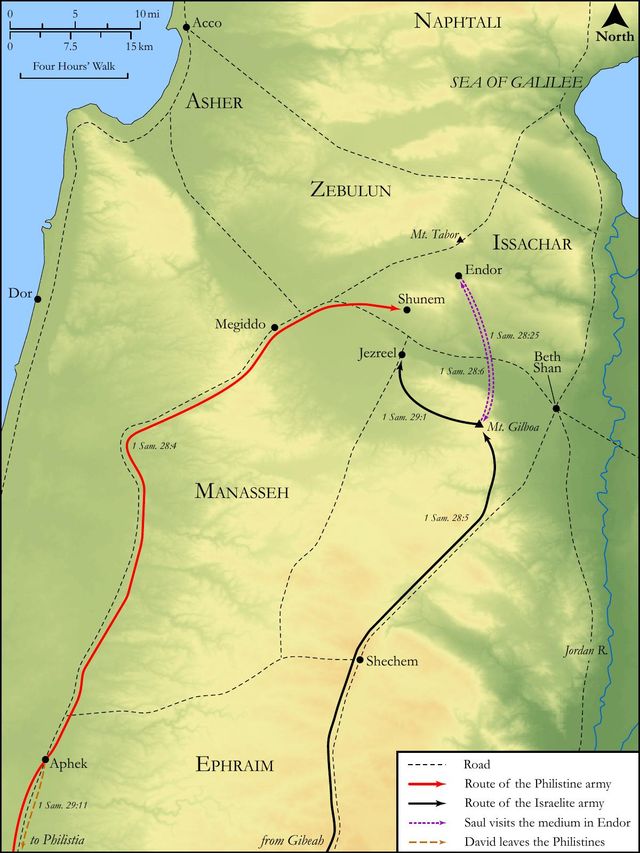
This verse is strategically placed at a crucial turning point in the narrative of David's flight from King Saul. Having fled Saul's relentless pursuit, David sought refuge with Achish, the Philistine king of Gath, and resided in Ziklag for sixteen months (1 Samuel 27:1-7). During this period, David engaged in raids against non-Israelite peoples (Geshurites, Girzites, Amalekites) while deceptively leading Achish to believe he was attacking Judahite or allied territories (1 Samuel 27:8-12). As the Philistines gathered their forces for a major confrontation with Israel at Aphek, Achish, trusting David implicitly, invited him and his men to join the Philistine army (1 Samuel 28:1-2). However, the other Philistine commanders vehemently opposed David's presence, fearing he would turn against them in battle to reconcile with Saul (1 Samuel 29:1-5). Achish, caught between his personal trust in David and the pragmatic demands of his military leaders, reluctantly agreed to David's dismissal. Verse 10 serves as Achish's final, direct instruction to David, reiterating the command for a swift and quiet departure to avoid further contention and ensure the Philistine army's unity.
Historical & Cultural Context
The Philistines, a formidable sea people who settled on the southwestern coast of Canaan, were perennial enemies of Israel, frequently clashing for control of territory and resources. Their military organization, including chariots and iron weaponry, often surpassed that of early Israel. Kings like Achish maintained their own contingents of warriors, and alliances, even with former enemies, were often pragmatic and based on mutual benefit or the need for refuge. David's decision to seek asylum with Achish was highly unusual and fraught with danger, both for his physical safety and his spiritual integrity as the anointed future king of Israel. The Philistine lords' suspicion of David was culturally and militarily astute; a warrior of David's renown, an Israelite, fighting against his own people was highly improbable, and the risk of defection in battle was too great to ignore. This context highlights the extreme precariousness of David's situation and the profound divine intervention required to extricate him from an impossible moral and strategic dilemma. The practice of "rising early" was a common and necessary custom in the lands of Israel and the Philistines for travel, military movements, and important departures, signifying efficiency, urgency, and the optimal time for undertaking significant journeys.
Key Themes
ShowHideThis verse powerfully illustrates Divine Providence, showcasing God's unseen hand guiding events to protect His chosen one, David, from a deeply compromising situation. Despite David's pragmatic but morally ambiguous alliance with the Philistines, God orchestrates the distrust of the Philistine commanders to prevent David from fighting against Israel, his own people and the covenant nation of God. This highlights God's unwavering commitment to His covenant with David and His plan for him as the future king, ensuring he remains untainted by direct conflict with his own nation, as seen in the broader narrative of 1 Samuel 29. Another crucial theme is God's Sovereignty over Human Plans, as the Philistine lords' decision, intended to secure their own military advantage and prevent perceived treachery, inadvertently serves God's greater purpose for David and Israel. The narrative also touches on the Complexities of Compromise, demonstrating the potential pitfalls and moral dilemmas that arise when one seeks refuge or advantage in unholy alliances, ultimately requiring divine intervention for resolution. This situation forces David to confront the consequences of his choices, even as God mercifully delivers him from an impossible ethical bind, underscoring the truth that "A man's heart deviseth his way: but the Lord directeth his steps" (Proverbs 16:9).
Exposition and Analysis
ShowHideKey Word Analysis
ShowHideThis verb properly means "to incline (the shoulder to a burden)" but is used as a denominative from "shoulder" (שְׁכֶם), literally meaning "to load up (on the back of man or beast), i.e. to start early in the morning." In this context, it conveys urgency and the expectation of immediate action at the first light of day. Achish is not merely suggesting a departure but commanding a swift and decisive one, emphasizing the need for David and his men to be gone before any further complications arise or the Philistine lords can change their minds or cause trouble. It implies a non-negotiable and timely exit.
Meaning "sovereign, i.e. controller (human or divine); lord, master, owner." In this specific context, "thy master's" refers to King Achish himself, indicating David's nominal subservience to him. The phrase "master's servants" (H113 + H5650) suggests that David and his men are to depart with some of Achish's own retinue who perhaps accompanied David to the muster, or it could be a subtle way of referring to David's men as being under Achish's nominal authority, thus making their dismissal an official act of the Philistine king. It underscores the formal nature of the dismissal and Achish's authority in the matter, even if he is acting under duress from his fellow lords.
A primitive root meaning "to walk (literally or figuratively); causatively, to carry (in various senses)." Here, it is a direct imperative, a command to exit. Its simplicity belies the profound significance of the action: David is being sent away from a battle that would have placed him in an irreconcilable conflict of loyalties. The command to "depart" is the culmination of the Philistine lords' distrust and Achish's reluctant compliance, serving as a divine deliverance for David.
Verse Breakdown
ShowHide"Wherefore now rise up early in the morning with thy master's servants that are come with thee:"
King Achish issues a direct, urgent command to David. The phrase "Wherefore now" indicates the conclusion of the discussion and the immediate necessity of the action. David is instructed to prepare for departure at the first light of day, accompanied by the servants of Achish who were presumably with him at the Philistine muster point. This detail emphasizes the official nature of the dismissal and perhaps ensures David's peaceful escort away from the Philistine camp, preventing any further confrontation or delay.
"and as soon as ye be up early in the morning, and have light, depart."
This clause reiterates and reinforces the previous instruction, emphasizing both the timing and the finality of the command. The repetition of "early in the morning" alongside "and have light" (from H215, meaning "to be luminous," indicating dawn, as soon as it is bright enough to travel) underscores the absolute urgency and non-negotiable nature of their departure. The final imperative "depart" leaves no room for argument or delay, marking the definitive end of David's involvement with the Philistine army in this campaign. It is a clear, concise, and immediate order for David and his men to leave the Philistine encampment.
Literary Devices
ShowHideThe passage in 1 Samuel 29 and specifically verse 10 employs several literary devices to enhance its meaning and impact. Repetition is evident in the phrase "early in the morning," which is used twice within this short verse, emphasizing the urgency and non-negotiable nature of David's dismissal. This underscores the Philistine lords' desire for David's swift removal. A significant element of Irony pervades the entire chapter: David, a renowned warrior and future king of Israel, is eager to fight for Achish, but is ironically prevented from doing so by the very enemies of Israel. This unexpected turn of events, orchestrated by the Philistine lords' distrust, serves as a divine deliverance for David, preventing him from engaging in a morally compromising battle against his own people. This divine orchestration can also be seen as Divine Providence acting as a narrative device, where God's unseen hand subtly directs the actions of human characters (in this case, the Philistine lords and Achish) to fulfill His greater purposes, without direct miraculous intervention. The narrative also builds Suspense leading up to this verse, as the reader wonders how David will navigate the impossible choice of fighting for the Philistines against Israel, only for the tension to be resolved by his unexpected dismissal, highlighting God's faithfulness to His chosen one.
Theological and Thematic Connections
ShowHideFirst Samuel 29:10 is a profound testament to God's sovereign control over seemingly random or even hostile human events. It demonstrates that even when His servants make questionable choices or find themselves in morally ambiguous situations, God's providential hand can intervene to protect them and advance His divine purposes. David's alliance with the Philistines was a pragmatic decision born of desperation, yet it placed him on the brink of an unthinkable act: fighting against his own nation, Israel, and potentially against Saul, God's anointed king (even if fallen). God, through the very distrust of Israel's enemies, mercifully extricated David from this impossible dilemma, preserving his integrity and ensuring his suitability for the future kingship. This episode underscores that God's plans are not thwarted by human folly or sin, but can even incorporate and redirect them for His glory and the good of His people. It is a powerful reminder that God's ways are higher than our ways, and His wisdom often operates through unexpected means to achieve His perfect will.
Reflection and Application
ShowHideThe dismissal of David in 1 Samuel 29:10 offers profound insights for believers today. It serves as a powerful reminder that God's providence is actively at work in our lives, even when we find ourselves in difficult or compromising circumstances, sometimes of our own making. What may initially appear to be a setback, a rejection, or a closed door can, in fact, be God's merciful intervention, saving us from a path that would lead to greater harm or compromise our integrity and witness. Just as God prevented David from fighting against his own people, He often works to steer us away from choices that would dishonor Him or hinder His purposes for us. This passage encourages us to trust God's overarching plan, even when our immediate circumstances are confusing, disappointing, or seem to thwart our own intentions. It challenges us to discern God's hand in unexpected dismissals, redirections, or even perceived failures, recognizing them as potential acts of divine protection and guidance. Ultimately, it calls us to greater reliance on God's wisdom in all our decisions, especially those that might place us in morally ambiguous territory, knowing that He is faithful to deliver us and fulfill His good purposes, even when we stumble.
Questions for Reflection
ShowHideFAQ
ShowHideWhy was David with the Philistines in the first place, and wasn't this a compromise?
ShowHideDavid sought refuge with the Philistines, specifically King Achish of Gath, because he was relentlessly pursued by King Saul and felt there was "nothing better for me than that I should speedily escape into the land of the Philistines" (1 Samuel 27:1). This was a pragmatic decision born of desperation, as all other avenues of safety within Israel seemed closed. While it provided immediate safety, it was indeed a significant compromise for the anointed future king of Israel. David was living among Israel's enemies, even pretending to raid Israelite allies to maintain Achish's trust (1 Samuel 27:8-12). This alliance placed him in a morally precarious position, highlighting the complexities and dangers of seeking security outside of God's direct guidance or in unholy alliances.
Why did Achish trust David, but the other Philistine lords didn't?
ShowHideKing Achish genuinely trusted David, believing David had fully defected from Saul and Israel. Achish likely saw David as a valuable asset, a skilled warrior who could bolster his own forces and weaken his enemy, Israel. He expressed this trust explicitly, stating, "I know that you are good in my sight, as an angel of God" (1 Samuel 29:6). The other Philistine lords, however, were more shrewd and suspicious. They recognized David's history as a formidable warrior for Israel and feared that he would betray them in battle to regain favor with Saul, turning against them to "reconcile himself to his master Saul with the heads of these men" (1 Samuel 29:4). Their distrust, though rooted in self-interest and military strategy, ultimately served as God's instrument to deliver David from an impossible moral dilemma.
Christ-Centered Fulfillment
ShowHideThe narrative of David's dismissal from the Philistine army in 1 Samuel 29:10, while seemingly a minor historical detail, powerfully foreshadows aspects of Christ's perfect life and God's sovereign plan of salvation. David, God's anointed, is providentially delivered from a morally compromising situation, preventing him from fighting against his own people. This divine protection over His chosen one points to God's ultimate safeguarding of His Son, Jesus, who perfectly fulfilled God's will without compromise. Unlike David, who found himself in a precarious alliance due to pragmatic choices born of desperation, Jesus lived a life of absolute obedience, never needing divine intervention to extricate Him from a self-imposed moral bind. Instead, Jesus willingly entered the ultimate "impossible situation"—bearing the sin of the world—not through compromise, but through sacrificial love, becoming the Lamb of God who takes away the sin of the world. God's sovereign hand, which orchestrated David's dismissal, is supremely evident in the cross of Christ, where human sin and divine purpose converged to achieve redemption, according to God's predetermined plan and foreknowledge. Just as David was preserved for his kingly role, Jesus, the true King, was preserved through resurrection to reign eternally, having perfectly accomplished the Father's mission through His humiliation and subsequent exaltation. This passage ultimately reminds us that God's plan for salvation, centered on Christ, is unshakeable, working through all circumstances, even the unexpected decisions of His enemies, to bring about His glorious purposes for His people.