


2 Samuel 19:22
Bible text: King James Version (1769 Blayney text) · Public domain
Bible text: King James Version with Strong's numbers · Public domain
Bible text: Berean Standard Bible · Public domain
Bible text: American Standard Version (1901) · Public domain
Bible text: World English Bible, Messianic edition · Public domain
Bible text: Geneva Bible (1599) · Public domain
Bible text: Young's Literal Translation · Public domain
- וַיֹּאמֶרvai·Yo·merand he saidH559Conj-w ¦ V-Qal-ConsecImperf-3msVerb Qal Consecutive Imperfect 3rd Singular Masculineוַandיֹּאמֶרhe said
- דָּוִדda·VidDavidH1732N-proper-mNoun Proper Masculine
- מַהmahwhat?H4100InterrogPronoun Interrogative
- לִּיli[is] to mePrep-l ¦ 1csSuffix Personal 1st Singular common genderלִּ[is] toיme
- וְלָכֶםve·la·Khemand to <the> youConj-w ¦ Prep-l ¦ 2mpSuffix Personal 2nd Plural Masculineוְandלָto <the>כֶםyou
- בְּנֵיbe·NeiO sons ofH1121N-mpcNoun Plural Masculine Construct
- צְרוּיָהtze·ru·YahZeruiahH6870N-proper-fNoun Proper Feminine
- כִּיkithatH3588PrtParticle Conditional
- תִהְיוּtih·yuyou will becomeH1961V-Qal-Imperf-2mpVerb Qal Imperfect 2nd Plural Masculine
- לִיlito <the> mePrep-l ¦ 1csSuffix Personal 1st Singular common genderלִto <the>יme
- הַיּוֹםhai·Yomthis dayH3117Art ¦ N-msNoun Singular Masculine Absoluteהַthisיּוֹםday
- לְשָׂטָןle·sa·Tan<into> an adversaryH7854Prep-l ¦ N-msNoun Singular Masculine Absoluteלְ<into>שָׂטָןan adversary
- הַיּוֹםhai·Yomthis dayH3117Art ¦ N-msNoun Singular Masculine Absoluteהַthisיּוֹםday
- יוּמַתYu·matwill he be put to death?H4191V-Hophal-Imperf-3msVerb Hophal Imperfect 3rd Singular Masculine
- אִישׁ'ishanyoneH376N-msNoun Singular Masculine Absolute
- בְּיִשְׂרָאֵלbe·Yis·ra·'Elin IsraelH3478Prep-b ¦ N-properNoun Proper LocationבְּinיִשְׂרָאֵלIsrael
- כִּיkiforH3588PrtParticle Conditional
- הֲלוֹאha·Lo'¿ notH3808Interrog ¦ NegParticle Negativeהֲ¿לוֹאnot
- יָדַעְתִּיya·Da'·tido I knowH3045V-Qal-Perf-1csVerb Qal Perfect 1st Singular common gender
- כִּיkithatH3588PrtParticle Conditional
- הַיּוֹםhai·Yomthis dayH3117Art ¦ N-msNoun Singular Masculine Absoluteהַthisיּוֹםday
- אֲנִי'a·niIH589Pro-1csPronoun Personal 1st Singular common gender
- מֶלֶךְMe·lekh[am] kingH4428N-msNoun Singular Masculine Absolute
- עַל'aloverH5921PrepPreposition
- יִשְׂרָאֵלYis·ra·'ElIsraelH3478N-properNoun Proper Location
English is a literal word-by-word gloss of the Hebrew, not the KJV's wording. Why?
This is the original text the KJV's translators worked from — each Hebrew word with its own literal English meaning in this verse, prepared by scholars at Tyndale House, Cambridge. The KJV translates whole sentences, not word by word, so its wording differs: one Hebrew word can become several English words, and the KJV may choose “the LORD” where the gloss reads “Yahweh”. Both are faithful — they answer different questions. For the KJV's own rendering, switch to the KJV text.
Details
See on the biblical-era maps

Study this verse
Public-domain commentary
Matthew Henry
From his Commentary on the Whole Bible. Henry comments on passages, not single verses — this entry covers 2 Samuel 19:16–23. His four-level outline is real structure in the source text, so it is rendered as structure.
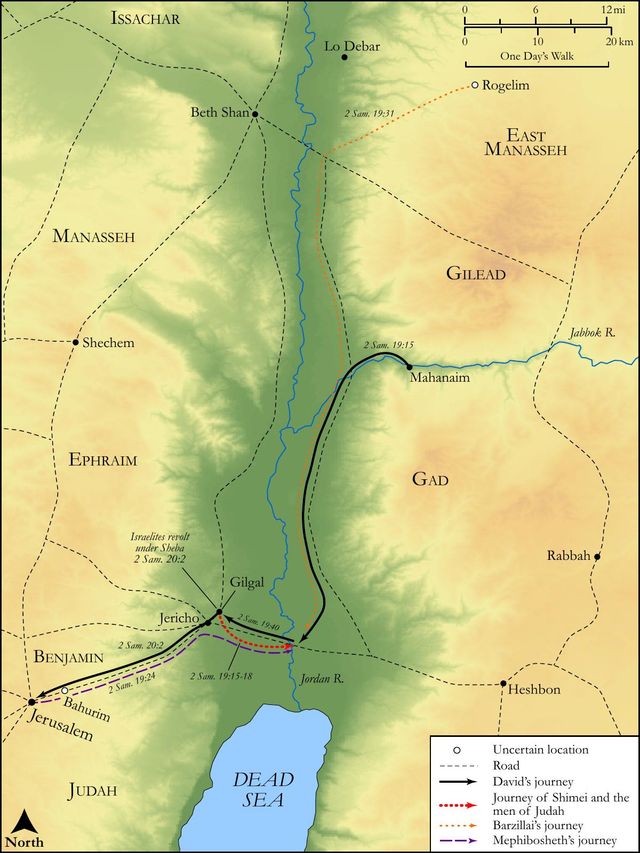
Perhaps Jordan was never passed with so much solemnity, nor with so many remarkable occurrences, as it was now, since Israel passed it under Joshua. David, in his afflictive flight, remembered God particularly from the land of Jordan (Psa 42:6), and now that land, more than any other, was graced with the glories of his return. David's soldiers furnished themselves with accommodations for their passage over this river, but, for his own family, a ferry-boat was sent on purpose, Sa2 19:18. A fleet of boats, say some; a bridge of boats was made, say others; the best convenience they had to serve him with. Two remarkable persons met him on the banks of Jordan, both of whom had abused him wretchedly when he was in his flight.
I.Ziba, who had abused him with his fair tongue, and by accusing his master, had obtained from the king a grant of his estate, Sa2 16:4.
A greater abuse he could not have done him, than, by imposing upon his credulity, to draw him in to do a thing so unkind to the son of his friend Jonathan. He comes now, with a retinue of sons and servants, to meet the king (Sa2 19:17), that he may obtain the king's favour, and so come off the better when Mephibosheth shall shortly undeceive him, and clear himself, Sa2 19:26.
II.Shimei, who had abused him with his foul tongue, railed at him, and cursed him, Sa2 16:5.
If David had been defeated, no doubt he would have continued to trample upon him, and have gloried in what he had done; but now that he sees him coming home in triumph, and returning to his throne, he thinks it his interest to make his peace with him. Those who now slight and abuse the Son of David would be glad to make their peace too when he shall come in his glory; but it will be too late. Shimei, to recommend himself to the king,
1.Came with good company, with the men of Judah, as one in their interest.
2.He brought a regiment of the men of Benjamin with him, 1000, of which perhaps he was chiliarch, or commander-in-chief, offering his own and their service to the king; or perhaps they were volunteers, whom by his interest he had got together to meet the king, which was the more obliging because of all the tribes of Israel there were none, except these and Judah, that appeared to pay him this respect.
3.What he did he hastened to do; he lost no time. Agree with thy adversary quickly, while thou art in the way. Here is,
(1.)The criminal's submission (Sa2 19:18-20): He fell down before the king, as a penitent, as a supplicant; and, that he might be thought sincere, he did it publicly before all David's servants, and his friends the men of Judah, yea, and before his own thousand. The offence was public, therefore the submission ought to be so. He owns his crime: Thy servant doth know that I have sinned. He aggravates it: I did perversely. He begs the king's pardon: Let not the king impute iniquity to thy servant, that is, deal with me as I deserve. He intimates that it was below the king's great and generous mind to take it to his heart; and pleads his early return to his allegiance, that he was the first of all the house of Joseph (that is, of Israel, who in the beginning of David's reign had distinguished themselves from Judah by their adherence to Ishbosheth, Sa2 2:10) that came to meet the king. He came first, that by his example of duty the rest might be induced, and by his experience of the king's clemency the rest might be encouraged to follow.
(2.)A motion made for judgment against him (Sa2 19:21): "Shall not Shimei be put to death as a traitor? Let him, of all men, be made an example." This motion was made by Abishai, who would have ventured his life to have been the death of Shimei when he was cursing, Sa2 16:9. David did not think fit to have it done then, because his judicial power was cut short; but, now that it was restored, why should not the law have its course? Abishai herein consulted what he supposed to be David's feelings more than his true interest. Princes have need to arm themselves against temptations to severity.
(3.)His discharge by the king's order, Sa2 19:22, Sa2 19:23. He rejected Abishai's motion with displeasure: What have I to do with you, you sons of Zeruiah? The less we have to do with those who are of an angry revengeful spirit, and who put us upon doing what is harsh and rigorous, the better. He looks upon these prosecutors as adversaries to him, though they pretended friendship and zeal for his honour. Those who advise us to what is wrong are really Satans, adversaries to us.
[1.]They were adversaries to his inclination, which was to clemency. He knew that he was this day king in Israel, restored to, and re-established in, his kingdom, and therefore his honour inclined him to forgive. It is the glory of kings to forgive those that humble and surrender themselves: Satis est prostrasse leoni - it suffices the lion that he has laid his victim prostrate. His joy inclined him to forgive. The pleasantness of his spirit on this great occasion forbade the entrance of any thing that was sour and peevish: joyful days should be forgiving days. Yet this was not all; his experience of God's mercy in restoring him to his kingdom, his exclusion from which he attributed to his sin, inclined him to show mercy to Shimei. Those that are forgiven must forgive. David had severely revenged the abuses done to his ambassadors by the Ammonites (Sa2 12:31), but easily passes by the abuse done to himself by an Israelite. That was an affront to Israel in general, and touched the honour of his crown and kingdom; this was purely personal, and therefore (according to the usual disposition of good men) he could the more easily forgive it.
[2.]They were adversaries to his interest. If he should put to death Shimei, who cursed him, those would expect the same fate who had taken up arms and actually levied war against him, which would drive them from him, while he was endeavouring to draw them to him. Acts of severity are seldom acts of policy. The throne is established by mercy. Shimei, hereupon, had his pardon signed and sealed with an oath, yet being bound, no doubt, to his good behaviour, and liable to be prosecuted if he afterwards misbehaved; and thus he was reserved to be, in due time, as much a monument of the justice of the government as he was now of its clemency, and in both of its prudence.
Continue studying 2 Samuel 19:22 across the web’s major study libraries — every link below opens this exact verse, chapter, or book on the destination site.
Read & Compare
 BibleGatewayThis verse in more than 200 translations and 70 languages.
 Bible.comThe YouVersion reader — hundreds of translations, reading plans, and highlights.
 ESV.orgCrossway's official English Standard Version reader.
 NET BibleThe NET translation with 60,000+ translators' notes on every rendering decision.
 STEP BibleTyndale House's free study tool — original text, vocabulary, and scholarly resources.
 BibliaLogos Bible Software's free web reader.
 USCCBThe New American Bible (Revised Edition) with the U.S. bishops' study notes.
Commentaries
 BibleHub CommentariesDozens of classic commentaries on this verse, gathered on one page.
 StudyLightMore than 100 commentary sets — the largest collection on the web.
 BibleRefPlain-English commentary on what this verse means, verse by verse.
 Enduring WordDavid Guzik's free commentary on this chapter, widely used by Bible teachers.
 Bible Study ToolsVerse commentary alongside Greek and Hebrew study aids.
Original Language & Research
- BibleHub InterlinearThe verse word by word — original language, transliteration, and English.
- BibleHub LexiconEvery word's original-language definition and Strong's entry.
 Blue Letter BibleDeep-study tools — Strong's numbers, concordance, and word studies.
 SefariaThe Hebrew text with Rashi and centuries of Jewish commentary.
Sermons, Hymns & Audio


TrulyRandomVerse is not affiliated with these sites and doesn’t control their content. They’re linked because they’re genuinely useful.
Summary
In King David, having triumphantly returned to Jerusalem and re-established his reign after Absalom's rebellion, delivers a sharp rebuke to his nephews, the sons of Zeruiah (Joab and Abishai), who advocate for the execution of Shimei. David emphatically declares that the day of his restoration is one of profound clemency and national reconciliation, not of vengeance or bloodshed, thereby asserting his supreme royal authority and setting a tone of grace for his reunited kingdom. This pivotal moment illuminates David's unique blend of strength, wisdom, and mercy in leadership, prioritizing unity and divine principles over immediate retribution.
Context
ShowHideLiterary Context
This verse is strategically placed at a critical juncture in David's life and reign, immediately following the devastating civil war initiated by his son Absalom. The preceding chapters, from 2 Samuel 15 through 2 Samuel 18, meticulously detail the rebellion's genesis, David's forced flight from Jerusalem, and the tragic, climactic death of Absalom. 2 Samuel 19 then narrates David's arduous journey back to his capital and the complex, often fraught, process of national reconciliation. Just moments before David's declaration in verse 22, Shimei, a Benjaminite who had publicly cursed and reviled David during his desperate flight (as recorded in 2 Samuel 16:5-13), prostrates himself before the returning king, desperately pleading for mercy. Abishai, one of David's fiercely loyal but often ruthless commanders, immediately demands Shimei's execution, viewing him as a traitor who deserved death. David's profound and authoritative response in 2 Samuel 19:22 serves as a powerful assertion of his royal prerogative, decisively overriding Abishai's vengeful counsel and establishing a policy of grace and unity for his newly restored kingdom.
Historical & Cultural Context
David's reign marked a significant period of consolidation and expansion for the nascent Israelite monarchy, yet it was frequently plagued by internal strife, as vividly demonstrated by Absalom's rebellion. In Israel, it was a strategically important practice for kings, upon their ascension to the throne or their triumphant restoration after a period of upheaval, to declare acts of clemency or general amnesty, as Saul did after the deliverance of Jabesh-gilead, saying, "There shall not a man be put to death this day." Such acts served multiple purposes: they showcased the monarch's benevolence, aimed to secure the loyalty of a potentially fractured populace, and projected an image of a just, merciful, and unifying ruler. The "sons of Zeruiah"—Joab and Abishai—were not merely David's nephews but his most formidable and influential military leaders. They were renowned for their unwavering loyalty to David, but equally for their independent, often brutal, and sometimes disobedient actions, such as Joab's unauthorized killing of Absalom in 2 Samuel 18:14. David's sharp rebuke in 2 Samuel 19:22 underscores the persistent tension between his divinely-inspired vision for a unified, righteous kingdom and the pragmatic, often violent, realities of power politics and military command prevalent in his era.
Key Themes
ShowHideThis verse profoundly contributes to several overarching themes woven throughout the books of Samuel. Firstly, it illuminates the nature of kingship under God. David's declaration emphasizes that true royal authority is not solely about wielding absolute power, but about exercising it with profound wisdom, discerning mercy, and a steadfast commitment to national unity and divine principles. His statement, "for do not I know that I [am] this day king over Israel?", is not merely a factual assertion but a powerful proclamation of his sovereign right to define the very character of his reign—a reign rooted in grace. Secondly, the verse starkly highlights the critical theme of mercy versus vengeance. David's magnanimous choice to forgive Shimei, despite the deeply personal and public insult, stands in stark contrast to the prevailing cultural expectation of swift retribution and the bloodthirsty counsel of his commanders. This act of clemency serves as a powerful testament to David's character, reflecting a deeper understanding of justice and reconciliation that aligns with God's own character of abundant mercy, as beautifully articulated in Psalm 103:8. Finally, the passage addresses the inherent challenges of leadership and internal conflict, illustrating David's ongoing struggle to manage powerful subordinates whose loyalty, while fierce, sometimes manifested as overzealousness or ruthless pragmatism, threatening to undermine his broader vision for the kingdom and its spiritual foundation.
Exposition and Analysis
ShowHideKey Word Analysis
ShowHideFrom the root שָׂטַן (H7854), this word signifies an "opponent" or "accuser." While it can refer to the arch-enemy Satan, in this context, David uses it to describe his nephews as those whose counsel acts as an opposition or hindrance to his specific will and the spirit he intends to establish on this momentous day. Their suggestion to execute Shimei, though perhaps born of loyalty, is perceived by David as a counter-purpose, challenging his royal prerogative to define the tone of his restored reign, which he desires to be one of clemency and unity.
From the primitive root יָדַע (H3045), this verb means "to ascertain by seeing," encompassing a wide range of senses including observation, care, recognition, and causative instruction or designation. When David asks, "for do not I know that I [am] this day king over Israel?", he is not seeking information but making a definitive assertion of his full awareness and understanding of his royal status and its inherent authority. It signifies his deliberate and informed decision-making, emphasizing that his choice for clemency is not impulsive but a conscious exercise of his sovereign knowledge and power.
Derived from מָלַךְ (H4428), this term denotes a monarch or ruler. David's proclamation, "I [am] this day king over Israel," is central to his assertion of authority. It is not merely a statement of his returned status but a declaration of his absolute sovereignty and the prerogative to determine matters of life and death, especially on a day of national restoration. This word underscores that the ultimate power to grant mercy or exact punishment rests solely with him, and his decision, made with full awareness of his royal office, is final and overrides the impulsive suggestions of his subordinates.
Verse Breakdown
ShowHide"And David said, What have I to do with you, ye sons of Zeruiah"
This opening phrase is a powerful idiomatic expression of sharp rebuke and dismissal. It conveys David's profound disagreement, impatience, and exasperation with the counsel offered by Abishai (and implicitly, Joab). It signifies a clear separation: their desires and actions are fundamentally contrary to David's will and the specific spirit he intends to embody on this significant day of his return. It sets an immediate boundary, distancing his royal purpose from their impulsive, vengeance-driven suggestions.
"that ye should this day be adversaries unto me?"
David clarifies the nature of their opposition. By advocating for Shimei's execution, they are acting as "adversaries" or "opponents" to David's overarching vision for his restored reign. Their desire for immediate retribution, though perhaps well-intentioned from a perspective of loyalty, directly clashes with David's intention to inaugurate his renewed kingship with an act of grace and national unity. Their counsel, therefore, is perceived as a hindrance to David's higher, more unifying purpose.
"shall there any man be put to death this day in Israel?"
This is a potent rhetorical question, designed to elicit an emphatic "no." David is unilaterally declaring a day of general amnesty and clemency. On the very day of his triumphant return and the re-establishment of his rule, he decrees that no one will be executed for past offenses related to the recent rebellion. This act of mercy is intended to foster deep healing, reconciliation, and stability throughout the nation, deliberately choosing to break the cycle of violence and retribution that had characterized the civil war.
"for do not I know that I [am] this day king over Israel?"
This second rhetorical question serves as the ultimate justification for David's decision and a firm, undeniable assertion of his supreme authority. It underscores that David is fully cognizant of his royal prerogative and the immense power that accompanies it. As the re-established king, he possesses the ultimate say in matters of life and death, and he chooses to exercise that power not through vengeance, but through an act of profound mercy. This statement firmly re-establishes his undisputed sovereignty and demonstrates his wisdom in leadership, contrasting sharply with the impulsive and limited perspective of his commanders.
Literary Devices
ShowHideThe verse is rich with several potent literary devices that effectively convey David's authority and the profound significance of his decision. Most prominent is the strategic use of Rhetorical Questions: "shall there any man be put to death this day in Israel?" and "for do not I know that I [am] this day king over Israel?". These questions are not posed to elicit information but to make emphatic, undeniable statements, powerfully underscoring David's absolute authority and his deliberate, sovereign choice for clemency. The first question establishes a sweeping policy of grace, while the second asserts the supreme royal prerogative that underpins that policy. The phrase "What have I to do with you" functions as a strong Idiom of Dismissal or Rebuke, clearly communicating David's profound disagreement, impatience, and rejection of his nephews' counsel. Furthermore, the verse highlights a stark Contrast between David's magnanimous, unifying vision for his reign and the ruthless, vengeful pragmatism of the sons of Zeruiah. This contrast serves to emphasize David's unique character as a king who, despite his own personal flaws, frequently sought to embody divine mercy and wisdom in his rule. Finally, David's concluding statement is a powerful Assertion of his undisputed sovereignty, leaving no room for argument or further debate from his subordinates, solidifying his command.
Theological and Thematic Connections
ShowHideDavid's declaration in 2 Samuel 19:22 is a profound theological statement about the very nature of true leadership and the righteous exercise of power. By choosing clemency over retribution on the day of his restoration, David consciously mirrors the divine character of mercy and grace, demonstrating a kingship that seeks to reflect God's own attributes. This act reflects a king who understands that his authority, though earthly and often fraught with human imperfections, is ultimately derived from God, and therefore should be exercised in a manner that seeks reconciliation, healing, and the establishment of peace, rather than perpetuating cycles of violence and division. It offers a glimpse into the ideal of a kingdom built on righteousness and grace, rather than mere coercive force. David's decision to forgive Shimei, despite the severe personal insult and the counsel for vengeance, elevates the principle of national unity and divine benevolence above personal grievance, demonstrating a profound maturity in leadership that recognizes the long-term spiritual and social health of the kingdom.
Reflection and Application
ShowHideDavid's decisive act of clemency in 2 Samuel 19:22 offers timeless and profound lessons for believers today, particularly concerning the exercise of leadership, the power of forgiveness, and the responsible use of influence. In our own lives, we are frequently presented with opportunities to respond to personal slights, opposition, or perceived injustices with retribution, often mirroring the "sons of Zeruiah" in our immediate desire for decisive, punitive justice. However, David's choice to declare a "day of no death" powerfully illustrates that true strength, wisdom, and spiritual maturity in leadership—whether within a family, a professional environment, a church, or a community—often reside in the profound capacity for mercy and reconciliation. This passage challenges us to deeply consider whether our actions and counsel contribute to healing, unity, and restoration, or if they inadvertently perpetuate division, bitterness, and cycles of conflict. Just as David understood that his re-established kingship called for a new spirit of grace and a break from past grievances, so too are we called to embody the spirit of forgiveness, especially when we find ourselves in a position of power, advantage, or influence. This passage encourages us to transcend personal grievances, to actively seek the greater good of reconciliation and communal flourishing, and to remember that grace, extended freely, can be a far more powerful and transformative force than punishment, fostering an environment where new beginnings and genuine healing can truly flourish.
Questions for Reflection
ShowHideFAQ
ShowHideWhy did David refer to his nephews as "adversaries" when they were loyal to him?
ShowHideDavid used the term "adversaries" (Hebrew: sâṭân, H7854, meaning "opponent" or "accuser") not to imply a general disloyalty, but to express that their specific counsel on this particular day was fundamentally contrary to his will and purpose. While Joab and Abishai were indeed fiercely loyal and highly effective military commanders, their approach was often characterized by ruthlessness and pragmatic retribution, prioritizing immediate justice over David's broader vision of reconciliation and national unity. On the day of his restoration, David intended to establish a tone of mercy and healing across the kingdom. Their suggestion to execute Shimei was perceived by David as an opposition to this specific royal prerogative and the spirit of clemency he wished to embody. Thus, in this precise instance, their counsel made them "adversaries" to David's desired course of action, hindering his greater purpose for the kingdom.
What is the significance of David saying, "shall there any man be put to death this day in Israel?"
ShowHideThis powerful rhetorical question signifies David's unilateral declaration of a general amnesty or clemency for all those who had opposed him during the rebellion. Upon his triumphant return to Jerusalem and the re-establishment of his kingship, David chose to inaugurate his reign with an act of grace rather than vengeance. Among the kings of that day, it was a common and strategic practice for kings to mark significant events like coronations or restorations with acts of mercy, such as freeing prisoners or pardoning offenses. David's declaration serves a crucial purpose: to heal the deep wounds of the recent civil war and to unify the fractured nation under his rule. It signals a new beginning, where past grievances related to the rebellion would not be met with capital punishment, thereby fostering stability, preventing further bloodshed, and promoting reconciliation among his people. It profoundly underscores his desire for peace and unity over punitive justice.
Christ-Centered Fulfillment
ShowHideDavid's profound act of clemency in 2 Samuel 19:22, where he asserts his kingship by choosing mercy over vengeance, serves as a powerful and poignant foreshadowing of the ultimate merciful King, Jesus Christ. David, though a flawed earthly monarch, here demonstrates a glimpse of divine kingship, choosing to establish his reign not through the execution of enemies but through an act of grace and reconciliation. This mirrors the very essence of Christ's eternal kingdom. While earthly kings often consolidate power through force, retribution, and the elimination of opposition, Jesus, the true King of Israel and the world, established His reign through self-sacrificial love and an unparalleled act of forgiveness. He did not come into the world to condemn it, but rather that the world might be saved through Him (John 3:17). On the cross, the ultimate act of reconciliation between God and humanity, Jesus, in His sovereign authority, prayed for His persecutors, "Father, forgive them, for they know not what they do" (Luke 23:34). Unlike the "sons of Zeruiah" who sought immediate punishment and death, Jesus, by His divine authority, offers abundant forgiveness and new life to all who repent and believe, declaring an eternal "day of salvation" that extends to all humanity (2 Corinthians 6:2). His kingship is not marked by the death of His adversaries, but by His own sacrificial death to conquer sin and death, thereby offering profound reconciliation to all who were once His enemies through their rebellion and sin (Romans 5:10). David's decision was an earthly shadow, a temporal glimpse, of the heavenly reality, where the King of kings rules with perfect justice tempered by infinite mercy, ushering in an eternal kingdom of unparalleled peace and boundless grace.