


2 Samuel 12:31
- וְאֶתve·'Etand <obj.>H853Conj-w ¦ DirObjMParticle Object Indicatorוְandאֶת<obj.>
- הָעָםha·'Amthe peopleH5971Art ¦ N-msNoun Singular Masculine Absoluteהָtheעָםpeople
- אֲשֶׁר'a·SherwhichH834RelParticle Relative
- בָּהּbah[was] in <the> itPrep-b ¦ 3fsSuffix Personal 3rd Singular Feminineבָּ[was] in <the>הּit
- הוֹצִיאho·Tzi'he brought outH3318V-Hiphil-Perf-3msVerb Hiphil Perfect 3rd Singular Masculine
- וַיָּשֶׂםvai·Ya·semand he set [them]H7760Conj-w ¦ V-Qal-ConsecImperf-3msVerb Qal Consecutive Imperfect 3rd Singular Masculineוַandיָּשֶׂםhe set [them]
- בַּמְּגֵרָהBa·me·ge·rahat the sawsH4050Prep-b ¦ N-fsNoun Singular Feminine Absoluteבַּat theמְּגֵרָהsaws
- וּבַחֲרִצֵיu·va·cha·ri·Tzeiand at [the] picks ofH2757Conj-w ¦ Prep-b ¦ N-mpcNoun Plural Masculine Constructוּandבַatחֲרִצֵי[the] picks of
- הַבַּרְזֶלha·bar·Zel<the> ironH1270Art ¦ N-msNoun Singular Masculine Absoluteהַ<the>בַּרְזֶלiron
- וּבְמַגְזְרֹתu·ve·mag·ze·Rotand at [the] axes ofH4037Conj-w ¦ Prep-b ¦ N-fpcNoun Plural Feminine Constructוּandבְatמַגְזְרֹת[the] axes of
- הַבַּרְזֶלha·bar·Zel<the> ironH1270Art ¦ N-msNoun Singular Masculine Absoluteהַ<the>בַּרְזֶלiron
- וְהֶעֱבִירve·he·'e·Virand he caused to passH5674Conj-w ¦ V-Hiphil-ConsecPerf-3msVerb Hiphil Consecutive Perfect 3rd Singular Masculineוְandהֶעֱבִירhe caused to pass
- אוֹתָם'o·Tam<obj.> themH853DirObjM ¦ 3mpParticle Object Indicatorאוֹתָ<obj.>םthem
- בַּמַּלְבֵּןba·mal·kenin the brick mold[s]H4404Prep-b ¦ N-msNoun Singular Masculine Absoluteבַּin theמַּלְבֵּןbrick mold[s]
- וְכֵןve·Khenand thusH3651Conj-w ¦ AdvAdverbוְandכֵןthus
- יַעֲשֶׂהya·'a·Sehhe didH6213V-Qal-Imperf-3msVerb Qal Imperfect 3rd Singular Masculine
- לְכֹלle·Kholto allH3605Prep-l ¦ N-mscNoun Singular Masculine Constructלְtoכֹלall
- עָרֵי'a·Rei[the] cities ofH5892N-mpcNoun Plural Masculine Construct
- בְנֵיve·nei[the] people ofH1121N-mpcNoun Plural Masculine Construct
- עַמּוֹןa·MonAmmonH5983N-proper-mNoun Proper Masculine
- וַיָּשָׁבvai·Ya·shovand he returnedH7725Conj-w ¦ V-Qal-ConsecImperf-3msVerb Qal Consecutive Imperfect 3rd Singular Masculineוַandיָּשָׁבhe returned
- דָּוִדda·VidDavidH1732N-proper-mNoun Proper Masculine
- וְכָלve·kholand allH3605Conj-w ¦ N-mscNoun Singular Masculine Constructוְandכָלall
- הָעָםha·'Amthe peopleH5971Art ¦ N-msNoun Singular Masculine Absoluteהָtheעָםpeople
- יְרוּשָׁלִָםye·ru·sha·LimJerusalemH3389N-properNoun Proper Location
English is a literal word-by-word gloss of the Hebrew, not the KJV's wording. Why?
This is the original text the KJV's translators worked from — each Hebrew word with its own literal English meaning in this verse, prepared by scholars at Tyndale House, Cambridge. The KJV translates whole sentences, not word by word, so its wording differs: one Hebrew word can become several English words, and the KJV may choose “the LORD” where the gloss reads “Yahweh”. Both are faithful — they answer different questions. For the KJV's own rendering, switch to the KJV text.
Details
See on the biblical-era map

Study this verse
Public-domain commentary
Matthew Henry
From his Commentary on the Whole Bible. Henry comments on passages, not single verses — this entry covers 2 Samuel 12:26–31.
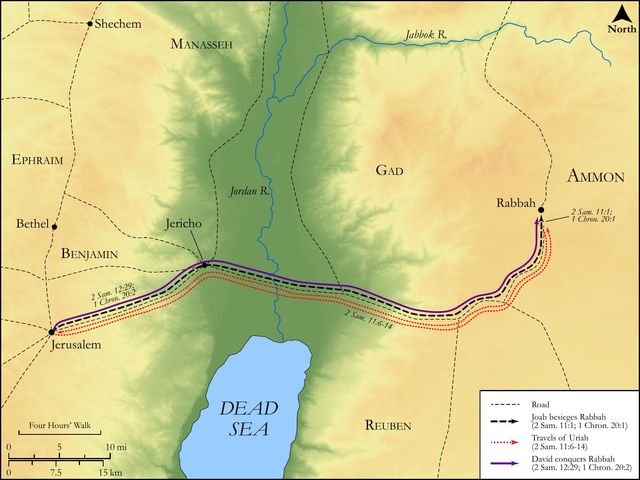
We have here an account of the conquest of Rabbah, and other cities of the Ammonites. Though this comes in here after the birth of David's child, yet it is most probable that it was effected a good while before, and soon after the death of Uriah, perhaps during the days of Bath-sheba's mourning for him. Observe, 1. That God was very gracious in giving David this great success against his enemies, notwithstanding the sin he had been guilty of just at that time when he was engaged in this war, and the wicked use he had made of the sword of the children of Ammon in the murder of Uriah. Justly might he have made that sword, thenceforward, a plague to David and his kingdom; yet he breaks it, and makes David's sword victorious, even before he repents, that this goodness of God might lead him to repentance. Good reason had David to own that God dealt not with him according to his sins, Psa 103:10. 2. That Joab acted very honestly and honourably; for when he had taken the city of waters, the royal city, where the palace was, and from which the rest of the city was supplied with water (and therefore, upon the cutting off of that, would be obliged speedily to surrender), he sent to David to come in person to complete this great action, that he might have the praise of it, Sa2 12:26-28. Herein he showed himself a faithful servant, that sought his master's honour, and his own only in subordination to his, and left an example to the servants of the Lord Jesus, in every thing they do, to consult his honour. Not unto us, but to thy name, give glory. 3. That David was both too haughty and too severe upon this occasion, and neither so humble nor so tender as he should have been. (1.) He seems to have been too fond of the crown of the king of Ammon, Sa2 12:30. Because it was of extraordinary value, by reason of the precious stones with which it was set, David would have it set upon his head, though it would have been better to have cast it at God's feet, and at this time to have put his own mouth in the dust, under guilt. The heart that is truly humbled for sin is dead to worldly glory and looks upon it with a holy contempt. (2.) He seems to have been too harsh with his prisoners of war, Sa2 12:31. Taking the city by storm, after it had obstinately held out against a long and expensive siege, if he had put all whom he found in arms to the sword in the heat of battle, it would have been severe enough; but to kill them afterwards in cold blood, and by cruel tortures, with saws and harrows, tearing them to pieces, did not become him who, when he entered upon the government, promised to sing of mercy as well as judgment, Psa 101:1. Had he made examples of those only who had abused his ambassadors, or advised or assisted in it, that being a violation of the law of nations, it might have been looked upon as a piece of necessary justice for terror to other nations; but to be thus severe with all the cities of the children of Ammon (that is, the garrisons or soldiers of the cities) was extremely rigorous, and a sign that David's heart was not yet made soft by repentance, else the bowels of his compassion would not have been thus shut up - a sign that he had not yet found mercy, else he would have been more ready to show mercy.
Continue studying 2 Samuel 12:31 across the web’s major study libraries — every link below opens this exact verse, chapter, or book on the destination site.
Read & Compare
 BibleGatewayThis verse in more than 200 translations and 70 languages.
 Bible.comThe YouVersion reader — hundreds of translations, reading plans, and highlights.
 ESV.orgCrossway's official English Standard Version reader.
 NET BibleThe NET translation with 60,000+ translators' notes on every rendering decision.
 STEP BibleTyndale House's free study tool — original text, vocabulary, and scholarly resources.
 BibliaLogos Bible Software's free web reader.
 USCCBThe New American Bible (Revised Edition) with the U.S. bishops' study notes.
Commentaries
 BibleHub CommentariesDozens of classic commentaries on this verse, gathered on one page.
 StudyLightMore than 100 commentary sets — the largest collection on the web.
 BibleRefPlain-English commentary on what this verse means, verse by verse.
 Enduring WordDavid Guzik's free commentary on this chapter, widely used by Bible teachers.
 Bible Study ToolsVerse commentary alongside Greek and Hebrew study aids.
Original Language & Research
- BibleHub InterlinearThe verse word by word — original language, transliteration, and English.
- BibleHub LexiconEvery word's original-language definition and Strong's entry.
 Blue Letter BibleDeep-study tools — Strong's numbers, concordance, and word studies.
 SefariaThe Hebrew text with Rashi and centuries of Jewish commentary.
Sermons, Hymns & Audio


TrulyRandomVerse is not affiliated with these sites and doesn’t control their content. They’re linked because they’re genuinely useful.
Summary
2 Samuel 12:31 concludes David's military campaign against the Ammonites, detailing the severe subjugation of the inhabitants of Rabbah and other Ammonite cities after their conquest. This verse portrays the harsh realities of ancient Near Eastern warfare, where defeated populations faced either forced labor under grueling conditions using various implements or, more grimly, execution by fire, underscoring the devastating consequences of conflict and the often-unforgiving nature of military victory in that era. It marks the successful end of the war, as David and his army return to Jerusalem after decisively subduing the Ammonite kingdom.
Context
ShowHideLiterary Context
This verse marks an abrupt and jarring return to the military narrative following a profound theological and personal interlude in David's life. The war with Ammon, initiated in 2 Samuel 10 due to King Hanun's egregious insult to David's envoys, had served as the grim backdrop for David's grievous sins involving Bathsheba and Uriah, comprehensively detailed in 2 Samuel 11. The preceding verses of 2 Samuel 12 focus intensely on Nathan's prophetic confrontation of David, David's profound repentance, the tragic death of Bathsheba's first child, and the subsequent birth of Solomon. Verse 31, therefore, shifts the reader sharply back from the personal and theological consequences of David's sin to the geopolitical consequences of the war, presenting a stark and unsettling conclusion to the Ammonite conflict, highlighting the often-brutal realities of David's reign even amidst spiritual restoration.
Historical & Cultural Context
Ancient Near Eastern warfare was notoriously brutal, often involving the annihilation, enslavement, or severe subjugation of conquered peoples. The treatment described in 2 Samuel 12:31 reflects common, albeit extreme, practices of the time, which could include forced labor (e.g., in brick-making, quarrying, or agriculture) or various forms of torture and execution. The mention of "saws, harrows of iron, and axes of iron" points to implements that could be used for both arduous labor and, in extreme cases, for dismemberment or torture. The reference to "passing through the brickkiln" is particularly ambiguous, interpreted by some as forced labor in brick factories (a common fate for captives, reminiscent of Israel's bondage in Egypt) and by others as a horrific method of execution by fire, akin to human sacrifice or immolation, which was practiced by some pagan cultures in the region (e.g., Molech worship). Such acts served not only as punishment but also as a powerful deterrent to future rebellion and a stark demonstration of the conquering king's absolute power and dominance. The Ammonites, descendants of Lot, had a long history of animosity with Israel, often engaging in border conflicts and idol worship, which further contextualizes the severity of David's actions in the eyes of his contemporaries.
Key Themes
ShowHideThis verse contributes to several key themes within the book of Samuel and the broader biblical narrative. It vividly illustrates the brutality and devastating consequences of ancient warfare, serving as a sobering reminder of human capacity for cruelty in conflict. It also highlights the complexity of David's character, revealing a darker, more ruthless side of his reign that occurred after his significant moral failures detailed in 2 Samuel 11. While David is portrayed elsewhere as a "man after God's own heart" (Acts 13:22), this passage demonstrates that even God's chosen leaders could operate within and sometimes succumb to the harsh cultural norms of their time. Furthermore, it touches upon themes of divine judgment (against the Ammonites for their aggression and insult towards David's envoys, as seen in 2 Samuel 10:1-5) and the fulfillment of God's promise to establish David's kingdom, even if achieved through means that are ethically challenging to modern readers. The narrative records these actions as historical events in the unfolding story of Israel, without explicitly endorsing them as divinely commanded.
Exposition and Analysis
ShowHideKey Word Analysis
ShowHideA primitive root meaning "to put," used in a great variety of applications, literal and figurative. In this context, it signifies David's direct action in placing the conquered people in a state of subjugation or under the specified implements. The ambiguity of the following preposition "under" (not in provided Strong's) is compounded by this verb, which simply denotes the act of placing or setting, leaving the precise nature of the "putting" open to interpretation as either forced labor or execution.
A primitive root meaning "to cross over," used very widely of any transition (literal or figurative). Here, it describes the action of making the people "pass through" the brickkiln. This verb is crucial to understanding the fate of the Ammonites in relation to the brickkiln, implying either a forced movement through a dangerous environment for labor or a horrific passage through fire for execution, aligning with the dual interpretations of the "brickkiln" itself.
Derived from a root meaning "to whiten" (referring to the color of bricks), this term refers to a place where bricks are made, typically involving intense heat. The phrase "made them pass through the brickkiln" (וַיַּעֲבֵרֵם בַּמַּלְבֵּן, vayya'avirem bammalben) is highly debated. It could mean forced labor, where captives were made to work in the dangerous and arduous conditions of brick-making, a common form of servitude for conquered peoples (cf. Israel's bondage in Egypt, Exodus 1:14). Alternatively, it could imply a horrific method of execution by fire, akin to human sacrifice or immolation, which was practiced by some pagan cultures in the region (e.g., Molech worship, Leviticus 18:21). The parallel account in 1 Chronicles 20:3 omits this specific phrase, adding to the interpretive challenge.
Verse Breakdown
ShowHide"And he brought forth the people that [were] therein"
This refers to David personally overseeing the disposition of the inhabitants of Rabbah, the Ammonite capital, after its capture. It emphasizes David's direct involvement and authority as the victorious king in determining the fate of the conquered population.
"and put [them] under saws, and under harrows of iron, and under axes of iron"
This clause describes the specific implements used in the subjugation. The interpretation hinges on the preposition "under." If literal, it suggests a gruesome form of execution or torture, where people were cut, torn, or hacked to death. If figurative, it implies forced labor, where the Ammonites were subjected to the most arduous and demeaning work using these heavy tools, perhaps as slaves in logging, farming, or mining operations. Both interpretations convey extreme suffering and complete subjugation.
"and made them pass through the brickkiln"
This phrase adds another layer of severity to the treatment. As detailed in the key word analysis, this could mean forcing the captives into slave labor in the dangerous and hot environment of brick factories, a common punishment for conquered peoples. Alternatively, and more horrifically, it could describe their execution by burning them alive in the kilns, a practice that, while extreme, was not unknown in ancient warfare and ritualistic practices among some pagan nations.
"and thus did he unto all the cities of the children of Ammon"
This crucial detail indicates that the severe treatment described was not an isolated incident confined to Rabbah but was systematically applied to all the conquered cities of the Ammonites. This demonstrates the widespread and comprehensive nature of David's subjugation of the Ammonite kingdom, ensuring their complete submission and preventing future rebellion.
"So David and all the people returned unto Jerusalem"
This concluding statement marks the successful completion of the Ammonite campaign. It signifies the triumphant return of David and his army to the capital, bringing the narrative of the conflict to a close. The stark contrast between the preceding brutality and the peaceful return to Jerusalem highlights the harsh realities and accepted norms of the ancient world regarding military conquest.
Literary Devices
ShowHideThe passage employs powerful Imagery to convey the brutality of David's actions. The explicit mention of "saws," "harrows of iron," "axes of iron," and "brickkiln" creates vivid and disturbing mental pictures of suffering and subjugation, whether through forced labor or execution. There is also a strong element of Juxtaposition in the broader narrative of 2 Samuel 12. The chapter begins with Nathan's powerful rebuke of David's sin, leading to David's profound repentance and God's forgiveness, followed by the birth of Solomon, a sign of divine grace. This personal and theological drama is sharply contrasted with the sudden shift back to the military conquest and the severe treatment of the Ammonites in verse 31. This Narrative Shift is jarring, forcing the reader to grapple with the complexities of David's character and the harsh realities of his reign, even after his spiritual restoration. The ambiguity surrounding the precise nature of the "under" and "brickkiln" phrases could also be seen as a form of Euphemism or Understatement if the actions were indeed executions, allowing the text to describe horrific acts without explicit, graphic detail, or it could be a Metonymy where the tools represent the forced labor associated with them.
Theological and Thematic Connections
ShowHide2 Samuel 12:31 presents a challenging passage for modern readers, forcing us to confront the ethical complexities within the biblical narrative. While God is sovereign and uses imperfect human agents to accomplish His purposes, this verse highlights the brutal realities of ancient warfare and the actions of human kings, which do not always align with the full revelation of God's character, particularly His mercy and justice as revealed in Christ. It reminds us that even "men after God's own heart" can engage in actions that reflect the fallenness of humanity and the harsh norms of their culture, rather than divine standards. The passage serves as a stark reminder of the devastating human cost of sin and conflict, both for the aggressors (Ammon) and those who execute judgment (Israel). It compels us to consider how God works through historical events and human choices, even those that cause discomfort, to achieve His broader redemptive purposes, ultimately pointing to a greater King whose reign is defined by love, peace, and restitution.
Reflection and Application
ShowHideThis passage, while difficult, offers profound opportunities for reflection and spiritual growth. It prevents us from sanitizing biblical history or creating an idealized, flawless view of its heroes. David, despite his profound spiritual depth, anointing, and genuine repentance, was undeniably a product of his time and capable of great severity. This unflinching honesty in the biblical narrative reminds us that the Bible is a realistic portrayal of human nature, even among those chosen by God. For believers, it underscores the ongoing need for spiritual discernment, to carefully distinguish between cultural practices of a specific historical period and the timeless, unchanging divine mandates for righteousness, mercy, and justice. It calls us to lament the horrors of war and the dehumanization of enemies, while also recognizing that God's justice can manifest in ways that challenge our contemporary sensibilities. Ultimately, this challenging text directs our gaze to the perfect standard of Christ, whose kingdom operates on principles radically different from earthly power structures and whose victory is achieved through self-giving love.
Questions for Reflection
ShowHideFAQ
ShowHideWas David's treatment of the Ammonites explicitly commanded or justified by God?
ShowHideThe biblical text does not explicitly state that God commanded David to treat the Ammonites in this specific, brutal manner. While God had commanded the Israelites to utterly destroy certain Canaanite nations as part of their conquest of the Promised Land (e.g., Deuteronomy 20:16-18), the Ammonites were not among those nations designated for complete annihilation. David's actions here appear to reflect the harsh realities and common practices of ancient Near Eastern warfare, where victorious kings often subjugated or annihilated defeated populations as a display of power, a means of control, and a deterrent to future rebellion. Scholars debate whether the passage describes literal torture and execution or forced labor, but in either case, it represents extreme severity. The narrative records David's actions as historical events without explicit divine endorsement or condemnation, leaving readers to grapple with the moral implications within the broader context of God's character and commands.
How does the account in 1 Chronicles 20:3 compare to 2 Samuel 12:31, and does it offer a different interpretation?
ShowHideThe parallel account in 1 Chronicles 20:3 uses very similar Hebrew phrasing to 2 Samuel 12:31, stating: "And he brought out the people who were in it and put them to work with saws, and with iron picks, and with axes." The key difference lies in the preposition "under" (Hebrew: tahat) used in 2 Samuel versus "with" (Hebrew: b') in 1 Chronicles, and the omission of "pass through the brickkiln" in Chronicles, instead using "cut them with saws" or "put them to work with saws" depending on translation. While some scholars argue that 1 Chronicles presents a slightly softer interpretation, implying forced labor with tools rather than being under them for torture/execution, the overall sense of severe subjugation and harsh treatment remains consistent between the two accounts. Both passages describe a comprehensive and brutal subjugation of the Ammonites by David, emphasizing their complete defeat and reduction to servitude.
Christ-Centered Fulfillment
ShowHideThe brutal subjugation of the Ammonites by King David in 2 Samuel 12:31 stands in stark contrast to the reign and conquest of the ultimate King, Jesus Christ. David, as an earthly monarch, brought forth a people and subjected them to instruments of iron and fire, conquering through physical might and severe judgment to establish his earthly kingdom. This earthly kingdom, though divinely established, operated within the fallen realities and harsh norms of its time. In stark opposition, Jesus, the Son of David and the true Lamb of God, conquers not with saws, harrows, or axes, but through self-sacrifice on a wooden cross. He does not put His enemies "under" instruments of torture, but rather takes the full weight of judgment upon Himself, conquering sin, death, and the powers of darkness through His suffering and resurrection (Colossians 2:15). While David's victory over the Ammonites involved physical destruction and forced labor, Christ's victory invites all peoples to freedom from the bondage of sin and into His kingdom of peace, where swords are beaten into plowshares and spears into pruning hooks (Isaiah 2:4). His kingdom is "not of this world" (John 18:36), and His call is to love enemies and pray for those who persecute (Matthew 5:44). Thus, 2 Samuel 12:31, though a difficult passage, ultimately highlights the radical difference between earthly kingship, even that of a divinely chosen king, and the redemptive, merciful, and spiritually transformative reign of Christ, whose victory is for the salvation of all who believe.