


Isaiah 16:5
- וְהוּכַןve·hu·Khanand it will be establishedH3559Conj-w ¦ V-Hophal-ConsecPerf-3msVerb Hophal Consecutive Perfect 3rd Singular Masculineוְandהוּכַןit will be established
- בַּחֶסֶדba·Che·sedin <the> covenant loyaltyH2617Prep-b ¦ N-msNoun Singular Masculine Absoluteבַּin <the>חֶסֶדcovenant loyalty
- כִּסֵּאki·Se'a throneH3678N-msNoun Singular Masculine Absolute
- וְיָשַׁבve·ya·Shavand he will sitH3427Conj-w ¦ V-Qal-ConsecPerf-3msVerb Qal Consecutive Perfect 3rd Singular Masculineוְandיָשַׁבhe will sit
- עָלָיו'a·Lavon itH5921Prep ¦ 3msPrepositionעָלָיonוit
- בֶּאֱמֶתbe·'e·Metin faithfulnessH571Prep-b ¦ N-fsNoun Singular Feminine Absoluteבֶּinאֱמֶתfaithfulness
- בְּאֹהֶלbe·'O·helin [the] tent ofH168Prep-b ¦ N-mscNoun Singular Masculine Constructבְּinאֹהֶל[the] tent of
- דָּוִדda·VidDavidH1732N-proper-mNoun Proper Masculine
- שֹׁפֵטsho·Fet[one who] judgesH8199V-Qal-Prtcpl-msVerb Qal Participle Singular Masculine Absolute
- וְדֹרֵשׁve·do·Reshand [one who] seeksH1875Conj-w ¦ V-Qal-Prtcpl-msVerb Qal Participle Singular Masculine Absoluteוְandדֹרֵשׁ[one who] seeks
- מִשְׁפָּטmish·PatjusticeH4941N-msNoun Singular Masculine Absolute
- וּמְהִרu·me·Hirand [one] prompt ofH4106Conj-w ¦ Adj-mscAdjective Singular Masculine Constructוּandמְהִר[one] prompt of
- צֶדֶקTze·dekrighteousnessH6664N-msNoun Singular Masculine Absolute
English is a literal word-by-word gloss of the Hebrew, not the KJV's wording. Why?
This is the original text the KJV's translators worked from — each Hebrew word with its own literal English meaning in this verse, prepared by scholars at Tyndale House, Cambridge. The KJV translates whole sentences, not word by word, so its wording differs: one Hebrew word can become several English words, and the KJV may choose “the LORD” where the gloss reads “Yahweh”. Both are faithful — they answer different questions. For the KJV's own rendering, switch to the KJV text.
Details
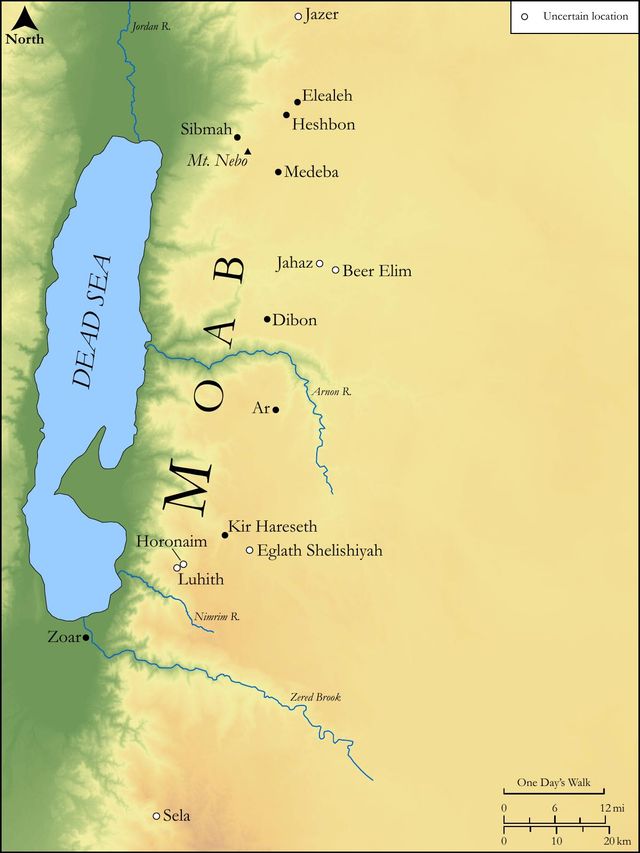
See on the biblical-era map
Study this verse
Public-domain commentary
Matthew Henry
From his Commentary on the Whole Bible. Henry comments on passages, not single verses — this entry covers Isaiah 16:1–5. His four-level outline is real structure in the source text, so it is rendered as structure.
God has made it to appear that he delights not in the ruin of sinners by telling them what they may do to prevent the ruin; so he does here to Moab.
I.He advises them to be just to the house of David, and to pay the tribute they had formerly covenanted to pay to the kings of his line (Isa 16:1): Send you the lamb to the ruler of the land. David made the Moabites tributaries to him, Sa2 8:2. They became his servants, and brought gifts. Afterwards they paid their tribute to the kings of Israel (Kg2 3:4), and paid it in lambs. Now the prophet requires them to pay it to Hezekiah. Let it be raised and levied from all parts of the country, from Selah, a frontier city of Moab on the one side, to the wilderness, a boundary of the kingdom on the other side: and let it be sent, where it should be sent, to the mount of the daughter of Zion, the city of David. Some take it as an advice to send a lamb for a sacrifice to God, the ruler of the earth (so it may be read), the Lord of the whole earth, ruler of all lands, the land of Moab as well as the land of Israel, "Send it to the temple built on Mount Zion." And some think it is in this sense spoken ironically, upbraiding the Moabites with their folly in delaying to repent and make their peace with God. "Now you would be glad to send a lamb to Mount Zion, to make the God of Israel your friend; but it is too late: the decree has gone forth, the consumption is determined, and the daughters of Moab shall be cast out as a wandering bird," Isa 16:2. I rather take it as good advice seriously given, like that of Daniel to Nebuchadnezzar when he was reading him his doom, Dan 4:27. Break off thy sins by righteousness, if it may be a lengthening of thy tranquillity. And it is applicable to the great gospel duty of submission to Christ, as the ruler of the land, and our ruler: "Send him the lamb, the best you have, yourselves a living sacrifice. When you come to God, the great ruler, come in the name of the Lamb, the Lamb of God. For else it shall be" (so we may read it) "that, as a wandering bird cast out of the nest, so shall the daughters of Moab be. If you will not pay your quit-rent, your just tribute to the king of Judah, you shall be turned out of your houses: The daughters of Moab (the country villages, or the women of your country) shall flutter about the fords of Arnon, attempting that way to make their escape to some other land, like a wandering bird thrown out of the nest half-fledged." Those that will not submit to Christ, nor be gathered under the shadow of his wings, shall be as a bird that wanders from her nest, that shall either be snatched up by the next bird of prey or shall wander endlessly in continual frights. Those that will not yield to the fear of God shall be made to yield to the fear of every thing else.
II.He advises them to be kind to the seed of Israel (Isa 16:3):
"Take counsel, call a convention, and consult among yourselves what is fit to be done in the present critical juncture; and you will find it your best way to execute judgment, to reverse all the unrighteous decrees you have made, by which you have put hardships upon the people of God, and, in token of your repentance for them, study now how to oblige them, and this shall be accepted of God more than all burnt-offering and sacrifice."
1.The prophet foresaw some storm coming upon the people of God, perhaps the good people of the ten tribes, or of the two and a half on the other side Jordan, whose country joined to that of Moab, and who, by the merciful providence of God, escaped the fury of the Assyrian army, had their lives given them for a prey, and were reserved for better times, but were put to the utmost extremity to shift for their own safety. The danger and trouble they were in were like the scorching heat at noon; the face of the spoiler was very fierce upon them and the oppressor and extortioner were ready to swallow them up after stripping them of what they had.
2.He bespeaks a shelter for them in the land of Moab, when their own land was made too hot for them. This judgment they must execute; thus wisely must they do for themselves, and thus kindly must they deal with the people of God. If they would themselves continue in their habitations, let them now open their doors to the distressed dispersed members of God's church, and be to them like a cool shade to those that bear the burden and heat of the day. Let them not discover those that absconded among them, nor deliver them up to the pursuers that made search for them: "Betray not him that wandereth, nor deliver him up" (as the Edomites did, Oba 1:13, Oba 1:14), "but hide the outcasts." This was that good work by which Rahab's faith was justified, and proved to be sincere, Heb 11:31. "Nay, do not only hide them for a time, but, if there be occasion, let them be naturalized: Let my outcasts dwell with thee, Moab (Isa 16:4); find a lodging for them and be thou a covert to them. Let them be taken under the protection of the government, though they are but poor, and likely to be a charge to thee." Note,
(1.)It is often the lot even of those who are Israelites indeed to be outcasts, driven out of house and harbour by persecution or war, Heb 11:37.
(2.)God owns them when men reject and disown them. They are outcasts, but they are my outcasts. The Lord knows those that are his wherever he finds them, even where no one else knows them.
(3.)God will find a rest and shelter for his outcasts; for, though they are persecuted, they are not forsaken. He will himself be their dwelling-place if they have no other, and in him they shall be at home.
(4.)God can, when he pleases, raise up friends for his people even among Moabites, when they can find none in all the land of Israel that can and dare shelter them. The earth often helps the woman, Rev 12:16.
(5.)Those that expect to find favour when they are in trouble themselves must show favour to those that are in trouble; and what service is done to God's outcasts shall no doubt be recompensed one way or other.
3.He assures them of the mercy God had in store for his people.
(1.)That they should not long need their kindness, or be troublesome to them: For the extortioner is almost at an end already, and the spoiler ceases. God's people shall not be long outcasts; they shall have tribulation ten days (Rev 2:10), and that is all. The spoiler would never cease spoiling if he might have his will; but God has him in a chain. Hitherto he shall go, but no further.
(2.)That they should, ere long, be in a capacity to return their kindness (Isa 16:5): "Though the throne of the ten tribes be sunk and overturned, yet the throne of David shall be established in mercy, by the mercy they receive from God and the mercy they show to others; and by the same methods may your throne be established if you please." It would engage great men to be kind to the people of God if they would but observe, as they easily might, how often such conduct brings the blessing of God upon kingdoms and families. "Make Hezekiah your friend, for you will find it your interest to do so upon the account both of the grace of God in him and the presence of God with him. He shall sit upon the throne in truth, and then he does indeed sit in honour and sit firmly. Then he shall sit judging, and will then be a protector to those that have been a shelter to the people of God." And see in him the character of a good magistrate.
[1.]He shall seek judgment; that is, he shall seek occasions of doing right to those that are wronged, and shall punish the injurious even before they are complained of: or he shall diligently search into every cause brought before him, that he may find where the right lies.
[2.]He shall hasten righteousness, and not delay to do justice, nor keep those long waiting that make application to him for the redress of their grievances. Though he seeks judgment, and deliberates upon it, yet he does not, under pretence of deliberation, stay the progress of the streams of justice. Let the Moabites take example by this, and then assure themselves that their state shall be established.
Historical interpretation
Historical reception
3 surviving comments on this verse. Each one is dated, so this reads as a timeline rather than a list.
Select a marker to jump to its quote. Markers stagger vertically where authors wrote within a few decades of each other.
According to Aquila, “his throne will be established in mercy,” or according to Theodotion, “the throne will be established with mercy.” Who will establish the throne? Or how is Christ born from the posterity of David? The throne will be established by the Moabites, according to the text; and Christ who is born from the tent (tabernacle) of David will sit upon the throne. By “the tent of David” the prophet means the church of God. David himself is called christ because from his posterity Christ is born according to flesh. Therefore, the tent (tabernacle) of David is the church, and the throne belongs to the head of the church. It refers to the humanity of Christ. Therefore, one should contemplate on the mystery of Christ revealed in the prophecy only in the Holy Spirit; and in such a cautious contemplation curiosity and speculation must be tamed.
“And a throne will be prepared in mercy, and on it will sit in truth, in the tabernacle of David, one who judges and seeks judgment and quickly renders what is just.” The Hebrews interpret this to mean that Hezekiah, a just man, after having expelled the Assyrians, will retain the throne of David and rule Judah, adjudging the people of God to be subject to himself in truth. Others understand that it is about Christ. With the antichrist reduced to dust and with the oppressor who had trampled all the earth removed, Christ the King will come and sit in the tabernacle of David and render to each person according to his works on the day of judgment. Neither is there any doubt that this chapter prophesies of Christ. But we are also able to understand the same thing in the first advent and to demonstrate in the tabernacle of the church that the surging victories of the churches of Moab in all the earth testify to the dominion of Christ.
(Verse 5) And a throne shall be prepared in mercy, and he shall sit upon it in truth, in the tabernacle of David, judging and seeking judgment, and quickly rendering what is just. The Hebrews interpret this place as follows: After the Assyrian is driven away, the just man Ezechias shall reign over Judah, and he shall retain the throne of David, ruling over the people of God in truth. Others understand it as referring to Christ. After the dust and destroyer of the Antichrist are removed, who trampled upon the whole earth, Christ the king shall come, who shall sit in the tabernacle of David, and on the day of judgment he shall render to all according to their works. And there is no doubt that this chapter predicts about Christ. But we can understand the same thing in his first coming, and show in the Church's tabernacle, that in all the land of Moab the trophies of the Churches rising up testify to the kingdom of Christ.
Continue studying Isaiah 16:5 across the web’s major study libraries — every link below opens this exact verse, chapter, or book on the destination site.
Read & Compare
 BibleGatewayThis verse in more than 200 translations and 70 languages.
 Bible.comThe YouVersion reader — hundreds of translations, reading plans, and highlights.
 ESV.orgCrossway's official English Standard Version reader.
 NET BibleThe NET translation with 60,000+ translators' notes on every rendering decision.
 STEP BibleTyndale House's free study tool — original text, vocabulary, and scholarly resources.
 BibliaLogos Bible Software's free web reader.
 USCCBThe New American Bible (Revised Edition) with the U.S. bishops' study notes.
Commentaries
 BibleHub CommentariesDozens of classic commentaries on this verse, gathered on one page.
 StudyLightMore than 100 commentary sets — the largest collection on the web.
 BibleRefPlain-English commentary on what this verse means, verse by verse.
 Enduring WordDavid Guzik's free commentary on this chapter, widely used by Bible teachers.
 Bible Study ToolsVerse commentary alongside Greek and Hebrew study aids.
Original Language & Research
- BibleHub InterlinearThe verse word by word — original language, transliteration, and English.
- BibleHub LexiconEvery word's original-language definition and Strong's entry.
 Blue Letter BibleDeep-study tools — Strong's numbers, concordance, and word studies.
 SefariaThe Hebrew text with Rashi and centuries of Jewish commentary.
Sermons, Hymns & Audio


TrulyRandomVerse is not affiliated with these sites and doesn’t control their content. They’re linked because they’re genuinely useful.
Summary
Isaiah 16:5 presents a profound prophetic pivot, shifting from the lamentable judgment upon Moab to a glorious vision of an enduring, divinely established throne. This future reign, rooted in God's unwavering mercy and steadfast truth, will be characterized by a righteous ruler from the lineage of David, who actively and zealously judges, seeks justice, and swiftly brings forth righteousness. It stands as a powerful beacon of hope, contrasting the transience of earthly powers with the stability and perfect equity of God's promised kingdom, ultimately anticipating a Messianic reign of unparalleled justice and compassion.
Context
ShowHideLiterary Context
Isaiah chapters 15 and 16 form a unified prophetic oracle, often termed the "Burden of Moab," detailing the impending judgment and desolation of the Moabite nation. The preceding verses (Isaiah 15:1-9 and Isaiah 16:1-4) vividly depict Moab's profound distress, its cities laid waste, its people in flight, and their desperate pleas for refuge, even appealing to Jerusalem for shelter. Amidst this scene of national collapse and deep lament, Isaiah 16:5 introduces a dramatic and theologically significant shift. It abruptly transitions from the immediate, temporal judgment of an earthly kingdom to the eternal, divine establishment of a righteous reign. This verse serves as a crucial turning point, offering a stark theological contrast and a glimmer of Messianic hope within the broader narrative of judgment, redirecting the reader's gaze from earthly despair to divine promise.
Historical & Cultural Context
The prophecies against Moab, alongside those against other surrounding nations in Isaiah (e.g., Isaiah 13, Isaiah 17), were delivered during a tumultuous period in the ancient Near East, dominated by the rising power of the Assyrian Empire. Moab, situated east of the Dead Sea, frequently interacted with and sometimes opposed Israel, though they also shared cultural and linguistic ties. The "burden" or oracle against Moab likely foreshadows a historical or impending military campaign, possibly by Assyria, that would devastate the region. Culturally, the "throne" (Hebrew: kiççêʼ) was the quintessential symbol of royal power, authority, and the seat of justice. The phrase "tabernacle of David" (Hebrew: ʼôhel of Dâvid) immediately evoked the foundational covenant God made with King David, promising an eternal dynasty and an enduring kingdom (2 Samuel 7:12-16). This cultural understanding would have instantly signaled a reference to the enduring, divinely sanctioned rule of a Davidic king, contrasting sharply with the transient and vulnerable nature of Moab's power.
Key Themes
ShowHideIsaiah 16:5 masterfully encapsulates several overarching themes central to Isaiah's prophecy and the broader Old Testament. Firstly, it underscores Divine Sovereignty and Justice, asserting that even amidst earthly chaos and judgment, God remains ultimately in control, establishing a kingdom founded on His own righteous character. Secondly, the verse highlights Mercy and Truth as Foundations of Righteous Rule, presenting these divine attributes (Hebrew: chêçêd and ʼemeth) not merely as abstract qualities but as the very pillars upon which a just administration is built. This echoes profound theological truths found elsewhere in scripture, such as the declaration in Psalm 89:14 that "Righteousness and justice are the foundation of your throne; steadfast love and faithfulness go before you." Thirdly and most significantly, it introduces the theme of Messianic Hope and the Davidic Covenant. The explicit reference to the "tabernacle of David" (Hebrew: ʼôhel of Dâvid) directly points to the promise of an everlasting Davidic dynasty, a promise that had seemingly fallen into disrepair, as lamented in passages like Amos 9:11. This verse thus anticipates the coming of a perfect Davidic King who will embody and enact ultimate justice and righteousness, offering stability and restoration in a world marked by injustice and instability.
Exposition and Analysis
ShowHideKey Word Analysis
ShowHideThis profound theological term encompasses kindness, steadfast love, covenantal loyalty, and enduring faithfulness. In Isaiah 16:5, its application to the establishment of the throne signifies that the very foundation and operational character of this promised reign are rooted in God's unwavering, compassionate commitment. It indicates a kingdom whose existence and governance are characterized by divine grace and loyal love, rather than by human might or political expediency.
This verb properly means to be erect, to set up, or to confirm, implying a state of being rendered sure, stable, and prepared. Its use here emphasizes the divine origin and unshakeable nature of the throne. Unlike the transient kingdoms of Moab or Assyria, this throne is divinely fixed and prepared, ensuring its permanence, reliability, and immutability. It speaks to an enduring reign that will not falter or be overthrown.
This noun denotes stability, certainty, trustworthiness, and faithfulness. When applied to the ruler sitting on the throne, it signifies that his rule will be characterized by absolute integrity, reliability, and adherence to what is genuinely right and real. This ruler will govern with complete honesty and fidelity, ensuring that justice is administered without corruption, deceit, or deviation from divine standards.
Verse Breakdown
ShowHide"And in mercy shall the throne be established:"
This opening clause immediately sets the divine context for the promised reign. It declares that the very foundation of this future throne is God's steadfast love (chêçêd) and covenantal faithfulness. The establishment of this throne is not a result of human power, conquest, or political maneuvering, but rather an act of divine compassion and unwavering commitment, thereby guaranteeing its stability and inherently righteous character.
"and he shall sit upon it in truth in the tabernacle of David,"
This segment identifies both the nature of the future ruler and his specific lineage. The one who occupies this throne will govern with absolute integrity and faithfulness (ʼemeth), ensuring a reign free from corruption or deceit. The phrase "in the tabernacle of David" is a profoundly significant Messianic reference, directly pointing to the Davidic dynasty and the promise of an enduring king from David's line, signifying the restoration, re-establishment, and ultimate fulfillment of God's covenant with David.
"judging, and seeking judgment, and hasting righteousness."
These three active participles dynamically describe the proactive and zealous nature of this ruler's reign. He is not merely a passive arbiter but one who actively pronounces verdicts (shâphaṭ), diligently pursues and investigates justice (dârash mishpâṭ), and swiftly brings about what is right (mâhîyr tsedeq). This tripartite description emphasizes a comprehensive, zealous, and decisive commitment to upholding moral and legal equity, ensuring that justice is not delayed but eagerly pursued and promptly implemented.
Literary Devices
ShowHideIsaiah 16:5 masterfully employs several literary devices to convey its powerful and hopeful message. Contrast is central to its impact, as the promise of a stable, righteous throne stands in stark opposition to the preceding lament over Moab's destruction, highlighting divine order and enduring promise amidst human chaos and transient earthly powers. Symbolism is profoundly evident in "the throne" itself, which represents ultimate authority, sovereignty, and the seat of divine governance, and in "the tabernacle of David," which symbolizes the enduring Davidic dynasty and the covenant God made with David, pointing to a restored and eternal kingship. The use of personification attributes active human-like qualities—"judging, and seeking judgment, and hasting righteousness"—to the divine or divinely appointed ruler, emphasizing the active, intentional, and dynamic nature of this just reign. Furthermore, the repetition and parallelism in the phrases "judging, and seeking judgment" reinforce the comprehensive and diligent pursuit of justice, while the culminating phrase "hasting righteousness" adds a powerful sense of urgency, decisiveness, and zealous commitment to this perfect rule.
Theological and Thematic Connections
ShowHideIsaiah 16:5 resonates deeply with core biblical truths, portraying a divine standard for kingship and anticipating a future reality rooted in God's immutable character. The establishment of this throne in "mercy" (chêçêd) and the ruler's governance "in truth" (ʼemeth) underscore that true, legitimate authority flows directly from God's loyal love and unwavering integrity. This vision of a just and righteous reign, actively pursuing equity and swift justice, stands as the ultimate hope for a fallen and chaotic world. It speaks powerfully to God's unwavering commitment to restore order, rectify all wrongs, and bring about His perfect will, not through human might or political maneuvering, but through His own divine attributes embodied in a chosen, ideal ruler. This verse thus seamlessly connects the immediate context of judgment to the broader redemptive narrative, pointing to a future where divine justice, mercy, and truth definitively prevail.
Reflection and Application
ShowHideIsaiah 16:5 offers profound insights for contemporary believers and leaders, serving as both an anchoring source of hope and a compelling blueprint for righteous living. In a world frequently characterized by pervasive injustice, corruption, and instability, this verse powerfully reminds us that God's ultimate plan is for a kingdom established on the unshakeable foundations of His mercy, truth, and active justice. This truth should profoundly anchor our hope, assuring us that God's sovereign and righteous rule will ultimately prevail, rectifying all wrongs and establishing perfect equity. For those entrusted with positions of authority—whether in government, community organizations, families, or the church—the attributes of this ideal ruler serve as a divine call to action. We are challenged to govern with compassion, integrity, and a proactive commitment to fairness, not merely reacting to injustice but actively and zealously "seeking judgment" and "hasting righteousness" within our respective spheres of influence. This verse also encourages us to fervently pray for and diligently work towards the manifestation of God's kingdom on earth, anticipating the full and glorious realization of this righteous reign.
Questions for Reflection
ShowHideFAQ
ShowHideWhat is the significance of the "tabernacle of David" in this verse?
ShowHideThe "tabernacle of David" (Hebrew: ʼôhel of Dâvid) is a profoundly significant reference to the Davidic dynasty and the foundational covenant God made with King David in 2 Samuel 7. In that covenant, God promised David an eternal house, kingdom, and throne. By Isaiah's time, the Davidic kingdom had faced considerable decline, division, and even temporary collapse. The use of "tabernacle" (which can also mean a temporary dwelling or booth) here might allude to the fallen or dilapidated state of David's house, as explicitly mentioned in Amos 9:11: "In that day will I raise up the tabernacle of David that is fallen." Therefore, its establishment in Isaiah 16:5 signifies a miraculous restoration, re-establishment, and ultimate fulfillment of this covenant, pointing to a future, perfect Davidic King who will reign in righteousness and enduring stability.
How does this verse relate to the broader context of judgment against Moab?
ShowHideIsaiah 16:5 serves as a striking theological counterpoint and a dramatic shift in focus within the preceding chapters detailing the "Burden of Moab" (Isaiah 15-16:4). While the earlier verses describe the utter devastation, lament, and impending judgment upon Moab, Isaiah 16:5 abruptly shifts the focus from earthly destruction and despair to divine establishment and enduring hope. It offers a glimmer of light and promise amidst the pronouncements of doom, suggesting that even in times of widespread judgment and chaos, God's ultimate plan involves the establishment of a just, stable, and merciful kingdom that transcends all earthly turmoil. It highlights that divine judgment is not the final word, but rather a prelude to the manifestation of God's righteous and eternal reign.
Christ-Centered Fulfillment
ShowHideIsaiah 16:5 finds its ultimate and glorious fulfillment in the person and redemptive work of Jesus Christ. He is the promised Son of David, the one upon whom the eternal throne is established, not by human decree or power, but by divine mercy and truth. The angel Gabriel's announcement to Mary explicitly connects Jesus to this prophecy, declaring, "He shall be great, and shall be called the Son of the Highest: and the Lord God shall give unto him the throne of his father David: And he shall reign over the house of Jacob for ever; and of his kingdom there shall be no end" (Luke 1:32-33). Jesus perfectly embodies the qualities of the ideal ruler described in Isaiah: He is the very embodiment of truth, proclaiming, "I am the way, the truth, and the life" (John 14:6), and His earthly ministry was characterized by profound mercy and compassion for the lost and suffering (Matthew 9:36). As the Lamb of God, He takes away the sin of the world (John 1:29), demonstrating the ultimate act of divine mercy and covenantal faithfulness. Furthermore, His future return will usher in a reign where He will judge the nations in perfect righteousness and truth, decisively "hasting righteousness" as He brings about the new heavens and new earth where justice dwells eternally (Revelation 19:11; 2 Peter 3:13). Thus, Isaiah's prophetic vision of a stable, merciful, and just reign finds its complete, eternal, and redemptive realization in the King of kings, Jesus Christ.