


2 Samuel 2:10
Bible text: King James Version (1769 Blayney text) · Public domain
Bible text: King James Version with Strong's numbers · Public domain
Bible text: Berean Standard Bible · Public domain
Bible text: American Standard Version (1901) · Public domain
Bible text: World English Bible, Messianic edition · Public domain
Bible text: Geneva Bible (1599) · Public domain
Bible text: Young's Literal Translation · Public domain
- בֶּןben[was] a son ofH1121N-mscNoun Singular Masculine Construct
- אַרְבָּעִים'ar·ba·'ImfortyH705N-mpNoun Plural Masculine Absolute
- שָׁנָהsha·Nahyear[s]H8141N-fsNoun Singular Feminine Absolute
- אִישׁ'ishIsh-H378N-proper-mNoun Proper Masculine
- בֹּשֶׁתBo·shetboshethH378N-proper-mNoun Proper Masculine
- בֶּןben[the] son ofH1121N-mscNoun Singular Masculine Construct
- שָׁאוּלsha·'UlSaulH7586N-proper-mNoun Proper Masculine
- בְּמָלְכוֹbe·ma·le·Khowhen he became kingH4427Prep-b ¦ V-Qal-Inf ¦ 3msVerb Qal Infinitive Constructבְּwhenמָלְכbecame kingוֹhe
- עַל'aloverH5921PrepPreposition
- יִשְׂרָאֵלYis·ra·'ElIsraelH3478N-properNoun Proper Location
- וּשְׁתַּיִםu·she·Ta·yimand twoH8147Conj-w ¦ N-fdNoun Dual Feminine Absoluteוּandשְׁתַּיִםtwo
- שָׁנִיםsha·NimyearsH8141N-mpNoun Plural Masculine Absolute
- מָלָךְma·Lakhhe reignedH4427V-Qal-Perf-3msVerb Qal Perfect 3rd Singular Masculine
- אַךְ'akhonlyH389AdvAdverb
- בֵּיתbeit[the] house ofH1004N-mscNoun Singular Masculine Construct
- יְהוּדָהye·hu·DahJudahH3063N-properNoun Proper Location
- הָיוּha·Yuthey wereH1961V-Qal-Perf-3cpVerb Qal Perfect 3rd Plural common gender
- אַחֲרֵי'a·cha·ReiafterH310Adj-mpcAdjective Numerical Plural Masculine Construct
- דָוִדda·VidDavidH1732N-proper-mNoun Proper Masculine
English is a literal word-by-word gloss of the Hebrew, not the KJV's wording. Why?
This is the original text the KJV's translators worked from — each Hebrew word with its own literal English meaning in this verse, prepared by scholars at Tyndale House, Cambridge. The KJV translates whole sentences, not word by word, so its wording differs: one Hebrew word can become several English words, and the KJV may choose “the LORD” where the gloss reads “Yahweh”. Both are faithful — they answer different questions. For the KJV's own rendering, switch to the KJV text.
Details
See on the biblical-era maps

Study this verse
Public-domain commentary
Matthew Henry
From his Commentary on the Whole Bible. Henry comments on passages, not single verses — this entry covers 2 Samuel 2:8–17. His three-level outline is real structure in the source text, so it is rendered as structure.
Here is, I. A rivalship between two kings - David, whom God made king, and Ishbosheth, whom Abner made king. One would have thought, when Saul was slain, and all his sons that had sense and spirit enough to take the field with him, David would come to the throne without any opposition, since all Israel knew, not only how he had signalized himself, but how manifestly God had designated him to it; but such a spirit of contradiction is there, in the devices of men, to the counsels of God, that such a weak and silly thing as Ishbosheth, who was not thought fit to go with his father to the battle, shall yet be thought fit to succeed him in the government, rather than David shall come peaceably to it. Herein David's kingdom was typical of the Messiah's, against which the heathens rage and the rulers take counsel, Psa 2:1, Psa 2:2. 1. Abner was the person who set up Ishbosheth in competition with David, perhaps in his zeal for the lineal succession (since they must have a king like the nations, in this they must be like them, that the crown must descend from father to son), or rather in his affection to his own family and relations (for he was Saul's uncle), and because he had no other way to secure to himself the post of honour he was in, as captain of the host. See how much mischief the pride and ambition of one man may be the occasion of. Ishbosheth would never have set up himself if Abner had not set him up, and made a tool of him to serve his own purposes. 2. Mahanaim, the place where he first made his claim, was on the other side Jordan, where it was thought David had the least interest, and being at a distance from his forces they might have time to strengthen themselves. But having set up his standard there, the unthinking people of all the tribes of Israel (that is, the generality of them) submitted to him (Sa2 2:9), and Judah only was entirely for David. This was a further trial of the faith of David in the promise of God, and of his patience, whether he could wait God's time for the performance of that promise. 3. Some difficulty there is about the time of the continuance of this competition. David reigned about seven years over Judah only (Sa2 2:11), and yet (Sa2 2:10) Ishbosheth reigned over Israel but two years: before those two years, or after, or both, it was in general for the house of Saul (Sa2 3:6), and not any particular person of that house, that Abner declared. Or these two years he reigned before the war broke out (Sa2 2:12), which continued long, even the remaining five years, Sa2 3:1.
II.An encounter between their two armies.
1.It does not appear that either side brought their whole force into the field, for the slaughter was but small, Sa2 2:30, Sa2 2:31. We may wonder,
(1.)That the men of Judah did not appear and act more vigorously for David, to reduce all the nation into obedience to him; but, it is likely, David would not suffer them to act offensively, choosing rather to wait till the thing would do itself or rather till God would do it for him, without the effusion of Israelitish blood; for to him, as a type of Christ, that was very precious, Psa 72:14. Even those that were his adversaries he looked upon as his subjects, and would treat them accordingly.
(2.)That the men of Israel could in a manner stand neuter, and sit down tamely under Ishbosheth, for so many years, especially considering what characters many of the tribes displayed at this time (as we find, Ch1 12:23, etc.): Wise men, mighty men, men of valour, expert in war, and not of double heart, and yet for seven years together, for aught that appears, most of them seemed indifferent in whose hand the public administration was. Divine Providence serves its own purposes by the stupidity of men at some times and the activity of the same persons at other times; they are unlike themselves, and yet the motions of Providence are uniform.
2.In this battle Abner was the aggressor. David sat still to see how the matter would fall, but the house of Saul, and Abner at the head of it, gave the challenge, and they went by the worst. Therefore go not forth hastily to strive, nor be forward to begin quarrels, lest thou know not what to do in the end thereof, Pro 25:8. A fool's lips and hands enter into contention.
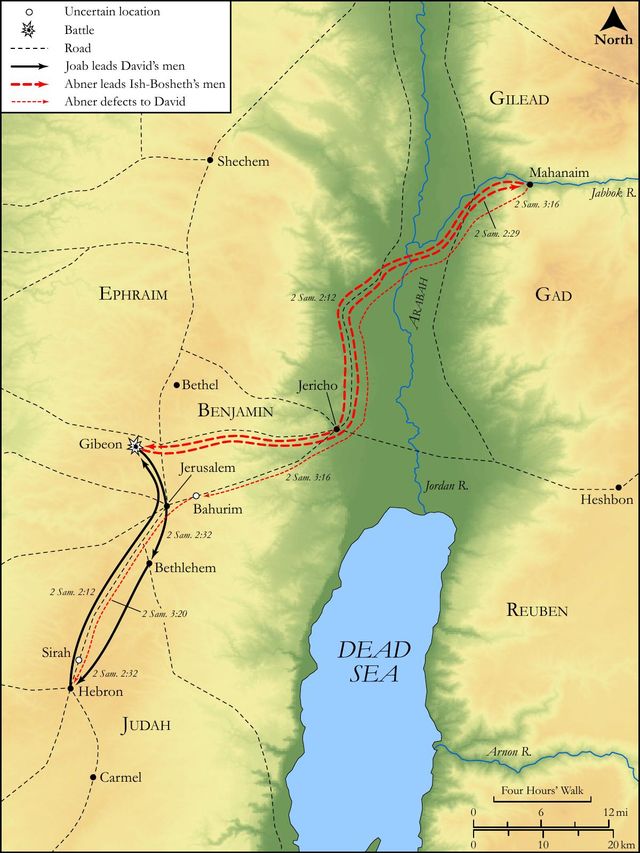
3.The seat of the war was Gibeon. Abner chose it because it was in the lot of Benjamin, where Saul had the most friends; yet, since he offered battle, Joab, David's general, would not decline it, but there joined issue with him, and met him by the pool of Gibeon, Sa2 2:13. David's cause, being built upon God's promise, feared not the disadvantages of the ground. The pool between them gave both sides time to deliberate.
4.The engagement was at first proposed by Abner, and accepted by Joab, to be between twelve and twelve of a side.
(1.)It should seem this trial of skill began in sport. Abner made the motion (Sa2 2:14): Let the young men arise and play before us, as gladiators. Perhaps Saul had used his men to these barbarous pastimes, like a tyrant indeed, and Abner had learnt of him to make a jest of wounds and death and divert himself with the scenes of blood and horror. He meant, "Let them fight before us," when he said, "Let them play before us." Fools thus make a mock at sin. but he is unworthy the name of a man that can be thus prodigal of human blood, that can thus throw about firebrands, arrows, and death, and say, Am not I in sport? Pro 26:18, Pro 26:19. Joab, having been bred up under David, had so much wisdom as not to make such a proposal, yet had not resolution enough to resist and gainsay it when another made it; for he stood upon a point of honour, and thought it a blemish to his reputation to refuse a challenge, and therefore said, Let them arise; not that he was fond of the sport, or expected that the duels would be decisive, but he would not be hectored by his antagonist. How many precious lives have thus been sacrificed to the caprices of proud men! Twelve of each side were accordingly called out as champions to enter the lists, a double jury of life and death, not of others', but their own; and the champions on Abner's side seem to have been most forward, for they took the field first (Sa2 2:15), having perhaps been bred up in a foolish ambition thus to serve the humour of their commander-in-chief. But,
(2.)However it began, it ended in blood (Sa2 2:16): They thrust every man his sword into his fellow's side (spurred on by honour, not by enmity); so they fell down together, that is, all the twenty-four were slain, such an equal match were they for one another, and so resolute, that neither side would either beg or give quarter; they did as it were by agreement (says Josephus) dispatch one another with mutual wounds. Those that strike at other men's lives often throw away their own and death only conquers and rides in triumph. The wonderful obstinacy of both sides was remembered in the name given to the place: Heldath-hazzurim - the field of rocky men, men that were not only strong in body, but of firm and unshaken constancy, that stirred not at the sight of death. Yet the stout-hearted were spoiled, and slept their sleep, Psa 76:5. Poor honour for men to purchase at so vast an expense! Those that lose their lives for Christ shall find them.
5.The whole army at length engaged, and Abner's forces were routed, Sa2 2:17. The former was a drawn battle, in which all were killed on both sides, and therefore they must put it upon another trial, in which (as it often happens) those that gave the challenge went away with loss. David had God on his side; his side therefore was victorious.
Historical interpretation
Historical reception
1 surviving comment on this verse from the historical church.
He reigned two years: Viz., before he began visibly to decline: but in all he reigned seven years and six months; for so long David reigned in Hebron.
Continue studying 2 Samuel 2:10 across the web’s major study libraries — every link below opens this exact verse, chapter, or book on the destination site.
Read & Compare
 BibleGatewayThis verse in more than 200 translations and 70 languages.
 Bible.comThe YouVersion reader — hundreds of translations, reading plans, and highlights.
 ESV.orgCrossway's official English Standard Version reader.
 NET BibleThe NET translation with 60,000+ translators' notes on every rendering decision.
 STEP BibleTyndale House's free study tool — original text, vocabulary, and scholarly resources.
 BibliaLogos Bible Software's free web reader.
 USCCBThe New American Bible (Revised Edition) with the U.S. bishops' study notes.
Commentaries
 BibleHub CommentariesDozens of classic commentaries on this verse, gathered on one page.
 StudyLightMore than 100 commentary sets — the largest collection on the web.
 BibleRefPlain-English commentary on what this verse means, verse by verse.
 Enduring WordDavid Guzik's free commentary on this chapter, widely used by Bible teachers.
 Bible Study ToolsVerse commentary alongside Greek and Hebrew study aids.
Original Language & Research
- BibleHub InterlinearThe verse word by word — original language, transliteration, and English.
- BibleHub LexiconEvery word's original-language definition and Strong's entry.
 Blue Letter BibleDeep-study tools — Strong's numbers, concordance, and word studies.
 SefariaThe Hebrew text with Rashi and centuries of Jewish commentary.
Sermons, Hymns & Audio


TrulyRandomVerse is not affiliated with these sites and doesn’t control their content. They’re linked because they’re genuinely useful.
Summary
2 Samuel 2:10 serves as a pivotal passage, formally delineating the immediate aftermath of Saul's death by establishing a fractured kingdom: Ishbosheth, Saul's son, is proclaimed king over the majority of Israel by Abner, while the tribe of Judah unequivocally pledges its allegiance to David. This verse thus encapsulates the profound political fragmentation and sets the stage for the protracted civil conflict that would inevitably lead to David's eventual unification of all Israel under his divinely appointed rule.
Context
ShowHideLiterary Context
The immediate literary context of 2 Samuel 2:10 is framed by the catastrophic defeat and death of King Saul and his sons at Gilboa, vividly recounted in 1 Samuel 31. Following this national tragedy, David, having genuinely mourned Saul and sought divine guidance from the Lord, is directed to Hebron, where he is subsequently anointed king over the house of Judah, as detailed in 2 Samuel 2:1-4. This verse then introduces the strategic counter-move orchestrated by Abner, Saul's army commander, who endeavors to perpetuate the Saulide dynasty by installing Ishbosheth as a rival king in Mahanaim. It formally articulates the nascent dual kingship and the politically fragmented state of Israel, directly preceding the escalating civil conflict between the two houses described from 2 Samuel 2:12 onwards, ultimately highlighting the tension between human ambition and divine appointment.
Historical & Cultural Context
Historically and culturally, the period immediately following the death of a monarch, particularly one who perished tragically in battle, was often characterized by a dangerous power vacuum and intense political maneuvering. Dynastic succession was a paramount concern among the kings of that day, and Abner, as Saul's cousin and commander of his army, would naturally seek to maintain the continuity and legitimacy of Saul's house. His choice of Mahanaim, a fortified city located east of the Jordan River, was a shrewd strategic move, establishing a secure base of power geographically removed from the immediate Philistine threat and David's burgeoning influence in the southern territory of Judah. The explicit division between "the house of Judah" and "Israel" reflects deep-seated tribal loyalties and regional identities that frequently resurfaced during periods of political instability. The anointing of kings, whether through popular acclamation, tribal recognition, or prophetic declaration, was a crucial ritual conferring legitimacy, and the dual anointings (David by Judah, Ishbosheth by Abner) set the stage for a legitimate, albeit contested, struggle for the unified throne of Israel.
Key Themes
ShowHide2 Samuel 2:10 contributes significantly to several overarching themes within the book of 2 Samuel and the broader Deuteronomistic History. Firstly, it vividly illustrates the theme of the Divided Kingdom, explicitly stating the initial schism between "Israel" (representing the northern tribes) under Ishbosheth and "the house of Judah" following David. This early, albeit temporary, division powerfully foreshadows the later, more permanent political and religious split of the kingdom after Solomon's reign, as dramatically recounted in 1 Kings 12. Secondly, the verse highlights the critical theme of Legitimacy and Succession. While Abner attempts to establish a humanly chosen successor in Ishbosheth, God's divine appointment of David, first revealed through Samuel in 1 Samuel 16:1-13, stands in stark contrast. Ishbosheth's short, troubled reign underscores the futility of resisting God's sovereign plan, which ultimately culminates in David's unified rule over all Israel, as prophesied and later realized in 2 Samuel 5:1-5. Finally, the passage underscores the theme of Loyalty and Allegiance, forcing the people to choose between a fading, humanly contrived dynasty and God's divinely chosen leader, a choice that carried profound implications for the nation's future and its covenant relationship with Yahweh.
Exposition and Analysis
ShowHideKey Word Analysis
ShowHideThis name literally translates to "man of shame" or "man of disgrace." Scholars widely believe this to be a deliberate scribal alteration of "Ish-Baal" (אִישׁ בַּעַל, "man of Baal"), a name that would have linked him to the Canaanite deity Baal. Such a change, known as a "cacophemism," was common in ancient Israelite texts to avoid pronouncing or writing the name of a pagan god. Regardless of its original form, the name "Ishbosheth" as it appears in the text serves as a subtle, yet potent, prophetic commentary on his short, inglorious, and ultimately tragic reign, which brought shame to Saul's house rather than honor, reflecting the futility of his claim.
While the name fundamentally means "he will rule as God" and typically refers to the unified twelve tribes, in this specific context, "Israel" is used in a more restricted sense. It denotes the northern tribes and territories that remained under the influence of Saul's house, distinct from the tribe of Judah. This usage highlights the immediate political and geographical fragmentation of the kingdom following Saul's death, emphasizing that Ishbosheth's authority was limited to those tribes that had not yet sworn allegiance to David, primarily those north of Jerusalem.
Derived from a root meaning "celebrated" or "praised," this term specifically denotes the tribe of Judah, David's own tribe and the territory associated with it. The explicit mention of "the house of Judah" following David directly contrasts with Ishbosheth's reign over "Israel," emphasizing the clear and immediate schism within the nation. This tribal allegiance signifies Judah's distinct political and spiritual alignment, creating a direct counterpoint to Ishbosheth's rule and confirming the reality of two competing centers of power in Israel, one divinely appointed and the other humanly contrived.
Verse Breakdown
ShowHide"Ishbosheth Saul's son [was] forty years old when he began to reign over Israel"
This clause formally introduces Ishbosheth, identifying him as the son of the deceased King Saul, thereby establishing his dynastic claim to the throne. The mention of his age, forty, indicates he was a mature adult, not a child, suggesting a deliberate choice by Abner to install a seemingly capable, albeit ultimately figurehead, king. His reign "over Israel" here specifically refers to the northern tribes and territories that remained loyal to Saul's house, distinct from Judah, immediately setting up the political division that defines the subsequent narrative.
"and reigned two years"
The brevity of Ishbosheth's reign is striking and highly significant. A mere two years underscores the inherent instability, lack of true authority, and ultimate illegitimacy of his kingship in the eyes of God. It highlights the temporary and fleeting nature of his rule, contrasting sharply with the long and enduring reign of David, and subtly hints at the ultimate futility of Abner's efforts to thwart God's chosen succession. This short duration also sets the stage for the swift resolution of the civil conflict and the eventual unification under David.
"But the house of Judah followed David"
This crucial contrasting clause immediately follows the description of Ishbosheth's short reign, powerfully emphasizing the existing schism and the divided loyalties within the nation. "The house of Judah" refers to the entire tribal entity, including its leaders and people, who had already acknowledged and anointed David as their king in Hebron. This clear statement of allegiance signifies Judah's distinct political and spiritual alignment, creating a direct counterpoint to Ishbosheth's rule and firmly establishing the reality of two competing centers of power in Israel, one of which was divinely ordained.
Literary Devices
ShowHide2 Samuel 2:10 masterfully employs several literary devices to convey its profound theological and narrative message. The most prominent is Juxtaposition and Contrast, evident in the immediate opposition presented: Ishbosheth reigns over "Israel," but "the house of Judah followed David." This direct comparison vividly portrays the fractured state of the nation and the two competing centers of power, highlighting the fundamental choice facing the people. Furthermore, the verse utilizes powerful Foreshadowing. Ishbosheth's name, meaning "man of shame," coupled with the remarkably brief "two years" of his reign, subtly yet powerfully foreshadows his ignominious end and the ultimate failure of his claim to the throne. This temporal brevity contrasts sharply with the long and prosperous reign of David that is to come, underscoring the temporary nature of humanly contrived power against divine purpose. There is also a strong element of Irony, as the very attempt to maintain Saul's dynasty through Ishbosheth ultimately serves to highlight the divine legitimacy and inevitable triumph of David's kingship, demonstrating that human machinations cannot ultimately thwart God's sovereign will and established plan.
Theological and Thematic Connections
ShowHideThe profound theological significance of 2 Samuel 2:10 lies in its powerful demonstration of God's unwavering sovereignty amidst human political maneuvering, resistance, and division. Despite the concerted efforts of Abner to establish a successor from Saul's house, the narrative subtly but firmly asserts that God's chosen king, David, already holds the true allegiance of Judah and, by divine decree, the ultimate claim to the throne of all Israel. This verse sets the stage for the inevitable triumph of God's divine plan over human attempts to thwart it, illustrating that while human leaders may rise and fall, and kingdoms may be temporarily divided, God's purposes for His people and His anointed one will ultimately prevail. It underscores the theological theme that true authority and lasting reign come not from human strength, dynastic claims, or political expediency, but from divine appointment, covenant faithfulness, and the sovereign will of Yahweh.
Reflection and Application
ShowHide2 Samuel 2:10 offers profound and enduring lessons for contemporary believers navigating a world often characterized by political division, competing loyalties, and seemingly chaotic circumstances. This verse serves as a powerful reminder that God's sovereign plan continues to unfold, even when human efforts appear to dominate the landscape and obscure divine purpose. It challenges us to discern where true authority and lasting hope lie – not in popular opinion, human ambition, or fleeting power structures, but in God's divinely appointed will and His eternal kingdom. Just as the house of Judah aligned itself with David, despite the apparent strength and immediate claim of Ishbosheth, we are called to align our lives, loyalties, and aspirations with Christ, trusting in His ultimate reign and the certainty of His kingdom, even when the path is unclear or requires patient endurance. This passage encourages us to remain steadfast in our faith, knowing that God's purposes will ultimately prevail, bringing divine order out of human chaos and ultimate unity out of present division.
Questions for Reflection
ShowHideFAQ
ShowHideWhy was Ishbosheth made king over Israel instead of David immediately after Saul's death?
ShowHideFollowing King Saul's tragic death, a significant power vacuum emerged in Israel. While David had been privately anointed by Samuel years earlier (1 Samuel 16:1-13) and was subsequently anointed king over Judah in Hebron (2 Samuel 2:1-4), Saul's army commander, Abner, sought to preserve the lineage and legacy of Saul's house. Abner likely viewed David as a formidable rival and aimed to consolidate power among the northern tribes by installing Ishbosheth, Saul's son, as a puppet king. This move was a calculated political and strategic attempt to maintain the Saulide dynasty and resist David's growing influence, leading to a period of civil war rather than an immediate, unified succession under God's chosen king.
What was the ultimate fate of Ishbosheth?
ShowHideIshbosheth's reign was short-lived and ended tragically. After his powerful commander Abner defected to David (2 Samuel 3:6-21), Ishbosheth was left vulnerable and demoralized, his authority severely undermined. He was eventually assassinated in his own home by two of his captains, Baanah and Rechab, who hoped to gain favor with David by eliminating his rival (2 Samuel 4:5-7). However, David vehemently condemned their treacherous act, executing them for shedding innocent blood, thereby demonstrating his commitment to justice and his non-complicity in the death of Saul's son, further solidifying his moral authority and legitimacy.
Christ-Centered Fulfillment
ShowHide2 Samuel 2:10, with its portrayal of a divided kingdom and a humanly appointed, temporary king contrasted with God's divinely chosen, enduring king, finds its ultimate and glorious fulfillment in Jesus Christ. Ishbosheth's brief and inglorious reign, a mere shadow of true kingship, stands in stark contrast to the eternal and universal reign of Christ, the true Son of David (Matthew 1:1). While ancient Israel was divided, with some following a humanly chosen leader and others following God's anointed, Jesus comes to unite all things in Himself, breaking down the dividing wall of hostility between Jew and Gentile (Ephesians 2:14). His kingdom is not of this world (John 18:36), nor is it established by human might, political maneuvering, or dynastic claims, but by divine power, sacrificial love, and resurrection glory. He is the ultimate Lamb of God who takes away the sin of the world (John 1:29), and the King of Kings and Lord of Lords, to whom every knee will ultimately bow and every tongue confess (Philippians 2:9-11). Unlike Ishbosheth, whose reign ended in shame and assassination, Christ's reign is one of eternal glory, bringing everlasting life, true peace, and ultimate justice to all who follow Him, unifying a people from every tribe, language, people, and nation under His everlasting dominion (Revelation 7:9-10).