


Jeremiah 41:5
Bible text: King James Version (1769 Blayney text) · Public domain
Bible text: King James Version with Strong's numbers · Public domain
Bible text: Berean Standard Bible · Public domain
Bible text: American Standard Version (1901) · Public domain
Bible text: World English Bible, Messianic edition · Public domain
Bible text: Geneva Bible (1599) · Public domain
Bible text: Young's Literal Translation · Public domain
- וַיָּבֹאוּvai·ya·Vo·'uand they cameH935Conj-w ¦ V-Qal-ConsecImperf-3mpVerb Qal Consecutive Imperfect 3rd Plural Masculineוַandיָּבֹאוּthey came
- אֲנָשִׁים'A·na·shimmenH582N-mpNoun Plural Masculine Absolute
- מִשְּׁכֶםmi·she·Khemfrom ShechemH7927Prep-m ¦ N-properNoun Proper LocationמִfromשְּׁכֶםShechem
- מִשִּׁלוֹmi·shi·Lofrom ShilohH7887Prep-m ¦ N-properNoun Proper LocationמִfromשִּׁלוֹShiloh
- וּמִשֹּׁמְרוֹןu·mi·sho·me·rOnand from SamariaH8111Conj-w ¦ Prep-m ¦ N-properNoun Proper LocationוּandמִfromשֹּׁמְרוֹןSamaria
- שְׁמֹנִיםshe·mo·NimeightyH8084Adj-mpAdjective Numerical Plural Masculine Absolute
- אִישׁ'IshmanH376N-msNoun Singular Masculine Absolute
- מְגֻלְּחֵיme·gu·le·Cheishaven ofH1548V-Pual-PassPrtcpl-mpVerb Pual Participle Passive Plural Masculine Construct
- זָקָןza·KanbeardH2206N-msNoun Singular Masculine Absolute
- וּקְרֻעֵיu·ke·ru·'Eiand torn ofH7167Conj-w ¦ V-Qal-PassPrtcpl-mpVerb Qal Participle Passive Plural Masculine Constructוּandקְרֻעֵיtorn of
- בְגָדִיםve·ga·DimclothesH899N-mpNoun Plural Masculine Absolute
- וּמִתְגֹּדְדִיםu·mit·go·de·Dimand having cut themselvesH1413Conj-w ¦ V-Hithpael-Prtcpl-mpVerb Hithpael Participle Plural Masculine Absoluteוּandמִתְגֹּדְדִיםhaving cut themselves
- וּמִנְחָהu·min·Chahand an offeringH4503Conj-w ¦ N-fsNoun Singular Feminine Absoluteוּandמִנְחָהan offering
- וּלְבוֹנָהu·le·vo·Nahand frankincenseH3828Conj-w ¦ N-fsNoun Singular Feminine Absoluteוּandלְבוֹנָהfrankincense
- בְּיָדָםbe·ya·Damin their handH3027Prep-b ¦ N-csc ¦ 3mpNoun Singular common gender Constructבְּinיָדָhandםtheir
- לְהָבִיאle·ha·Vi'to bringH935Prep-l ¦ V-Hiphil-InfVerb Hiphil Infinitive Constructלְtoהָבִיאbring
- בֵּיתbeit[the] house ofH1004N-mscNoun Singular Masculine Construct
- יְהוָהYah·wehYahwehH3068N-properNoun Proper Title
English is a literal word-by-word gloss of the Hebrew, not the KJV's wording. Why?
This is the original text the KJV's translators worked from — each Hebrew word with its own literal English meaning in this verse, prepared by scholars at Tyndale House, Cambridge. The KJV translates whole sentences, not word by word, so its wording differs: one Hebrew word can become several English words, and the KJV may choose “the LORD” where the gloss reads “Yahweh”. Both are faithful — they answer different questions. For the KJV's own rendering, switch to the KJV text.
Details
See on the biblical-era map
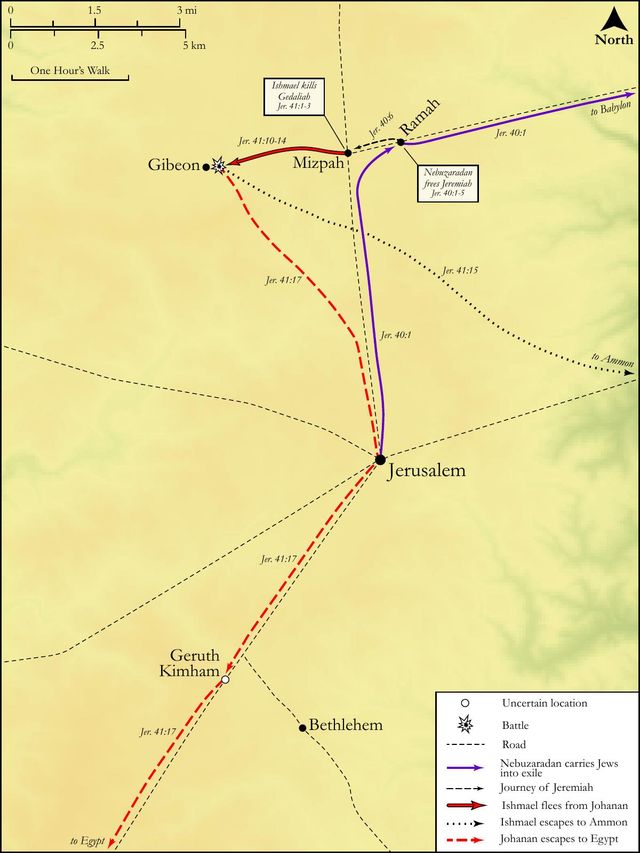
Study this verse
Public-domain commentary
Matthew Henry
From his Commentary on the Whole Bible. Henry comments on passages, not single verses — this entry covers Jeremiah 41:1–10. His two-level outline is real structure in the source text, so it is rendered as structure.
It is hard to say which is more astonishing, God's permitting or men's perpetrating such villanies as here we find committed. Such base, barbarous, bloody work is here done by men who by their birth should have been men of honour, by their religion just men, and this done upon those of their own nature, their own nation, their own religion, and now their brethren in affliction, when they were all brought under the power of the victorious Chaldeans, and smarting under the judgments of God, upon no provocation, nor with any prospect of advantage - all done, not only in cold blood, but with art and management. We have scarcely such an instance of perfidious cruelty in all the scripture; so that with John, when he saw the woman drunk with the blood of the saints, we may well wonder with great admiration. But God permitted it for the completing of the ruin of an unhumbled people, and the filling up of the measure of their judgments, who had filled up the measure of their iniquities. Let it inspire us with an indignation at the wickedness of men and an awe of God's righteousness.
I.Ishmael and his party treacherously killed Gedaliah himself in the first place.
Though the king of Babylon had made him a great man, had given him a commission to be governor of the land which he had conquered, though God had made him a good man and a great blessing to his country, and his agency for its welfare was as life from the dead, yet neither could secure him. Ishmael was of the seed royal (Jer 41:1) and therefore jealous of Gedaliah's growing greatness, and enraged that he should merit and accept a commission under the king of Babylon. He had ten men with him that were princes of the king too, guided by the same peevish resentments that he was; these had been with Gedaliah before, to put themselves under his protection (Jer 40:8), and now came again to make him a visit; and they did eat bread together in Mizpah. he entertained them generously, and entertained no jealousy of them, notwithstanding the information given him by Johanan. They pretended friendship to him, and gave him no warning to stand on his guard; he was in sincerity friendly to them, and did all he could to oblige them. But those that did eat bread with him lifted up the heel against him. They did not pick a quarrel with him, but watched an opportunity, when they had him alone, and assassinated him, Jer 41:2.
II.They likewise put all to the sword that they found in arms there, both Jews and Chaldeans, all that were employed under Gedaliah or were in any capacity to revenge his death, Jer 41:3. As if enough of the blood of Israelites had not been shed by the Chaldeans, their own princes here mingle it with the blood of the Chaldeans. The vine-dressers and the husbandmen were busy in the fields, and knew nothing of this bloody massacre; so artfully was it carried on and concealed.
III.Some good honest men, that were going all in tears to lament the desolations of Jerusalem, were drawn in by Ishmael, and murdered with the rest. Observe,
1.Whence they came (Jer 41:5) - from Shechem, Samaria, and Shiloh, places that had been famous, but wee now reduced; they belonged to the ten tribes, but there were some in those countries that retained an affection for the worship of the God of Israel.
2.Whither they were going - to the house of the Lord, the temple at Jerusalem, which, no doubt, they had heard of the destruction of, and were going to pay their respects to its ashes, to see its ruins, that their eye might affect their heart with sorrow for them. They favour the dust thereof, Psa 102:14. They took offerings and incense in their hand, that if they should find any altar there, though it were but an altar of earth, and any priest ready to officiate, they might not be without something to offer; if not, yet they showed their good-will, as Abraham, when he came to the place of the altar, though the altar was gone. The people of God used to go rejoicing to the house of the Lord, but these went in the habit of mourners, with their clothes rent and their heads shaven; for the providence of God loudly called to weeping and mourning, because it was not with the faithful worshippers of God as in months past.
3.How they were decoyed into a fatal snare by Ishmael's malice. Hearing of their approach, he resolved to be the death of them too, so bloodthirsty was he. He seemed as if he hated every one that had the name of an Israelite or the face of an honest man. These pilgrims towards Jerusalem he had a spite to, for the sake of their errand. Ishmael went out to meet them with crocodiles' tears, pretending to bewail the desolations of Jerusalem as much as they; and, to try how they stood affected to Gedaliah and his government, he courted them into the town and found them to have a respect for him, which confirmed him in his resolution to murder them. He said, Come to Gedaliah, pretending he would have them come and live with him, when really he intended that they should come and die with him, Jer 41:6. They had heard such a character of Gedaliah that they were willing enough to be acquainted with him; but Ishmael, when he had them in the midst of the town, fell upon them and slew them (Jer 41:7), and no doubt took the offerings they had and converted them to his own use; for he that would not stick at such a murder would not stick at sacrilege. Notice is taken of his disposing of the dead bodies of these and the rest that he had slain; he tumbled them all into a great pit (Jer 41:7), the same pit that Asa king of Judah had digged long before, either in the city or adjoining to it, when he built or fortified Mizpah (Kg1 15:22), to be a frontier-garrison against Baasha king of Israel and for fear of him, Jer 41:9. Note, Those that dig pits with a good intention know not what bad use they may be put to, one time or other. He slew so many that he could not afford them each a grave, or would not do them so much honour, but threw them all promiscuously into one pit. Among these last that were doomed to the slaughter there were ten that obtained a pardon, by working, not on the compassion, but the covetousness, of those that had them at their mercy, Jer 41:8. They said to Ishmael, when he was about to suck their blood, like an insatiable horseleech, after that of the companions, Slay us not, for we have treasurers in the field, country treasures, large stocks upon the ground, abundance of such commodities as the country affords, wheat and barley, and oil and honey, intimating that they would discover it to him and put him in possession of it all, if he would spare them. Skin for skin, and all that a man has, will he give for his life. This bait prevailed. Ishmael saved them, not for the love of mercy, but for the love of money. Here were riches kept for the owners thereof, not to their hurt (Ecc 5:13) and to cause them to lose their lives (Job 31:39), but to their good and the preserving of their lives. Solomon observes that sometimes the ransom of a man's life is his riches. But those who think thus to bribe death, when it comes with commission, and plead with it, saying, Slay us not, for we have treasures in the field, will find death inexorable and themselves wretchedly deceived.
IV.He carried off the people prisoners.
The king's daughters (whom the Chaldeans cared not for troubling themselves with when they had the king's sons) and the poor of the land, the vine-dressers and husband-men, that were committed to Gedaliah's charge, were all led away prisoners towards the country of the Ammonites (Jer 41:10), Ishmael probably intending to make a present of them, as the trophies of his barbarous victory, to the king of that country, that set him on. This melancholy story is a warning to us never to be secure in this world. Worse may be yet to come when we think the worst is over; and that end of one trouble, which we fancy to be the end of all trouble, may prove to be the beginning of another, of a greater. These prisoners thought, Surely the bitterness of death, and of captivity, is past; and yet some died by the sword and others went into captivity. When we think ourselves safe, and begin to be easy, destruction may come that way that we little expect it. There is many a ship wrecked in the harbour. We can never be sure of peace on this side heaven.
Continue studying Jeremiah 41:5 across the web’s major study libraries — every link below opens this exact verse, chapter, or book on the destination site.
Read & Compare
 BibleGatewayThis verse in more than 200 translations and 70 languages.
 Bible.comThe YouVersion reader — hundreds of translations, reading plans, and highlights.
 ESV.orgCrossway's official English Standard Version reader.
 NET BibleThe NET translation with 60,000+ translators' notes on every rendering decision.
 STEP BibleTyndale House's free study tool — original text, vocabulary, and scholarly resources.
 BibliaLogos Bible Software's free web reader.
 USCCBThe New American Bible (Revised Edition) with the U.S. bishops' study notes.
Commentaries
 BibleHub CommentariesDozens of classic commentaries on this verse, gathered on one page.
 StudyLightMore than 100 commentary sets — the largest collection on the web.
 BibleRefPlain-English commentary on what this verse means, verse by verse.
 Enduring WordDavid Guzik's free commentary on this chapter, widely used by Bible teachers.
 Bible Study ToolsVerse commentary alongside Greek and Hebrew study aids.
Original Language & Research
- BibleHub InterlinearThe verse word by word — original language, transliteration, and English.
- BibleHub LexiconEvery word's original-language definition and Strong's entry.
 Blue Letter BibleDeep-study tools — Strong's numbers, concordance, and word studies.
 SefariaThe Hebrew text with Rashi and centuries of Jewish commentary.
Sermons, Hymns & Audio


TrulyRandomVerse is not affiliated with these sites and doesn’t control their content. They’re linked because they’re genuinely useful.
Summary
Jeremiah 41:5 vividly portrays a poignant and complex scene in the immediate aftermath of Jerusalem's destruction and Gedaliah's assassination. It describes eighty men from the historically significant northern cities of Shechem, Shiloh, and Samaria, making a pilgrimage to the ruined Temple site in Jerusalem. Their appearance—marked by shaven beards, torn clothes, and self-inflicted cuts—eloquently conveys profound grief and lamentation. Simultaneously, their carrying of traditional offerings and incense signifies a persistent, albeit spiritually mixed and potentially misguided, devotion to the "house of the LORD," underscoring the spiritual confusion and enduring attachment to sacred tradition amidst unprecedented national catastrophe.
Context
ShowHideLiterary Context
This verse is strategically placed immediately following the brutal and treacherous assassination of Gedaliah, the Babylonian-appointed governor, and his Jewish and Chaldean companions by Ishmael and his ten men, as detailed in Jeremiah 41:1-3. The arrival of these eighty men, seemingly unaware of the recent massacre, creates a jarring and unsettling juxtaposition. Their solemn pilgrimage to the desolate Temple site highlights a continuity of spiritual longing that stands in stark contrast to the political chaos, violence, and betrayal unfolding around them. This brief interlude of grief-stricken devotion precedes Ishmael's subsequent abduction of the remaining people and their eventual flight towards Egypt, a narrative arc that continues through Jeremiah 42 and Jeremiah 43. Thus, Jeremiah 41:5 serves as a powerful illustration of the deep spiritual and emotional turmoil experienced by the remnant of Judah in the immediate aftermath of the exile and the catastrophic destruction of their sacred institutions.
Historical & Cultural Context
The backdrop for Jeremiah 41:5 is the harrowing period following the fall of Jerusalem to Babylon in 586 BC and the subsequent Babylonian exile. The glorious Temple, once the spiritual heart of Israel, lay in desolate ruins. The men mentioned hail from Shechem, Shiloh, and Samaria—cities historically significant to the northern kingdom of Israel, which had fallen to Assyria centuries earlier. Their pilgrimage to Jerusalem, despite the city's devastation and the recent political upheaval, speaks to an enduring, pan-Israelite spiritual attachment to the "house of the LORD." Their physical actions—shaven beards and rent clothes—were universally recognized signs of extreme grief and mourning in Israel, lamenting national tragedy and desolation. However, the act of "cutting themselves" was explicitly forbidden by Mosaic Law (as seen in Deuteronomy 14:1 and Leviticus 19:28), indicating a blend of genuine sorrow with potentially syncretistic or misguided religious practices, perhaps born out of desperation or ignorance during a time of immense national trauma and spiritual disarray.
Key Themes
ShowHideJeremiah 41:5 powerfully illustrates several key themes prevalent in the book of Jeremiah and this period of Israelite history. Firstly, it highlights Profound Mourning and Lament for the destruction of Jerusalem and the Temple, visibly expressed through the men's physical actions of grief. Secondly, it demonstrates an Enduring Spiritual Connection to the sacred site, as individuals from distant regions still felt compelled to bring offerings and incense to the ruined "house of the LORD," signifying the persistent significance of Jerusalem as the center of worship. Thirdly, the verse reveals the presence of Religious Syncretism or Compromise, as the men engage in forbidden self-mutilation alongside legitimate acts of worship, underscoring the spiritual confusion and the erosion of pure Mosaic practices during a time of national crisis. Finally, these men represent a Persistent Remnant—a segment of the population not exiled—who, despite their imperfections, maintained some form of spiritual connection to the covenant and the traditions of their forefathers, even if imperfectly understood or practiced.
Exposition and Analysis
ShowHideKey Word Analysis
ShowHideThis primitive root, translated as "having cut themselves," carries the meaning "to crowd" or "to gash (as if by pressing into)." In this context, it refers to the self-inflicted gashes or incisions made on the body as a sign of extreme grief or religious fervor. This practice was explicitly forbidden in Mosaic Law, marking it as a pagan mourning ritual often associated with Baal worship (1 Kings 18:28). Its inclusion here highlights the spiritual compromise or desperation prevalent among some Israelites during this period of national trauma.
Translated as "offerings," this term denotes a "donation," "tribute," or specifically a "sacrificial offering (usually bloodless and voluntary)." It refers to grain offerings, meal offerings, or gifts brought to God. The fact that these men carried minchâh alongside incense indicates their intent to perform acts of worship and devotion, even though the Temple was destroyed. This juxtaposition of legitimate offerings with forbidden mourning practices underscores the complex spiritual state of the people.
Meaning "house," this versatile word is used here in the phrase "the house of the LORD." While it can refer to a physical dwelling, it most prominently denotes the Temple in Jerusalem. Even though the Temple lay in ruins, the site itself retained immense spiritual significance for these pilgrims, symbolizing the enduring presence of God and the center of Israelite worship, despite its physical desolation.
Verse Breakdown
ShowHide"That there came certain from Shechem, from Shiloh, and from Samaria, [even] fourscore men"
This clause identifies the origin and number of the pilgrims. Their provenance from the historically northern cities of Shechem, Shiloh, and Samaria, which were part of the former kingdom of Israel, indicates a broader, pan-Israelite spiritual connection to Jerusalem. This connection transcended the political and geographical divisions that had existed for centuries, demonstrating a persistent spiritual unity despite national fragmentation. The "fourscore men" (eighty men) represent a significant group, underscoring the collective and intentional nature of their pilgrimage.
"having their beards shaven, and their clothes rent, and having cut themselves"
This describes the physical state and actions of the men, which are potent visual cues of extreme lamentation and distress. Shaving beards and tearing clothes were traditional and acceptable signs of deep mourning and distress in ancient Israel, often performed in response to national tragedy or personal loss. However, the phrase "having cut themselves" points to self-mutilation, a practice explicitly forbidden by God's law as it was associated with pagan mourning rites and idolatry. This detail reveals a troubling blend of genuine grief with practices that deviated from covenantal purity, reflecting the spiritual disarray of the time.
"with offerings and incense in their hand, to bring [them] to the house of the LORD"
This final clause clarifies the explicit purpose of their arduous journey. Despite their outward signs of distress and their engagement in forbidden rituals, their ultimate intention was to bring legitimate "offerings" (bloodless sacrifices, typically grain or meal offerings) and "incense"—elements central to Israelite worship—to the sacred site of the Temple in Jerusalem. This demonstrates a persistent, if imperfect, desire to connect with God and observe ancient traditions, even in the face of utter devastation and the absence of a functioning Temple.
Literary Devices
ShowHideJeremiah 41:5 employs several powerful literary devices to convey its complex message and evoke deep emotional resonance. Juxtaposition is profoundly evident, as the scene of these devout, albeit misguided, pilgrims arriving in deep mourning immediately follows the brutal and treacherous assassination of Gedaliah and his men. This stark contrast highlights the profound chaos and spiritual fragmentation of the time, where acts of profound violence and sincere, yet flawed, devotion exist side-by-side. Symbolism is richly used through the men's physical appearance: their shaven beards and rent clothes are universal symbols of extreme grief, national humiliation, and profound sorrow. Their self-inflicted cuts, conversely, symbolize a desperate, syncretistic form of lament that tragically violates divine law. The offerings and incense, despite the context, symbolize a tenacious, if imperfect, spiritual longing and adherence to ancient worship traditions. The overall effect evokes pathos, drawing the reader into the profound sorrow, spiritual confusion, and desperate hope of a people grappling with the utter desolation of their sacred institutions and national identity.
Theological and Thematic Connections
ShowHideJeremiah 41:5 offers a profound theological insight into the human response to divine judgment and national catastrophe. It reveals a people deeply wounded and in mourning, yet still driven by an innate spiritual longing to connect with God at His designated dwelling place, even when that place lies in ruins. The paradox lies in their sincere devotion being mixed with practices explicitly forbidden by the very God they sought to honor. This highlights the dangers of syncretism and the erosion of pure worship when a people are under immense duress and lack clear spiritual leadership. Their actions underscore that outward displays of piety, even those born of deep emotion, do not automatically equate to worship that is pleasing to God if it deviates from His revealed will. The verse serves as a sober reminder that true worship requires not only heartfelt devotion but also obedience and adherence to God's commands, especially regarding the purity and integrity of spiritual practices.
Reflection and Application
ShowHideJeremiah 41:5 provides a powerful mirror for contemporary believers, inviting us to reflect on the nature of our own devotion and worship, especially in times of personal or collective distress. The men from Shechem, Shiloh, and Samaria demonstrate an undeniable spiritual hunger and a deep attachment to sacred tradition, even when the physical manifestation of their faith (the Temple) is destroyed. This speaks to the enduring human need for God, for sacred spaces, and for communal expressions of faith. However, their inclusion of forbidden practices serves as a crucial warning: genuine emotion and sincere intent are not sufficient if our worship deviates from God's revealed truth. In our own lives, we must guard against blending our faith with cultural norms, personal preferences, or desperate measures that contradict biblical principles, even when driven by profound grief or perceived necessity. This verse challenges us to examine whether our worship is truly "in spirit and in truth," aligning with God's Word rather than merely human tradition, emotional impulse, or syncretistic practices. It also encourages perseverance in faith, reminding us that even amidst desolation and chaos, the longing for God's presence can persist and guide us to seek Him in ways that are both heartfelt and obedient.
Questions for Reflection
ShowHideFAQ
ShowHideWhy were these men from northern cities coming to Jerusalem, especially after its destruction?
ShowHideDespite the political division that had long existed between the northern kingdom of Israel and the southern kingdom of Judah, and even after Jerusalem's devastating destruction by Babylon, the city and its Temple site retained immense spiritual significance for many Israelites. Jerusalem was the designated place where God's name dwelt, the historical center of Israelite worship, and the location of the most significant festivals. Their pilgrimage demonstrates a deep-seated, enduring attachment to the covenant and the sacred traditions associated with the "house of the LORD," even in its ruined state. It shows that spiritual devotion and a sense of national identity could transcend political boundaries and physical devastation, reflecting a persistent hope or a profound lament for what was lost, even if expressed imperfectly.
Why did they engage in forbidden practices like cutting themselves?
ShowHideThe practice of self-mutilation (cutting oneself) was a common mourning ritual among the nations, often associated with pagan deities and their cults (e.g., the prophets of Baal in 1 Kings 18:28). While it was explicitly forbidden by Mosaic Law for Israelites (as stated in Deuteronomy 14:1 and Leviticus 19:28), it likely persisted among some segments of the population. During times of immense national trauma and spiritual confusion, people might resort to desperate or syncretistic practices, either out of ignorance of the Law, a desire to express extreme grief, or the pervasive influence of the pagan nations round about. This detail highlights a troubling blend of genuine sorrow and a lapse in adherence to God's revealed will, underscoring the spiritual challenges and syncretism present in Judah during this dark period.
Christ-Centered Fulfillment
ShowHideJeremiah 41:5, with its depiction of a people mourning a destroyed physical temple yet seeking to offer worship, finds its ultimate Christ-centered fulfillment in the person and work of Jesus. The ruined "house of the LORD" foreshadows the profound shift from a physical dwelling place for God to a spiritual one. Jesus Himself declared, "Destroy this temple, and in three days I will raise it up," speaking of the temple of His body (John 2:19-21). He is the true Temple, the ultimate meeting place between God and humanity, rendering all physical structures and their associated rituals secondary. The offerings and incense carried by the men, though well-intentioned, point to Christ's perfect and once-for-all sacrifice, which completely fulfills and supersedes the need for animal offerings and incense (Hebrews 10:1-10). Furthermore, the shift from localized worship to worship "in spirit and truth" (John 4:21-24) means that believers no longer need to journey to a physical site, ruined or otherwise, to encounter God. Instead, through Christ, we have direct and confident access to the Father, with Jesus serving as our great High Priest and intercessor (Hebrews 4:14-16). The deep mourning for a lost physical center ultimately finds its redemption in the spiritual lament for sin, which Christ, the Lamb of God, alone can take away (John 1:29). Thus, the mixed and imperfect devotion of these pilgrims gives way to the perfect devotion of Christ, who establishes a new covenant where true worship is centered on Him and His finished work, enabling all believers to approach God's throne of grace.