


Jeremiah 41:4
- וַיְהִיvay·Hiand it wasH1961Conj-w ¦ V-Qal-ConsecImperf-3msVerb Qal Consecutive Imperfect 3rd Singular Masculineוַandיְהִיit was
- בַּיּוֹםbai·Yomon the dayH3117Prep-b ¦ N-msNoun Singular Masculine Absoluteבַּon theיּוֹםday
- הַשֵּׁנִיha·she·Ni<the> secondH8145Art ¦ Adj-msAdjective Numerical Position Singular Masculine Absoluteהַ<the>שֵּׁנִיsecond
- לְהָמִיתle·ha·Mitof killingH4191Prep-l ¦ V-Hiphil-InfVerb Hiphil Infinitive Constructלְofהָמִיתkilling
- אֶת'et<obj.>H853DirObjMParticle Object Indicator
- גְּדַלְיָהוּge·dal·Ya·huGedaliahH1436N-proper-mNoun Proper Masculine
- וְאִישׁve·'Ishand anyoneH376Conj-w ¦ N-msNoun Singular Masculine Absoluteוְandאִישׁanyone
- לֹאlo'notH3808NegParticle Negative
- יָדָעya·Da'he knewH3045V-Qal-Perf-3msVerb Qal Perfect 3rd Singular Masculine
English is a literal word-by-word gloss of the Hebrew, not the KJV's wording. Why?
This is the original text the KJV's translators worked from — each Hebrew word with its own literal English meaning in this verse, prepared by scholars at Tyndale House, Cambridge. The KJV translates whole sentences, not word by word, so its wording differs: one Hebrew word can become several English words, and the KJV may choose “the LORD” where the gloss reads “Yahweh”. Both are faithful — they answer different questions. For the KJV's own rendering, switch to the KJV text.
Details
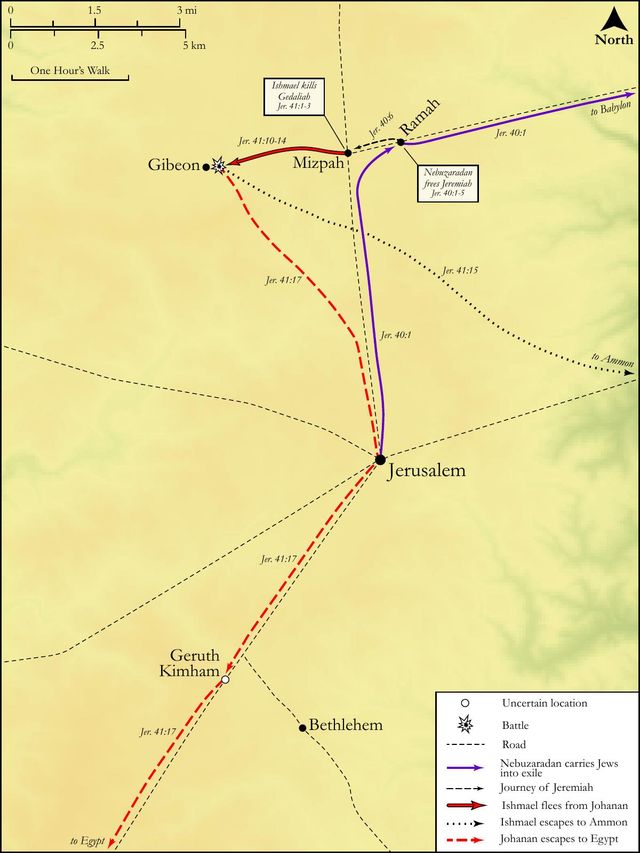
See on the biblical-era map
Study this verse
Public-domain commentary
Matthew Henry
From his Commentary on the Whole Bible. Henry comments on passages, not single verses — this entry covers Jeremiah 41:1–10. His two-level outline is real structure in the source text, so it is rendered as structure.
It is hard to say which is more astonishing, God's permitting or men's perpetrating such villanies as here we find committed. Such base, barbarous, bloody work is here done by men who by their birth should have been men of honour, by their religion just men, and this done upon those of their own nature, their own nation, their own religion, and now their brethren in affliction, when they were all brought under the power of the victorious Chaldeans, and smarting under the judgments of God, upon no provocation, nor with any prospect of advantage - all done, not only in cold blood, but with art and management. We have scarcely such an instance of perfidious cruelty in all the scripture; so that with John, when he saw the woman drunk with the blood of the saints, we may well wonder with great admiration. But God permitted it for the completing of the ruin of an unhumbled people, and the filling up of the measure of their judgments, who had filled up the measure of their iniquities. Let it inspire us with an indignation at the wickedness of men and an awe of God's righteousness.
I.Ishmael and his party treacherously killed Gedaliah himself in the first place.
Though the king of Babylon had made him a great man, had given him a commission to be governor of the land which he had conquered, though God had made him a good man and a great blessing to his country, and his agency for its welfare was as life from the dead, yet neither could secure him. Ishmael was of the seed royal (Jer 41:1) and therefore jealous of Gedaliah's growing greatness, and enraged that he should merit and accept a commission under the king of Babylon. He had ten men with him that were princes of the king too, guided by the same peevish resentments that he was; these had been with Gedaliah before, to put themselves under his protection (Jer 40:8), and now came again to make him a visit; and they did eat bread together in Mizpah. he entertained them generously, and entertained no jealousy of them, notwithstanding the information given him by Johanan. They pretended friendship to him, and gave him no warning to stand on his guard; he was in sincerity friendly to them, and did all he could to oblige them. But those that did eat bread with him lifted up the heel against him. They did not pick a quarrel with him, but watched an opportunity, when they had him alone, and assassinated him, Jer 41:2.
II.They likewise put all to the sword that they found in arms there, both Jews and Chaldeans, all that were employed under Gedaliah or were in any capacity to revenge his death, Jer 41:3. As if enough of the blood of Israelites had not been shed by the Chaldeans, their own princes here mingle it with the blood of the Chaldeans. The vine-dressers and the husbandmen were busy in the fields, and knew nothing of this bloody massacre; so artfully was it carried on and concealed.
III.Some good honest men, that were going all in tears to lament the desolations of Jerusalem, were drawn in by Ishmael, and murdered with the rest. Observe,
1.Whence they came (Jer 41:5) - from Shechem, Samaria, and Shiloh, places that had been famous, but wee now reduced; they belonged to the ten tribes, but there were some in those countries that retained an affection for the worship of the God of Israel.
2.Whither they were going - to the house of the Lord, the temple at Jerusalem, which, no doubt, they had heard of the destruction of, and were going to pay their respects to its ashes, to see its ruins, that their eye might affect their heart with sorrow for them. They favour the dust thereof, Psa 102:14. They took offerings and incense in their hand, that if they should find any altar there, though it were but an altar of earth, and any priest ready to officiate, they might not be without something to offer; if not, yet they showed their good-will, as Abraham, when he came to the place of the altar, though the altar was gone. The people of God used to go rejoicing to the house of the Lord, but these went in the habit of mourners, with their clothes rent and their heads shaven; for the providence of God loudly called to weeping and mourning, because it was not with the faithful worshippers of God as in months past.
3.How they were decoyed into a fatal snare by Ishmael's malice. Hearing of their approach, he resolved to be the death of them too, so bloodthirsty was he. He seemed as if he hated every one that had the name of an Israelite or the face of an honest man. These pilgrims towards Jerusalem he had a spite to, for the sake of their errand. Ishmael went out to meet them with crocodiles' tears, pretending to bewail the desolations of Jerusalem as much as they; and, to try how they stood affected to Gedaliah and his government, he courted them into the town and found them to have a respect for him, which confirmed him in his resolution to murder them. He said, Come to Gedaliah, pretending he would have them come and live with him, when really he intended that they should come and die with him, Jer 41:6. They had heard such a character of Gedaliah that they were willing enough to be acquainted with him; but Ishmael, when he had them in the midst of the town, fell upon them and slew them (Jer 41:7), and no doubt took the offerings they had and converted them to his own use; for he that would not stick at such a murder would not stick at sacrilege. Notice is taken of his disposing of the dead bodies of these and the rest that he had slain; he tumbled them all into a great pit (Jer 41:7), the same pit that Asa king of Judah had digged long before, either in the city or adjoining to it, when he built or fortified Mizpah (Kg1 15:22), to be a frontier-garrison against Baasha king of Israel and for fear of him, Jer 41:9. Note, Those that dig pits with a good intention know not what bad use they may be put to, one time or other. He slew so many that he could not afford them each a grave, or would not do them so much honour, but threw them all promiscuously into one pit. Among these last that were doomed to the slaughter there were ten that obtained a pardon, by working, not on the compassion, but the covetousness, of those that had them at their mercy, Jer 41:8. They said to Ishmael, when he was about to suck their blood, like an insatiable horseleech, after that of the companions, Slay us not, for we have treasurers in the field, country treasures, large stocks upon the ground, abundance of such commodities as the country affords, wheat and barley, and oil and honey, intimating that they would discover it to him and put him in possession of it all, if he would spare them. Skin for skin, and all that a man has, will he give for his life. This bait prevailed. Ishmael saved them, not for the love of mercy, but for the love of money. Here were riches kept for the owners thereof, not to their hurt (Ecc 5:13) and to cause them to lose their lives (Job 31:39), but to their good and the preserving of their lives. Solomon observes that sometimes the ransom of a man's life is his riches. But those who think thus to bribe death, when it comes with commission, and plead with it, saying, Slay us not, for we have treasures in the field, will find death inexorable and themselves wretchedly deceived.
IV.He carried off the people prisoners.
The king's daughters (whom the Chaldeans cared not for troubling themselves with when they had the king's sons) and the poor of the land, the vine-dressers and husband-men, that were committed to Gedaliah's charge, were all led away prisoners towards the country of the Ammonites (Jer 41:10), Ishmael probably intending to make a present of them, as the trophies of his barbarous victory, to the king of that country, that set him on. This melancholy story is a warning to us never to be secure in this world. Worse may be yet to come when we think the worst is over; and that end of one trouble, which we fancy to be the end of all trouble, may prove to be the beginning of another, of a greater. These prisoners thought, Surely the bitterness of death, and of captivity, is past; and yet some died by the sword and others went into captivity. When we think ourselves safe, and begin to be easy, destruction may come that way that we little expect it. There is many a ship wrecked in the harbour. We can never be sure of peace on this side heaven.
Continue studying Jeremiah 41:4 across the web’s major study libraries — every link below opens this exact verse, chapter, or book on the destination site.
Read & Compare
 BibleGatewayThis verse in more than 200 translations and 70 languages.
 Bible.comThe YouVersion reader — hundreds of translations, reading plans, and highlights.
 ESV.orgCrossway's official English Standard Version reader.
 NET BibleThe NET translation with 60,000+ translators' notes on every rendering decision.
 STEP BibleTyndale House's free study tool — original text, vocabulary, and scholarly resources.
 BibliaLogos Bible Software's free web reader.
 USCCBThe New American Bible (Revised Edition) with the U.S. bishops' study notes.
Commentaries
 BibleHub CommentariesDozens of classic commentaries on this verse, gathered on one page.
 StudyLightMore than 100 commentary sets — the largest collection on the web.
 BibleRefPlain-English commentary on what this verse means, verse by verse.
 Enduring WordDavid Guzik's free commentary on this chapter, widely used by Bible teachers.
 Bible Study ToolsVerse commentary alongside Greek and Hebrew study aids.
Original Language & Research
- BibleHub InterlinearThe verse word by word — original language, transliteration, and English.
- BibleHub LexiconEvery word's original-language definition and Strong's entry.
 Blue Letter BibleDeep-study tools — Strong's numbers, concordance, and word studies.
 SefariaThe Hebrew text with Rashi and centuries of Jewish commentary.
Sermons, Hymns & Audio


TrulyRandomVerse is not affiliated with these sites and doesn’t control their content. They’re linked because they’re genuinely useful.
Summary
Jeremiah 41:4 marks a chilling and pivotal moment in the tragic aftermath of Jerusalem's fall, revealing the calculated secrecy surrounding Ishmael's treacherous actions. On the second day following his brutal assassination of Gedaliah, the Babylonian-appointed governor, Ishmael's subsequent movements and intentions remained entirely unknown to the broader populace. This verse powerfully underscores the clandestine nature of his ongoing conspiracy, setting the stage for further deception and highlighting the profound vulnerability of the unsuspecting remnant in Judah, who were left without leadership or awareness of the hidden danger.
Context
ShowHideLiterary Context
This verse is situated within a deeply tumultuous and sorrowful period in the book of Jeremiah, specifically detailing the fate of the Jewish remnant left in Judah after the destruction of Jerusalem and the Babylonian exile (Chapters 40-44). Jeremiah 40 recounts Nebuchadnezzar's appointment of Gedaliah as governor, offering a fragile hope for stability and a return to normal life. However, this peace is violently shattered in Jeremiah 41, where Ishmael, a man of royal descent, orchestrates the brutal murder of Gedaliah and his companions (Jeremiah 41:1-3). Verse 4 immediately follows this horrific act, emphasizing the critical element of secrecy that allowed Ishmael to continue his nefarious plans, as detailed in Jeremiah 41:5-10. The lack of public knowledge is not merely an observation but a crucial plot device, enabling Ishmael's subsequent deception of the eighty men from Shechem, Shiloh, and Samaria, who were unaware of the recent massacre at Mizpah.
Historical & Cultural Context
Following the catastrophic destruction of Jerusalem in 586 BC and the deportation of many Jews to Babylon, Nebuchadnezzar appointed Gedaliah, a trusted figure from a prominent family (the son of Ahikam, who had previously protected Jeremiah in Jeremiah 26:24), as governor over the remaining Jewish population. His appointment aimed to establish a stable, vassal state, offering a chance for the land to recover. Ishmael, described as "of the royal family" (Jeremiah 41:1), represented a faction likely resentful of Babylonian rule and Gedaliah's cooperation. He harbored aspirations to restore a Judean monarchy or align with Ammonite interests, as suggested by his connection to Baalis, king of the Ammonites (Jeremiah 40:14). The cultural context highlights the deep political divisions and profound instability in post-conquest Judah, where loyalty was fractured, and violent power struggles were common. The clandestine nature of Ishmael's actions reflects the desperate and ruthless tactics employed in such a volatile environment, where swift, decisive, and hidden moves could grant a temporary advantage to those seeking power.
Key Themes
ShowHideThis verse powerfully contributes to several overarching themes in the book of Jeremiah. Firstly, it starkly illustrates the theme of Treachery and Betrayal, as Ishmael, a fellow Israelite, betrays the trust placed in Gedaliah and the fragile peace he sought to establish for the remnant. The explicit mention of "no man knew it" amplifies the depth of this betrayal, transforming it from a mere act of violence into a calculated act of deceit and conspiracy. Secondly, it highlights the pervasive theme of Chaos and Instability that plagued Judah after the fall of Jerusalem, demonstrating how even a well-intentioned leader like Gedaliah could not prevent the internal strife that continued to unravel the nation. Thirdly, the verse speaks to the theme of Human Depravity and the Consequences of Sin, showing how one act of violence (Gedaliah's murder) begets further calculated evil, operating under the cover of darkness. Ishmael's actions illustrate the self-destructive path of those who prioritize personal ambition or misguided nationalism over peace and righteousness, ultimately leading the remnant into further suffering and exile, culminating in their disobedience and flight to Egypt (Jeremiah 43:1-7).
Exposition and Analysis
ShowHideKey Word Analysis
ShowHideThis name, meaning "Jah has become great," carries a poignant irony in this context. Gedaliah was the son of Ahikam and grandson of Shaphan, a family known for their loyalty to Jeremiah and their reformist tendencies during Josiah's reign. Appointed by the Babylonians as governor, he represented the last vestige of stable, albeit foreign-imposed, leadership for the remnant in Judah. His assassination, despite his name signifying divine greatness, tragically plunged the already devastated land into further chaos and fear, leading to the desperate flight to Egypt, against God's direct command.
This term refers to a literal day, often encompassing the period from sunrise to sunset or from one sunset to the next. In the phrase "the second day," it precisely dates the events, indicating that Ishmael did not immediately flee after the assassination of Gedaliah. This temporal detail is crucial; it highlights a deliberate pause in Ishmael's plan, allowing him time to consolidate his position, plan his next moves, or simply for the immediate shock of the murders to subside before executing his further deceptions. The specific timing underscores the methodical and calculated nature of his treachery.
This primitive root signifies "to know," encompassing a wide spectrum of understanding, from simple observation to intimate acquaintance, discernment, and even instruction. In the context of "no man knew it" (וְאִישׁ לֹא יָדַע), it emphasizes the complete absence of public awareness or comprehension regarding Ishmael's heinous act and his continued presence at Mizpah. This lack of knowledge was not accidental but a calculated strategic advantage for Ishmael, allowing him to exploit the ignorance of others and further his deceptive plans before news could spread or resistance could be mounted. It powerfully highlights the element of stealth and the profound vulnerability of those unaware of the hidden danger.
Verse Breakdown
ShowHide"And it came to pass the second day after he had slain Gedaliah,"
This clause precisely establishes the timeline of events following the initial massacre. The phrase "the second day" is critical, indicating that Ishmael did not immediately flee Mizpah after murdering Gedaliah and his Chaldean and Jewish companions (Jeremiah 41:2-3). Instead, he remained at the site of the murders for at least another full day. This delay suggests a deliberate, calculated pause, perhaps to ensure the complete silence of his victims, to consolidate his position, or to plan the next phase of his treacherous scheme, which involved intercepting unsuspecting pilgrims. It reveals the cold, methodical nature of Ishmael's conspiracy.
"and no man knew [it],"
This powerful and chilling statement reveals the absolute secrecy surrounding Ishmael's actions. The murder of Gedaliah, the governor, and his guards, along with Ishmael's continued presence and machinations at Mizpah, were kept entirely hidden from the general populace. This profound lack of awareness was a strategic advantage for Ishmael, enabling him to intercept a group of eighty pilgrims coming from Shechem, Shiloh, and Samaria on their way to Jerusalem (Jeremiah 41:5), exploiting their ignorance of the recent tragedy. The secrecy underscores the depth of Ishmael's cunning and the extreme vulnerability of a populace left without leadership or accurate information, making them susceptible to his murderous deception.
Literary Devices
ShowHideJeremiah 41:4 masterfully employs several literary devices to heighten the dramatic tension and underscore the tragic nature of the unfolding events. The most prominent is Dramatic Irony, where the audience is fully aware of the horrific truth of Gedaliah's assassination and Ishmael's continued presence and malevolent intentions, while the characters within the narrative (specifically the unsuspecting populace and the pilgrims in subsequent verses) remain tragically ignorant. This creates a palpable sense of Suspense as the reader anticipates the inevitable clash between Ishmael's hidden malice and his unsuspecting victims. The simple, declarative statement "and no man knew [it]" functions as a profound form of Understatement, as the far-reaching and devastating implications of this lack of knowledge—the vulnerability of the remnant and the opportunity for further bloodshed—are far greater than the plain words suggest. This element of secrecy also serves as a powerful Foreshadowing of the deeper deception and violence that Ishmael will perpetrate, revealing how evil often thrives and expands under the cover of darkness and ignorance.
Theological and Thematic Connections
ShowHideJeremiah 41:4 profoundly illustrates the destructive power of hidden sin and the vulnerability of humanity in the face of concealed evil. The theological implication is that while human eyes may be blind to clandestine acts, God's knowledge is absolute and all-encompassing. Ishmael's attempt to operate in secrecy, believing his deeds were unknown, stands in stark contrast to the divine omnipresence. This verse serves as a sober reminder that true justice and accountability ultimately rest with a God who "sees what is done in secret" (Matthew 6:4). The treachery and deception described here underscore the fallen nature of humanity and the tragic consequences when individuals prioritize selfish ambition over righteousness and peace, leading to further suffering for an already devastated people. It highlights the pervasive nature of sin's corruption, even among the remnant, leading to internal strife that compounds external pressures.
Reflection and Application
ShowHideThe chilling reality of Jeremiah 41:4, where a heinous crime and its perpetrator remain hidden, serves as a powerful mirror for personal and societal reflection. It reminds us that evil often thrives in the shadows, nurtured by secrecy and deception. Just as Ishmael's hidden actions led to further tragedy for the remnant, so too can unconfessed sin or unaddressed injustices fester and cause widespread harm within our own lives and communities. This verse calls us to a profound self-examination: are there areas where we operate in secrecy, hoping to conceal our true motives or actions from others or even from God? Do we, by our silence or inaction, inadvertently contribute to cultures of secrecy that allow injustice to persist or evil to flourish unchecked? The passage challenges us to be people of truth and transparency, recognizing that while human eyes may not know, nothing is hidden from the all-seeing God. It compels us to pray for discernment to expose hidden evils and to champion truth, even when it is difficult or unpopular, trusting that God will ultimately bring all things into the light, ensuring that justice prevails.
Questions for Reflection
ShowHideFAQ
ShowHideWhy was it important that "no man knew [it]"?
ShowHideThe secrecy was absolutely crucial for Ishmael's continued deception and strategic advantage. If the public had known about Gedaliah's assassination, Ishmael would have been immediately apprehended or faced organized resistance. By keeping his actions hidden for "the second day," he was able to intercept a group of unsuspecting pilgrims from Shechem, Shiloh, and Samaria (Jeremiah 41:5), lure them to Mizpah under false pretenses, and then murder most of them, taking the rest captive. This highlights his cunning, ruthless determination to consolidate power, and his exploitation of the chaos he had created.
What was Ishmael's motive for assassinating Gedaliah and acting in secrecy?
ShowHideIshmael, being "of the royal family" (Jeremiah 41:1), likely harbored deep resentment towards Gedaliah's appointment by the Babylonians as governor. His motives appear to be a complex mix of political ambition (perhaps hoping to restore a Judean monarchy under his own leadership), loyalty to a rival faction (possibly aligned with Baalis, king of the Ammonites, as mentioned in Jeremiah 40:14), and a deep-seated animosity towards those cooperating with Babylon. The secrecy allowed him to carry out his coup without immediate opposition, hoping to seize control of the remaining Jewish population and resources before any counter-action could be mounted.
What happened immediately after "no man knew it"?
ShowHideImmediately following this verse, Ishmael's treachery escalated. He encountered eighty men on their way to Jerusalem to offer sacrifices and mourn the temple's destruction (Jeremiah 41:5). He lured them to Mizpah under the pretense of meeting Gedaliah, then brutally murdered seventy of them, throwing their bodies into a cistern (Jeremiah 41:7-9). He then took the remaining ten men, along with the king's daughters and Jeremiah, captive, intending to flee to Ammon (Jeremiah 41:10). This sequence of events vividly demonstrates how his initial act of secrecy enabled further horrific deeds and deepened the tragedy for the remnant.
Christ-Centered Fulfillment
ShowHideJeremiah 41:4, with its stark portrayal of hidden treachery and a world ignorant of unfolding evil, finds profound Christ-centered fulfillment in the person and work of Jesus. In sharp contrast to Ishmael's clandestine acts and the darkness in which he operated, Jesus's life, death, and resurrection were public and transparent, fulfilling prophecies "not done in a corner" (Acts 26:26). While Ishmael sought to deceive and destroy under the cover of darkness, Jesus is the "light of the world" who came to expose the works of darkness and bring truth into the open (John 8:12; John 3:19-21). The "no man knew it" of Jeremiah's time speaks to humanity's spiritual blindness to sin and its devastating consequences, a blindness that Christ came to heal, revealing the true nature of God and the path to salvation (John 9:39). Ultimately, while Ishmael's hidden deeds led to further death, chaos, and exile for the remnant, Christ's public sacrifice on the cross, the ultimate act of love and truth, conquered sin and death, offering true freedom and eternal life to all who believe. His saving work is not hidden but is to be "proclaimed in all the world" (Romans 1:8), ensuring that His redemptive triumph is "known throughout the earth" (Psalm 98:2).