


Acts 26:26
Bible text: King James Version (1769 Blayney text) · Public domain
Bible text: King James Version with Strong's numbers · Public domain
Bible text: Berean Standard Bible · Public domain
Bible text: American Standard Version (1901) · Public domain
Bible text: World English Bible, Messianic edition · Public domain
Bible text: Geneva Bible (1599) · Public domain
Bible text: Young's Literal Translation · Public domain
- ἐπίσταταιepistataiUnderstandsG1987V-PNI-3SVerb Present Middle Or Passive Deponent Indicative 3rd Singular
- γὰρgarforG1063CONJConjunction
- περὶpericoncerningG4012PREPPreposition
- τούτωνtoutōnthese thingsG3778D-GPNDemonstrative pronoun Genitive Plural Neuter
- ὁhotheG3588T-NSMDefinite article Nominative Singular Masculine
- βασιλεύςbasileuskingG935N-NSMNoun Nominative Singular Masculine
- πρὸςprostoG4314PREPPreposition
- ὃνhonwhomG3739R-ASMRelative pronoun Accusative Singular Masculine
- καὶkaialsoG2532CONJConjunction
- παρρησιαζόμενοςparrēsiazomenosusing boldnessG3955V-PNP-NSMVerb Present Middle Or Passive Deponent Participle Nominative Singular Masculine
- λαλῶ·lalōI speakG2980V-PAI-1SVerb Present Active Indicative 1st Singular
- λανθάνεινlanthaneinHidingG2990V-PANVerb Present Active Infinitive
- γὰρgarforG1063CONJConjunction
- αὐτόνautonhimG846P-ASMPersonal pronoun Accusative Singular Masculine
- τιtianyG5100X-ASNIndefinite pronoun Accusative Singular Neuter
- τούτωνtoutōnof these thingsG3778D-GPNDemonstrative pronoun Genitive Plural Neuter
- οὐounotG3756PRT-NNegative Particle Negative
- πείθομαιpeithomaiI am persuadedG3982V-PPI-1SVerb Present Passive Indicative 1st Singular
- οὐθέν·outhenno [thing]G3762A-ASNAdjective Accusative Singular Neuter
- οὐounotG3756PRT-NNegative Particle Negative
- γάρgarforG1063CONJConjunction
- ἐστινestinisG1510V-PAI-3SVerb Present Active Indicative 3rd Singular
- ἐνeninG1722PREPPreposition
- γωνίᾳgōniaa cornerG1137N-DSFNoun Dative Singular Feminine
- πεπραγμένονpepragmenondoneG4238V-RPP-NSNVerb Perfect Passive Participle Nominative Singular Neuter
- τοῦτοtoutoof these thingsG3778D-NSNDemonstrative pronoun Nominative Singular Neuter
English is a literal word-by-word gloss of the Greek, not the KJV's wording. Why?
This is the original text the KJV's translators worked from — each Greek word with its own literal English meaning in this verse, prepared by scholars at Tyndale House, Cambridge. The KJV translates whole sentences, not word by word, so its wording differs: one Greek word can become several English words, and the KJV may choose “charity” where the gloss reads “love”. Both are faithful — they answer different questions. For the KJV's own rendering, switch to the KJV text.
Details
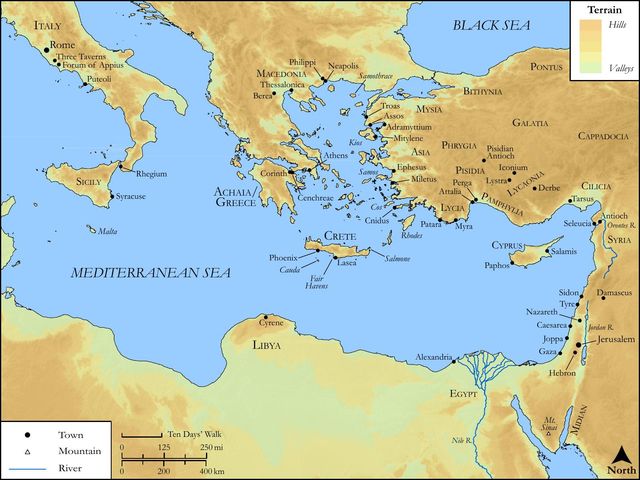
See on the biblical-era maps

Study this verse
Public-domain commentary
Matthew Henry
From his Commentary on the Whole Bible. Henry comments on passages, not single verses — this entry covers Acts 26:24–32. His four-level outline is real structure in the source text, so it is rendered as structure.
We have reason to think that Paul had a great deal more to say in defence of the gospel he preached, and for the honour of it, and to recommend it to the good opinion of this noble audience; he had just fallen upon that which was the life of the cause - the death and resurrection of Jesus Christ, and here he is in his element; now he warms more than before, his mouth is opened towards them, his heart is enlarged. Lead him but to this subject, and let him have leave to go on, and he will never know when to conclude; for the power of Christ's death, and the fellowship of his sufferings, are with him inexhaustible subjects. It was a thousand pities then that he should be interrupted, as he is here, and that, being permitted to speak for himself (Act 26:1), he should not be permitted to say all he designed. But it was a hardship often put upon him, and is a disappointment to us too, who read his discourse with so much pleasure. But there is no remedy, the court thinks it is time to proceed to give in their judgment upon his case.
I.Festus, the Roman governor, is of opinion that the poor man is crazed, and that Bedlam is the fittest place for him.
he is convinced that he is no criminal, no bad man, that should be punished, but he takes him to be a lunatic, a distracted man, that should be pitied, but at the same time should not be heeded, nor a word he says regarded; and thus he thinks he has found out an expedient to excuse himself both from condemning Paul as a prisoner and from believing him as a preacher; for, if he be not compos mentis - in his senses, he is not to be either condemned or credited. Now here observe,
1.What it was that Festus said of him (Act 26:24): He said with a loud voice, did not whisper it to those that sat next him; if so, it had been the more excusable, but (without consulting Agrippa, to whose judgment he had seemed to pay profound deference, Act 25:26), said aloud, that he might oblige Paul to break off his discourse, and might divert the auditors from attending to it "Paul, thou art beside thyself, thou talkest like a madman, like one with a heated brain, that knowest not what thou sayest;" yet he does not suppose that a guilty conscience had disturbed his reason, nor that his sufferings, and the rage of his enemies against him, had given any shock to it; but he puts the most candid construction that could be upon his delirium: Much learning hath made thee mad, thou hast cracked thy brains with studying. This he speaks, not so much in anger, as in scorn and contempt. He did not understand what Paul said; it was above his capacity, it was all a riddle to him, and therefore he imputes it all to a heated imagination. Si non vis intelligi, debes negligi - if thou art not willing to be understood, thou oughtest to be neglected.
(1.)He owns Paul to be a scholar, and a man of learning, because he could so readily refer to what Moses and the prophets wrote, books that he was a stranger to; and even this is turned to his reproach. The apostles, who were fishermen, were despised because they had no learning; Paul, who was a university-man, and bred a Pharisee, is despised as having too much learning, more than did him good. Thus the enemies of Christ's ministers will always have something or other to upbraid them with.
(2.)He reproaches him as a madman. The prophets of the Old Testament were thus stigmatized, to prejudice people against them by putting them into an ill-name: Wherefore came this mad fellow unto thee? said the captains of the prophet, Kg2 9:11; Hos 9:7. John Baptist and Christ were represented as having a devil, as being crazed. It is probable that Paul now spoke with more life and earnestness than he did in the beginning of his discourse, and used more gestures that were expressive of his zeal, and therefore Festus put this invidious character upon him, which perhaps never a one in the company but himself thought of. It is not so harmless a suggestion as some make it to say concerning those that are zealous in religion above others that they are crazed.
2.How Paul cleared himself from this invidious imputation, which whether he had ever lain under before is not certain; it should seem, it had been said of him by the false apostles, for he ways (Co2 5:13), If we be beside ourselves, as they say we are, it is to God; but he was never charged with this before the Roman governor, and therefore he must say something to this.
(1.)He denies the charge, with due respect indeed to the governor, but with justice to himself, protesting that there was neither ground nor colour for it (Act 26:25): "I am not mad, most noble Festus, nor ever was, nor any thing like it; the use of my reason, thanks be to God, has been all my days continued to me, and at this time I do not ramble, but speak the words of truth and soberness, and know what I say." Observe, Though Festus gave Paul this base and contemptuous usage, not becoming a gentlemen, much less a judge, yet Paul is so far from resenting it, and being provoked by it, that he gives him all possible respect, compliments him with his title of honour, most noble Festus, to teach us not to render railing for railing, nor one invidious character for another, but to speak civilly to those who speak slightly of us. It becomes us, upon all occasions, to speak the words of truth and soberness, and then we may despise the unjust censures of men.
(2.)He appeals to Agrippa concerning what he spoke (Act 26:26): For the king knows of these things, concerning Christ, and his death and resurrection, and the prophecies of the Old Testament, which had their accomplishment therein. He therefore spoke freely before him, who knew these were no fancies, but matters of fact, knew something of them, and therefore would be willing to know more: For I am persuaded that none of these things are hidden from him; no, not that which he had related concerning his own conversion, and the commission he had received to preach the gospel. Agrippa could not but have heard of it, having been so long conversant among the Jews. This thing was not done in a corner; all the country rang of it; and any of the Jews present might have witnessed for him that they had heard it many a time from others, and therefore it was unreasonable to censure him as a distracted man for relating it, much more for speaking of the death and resurrection of Christ, which was so universally spoken of. Peter tells Cornelius and his friends (Act 10:37), That word you know which was published throughout all Judea concerning Christ; and therefore Agrippa could not be ignorant of it, and it was a shame for Festus that he was so.
II.Agrippa is so far from thinking him a madman that he thinks he never heard a man argue more strongly, nor talk more to the purpose.
1.Paul applies himself closely to Agrippa's conscience. Some think Festus was displeased at Paul because he kept his eye upon Agrippa, and directed his discourse to him all along, and that therefore he gave him that interruption, Act 26:24. But, if that was the thing that affronted him, Paul regards it not: he will speak to those who understand him, and whom he is likely to fasten something upon, and therefore still addresses Agrippa; and, because he had mentioned Moses and the prophets as confirming the gospel he preached, he refers Agrippa to them (Act 26:27): "King Agrippa, believest thou the prophets? Dost thou receive the scriptures of the Old Testament as a divine revelation, and admit them as foretelling good things to come?" He does not stay for an answer, but, in compliment to Agrippa, takes it for granted: I know that thou believest; for every one knew that Agrippa professed the Jews' religion, as his fathers had done, and therefore both knew the writings of the prophets and gave credit to them. Note, It is good dealing with those who have acquaintance with the scriptures and believe them; for such one has some hold of.
2.Agrippa owns there was a great deal of reason in what Paul said (Act 26:28): Almost thou persuadest me to be a Christian. Some understand this as spoken ironically, and read it thus, Wouldst thou in so little a time persuade me to be a Christian? But, taking it so, it is an acknowledgement that Paul spoke very much to the purpose, and that, whatever others thought of it, to his mind there came a convincing power along with what he said: "Paul, thou art too hasty, thou canst not think to make a convert of me all of a sudden." Others take it as spoken seriously, and as a confession that he was in a manner, or within a little, convinced that Christ was the Messiah; for he could not but own, and had many a time thought so within himself, that the prophecies of the Old Testament had had their accomplishment in him; and now that it is urged thus solemnly upon him he is ready to yield to the conviction, he begins to sound a parley, and to think of rendering. He is as near being persuaded to believe in Christ as Felix, when he trembled, was to leave his sins: he sees a great deal of reason for Christianity; the proofs of it, he owns, are strong, and such as he cannot answer; the objections against it trifling, and such as he cannot for shame insist upon; so that if it were not for his obligations to the ceremonial law, and his respect to the religion of his fathers and of his country, or his regard to his dignity as a king and to his secular interests, he would turn Christian immediately. Note, Many are almost persuaded to be religious who are not quite persuaded; they are under strong convictions of their duty, and of the excellency of the ways of God, but yet are overruled by some external inducements, and do not pursue their convictions.
3.Paul, not being allowed time to pursue his argument, concludes with a compliment, or rather a pious wish that all his hearers were Christians, and this wish turned into a prayer: euxaimēn an tō Theō - I pray to God for it (Act 26:29); it was his heart's desire and prayer to God for them all that they might be saved, Rom 10:1. That not only thou but all that hear me this day (for he has the same kind design upon them all) were both almost, and altogether, such as I am, except these bonds. Hereby,
(1.)He professes his resolution to cleave to his religion, as that which he was entirely satisfied in, and determined to live and die by. In wishing that they were all as he was, he does in effect declare against ever being as they were, whether Jews or Gentiles, how much soever it might be to his worldly advantage. He adheres to the instruction God gave to the prophet (Jer 15:19), Let them return unto thee, but return not thou unto them.
(2.)He intimates his satisfaction not only in the truth, but in the benefit and advantage of Christianity; he had so much comfort in it for the present, and was so sure it would end in his eternal happiness, that he could not wish better to the best friend he had in the world than to wish him such a one as he was, a faithful zealous disciple of Jesus Christ. Let my enemy be as the wicked, says Job, Job 27:7. Let my friend be as the Christian, says Paul.
(3.)He intimates his trouble and concern that Agrippa went no further than being almost such a one as he was, almost a Christian, and not altogether one; for he wishes that he and the rest of them might be not only almost (what good would that do?) but altogether such as he was, sincere thorough-paced Christians.
(4.)He intimates that it was the concern, and would be the unspeakable happiness, of every one of them to become true Christians - that there is grace enough in Christ for all, be they ever so many - enough for each, be they ever so craving.
(5.)He intimates the hearty good-will he bore to them all; he wishes them,
[1.]As well as he wished his own soul, that they might be as happy in Christ as he was.
[2.]Better than he now was as to his outward condition, for he excepts these bonds; he wishes they might all be comforted Christians as he was, but not persecuted Christians as he was - that they might taste as much as he did of the advantages that attended religion, but not so much of its crosses. They had made light of his imprisonment, and were in no concern for him. Felix detained him in bonds to gratify the Jews. Now this would have tempted many a one to wish them all in his bonds, that they might know what it was to be confined as he was, and then they would know the better how to pity him; but he was so far from this that, when he wished them in bonds to Christ, he desired they might never be in bonds for Christ. Nothing could be said more tenderly nor with a better grace.
III.They all agree that Paul is an innocent man, and is wronged in his prosecution.
1.The court broke up with some precipitation (Act 26:30): When he had spoken that obliging word (Act 26:29), which moved them all, the king was afraid, if he were permitted to go on, he would say something yet more moving, which might work upon some of them to appear more in his favour than was convenient, and perhaps might prevail with them to turn Christians. The king himself found his own heart begin to yield, and durst not trust himself to hear more, but, like Felix, dismissed Paul for this time. They ought in justice to have asked the prisoner whether he had any more to say for himself; but they thought he had said enough, and therefore the king rose up, and the governor, and Bernice, and those that sat with them, concluding the case was plain, and with this they contented themselves, when Paul had more to say which would have made it plainer.
2.They all concurred in an opinion of Paul's innocency, Act 26:31. The court withdrew to consult of the matter, to know one another's minds upon it, and they talked among themselves, all to the same purport, that this man does nothing worthy of bonds - he is not a dangerous man, whom it is prudent to confine. After this, Nero made a law for the putting of those to death who professed the Christian religion, but as yet there was no law of that kind among the Romans, and therefore no transgression; and this judgment of theirs is a testimony against that wicked law which Nero made not long after this, that Paul, the most active zealous Christian that ever was, was adjudged, even by those that were no friends to his way, to have done nothing worthy of death, or of bonds. Thus was he made manifest in the conscience of those who yet would not receive his doctrine; and the clamours of the hot-headed Jews, who cried out, Away with him, it is not fit he should live, were shamed by the moderate counsels of this court.
3.Agrippa gave his judgment that he might have been set at liberty, if he had not himself appealed to Caesar (Act 26:32), but by that appeal he had put a bar in his own door. Some think that by the Roman law this was true, that, when a prisoner had appealed to the supreme court, the inferior courts could no more discharge him than they could condemn him; and we suppose the law was so, if the prosecutors joined issue upon the appeal, and consented to it. But it does not appear that in Paul's case the prosecutors did so; he was forced to do it, to screen himself from their fury, when he saw the governor did not take the care he ought to have done for his protection. And therefore others think that Agrippa and Festus, being unwilling to disoblige the Jews by setting him at liberty, made this serve for an excuse of their continuing him in custody, when they themselves knew they might have justified the discharging of him. Agrippa, who was but almost persuaded to be a Christian, proves no better than if he had not been at all persuaded. And now I cannot tell,
(1.)Whether Paul repented of his having appealed to Caesar, and wished he had not done it, blaming himself for it as a rash thing, now he saw that was the only thing that hindered his discharge. He had reason perhaps to reflect upon it with regret, and to charge himself with imprudence and impatience in it, and some distrust of the divine protection. He had better have appealed to God than to Caesar. It confirms what Solomon says (Ecc 6:12), Who knows what is good for man in this life? What we think is for our welfare often proves to be a trap; such short-sighted creatures are we, and so ill-advised in leaning, as we do, to our own understanding. Or,
(2.)Whether, notwithstanding this, he was satisfied in what he had done, and was easy in his reflections upon it. His appealing to Caesar was lawful, and what became a Roman citizen, and would help to make his cause considerable; and forasmuch as when he did it it appeared to him, as the case then stood, to be for the best, though afterwards it appeared otherwise, he did not vex himself with any self-reproach in the matter, but believed there was a providence in it, and it would issue well at last. And besides, he was told in a vision that he must bear witness to Christ at Rome, Act 23:11. And it is all one to him whether he goes thither a prisoner or at his liberty; he knows the counsel of the Lord shall stand, and says, Let it stand. The will of the Lord be done.
Historical interpretation
Two Centuries of Reception
3 surviving comments on this verse. Each one is dated, so this reads as a timeline rather than a list.
Select a marker to jump to its quote. Markers stagger vertically where authors wrote within a few decades of each other.
If he was in heaven, when would he not see what was doing in Italy? For the Italian land is "not in a corner." And yet, had he been a god, nothing ought to have escaped him.
Then too he gives him to understand why, turning from him, he addressed his speech to the king: "For the king knoweth of these things, before whom also I speak freely: for I am persuaded that none of these things are hidden from him: for this thing was not done in a corner." He shows, that the king knows all perfectly; at the same time, all but saying to the Jews, And ye indeed ought to have known these things-for this is the meaning of that which he adds, "For this thing was not done in a corner."
"For this thing," he says, "was not done in a corner." Here he speaks of the Cross, of the Resurrection: that the doctrine was come to every part of the world.
Continue studying Acts 26:26 across the web’s major study libraries — every link below opens this exact verse, chapter, or book on the destination site.
Read & Compare
 BibleGatewayThis verse in more than 200 translations and 70 languages.
 Bible.comThe YouVersion reader — hundreds of translations, reading plans, and highlights.
 ESV.orgCrossway's official English Standard Version reader.
 NET BibleThe NET translation with 60,000+ translators' notes on every rendering decision.
 STEP BibleTyndale House's free study tool — original text, vocabulary, and scholarly resources.
 BibliaLogos Bible Software's free web reader.
 USCCBThe New American Bible (Revised Edition) with the U.S. bishops' study notes.
Commentaries
 BibleHub CommentariesDozens of classic commentaries on this verse, gathered on one page.
 StudyLightMore than 100 commentary sets — the largest collection on the web.
 BibleRefPlain-English commentary on what this verse means, verse by verse.
 Enduring WordDavid Guzik's free commentary on this chapter, widely used by Bible teachers.
 Bible Study ToolsVerse commentary alongside Greek and Hebrew study aids.
Original Language & Research
- BibleHub InterlinearThe verse word by word — original language, transliteration, and English.
- BibleHub LexiconEvery word's original-language definition and Strong's entry.
 Blue Letter BibleDeep-study tools — Strong's numbers, concordance, and word studies.
 CNTR CollationThe earliest Greek manuscripts of this verse, collated letter by letter.
Sermons, Hymns & Audio


TrulyRandomVerse is not affiliated with these sites and doesn’t control their content. They’re linked because they’re genuinely useful.
Summary
In Acts 26:26, the Apostle Paul, standing before King Agrippa II, Governor Festus, and other Roman and Jewish dignitaries, asserts the undeniable public nature of the events surrounding Jesus Christ and the nascent Christian movement. With profound confidence and frankness, Paul declares his conviction that King Agrippa, being well-versed in Jewish customs and prophecies, is fully aware of the very matters Paul is discussing, emphasizing that these transformative events were not clandestine occurrences but transpired openly for all to see.
Context
ShowHideLiterary Context
This verse is situated within Paul's final recorded defense speech in the book of Acts, delivered in Caesarea before King Agrippa II and Governor Festus. Paul, having been falsely accused by Jewish leaders in Jerusalem and subsequently appealing to Caesar, is granted this hearing by Festus, who seeks clarity on the charges to include in his report to the emperor. Paul seizes this unique opportunity, not merely to defend himself against specific accusations, but to boldly proclaim the Gospel, centering his entire argument on his dramatic conversion experience on the Damascus road (Acts 9), his subsequent calling as an apostle to the Gentiles, and, crucially, the resurrection of Jesus Christ. The immediate verses (Acts 26:24-25) show Festus interrupting Paul, accusing him of madness, to which Paul calmly responds, affirming his sanity and the truth of his words. Verse 26 then directly addresses Agrippa, appealing to his presumed knowledge.
Historical & Cultural Context
King Agrippa II was the last of the Herodian line, ruling over territories north of Galilee. He and his sister Bernice were present at this hearing. Agrippa was known to be an expert in Jewish law, customs, and religious matters, which made him an ideal audience for Paul's defense, as Paul's arguments heavily relied on the fulfillment of Old Testament prophecies. Caesarea Maritima, where this trial took place, was the Roman administrative capital of Judea, a bustling port city with a diverse population, making it a significant center for public discourse and legal proceedings. The Roman legal system, though often perceived as just, could be influenced by political expediency, as seen in Festus's desire to please the Jews (Acts 24:27). Paul's assertion that "this thing was not done in a corner" directly challenged any perception of Christianity as a secretive cult, aligning it instead with public, verifiable historical events that occurred within the Roman Empire and Jewish society.
Key Themes
ShowHideA central theme in this passage, and indeed throughout Paul's defense, is the public nature of the Gospel and the events surrounding Jesus's life, death, and resurrection. Paul emphasizes that these were not obscure, private occurrences but widely known and discussed. This underpins the verifiability and historical grounding of the Christian faith. Another prominent theme is boldness in proclamation, as Paul, a prisoner, speaks with remarkable freedom and confidence before powerful rulers, demonstrating his unwavering conviction in the truth of his message and his divine calling (Acts 26:16-18). His appeal to Agrippa's knowledge also highlights the theme of prophetic fulfillment, suggesting that the Jewish Scriptures anticipated these very events, making them comprehensible to someone with Agrippa's background (Acts 26:22-23).
Exposition and Analysis
ShowHideKey Word Analysis
ShowHideThis word signifies not merely superficial acquaintance but a deep comprehension or being intimately acquainted with something, implying a putting of the mind upon a subject. Paul is suggesting that Agrippa possesses an informed understanding of the Jewish prophecies and the events related to Jesus, not just a passing familiarity.
Derived from "parrhesia," meaning "all speech" or "freedom of speech," this term conveys the idea of speaking with boldness, frankness, and confidence, without fear or hesitation. Despite being a prisoner on trial, Paul exercises remarkable candor and openness in addressing the king.
Literally meaning "an angle" or "a corner," this word is used idiomatically in this context. To say something was "not done in a corner" means it was not done secretly, obscurely, or in a hidden place, but publicly, openly, and in plain sight.
Verse Breakdown
ShowHide"For the king knoweth of these things"
Paul begins by appealing directly to King Agrippa's presumed knowledge. "These things" refers to the core tenets of Paul's testimony: the life, death, resurrection of Jesus, and the subsequent spread of the Christian message, all of which Paul argues are consistent with Jewish prophecy. Paul implies that Agrippa, as a Herodian ruler with a Jewish background, would be well-informed about the religious and political developments in Judea, including the rise of Christianity.
"before whom also I speak freely"
Paul emphasizes his unreserved and bold manner of speaking. Despite the high-stakes environment of a Roman court and his status as a prisoner, Paul speaks with "parrhesia"—frankness and confidence—because he believes his message is true and verifiable, and he trusts that Agrippa is capable of understanding it.
"for I am persuaded that none of these things are hidden from him"
This clause reinforces Paul's conviction that Agrippa is not ignorant of the facts. Paul is "persuaded" (peíthō) or convinced that Agrippa has knowledge of these events. The implication is that the events of Jesus's ministry, crucifixion, and resurrection were so significant and public that they could not have escaped the notice of a ruler like Agrippa, who was deeply involved in Jewish affairs.
"for this thing was not done in a corner"
This is the climactic and most vivid statement of the verse. It is an idiomatic expression asserting that the events Paul speaks of were not secret, private, or obscure. Instead, they occurred in the full view of the public, affecting many, and were widely known and discussed throughout Judea and beyond. This phrase powerfully underscores the historical and verifiable nature of the Christian message.
Literary Devices
ShowHidePaul's address in Acts 26:26 masterfully employs several literary devices. The direct address to Agrippa, "For the king knoweth of these things," exemplifies Apostrophe, a rhetorical device where the speaker directly addresses an absent or imaginary person or an abstract quality or thing. This creates a sense of intimacy and direct challenge, drawing Agrippa into the argument. The phrase "this thing was not done in a corner" is a powerful Idiom, conveying the idea of public knowledge and transparency. It vividly contrasts the open nature of the Gospel events with any notion of secrecy or hidden cultic practices. Furthermore, Paul's assertion that "none of these things are hidden from him" can be seen as a form of Understatement or Litotes, where an affirmative is expressed by the negation of its contrary. By stating that the events are not hidden, Paul strongly implies that they are, in fact, widely and publicly known, thereby emphasizing their undeniable reality and significance.
Theological and Thematic Connections
ShowHideActs 26:26 powerfully underscores the historical and public nature of the Christian faith, demonstrating that its core tenets are not based on myth or secret knowledge, but on verifiable events that occurred in plain sight. This emphasis on public witness aligns with the biblical understanding of God's revelation as something that is openly declared and accessible, not confined to an elite few. The resurrection of Jesus, in particular, was a public event, attested to by numerous eyewitnesses, forming the bedrock of the apostolic message. Paul's confidence stems from this objective reality, inviting Agrippa to acknowledge what he already knows to be true.
Reflection and Application
ShowHideActs 26:26 offers profound encouragement and guidance for believers today. It reminds us that our faith is not a private, subjective experience divorced from reality, but is rooted in historical events that were publicly witnessed and widely known. This should instill in us a deep confidence in the truth of the Gospel, empowering us to speak "freely" and boldly about Christ, just as Paul did before Agrippa. We are called to be transparent in our faith, allowing its light to shine openly rather than confining it to the "corners" of our private lives. In a world often skeptical of truth claims, the verifiable and open nature of the Gospel provides a solid foundation for our witness. We are challenged to consider how we might present the truth of Christ in ways that appeal to the existing knowledge and understanding of those around us, inviting them to confront the undeniable reality of God's work in history.
Questions for Reflection
ShowHideFAQ
ShowHideWhat does Paul mean by "this thing was not done in a corner"?
ShowHideThis is an idiomatic expression meaning that the events Paul was referring to—primarily the life, ministry, death, and resurrection of Jesus Christ, and the subsequent growth of the early Christian movement—were not obscure, secret, or hidden occurrences. Instead, they were public, widely known, and openly discussed events that took place in the full view of society. Paul uses this phrase to emphasize the verifiable and undeniable historical reality of the foundation of the Christian faith, asserting that King Agrippa, being well-informed about Jewish affairs, would certainly be aware of them. It contrasts with the idea of a clandestine or secretive cult.
Why was it important for Paul to appeal to King Agrippa's knowledge?
ShowHidePaul appealed to King Agrippa's knowledge for several strategic reasons. First, Agrippa was known to be an expert in Jewish law, customs, and prophecies (Acts 26:3). By framing his defense in terms of prophetic fulfillment and events known to Agrippa, Paul sought to establish common ground and demonstrate that Christianity was not a new, foreign religion but the logical culmination of Jewish Scripture. Second, it served as a powerful rhetorical device, suggesting that the truth of the Gospel was so evident that even a non-Christian ruler like Agrippa could not deny its historical reality. Paul aimed to persuade Agrippa not just of his innocence, but of the truth of the Gospel itself, hoping for a conversion (Acts 26:27-29).
Christ-Centered Fulfillment
ShowHideActs 26:26, with its declaration that "this thing was not done in a corner," profoundly points to the Christ-centered fulfillment of God's redemptive plan. The entire narrative of salvation, culminating in Jesus Christ, is presented not as a mystical, hidden truth for a select few, but as a public, historical reality unfolding in the full light of human history. Jesus's ministry was conducted openly, teaching in synagogues and the Temple courts (John 18:20), performing miracles before crowds (Luke 8:43-48), and speaking plainly about His identity and mission. His crucifixion, far from being a secret execution, was a public spectacle outside Jerusalem's walls, witnessed by many (Matthew 27:33-50). Most critically, His resurrection was attested to by numerous eyewitnesses over a period of forty days (Acts 1:3), appearing to hundreds at once (1 Corinthians 15:6). This public, verifiable nature of Christ's life, death, and resurrection is the very foundation of the Gospel Paul proclaimed. It underscores that God's ultimate act of salvation was not whispered in a "corner" but was a monumental, world-altering event, intended to be known by all nations (Matthew 28:19-20), inviting open scrutiny and demanding a public response of faith and repentance.