


Acts 26:2
Bible text: King James Version (1769 Blayney text) · Public domain
Bible text: King James Version with Strong's numbers · Public domain
Bible text: Berean Standard Bible · Public domain
Bible text: American Standard Version (1901) · Public domain
Bible text: World English Bible, Messianic edition · Public domain
Bible text: Geneva Bible (1599) · Public domain
Bible text: Young's Literal Translation · Public domain
- περὶperiConcerningG4012PREPPreposition
- πάντωνpantōnallG3956A-GPNAdjective Genitive Plural Neuter
- ὧνhōnof whichG3739R-GPNRelative pronoun Genitive Plural Neuter
- ἐγκαλοῦμαιegkaloumaiI am accusedG1458V-PPI-1SVerb Present Passive Indicative 1st Singular
- ὑπὸhupobyG5259PREPPreposition
- ἸουδαίωνIoudaiōn[the] JewsG2453N-GPM-PGNoun Genitive Plural Masculine Person Gentilic
- βασιλεῦbasileuKingG935N-VSM-TNoun Vocative Singular Masculine Person Gentilic
- ἈγρίππαAgrippaAgrippaG67N-VSM-PNoun Vocative Singular Masculine Person Gentilic
- ἥγημαιhēgēmaiI have esteemedG2233V-RNI-1SVerb Perfect Middle Or Passive Deponent Indicative 1st Singular
- ἐμαυτὸνemautonmyselfG1473F-1ASMReflexive pronoun Accusative 1st Singular Masculine
- μακάριονmakarionfortunateG3107A-ASMAdjective Accusative Singular Masculine
- ἐπὶepibeforeG1909PREPPreposition
- σοῦsouyouG4771P-2GSPersonal pronoun Genitive 2nd Singular
- μέλλωνmellōnbeing aboutG3195V-PAP-NSMVerb Present Active Participle Nominative Singular Masculine
- σήμερονsēmerontodayG4594ADVAdverb
- ἀπολογεῖσθαι·apologeisthaito present a defenseG626V-PNNVerb Present Middle Or Passive Deponent Infinitive
English is a literal word-by-word gloss of the Greek, not the KJV's wording. Why?
This is the original text the KJV's translators worked from — each Greek word with its own literal English meaning in this verse, prepared by scholars at Tyndale House, Cambridge. The KJV translates whole sentences, not word by word, so its wording differs: one Greek word can become several English words, and the KJV may choose “charity” where the gloss reads “love”. Both are faithful — they answer different questions. For the KJV's own rendering, switch to the KJV text.
Details
See on the biblical-era maps
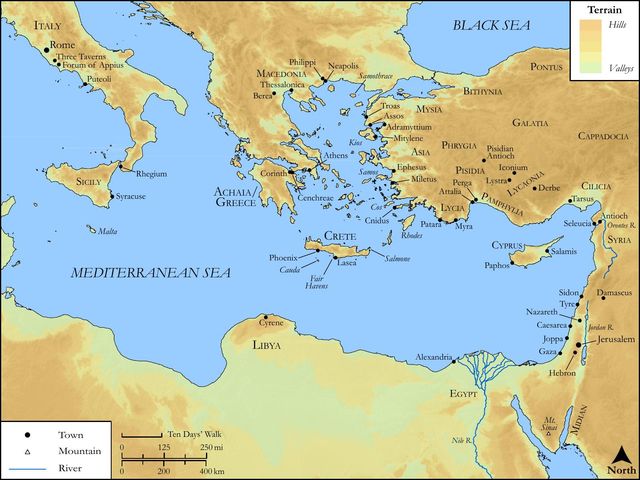
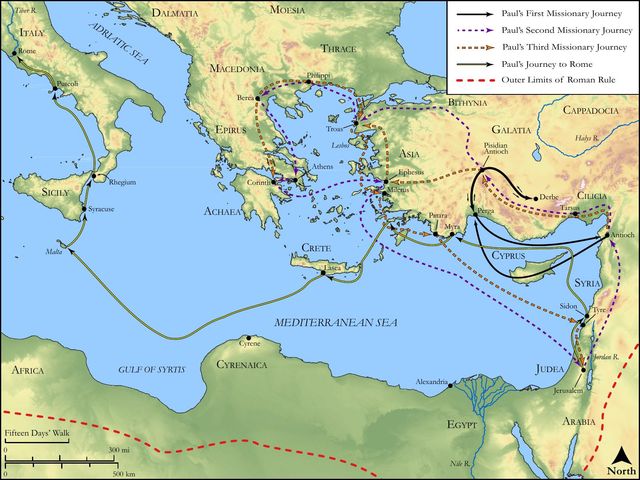
Study this verse
Public-domain commentary
Matthew Henry
From his Commentary on the Whole Bible. Henry comments on passages, not single verses — this entry covers Acts 26:1–11. His four-level outline is real structure in the source text, so it is rendered as structure.
Agrippa was the most honourable person in the assembly, having the title of king bestowed upon him, though otherwise having only the power of other governors under the emperor, and, though not here superior, yet senior, to Festus; and therefore, Festus having opened the cause, Agrippa, as the mouth of the court, intimates to Paul a licence given him to speak for himself, Act 26:1. Paul was silent till he had this liberty allowed him; for those are not the most forward to speak that are best prepared to speak and speak best. This was a favour which the Jews would not allow him, or not without difficulty; but Agrippa freely gives it to him. And Paul's cause was so good that he desired no more than to have liberty to speak for himself; he needed no advocate, no Tertullus, to speak for him. Notice is taken of his gesture: He stretched forth his hand, as one that was under no consternation at all, but had perfect freedom and command of himself; it also intimates that he was in earnest, and expected their attention while he answered for himself. Observe, He did not insist upon his having appealed to Caesar as an excuse for being silent, did not say, "I will be examined no more till I come to the emperor himself;" but cheerfully embraced the opportunity of doing honour to the cause he suffered for. If we must be ready to give a reason of the hope that is in us to every man that asketh us, much more to every man in authority, Pe1 3:15. Now in this former part of the speech,
I.Paul addressed himself with a very particular respect to Agrippa, Act 26:2, Act 26:3.
He answered cheerfully before Felix, because he knew he had been many years a judge to that nation, Act 24:10. But his opinion of Agrippa goes further. Observe,
1.Being accused of the Jews, and having many base things laid to his charge, he is glad he has an opportunity of clearing himself; so far is he from imagining that his being an apostle exempted him from the jurisdiction of the civil powers. Magistracy is an ordinance of God, which we have all benefit by, and therefore must all be subject to.
2.Since he is forced to answer for himself, he is glad it is before king Agrippa, who, being himself a proselyte to the Jewish religion, understood all matters relating to it better than the other Roman governors did: I know thee to be expert in all customs and questions which are among the Jews. It seems, Agrippa was a scholar, and had been particularly conversant in the Jewish learning, was expert in the customs of the Jewish religion, and knew the nature of them, and that they were not designed to be either universal or perpetual. He was expert also in the questions that arose upon those customs, in determining which the Jews themselves were not all of a mind. Agrippa was well versed in the scriptures of the Old Testament, and therefore could make a better judgment upon the controversy between him and the Jews concerning Jesus being the Messiah than another could. It is an encouragement to a preacher to have those to speak to that are intelligent, and can discern things that differ. When Paul says, Judge you what I say, yet he speaks as to wise men, Co1 10:15.
3.He therefore begs that he would hear him patiently, makrothumōs - with long suffering. Paul designs a long discourse, and begs that Agrippa will hear him out, and not be weary; he designs a plain discourse, and begs that he will hear him with mildness, and not be angry. Paul had some reason to fear that as Agrippa, being a Jew, was well versed in the Jewish customs, and therefore the more competent judge of his cause, so he was soured in some measure with the Jewish leaven, and therefore prejudiced against Paul as the apostle of the Gentiles; he therefore says this to sweeten him: I beseech thee, hear me patiently. Surely the least we can expect, when we preach the faith of Christ, is to be heard patiently.
II.He professes that though he was hated and branded as a apostate, yet he still adhered to all that good which he was first educated and trained up in; his religion was always built upon the promise of God made unto the fathers; and this he still built upon.
1.See here what his religion was in his youth: His manner of life was well known, Act 26:4, Act 26:5. He was not indeed born among his own nation, but he was bred among them at Jerusalem. Though he had of late years been conversant with the Gentiles (which had given great offence to the Jews), yet at his setting out in the world he was intimately acquainted with the Jewish nation, and entirely in their interests. His education was neither foreign nor obscure; it was among his own nation at Jerusalem, where religion and learning flourished. All the Jews knew it, all that could remember so long, for Paul made himself remarkable betimes. Those that knew him from the beginning could testify for him that he was a Pharisee, that he was not only of the Jewish religion, and an observer of all the ordinances of it, but that he was of the most strict sect of that religion, most nice and exact in observing the institutions of it himself, and most rigid and critical in imposing them upon others. He was not only called a Pharisee, but he lived a Pharisee. All that knew him knew very well that never any Pharisee conformed more punctually to the rules of his order than he did. Nay, and he was of the better sort of Pharisees; for he was brought up at the feet of Gamaliel, who was an eminent rabbi of the school of house of Hillel, which was in much greater reputation for religion than the school or house of Samai. Now if Paul was a Pharisee, and lived a Pharisee,
(1.)Then he was a scholar, a man of learning, and not an ignorant, illiterate, mechanic; the Pharisees knew the law, and were well versed in it, and in the traditional expositions of it. It was a reproach to the other apostles that they had not had an academical education, but were bred fishermen, Act 4:13. Therefore, that the unbelieving Jews might be left without excuse, here is an apostle raised up that had sat at the feet of their most eminent doctors.
(2.)Then he was a moralist, a man of virtue, and not a rake or loose debauched young man. If he lived like a Pharisee, he was no drunkard nor fornicator; and, being a young Pharisee, we may hope he was no extortioner, nor had yet learned the arts which the crafty covetous old Pharisees had of devouring the houses of poor widows; but he was, as touching the righteousness which is in the law, blameless. He was not chargeable with any instance of open vice and profaneness; and therefore, as he could not be thought to have deserted his religion because he did not know it (for he was a learned man), so he could not be thought to have deserted it because he did not love it, or was disaffected to the obligations of it, for he was a virtuous man, and not inclined to any immorality.
(3.)Then he was orthodox, sound in the faith, and not a deist or sceptic, or a man of corrupt principles that led to infidelity. He was a Pharisee, in opposition to a Sadducee; he received those books of the Old Testament which the Sadducees rejected, believed a world of spirits, the immortality of the soul, the resurrection of the body, and the rewards and punishments of the future state, all which the Sadducees denied. They could not say, He quitted his religion for want of a principle, or for want of a due regard to divine revelation; no, he always had a veneration for the ancient promise made of God unto the fathers, and built his hope upon it.
Now though Paul knew very well that all this would not justify him before God, nor make a righteousness for him yet he knew it was for his reputation among the Jews, and an argument ad hominem - such as Agrippa would feel, that he was not such a man as they represented him to be. Though he counted it but loss that he might win Christ, yet he mentioned it when it might serve to honour Christ. He knew very well that all this while he was a stranger to the spiritual nature of the divine law, and to heart-religion, and that except his righteousness exceeded this he should never go to heaven; yet he reflects upon it with some satisfaction that he had not been before his conversion an atheistical, profane, vicious man, but, according to the light he had, had lived in all good conscience before God.
2.See here what his religion is. He has not indeed such a zeal for the ceremonial law as he had in his youth. The sacrifices and offerings appointed by that, he thinks, are superseded by the great sacrifice which they typified; ceremonial pollutions and purifications from them he makes no conscience of, and thinks the Levitical priesthood is honourably swallowed up in the priesthood of Christ; but for the main principles of his religion he is as zealous for them as ever, and more so, and resolves to live and die by them.
(1.)His religion is built upon the promise made of God unto the fathers. It is built upon divine revelation, which he receives and believes, and ventures his soul upon; it is built upon divine grace, and that grace manifested and conveyed by promise. The promise of God is the guide and ground of his religion, the promise made to the fathers, which was more ancient than the ceremonial law, that covenant which was confirmed before of God in Christ, and which the law, that was not till four hundred and thirty years after, could not disannul, Gal 3:17. Christ and heaven are the two great doctrines of the gospel - that God has given to us eternal life, and this life is in his Son. Now these two are the matter of the promise made unto the fathers. It may look back as far as the promise made to father Adam, concerning the seed of the woman, and those discoveries of a future state which the first patriarchs acted faith upon, and were saved by that faith; but it respects chiefly the promise made to father Abraham, that in his seed all the families of the earth should be blessed, and that God would be a God to him, and to his seed after him: the former meaning Christ, the latter heaven; for, if God had not prepared for them a city, he would have been ashamed to have called himself their God. Heb 11:16.
(2.)His religion consists in the hopes of this promise. He places it not, as they did, in meats and drinks, and the observance of carnal ordinances (God had often shown what little account he made of them), but in a believing dependence upon God's grace in the covenant, and upon the promise, which was the great charter by which the church was first incorporated.
[1.]He had hope in Christ as the promised seed; he hoped to be blessed in him, to receive the blessing of God and to be truly blessed.
[2.]He had hopes of heaven; this is expressly meant, as appears by comparing Act 24:15, That there shall be a resurrection of the dead. Paul had no confidence in the flesh, but in Christ; no expectation at all of great things in this world, but of greater things in the other world than any this world can pretend to; he had his eye upon a future state.
(3.)Herein he concurred with all the pious Jews; his faith was not only according to the scripture, but according to the testimony of the church, which was a support to it. Though they set him up as a mark, he was not singular: "Our twelve tribes, the body of the Jewish church, instantly serving God day and night, hope to come to this promise, that is, to the good promised." The people of Israel are called the twelve tribes, because so they were at first; and, though we read not of the return of the ten tribes in a body, yet we have reason to think many particular persons, more or less of every tribe, returned to their own land; perhaps, by degrees, the greater part of those that were carried away. Christ speaks of the twelve tribes, Mat 19:28. Anna was of the tribe of Asher, Luk 2:36. James directs his epistle to the twelve tribes scattered abroad, Jam 1:1. "Our twelve tribes, which make up the body of our nation, to which I and others belong. Now all the Israelites profess to believe in this promise, both of Christ and heaven, and hope to come to the benefits of them. They all hope for a Messiah to come, and we that are Christians hope in a Messiah already come; so that we all agree to build upon the same promise. They look for the resurrection of the dead and the life of the world to come, and this is what I look for. Why should I be looked upon as advancing something dangerous and heterodox, or as an apostate from the faith and worship of the Jewish church, when I agree with them in this fundamental article? I hope to come to the same heaven at last that they hope to come to; and, if we expect to meet so happily in our end, why should we fall out so unhappily by the way?" Nay, the Jewish church not only hoped to come to this promise, but, in the hope of it, they instantly served God day and night. The temple-service, which consisted in a continual course of religious duties, morning and evening, day and night, from the beginning of the year to the end of it, and was kept up by the priests and Levites, and the stationary men, as they called them, who continually attended there to lay their hands upon the public sacrifices, as the representatives of all the twelve tribes, this service was kept up in the profession of faith in the promise of eternal life, and, in expectation of it, Paul instantly serves God day and night in the gospel of his Son; the twelve tribes by their representatives do so in the law of Moses, but he and they do it in hope of the same promise: "Therefore they ought not to look upon me as a deserter from their church, so long as I hold by the same promise that they hold by." Much more should Christians, who hope in the same Jesus, for the same heaven, though differing in the modes and ceremonies of worship, hope the best one of another, and live together in holy love. Or it may be meant of particular persons who continued in the communion of the Jewish church, and were very devout in their way, serving God with great intenseness, and a close application of mind, and constant in it, night and day, as Anna, who departed not from the temple, but served God (it is the same word here used) in fastings and prayers night and day, Luk 2:37. "In this way they hope to come to the promise, and I hope they will." Note, Those only can upon good grounds hope for eternal life that are diligent and constant in the service of God; and the prospect of that eternal life should engage us to diligence and constancy in all religious exercises. We should go on with our work with heaven in our eye. And of those that instantly serve God day and night, though not in our way, we ought to judge charitably.
(4.)This was what he was now suffering for - for preaching that doctrine which they themselves, if they did but understand themselves aright, must own: I am judged for the hope of the promise made unto the fathers. He stuck to the promise, against the ceremonial law, while his persecutors stuck to the ceremonial law, against the promise: "It is for this hope's sake, king Agrippa, that I am accused of the Jews - because I do that which I think myself obliged to do by the hope of this promise." It is common for men to hate and persecute the power of that religion in others which yet they pride themselves in the form of. Paul's hope was what they themselves also allowed (Act 24:15), and yet they were thus enraged against him for practising according to that hope. But it was his honour that when he suffered as a Christian he suffered for the hope of Israel, Act 28:20.
(5.)This was what he would persuade all that heard him cordially to embrace (Act 26:8): Why should it be thought a thing incredible with you that God should raise the dead? This seems to come in somewhat abruptly; but it is probable Paul said much more than is here recorded, and that he explained the promise made to the fathers to be the promise of the resurrection and eternal life, and proved that he was in the right way of pursuing his hope of that happiness because he believed in Christ who had risen from the dead, which was a pledge and earnest of that resurrection which the fathers hoped for. Paul is therefore earnest to know the power of Christ's resurrection, that by it he might attain to the resurrection of the dead; see Phi 3:10, Phi 3:11. Now many of his hearers were Gentiles, most of them perhaps, Festus particularly, and we may suppose, when they heard him speak so much of Christ's resurrection, and of the resurrection from the dead, which the twelve tribes hoped for, that they mocked, as the Athenians did, began to smile at it, and whispered to one another what an absurd thing it was, which occasioned Paul thus to reason with them. What! is it thought incredible with you that God should raise the dead? So it may be read. If it be marvellous in your eyes, should it be marvellous in mine eyes, saith the Lord of hosts? Zac 8:6. If it be above the power of nature, yet it is not above the power of the God of nature. Note, There is no reason why we should think it at all incredible that God should raise the dead. We are not required to believe any thing that is incredible, any thing that implies a contradiction. There are motives of credibility sufficient to carry us through all the doctrines of the Christian religion, and this particularly of the resurrection of the dead. Has not God an infinite almighty power, to which nothing is impossible? Did not he make the world at first out of nothing, with a word's speaking? Did he not form our bodies, form them out of the clay, and breathe into us the breath of life at first? and cannot the same power form them again out of their own clay, and put life into them again? Do we not see a kind of resurrection in nature, at the return of every spring? Has the sun such a force to raise dead plants, and should it seem incredible to us that God should raise dead bodies?
III.He acknowledges that while he continued a Pharisee he was a bitter enemy to Christians and Christianity, and thought he ought to be so, and continued so to the moment that Christ wrought that wonderful change in him. This he mentions,
1.To show that his becoming a Christian and a preacher was not the product and result of any previous disposition or inclination that way, or any gradual advance of thought in favour of the Christian doctrine; he did not reason himself into Christianity by a chain of arguments, but was brought into the highest degree of an assurance of it, immediately from the highest degree of prejudice against it, by which it appeared that he was made a Christian and a preacher by a supernatural power; so that his conversion in such a miraculous way was not only to himself, but to others also, a convincing proof of the truth of Christianity.
2.Perhaps he designs it for such an excuse of his persecutors as Christ made for his, when he said, They know not what they do. Paul himself once thought he did what he ought to do when he persecuted the disciples of Christ, and he charitably thinks they laboured under the like mistake. Observe,
(1.)What a fool he was in his opinion (Act 26:9): He thought with himself that he ought to do many things, every thing that lay in his power, contrary to the name of Jesus of Nazareth, contrary to his doctrine, his honour, his interest. That name did not harm, yet, because it agreed not with the notion he had of the kingdom of the Messiah, he was for doing all he could against it. He thought he did God good service in persecuting those who called on the name of Jesus Christ. Note, It is possible for those to be confident they are in the right who yet are evidently in the wrong; and for those to think they are doing their duty who are wilfully persisting in the greatest sin. Those that hated their brethren, and cast them out, said, Let the Lord be glorified, Isa 66:5. Under colour and pretext of religion, the most barbarous and inhuman villanies have been not only justified, but sanctified and magnified, Joh 16:2.
(2.)What a fury he was in his practice, Act 26:10, Act 26:11. There is not a more violent principle in the world than conscience misinformed. When Paul thought it his duty to do all he could against the name of Christ, he spared no pains nor cost in it. He gives an account of what he did of that kind, and aggravates it as one that was truly penitent for it: I was a blasphemer, a persecutor, Ti1 1:13.
[1.]He filled the jails with Christians, as if they had been the worst of criminals, designing hereby not only to terrify them, but to make them odious to the people. He was the devil that cast some of them into prison (Rev 2:10), took them into custody, in order to their being prosecuted. Many of the saints did I shut up in prison (Act 26:10), both men and women, Act 8:3.
[2.]He made himself the tool of the chief priests. Herein from them he received authority, as an inferior officer, to put their laws in execution, and proud enough he was to be a man in authority for such a purpose.
[3.]He was very officious to vote, unasked for, the putting of Christians to death, particularly Stephen, to whose death Saul was consenting (Act 8:1), and so made himself particeps criminis - partaker of the crime. Perhaps he was, for his great zeal, though young, made a member of the sanhedrim, and there voted for the condemning of Christians to die; or, after they were condemned, he justified what was done, and commended it, and so made himself guilty ex post facto - after the deed was committed, as if he had been a judge or jury-man.
[4.]He brought them under punishments of an inferior nature, in the synagogues, where they were scourged as transgressors of the rules of the synagogue. He had a hand in the punishing of many; nay, it should seem the same persons were by his means often punished, as he himself was five times, Co2 11:24.
[5.]He not only punished them for their religion, but, taking a pride in triumphing over men's consciences, he forced them to abjure their religion, by putting them to the torture: "I compelled them to blaspheme Christ, and to say he was a deceiver and they were deceived in him - compelled them to deny their Master, and renounce their obligations to him." Nothing will lie heavier upon persecutors than forcing men's consciences, how much soever they may now triumph in the proselytes they have made by their violences.
[6.]His rage swelled so against Christians and Christianity that Jerusalem itself was too narrow a stage for it to act upon, but, being exceedingly mad against them, he persecuted them even to strange cities. He was mad at them, to see how much they had to say for themselves, notwithstanding all he did against them, mad to see them multiply the more for their being afflicted. He was exceedingly mad; the stream of his fury would admit no banks, no bounds, but he was as much a terror to himself as he was to them, so great was his vexation within himself that he could not prevail, as well as his indignation against them. Persecutors are mad men, and some of them exceedingly mad. Paul was mad to see that those in other cities were not so outrageous against the Christians, and therefore made himself busy where he had no business, and persecuted the Christians even in strange cities. There is not a more restless principle than malice, especially that which pretends conscience.
This was Paul's character, and this his manner of life in the beginning of his time; and therefore he could not be presumed to be a Christian by education or custom, or to be drawn in by hope of preferment, for all imaginable external objections lay against his being a Christian.
Historical interpretation
Three Centuries of Reception
3 surviving comments on this verse. Each one is dated, so this reads as a timeline rather than a list.
Select a marker to jump to its quote. Markers stagger vertically where authors wrote within a few decades of each other.
Again he is ready to render an account, and that, before the man who was the best informed on the subject; and with much boldness, seeing they were not his judges to condemn him: but still, though they were not his judges, since that declaration was in force, "Unto Caesar shall thou go," he renders an account and gives full answers, "touching all the things," and not merely on one and another here and there.
"Then Paul stretched forth the hand, and answered for himself. I think myself happy, king Agrippa, because I shall answer for myself this day before thee touching all the things whereof I am accused of the Jews. Especially because I know thee to be expert in all questions which are among the Jews: wherefore I beseech thee to hear me patiently." And yet, had he been conscious of guilt, he should have feared at being tried in the presence of one who knew all the facts: but this is a mark of a clear conscience, not to shrink from a judge who has an accurate knowledge of the circumstances, but even to rejoice, and to call himself happy. "I beseech thee," he says, "to hear me patiently." Since he is about to lengthen out his speech, and to say something about himself, on this account, he premises an entreaty.
Of all the things I am accused of by the Jews, King Agrippa, I consider myself fortunate before you, since you are to defend me today. Another Edition translated this verse thusly: I consider myself fortunate, starting today to render a defense before you. Which in a certain place, Saint Jerome placed with his exposition thus: "Of all the things I am accused of by the Jews, O King Agrippa, I consider myself fortunate, since before you I am to be defended today, who especially know all the customs and questions among the Jews. For he had read that in Isaiah: Blessed is he who speaks into the ears of a listener, and knew that the words of an oration profit as much as the judge's prudence has understood."
Continue studying Acts 26:2 across the web’s major study libraries — every link below opens this exact verse, chapter, or book on the destination site.
Read & Compare
 BibleGatewayThis verse in more than 200 translations and 70 languages.
 Bible.comThe YouVersion reader — hundreds of translations, reading plans, and highlights.
 ESV.orgCrossway's official English Standard Version reader.
 NET BibleThe NET translation with 60,000+ translators' notes on every rendering decision.
 STEP BibleTyndale House's free study tool — original text, vocabulary, and scholarly resources.
 BibliaLogos Bible Software's free web reader.
 USCCBThe New American Bible (Revised Edition) with the U.S. bishops' study notes.
Commentaries
 BibleHub CommentariesDozens of classic commentaries on this verse, gathered on one page.
 StudyLightMore than 100 commentary sets — the largest collection on the web.
 BibleRefPlain-English commentary on what this verse means, verse by verse.
 Enduring WordDavid Guzik's free commentary on this chapter, widely used by Bible teachers.
 Bible Study ToolsVerse commentary alongside Greek and Hebrew study aids.
Original Language & Research
- BibleHub InterlinearThe verse word by word — original language, transliteration, and English.
- BibleHub LexiconEvery word's original-language definition and Strong's entry.
 Blue Letter BibleDeep-study tools — Strong's numbers, concordance, and word studies.
 CNTR CollationThe earliest Greek manuscripts of this verse, collated letter by letter.
Sermons, Hymns & Audio


TrulyRandomVerse is not affiliated with these sites and doesn’t control their content. They’re linked because they’re genuinely useful.
Summary
In Acts 26:2, the Apostle Paul, standing as a prisoner before King Agrippa II, expresses a profound sense of contentment and privilege. He considers himself fortunate to have the opportunity on this very day to present his defense concerning the accusations leveled against him by the Jewish leaders. This declaration reveals Paul's unwavering composure and his strategic view of his trial as a divinely appointed platform to proclaim the Gospel, rather than merely a legal ordeal.
Context
ShowHideLiterary Context
This verse initiates Paul's climactic defense before King Agrippa II, Bernice, Governor Festus, and other high-ranking officials in Caesarea. It follows Festus's dilemma regarding Paul's case, as he found no clear Roman legal charge against Paul but needed to send him to Caesar for appeal. Festus, recognizing Agrippa's expertise in Jewish matters, arranged this hearing not as a formal trial, but as an investigative session to gather information for Caesar (Acts 25:26). Paul had been imprisoned for approximately two years, enduring previous hearings before Felix (Acts 24) and Festus (Acts 25), and consistently faced opposition from Jewish leaders who viewed his ministry as a threat to their traditions and authority. His address here is the culmination of these earlier encounters, providing a comprehensive account of his conversion and calling.
Historical & Cultural Context
The setting is Caesarea Maritima, the Roman provincial capital of Judea, a bustling port city with a diverse population. King Agrippa II, a great-grandson of Herod the Great, was the last of the Herodian dynasty to rule over any part of Israel, holding territories north of Judea. He and his sister Bernice were intimately familiar with Jewish customs, laws, and the various sects like the Pharisees and Sadducees, making Agrippa an ideal listener for Paul's defense, which revolved around Jewish religious disputes rather than typical Roman crimes. Paul's imprisonment was a result of accusations from influential Jewish leaders, particularly from Jerusalem, who accused him of defiling the Temple and inciting riots (Acts 21:27-28). Roman law required a clear charge for a prisoner to be sent to Caesar, and Festus hoped Agrippa's insight would provide this clarity, unaware that Paul's defense would transcend legalities and become a powerful evangelistic appeal.
Key Themes
ShowHidePaul's address to Agrippa is rich with several overarching themes. Firstly, it powerfully demonstrates Apostolic Defense and Witness, as Paul seizes every opportunity, even under duress, to proclaim the Gospel and vindicate his mission (Acts 22:1-21 and Acts 24:10-21). Secondly, it highlights the theme of Divine Sovereignty and Providence, showing how God orchestrates circumstances, even imprisonment, to advance His kingdom and bring the message of Christ before powerful leaders (Acts 9:15). Thirdly, the passage underscores the Fulfillment of Old Testament Prophecy in Jesus Christ, as Paul consistently grounds his message in the Hebrew Scriptures, arguing that his preaching is not a new religion but the culmination of Israel's hope (Acts 26:22-23). Finally, it exemplifies Joy and Contentment in Suffering, as Paul's "happiness" in his chains mirrors his consistent teaching on finding joy in all circumstances for the sake of the Gospel (Philippians 4:11-13).
Exposition and Analysis
ShowHideKey Word Analysis
ShowHideThis word signifies a state of being supremely blessed, fortunate, or well-off. It is not merely a fleeting emotion but a deep, abiding sense of favor or privilege. Paul's use of "happy" here indicates a profound spiritual contentment and a recognition of the unique, divinely appointed opportunity he has been given, rather than a superficial joy in his circumstances as a prisoner.
Derived from a root meaning "to lead," this term here denotes "to deem," "to consider," or "to account." It implies a deliberate, reasoned judgment or assessment. Paul is not merely feeling happy; he is consciously evaluating his situation and concluding that it is a blessed opportunity, demonstrating a perspective rooted in faith and purpose.
This word means "to call in (as a debt or demand)," "to bring to account," "to charge," or "to criminate." It refers to the formal charges or indictments brought against someone. Paul acknowledges the gravity of the legal accusations against him, setting the stage for his defense, which he views as an opportunity to clarify the true nature of his "offense"—preaching the resurrected Christ.
Verse Breakdown
ShowHide"I think myself happy, king Agrippa"
Paul begins with a respectful and strategic address to King Agrippa. His declaration of "happiness" is not a sign of naivety or disrespect for the court, but a profound expression of his inner conviction. He considers it a privilege to speak before someone with Agrippa's intimate knowledge of Jewish customs and prophecies, believing this understanding will allow for a more informed judgment of his case.
"because I shall answer for myself this day before thee"
Paul articulates the reason for his contentment: he has been granted the opportunity to personally present his defense. This is significant because it allows him to explain his actions and beliefs directly, rather than relying on intermediaries or having his case misrepresented. The phrase "this day" emphasizes the immediate and providential nature of the moment.
"touching all the things whereof I am accused of the Jews"
This clause clarifies the subject of Paul's defense. He is not being tried for common crimes, but for matters related to Jewish law and tradition, specifically the accusations brought by the Jewish leaders. This sets the stage for Paul to explain how his belief in Jesus as the Messiah is not a deviation from Judaism but its fulfillment, directly addressing the core of the charges against him.
Literary Devices
ShowHideThe verse employs several literary devices that enhance its impact. Paul's opening statement exhibits Ethos, as he immediately establishes a respectful and appreciative tone towards King Agrippa, recognizing his unique qualifications to understand the nuances of the case. This builds credibility and goodwill. There is also a subtle Irony in Paul's declaration of "happiness" while standing as a prisoner facing serious charges; his joy stems not from his circumstances but from the divine opportunity they present, contrasting sharply with the typical emotional response to such a predicament. Furthermore, the verse demonstrates Apostolic Boldness and Composure, as Paul, despite being in chains, maintains a dignified and purposeful demeanor, transforming a legal defense into a powerful platform for evangelism.
Theological and Thematic Connections
ShowHidePaul's "happiness" in Acts 26:2 is a profound theological statement, reflecting a deep understanding of divine sovereignty and the redemptive purpose of suffering. It is not a superficial emotion but a conviction rooted in his identity as an apostle called to bear witness to Christ before kings and Gentiles (Acts 9:15). This attitude aligns with the broader New Testament teaching that believers can find joy and peace even amidst persecution and adversity, knowing that God works all things for good for those who love Him and are called according to His purpose (Romans 8:28). Paul's perspective transforms a potential humiliation into a platform for God's glory, demonstrating that true blessedness comes from fulfilling God's will, regardless of external circumstances.
Reflection and Application
ShowHidePaul's posture in Acts 26:2 offers a powerful model for believers navigating difficult or unjust situations today. His ability to view a trial as an opportunity for divine purpose challenges us to reframe our own adversities. Instead of succumbing to despair, bitterness, or self-pity when facing accusations, misunderstandings, or hardship, Paul demonstrates how faith can transform a defensive stance into an offensive witness. This teaches us the importance of maintaining a God-centered perspective, recognizing that even our struggles can be orchestrated by God for His glory and the advancement of His kingdom. It calls us to cultivate a readiness to articulate our faith and the hope within us, seizing every platform—whether public or private, grand or humble—to bear witness to Christ, trusting that God will empower us to speak with grace and truth.
Questions for Reflection
ShowHideFAQ
ShowHideWhy was Paul "happy" despite being a prisoner on trial for his life?
ShowHidePaul's "happiness" (Greek: makários) was not a superficial emotion based on pleasant circumstances, but a deep spiritual conviction rooted in his understanding of God's sovereign plan. He considered himself supremely blessed and privileged because he was given a unique opportunity to articulate his faith and the truth of the Gospel before influential leaders like King Agrippa, Governor Festus, and other dignitaries. For Paul, this was a fulfillment of his apostolic calling to bear witness to Christ before kings and Gentiles (Acts 9:15). He viewed his predicament not as a misfortune, but as a providential platform to advance the kingdom of God, demonstrating his profound contentment in fulfilling God's will regardless of his personal comfort or freedom (Philippians 4:11-13).
Christ-Centered Fulfillment
ShowHidePaul's serene confidence and "happiness" in the face of false accusations and impending judgment profoundly reflect the Christ-centered nature of his life and mission. Just as Paul stood before Agrippa, ready to give an account, so too did Christ stand before Pilate and Herod, enduring unjust accusations yet maintaining divine composure (Matthew 27:11-14; Luke 23:8-11). Paul's willingness to "answer for himself" and transform a legal defense into an evangelistic sermon mirrors Christ's own testimony, who, even in His suffering, bore witness to the truth of the Kingdom of God (John 18:37). Paul's entire defense, which immediately follows this verse, centers on the resurrection of Jesus Christ, the very core of the Gospel, demonstrating that his life, trials, and ultimate vindication are inextricably linked to the work of the Messiah. His steadfastness in adversity, therefore, is not merely a display of personal virtue but a powerful testament to the indwelling Christ, who empowers believers to live out His mission, even unto death, confident in the ultimate triumph of the Lamb of God (Revelation 5:12).