


Jeremiah 26:24
Bible text: King James Version (1769 Blayney text) · Public domain
Bible text: Berean Standard Bible · Public domain
Bible text: American Standard Version (1901) · Public domain
Bible text: World English Bible, Messianic edition · Public domain
Bible text: Geneva Bible (1599) · Public domain
Bible text: Young's Literal Translation · Public domain
- אַךְ'AkhneverthelessH389AdvAdverb
- יַדyad[the] hand ofH3027N-cscNoun Singular common gender Construct
- אֲחִיקָם'a·chi·KamAhikamH296N-proper-mNoun Proper Masculine
- בֶּןben[the] son ofH1121N-mscNoun Singular Masculine Construct
- שָׁפָןsha·FanShaphanH8227N-proper-mNoun Proper Masculine
- הָיְתָהha·ye·Tahit wasH1961V-Qal-Perf-3fsVerb Qal Perfect 3rd Singular Feminine
- אֶת'etwithH854PrepPreposition
- יִרְמְיָהוּyir·me·Ya·huJeremiahH3414N-proper-mNoun Proper Masculine
- לְבִלְתִּיle·vil·Tito notH1115Prep-l ¦ N-csNoun Singular common gender Absoluteלְtoבִלְתִּיnot
- תֵּתtetto giveH5414V-Qal-InfVerb Qal Infinitive Construct
- אֹתוֹ'o·To<obj.> himH853DirObjM ¦ 3msParticle Object Indicatorאֹת<obj.>וֹhim
- בְיַדve·yadin [the] hand ofH3027Prep-b ¦ N-cscNoun Singular common gender Constructבְinיַד[the] hand of
- הָעָםha·'Amthe peopleH5971Art ¦ N-msNoun Singular Masculine Absoluteהָtheעָםpeople
- לַהֲמִיתוֹla·ha·mi·Toto put to death himH4191Prep-l ¦ V-Hiphil-Inf ¦ 3msVerb Hiphil Infinitive Constructלַtoהֲמִיתput to deathוֹhim
English is a literal word-by-word gloss of the Hebrew, not the KJV's wording. Why?
This is the original text the KJV's translators worked from — each Hebrew word with its own literal English meaning in this verse, prepared by scholars at Tyndale House, Cambridge. The KJV translates whole sentences, not word by word, so its wording differs: one Hebrew word can become several English words, and the KJV may choose “the LORD” where the gloss reads “Yahweh”. Both are faithful — they answer different questions. For the KJV's own rendering, switch to the KJV text.
Details
See on the biblical-era map
Study this verse
Public-domain commentary
Matthew Henry
From his Commentary on the Whole Bible. Henry comments on passages, not single verses — this entry covers Jeremiah 26:16–24. His two-level outline is real structure in the source text, so it is rendered as structure.
Here is, I. The acquitting of Jeremiah from the charge exhibited against him. He had indeed spoken the words as they were laid in the indictment, but they are not looked upon to be seditious or treasonable, ill-intended or of any bad tendency, and therefore the court and country agree to find him not guilty. The priests and prophets, notwithstanding his rational plea for himself, continued to demand judgment against him; but the princes, and all the people, are clear in it that this man is not worthy to die (Jer 26:16); for (say they) he hath spoken to us, not of himself, but in the name of the Lord our God. And are they willing to own that he did indeed speak to them in the name of the Lord and that that Lord is their God? Why then did they not amend their ways and doings, and take the method he prescribed to prevent the ruin of their country? If they say, His prophecy is from heaven, it may justly be asked, Why did you not then believe him? Mat 21:25. Note, It is a pity that those who are so far convinced of the divine original of gospel preaching as to protect it from the malice of others do not submit to the power and influence of it themselves.
II.A precedent quoted to justify them in acquitting Jeremiah.
Some of the elders of the land, either the princes before mentioned or the more intelligent men of the people, stood up, and put the assembly in mind of a former case, as is usual with us in giving judgment; for the wisdom of our predecessors is a direction to us. The case referred to is that of Micah. We have extant the book of his prophecy among the minor prophets.
1.Was it thought strange that Jeremiah prophesied against this city and the temple? Micah did so before him, even in the reign of Hezekiah, that reign of reformation, Jer 26:18. Micah said it as publicly as Jeremiah had now spoken to the same purport, Zion shall be ploughed like a field, the building shall be all destroyed, so that nothing shall hinder but it may be ploughed; Jerusalem shall become heaps of ruins, and the mountain of the house on which the temple is built shall be as the high places of the forest, overrun with briers and thorns. That prophet not only spoke this, but wrote it, and left it on record; we find it, Mic 3:12. By this it appears that a man may be, as Micah was, a true prophet of the Lord, and yet may prophesy the destruction of Zion and Jerusalem. When we threaten secure sinners with the taking away of the Spirit of God and the kingdom of God from them, and declining churches with the removal of the candlestick, we say no more than what has been said many a time, and what we have warrant from the word of God to say.
2.Was it thought fit by the princes to justify Jeremiah in what he had done? It was what Hezekiah did before them in a like case. Did Hezekiah, and the people of Judah (that is, the representatives of the people, the commons in parliament), did they complain of Micah the prophet? Did they impeach him, or make an act to silence him and put him to death? No; on the contrary, they took the warning he gave them. Hezekiah, that renowned prince, of blessed memory, set a good example before his successors, for he feared the Lord (Jer 26:19), as Noah, who, being warned of God of things not seen as yet, was moved with fear. Micah's preaching drove him to his knees; he besought the Lord to turn away the judgment threatened and to be reconciled to them, and he found it was not in vain to do so, for the Lord repented him of the evil and returned in mercy to them; he sent an angel, who routed the army of the Assyrians, that threatened to plough Zion like a field. Hezekiah got good by the preaching, and then you may be sure he would do no harm to the preacher. These elders conclude that it would be of dangerous consequence to the state if they should gratify the importunity of the priests and prophets in putting Jeremiah to death: Thus might we procure great evil against our souls. Note, It is good to deter ourselves from sin with the consideration of the mischief we shall certainly do to ourselves by it and the irreparable damage it will be to our own souls.
III.Here is an instance of another prophet that was put to death by Jehoiakim for prophesying as Jeremiah had done, Jer 26:20, etc.
Some make this to be urged by the prosecutors, as a case that favoured the prosecution, a modern case, in which speaking such words as Jeremiah had spoken was adjudged treason. Others think that the elders, who were advocates for Jeremiah, alleged this to show that thus they might procure great evil against their souls, for it would be adding sin to sin. Jehoiakim, the present king, had slain one prophet already; let them not fill up the measure by slaying another. Hezekiah, who protected Micah, prospered; but did Jehoiakim prosper who slew Urijah? No; they all saw the contrary. As good examples, and the good consequences of them, should encourage us in that which is good, so the examples of bad men, and the bad consequences of them, should deter us from that which is evil. But some good interpreters take this narrative from the historian that penned the book, Jeremiah himself, or Baruch, who, to make Jeremiah's deliverance by means of the princes the more wonderful, takes notice of this that happened about the same time; for both were in the reign of Jehoiakim, and this in the beginning of his reign, Jer 26:1. Observe,
1.Urijah's prophecy. It was against this city, and this land, according to all the words of Jeremiah. The prophets of the Lord agreed in their testimony, and one would have thought that out of the mouth of so many witnesses the word would be regarded.
2.The prosecution of him for it, Jer 26:21. Jehoiakim and his courtiers were exasperated against him, and sought to put him to death; in this wicked design the king himself was principally concerned.
3.His absconding thereupon: When he heard that the king had become his enemy, and sought his life, he was afraid, and fled, and went in to Egypt. This was certainly his fault, and an effect of the weakness of his faith, and it sped accordingly. He distrusted God, and his power to protect him and bear him out; he was too much under the power of that fear of man which brings a snare. It looked as if he durst not stand to what he had said or was ashamed of his Master. It was especially unbecoming him to flee into Egypt, and so in effect to abandon the land of Israel and to throw himself quite out of the way of being useful. Note, There are many that have much grace, but they have little courage, that are very honest, but withal very timorous.
4.His execution notwithstanding. Jehoiakim's malice, one would think, might have contented itself with his banishment, and it might suffice to have driven him out of the country; but those are bloodthirsty that hate the upright, Pro 29:10. It was the life, that precious life, that he hunted after, and nothing else would satisfy him. So implacable is his revenge that he sends a party of soldiers into Egypt, some hundreds of miles, and they bring him back by force of arms. It would not sufficiently gratify him to have him slain in Egypt, but he must feed his eyes with the bloody spectacle. They brought him to Jehoiakim, and he slew him with the sword, for aught I know with his own hands. Yet neither did this satisfy his insatiable malice, but he loads the dead body of the good man with infamy, would not allow it the decent respects usually and justly paid to the remains of men of distinction, but cast it into the graves of the common people, as if he had not been a prophet of the Lord; thus was the shield of Saul vilely cast away, as though he had not been anointed with oil. Thus Jehoiakim hoped both to ruin his reputation with the people, that no heed might be given to his predictions, and to deter others from prophesying in like manner; but in vain; Jeremiah says the same. There is no contending with the word of God. Herod thought he had gained his point when he had cut off John Baptist's head, but found himself deceived when, soon after, he heard of Jesus Christ, and said, in a fright, This is John the Baptist.
IV.Here is Jeremiah's deliverance.
Though Urijah was lately put to death, and persecutors, when they have tasted the blood of saints, are apt to thirst after more (as Herod, Act 12:2, Act 12:3), yet God wonderfully preserved Jeremiah, though he did not flee, as Urijah did, but stood his ground. Ordinary ministers may use ordinary means, provided they be lawful ones, for their own preservation; but those that had an extraordinary protection. God raised up a friend for Jeremiah, whose hand was with him; he took him by the hand in a friendly way, encouraged him, assisted him, appeared for him. It was Ahikam the son of Shaphan, one that was a minister of state in Josiah's time; we read of him, Kg2 22:12. Some think Gedaliah was the son of this Ahikam. He had a great interest, it should seem, among the princes, and he used it in favour of Jeremiah, to prevent the further designs of the priests and prophets against him, who would have had him turned over into the hand of the people, not those people (Jer 26:16) that had adjudged him innocent, but the rude and insolent mob, whom they could persuade by their cursed insinuations not only to cry, Crucify him, crucify him, but to stone him to death in a popular tumult; for perhaps Jehoiakim had been so reproached by his own conscience for slaying Urijah that they despaired of making him the tool of their malice. Note, God can, when he pleases, raise up great men to patronize good men; and it is an encouragement to us to trust him in the way of duty that he has all men's hearts in his hands.
Historical interpretation
Historical reception
2 surviving comments on this verse. Each one is dated, so this reads as a timeline rather than a list.
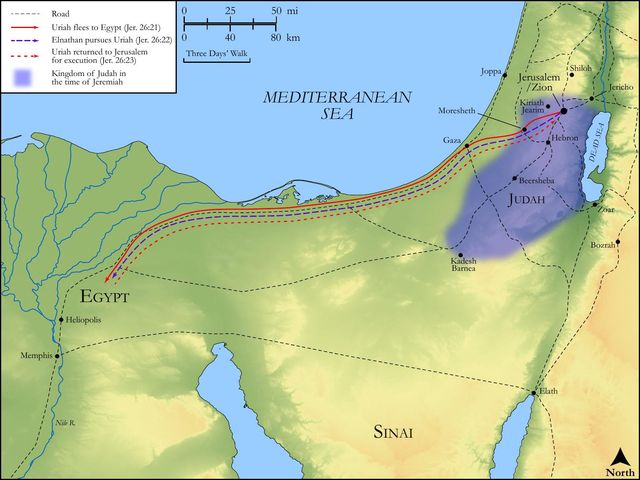
(Verse 20 onwards) There was also a prophet man in the name of the Lord, Uriah, the son of Shemai from Kiriath-Jearim, and he prophesied against this city and against this land, according to all the words of Jeremiah. And King Jehoiakim and all his powerful men and officials heard these words, and the king sought to put him to death. But Uriah heard about it and was afraid, so he fled and went to Egypt. And what follows: King Jehoiakim sent men to Egypt, including Elnathan son of Achbor, and his men with him, but it is not found in the Septuagint. Your question: And they brought Uriah out of Egypt, and brought him to King Joakim, and he struck him with a sword, and cast his body in the graves of the common people. However, the great Ahikam the son of Shaphan was with Jeremiah, so that he would not be handed over to the people to be killed. It is asked why Uriah the son of Shimei from the town of Kiriath-jearim, who prophesied the same things as Jeremiah, was terrified and fled to Egypt, and when he returned, he was killed; and yet Jeremiah was able to escape, even though he certainly did not flee, but boldly persisted in his previous judgment, and was freed from the judgment of both the common people and the rulers, as well as the advice of the elders, against the accusers, the priests, and the false prophets. To briefly respond to this: it is not at all possible to know the judgment of God, since the same cause and the same opinion result in one person being punished and another being set free. Unless, perhaps, we can respond by saying that Uriah was condemned and killed by the accusers and the people, while Jeremiah was reserved for the judgment of God in order to preach to the rest of the unfortunate people and bring them to repentance. This is indeed also read in the Acts of the Apostles, where we learn that the Apostle James (Acts 12) immediately endured the sentence of Herod and was rewarded with martyrdom, while blessed Peter and the other Apostles were reserved for the teaching of the Lord. And the steadfastness of the prophet Uriah is worth noting, as he did not change his opinion even when he was brought back from Egypt, but rather, seeing that death was being planned against him, he still spoke the words that the Lord had commanded. And his fear and flight and entry into Egypt are not signs of unfaithfulness, but rather of prudence: so that we do not offer ourselves to dangers in vain. Otherwise, we also read of the Lord and Savior falling into the hands of those who pursued him (Luke 4, John 8); and he commanded the Apostles: 'When they persecute you in this city, flee to another' (Matthew 10, 23). It is also asked how Joacim, the king of Judah, of small and weakened empire, and already on the verge of perishing, had the power to send to Egypt and bring back Uriah. This is easily solved if we consider that he was appointed a ruler by the king of Egypt, Nechao, and this prophecy was made at the beginning of his reign. Although Jeremiah was freed by the help of the Lord, it is also attributed to Uriah as the one through whom the Lord freed his prophet. This Uriah is, of course, the son of Stephan, as we will read later, when Jeremiah is freed from the danger of death by the advice and assistance of Abdelech the Ethiopian eunuch (Jeremiah 38).
Jeremiah needed the help of Ahikam. How much more do we need that of God.
Continue studying Jeremiah 26:24 across the web’s major study libraries — every link below opens this exact verse, chapter, or book on the destination site.
Read & Compare
 BibleGatewayThis verse in more than 200 translations and 70 languages.
 Bible.comThe YouVersion reader — hundreds of translations, reading plans, and highlights.
 ESV.orgCrossway's official English Standard Version reader.
 NET BibleThe NET translation with 60,000+ translators' notes on every rendering decision.
 STEP BibleTyndale House's free study tool — original text, vocabulary, and scholarly resources.
 BibliaLogos Bible Software's free web reader.
 USCCBThe New American Bible (Revised Edition) with the U.S. bishops' study notes.
Commentaries
 BibleHub CommentariesDozens of classic commentaries on this verse, gathered on one page.
 StudyLightMore than 100 commentary sets — the largest collection on the web.
 BibleRefPlain-English commentary on what this verse means, verse by verse.
 Enduring WordDavid Guzik's free commentary on this chapter, widely used by Bible teachers.
 Bible Study ToolsVerse commentary alongside Greek and Hebrew study aids.
Original Language & Research
- BibleHub InterlinearThe verse word by word — original language, transliteration, and English.
- BibleHub LexiconEvery word's original-language definition and Strong's entry.
 Blue Letter BibleDeep-study tools — Strong's numbers, concordance, and word studies.
 SefariaThe Hebrew text with Rashi and centuries of Jewish commentary.
Sermons, Hymns & Audio


TrulyRandomVerse is not affiliated with these sites and doesn’t control their content. They’re linked because they’re genuinely useful.
Summary
Jeremiah 26:24 records a pivotal divine intervention in the life of the prophet Jeremiah, revealing how the influential support of Ahikam, son of Shaphan, was instrumental in preventing his execution by a hostile populace and enraged religious leaders. This verse serves as a powerful testament to God's sovereign providence, utilizing human agency to safeguard His chosen messenger, thereby ensuring the continuation of Jeremiah's prophetic ministry despite intense and life-threatening opposition to his message of judgment and repentance for Judah.
Context
ShowHideLiterary Context
Jeremiah 26 functions as a self-contained narrative unit, strategically positioned within the book to vividly illustrate the profound opposition Jeremiah encountered during the nascent years of King Jehoiakim's tumultuous reign. The chapter commences with Jeremiah's audacious temple sermon, where he delivers a stark warning that Jerusalem and its revered temple face a fate akin to Shiloh's destruction if the people persist in their unrepentant ways, a message detailed in Jeremiah 26:1-6. This pronouncement, interpreted as both blasphemy and treason, incites the priests, false prophets, and the general populace to demand his immediate execution, as described in Jeremiah 26:7-11. Jeremiah's courageous and divinely-commissioned defense, found in Jeremiah 26:12-15, prompts a crucial debate among the officials. Some recall the precedent of Micah's prophecy during King Hezekiah's era, which led to national repentance rather than execution, a point highlighted in Jeremiah 26:16-19. The immediate literary backdrop is further darkened by the tragic account of Uriah, another prophet who delivered a similar message but was relentlessly pursued and executed by Jehoiakim, as narrated in Jeremiah 26:20-23. Thus, Jeremiah 26:24 serves as the climactic resolution, marking the successful intervention that spares Jeremiah's life and powerfully underscores God's protective hand over His faithful messenger.
Historical & Cultural Context
The events depicted in Jeremiah 26 transpired early in the reign of King Jehoiakim (609-598 BC), a period characterized by profound political instability and precipitous spiritual decline within the kingdom of Judah. Jehoiakim, unlike his righteous father King Josiah, was a wicked and oppressive monarch, installed as a puppet king by Pharaoh Neco II, and notoriously hostile to prophetic voices. The populace harbored a dangerous false sense of security, rooted in the erroneous belief that God would never permit His sacred temple in Jerusalem to be destroyed, making Jeremiah's message of impending doom particularly incendiary. Culturally, the Hebrew term for "hand" (yad) frequently conveyed concepts of power, authority, influence, or even possession, which is vital for grasping the full weight of Ahikam's intervention. Ahikam himself belonged to the highly respected and influential family of Shaphan; his father, Shaphan, was a prominent scribe and official in King Josiah's court, famously instrumental in the discovery of the Book of the Law and its presentation to the king, as recorded in 2 Kings 22:8-10. This family's established legacy of reverence for God's word and support for righteous reform lent immense credibility and significant political weight to Ahikam's standing among Judah's elders and officials.
Key Themes
ShowHideThis verse profoundly highlights several critical themes pervasive throughout the book of Jeremiah and the broader biblical narrative. Firstly, it powerfully underscores the divine protection of God's prophets in the face of intense human opposition. Jeremiah's life was genuinely imperiled, yet God sovereignly used a human agent to preserve him, demonstrating His ultimate control over hostile forces. Secondly, it vividly illustrates the perilous nature of proclaiming God's unpopular truth, especially when that truth directly challenges entrenched religious and political establishments. Jeremiah's message of impending judgment was met with a demand for his execution, reflecting the deep-seated human resistance to genuine repentance. Thirdly, the verse emphasizes the indispensable role of faithful individuals in positions of influence. Ahikam's courageous stand, deeply rooted in his family's legacy of fidelity to God's word, serves as a compelling model of how God strategically uses human instruments to accomplish His divine purposes. Finally, it subtly yet powerfully contrasts true prophecy with a dangerous false security, revealing that reliance on mere religious structures, such as the Temple, without accompanying genuine obedience inevitably leads to divine judgment, and that God's authentic messengers often face the wrath of those who prefer comforting deceptions.
Exposition and Analysis
ShowHideKey Word Analysis
ShowHideThis primitive Hebrew word, distinct from kaph (the closed hand), specifically refers to the open hand, symbolizing power, means, direction, or influence. In this context, "the hand of Ahikam" denotes his potent influence and authoritative intervention. It signifies not merely his physical presence but his formidable capacity to exert authority and decisively sway opinion among the officials and the people, thereby effectively preventing Jeremiah's execution. It implies a protective, guiding, and enabling power that actively shielded the prophet.
Derived from the Hebrew words for "brother" (ach) and "rise" (qum), this name translates to "brother of rising" or "my brother has risen." The name itself inherently conveys a sense of prominence, elevation, or even deliverance. Ahikam was a high-ranking official, the son of Shaphan, whose family was renowned for their integrity and steadfast support of God's word. His name subtly foreshadows his crucial role in "raising up" or preserving Jeremiah from certain death, acting as a true "brother" in the spiritual sense of an ally, advocate, and protector.
A fundamental Hebrew root verb meaning "to die," applicable both literally and figuratively, and in its causative form, "to kill." Here, it unequivocally refers to the literal execution of Jeremiah. The phrase "to put him to death" signifies the ultimate, murderous intention of the enraged mob and the hostile religious and political leaders. Ahikam's intervention directly counteracted this fatal intent, powerfully highlighting the extreme gravity of the situation and the immense magnitude of his life-saving protective act.
Verse Breakdown
ShowHide"Nevertheless the hand of Ahikam the son of Shaphan was with Jeremiah,"
This clause introduces a critical narrative pivot, emphasizing that despite the overwhelming opposition and the fervent demand for Jeremiah's death, Ahikam's powerful influence and unwavering support were actively present with the prophet. Ahikam, a high-ranking official from a prominent and God-fearing family, strategically leveraged his authority and esteemed standing to defend Jeremiah. The phrase "was with Jeremiah" signifies active support, resolute advocacy, and tangible protection, far beyond mere passive presence.
"that they should not give him into the hand of the people"
This explains the precise objective and outcome of Ahikam's intervention: to prevent Jeremiah from being delivered into the control of the enraged populace. The "hand of the people" here represents the collective will, overwhelming power, and violent intent of the inflamed mob, who were poised to carry out an immediate execution. This phrase vividly underscores the immediate and dire peril Jeremiah faced, as mob justice frequently bypassed formal legal processes, leading to swift and brutal death.
"to put him to death."
This conclusive phrase explicitly articulates the ultimate, murderous intention of those who vehemently opposed Jeremiah. It leaves no ambiguity regarding the desired outcome of Jeremiah's accusers and underscores the severity of the threat. Ahikam's intervention directly thwarted this fatal aim, confirming the life-saving nature of his courageous act.
Literary Devices
ShowHideThe verse masterfully employs Metonymy and Synecdoche through the repeated and nuanced use of "hand." "The hand of Ahikam" functions as a metonym, representing Ahikam's personal power, profound influence, and decisive protective action. It encapsulates his authority and his capacity to intervene effectively and decisively. Conversely, "the hand of the people" serves as a synecdoche, where "hand" stands for the collective power, unified will, and violent, destructive intent of the enraged mob. This dual application of "hand" powerfully emphasizes the stark Contrast between opposing forces: Ahikam's singular, protective influence against the people's collective, destructive intent. Furthermore, there is an implicit Contrast with the tragic fate of Uriah, another prophet, recounted in the immediately preceding verses (Jeremiah 26:20-23), where no such "hand" of protection was present, directly leading to Uriah's execution. This profound contrast underscores the miraculous nature of Jeremiah's deliverance and highlights the overarching theme of Divine Providence, wherein God sovereignly works through human agents like Ahikam to preserve His divine purposes and protect His faithful prophet.
Theological and Thematic Connections
ShowHideJeremiah 26:24 profoundly illustrates the enduring theological principle that God frequently works through human instruments to accomplish His divine purposes, particularly in safeguarding His faithful servants. Even when faced with overwhelming opposition and imminent danger, God's sovereign hand is actively at work, often manifesting through unexpected allies or individuals strategically placed in positions of influence. Ahikam's intervention is not merely a political maneuver but a divinely orchestrated act of deliverance, demonstrating God's unwavering commitment to preserving His messenger so that His holy word might continue to be proclaimed without hindrance. This verse serves as a powerful and timeless reminder that faithfulness to God's truth, though it may indeed invite persecution and hardship, is never without divine oversight and protection, even if that protection comes through the courage and intervention of others.
Reflection and Application
ShowHideJeremiah 26:24 offers profound and enduring lessons for contemporary believers, challenging us to deeply consider our own roles in defending truth and actively protecting those who courageously speak it, even when such truth is unpopular, inconvenient, or dangerous. Ahikam's courageous stand serves as a powerful reminder that God frequently uses seemingly ordinary, yet influential, people to accomplish extraordinary acts of preservation, justice, and mercy. We are called to embody the spirit of Ahikam, willing to leverage our influence, resources, or position, no matter how seemingly small, to stand resolutely for what is right and to actively support those who face persecution for their faith or for proclaiming God's truth. This verse also provides immense encouragement and reassurance to those who feel isolated, vulnerable, or threatened for their convictions; it steadfastly reassures us that God's protective hand is perpetually at work, often manifesting through the unexpected kindness, courage, or intervention of others. It powerfully underscores that even in the darkest and most perilous moments, when the forces of opposition appear overwhelming, God maintains ultimate sovereignty and faithfully provides deliverance, often through the very human connections and relationships He orchestrates.
Questions for Reflection
ShowHideFAQ
ShowHideWho was Ahikam, and why was his intervention significant for Jeremiah?
ShowHideAhikam was a highly prominent and influential official serving in the court of King Jehoiakim, and he was the son of Shaphan, a revered scribe who played a pivotal role in King Josiah's earlier religious reforms. His family was widely recognized for their deep reverence for God's law and their consistent support for prophetic voices. Ahikam's intervention was profoundly significant because he strategically used his considerable influence and authority to prevent the enraged mob and hostile religious leaders from executing Jeremiah. At a time when Jeremiah's life was in grave and immediate danger, Ahikam's "hand" (representing his power, authority, and influence) was actively "with Jeremiah," effectively shielding him from the people's murderous intent. This courageous act of protection was absolutely crucial for Jeremiah's survival, enabling him to continue his vital prophetic ministry, and it powerfully highlights God's providence working through dedicated human agents. This echoes how God uses individuals to protect His purposes, much like the wise counsel of Gamaliel saved the apostles in Acts 5:34-39.
What does Jeremiah 26:24 teach us about God's protection of His servants?
ShowHideThis verse teaches us a profound truth: God's protection of His servants is frequently manifested through human means. While God is absolutely sovereign and possesses the power to intervene miraculously, He often chooses to work through faithful individuals who are willing to courageously stand for truth and justice. Jeremiah's deliverance was not a direct, supernatural intervention from the heavens, but rather through the courageous, timely, and strategic action of Ahikam. This demonstrates that God effectively uses His people, their influence, their positions, and their relationships to fulfill His purposes and preserve His messengers. It powerfully reassures us that even when facing severe opposition and seemingly insurmountable odds, God's protective hand is ever-present, often working through the "hands" of those He raises up to help. This divine pattern is consistently observed throughout Scripture, where God employs individuals such as Esther to protect her people (Esther 4:14) or various leaders to guide His chosen ones.
Christ-Centered Fulfillment
ShowHideJeremiah's harrowing experience in Jeremiah 26:24 profoundly foreshadows the life, ministry, and ultimate sacrifice of Jesus Christ. Like Jeremiah, Jesus was the ultimate Prophet who faithfully proclaimed God's unvarnished truth, often challenging the entrenched religious and political establishments of His era. He, too, faced intense opposition and overwhelming demands for His death from the very people He came to redeem (John 1:11). While Jeremiah was providentially protected from physical death by the "hand of Ahikam," Jesus, the unique and ultimate Prophet and Son of God, willingly surrendered Himself to the "hand" of His persecutors, not to be saved from physical death, but to accomplish a far greater and eternal salvation. His sacrificial death on the cross was not a failure of divine protection, but rather the very means by which God's ultimate protective "hand" would be extended to all humanity, delivering us from the spiritual death caused by sin and rebellion (Romans 5:8). The very "hand of God" that permitted Jesus to be crucified was the same omnipotent "hand" that raised Him triumphantly from the dead (Acts 2:24), thereby securing eternal life and spiritual deliverance for all who place their faith in Him. Thus, while Ahikam's courageous intervention saved Jeremiah for a temporal period, Christ's unparalleled sacrifice provides eternal deliverance, fulfilling the deepest human need for a divine protector who definitively conquers death itself.