


2 Samuel 16:15
Bible text: King James Version (1769 Blayney text) · Public domain
Bible text: Berean Standard Bible · Public domain
Bible text: American Standard Version (1901) · Public domain
Bible text: World English Bible, Messianic edition · Public domain
Bible text: Geneva Bible (1599) · Public domain
Bible text: Young's Literal Translation · Public domain
- וְאַבְשָׁלוֹםve·'av·sha·Lomand AbsalomH53Conj-w ¦ N-proper-mNoun Proper MasculineוְandאַבְשָׁלוֹםAbsalom
- וְכָלve·kholand allH3605Conj-w ¦ N-mscNoun Singular Masculine Constructוְandכָלall
- הָעָםha·'Amthe peopleH5971Art ¦ N-msNoun Singular Masculine Absoluteהָtheעָםpeople
- אִישׁ'ish[the] man ofH376N-mscNoun Singular Masculine Construct
- יִשְׂרָאֵלYis·ra·'ElIsraelH3478N-properNoun Proper Location
- בָּאוּBa·'uthey cameH935V-Qal-Perf-3cpVerb Qal Perfect 3rd Plural common gender
- יְרוּשָׁלִָםye·ru·sha·LimJerusalemH3389N-properNoun Proper Location
- וַאֲחִיתֹפֶלva·'a·chi·To·feland AhithophelH302Conj-w ¦ N-proper-mNoun Proper MasculineוַandאֲחִיתֹפֶלAhithophel
- אִתּוֹ'i·To[was] with himH854Prep ¦ 3msPreposition Definiteאִתּ[was] withוֹhim
English is a literal word-by-word gloss of the Hebrew, not the KJV's wording. Why?
This is the original text the KJV's translators worked from — each Hebrew word with its own literal English meaning in this verse, prepared by scholars at Tyndale House, Cambridge. The KJV translates whole sentences, not word by word, so its wording differs: one Hebrew word can become several English words, and the KJV may choose “the LORD” where the gloss reads “Yahweh”. Both are faithful — they answer different questions. For the KJV's own rendering, switch to the KJV text.
Details
See on the biblical-era maps

Study this verse
Public-domain commentary
Matthew Henry
From his Commentary on the Whole Bible. Henry comments on passages, not single verses — this entry covers 2 Samuel 16:15–23. His four-level outline is real structure in the source text, so it is rendered as structure.
Absalom had notice sent him speedily by some of his friends at Jerusalem that David had withdrawn, and with what a small retinue he had gone; so that the coasts were clear, Absalom might take possession of Jerusalem when he pleased. The gates were open, and there was none to oppose him. Accordingly he came without delay (Sa2 16:15), extremely elevated, no doubt, with this success at first, and that that in which, when he formed his design, he probably apprehended the greatest difficulty, was so easily and effectually done. Now that he is master of Jerusalem he concludes all his own, the country will follow of course. God suffers wicked men to prosper awhile in their wicked plots, even beyond their expectation, that their disappointment may be the more grievous and disgraceful. The most celebrated politicians of that age were Ahithophel and Hushai. The former Absalom brings with him to Jerusalem (Sa2 16:15), the other meets him there (Sa2 16:16), so that he cannot but think himself sure of success, when he has both these to be his counsellors; on them he relies, and consults not the ark, though he has that with him. But miserable counsellors were they both; for,
I.Hushai would never counsel him to do wisely.
He was really his enemy, and designed to betray him, while he pretended to be in his interest; so that Absalom could not have a more dangerous man about him.
1.Hushai complimented him upon his accession to the throne, as if he had been abundantly satisfied in this title, and well pleased that he had come to the possession, Sa2 16:16. What arts of dissimulation are those tempted to use who govern themselves by fleshly wisdom! and how happy are those who have not known these depths of Satan, but have their conversation in the world with simplicity and godly sincerity!
2.Absalom was surprised to find him for him who was known to be David's intimate friend and confidant. He asks him, Is this thy kindness to thy friend? (Sa2 16:17), pleasing himself with this thought, that all would be his, since Hushai was. He doubts not of his sincerity, but easily believes what he wishes to be true, that David's best friends are so in love with himself as to take the first opportunity to declare for him, though the pride of his heart deceived him, Oba 1:3. Hushai confirmed him in the belief that he was hearty for him. For, though David is his friend, yet he is for the king in possession, Sa2 16:18. Whom the people choose, and Providence smiles upon, he will be faithful to; and he is for the king in succession (Sa2 16:19), the rising sun. It was true, he loved his father; but he had had his day, and it was over; and why should he not love his successor as well? Thus he pretended to give reasons for a resolution he abhorred the thought of.
II.Ahithophel counselled him to do wickedly, and so did as effectually betray him as he did who was designedly false to him; for those that advise men to sin certainly advise them to their hurt; and that government which is founded in sin is founded in the sand.
1.It seems, Ahithophel was noted as a deep politician; his counsel was as if a man had enquired at the oracle of God, Sa2 16:23. Such reputation was he in for subtlety and sagacity in public affairs, such reaches had he beyond other privy-counselors, such reasons would he give for his advice, and such success generally his projects had, that all people, good and bad, both David and Absalom, had a profound regard for his sentiments, too much by far, when they regarded him as an oracle of God; shall the prudence of any mortal compare with him who only is wise? Let us observe from this account of Ahithophel's fame for policy,
(1.)That many excel in worldly wisdom who are utterly destitute of heavenly grace, because those who set up for oracles themselves are apt to despise the oracles of God. God has chosen the foolish things of the world; and the greatest statesmen are seldom the greatest saints.
(2.)That frequently the greatest politicians act most foolishly for themselves. Ahithophel was cried up for an oracle, and yet very unwisely took part with Absalom, who was not only a usurper, but a rash youth, never likely to come to good, whose fall, and the fall of all that adhered to him, any one, with the tenth part of the policy that Ahithophel pretended to, might foresee. Well, after all, honesty is the best policy, and will be found so in the long run. But,
2.His policy in this case defeated its own aim. Observe,
(1.)The wicked counsel Ahithophel gave to Absalom. Finding that David had left his concubines to keep the house, he advised him to lie with them (Sa2 16:21), a very wicked thing. The divine law had made it a capital crime, Lev 20:11. The apostle speaks of it as a piece of villany not so much as named among the Gentiles, Co1 5:1. Reuben lost his birthright for it. But Ahithophel advised Absalom to it as a public thing, because it would give assurance to all Israel,
[1.]That he was in good earnest in his pretensions. No doubt he resolved to make himself master of all that belonged to his predecessor when he began with his concubines.
[2.]That he was resolved never to make peace with his father upon any terms; for by this he would render himself so odious to his father that he would never be reconciled to him, which perhaps the people were jealous of and that they must be sacrificed to the reconciliation. Having drawn the sword, he did, by this provocation, throw away the scabbard, which would strengthen the hands of his party and keep them firmly to him. This was Ahithophel's cursed policy, which bespoke him rather an oracle of devil than of God.
(2.)Absalom's compliance with this counsel. It entirely suited his lewd and wicked mind, and he delayed not to put it in execution, Sa2 16:22. When an unnatural rebellion was the opera, what fitter prologue could there be to it than such unnatural lust? Thus was his wickedness all of a piece, and such as a conscience not quite seared could not entertain the thoughts of without the utmost horror. Nay, the client outdoes what his counsel advises. Ahithophel advised him to do it, that all Israel shall see it. A tent is accordingly spread on the top of the house for the purpose; so impudently does he declare his sin as Sodom. Yet, in this, the word of God was fulfilled in the letter of it: God had threatened, by Nathan, that, for defiling Bath-sheba, David should have his own wives publicly debauched (Sa2 12:11, Sa2 12:12), and some think that Ahithophel, in advising it, designed to be revenged on David for the injury done to Bath-sheba, who was his grand-daughter: for she was the daughter of Eliam (Sa2 11:3), who was the son of Ahithophel, Sa2 23:34. Job speaks of this as the just punishment of adultery (Let my wife grind to another, Job 31:9, Job 31:10), and the prophet, Hos 4:13, Hos 4:14. What to think of these concubines, who submitted to this wickedness, I know not; but how unrighteous soever Absalom and they were, we must say, The Lord is righteous: nor shall any word of his fall to the ground.
Continue studying 2 Samuel 16:15 across the web’s major study libraries — every link below opens this exact verse, chapter, or book on the destination site.
Read & Compare
 BibleGatewayThis verse in more than 200 translations and 70 languages.
 Bible.comThe YouVersion reader — hundreds of translations, reading plans, and highlights.
 ESV.orgCrossway's official English Standard Version reader.
 NET BibleThe NET translation with 60,000+ translators' notes on every rendering decision.
 STEP BibleTyndale House's free study tool — original text, vocabulary, and scholarly resources.
 BibliaLogos Bible Software's free web reader.
 USCCBThe New American Bible (Revised Edition) with the U.S. bishops' study notes.
Commentaries
 BibleHub CommentariesDozens of classic commentaries on this verse, gathered on one page.
 StudyLightMore than 100 commentary sets — the largest collection on the web.
 BibleRefPlain-English commentary on what this verse means, verse by verse.
 Enduring WordDavid Guzik's free commentary on this chapter, widely used by Bible teachers.
 Bible Study ToolsVerse commentary alongside Greek and Hebrew study aids.
Original Language & Research
- BibleHub InterlinearThe verse word by word — original language, transliteration, and English.
- BibleHub LexiconEvery word's original-language definition and Strong's entry.
 Blue Letter BibleDeep-study tools — Strong's numbers, concordance, and word studies.
 SefariaThe Hebrew text with Rashi and centuries of Jewish commentary.
Sermons, Hymns & Audio


TrulyRandomVerse is not affiliated with these sites and doesn’t control their content. They’re linked because they’re genuinely useful.
Summary
2 Samuel 16:15 chronicles the dramatic and unopposed entry of Absalom into Jerusalem, accompanied by the people of Israel and the influential counselor Ahithophel. This pivotal moment marks the temporary culmination of Absalom's meticulously planned rebellion, signifying the apparent overthrow of King David's reign and the seizure of the capital, thereby solidifying Absalom's claim to the throne and plunging the kingdom into a profound crisis of loyalty, power, and divine sovereignty.
Context
ShowHideLiterary Context
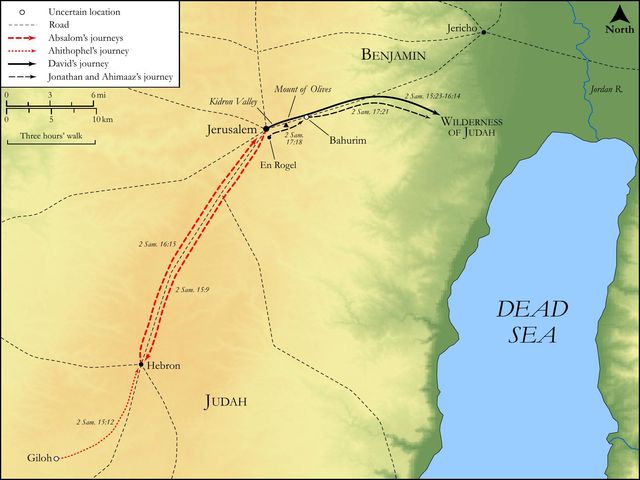
This verse immediately follows King David's sorrowful and strategic flight from Jerusalem, as detailed in 2 Samuel 15. David's decision to evacuate the city, rather than engage in civil war within its sacred walls, was motivated by a desire to prevent bloodshed and a deep trust in God's ultimate control over the unfolding events. His departure involved sending key figures like Zadok and Abiathar, along with the Ark of the Covenant, back to Jerusalem, not only to protect the Ark but also to establish an intelligence network. Crucially, David also dispatched Hushai the Archite, his loyal confidant, with instructions to feign allegiance to Absalom and strategically undermine the counsel of Ahithophel (2 Samuel 15:32-37). Absalom's triumphant arrival in Jerusalem, therefore, is the direct consequence of David's retreat, representing the successful initial phase of the coup and setting the stage for the intense strategic and military maneuvers that will follow.
Historical & Cultural Context
In ancient Israel, Jerusalem was far more than just a political capital; it was the spiritual heart of the nation, housing the Ark of the Covenant and symbolizing God's presence among His people. Its capture without resistance by Absalom was a profound symbolic victory, signaling to the populace that the transfer of power was complete and, to many, perhaps divinely sanctioned. The phrase "all the people the men of Israel" indicates a widespread popular uprising, reflecting the charismatic appeal Absalom had cultivated over years, subtly undermining David's authority through public relations and false promises of justice (2 Samuel 15:1-6). The defection of a trusted counselor like Ahithophel was particularly devastating. Such figures held immense sway due to their wisdom, access to royal secrets, and perceived divine insight. His presence lent significant legitimacy and strategic brilliance to Absalom's rebellion, making it appear formidable and divinely favored in the eyes of many.
Key Themes
ShowHideThis verse powerfully underscores several key themes pervasive in the broader narrative of 2 Samuel. Firstly, it highlights the fragility of human power and the precarious nature of kingship, even for divinely chosen monarchs like David. Despite his establishment and God's covenant promises, David's authority could be swiftly challenged and seemingly overthrown by internal rebellion. Secondly, the narrative emphasizes the devastating impact of betrayal, particularly from within one's own family and inner circle. Absalom's rebellion is a profound act of filial disloyalty and usurpation, while Ahithophel's defection represents a deep breach of trust from a close confidant, whose counsel was considered as if one had inquired of the oracle of God. Thirdly, the swiftness of Absalom's takeover illustrates the consequences of sin within David's household, implicitly fulfilling the prophecy of Nathan concerning the sword never departing from David's house due to his actions with Bathsheba and Uriah (2 Samuel 12:10-11). Finally, though not explicitly stated, the unfolding events subtly point to divine sovereignty, as God allows these trials to unfold, yet ultimately works to preserve His covenant promises and David's lineage, demonstrating His ultimate control over human affairs.
Exposition and Analysis
ShowHideKey Word Analysis
ShowHideFrom the root meaning "father of peace (i.e. friendly)," this name stands in stark ironic contrast to the character's actions. Absalom's rebellion brings anything but peace to David's kingdom and family, instead ushering in a period of violent disruption, usurpation of authority, and profound familial strife. The name highlights the tragic paradox of his life, where a desire for power overshadows any potential for genuine peace, ultimately leading to his own destruction and chaos for the nation.
Meaning "founded peaceful" or "possession of peace," this name for the capital city is deeply ironic in the context of Absalom's entry. The city, intended as a center of peace and divine presence, becomes the stage for rebellion, betrayal, and the temporary overthrow of its rightful king. Absalom's "peaceful" entry is a deceptive calm before the storm of civil war, highlighting the disruption of the very peace the city's name implies.
Derived from "brother of folly," this name carries a profound layer of irony, especially given Ahithophel's reputation for exceptionally wise and divinely inspired counsel. His defection from David to Absalom, while initially appearing to be a shrewd strategic move, ultimately leads to his own demise when his counsel is rejected in favor of Hushai's, leading him to commit suicide (2 Samuel 17:23). His presence here signifies the rebellion's initial intellectual and strategic strength, yet his name foreshadows the ultimate folly of opposing God's chosen king and the tragic end of human wisdom when it stands against divine purpose.
Verse Breakdown
ShowHide"And Absalom, and all the people the men of Israel"
This opening clause immediately establishes the key figures of the rebellion and the breadth of its support. Absalom is the charismatic leader, but the inclusion of "all the people the men of Israel" highlights that his movement had successfully mobilized a significant portion of the nation, indicating a widespread defection of loyalty from David. This collective noun emphasizes the popular momentum behind the coup, suggesting that Absalom's cause had resonated deeply with the populace, perhaps due to David's recent moral failures or perceived administrative shortcomings.
"came to Jerusalem"
This phrase denotes the successful and unopposed capture of the capital city. Jerusalem, David's royal and spiritual center, falls without a battle, symbolizing the apparent ease with which Absalom seized power. This swift entry underscores the effectiveness of Absalom's long-term conspiracy and David's strategic decision to evacuate, avoiding a bloody civil war within the city walls. The lack of resistance amplifies the dramatic impact of the transfer of power.
"and Ahithophel with him"
This final clause is concise but loaded with immense significance. Ahithophel was David's most trusted and brilliant counselor, whose advice was considered as if one had inquired of the oracle of God. His presence alongside Absalom signifies the rebellion's strategic depth and intellectual prowess, demonstrating that it was not merely a youthful uprising but a well-orchestrated coup with formidable minds behind it. His defection was a profound blow to David's morale and a massive boost to Absalom's legitimacy and tactical advantage, making the rebellion seem almost unstoppable in its initial stages.
Literary Devices
ShowHideThe verse employs several potent literary devices to convey its dramatic message. Conciseness is paramount, as a monumental shift in power is conveyed in a single, declarative sentence, emphasizing the swiftness and decisiveness of Absalom's takeover. The inclusion of "all the people the men of Israel" functions as a form of Synecdoche, where a part (the men) represents the whole (the nation's widespread support), amplifying the perceived legitimacy and scale of the rebellion. There is also a strong element of Dramatic Irony, particularly with the mention of Absalom and Ahithophel. Absalom, whose name means "father of peace," brings war and chaos, while Ahithophel, the renowned wise counselor whose name means "brother of folly," ultimately acts in folly by opposing God's anointed and later takes his own life. The verse also serves as Foreshadowing, setting the stage for the intense strategic battle of wits that will ensue, particularly concerning Ahithophel's counsel and Hushai's counter-counsel, which will ultimately lead to the rebellion's downfall and the restoration of David's throne.
Theological and Thematic Connections
ShowHide2 Samuel 16:15 serves as a stark reminder of the profound consequences of sin and the complex, often painful, outworking of divine judgment within the covenant community. David's prior transgressions, particularly with Bathsheba and Uriah, had led to Nathan's prophecy that "the sword shall never depart from your house" (2 Samuel 12:10), and Absalom's rebellion is a direct, albeit painful, fulfillment of this prophetic word, highlighting God's faithfulness to His warnings even as He remains faithful to His promises. The verse underscores the fragility of human power and loyalty, demonstrating how quickly even a divinely appointed king can be brought low by internal strife and betrayal. Yet, even in this moment of apparent defeat, God's sovereign hand is at work, orchestrating events to test David's faith, refine his character, and ultimately demonstrate His control over the affairs of nations and kings, ensuring that His ultimate purposes prevail despite human rebellion and folly.
Reflection and Application
ShowHideThe scene of Absalom's triumphant entry into Jerusalem, with David in sorrowful flight, offers profound lessons for believers today. It reminds us that even those who are deeply devoted to God can experience periods of intense adversity, betrayal, and apparent defeat. David's humiliation was a direct consequence of his past sins, yet God used this painful season to deepen his reliance on divine grace and sovereignty. In our own lives, we may face betrayals from those we trust, or witness the triumph of unrighteousness, causing us to question God's presence or justice. This narrative encourages us to look beyond immediate circumstances, trusting that God remains in control, even when His plans are veiled by human chaos and suffering. It calls us to examine our own hearts for seeds of ambition or disloyalty, and to cultivate steadfastness and humility, remembering that true authority and peace come from God alone, not from worldly power or popular acclaim. It also serves as a poignant reminder that even the most trusted human counsel can fail, and true wisdom is found only in alignment with God's will.
Questions for Reflection
ShowHideFAQ
ShowHideWhy was Ahithophel's presence with Absalom so significant?
ShowHideAhithophel's presence was profoundly significant because he was not merely a general supporter but David's most trusted and highly esteemed counselor. His advice was so respected that it was considered as if one had inquired of the oracle of God. His defection to Absalom's side was a devastating blow to David, both personally and strategically. It signaled that Absalom's rebellion was not just a youthful uprising but a serious, well-planned coup with formidable strategic minds behind it. Ahithophel's counsel provided Absalom with immediate tactical advantages, such as advising him to publicly claim David's concubines to demonstrate the irreversible break with his father (2 Samuel 16:20-22). His betrayal underscored the depth of David's crisis and the perceived legitimacy of Absalom's claim in the eyes of many Israelites, making the rebellion appear almost unstoppable in its initial stages.
Christ-Centered Fulfillment
ShowHideThe narrative of Absalom's rebellion, culminating in his seizure of Jerusalem, finds profound Christ-centered fulfillment in several ways. David, as the anointed king, suffering betrayal and being driven from his throne, foreshadows the ultimate suffering and rejection of the greater Son of David, Jesus Christ. Just as Absalom, the "father of peace," brought chaos and war, so too did humanity, through sin, rebel against the true King of Peace, leading to spiritual alienation and death. Jesus, the rightful King, also entered Jerusalem, not to seize a worldly throne through rebellion, but in humility on a donkey, offering true peace (Matthew 21:5). He was betrayed by a trusted disciple, Judas Iscariot, for a mere sum of money (Matthew 26:14-16), just as David was betrayed by Ahithophel. Yet, unlike David's temporary exile, Christ's "defeat" on the cross was the ultimate victory, a strategic divine maneuver to reclaim His kingdom and reconcile humanity to God (Colossians 2:15). Through His suffering, death, and resurrection, Jesus established an eternal kingdom that cannot be shaken by human rebellion or betrayal, securing a peace far beyond the fleeting political stability David sought (Hebrews 12:28). Thus, Absalom's brief triumph in Jerusalem ultimately points to the enduring reign of Christ, whose kingdom is not of this world, yet triumphs over all earthly powers and betrayals, offering true and lasting peace to all who believe.