


2 Samuel 16:14
- וַיָּבֹאvai·ya·Vo'and he cameH935Conj-w ¦ V-Qal-ConsecImperf-3msVerb Qal Consecutive Imperfect 3rd Singular Masculineוַandיָּבֹאhe came
- הַמֶּלֶךְha·Me·lekhthe kingH4428Art ¦ N-msNoun Singular Masculine Absoluteהַtheמֶּלֶךְking
- וְכָלve·kholand allH3605Conj-w ¦ N-mscNoun Singular Masculine Constructוְandכָלall
- הָעָםha·'Amthe peopleH5971Art ¦ N-msNoun Singular Masculine Absoluteהָtheעָםpeople
- אֲשֶׁר'a·SherwhichH834RelParticle Relative
- אִתּוֹ'i·To[was] with himH854Prep ¦ 3msPreposition Definiteאִתּ[was] withוֹhim
- עֲיֵפִים'a·ye·FimexhaustedH5889Adj-mpAdjective Plural Masculine Absolute
- וַיִּנָּפֵשׁvai·yi·na·Feshand he refreshed himselfH5314Conj-w ¦ V-Niphal-ConsecImperf-3msVerb Niphal Consecutive Imperfect 3rd Singular Masculineוַandיִּנָּפֵשׁhe refreshed himself
- שָׁםShamthereH8033AdvAdverb
English is a literal word-by-word gloss of the Hebrew, not the KJV's wording. Why?
This is the original text the KJV's translators worked from — each Hebrew word with its own literal English meaning in this verse, prepared by scholars at Tyndale House, Cambridge. The KJV translates whole sentences, not word by word, so its wording differs: one Hebrew word can become several English words, and the KJV may choose “the LORD” where the gloss reads “Yahweh”. Both are faithful — they answer different questions. For the KJV's own rendering, switch to the KJV text.
Details
See on the biblical-era map

Study this verse
Public-domain commentary
Matthew Henry
From his Commentary on the Whole Bible. Henry comments on passages, not single verses — this entry covers 2 Samuel 16:5–14. His four-level outline is real structure in the source text, so it is rendered as structure.
We here find how David bore Shimei's curses much better than he had borne Ziba's flatteries. By the latter he was brought to pass a wrong judgment on another, by the former to pass a right judgment on himself. The world's smiles are more dangerous than its frowns. Observe here,
I.How insolent and furious Shimei was, and how his malice took occasion from David's present distress to be so much the more outrageous.
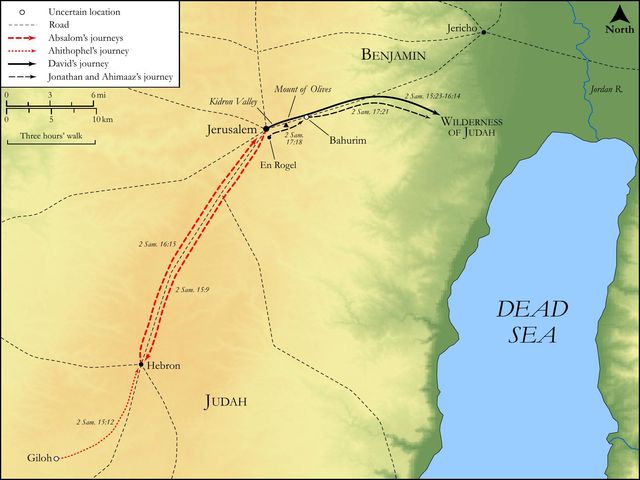
David, in his flight, had come to Bahurim, a city of Benjamin in or near which this Shimei lived, who, being of the house of Saul (with the fall of which all his hopes of preferment fell), had an implacable enmity to David, unjustly looking upon him as the ruin of Saul and his family only because, by the divine appointment, he succeeded Saul. While David was in prosperity and power, Shimei hated him as much as he did now, but he durst not then say anything against him. God knows what is in the hearts of those that are disaffected to him and his government, but earthly princes do not. Now he came forth, and cursed David with all the bad words and wishes he could invent, Sa2 16:5. Observe,
1.Why he took this opportunity to give vent to his malice.
(1.)Because now he thought he might do it safely; yet, if David had thought proper to resent the provocation, it would have cost Shimei his life.
(2.)Because now it would be most grievous to David, would add affliction to his grief, and pour vinegar into his wounds. He complains of those as most barbarous who talk to the grief of those whom God has wounded, Psa 69:26. So Shimei did, loading him with curses whom no generous eye could look upon without compassion.
(3.)Because now he thought that Providence justified his reproaches, and that David's present afflictions proved him to be as bad a man as he was willing to represent him. Job's friends condemned him upon this false principle. Those that are under the rebukes of a gracious God must not think it strange if these bring upon them the reproaches of evil men. If once it be said, God hath forsaken him, presently it follows, Persecute and take him, Psa 71:11. But it is the character of a base spirit thus to trample upon those that are down, and insult over them.
2.How his malice was expressed. See,
(1.)What this wretched man did: He cast stones at David (Sa2 16:6), as if his king had been a dog, or the worst of criminals, whom all Israel must stone with stones till he die. Perhaps he kept at such a distance that the stones he threw could not reach David, nor any of his attendants, yet he showed what he would have done if it had been in his power. He cast dust (Sa2 16:13), which, probably, would blow into his own eyes, like the curses he threw, which, being causeless, would return upon his own head. Thus, while his malice made him odious, the impotency of it made him ridiculous and contemptible. Those that fight against God cannot hurt him, though they hate him. If thou sinnest, what doest thou against him? Job 35:6. It was an aggravation of his wickedness that David was attended with his mighty men on his right hand and on his left, so that he was not in so forlorn a condition as he thought (persecuted but not forsaken), and that he continued to do it, and did it the more passionately, for David's bearing it patiently.
(2.)What he said. With the stones he shot his arrows, even bitter words (Sa2 16:7, Sa2 16:8), in contempt of that law, Thou shalt not curse the gods, Exo 22:28. David was a man of honour and conscience, and in great reputation for every thing that was just and good; what could this foul mouth say against him? Why, truly, what was done long since to the house of Saul was the only thing which he could recollect, and with this he upbraided David because it was the thing that he himself was a loser by. See how apt we are to judge of men and their character by what they are to us, and to conclude that those are certainly evil men that have ever so justly been, or that we ever so unjustly think have been, instruments of evil to us. So partial are we to ourselves that no rule can be more fallacious than this. No man could be more innocent of the blood of the house of Saul than David was. Once and again he spared Saul's life, while Saul sought his. When Saul and his sons were slain by the Philistines, David and his men were many miles off; and, when they heard it, they lamented it. From the murder of Abner and Ish-bosheth he had sufficiently cleared himself; and yet all the blood of the house of Saul must be laid at his door. Innocency is no fence against malice and falsehood; nor are we to think it strange if we be charged with that from which we have been most careful to keep ourselves. It is well for us that men are not to be our judges, but he whose judgment is according to truth. The blood of the house of Saul is here most unjustly charged upon David,
[1.]As that which gave him his character, and denominated him a bloody man and a man of Belial, Sa2 16:7. And, if a man of blood, no doubt a man of Belial, that is, a child of the devil, who is called Belial (Co2 6:15), and who was a murderer from the beginning. Bloody men are the worst of men.
[2.]As that which brought the present trouble upon him: "Now that thou art dethroned, and driven out to the wilderness, the Lord has returned upon thee the blood of the house of Saul." See how forward malicious men are to press God's judgments into the service of their own passion and revenge. If any who have, as they think, wronged them, should come into trouble, the injury done to them must be made the cause of the trouble. But we must take heed lest we wrong God by making his providence thus to patronise our foolish and unjust resentments. As the wrath of man works not the righteousness of God, so the righteousness of God serves not the wrath of man.
[3.]As that which would now be his utter ruin; for he endeavours to make him despair of ever recovering his throne again. Now they said, There is no help for him in God (Psa 3:2), the Lord hath delivered the kingdom into the hand of Absalom (not Mephibosheth - the house of Saul never dreamed of making him king, as Ziba suggested), and thou art taken in thy mischief, that is, "the mischief that will be thy destruction, and all because thou art a bloody man." Thus Shimei cursed.
II.See how patient and submissive David was under this abuse.
The sons of Zeruiah, Abishai particularly, were forward to maintain David's honour with their swords; they resented the affront keenly, as well they might: Why should this dead dog be suffered to curse the king? Sa2 16:9. If David will but give them leave, they will put these lying cursing lips to silence, and take off his head; for his throwing stones at the king was an overt act, which abundantly proved that he compassed and imagined his death. But the king would by no means suffer it: What have I to do with you? So let him curse. Thus Christ rebuked the disciples, who, in zeal for his honour, would have commanded fire from heaven on the town that affronted him, Luk 9:55. Let us see with what considerations David quieted himself.
1.The chief thing that silenced him was that he had deserved this affliction. This is not mentioned indeed; for a man may truly repent, and yet needs not, upon all occasions, proclaim his penitent reflections. Shimei unjustly upbraided him with the blood of Saul: from that his conscience acquitted him, but, at the same time, it charged him with the blood of Uriah. "The reproach is too true" (thinks David), "though false as he means it." Note, A humble tender spirit will turn reproaches into reproofs, and so get good by them, instead of being provoked by them.
2.He observes the hand of God in it: The Lord hath said unto him, Curse David (Sa2 16:10), and again, So let him curse, for the Lord hath bidden him, Sa2 16:11. As it was Shimei's sin, it was not from God, but from the devil and his own wicked heart, nor did God's hand in it excuse or extenuate it, much less justify it, any more than it did the sin of those who put Christ to death, Act 2:23, Act 4:28. But, as it was David's affliction, it was from the Lord, one of the evils which he raised up against him. David looked above the instrument of his trouble to the supreme director, as Job, when the plunderers had stripped him, acknowledged, The Lord hath taken away. Nothing more proper to quiet a gracious soul under affliction than an eye to the hand of God in it. I opened not my mouth, because thou didst it. The scourge of the tongue is God's rod.
3.He quiets himself under the less affliction with the consideration of the greater (Sa2 16:11): My son seeks my life, much more may this Benjamite. Note, Tribulation works patience in those that are sanctified. The more we bear the better able we should be to bear still more; what tries our patience should improve it. The more we are inured to trouble the less we should be surprised at it, and not think it strange. Marvel not that enemies are injurious, when even friends are unkind; nor that friends are unkind, when even children are undutiful.
4.He comforts himself with hopes that God would, in some way or other, bring good to him out of his affliction, would balance the trouble itself, and recompense his patience under it: "The Lord will requite me good for his cursing. If God bid Shimei grieve me, it is that he himself may the more sensibly comfort me; surely he has mercy in store for me, which he is preparing me for by this trial." We may depend upon God as our pay-master, not only for our services, but for our sufferings. Let them curse, but bless thou. David, at length, is housed at Bahurim (Sa2 16:14), where he meets with refreshment, and is hidden from this strife of tongues.
Continue studying 2 Samuel 16:14 across the web’s major study libraries — every link below opens this exact verse, chapter, or book on the destination site.
Read & Compare
 BibleGatewayThis verse in more than 200 translations and 70 languages.
 Bible.comThe YouVersion reader — hundreds of translations, reading plans, and highlights.
 ESV.orgCrossway's official English Standard Version reader.
 NET BibleThe NET translation with 60,000+ translators' notes on every rendering decision.
 STEP BibleTyndale House's free study tool — original text, vocabulary, and scholarly resources.
 BibliaLogos Bible Software's free web reader.
 USCCBThe New American Bible (Revised Edition) with the U.S. bishops' study notes.
Commentaries
 BibleHub CommentariesDozens of classic commentaries on this verse, gathered on one page.
 StudyLightMore than 100 commentary sets — the largest collection on the web.
 BibleRefPlain-English commentary on what this verse means, verse by verse.
 Enduring WordDavid Guzik's free commentary on this chapter, widely used by Bible teachers.
 Bible Study ToolsVerse commentary alongside Greek and Hebrew study aids.
Original Language & Research
- BibleHub InterlinearThe verse word by word — original language, transliteration, and English.
- BibleHub LexiconEvery word's original-language definition and Strong's entry.
 Blue Letter BibleDeep-study tools — Strong's numbers, concordance, and word studies.
 SefariaThe Hebrew text with Rashi and centuries of Jewish commentary.
Sermons, Hymns & Audio


TrulyRandomVerse is not affiliated with these sites and doesn’t control their content. They’re linked because they’re genuinely useful.
Summary
2 Samuel 16:14 captures a poignant moment in King David's desperate flight from Absalom's rebellion, depicting him and his loyal followers arriving utterly exhausted but finding a crucial opportunity for refreshment. This brief verse underscores the profound human vulnerability of even a powerful king, the physical and emotional toll of leadership in crisis, and the subtle yet significant theme of divine provision and human resilience amidst overwhelming adversity, allowing them to regain strength for the arduous journey ahead.
Context
ShowHideLiterary Context
This verse is situated at a critical juncture in the narrative of David's reign, specifically during the climax of Absalom's rebellion detailed in 2 Samuel 15. Having been forced to flee Jerusalem to avoid bloodshed, David's journey is marked by a series of dramatic encounters. Immediately preceding 2 Samuel 16:14, David has endured the public humiliation and bitter curses of Shimei, a Benjaminite from the house of Saul, who accused David of being a bloodthirsty man and a usurper (2 Samuel 16:5-13). David's refusal to allow Abishai to retaliate against Shimei, acknowledging that his suffering might be God's will, sets the tone for his humble and weary state as he continues his flight. The verse thus serves as a brief pause, a moment of physical respite, before the narrative plunges back into the strategic maneuvers and eventual confrontation between David and Absalom.
Historical & Cultural Context
David's flight from Jerusalem was an extraordinary event, highlighting the precarious nature of kingship in ancient Israel, where loyalty could shift rapidly and succession was often contested. The rebellion of a son against his father, especially a king, was a profound cultural and political shock, threatening the very fabric of the kingdom. The journey itself, likely eastward towards the Jordan River and beyond, would have been arduous. The terrain was rugged and often arid, making travel physically demanding, particularly for a large company including women and children, and for a king who was no longer young. The act of "refreshing themselves" would have involved finding water, shade, and a temporary place of safety, which in the wilderness was often a matter of survival. This context emphasizes the raw, unvarnished reality of David's predicament, stripped of royal pomp and reduced to the basic human needs for sustenance and rest.
Key Themes
ShowHide2 Samuel 16:14 contributes to several overarching themes within 2 Samuel and the broader biblical narrative. Firstly, it powerfully illustrates human vulnerability and exhaustion, even for those in positions of power. David, the mighty warrior-king, is depicted as "weary," underscoring the universal reality of human physical and emotional limits. Secondly, it subtly points to divine provision and sustenance. Despite the chaos and immediate threat, God provides a moment and place for refreshment, echoing how God sustains His people even in the wilderness, as seen in the provision of rest and green pastures in Psalm 23:2. Thirdly, the verse highlights the weight of leadership. David's weariness is not merely personal but reflective of the immense burden he carries for his kingdom, choosing flight to prevent bloodshed in Jerusalem. Finally, it speaks to resilience amidst adversity. The ability to "refresh themselves" signifies a fundamental human and spiritual capacity to regroup and endure, suggesting that even in the depths of despair, hope and the will to continue can be renewed.
Exposition and Analysis
ShowHideKey Word Analysis
ShowHideFrom the root עָיֵף, this adjective describes a state of profound physical and often emotional exhaustion. It conveys a deep fatigue that goes beyond simple tiredness, implying a depletion of strength and energy, often accompanied by thirst or faintness. In this context, it vividly portrays the physical toll of David's hurried flight and the emotional burden of his son's rebellion and the public humiliation he endured, emphasizing his utter spent condition.
A primitive root, נָפַשׁ means "to breathe." Passively, it signifies "to be breathed upon," and figuratively, "to be refreshed as if by a current of air." This word beautifully captures the act of regaining breath, vitality, and strength after exertion or distress. In the context of the verse, it describes the deliberate and necessary act of recovery, indicating that David and his people found a moment to catch their breath, rest, and renew their physical and mental energy.
Verse Breakdown
ShowHide"And the king, and all the people that [were] with him"
This phrase emphasizes the collective nature of the ordeal and the shared experience of suffering. It's not just David, but his entire loyal retinue – his household, his mighty men, and all who chose to follow him into exile. This highlights the shared loyalty and burden, but also the immense responsibility David bore for their well-being, as their leader.
"came weary"
This clause directly describes their physical and mental state upon arrival. It paints a vivid picture of a group utterly spent, their bodies aching, their spirits heavy from the trauma of flight, betrayal, and public scorn. It humanizes David, showing him not as an invincible monarch but as a vulnerable man experiencing the same profound fatigue as his followers.
"and refreshed themselves there"
This crucial phrase denotes a moment of respite and recovery. The act of "refreshing themselves" implies finding water, food, and a safe place to rest, however briefly. The adverb "there" (likely referring to the vicinity of Bahurim or further east towards the Jordan, a place of temporary safety) indicates a specific location where this much-needed recovery occurred, suggesting divine providence in providing such a space amidst their desperate flight. It signifies a necessary pause to regain strength for the continued journey and struggle.
Literary Devices
ShowHideThe verse employs several powerful literary devices. Pathos is evident in the depiction of the king and his people as "weary," evoking sympathy for their plight and highlighting the emotional and physical toll of their desperate flight. There is a strong element of Contrast between their initial state of profound exhaustion ("weary") and the subsequent act of recovery ("refreshed themselves"), underscoring the resilience and the necessity of finding respite even in dire circumstances. The journey itself, and this specific moment of rest, can be seen as Symbolism for life's arduous trials, where moments of weariness are inevitable but are often met with unexpected opportunities for renewal. The simple, direct language contributes to the stark realism of the narrative, allowing the reader to feel the weight of their journey and the relief of their pause.
Theological and Thematic Connections
ShowHideThis seemingly simple verse offers profound theological insights into God's sovereignty, human vulnerability, and the nature of divine provision. Even in the midst of profound suffering, political upheaval, and personal betrayal, God's sustaining hand is subtly at work. The weariness of David and his people underscores the reality of human limitation and dependence, even for the most powerful among us. Their ability to "refresh themselves" is not merely an act of human will but an implicit testimony to God's grace, providing strength and rest when all seems lost. It reminds us that God does not always remove the trials, but He faithfully provides the necessary sustenance to endure them, equipping His servants for the path ahead.
Reflection and Application
ShowHideThe experience of David and his weary company resonates deeply with the human condition. In a world that often glorifies constant activity and relentless striving, this verse serves as a powerful reminder that even the most resilient and divinely appointed leaders are subject to physical and emotional limits. It calls us to acknowledge our own weariness, whether from the burdens of leadership, the stresses of daily life, or the pain of personal trials. Just as David and his people needed to "refresh themselves," we too must intentionally seek out moments and means of rest—physically, mentally, and spiritually. This isn't a luxury but a necessity for sustained effectiveness and well-being. Trusting in God's provision means recognizing that He often provides the very resources, people, or opportunities for rest that we desperately need, enabling us to continue our journey with renewed strength and perspective.
Questions for Reflection
ShowHideFAQ
ShowHideWhy is David's weariness emphasized in this verse?
ShowHideDavid's weariness is emphasized to highlight his profound human vulnerability and the immense toll of his circumstances. He is not portrayed as an invincible king, but as a man experiencing the very real physical and emotional exhaustion of flight, betrayal by his own son, and public humiliation. This emphasis underscores the gravity of Absalom's rebellion and the personal suffering it inflicted upon David, making him relatable to all who experience deep fatigue and distress. It also serves to magnify the subsequent act of refreshment, showing that even a king needs basic human sustenance and rest.
What is the significance of the phrase "refreshed themselves"?
ShowHideThe phrase "refreshed themselves" is highly significant, especially given the preceding "came weary." It signifies a crucial moment of respite and recovery amidst a desperate situation. This act implies finding water, food, and a safe place to rest, which in the wilderness was often a matter of survival. Theologically, it subtly points to divine provision, suggesting that even when David was at his lowest, God provided the means for him and his people to regain strength. It speaks to the theme of human resilience and the necessity of intentional rest for endurance, allowing them to continue their arduous journey.
Where exactly did David and his people refresh themselves?
ShowHideThe text states simply "there," implying a specific but unnamed location known to the original audience or understood as a temporary stopping point. Based on the narrative flow, they had just passed Bahurim, where Shimei cursed David (2 Samuel 16:5). Therefore, "there" likely refers to a location further east, on the route towards the Jordan River and the wilderness beyond, where David intended to regroup. It was a place of temporary safety and opportunity for rest before the next phase of their flight and the eventual confrontation with Absalom's forces.
Christ-Centered Fulfillment
ShowHideThe weariness of King David and his people in 2 Samuel 16:14 finds its ultimate fulfillment and deepest resonance in the person of Jesus Christ. David, though a king, was a man subject to human limitations and the crushing weight of betrayal and suffering. Christ, the true and eternal King, likewise experienced profound weariness, not from fleeing an earthly rebellion, but from bearing the weight of humanity's sin and the relentless opposition of a fallen world. He knew what it was to have "nowhere to lay his head" (Matthew 8:20), to be "a man of sorrows and acquainted with grief" (Isaiah 53:3), and to be utterly spent in His mission. Yet, unlike David who sought refreshment for continued earthly struggle, Jesus endured ultimate exhaustion, crying out "It is finished" (John 19:30) on the cross, providing the ultimate rest for His people. He is the one who invites all who are weary and burdened to "come to me, and I will give you rest" (Matthew 11:28), offering a spiritual Sabbath rest that transcends physical refreshment (Hebrews 4:9-10). David's temporary respite foreshadows the eternal rest and renewal found only in Christ, who perfectly fulfilled the role of the suffering yet sovereign King, enduring all weariness to secure our ultimate peace.