


2 Samuel 16:13
Bible text: King James Version (1769 Blayney text) · Public domain
Bible text: King James Version with Strong's numbers · Public domain
Bible text: Berean Standard Bible · Public domain
Bible text: American Standard Version (1901) · Public domain
Bible text: World English Bible, Messianic edition · Public domain
Bible text: Geneva Bible (1599) · Public domain
Bible text: Young's Literal Translation · Public domain
- וַיֵּלֶךְvai·Ye·lekhand he wentH1980Conj-w ¦ V-Qal-ConsecImperf-3msVerb Qal Consecutive Imperfect 3rd Singular Masculineוַandיֵּלֶךְhe went
- דָּוִדda·VidDavidH1732N-proper-mNoun Proper Masculine
- וַאֲנָשָׁיוva·'a·na·Shavand his menH582Conj-w ¦ N-mpc ¦ 3msNoun Plural Masculine Constructוַandאֲנָשָׁיmenוhis
- בַּדָּרֶךְba·Da·rekhon the roadH1870Prep-b ¦ N-csNoun Singular common gender Absoluteבַּon theדָּרֶךְroad
- וְשִׁמְעִיve·shim·'Iand ShimeiH8096Conj-w ¦ N-proper-mNoun Proper MasculineוְandשִׁמְעִיShimei
- הֹלֵךְho·leKh[was] goingH1980V-Qal-Prtcpl-msVerb Qal Participle Singular Masculine Absolute
- בְּצֵלַעbe·Tze·la'on [the] side ofH6763Prep-b ¦ N-fscNoun Singular Feminine Constructבְּonצֵלַע[the] side of
- הָהָרha·Harthe mountainH2022Art ¦ N-msNoun Singular Masculine Absoluteהָtheהָרmountain
- לְעֻמָּתוֹle·'u·ma·To<to> parallel with himH5980Prep-l ¦ N-fsc ¦ 3msNoun Singular Feminine Constructלְ<to>עֻמָּתparallel withוֹhim
- הָלוֹךְha·loKhhe wentH1980V-Qal-InfAbsVerb Qal Infinitive Absolute
- וַיְקַלֵּלvay·ka·Leland he cursedH7043Conj-w ¦ V-Piel-ConsecImperf-3msVerb Piel Consecutive Imperfect 3rd Singular Masculineוַandיְקַלֵּלhe cursed
- וַיְסַקֵּלvay·sa·Keland he stoned [them]H5619Conj-w ¦ V-Piel-ConsecImperf-3msVerb Piel Consecutive Imperfect 3rd Singular Masculineוַandיְסַקֵּלhe stoned [them]
- בָּאֲבָנִיםba·'a·va·Nimwith <the> stonesH68Prep-b ¦ N-fpNoun Plural Feminine Absoluteבָּwith <the>אֲבָנִיםstones
- לְעֻמָּתוֹle·'u·ma·To<to> parallel with himH5980Prep-l ¦ N-fsc ¦ 3msNoun Singular Feminine Constructלְ<to>עֻמָּתparallel withוֹhim
- וְעִפַּרve·'i·Parand he dusted [them]H6080Conj-w ¦ V-Piel-ConsecPerf-3msVerb Piel Consecutive Perfect 3rd Singular Masculineוְandעִפַּרhe dusted [them]
- בֶּעָפָרbe·'a·Farwith <the> dustH6083Prep-b ¦ N-msNoun Singular Masculine Absoluteבֶּwith <the>עָפָרdust
English is a literal word-by-word gloss of the Hebrew, not the KJV's wording. Why?
This is the original text the KJV's translators worked from — each Hebrew word with its own literal English meaning in this verse, prepared by scholars at Tyndale House, Cambridge. The KJV translates whole sentences, not word by word, so its wording differs: one Hebrew word can become several English words, and the KJV may choose “the LORD” where the gloss reads “Yahweh”. Both are faithful — they answer different questions. For the KJV's own rendering, switch to the KJV text.
Details
See on the biblical-era maps
Study this verse
Public-domain commentary
Matthew Henry
From his Commentary on the Whole Bible. Henry comments on passages, not single verses — this entry covers 2 Samuel 16:5–14. His four-level outline is real structure in the source text, so it is rendered as structure.
We here find how David bore Shimei's curses much better than he had borne Ziba's flatteries. By the latter he was brought to pass a wrong judgment on another, by the former to pass a right judgment on himself. The world's smiles are more dangerous than its frowns. Observe here,
I.How insolent and furious Shimei was, and how his malice took occasion from David's present distress to be so much the more outrageous.
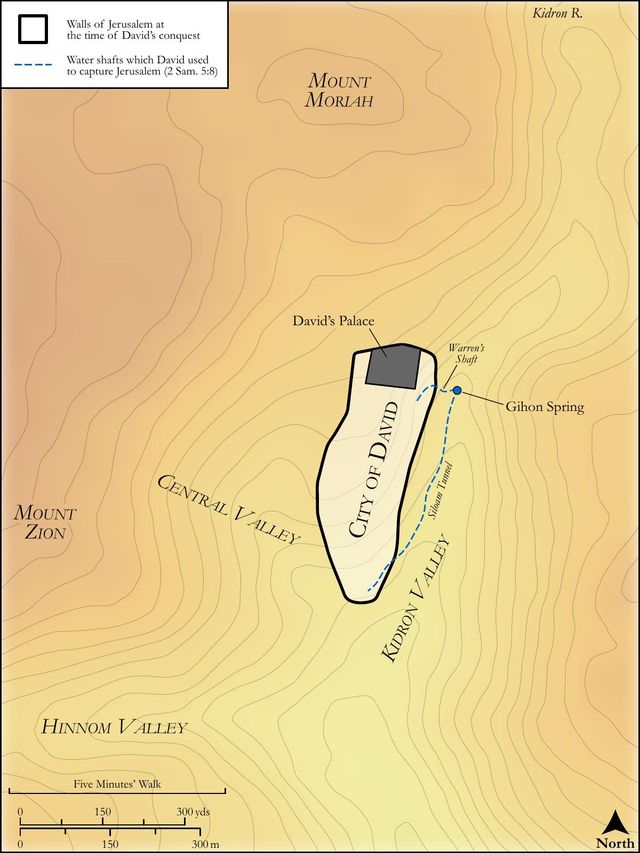
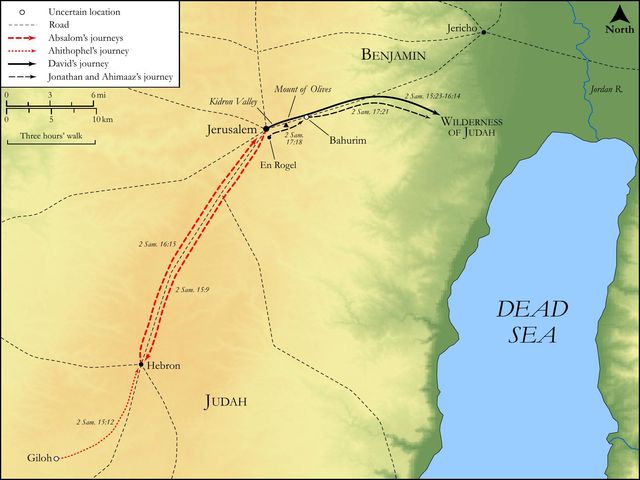
David, in his flight, had come to Bahurim, a city of Benjamin in or near which this Shimei lived, who, being of the house of Saul (with the fall of which all his hopes of preferment fell), had an implacable enmity to David, unjustly looking upon him as the ruin of Saul and his family only because, by the divine appointment, he succeeded Saul. While David was in prosperity and power, Shimei hated him as much as he did now, but he durst not then say anything against him. God knows what is in the hearts of those that are disaffected to him and his government, but earthly princes do not. Now he came forth, and cursed David with all the bad words and wishes he could invent, Sa2 16:5. Observe,
1.Why he took this opportunity to give vent to his malice.
(1.)Because now he thought he might do it safely; yet, if David had thought proper to resent the provocation, it would have cost Shimei his life.
(2.)Because now it would be most grievous to David, would add affliction to his grief, and pour vinegar into his wounds. He complains of those as most barbarous who talk to the grief of those whom God has wounded, Psa 69:26. So Shimei did, loading him with curses whom no generous eye could look upon without compassion.
(3.)Because now he thought that Providence justified his reproaches, and that David's present afflictions proved him to be as bad a man as he was willing to represent him. Job's friends condemned him upon this false principle. Those that are under the rebukes of a gracious God must not think it strange if these bring upon them the reproaches of evil men. If once it be said, God hath forsaken him, presently it follows, Persecute and take him, Psa 71:11. But it is the character of a base spirit thus to trample upon those that are down, and insult over them.
2.How his malice was expressed. See,
(1.)What this wretched man did: He cast stones at David (Sa2 16:6), as if his king had been a dog, or the worst of criminals, whom all Israel must stone with stones till he die. Perhaps he kept at such a distance that the stones he threw could not reach David, nor any of his attendants, yet he showed what he would have done if it had been in his power. He cast dust (Sa2 16:13), which, probably, would blow into his own eyes, like the curses he threw, which, being causeless, would return upon his own head. Thus, while his malice made him odious, the impotency of it made him ridiculous and contemptible. Those that fight against God cannot hurt him, though they hate him. If thou sinnest, what doest thou against him? Job 35:6. It was an aggravation of his wickedness that David was attended with his mighty men on his right hand and on his left, so that he was not in so forlorn a condition as he thought (persecuted but not forsaken), and that he continued to do it, and did it the more passionately, for David's bearing it patiently.
(2.)What he said. With the stones he shot his arrows, even bitter words (Sa2 16:7, Sa2 16:8), in contempt of that law, Thou shalt not curse the gods, Exo 22:28. David was a man of honour and conscience, and in great reputation for every thing that was just and good; what could this foul mouth say against him? Why, truly, what was done long since to the house of Saul was the only thing which he could recollect, and with this he upbraided David because it was the thing that he himself was a loser by. See how apt we are to judge of men and their character by what they are to us, and to conclude that those are certainly evil men that have ever so justly been, or that we ever so unjustly think have been, instruments of evil to us. So partial are we to ourselves that no rule can be more fallacious than this. No man could be more innocent of the blood of the house of Saul than David was. Once and again he spared Saul's life, while Saul sought his. When Saul and his sons were slain by the Philistines, David and his men were many miles off; and, when they heard it, they lamented it. From the murder of Abner and Ish-bosheth he had sufficiently cleared himself; and yet all the blood of the house of Saul must be laid at his door. Innocency is no fence against malice and falsehood; nor are we to think it strange if we be charged with that from which we have been most careful to keep ourselves. It is well for us that men are not to be our judges, but he whose judgment is according to truth. The blood of the house of Saul is here most unjustly charged upon David,
[1.]As that which gave him his character, and denominated him a bloody man and a man of Belial, Sa2 16:7. And, if a man of blood, no doubt a man of Belial, that is, a child of the devil, who is called Belial (Co2 6:15), and who was a murderer from the beginning. Bloody men are the worst of men.
[2.]As that which brought the present trouble upon him: "Now that thou art dethroned, and driven out to the wilderness, the Lord has returned upon thee the blood of the house of Saul." See how forward malicious men are to press God's judgments into the service of their own passion and revenge. If any who have, as they think, wronged them, should come into trouble, the injury done to them must be made the cause of the trouble. But we must take heed lest we wrong God by making his providence thus to patronise our foolish and unjust resentments. As the wrath of man works not the righteousness of God, so the righteousness of God serves not the wrath of man.
[3.]As that which would now be his utter ruin; for he endeavours to make him despair of ever recovering his throne again. Now they said, There is no help for him in God (Psa 3:2), the Lord hath delivered the kingdom into the hand of Absalom (not Mephibosheth - the house of Saul never dreamed of making him king, as Ziba suggested), and thou art taken in thy mischief, that is, "the mischief that will be thy destruction, and all because thou art a bloody man." Thus Shimei cursed.
II.See how patient and submissive David was under this abuse.
The sons of Zeruiah, Abishai particularly, were forward to maintain David's honour with their swords; they resented the affront keenly, as well they might: Why should this dead dog be suffered to curse the king? Sa2 16:9. If David will but give them leave, they will put these lying cursing lips to silence, and take off his head; for his throwing stones at the king was an overt act, which abundantly proved that he compassed and imagined his death. But the king would by no means suffer it: What have I to do with you? So let him curse. Thus Christ rebuked the disciples, who, in zeal for his honour, would have commanded fire from heaven on the town that affronted him, Luk 9:55. Let us see with what considerations David quieted himself.
1.The chief thing that silenced him was that he had deserved this affliction. This is not mentioned indeed; for a man may truly repent, and yet needs not, upon all occasions, proclaim his penitent reflections. Shimei unjustly upbraided him with the blood of Saul: from that his conscience acquitted him, but, at the same time, it charged him with the blood of Uriah. "The reproach is too true" (thinks David), "though false as he means it." Note, A humble tender spirit will turn reproaches into reproofs, and so get good by them, instead of being provoked by them.
2.He observes the hand of God in it: The Lord hath said unto him, Curse David (Sa2 16:10), and again, So let him curse, for the Lord hath bidden him, Sa2 16:11. As it was Shimei's sin, it was not from God, but from the devil and his own wicked heart, nor did God's hand in it excuse or extenuate it, much less justify it, any more than it did the sin of those who put Christ to death, Act 2:23, Act 4:28. But, as it was David's affliction, it was from the Lord, one of the evils which he raised up against him. David looked above the instrument of his trouble to the supreme director, as Job, when the plunderers had stripped him, acknowledged, The Lord hath taken away. Nothing more proper to quiet a gracious soul under affliction than an eye to the hand of God in it. I opened not my mouth, because thou didst it. The scourge of the tongue is God's rod.
3.He quiets himself under the less affliction with the consideration of the greater (Sa2 16:11): My son seeks my life, much more may this Benjamite. Note, Tribulation works patience in those that are sanctified. The more we bear the better able we should be to bear still more; what tries our patience should improve it. The more we are inured to trouble the less we should be surprised at it, and not think it strange. Marvel not that enemies are injurious, when even friends are unkind; nor that friends are unkind, when even children are undutiful.
4.He comforts himself with hopes that God would, in some way or other, bring good to him out of his affliction, would balance the trouble itself, and recompense his patience under it: "The Lord will requite me good for his cursing. If God bid Shimei grieve me, it is that he himself may the more sensibly comfort me; surely he has mercy in store for me, which he is preparing me for by this trial." We may depend upon God as our pay-master, not only for our services, but for our sufferings. Let them curse, but bless thou. David, at length, is housed at Bahurim (Sa2 16:14), where he meets with refreshment, and is hidden from this strife of tongues.
Historical interpretation
Historical reception
4 surviving comments on this verse. Each one is dated, so this reads as a timeline rather than a list.
Select a marker to jump to its quote. Markers stagger vertically where authors wrote within a few decades of each other.
We can show, too, that holy David was like Paul in this same class of virtue. When … Shimei cursed him and charged him with heavy offenses, at the first he was silent and humbled himself, and was silent even about his good deeds, that is, his knowledge of good works. Then he even asked to be cursed; for when he was cursed he hoped to gain divine pity.But see how he stored up humility and justice and prudence so as to merit grace from the Lord! At first he said, “Therefore he cursed me, because the Lord has said to him that he should curse.” Here we have humility; for he thought that those things which are divinely ordered were to be endured with an even mind, as though he were but some servant lad. Then he said, “Behold, my son, who came forth of my body, seeks my life.” Here we have justice. For if we suffer hard things at the hand of our own family, why are we angry at what is done to us by strangers? Lastly he says, “Let him alone that he may curse, for the Lord has bidden him. It may be that the Lord will look on my humiliation and requite me good for this cursing.” So he bore not only the abuse but left the man unpunished when throwing stones and following him. No, even more. After his victory he freely granted him pardon when he asked for it.
I have written to show that holy David, in true evangelical spirit, was not only not offended but was even thankful to his abuser and was delighted rather than angered by his wrongs, for which he thought some return would be granted to him. But, though perfect, he sought something still more perfect. As a man he grew hot at the pain of his wrongs, but like a good soldier he conquered, he endured like a brave wrestler.
What need is there to be troubled when we hear abuse? Why do we not imitate him who says, “I was dumb and humbled myself, and kept silence even from good words.” Or did David only say this, and not act up to it? No, he also acted up to it. For when Shimei the son of Gera reviled him, David was silent; and although he was surrounded with armed men he did not return the abuse, nor seek revenge: no, even when the son of Zeruiah spoke to him, because he wished to take vengeance on him, David did not permit it. He went on as though dumb and humbled; he went on in silence; nor was he disturbed, although called a bloody man, though he was conscious of his own gentleness. He therefore was not disturbed by insults, for he had full knowledge of his own good works.He, then, who is quickly roused by wrong makes himself seem deserving of insult, even while he wishes to be shown not to deserve it. He who despises wrongs is better off than he who grieves over them. For he who despises them looks down on them, as though he doesn’t feel them; but he who grieves over them is tormented, just as though he actually felt them.
For if we suffer evil by human hands, we cut off no small part of our debt by nobly bearing what is done to us. Therefore we receive no injury; for God reckons the ill treatment towards our debt, not according to the principle of justice but of his lovingkindness; and for this cause he didn’t relieve the one who suffered evil.… And when he bore with Shimei cursing him, David said, “Let him alone, that the Lord may see my abasement and requite me [with] good for this day.” For when he doesn’t aid us when we suffer wrong, then we are advantaged most of all; for he sets it to the account of our sins, if we bear it thankfully.
Have recourse, O Lord, always to your mercy, and sustain the weakness of my flesh by your divine assistance. “What have I to do,” he says, “with you also, you sons of Zeruiah? Let Shimei curse. The Lord has bidden him to curse David. And who shall say to him, ‘Why have you done so?’ ” For the will of God is not to be discussed but kindly accepted.… Therefore, the commandments of God are possible, which we know David had kept; and, yet, we find holy people growing weary in maintaining justice forever.
Continue studying 2 Samuel 16:13 across the web’s major study libraries — every link below opens this exact verse, chapter, or book on the destination site.
Read & Compare
 BibleGatewayThis verse in more than 200 translations and 70 languages.
 Bible.comThe YouVersion reader — hundreds of translations, reading plans, and highlights.
 ESV.orgCrossway's official English Standard Version reader.
 NET BibleThe NET translation with 60,000+ translators' notes on every rendering decision.
 STEP BibleTyndale House's free study tool — original text, vocabulary, and scholarly resources.
 BibliaLogos Bible Software's free web reader.
 USCCBThe New American Bible (Revised Edition) with the U.S. bishops' study notes.
Commentaries
 BibleHub CommentariesDozens of classic commentaries on this verse, gathered on one page.
 StudyLightMore than 100 commentary sets — the largest collection on the web.
 BibleRefPlain-English commentary on what this verse means, verse by verse.
 Enduring WordDavid Guzik's free commentary on this chapter, widely used by Bible teachers.
 Bible Study ToolsVerse commentary alongside Greek and Hebrew study aids.
Original Language & Research
- BibleHub InterlinearThe verse word by word — original language, transliteration, and English.
- BibleHub LexiconEvery word's original-language definition and Strong's entry.
 Blue Letter BibleDeep-study tools — Strong's numbers, concordance, and word studies.
 SefariaThe Hebrew text with Rashi and centuries of Jewish commentary.
Sermons, Hymns & Audio


TrulyRandomVerse is not affiliated with these sites and doesn’t control their content. They’re linked because they’re genuinely useful.
Summary
2 Samuel 16:13 vividly portrays King David's profound public humiliation during Absalom's rebellion as he flees Jerusalem. Shimei, a Benjamite from Saul's clan, seizes this moment of vulnerability to relentlessly revile the king, following him along the hillside, cursing him, throwing stones, and casting dust. This poignant scene not only underscores David's deep personal and political distress but also highlights his remarkable humility and unwavering trust in divine sovereignty amidst intense, unjust suffering.
Context
ShowHideLiterary Context
This verse is situated within the dramatic narrative of Absalom's rebellion against his father, King David, detailed in 2 Samuel 15. David has just made the difficult decision to flee Jerusalem to avoid direct conflict and bloodshed within the city. As he ascends the Mount of Olives weeping, he encounters Shimei (2 Samuel 16:5). The preceding verses describe David's humble acceptance of this ordeal, viewing it as potentially permitted by God, as seen in his words to Abishai in 2 Samuel 16:10-12. Shimei's aggressive actions in verse 13 are a direct continuation of his verbal assault, intensifying the public shaming and physical threat against the fleeing king and his entourage. This event is a stark contrast to David's earlier triumphs and foreshadows the complex path to his eventual restoration.
Historical & Cultural Context
Shimei's actions are deeply rooted in the political and social dynamics of ancient Israel. As a Benjamite and a descendant of Saul's house, Shimei harbored deep-seated resentment towards David, whom he likely blamed for the downfall of Saul's dynasty. In Israel, public cursing, throwing stones, and casting dust were not mere insults but potent, ritualistic acts of extreme contempt, shaming, and rejection. Throwing stones could signify a death sentence or utter rejection, while casting dust was a gesture of mourning, lament, or profound disdain, often used to express a desire for the cursed person's demise or utter humiliation. These actions were designed to strip the target of their dignity and authority, especially a king, in full public view. The "hill's side" provided Shimei with a vantage point, allowing him to perform his acts of defiance and humiliation openly and safely from a distance.
Key Themes
ShowHide2 Samuel 16:13 contributes significantly to several overarching themes in the book of Samuel and David's life. It powerfully illustrates the theme of unjust suffering and humiliation, demonstrating that even God's anointed can face intense, undeserved scorn and physical assault. Crucially, it highlights divine sovereignty and David's humility, as David interprets Shimei's actions not merely as human malice but as potentially permitted or even ordained by God, as expressed in 2 Samuel 16:10-12. This perspective reflects David's understanding that God might be using this tribulation as a consequence for his past sins, echoing Nathan's prophecy concerning the sword never departing from his house in 2 Samuel 12:11. Furthermore, the passage underscores the theme of patience and restraint in adversity, as David chooses not to retaliate, demonstrating a profound trust in God's ultimate justice and timing.
Exposition and Analysis
ShowHideKey Word Analysis
ShowHideThis verb, from H7043, means to be light, swift, or trifling. In the Hiphil stem, as used here, it means to treat lightly, despise, or revile. It implies a deliberate act of contempt and disdain, seeking to diminish the honor and authority of the one being cursed. Shimei's cursing was an act of public degradation, aiming to strip David of his kingly dignity.
This verb, from H5619, means to be weighty, but is used here in the sense of lapidation or stoning. While çâqal often refers to stoning as a form of capital punishment, here it is used as an act of extreme insult and aggression. It signifies a profound rejection and hostile intent, a physical manifestation of Shimei's desire to harm and humiliate David. It was a gesture of utter contempt for the person being targeted, akin to declaring them worthy of death or expulsion.
This verb, from H6080, means to pulverize or to be dust. This action is a powerful non-verbal symbol. In Israel, casting dust over one's head or towards another could signify deep mourning, lamentation, or, as in this context, extreme contempt, rejection, and a wish for the person's downfall. It was a public declaration of utter disdain, treating the king as if he were already dead or utterly worthless.
Verse Breakdown
ShowHide"And as David and his men went by the way"
This sets the scene, emphasizing the vulnerable state of the king and his loyal followers. They are not in a position of power or defense, but on a journey of flight, making them susceptible to public affronts. The phrase "by the way" (H1870, derek) highlights their precarious journey.
"Shimei went along on the hill's side over against him"
This detail highlights Shimei's deliberate and sustained act of aggression. He positions himself strategically on the opposite hillside (H2022, har), ensuring he is visible and audible, maximizing the public nature and impact of his insults while maintaining a safe distance from David's immediate retinue.
"and cursed as he went"
This signifies a continuous, unrelenting verbal assault. Shimei's curses were not a single outburst but an ongoing stream of vitriol, designed to heap shame and dishonor upon the king at every step of his humiliating retreat. The repetition of "went" (H1980, hâlak) emphasizes the persistent nature of his harassment.
"and threw stones at him"
This adds a physical dimension to the verbal abuse, demonstrating Shimei's intense animosity. The stones (H68, ʼeben), though perhaps not directly hitting David, served as a tangible expression of his desire for David's harm and destruction, a public declaration of his contempt.
"and cast dust"
This final action completes the ritualistic shaming. Casting dust (H6083, ʻâphâr) underscores the depth of Shimei's disdain, treating David as if he were a corpse or an outcast, utterly rejected and despised. It is a powerful visual symbol of utter contempt and a wish for the king's demise.
Literary Devices
ShowHideThe passage employs several potent literary devices to convey the depth of David's humiliation and his response. Irony is prominent, as the once-victorious King David, God's anointed, is now a fleeing figure, subjected to public abuse by a mere subject from a rival house. This stark reversal of fortune underscores the unpredictable nature of power and the consequences of sin. Symbolism is powerfully utilized through Shimei's actions: the stones represent hostility and a desire for harm, while the dust symbolizes contempt, rejection, and a wish for David's downfall. These are not random acts but culturally loaded gestures of extreme shaming. The narrative also employs contrast, juxtaposing Shimei's unrestrained malice with David's remarkable self-control and humble acceptance, highlighting David's spiritual maturity in the face of provocation. Furthermore, this scene serves as a subtle foreshadowing of David's eventual restoration, as his patient endurance in this moment of suffering aligns with a pattern of divine testing and ultimate vindication seen throughout his life.
Theological and Thematic Connections
ShowHideThe scene of Shimei cursing David is a profound theological statement on the nature of suffering, divine sovereignty, and human response. It challenges the simplistic notion that suffering is always a direct result of personal sin, though David himself considered the possibility (2 Samuel 16:10-12). More deeply, it illustrates that God can permit or even orchestrate difficult circumstances, including unjust attacks, for His sovereign purposes – whether for discipline, refinement, or to reveal deeper spiritual truths. David's response of restraint and trust in God's justice models a profound faith that commits one's cause to the Lord rather than seeking immediate retribution. This passage foreshadows the greater suffering of the Messiah, who would endure far greater contempt and injustice without retaliation, ultimately for the salvation of humanity.
Reflection and Application
ShowHideThe encounter between David and Shimei offers timeless lessons on how to navigate unjust criticism, public humiliation, and personal attacks. David's example encourages believers to cultivate a profound trust in God's sovereignty, recognizing that even in moments of intense opposition, God remains in control and may be using difficult circumstances for His purposes, whether for our spiritual growth, the demonstration of His justice, or the unfolding of His greater plan. Rather than immediately retaliating or defending ourselves, David's restraint teaches us the wisdom of exercising patience and committing our cause to God, allowing Him to handle the situation in His way and His time. This requires a deep humility, a willingness to surrender our right to self-vindication, and a reliance on divine grace rather than personal power or pride. Ultimately, this scene reminds us that our true vindication comes from God, not from our own efforts to silence our accusers.
Questions for Reflection
ShowHideFAQ
ShowHideWhy did Shimei curse David so vehemently?
ShowHideShimei's intense animosity stemmed primarily from his loyalty to the fallen house of Saul, of which he was a kinsman, as revealed in 2 Samuel 16:5. He viewed David as a usurper and likely held him responsible for the demise of Saul's dynasty. Shimei interpreted David's current distress—fleeing Absalom's rebellion—as divine judgment for the "blood of the house of Saul," as he explicitly states in 2 Samuel 16:8. He believed that God was repaying David for his alleged injustices against Saul and his family. He saw David's vulnerability as an opportunity to publicly express his deep-seated resentment and to shame the king he believed was illegitimate.
Why did David not allow his men to retaliate against Shimei?
ShowHideDavid's refusal to allow his mighty men, particularly Abishai, to kill Shimei, as recorded in 2 Samuel 16:9-12, reveals his profound spiritual maturity and trust in God's sovereignty. David understood that while Shimei's actions were malicious, they were ultimately permitted by God. He famously declared, "Let him alone, and let him curse, for the Lord has told him to curse David" in 2 Samuel 16:11. This was not passive resignation but an active faith that God was working through these circumstances, perhaps even using Shimei's curses as a form of divine discipline or testing. David believed that if he humbly endured this suffering, God might ultimately bless him, as he expresses hope in 2 Samuel 16:12. His restraint demonstrated a commitment to God's justice over personal vengeance, trusting that God would ultimately vindicate him.
Christ-Centered Fulfillment
ShowHideThe unjust suffering and humble endurance of King David in 2 Samuel 16:13 serve as a powerful foreshadowing of the ultimate King, Jesus Christ. David, though God's anointed, experienced profound public humiliation and rejection at the hands of his own people and a vengeful kinsman. He was cursed, stoned, and treated with utter contempt while in a state of vulnerability and flight. This mirrors the experience of Jesus, the true Son of David, who willingly emptied Himself and endured far greater scorn and suffering for humanity's sake. Just as Shimei cursed David, Jesus was "despised and rejected by men, a man of sorrows and acquainted with grief," as prophesied in Isaiah 53:3. He was mocked, spit upon, and reviled by the crowds and soldiers, enduring the ultimate public shaming on the cross, as vividly described in Matthew 27:27-31. Unlike David, whose suffering was partly a consequence of his own sin, Jesus was perfectly innocent, yet He "committed no sin, neither was deceit found in his mouth. When he was reviled, he did not revile in return; when he suffered, he did not threaten, but continued entrusting himself to him who judges justly," a profound truth articulated in 1 Peter 2:22-23. Christ's profound humility and obedience, even to the point of death, exemplify the ultimate trust in the Father's sovereign plan, as celebrated in Philippians 2:8. His endurance of rejection and suffering led not to temporary restoration, like David's, but to eternal vindication and the salvation of all who believe, as He is now seated at the right hand of God, "the author and perfecter of our faith, who for the joy that was set before him endured the cross, despising the shame," a triumphant declaration in Hebrews 12:2.