


Hosea 4:13
Bible text: King James Version (1769 Blayney text) · Public domain
Bible text: King James Version with Strong's numbers · Public domain
Bible text: Berean Standard Bible · Public domain
Bible text: American Standard Version (1901) · Public domain
Bible text: World English Bible, Messianic edition · Public domain
Bible text: Geneva Bible (1599) · Public domain
Bible text: Young's Literal Translation · Public domain
- עַל'alonH5921PrepPreposition
- רָאשֵׁיra·Shei[the] tops ofH7218N-mpcNoun Plural Masculine Construct
- הֶהָרִיםhe·ha·Rimthe mountainsH2022Art ¦ N-mpNoun Plural Masculine Absoluteהֶtheהָרִיםmountains
- יְזַבֵּחוּye·za·Be·chuthey sacrificeH2076V-Piel-Imperf-3mpVerb Piel Imperfect 3rd Plural Masculine
- וְעַלve·'aland onH5921Conj-w ¦ PrepPrepositionוְandעַלon
- הַגְּבָעוֹתha·ge·va·'Otthe hillsH1389Art ¦ N-fpNoun Plural Feminine Absoluteהַtheגְּבָעוֹתhills
- יְקַטֵּרוּye·ka·Te·ruthey make smokeH6999V-Piel-Imperf-3mpVerb Piel Imperfect 3rd Plural Masculine
- תַּחַתTa·chatunderH8478N-mscNoun Singular Masculine Construct
- אַלּוֹן'a·LonoakH437N-msNoun Singular Masculine Absolute
- וְלִבְנֶהve·liv·Nehand poplarH3839Conj-w ¦ N-msNoun Singular Masculine Absoluteוְandלִבְנֶהpoplar
- וְאֵלָהve·'e·Lahand terebinthH424Conj-w ¦ N-fsNoun Singular Feminine Absoluteוְandאֵלָהterebinth
- כִּיkiforH3588PrtParticle Conditional
- טוֹבTov[is] goodH2896Adj-msAdjective Singular Masculine Absolute
- צִלָּהּtzi·Lahits shadeH6738N-msc ¦ 3fsNoun Singular Masculine Constructצִלָּshadeהּits
- עַל'althere-H5921PrepPreposition
- כֵּןKen-foreH3651AdvAdverb
- תִּזְנֶינָהtiz·Nei·nahthey prostitute themselvesH2181V-Qal-Imperf-3fpVerb Qal Imperfect 3rd Plural Feminine
- בְּנוֹתֵיכֶםbe·No·tei·Khemyour daughtersH1323N-fpc ¦ 2mpNoun Plural Feminine Constructבְּנוֹתֵיdaughtersכֶםyour
- וְכַלּוֹתֵיכֶםve·kha·lo·tei·Khemand your bridesH3618Conj-w ¦ N-fpc ¦ 2mpNoun Plural Feminine Constructוְandכַלּוֹתֵיbridesכֶםyour
- תְּנָאַפְנָהte·na·'Af·nahthey commit adulteryH5003V-Piel-Imperf-3fpVerb Piel Imperfect 3rd Plural Feminine
English is a literal word-by-word gloss of the Hebrew, not the KJV's wording. Why?
This is the original text the KJV's translators worked from — each Hebrew word with its own literal English meaning in this verse, prepared by scholars at Tyndale House, Cambridge. The KJV translates whole sentences, not word by word, so its wording differs: one Hebrew word can become several English words, and the KJV may choose “the LORD” where the gloss reads “Yahweh”. Both are faithful — they answer different questions. For the KJV's own rendering, switch to the KJV text.
Details
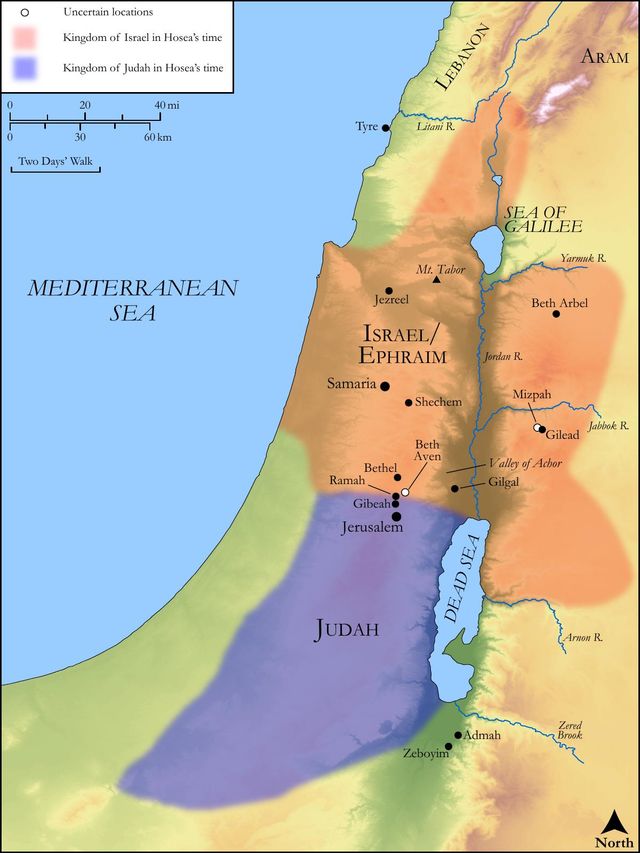
See on the biblical-era map
Study this verse
Public-domain commentary
Matthew Henry
From his Commentary on the Whole Bible. Henry comments on passages, not single verses — this entry covers Hosea 4:12–19. His three-level outline is real structure in the source text, so it is rendered as structure.
In these verses we have, as before,
I.The sins charged upon the people of Israel, for which God had a controversy with them, and they are,
1.Spiritual whoredom, or idolatry. They have in them a spirit of whoredoms, a strong inclination to that sin; the bent and bias of their hearts are that way; it is their own iniquity; they are carried out towards it with an unaccountable violence, and this causes them to err. Note, The errors and mistakes of the judgment are commonly owing to the corrupt affections; men therefore have a good opinion of sin, because they have a disposition towards it. And having such erroneous notions of idols, and such passionate motions towards them, no marvel that with such a head and such a heart they have gone a whoring from under their God, Hos 4:12. They ought to have been in subjection to him as their head and husband, to have been under his guidance and command, but they revolted from their allegiance, and put themselves under the guidance and protection of false gods. So (Hos 4:15) Israel has played the harlot; their conduct in the worship of their idols was like that of a harlot, wanton and impudent. And (Hos 4:16), Israel slideth back as a backsliding heifer, as an untamed heifer (so some), or as a perverse or refractory one (so others), as a heifer that is turned loose runs madly about the pasture, or, if put under the yoke (which seems rather to be alluded to here), will draw back instead of going forward, will struggle to get her neck out of the yoke and her feet out of the furrow. Thus unruly, ungovernable, untractable, were the people of Israel. They had begun to draw in the yoke of God's ordinances, but they drew back, as children of Belial, that will not endure the yoke; and when the prophets were sent with the goads of reproof, to put them forward, they kicked against the pricks, and ran backwards. The sum of all is (Hos 4:17), Ephraim is joined to idols, is perfectly wedded to them; his affections are glued to them, and his heart is upon them. There are two instances given of their spiritual whoredom, in both which they gave that honour to their idols which is due to God only: - (1.) They consulted them as oracles, and used those arts of divination which they had learned from their idolatrous priests (Hos 4:12): My people ask counsel at their stocks, their wooden gods; they apply to them for advice and direction in what they should do and for information concerning the event. They say to a stock, Thou art my father (Jer 2:27); and, if it were indeed a father, it were worthy of this honour; but it was a great affront to God, who was indeed their Father, and whose lively oracles they had among them, with which they had liberty to consult at any time, thus to ask counsel at their stocks. And they expect that their staff should declare to them what course they should take and what the event should be. It is probable that this refers to some wicked methods of divination used among the Gentiles, and which the Jews learned from them, by a piece of wood, or by a staff, like Nebuchadnezzar's divining by his arrows, Eze 21:21. Note, Those who forsake the oracles of God, to take their measures from the world and the flesh, do in effect but consult with their stocks and their staves. (2.) They offered sacrifice to them as gods, whose favour they wanted and whose wrath they dreaded and deprecated (Hos 4:13): They sacrifice to them, to atone and pacify them, and burn incense to them, to please and gratify them, and hope by both to recommend themselves to them. God had pitched upon the place where he would record his name; but they, having forsaken that, chose places for their irreligious rites which pleased their own fancies; they chose, [1.] High places, upon the tops of the mountains and upon the hills, foolishly imagining that the height of the ground gave them some advantage in their approaches towards heaven. [2.] Shady places, under oaks, and poplars, and elms, because the shadow thereof is pleasant to them, especially in those hot countries, and therefore they thought it was pleasing to their gods; or they fancied that a thick shade befriends contemplation, possesses the mind with something of awe, and therefore is proper for devotion.
2.Corporal whoredom is another crime here charged upon them: They have committed whoredom continually, Hos 4:18. They drove a trade of uncleanness; it was not a single act now and then, but their constant practice, as it is of many that have eyes full of adultery and which cannot cease from that sin, Pe2 2:14. Now the abominable filthiness and lewdness that was found in Israel is here spoken of,
(1.)As a concomitant of their idolatry; their false gods drew them to it; for the devil whom they worshipped, though a spirit, is an unclean spirit. Those that worshipped idols were separated with harlots, and they sacrificed with harlots; for because they liked not to retain God in their knowledge, but dishonoured him, therefore God gave them up to vile affections, by the indulging of which they dishonoured themselves, Rom 1:24, Rom 1:28.
(2.)As a punishment of it. The men that worshipped idols were separated with harlots that attended the idolatrous rites, as in the worship of Baal-peor, Num 25:1, Num 25:2. To punish them for that God gave up their wives and daughters to the like vile affections: They committed whoredom and adultery (Hos 4:13), which could not but be a great grief and reproach to their husbands and parents; for those that are not chaste themselves desire to have their wives and daughters so. But thus they might read their sin in their punishment, as David's adultery was punished in the debauching of his concubines by his own son, Sa2 12:11. Note, When the same sin in others is made men's grief and affliction which they have themselves been guilty of they must own that the Lord is righteous.
3.The perverting of justice, Hos 4:18. Their rulers (be it spoken to their shame) do love, Give ye, that is, they love bribes, and have it continually in their mouths, Give, give. They are given to filthy lucre; every one that has any business with them must expect to be asked, What will you give? Though, as rulers, they are bound by office to do justice, yet none can have justice done them without a fee; and you may be sure that for a fee they will do injustice. Note, The love of money is the ruin of equity and the root of all iniquity. But of all men it is a shame for rulers (who should be men fearing God and hating covetousness) to love Give ye. Perhaps this is intended in that part of the charge here, Their drink is sour; it is dead; it is gone. Justice, duly administered, is refreshing, like drink to the thirsty, but when it is perverted, and rulers take rewards either to acquit the guilty or to condemn the innocent, the drink is sour; they turn judgment into wormwood, Amo 5:7. Or it may refer in general to the depraved morals of the whole nation; they had lost all their life and spirit, and were as offensive to God as dead and sour drink is to us. See Deu 32:32, Deu 32:33.
II.The tokens of God's wrath against them for their sins.
1.Their wives and daughters should not be punished for the injury and disgrace they did to their families (Hos 4:14): I will not punish your daughters; and, not being punished for their sin, they would go on in it. Note, The impunity of one sinner is sometimes made the punishment of another. Or, "I will not punish them as I will punish you; for you must own, as Judah did concerning his daughter-in-law, that they are more righteous than you," Gen 38:26.
2.They themselves should prosper for a while, but their prosperity should help to destroy them. It comes in as a token of God's wrath (Hos 4:16): The Lord will feed them as a lamb in a large place; they shall have a fat pasture, and a large one, in which they shall be fed to the full, and fed of the best, but it shall be only to prepare them for the slaughter, as a lamb is that is so fed. If they wax fat and kick, they do but wax fat for the butcher. But others make them feed as a lamb on the common, a large place indeed, but where it has short grass and lies exposed. The Shepherd of Israel will turn them both out of his pastures and out of his protection.
3.No means should be used to bring them to repentance (Hos 4:17): "Ephraim is joined to idols, is in love with them and addicted to them, and therefore let him alone, as Hos 4:4, Let no man reprove him. Let him be given up to his own heart's lusts, and walk in his own counsel; we would have healed him, and he would not be healed, therefore forsake him," See what their end will be, Deu 32:20. Note, It is a sad and sore judgment for any man to be let alone in sin, for God to say concerning a sinner, "He is joined to his idols, the world and the flesh; he is incurably proud, covetous, or profane, an incurable drunkard or adulterer; let him alone; conscience, let him alone; minister, let him alone; providences, let him alone. Let nothing awaken him till the flames of hell do it." The father corrects not the rebellious son any more when he determines to disinherit him. "Those that are not disturbed in their sin will be destroyed for their sin." 4. They should be hurried away with a swift and shameful destruction (Hos 4:19): The wind has bound her up in her wings, to carry her away into captivity, suddenly, violently, and irresistibly; he shall take them away as with a whirlwind, Psa 58:9. And then they shall be ashamed because of their sacrifices, ashamed of their sin in offering sacrifice to idols, ashamed of their folly in putting themselves to such an expense upon gods that have no power to help them, and thereby making that God their enemy who has almighty power to destroy them. Note, There are sacrifices that men will one day be ashamed of. Those that have sacrificed their time, strength, honour, and all their comforts, to the world and the flesh, will shortly be ashamed of it. Yea, and those that bring to God blind, and lame, and heartless sacrifices, will be ashamed of them too.
III.The warning given to Judah not to sin after the similitude of Israel's transgression.
It is said in the close of Hos 4:14, Those that do not understand shall fall; those must needs fall that do not understand how to avoid, or get over, the stumbling-blocks they meet with (and therefore let him that thinks he stands take heed lest he fall), particularly the two tribes (Hos 4:15): Though thou, Israel, play the harlot, yet let not Judah offend. Though Israel be given to idolatry, yet let not Judah take the infection. Now,
1.This was a very needful caution. The men of Israel were brethren, and near neighbours, to the men of Judah; Israel was more numerous, and at this time in a prosperous condition, and therefore there was danger lest the men of Judah should learn their way and get a snare to their souls. Note, The nearer we are to the infection of sin the more need we have to stand upon our guard.
2.It was a very rational caution: "Let Israel play the harlot, yet let not Judah do so; for Judah has greater means of knowledge than Israel, has the temple and priesthood, and a king of the house of David; from Judah Shiloh is to come; and for Judah God has reserved great blessings in store; therefore let not Judah offend, for more is expected from them than from Israel, they will have more to answer for if they do offend, and from them God will take it more unkindly. If Israel play the harlot, let not Judah do so too, for then God will have no professing people in the world." God bespeaks Judah here, as Christ does the twelve, when many turned their backs upon him, Will you also go away? Joh 6:67. Note, Those that have hitherto kept their integrity should, for that reason, still hold it fast, even in times of general apostasy. Now, to preserve Judah from offending as Israel had done, two rules are here given: - (1.) That they might not be guilty of idolatry they must keep at a distance from the places of idolatry: Come not you unto Gilgal, where all their wickedness was (Hos 9:15; Hos 12:11); there they multiplied transgression (Amo 4:4); and perhaps they contracted a veneration for that place because there it was said to Joshua, The place where thou standest is holy ground (Jos 5:15); therefore they are forbidden to enter into Gilgal, Amo 5:5. And for the same reason they must not go up to Bethel, here called the house of vanity, for so Bethaven signifies, not the house of God, as Bethel signifies. Note, Those that would be kept from sin, and not fall into the devil's hands, must studiously avoid the occasions of sin and not come upon the devil's ground. (2.) That they might not be guilty of idolatry they must take heed of profaneness, and not swear, The Lord liveth. They are commanded to swear, The Lord liveth in truth and righteousness (Jer 4:2); and therefore that which is here forbidden is swearing so in untruth and unrighteousness, swearing rashly and lightly, or falsely and with deceit, or swearing by the Lord and the idol, Zep 1:5. Note, Those that would be steady in their adherence to God must possess themselves with an awe and reverence of God, and always speak of him with solemnity and seriousness; for those that can make a jest of the true God will make a god of any thing.
Historical interpretation
Historical reception
1 surviving comment on this verse from the historical church.
"On the tops of the mountains, they sacrificed, and on the hills, they burned incense under an oak and a poplar and a terebinth because its shade was good." According to the Law, it is commanded that one should not offer sacrifice to the Lord anywhere other than the place that the Lord God chooses. Trees are not to be planted near the altar so that a passive and indulgent religion does not overthrow the austerity of the one true religion. On the contrary, Israel was sacrificing on the mountains and burning incense on the hills, loving the high places of the earth, for they had forsaken the Most High God and sought shadows, having lost the truth. This is what we read about each king: "But the high places were not taken away; the people still sacrificed and burned incense on the high places" (3 Kings 22:44), which in Hebrew is called Bama. Heretics promise themselves the sublimity of their doctrines and sacrifice under oak, poplar and terebinth, under barren trees, having neither fig nor vine, under which the Saint is said to rest. However, they sometimes assume a terebinth for themselves, which, according to Isaiah, has no leaves, so that they may seem to imitate the example of Abraham. (Isaiah VI)
Continue studying Hosea 4:13 across the web’s major study libraries — every link below opens this exact verse, chapter, or book on the destination site.
Read & Compare
 BibleGatewayThis verse in more than 200 translations and 70 languages.
 Bible.comThe YouVersion reader — hundreds of translations, reading plans, and highlights.
 ESV.orgCrossway's official English Standard Version reader.
 NET BibleThe NET translation with 60,000+ translators' notes on every rendering decision.
 STEP BibleTyndale House's free study tool — original text, vocabulary, and scholarly resources.
 BibliaLogos Bible Software's free web reader.
 USCCBThe New American Bible (Revised Edition) with the U.S. bishops' study notes.
Commentaries
 BibleHub CommentariesDozens of classic commentaries on this verse, gathered on one page.
 StudyLightMore than 100 commentary sets — the largest collection on the web.
 BibleRefPlain-English commentary on what this verse means, verse by verse.
 Enduring WordDavid Guzik's free commentary on this chapter, widely used by Bible teachers.
 Bible Study ToolsVerse commentary alongside Greek and Hebrew study aids.
Original Language & Research
- BibleHub InterlinearThe verse word by word — original language, transliteration, and English.
- BibleHub LexiconEvery word's original-language definition and Strong's entry.
 Blue Letter BibleDeep-study tools — Strong's numbers, concordance, and word studies.
 SefariaThe Hebrew text with Rashi and centuries of Jewish commentary.
Sermons, Hymns & Audio


TrulyRandomVerse is not affiliated with these sites and doesn’t control their content. They’re linked because they’re genuinely useful.
Summary
Hosea 4:13 delivers a scathing indictment against ancient Israel, particularly the northern kingdom, for their rampant idolatry and its severe moral consequences. The verse exposes how Israel's abandonment of Yahweh for pagan worship on "high places" – under the deceptive comfort of sacred trees – directly led to widespread sexual immorality among their daughters and spouses, illustrating the profound link between spiritual unfaithfulness and societal moral decay.
Context
ShowHideLiterary Context
This verse is situated within Hosea 4, which opens with a divine "controversy" or "lawsuit" (rîḇ) against Israel (Hosea 4:1). God brings charges against His people for their lack of truth, mercy, and knowledge of God in the land. The preceding verses (Hosea 4:2-3) detail the pervasive societal breakdown, including swearing, lying, murder, stealing, and adultery, leading to the desolation of the land. Verse 13 then provides a specific example of the spiritual root of this moral collapse: their idolatrous worship practices. The subsequent verses (Hosea 4:14-19) continue to elaborate on the consequences of their spiritual and moral corruption, emphasizing that even the priests and prophets are implicated in the nation's sin.
Historical & Cultural Context
During the period of the divided monarchy, particularly in the Northern Kingdom of Israel (Ephraim), there was a persistent syncretism where the worship of Yahweh was blended with the worship of Canaanite deities like Baal and Asherah. This practice often occurred at "high places" (Hebrew: bamot), which were elevated sites, sometimes natural hills or mountains, where altars and cultic objects were erected. These sites were traditionally associated with pagan fertility cults, often involving ritual prostitution to invoke agricultural prosperity. The mention of "oaks and poplars and elms" points to specific trees considered sacred in these Canaanite rites, believed to embody divine presence or power, offering a "good shadow" – a deceptive sense of security, comfort, or spiritual efficacy that lured the Israelites away from exclusive devotion to Yahweh.
Key Themes
ShowHideHosea 4:13 powerfully contributes to several overarching themes in the book. Primarily, it underscores the theme of Idolatry as Spiritual Adultery, a pervasive metaphor throughout Hosea where Israel's unfaithfulness to God is likened to a wife's infidelity to her husband (Hosea 1-3). The verse explicitly links this spiritual betrayal to Moral Decay and Societal Breakdown, demonstrating that a nation's spiritual health directly impacts its ethical fabric. The "whoredom" and "adultery" of the daughters and spouses are not merely isolated sins but a direct consequence and reflection of the parents' (and the nation's) spiritual "whoredom" with idols. Furthermore, the phrase "because the shadow thereof is good" highlights the Deceptive Allure of Sin, revealing how pagan practices offered immediate, tangible, and seemingly beneficial outcomes (like fertility or prosperity) that masked their true destructive nature and ultimate spiritual emptiness, drawing people away from the true source of blessing found in a covenant relationship with God, as seen in the warnings of Deuteronomy 6:10-15.
Exposition and Analysis
ShowHideKey Word Analysis
ShowHideThis primitive root signifies the slaughter of an animal, typically in the context of a religious offering. In Hosea 4:13, it highlights the act of offering sacrifices to false gods, directly violating the covenant command against idolatry. The term underscores the perversion of a divinely ordained practice (sacrifice to Yahweh) being redirected to pagan deities.
This adjective describes something as good in the widest sense, encompassing beauty, favor, pleasantness, or prosperity. In this context, "the shadow thereof is good" reveals the perceived benefit or attractiveness of the pagan worship sites. It speaks to the deceptive allure and superficial comfort that drew Israel away from Yahweh, suggesting that the idolatrous practices offered a false sense of well-being or spiritual satisfaction.
This primitive root refers to committing adultery or fornication, often specifically of the female. Crucially, in prophetic literature, it is frequently used metaphorically to describe Israel's spiritual unfaithfulness and idolatry, portraying the nation as a harlot who has abandoned her covenant husband, Yahweh. The explicit linking of literal sexual immorality ("your daughters shall commit whoredom") to the preceding spiritual "whoredom" of idolatry demonstrates the direct and devastating consequences of spiritual apostasy on societal morality.
Verse Breakdown
ShowHide"They sacrifice upon the tops of the mountains, and burn incense upon the hills"
This clause describes the specific location and nature of Israel's idolatrous worship. "Tops of the mountains" and "hills" refer to the "high places" (bamot), which were prevalent sites for Canaanite cultic activities dedicated to Baal and Asherah, in direct defiance of God's command to worship Him exclusively in Jerusalem. The acts of "sacrifice" and "burning incense" are cultic rituals, here perverted by being offered to false gods, signifying a complete abandonment of Yahweh's prescribed worship.
"under oaks and poplars and elms, because the shadow thereof is good"
This phrase further specifies the setting of their pagan worship, identifying particular trees that were considered sacred in Canaanite religion. The "good shadow" they provided refers to the physical comfort (shade from the sun) but also metaphorically to the perceived spiritual comfort, allure, or efficacy of these pagan practices. It highlights the deceptive attraction of idolatry, offering a superficial sense of security or blessing that masked its true destructive nature.
"therefore your daughters shall commit whoredom, and your spouses shall commit adultery"
This is the stark consequence clause, directly linking the spiritual idolatry of the parents/nation to the literal sexual immorality of their descendants. The "therefore" establishes a causal connection: because the people engaged in spiritual "whoredom" with idols, their families would experience literal "whoredom" and "adultery." This demonstrates God's judgment and the principle that spiritual rebellion inevitably leads to moral degradation and societal breakdown, often mirroring the nature of the initial spiritual sin.
Literary Devices
ShowHideHosea 4:13 makes powerful use of Symbolism and Metaphor. The "mountains" and "hills" symbolize the "high places" of pagan worship, which were centers of spiritual rebellion against Yahweh. The "oaks, poplars, and elms" are not merely trees but symbolize the sacred groves associated with Canaanite fertility cults, representing the deceptive allure of false worship. The most profound literary device is the Metaphorical Linkage between spiritual idolatry and literal sexual immorality. The "whoredom" of the daughters and "adultery" of the spouses serve as a direct, tangible consequence and a mirroring of the nation's spiritual "whoredom" (idolatry) against God. This creates a stark Juxtaposition between the perceived "goodness" of the pagan shadow and the actual moral decay it produces. The phrase "because the shadow thereof is good" also employs Irony, as what appears to be good and comforting leads directly to devastating moral corruption and divine judgment.
Theological and Thematic Connections
ShowHideHosea 4:13 profoundly illustrates the biblical principle that spiritual apostasy inevitably leads to moral and societal decay. Israel's turning from the one true God to the worship of idols, particularly fertility cults, directly resulted in the breakdown of sexual purity within their families. This demonstrates that true morality flows from a right relationship with God, and when that relationship is corrupted by idolatry, the very fabric of society unravels. The "good shadow" of pagan trees highlights the deceptive nature of sin, which often promises comfort or benefit but ultimately delivers destruction and judgment. This passage serves as a timeless warning that anything that takes precedence over God in our lives becomes an idol, and such spiritual infidelity will have tangible, often devastating, consequences in our personal lives, families, and communities.
Reflection and Application
ShowHideHosea 4:13 presents a sobering mirror for contemporary believers, challenging us to examine the "high places" in our own lives. While we may not literally sacrifice on mountaintops, modern idolatry manifests in anything that displaces God from His rightful supremacy – be it the pursuit of wealth, status, pleasure, comfort, or even self-reliance. The "good shadow" of these idols promises satisfaction, security, or happiness, but ultimately, they lead to spiritual emptiness and moral compromise. Just as Israel's spiritual unfaithfulness led to literal sexual immorality, our own spiritual compromises can subtly erode our character and impact those around us, particularly our families. This verse calls us to a radical self-examination, urging us to identify and dismantle any idols in our hearts, returning to exclusive devotion to the Lord. It reminds us that genuine spiritual health is the foundation for moral integrity and that our commitment to God has profound implications for the well-being of our households and communities.
Questions for Reflection
ShowHideFAQ
ShowHideWhat is the significance of the "mountains," "hills," and "trees" in this verse?
ShowHideThe "mountains," "hills," and specific "oaks, poplars, and elms" mentioned in Hosea 4:13 are highly significant because they represent the "high places" (bamot) where ancient Israelites engaged in pagan worship. These were often elevated natural sites or constructed altars where Canaanite fertility cults, dedicated to deities like Baal and Asherah, were practiced. The trees were considered sacred in these cults, believed to embody divine presence or power, and offered a "good shadow" – a deceptive sense of comfort, security, or spiritual efficacy that lured the Israelites away from exclusive devotion to Yahweh. Their use signifies a direct violation of God's command for centralized, pure worship and highlights the syncretism prevalent in Israel. The Lord had explicitly forbidden such practices, as seen in Deuteronomy 12:2-4.
How does spiritual idolatry lead to literal sexual immorality, as described here?
ShowHideHosea 4:13 establishes a direct causal link between Israel's spiritual idolatry and the literal sexual immorality of their daughters and spouses. This connection is multifaceted. Theologically, Israel's covenant with Yahweh was often portrayed as a marriage; thus, idolatry was spiritual "whoredom" or "adultery" against God. When the people broke their covenant with God, they abandoned the moral framework and divine standards that uphold purity and faithfulness. Furthermore, many Canaanite fertility cults involved ritual prostitution as a means of invoking divine blessing for crops and livestock. By participating in these pagan rituals, the Israelites not only committed spiritual adultery but also exposed themselves and their families to, and even encouraged, literal sexual immorality. The actions of the parents (spiritual infidelity) directly influenced the moral behavior of their children, demonstrating how a nation's spiritual health underpins its ethical integrity, as also warned in Leviticus 18:24-30.
Christ-Centered Fulfillment
ShowHideHosea 4:13, with its stark portrayal of Israel's spiritual and moral decay due to idolatry, finds its ultimate fulfillment and resolution in Jesus Christ. Israel's spiritual "whoredom" was a profound breach of covenant, a rejection of their divine Husband. Jesus, as the incarnate Son of God, perfectly embodies the faithfulness that Israel lacked, living a life of complete obedience and exclusive devotion to the Father. He came not only to expose the depths of human sin, including idolatry and its resulting immorality, but also to provide the definitive solution. Through His atoning sacrifice on the cross, Jesus bore the judgment for humanity's spiritual and literal "whoredom," offering forgiveness and reconciliation. He became the true "good shadow," not a deceptive comfort under pagan trees, but the very "light of the world" (as declared in John 8:12), offering genuine refuge and spiritual life. In Christ, believers are redeemed from the bondage of idolatry and empowered by the Holy Spirit to live lives of purity and faithfulness, becoming the "bride of Christ" (as described in Ephesians 5:25-27) who is being sanctified and made ready for Him, thereby fulfilling the covenant relationship that Israel so tragically broke. He is the one who truly takes away the sin of the world, including the spiritual and moral corruption highlighted in Hosea 4:13, as proclaimed by John the Baptist in John 1:29.