


2 Samuel 23:34
Bible text: King James Version (1769 Blayney text) · Public domain
Bible text: King James Version with Strong's numbers · Public domain
Bible text: Berean Standard Bible · Public domain
Bible text: American Standard Version (1901) · Public domain
Bible text: World English Bible, Messianic edition · Public domain
Bible text: Geneva Bible (1599) · Public domain
Bible text: Young's Literal Translation · Public domain
- אֱלִיפֶלֶט'e·li·Fe·letElipheletH467N-proper-mNoun Proper Masculine
- בֶּןben[the] son ofH1121N-mscNoun Singular Masculine Construct
- אֲחַסְבַּי'a·chas·BaiAhasbaiH308N-proper-mNoun Proper Masculine
- בֶּןben[the] son ofH1121N-mscNoun Singular Masculine Construct
- הַמַּעֲכָתִיha·ma·'a·kha·Tithe MaacathiteH4602Art ¦ N-msNoun Gentilic Singular Masculine AbsoluteהַtheמַּעֲכָתִיMaacathite
- אֱלִיעָם'e·li·'AmEliamH463N-proper-mNoun Proper Masculine
- בֶּןben[the] son ofH1121N-mscNoun Singular Masculine Construct
- אֲחִיתֹפֶל'a·chi·To·felAhithophelH302N-proper-mNoun Proper Masculine
- הַגִּלֹנִיha·gi·lo·Nithe GiloniteH1526Art ¦ N-msNoun Gentilic Singular Masculine AbsoluteהַtheגִּלֹנִיGilonite
English is a literal word-by-word gloss of the Hebrew, not the KJV's wording. Why?
This is the original text the KJV's translators worked from — each Hebrew word with its own literal English meaning in this verse, prepared by scholars at Tyndale House, Cambridge. The KJV translates whole sentences, not word by word, so its wording differs: one Hebrew word can become several English words, and the KJV may choose “the LORD” where the gloss reads “Yahweh”. Both are faithful — they answer different questions. For the KJV's own rendering, switch to the KJV text.
Details
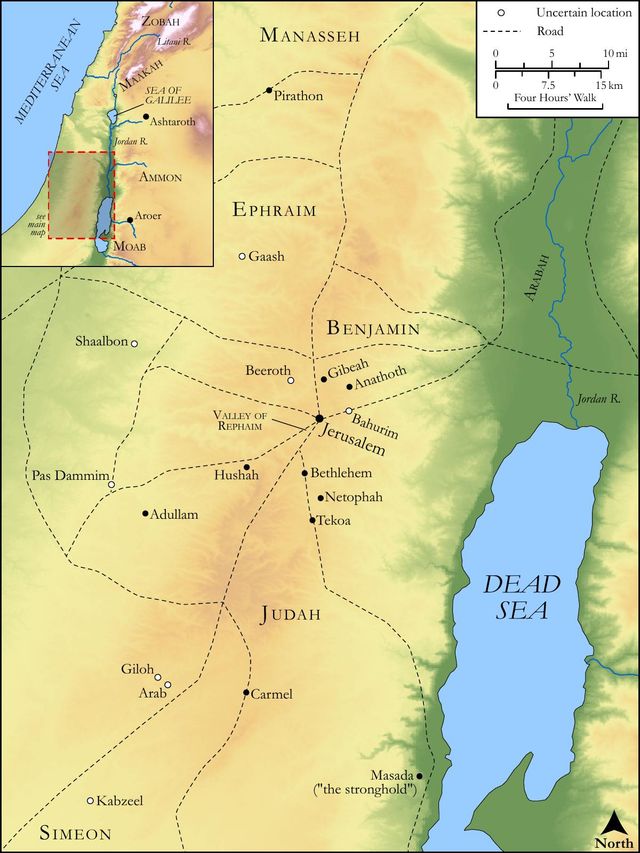
See on the biblical-era maps

Study this verse
Continue studying 2 Samuel 23:34 across the web’s major study libraries — every link below opens this exact verse, chapter, or book on the destination site.
Read & Compare
 BibleGatewayThis verse in more than 200 translations and 70 languages.
 Bible.comThe YouVersion reader — hundreds of translations, reading plans, and highlights.
 ESV.orgCrossway's official English Standard Version reader.
 NET BibleThe NET translation with 60,000+ translators' notes on every rendering decision.
 STEP BibleTyndale House's free study tool — original text, vocabulary, and scholarly resources.
 BibliaLogos Bible Software's free web reader.
 USCCBThe New American Bible (Revised Edition) with the U.S. bishops' study notes.
Commentaries
 BibleHub CommentariesDozens of classic commentaries on this verse, gathered on one page.
 StudyLightMore than 100 commentary sets — the largest collection on the web.
 BibleRefPlain-English commentary on what this verse means, verse by verse.
 Enduring WordDavid Guzik's free commentary on this chapter, widely used by Bible teachers.
 Bible Study ToolsVerse commentary alongside Greek and Hebrew study aids.
Original Language & Research
- BibleHub InterlinearThe verse word by word — original language, transliteration, and English.
- BibleHub LexiconEvery word's original-language definition and Strong's entry.
 Blue Letter BibleDeep-study tools — Strong's numbers, concordance, and word studies.
 SefariaThe Hebrew text with Rashi and centuries of Jewish commentary.
Sermons, Hymns & Audio


TrulyRandomVerse is not affiliated with these sites and doesn’t control their content. They’re linked because they’re genuinely useful.
Summary
2 Samuel 23:34 concludes the esteemed roster of King David's elite warriors, known as his "mighty men," by specifically naming Eliphelet the son of Ahasbai, identified as a Maachathite, and Eliam the son of Ahithophel, the Gilonite. This verse, though brief, serves as a vital genealogical and historical record, underscoring the diverse origins and unwavering loyalty of the individuals who formed the bedrock of David's kingdom, while also subtly hinting at the complex and often fraught personal relationships that characterized his royal court, particularly through the significant familial ties of Eliam.
Context
ShowHideLiterary Context
This verse is an integral part of the appendix to the book of 2 Samuel, specifically within the detailed list of David's most distinguished warriors found in 2 Samuel 23:8-39. This section immediately follows David's "last words" in 2 Samuel 23:1-7, serving as a testament to the human instruments through whom God established and maintained David's kingdom. The list begins by highlighting the heroic feats of the "Three" and the "Thirty," but as it progresses, it transitions to a simple enumeration of names, emphasizing their inclusion in this elite group as sufficient commendation. Verse 2 Samuel 23:34 adds two more names to this comprehensive roll call, ensuring a thorough historical record of those who served David with distinction. The overall passage acts as a final tribute to the loyalty and valor that underpinned David's reign.
Historical & Cultural Context
David's reign (c. 1010-970 BC) was a pivotal era of military expansion and political consolidation for ancient Israel. The establishment and maintenance of a strong, loyal military force were paramount for national security and the projection of royal authority. The practice of maintaining detailed lists of elite warriors was common in Israel, serving as a means of honoring service, documenting achievements, and reinforcing social hierarchies. The meticulous recording of lineage—identifying individuals by their father ("son of Ahasbai," "son of Ahithophel") and often by their regional or tribal origin ("the Maachathite," "the Gilonite")—was crucial for establishing identity, social standing, and geographical ties. Maachah was a small Aramean kingdom located northeast of the Sea of Galilee, indicating the diverse origins of some of David's loyalists. Giloh, on the other hand, was a town in the hill country of Judah, suggesting a local Judean background for Ahithophel and his family, emphasizing the broad spectrum of individuals drawn into David's service.
Key Themes
ShowHideThe passage detailing David's mighty men, including 2 Samuel 23:34, contributes significantly to several overarching themes within 2 Samuel and the broader Deuteronomistic History. A primary theme is the loyalty and faithfulness demonstrated by these warriors towards David, the divinely chosen king. Their dedicated service underscores the human commitment necessary to actualize God's covenant promises to David. Another crucial theme is God's sovereignty in raising up and utilizing a diverse array of individuals, even those with complicated personal histories, to fulfill His purposes. The inclusion of Eliam, whose family is deeply intertwined with David's most grievous sin and a future act of profound betrayal, powerfully illustrates the intricate and often conflicted nature of human relationships within God's overarching plan, a reality consistently explored throughout the narrative of David's reign. This highlights God's ability to work through and even redeem complex human circumstances.
Exposition and Analysis
ShowHideKey Word Analysis
ShowHideThis name means "God of deliverance" or "God is his deliverance." While no specific heroic deeds are attributed to this particular Eliphelet in the biblical narrative, the name itself carries profound theological significance. It points to a family's faith or a foundational belief in divine intervention and rescue. In the context of David's mighty men, it serves as a subtle reminder that even the seemingly minor figures in God's grand narrative operate within a framework where God is the ultimate source of strength and salvation, actively involved in the lives of His people and their leaders.
This name translates to "God of (the) people" or "My God is kinsman." The profound significance of Eliam's name is amplified by his familial connections: he is identified as the son of Ahithophel and, crucially, as the father of Bathsheba (2 Samuel 11:3). The meaning "God of the people" takes on a poignant, almost ironic, dimension given the immense personal and national turmoil that arose from David's sin involving Eliam's daughter and the subsequent betrayal by Eliam's father. Despite these deeply traumatic events, Eliam's continued presence among David's loyal elite speaks to a remarkable personal allegiance that transcended severe family grievances, embodying a complex loyalty to the king.
This name means "brother of folly" or "my brother is foolish." Ahithophel was David's highly esteemed and trusted counselor who famously betrayed him by joining Absalom's rebellion (2 Samuel 15:12). The etymology of his name, particularly "brother of folly," becomes strikingly prophetic and tragically ironic in light of his ultimate act of treachery and his subsequent suicide (2 Samuel 17:23), an act of profound foolishness in the face of God's sovereign plan for David. His inclusion here, through his son Eliam, highlights the intricate and often tragic interplay of loyalty and betrayal that permeated David's court.
Verse Breakdown
ShowHide"Eliphelet the son of Ahasbai, the son of the Maachathite"
This clause introduces Eliphelet, identifying him through his paternal lineage, Ahasbai, and further specifying his ancestral or regional origin as "the Maachathite." The Maachathites were inhabitants of Maakah, a small Aramean kingdom situated east of the Jordan River. This triple designation (name, father, and regional/tribal affiliation) was a standard method in Israel for precise identification, particularly for individuals of standing or those being recorded in official rosters. It demonstrates the diverse composition of David's loyal forces, which included individuals from beyond the traditional Israelite tribes who had pledged their allegiance to him.
"Eliam the son of Ahithophel the Gilonite"
This clause introduces Eliam, identifying him as the son of Ahithophel, who is further specified as "the Gilonite," meaning he was from Giloh, a town located in the hill country of Judah. This identification is profoundly significant due to Eliam's other known biblical connections: he is explicitly identified in 2 Samuel 11:3 as the father of Bathsheba, the woman with whom David committed adultery. Furthermore, his father, Ahithophel, later became a central figure in Absalom's rebellion against David. Eliam's inclusion among David's loyal mighty men, despite his deep personal connections to David's sin and Ahithophel's subsequent betrayal, speaks volumes about the complex nature of personal loyalty and the often conflicted relationships within David's court. It powerfully illustrates that individual allegiance could, in some cases, transcend profound family grievances and future political treachery.
Literary Devices
ShowHideThe listing in 2 Samuel 23:34, as part of the broader enumeration of David's mighty men, primarily employs a Catalogue or List format. This device is utilized to systematically enumerate individuals, serving both to honor them and to preserve their memory within the historical record of David's reign. The specific use of Genealogy or Lineage (e.g., "the son of Ahasbai," "the son of Ahithophel") is a crucial literary technique within this catalogue, providing essential identifying information and establishing familial connections that are often highly significant to the broader biblical narrative. In the case of Eliam, there is a profound element of Irony and Juxtaposition. Eliam, a loyal and honored warrior of David, is starkly juxtaposed with his father, Ahithophel, who became David's most cunning and devastating betrayer, and his daughter, Bathsheba, who was at the center of David's greatest moral failure. This striking contrast highlights the complex and often contradictory nature of human relationships and loyalties within the divine plan, revealing how God orchestrates His purposes through imperfect people and incredibly complicated circumstances.
Theological and Thematic Connections
ShowHideThe brief mention of Eliphelet and, more notably, Eliam in 2 Samuel 23:34, serves as a powerful theological commentary on the nature of loyalty, the pervasive consequences of sin, and God's enduring sovereignty amidst profound human brokenness. Eliam's continued faithfulness as one of David's mighty men, despite the future betrayal of his father, Ahithophel, and the tragic involvement of his daughter, Bathsheba, in David's sin, reveals a profound personal allegiance that transcends deeply rooted family grievances. This highlights the intricate tapestry of human relationships that God weaves into His divine plan, demonstrating that individual choices and loyalties can stand distinct from familial actions. It also subtly underscores the far-reaching and devastating impact of David's sin, while simultaneously showcasing God's ability to maintain His covenant and establish His kingdom even through flawed human instruments and amidst profound personal and political turmoil. The very existence of this list, honoring men like Eliam, testifies to the value of unwavering service and the grace that allows individuals to remain faithful even when deeply wounded or connected to those who have fallen.
Reflection and Application
ShowHide2 Samuel 23:34, though seemingly a simple enumeration of names, invites us to look beyond the surface and delve into the profound human stories and spiritual lessons embedded within the biblical narrative. The inclusion of Eliam, a man whose family was so deeply entangled with David's greatest moral failing and a subsequent devastating betrayal, challenges us to reflect on the nature of loyalty, the complexities of forgiveness, and the enduring power of personal commitment. It prompts us to consider how we navigate intricate relationships, especially when those closest to us cause pain, choose paths of unfaithfulness, or are embroiled in scandal. Eliam's example, however brief, suggests that true allegiance can transcend personal grievances and familial disgrace, demonstrating a remarkable resilience of character. This verse also serves as a powerful reminder that God uses all kinds of people, with all kinds of backgrounds and family histories—flawed, complicated, and even connected to great sin—to accomplish His sovereign purposes. It encourages us to appreciate the "unsung heroes" in our own lives and communities—those who faithfully serve, often behind the scenes, whose quiet dedication forms the backbone of any great endeavor, whether it be a family, a church, or a nation. Their contributions, though not always celebrated with extensive narratives, are vital, remembered by God, and essential to His ongoing work in the world.
Questions for Reflection
ShowHideFAQ
ShowHideWhy are these "minor" figures listed in such an important part of David's story?
ShowHideThe inclusion of seemingly minor figures like Eliphelet and Eliam in 2 Samuel 23:34 is profoundly significant for multiple reasons. Firstly, it functions as a comprehensive "roll call of honor," ensuring that all who contributed significantly to the establishment and security of David's kingdom, regardless of the extent of their recorded deeds, are remembered and acknowledged. This reflects Israel's practice of meticulously documenting loyal service and valor. Secondly, it highlights the diverse composition of David's loyal inner circle, drawing from various regions and families, demonstrating the breadth of his support. Most importantly, in the specific case of Eliam, his inclusion provides crucial genealogical and relational insights. His identity as the son of Ahithophel and father of Bathsheba (2 Samuel 11:3) reveals the intricate and often painful web of relationships within David's court, underscoring the king's personal failings and their far-reaching consequences, while simultaneously showcasing an individual's remarkable personal loyalty despite severe grievances. These "minor" details often provide deep theological and human insights that a broader narrative might otherwise overlook, enriching our understanding of God's work through complex human realities.
What is the significance of Eliam's family connections to Ahithophel and Bathsheba?
ShowHideThe familial connections of Eliam are profoundly significant and add layers of meaning to this seemingly simple verse. Eliam is identified as the son of Ahithophel, David's trusted and shrewd counselor who later became a key figure in Absalom's rebellion and notoriously betrayed David (2 Samuel 15:12). Furthermore, Eliam is also the father of Bathsheba, the woman with whom David committed adultery, an act that led to the death of their first child and a series of devastating calamities for David's household, as prophesied by Nathan (2 Samuel 11:3 and 2 Samuel 12:10-12). The astonishing fact that Eliam, despite these deeply personal and traumatic events involving his father's treachery and his daughter's profound dishonor at the hands of David, remained a loyal warrior in David's elite corps, speaks volumes. It highlights the complex interplay of personal loyalty, forgiveness, and the enduring nature of service, even amidst profound pain and betrayal. It also underscores the far-reaching consequences of David's sin, while simultaneously showing God's ability to work through flawed individuals and intricate human relationships to accomplish His divine plan, demonstrating that grace can abound even where sin has increased.
Christ-Centered Fulfillment
ShowHideThe list of David's mighty men, culminating with figures like Eliphelet and Eliam in 2 Samuel 23:34, serves as a profound foreshadowing of the ultimate King, Jesus Christ, and the nature of His eternal kingdom. Just as David's earthly kingdom was established and maintained by the unwavering loyalty of diverse individuals, often from unexpected backgrounds, so too is Christ's spiritual kingdom built upon the faithful allegiance of His followers, drawn from every tribe, tongue, people, and nation (Revelation 7:9-10). The complex human dynamics seen in Eliam's story—his steadfast loyalty to David amidst his father's betrayal and his daughter's tragic involvement in David's sin—powerfully point to the perfect and unblemished loyalty of Christ. Though betrayed by His own disciples (John 13:21) and rejected by His people (John 1:11), Jesus remained perfectly faithful to the Father's will even unto death on the cross (Philippians 2:8). Furthermore, while David's kingdom was established through military prowess and human allegiance, Christ's kingdom is founded on His sacrificial love and the spiritual transformation of hearts, inviting all to become His "mighty men and women" not by physical strength, but by the indwelling power of the Holy Spirit, enabling them to be His witnesses to the ends of the earth (Acts 1:8). The ultimate "God of deliverance" is not merely a name but the person of Jesus, who delivers us from the bondage of sin and the power of death, establishing a kingdom that will never end (Hebrews 2:14-15 and Daniel 7:14).