


2 Samuel 23:35
Bible text: King James Version (1769 Blayney text) · Public domain
Bible text: Berean Standard Bible · Public domain
Bible text: American Standard Version (1901) · Public domain
Bible text: World English Bible, Messianic edition · Public domain
Bible text: Geneva Bible (1599) · Public domain
Bible text: Young's Literal Translation · Public domain
- חֶצְרַיchetz·roHezraiH2695N-proper-mNoun Proper Masculine
- הַכַּרְמְלִיha·kar·me·Lithe CarmeliteH3761Art ¦ N-msNoun Gentilic Singular Masculine AbsoluteהַtheכַּרְמְלִיCarmelite
- פַּעֲרַיpa·'a·RaiPaaraiH6474N-proper-mNoun Proper Masculine
- הָאַרְבִּיha·'ar·Bithe ArbiteH701Art ¦ N-msNoun Gentilic Singular Masculine AbsoluteהָtheאַרְבִּיArbite
English is a literal word-by-word gloss of the Hebrew, not the KJV's wording. Why?
This is the original text the KJV's translators worked from — each Hebrew word with its own literal English meaning in this verse, prepared by scholars at Tyndale House, Cambridge. The KJV translates whole sentences, not word by word, so its wording differs: one Hebrew word can become several English words, and the KJV may choose “the LORD” where the gloss reads “Yahweh”. Both are faithful — they answer different questions. For the KJV's own rendering, switch to the KJV text.
Details
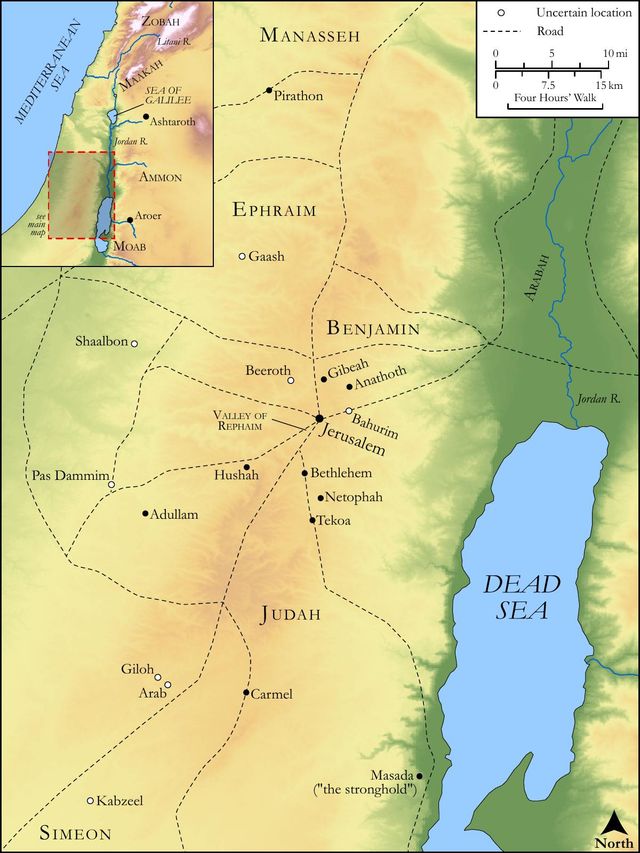
See on the biblical-era maps

Study this verse
Continue studying 2 Samuel 23:35 across the web’s major study libraries — every link below opens this exact verse, chapter, or book on the destination site.
Read & Compare
 BibleGatewayThis verse in more than 200 translations and 70 languages.
 Bible.comThe YouVersion reader — hundreds of translations, reading plans, and highlights.
 ESV.orgCrossway's official English Standard Version reader.
 NET BibleThe NET translation with 60,000+ translators' notes on every rendering decision.
 STEP BibleTyndale House's free study tool — original text, vocabulary, and scholarly resources.
 BibliaLogos Bible Software's free web reader.
 USCCBThe New American Bible (Revised Edition) with the U.S. bishops' study notes.
Commentaries
 BibleHub CommentariesDozens of classic commentaries on this verse, gathered on one page.
 StudyLightMore than 100 commentary sets — the largest collection on the web.
 BibleRefPlain-English commentary on what this verse means, verse by verse.
 Enduring WordDavid Guzik's free commentary on this chapter, widely used by Bible teachers.
 Bible Study ToolsVerse commentary alongside Greek and Hebrew study aids.
Original Language & Research
- BibleHub InterlinearThe verse word by word — original language, transliteration, and English.
- BibleHub LexiconEvery word's original-language definition and Strong's entry.
 Blue Letter BibleDeep-study tools — Strong's numbers, concordance, and word studies.
 SefariaThe Hebrew text with Rashi and centuries of Jewish commentary.
Sermons, Hymns & Audio


TrulyRandomVerse is not affiliated with these sites and doesn’t control their content. They’re linked because they’re genuinely useful.
Summary
2 Samuel 23:35 is a concise yet profoundly significant verse embedded within the esteemed catalog of David's mighty men, an elite roster of warriors who served King David with extraordinary loyalty and valor. This particular verse names Hezrai the Carmelite and Paarai the Arbite, two individuals whose inclusion in this distinguished fighting force testifies to their vital, though unelaborated, contributions to the establishment and stability of Israel's kingdom under David. Their presence underscores the diverse origins and collective strength of the faithful companions who formed the backbone of David's reign, highlighting that every member, regardless of their public renown, played an indispensable role in God's unfolding plan.
Context
ShowHideLiterary Context
This verse is situated within 2 Samuel 23:8-39, a detailed appendix to the book of 2 Samuel that meticulously lists the names and, in some instances, the heroic exploits of David's most courageous and faithful warriors. This "roll of honor" immediately follows David's "last words" in 2 Samuel 23:1-7, which serve as a theological and prophetic summary of his reign and God's enduring covenant with him. The list of mighty men functions as a powerful testament to the human instruments through whom God fulfilled His promises to David, showcasing the practical outworking of divine blessing through loyal human agency. It precedes the account of David's census and its consequences in 2 Samuel 24, effectively concluding the narrative of David's life and reign by highlighting the steadfast loyalty and collective strength that characterized his most trusted companions. The placement emphasizes that while God is sovereign, He works through devoted individuals.
Historical & Cultural Context
Among the kings of that day, a king's strength, security, and legitimacy were often intrinsically linked to the loyalty and prowess of his elite guard and fighting force. David's "mighty men" were far more than mere soldiers; they constituted a dedicated core of individuals who had been with him through his arduous fugitive years, his ascent to power, and the eventual consolidation of his kingdom. Their personal devotion to David was paramount, frequently transcending traditional tribal loyalties. The geographical designations "Carmelite" and "Arbite" are culturally significant in this context. They identify the men by their place of origin, a common practice in ancient Israel that not only provided identification but also subtly hinted at the broad diversity of support David garnered from various regions and tribes across Israel. Carmel was a fertile and prominent region in the north, while Arba is strongly associated with Hebron, an ancient and highly significant city in the south, serving as David's first capital before Jerusalem, as noted in 2 Samuel 5:5.
Key Themes
ShowHideThe inclusion of Hezrai and Paarai, alongside other less detailed entries in this extensive list, contributes significantly to several overarching themes within the biblical narrative. First, it powerfully emphasizes Loyalty and Service, illustrating the profound dedication these men offered to King David and, by extension, to God's chosen king. Their unwavering commitment was foundational to David's success and the security of the kingdom, reflecting the divine principle that God works through chosen leaders and their faithful supporters, as exemplified by David's anointing in 1 Samuel 16:13. Second, the list highlights Recognition and Remembrance. Even for those whose specific deeds are not enumerated, their very inclusion in this esteemed list signifies divine and royal recognition of their commitment, ensuring their names are remembered for posterity. This echoes the divine principle of remembering the righteous, as seen in passages like Psalm 112:6. Finally, the comprehensive nature of the list underscores The Importance of Every Member in a collective endeavor. Victory and stability are not solely due to the leader, but to the collective efforts of many, even those who may seem less prominent than figures like the chief among the mighty men. These individuals, regardless of their specific fame, played crucial roles in securing and maintaining the kingdom.
Exposition and Analysis
ShowHideKey Word Analysis
ShowHideThis personal name, H2695, is relatively uncommon in the biblical text. According to the provided Strong's data, it is "by an orthographical variation for חֶצְרוֹן; enclosure." This suggests a connection to the idea of being "enclosed" or "protected." In the context of a warrior, this could imply someone who provides protection, acts as a guardian, or perhaps operates effectively within a confined or strategic area of battle. The uniqueness of the name underscores the individual identity of this specific warrior within David's elite force.
This is another rare personal name, H6474, derived "from פָּעַר; yawning." While "yawning" might seem an unusual descriptor for a warrior, the root "פָּעַר" (pa'ar) can also carry connotations of "opening wide" or "cleaving." For a warrior, this could metaphorically suggest someone who "opens" a path through enemy lines, "cleaves" through opposition, or "uncovers" hidden dangers. Such etymological connections in ancient naming conventions often hinted at perceived characteristics, roles, or even aspirations for the individual.
These are gentilic adjectives, H3761 and H701 respectively, indicating the geographical origin of the individuals. "Carmelite" (H3761) is a "patron from כַּרְמֶל; a Karmelite or inhabitant of Karmel (the town)." Carmel was a region renowned for its fertility, natural beauty, and later, its association with significant prophetic events. This suggests Hezrai came from a prosperous and perhaps strategically important area. "Arbite" (H701) is "patrial from אֲרָב; an Arbite or native of Arab." Arba is widely identified with Kiriath-Arba, the ancient name for Hebron. Hebron held immense significance for David, serving as his first capital for seven years (as seen in 2 Samuel 5:5) and possessing deep patriarchal roots. To have a warrior from Hebron in David's elite guard would have symbolized strong support from a historically crucial and foundational region.
Verse Breakdown
ShowHide"Hezrai the Carmelite"
This phrase introduces one of David's mighty men, identifying him by his personal name, Hezrai, and his geographical origin, Carmel. The designation "the Carmelite" places him geographically, indicating his roots in the fertile and prominent region of Carmel. This detail, though brief, highlights the diverse geographical representation within David's loyal fighting force, demonstrating the widespread support for his kingdom across different parts of Israel. It suggests that David's influence and the loyalty he commanded extended beyond a single tribe or region.
"Paarai the Arbite"
Similarly, this clause introduces another warrior, Paarai, and identifies him by his origin from Arba. As noted, Arba is strongly linked to Hebron, a city of immense historical and personal significance to David, having been his first capital. The inclusion of a warrior from such a foundational and historically revered city underscores the depth and breadth of loyalty David commanded, drawing men from ancient, established centers as well as other regions. The juxtaposition of these two men, with their distinct geographical tags, subtly reinforces the idea of a unified kingdom built upon the diverse contributions of its people, all serving a common king.
Literary Devices
ShowHideThe primary literary device at play in 2 Samuel 23:35, and indeed throughout the entire list of mighty men, is Catalog or List. This technique is a common feature of Scripture, as in the genealogies of Genesis and Chronicles, serving to record, honor, and legitimize. By systematically listing names, the text creates a formal roll of honor, preserving the memory of these individuals for posterity and emphasizing their collective contribution to David's reign. The specific identifiers like "the Carmelite" and "the Arbite" function as Epithets, descriptive titles that provide essential additional information about the individual, primarily their place of origin. These epithets are a form of Metonymy, where the place name stands in for the person's identity or background, effectively encapsulating their regional affiliation and the breadth of support for David. The very act of naming, or Onomastics, is deeply significant here; it underscores the importance of individual recognition, even for those whose specific deeds are not elaborated upon. The inclusion of their names ensures that these men are not forgotten, reflecting a cultural and theological value placed on remembrance and legacy, particularly for those who serve faithfully.
Theological and Thematic Connections
ShowHideThe brief mention of Hezrai and Paarai, alongside others in David's esteemed list, carries profound theological weight, underscoring God's meticulous attention to every individual involved in His redemptive plan. It reveals that divine recognition is not limited to those who perform the most spectacular feats or hold the most prominent positions. Rather, God values the faithful service of all His servants, even those whose contributions might appear modest or go largely unnoticed by human standards. This principle teaches us that every act of loyalty, courage, and dedication in God's kingdom is seen and remembered by Him, regardless of whether it garners human acclaim. It speaks to the comprehensive nature of God's knowledge and His unwavering commitment to honoring those who serve Him and His chosen instruments, affirming that no genuine service rendered in faith is ever forgotten in the divine economy.
Reflection and Application
ShowHideThe inclusion of Hezrai the Carmelite and Paarai the Arbite in David's esteemed list, despite the absence of detailed heroic narratives for them, offers a powerful and comforting lesson for contemporary believers. It reminds us that faithful service, no matter how seemingly small, obscure, or unrecognized by human standards, is profoundly significant in God's eyes. Our diligence in our roles, whether prominent or behind the scenes, contributes to a greater, divine purpose that transcends our immediate perception. This verse encourages us to value the diverse contributions of individuals within any community or organization, especially within the church. Just as these men served David, we are called to serve Christ with unwavering loyalty, knowing that our labor in the Lord is never in vain. It fosters a profound sense of dignity and purpose for every believer, affirming that God often uses ordinary people from various backgrounds to accomplish His extraordinary purposes, building His kingdom through their collective and individual efforts. We are invited to serve faithfully, trusting that our names, and indeed our every act of service, are known and cherished by our King, who sees in secret and rewards openly.
Questions for Reflection
ShowHideFAQ
ShowHideWhy are some of David's mighty men given so little detail compared to others?
ShowHideThe varying levels of detail for David's mighty men reflect the primary purpose of the list, which is to serve as an honor roll and a testament to the collective strength and loyalty that supported David's reign, rather than a comprehensive biographical account of each individual. While some, like the "Three" or the "Thirty," had specific heroic deeds highlighted to illustrate their extraordinary valor (e.g., 2 Samuel 23:9-12), others, like Hezrai and Paarai, are simply named and identified by their origin. Their inclusion, even without detailed exploits, signifies their vital membership in this elite group and their contribution to the kingdom. It underscores the principle that not every valuable contribution needs a dramatic narrative; simply being counted among the faithful is an honor. This also subtly points to God's comprehensive knowledge, where every individual's service is known and valued, even if not fully elaborated in human records.
What is the significance of their geographical designations ("Carmelite," "Arbite")?
ShowHideThe geographical designations "Carmelite" and "Arbite" are significant for several reasons. First, they serve as common identifiers in Israel, specifying the individual's place of origin in a time when family and regional ties were paramount. Second, these designations highlight the diverse geographical reach of David's support. Hezrai, "the Carmelite," came from the fertile and prominent region of Carmel, known for its natural beauty and strategic importance. Paarai, "the Arbite," likely hailed from Arba, the ancient name for Hebron. Hebron was a city of immense historical and personal significance to David, serving as his first capital for seven years (as noted in 2 Samuel 5:5). The presence of warriors from such varied and significant regions underscores the broad-based loyalty and national unity that David managed to forge, drawing strength from across the tribes and territories of Israel. It shows that his kingdom was built on the collective efforts of men from all corners of the land, demonstrating the comprehensive nature of his support.
Christ-Centered Fulfillment
ShowHideWhile 2 Samuel 23:35 explicitly details men serving an earthly king, it powerfully foreshadows the nature of faithful service in the eternal kingdom of Christ. David's mighty men, diverse in origin and varying in renown, collectively supported the king chosen by God. In the New Testament, we see that Christ's kingdom is similarly built by a diverse company of believers—His disciples, apostles, and countless unnamed followers—who serve Him with unwavering loyalty. Just as Hezrai and Paarai contributed to David's reign, every believer, regardless of their perceived prominence or the scale of their public ministry, is a vital member of the body of Christ, as beautifully articulated in 1 Corinthians 12:12-27. The Lord Jesus, the ultimate King, sees and values every act of service, every cup of cold water given in His name (Matthew 10:42), and every quiet act of faithfulness offered to Him. The true "mighty men" and "mighty women" of Christ's kingdom are those who faithfully follow Him, whether their names are widely known or recorded only in the Lamb's Book of Life (Revelation 21:27). Their loyalty is not to an earthly monarch, but to the King of Kings, whose kingdom is eternal and whose reward for faithful service is everlasting life and commendation, as promised in Matthew 25:34-40. Thus, these brief mentions in 2 Samuel resonate with the profound truth that in God's economy, every faithful servant is remembered and honored by the King of all creation.