


2 Samuel 11:3
- וַיִּשְׁלַחvai·yish·Lachand he sentH7971Conj-w ¦ V-Qal-ConsecImperf-3msVerb Qal Consecutive Imperfect 3rd Singular Masculineוַandיִּשְׁלַחhe sent
- דָּוִדda·VidDavidH1732N-proper-mNoun Proper Masculine
- וַיִּדְרֹשׁvai·yid·Roshand he enquiredH1875Conj-w ¦ V-Qal-ConsecImperf-3msVerb Qal Consecutive Imperfect 3rd Singular Masculineוַandיִּדְרֹשׁhe enquired
- לָאִשָּׁהla·'i·Shahof the womanH802Prep-l ¦ N-fsNoun Singular Feminine Absoluteלָof theאִשָּׁהwoman
- וַיֹּאמֶרvai·Yo·merand he saidH559Conj-w ¦ V-Qal-ConsecImperf-3msVerb Qal Consecutive Imperfect 3rd Singular Masculineוַandיֹּאמֶרhe said
- הֲלוֹאha·lo'¿ notH3808Interrog ¦ NegParticle Negativeהֲ¿לוֹאnot
- זֹאתzoT[is] thisH2063PrtParticle Demonstrative
- בַּתbatBath-H1339N-proper-fNoun Proper Feminine
- שֶׁבַעShe·va'-shebaH1339N-proper-fNoun Proper Feminine
- בַּתbat[the] daughter ofH1323N-fscNoun Singular Feminine Construct
- אֱלִיעָם'e·li·'AmEliamH463N-proper-mNoun Proper Masculine
- אֵשֶׁת'E·shet[the] wife ofH802N-fscNoun Singular Feminine Construct
- אוּרִיָּה'u·ri·YahUriahH223N-proper-mNoun Proper Masculine
- הַחִתִּיha·chi·Tithe HittiteH2850Art ¦ N-msNoun Gentilic Singular Masculine AbsoluteהַtheחִתִּיHittite
English is a literal word-by-word gloss of the Hebrew, not the KJV's wording. Why?
This is the original text the KJV's translators worked from — each Hebrew word with its own literal English meaning in this verse, prepared by scholars at Tyndale House, Cambridge. The KJV translates whole sentences, not word by word, so its wording differs: one Hebrew word can become several English words, and the KJV may choose “the LORD” where the gloss reads “Yahweh”. Both are faithful — they answer different questions. For the KJV's own rendering, switch to the KJV text.
Details
See on the biblical-era map
Study this verse
Public-domain commentary
Matthew Henry
From his Commentary on the Whole Bible. Henry comments on passages, not single verses — this entry covers 2 Samuel 11:1–5. His three-level outline is real structure in the source text, so it is rendered as structure.
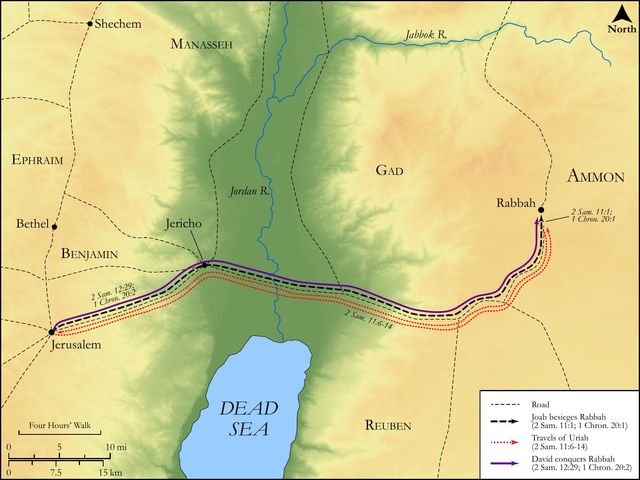
Here is, I. David's glory, in pursuing the war against the Ammonites, Sa2 11:1. We cannot take that pleasure in viewing this great action which hitherto we have taken in observing David's achievements, because the beauty of it was stained and sullied by sin; otherwise we might take notice of David's wisdom and bravery in following his blow. Having routed the army of the Ammonites in the field, as soon as ever the season of the year permitted he sent more forces to waste the country and further to avenge the quarrel of his ambassadors. Rabbah, their metropolis, made a stand, and held out a great while. To this city Joab laid close siege, and it was at the time of this siege that David fell into this sin.
II.David's shame, in being himself conquered, and led captive by his own lust.
The sin he was guilty of was adultery, against the letter of the seventh commandment, and (in the judgment of the patriarchal age) a heinous crime, and an iniquity to be punished by the judges (Job 31:11), a sin which takes away the heart, and gets a man a wound and dishonour, more than any other, and the reproach of which is not wiped away.
1.Observe the occasions which led to this sin.
(1.)Neglect of his business. When he should have been abroad with his army in the field, fighting the battles of the Lord, he devolved the care upon others, and he himself tarried still at Jerusalem, Sa2 11:1. To the war with the Syrians David went in person, Sa2 10:17. Had he been now at his post at the head of his forces, he would have been out of the way of this temptation. When we are out of the way of our duty we are in the way of temptation.
(2.)Love of ease, and the indulgence of a slothful temper: He came off his bed at evening-tide, Sa2 11:2. There he had dozed away the afternoon in idleness, which he should have spent in some exercise for his own improvement or the good of others. He used to pray, not only morning and evening, but at noon, in the day of his trouble: it is to be feared he had, this noon, omitted to do so. Idleness gives great advantage to the tempter. Standing waters gather filth. The bed of sloth often proves the bed of lust.
(3.)A wandering eye: He saw a woman washing herself, probably from some ceremonial pollution, according to the law. The sin came in at the eye, as Eve's did. Perhaps he sought to see her, at least he did not practise according to his own prayer, Turn away my eyes from beholding vanity, and his son's caution in a like case, Look not thou on the wine it is red. Either he had not, like Job, made a covenant with his eyes, or, at this time, he had forgotten it.
2.The steps of the sin. When he saw her, lust immediately conceived, and,
(1.)He enquired who she was (Sa2 11:3), perhaps intending only, if she were unmarried, to take her to wife, as he had taken several; but, if she were a wife, having no design upon her.
(2.)The corrupt desire growing more violent, though he was told she was a wife, and whose wife she was, yet he sent messengers for her, and then, it may be, intended only to please himself with her company and conversation. But,
(3.)When she came he lay with her, she too easily consenting, because he was a great man, and famed for his goodness too. Surely (thinks she) that can be no sin which such a man as David is the mover of. See how the way of sin is down-hill; when men begin to do evil they cannot soon stop themselves. The beginning of lust, as of strife, is like the letting forth of water; it is therefore wisdom to leave it off before it be meddled with. The foolish fly fires her wings, and fools away her life at last, by playing about the candle.
3.The aggravations of the sin.
(1.)He was now in years, fifty at least, some think more, when those lusts which are more properly youthful, one would think, should not have been violent in him,
(2.)He had many wives and concubines of his own; this is insisted on, Sa2 12:8.
(3.)Uriah, whom he wronged, was one of his own worthies, a person of honour and virtue, one that was now abroad in his service, hazarding his life in the high places of the field for the honour and safety of him and his kingdom, where he himself should have been.
(4.)Bath-sheba, whom he debauched, was a lady of good reputation, and, till she was drawn by him and his influence into this wickedness, had no doubt preserved her purity. Little did she think that ever she could have done so bad a thing as to forsake the guide of her youth, and forget the covenant of her God; nor perhaps could any one in the world but David have prevailed against her. The adulterer not only wrongs and ruins his own soul, but, as much as he can, another's soul too.
(5.)David was a king, whom God had entrusted with the sword of justice and the execution of the law upon other criminals, particularly upon adulterers, who were, by the law, to be put to death; for him therefore to be guilty of those crimes himself was to make himself a pattern, when he should have been a terror, to evil doers. With what face could he rebuke or punish that in others which he was conscious to himself of being guilty of? See Rom 2:22. Much more might be said to aggravate the sin; and I can think but of one excuse for it, which is that it was done but once; it was far from being his practice; it was by the surprise of a temptation that he was drawn into it. He was not one of those of whom the prophet complains that they were as fed horses, neighing every one after his neighbour's wife (Jer 5:8); but this once God left him to himself, as he did Hezekiah, that he might know what was in his heart, Ch2 32:31. Had he been told of it before, he would have said, as Hazael, What! is thy servant a dog? But by this instance we are taught what need we have to pray every day, Father, in heaven, lead us not into temptation, and to watch, that we enter not into it.
Historical interpretation
Historical reception
2 surviving comments on this verse. Each one is dated, so this reads as a timeline rather than a list.
Select a marker to jump to its quote. Markers stagger vertically where authors wrote within a few decades of each other.
We have taken up the task of writing an apology for the present style of the prophet David, not because he needs this gift, who has excelled in such great merits and flourished in virtues, but because many people, reading the sequence of his deeds without considering the power of the Scriptures or the hidden mysteries, wonder how such a great prophet did not avoid the contagion of adultery first and then of murder.
Therefore, it was our desire to review the history itself, which seems to have been exposed to sin. For in the second book of Kings (2 Samuel 11:2-27), we read that while David was walking in his royal palace, he saw a woman bathing (her name was Bathsheba), of remarkable beauty and grace, with a very attractive face, and he was overcome by the desire to possess her. However, the woman was married to a man named Uriah, and the scene of his death was arranged by royal command. For although it had no effect on his desire, yet it was considered to greatly impede his sense of shame for adultery.
Therefore, let us begin with the most obvious, whom God justified, so that you may not judge. 'For it is of little concern to me,' says Paul, 'that I should be judged by you or by any human court; indeed, I do not even judge myself' (1 Corinthians 4:3). Even though he was still in the body and subject to temptation, he did not judge himself because a spiritual person is not judged by anyone but God alone. Finally, he added, 'The one who judges me is the Lord' (1 Corinthians 4:4). Therefore, do not judge anything before the appointed time (ibid., 4 and 5). But David has already fulfilled his time and has earned grace, and he is justified by Christ; since David himself rejoiced in being called the son of the Lord, and those who confessed him in this way were enlightened. Why do you call a man of God from a reward to judgment? The Lord has already judged him, of whom he said to Solomon: If you walk before me as your father David walked in the holiness of heart and righteousness, in order to do everything I commanded him (3 Kings 9:4). Is he worthy of judgment or reward, who has done everything according to heavenly commands, walking in holiness and righteousness of heart? Where the vices and sins of others are hidden, there David receives divine testimony of his virtue and glory. And we discuss his sin in vain, for it is through his merit and grace that the sins of others have been revealed. For when Solomon sinned by not keeping the Lord's commands and God intended to divide his kingdom into many parts, He said to him: However, I will not do this in your days because of your father David. I will take it from the hand of your son. However, I will not take the whole kingdom; I will give him one scepter because of my servant David (3 Kings 11:12-13). Therefore, since the Lord justifies, who is there to condemn? What God has cleansed, you must not call common (Acts 10:15).
Nevertheless, with due regard to heavenly judgment, in which you honor the prophet even more, enter into his actions and behaviors. Do not marvel at the man, and do not judge him to be equal to the angels, because he has spent most of his life, even from childhood, dwelling in riches, honors, and positions of power, and has been subjected to many temptations. He has only once given in to error, and it is through this error that even the angels of heaven, as Scripture recounts (Genesis 6:2), were cast down from their virtue and grace. Indeed, another error of his is mentioned, that he caused the people to be counted.
It would be better for the sun to be extinguished than for David’s words to be forgotten and not transmitted to others. He fell into adultery and envy. For he saw, he says, a beautiful woman bathing and became enamored of her; and later he succeeded in doing all that he fancied.And the prophet was found in adultery, the pearl in mud. However, he did not yet understand that he had sinned, the passion ravaged him to such a great extent. Because, when the charioteer gets drunk, the chariot moves in an irregular, disorderly manner. What the charioteer is to the chariot, the soul is to the body. If the soul becomes darkened, the body rolls in mud. As long as the charioteer stands firm, the chariot drives smoothly. However, when he becomes exhausted and is unable to hold the reins firmly, you see this very chariot in terrible danger. This exact same thing happens to human beings. As long as the soul is sober and vigilant, this very body remains in purity. However, when the soul is darkened, this very body rolls in mud and in lusts.
Therefore, what did David do? He committed adultery; yet neither was he aware nor was he censured by anyone. This occurred in his most venerable years, so you may learn that, if you are indolent, not even old age benefits you, nor, if you are earnest, can youthful years seriously harm you. Behavior does not depend on age but on the direction of the will.…
So you may learn that the affairs of prudence rely upon the will and do not depend on age, just remember that David was found in his venerable years falling into adultery and committing murder; and he reached such a pathetic state that he was unaware that he had sinned, because his mind, which was the charioteer, was drunk from debauchery.
Continue studying 2 Samuel 11:3 across the web’s major study libraries — every link below opens this exact verse, chapter, or book on the destination site.
Read & Compare
 BibleGatewayThis verse in more than 200 translations and 70 languages.
 Bible.comThe YouVersion reader — hundreds of translations, reading plans, and highlights.
 ESV.orgCrossway's official English Standard Version reader.
 NET BibleThe NET translation with 60,000+ translators' notes on every rendering decision.
 STEP BibleTyndale House's free study tool — original text, vocabulary, and scholarly resources.
 BibliaLogos Bible Software's free web reader.
 USCCBThe New American Bible (Revised Edition) with the U.S. bishops' study notes.
Commentaries
 BibleHub CommentariesDozens of classic commentaries on this verse, gathered on one page.
 StudyLightMore than 100 commentary sets — the largest collection on the web.
 BibleRefPlain-English commentary on what this verse means, verse by verse.
 Enduring WordDavid Guzik's free commentary on this chapter, widely used by Bible teachers.
 Bible Study ToolsVerse commentary alongside Greek and Hebrew study aids.
Original Language & Research
- BibleHub InterlinearThe verse word by word — original language, transliteration, and English.
- BibleHub LexiconEvery word's original-language definition and Strong's entry.
 Blue Letter BibleDeep-study tools — Strong's numbers, concordance, and word studies.
 SefariaThe Hebrew text with Rashi and centuries of Jewish commentary.
Sermons, Hymns & Audio


TrulyRandomVerse is not affiliated with these sites and doesn’t control their content. They’re linked because they’re genuinely useful.
Summary
This pivotal verse marks David's deliberate transition from passive observation to active transgression, as he dispatches messengers to ascertain the identity of the woman he saw bathing. Despite receiving explicit information that she is Bathsheba, the daughter of Eliam, and crucially, the wife of Uriah the Hittite—one of his most loyal and esteemed soldiers—David consciously proceeds with his lustful intent. The precise inquiry and clear identification underscore the premeditated nature of David's impending sin, revealing a profound moral and ethical failure at the zenith of his reign.
Context
ShowHideLiterary Context
2 Samuel 11:3 is a crucial turning point, immediately following David's initial, illicit gaze at Bathsheba from his rooftop in 2 Samuel 11:2. This scene starkly contrasts with the preceding chapters, which detail David's military triumphs, the consolidation of his kingdom, and his reputation as a righteous king, as seen in narratives like 2 Samuel 8 and 2 Samuel 10. While his army is engaged in a critical siege against the Ammonites, David remains in Jerusalem, a decision that creates the opportunity for his moral lapse. The act of "sending and enquiring" in this verse is not a casual curiosity but a deliberate pursuit, signaling David's transition from internal desire to external, intentional action, setting the stage for the catastrophic events that follow.
Historical & Cultural Context
In ancient Israel, kings wielded immense power, and the temptation to abuse this authority was a constant danger. While polygamy was practiced among Israelite kings, adultery—especially with a married woman—was a severe transgression under Mosaic Law, punishable by death (Leviticus 20:10). Uriah's presence as a Hittite, yet serving as one of David's elite "mighty men" (2 Samuel 23:39), highlights the integration of loyal foreigners into David's military and court. The Hittites were a significant people group in the ancient Near East, and Uriah's unwavering dedication, despite his non-Israelite background, stands in stark and ironic contrast to David's betrayal. The setting in Jerusalem, the capital, underscores the public nature of David's position and the potential for his actions to have far-reaching scandal and consequences throughout the kingdom.
Key Themes
ShowHideThis verse is foundational to the unfolding themes of sin's progression, the corrosive nature of unchecked power, and the immutable principle of divine justice within the Davidic narrative. David's actions here represent a profound departure from his earlier characterization as "a man after God's own heart" (1 Samuel 13:14). The narrative meticulously charts the destructive path of sin, moving from an initial lustful gaze (2 Samuel 11:2) to deliberate inquiry (2 Samuel 11:3), then to adultery (2 Samuel 11:4) and ultimately murder (2 Samuel 11:15). It also introduces the critical theme of covenant infidelity, as David, the covenant king, flagrantly violates God's commands. The subsequent chapters, particularly 2 Samuel 12, will vividly detail the severe and lasting repercussions of David's actions, illustrating that even those divinely chosen are accountable to God's law and that sin inevitably yields devastating consequences for individuals, families, and nations.
Exposition and Analysis
ShowHideKey Word Analysis
ShowHideThis verb signifies a purposeful and active pursuit, investigation, or seeking of information, often with a specific intent. It implies more than a casual question; it suggests a focused, determined effort to uncover details. In the context of David's actions, "enquiring" about Bathsheba's identity reveals his conscious decision to move beyond mere observation and to initiate a process that would lead to contact. This marks a critical moral boundary crossing, as his desire transitions into a deliberate, calculated step towards its fulfillment.
Meaning "daughter of an oath" or "daughter of seven," her name carries a poignant irony given the covenant themes central to the book of 2 Samuel. Her identification as "the daughter of Eliam" is significant, as Eliam is listed among David's "mighty men" in 2 Samuel 23:34, and is widely understood to be the son of Ahithophel, David's trusted counselor (2 Samuel 15:12). This familial connection deepens the layer of personal and political betrayal inherent in David's sin, as he is not only violating divine law but also betraying the trust of a loyal servant and potentially a key advisor.
Uriah's name, meaning "Yahweh is my light" or "Yahweh is my flame," stands in stark and tragic contrast to the darkness of David's actions against him. His ethnic designation as a "Hittite" emphasizes his foreign origin, yet he is unequivocally identified as "the wife of Uriah the Hittite," a man renowned for his unwavering loyalty, integrity, and dedication to David, even being listed among David's elite "mighty men" in 2 Samuel 23:39. This clear and precise identification of Bathsheba as a married woman, and specifically to such a faithful soldier, eliminates any claim of ignorance on David's part and profoundly magnifies the deliberate and heinous nature of his sin.
Verse Breakdown
ShowHide"And David sent and enquired after the woman."
This clause immediately establishes David's active role and initiative in the unfolding tragedy. The phrase "David sent" indicates a formal, deliberate command, leveraging his royal authority to satisfy a personal, illicit desire. His "enquiring" signifies a transition from passive observation to an intentional investigation, crossing a critical threshold from temptation to the purposeful pursuit of sin.
"And [one] said, [Is] not this Bathsheba, the daughter of Eliam,"
The response to David's inquiry is swift, clear, and rhetorically pointed. The question "Is not this...?" suggests that Bathsheba's identity was either already known to David, or readily ascertainable and perhaps even common knowledge. Her lineage, explicitly linking her to Eliam (likely the son of Ahithophel, a key figure in David's inner circle), adds a profound dimension of personal and political betrayal, as David's actions would directly impact a family closely associated with his loyal court.
"the wife of Uriah the Hittite?"
This final piece of information is the most damning and morally unequivocal. It explicitly and unambiguously states that Bathsheba is a married woman, and her husband is Uriah—a loyal, esteemed, and currently deployed soldier in David's army, one of his "mighty men." This detail leaves no room for David to claim ignorance or misunderstanding regarding her marital status. He is fully informed that the woman he desires is another man's wife, and not just any man, but a faithful subject who is actively risking his life in battle for David's kingdom.
Literary Devices
ShowHideThe narrative in 2 Samuel 11:3 masterfully employs several literary devices to heighten the moral stakes and underscore David's culpability. Irony is profoundly evident, as David, the righteous king and "man after God's own heart," is depicted actively pursuing adultery, while Uriah, a foreign soldier, embodies unwavering loyalty and integrity. The rhetorical question, "Is not this Bathsheba, the daughter of Eliam, the wife of Uriah the Hittite?" serves as a powerful form of dramatic irony, as the audience is acutely aware of the devastating implications of this knowledge, while David, despite receiving this crucial information, proceeds with his sin. This question also functions as a subtle yet potent foreshadowing, hinting at the severe and far-reaching consequences that will inevitably follow David's flagrant disregard for divine law and his abuse of power. The swift, precise identification of Bathsheba, contrasting sharply with David's initial ignorance or feigned ignorance, also creates a stark contrast between David's moral blindness and the clear moral boundaries that are being transgressed.
Theological and Thematic Connections
ShowHide2 Samuel 11:3 serves as a critical juncture in the biblical narrative, vividly illustrating the insidious progression of sin from a fleeting thought or lustful gaze to a deliberate act of inquiry, setting the stage for adultery and ultimately murder. The theological implications are profound, highlighting the universal human susceptibility to temptation and the potential for even divinely appointed leaders to fall into grave sin. David's actions here represent a severe abuse of his royal power, as he leverages his authority not for justice or protection, but for personal gratification at the devastating expense of another's marriage and life. This narrative powerfully underscores the principle that sin, once conceived, actively seeks fulfillment, and that knowledge of wrongdoing does not always deter the determined sinner. It sets the stage for the themes of divine judgment and the painful, generational consequences of sin, demonstrating God's unwavering commitment to justice and righteousness, even for His chosen ones.
Reflection and Application
ShowHideThis verse serves as a profound and sobering warning about the insidious progression of sin. David's initial glance at Bathsheba was a temptation, but his subsequent action of "sending and enquiring" transformed it into a deliberate and active pursuit of sin. This crucial distinction reminds us that temptation itself is not sin, but yielding to it—actively seeking to fulfill a sinful desire—is where the line is crossed and culpability begins. For us, this means cultivating spiritual discernment to recognize the early stages of temptation and erecting firm boundaries before our desires lead us to actions we will deeply regret. It calls us to introspectively examine our hearts for any areas where we might be actively "enquiring" after something God has explicitly forbidden, rather than turning away in repentance and obedience. Furthermore, David's egregious abuse of power, leveraging his authority to obtain what was not rightfully his, challenges us to critically consider how we use whatever influence, position, or resources we possess. Do we use them to serve others, uphold justice, and honor God, or to gratify selfish impulses and exploit vulnerabilities? The narrative compels us to cultivate self-control, integrity, and a deep reverence for God's commands, understanding that true freedom, flourishing, and blessing comes from faithful obedience, not from indulging every impulse.
Questions for Reflection
ShowHideFAQ
ShowHideWhy is Uriah being a Hittite significant?
ShowHideUriah's identity as a Hittite is profoundly significant for several reasons. First, it underscores his foreign origin, yet he is prominently listed among David's most loyal and elite soldiers, his "mighty men" (2 Samuel 23:39). This highlights his exceptional dedication and faithfulness to David and to Israel, despite not being an Israelite by birth or covenant. Second, and perhaps most crucially, it creates a powerful moral contrast: the foreign soldier demonstrates greater loyalty, integrity, and adherence to military duty and personal honor than David, the king of Israel, who flagrantly betrays him. This profound irony deepens David's culpability and foreshadows the tragic consequences of his actions, as he will later orchestrate Uriah's death to cover his sin (2 Samuel 11:14-17). Uriah's character stands as a silent rebuke to David's moral failure.
Christ-Centered Fulfillment
ShowHideThe tragic narrative of David and Bathsheba, initiated by David's deliberate inquiry in 2 Samuel 11:3, powerfully underscores the inherent brokenness of even the most revered human kings and the profound need for a greater King who would not succumb to temptation or abuse His power. David, though divinely chosen and called "a man after God's own heart," failed profoundly at this critical juncture, demonstrating the pervasive reach of sin even in the lives of the righteous. In stark contrast, Jesus Christ stands as the perfectly righteous King, the true Son of David, who faced every conceivable temptation yet remained entirely without sin (Hebrews 4:15). Where David used his authority for selfish gratification and personal gain, Jesus exercised His divine power for redemptive purposes, ultimately laying down His life in sacrificial love for the sake of His bride, the Church (Ephesians 5:25). The consequences of David's sin brought judgment, sorrow, and division upon his house and kingdom; however, Christ, through His perfect obedience and atoning sacrifice on the cross, bore the full judgment for our sins, offering forgiveness, reconciliation, and new life to all who believe (2 Corinthians 5:21). Thus, the failure of David in 2 Samuel 11:3 points forward to the perfect faithfulness and redemptive work of Jesus, who alone fulfills the ideal of a covenant-keeping King, establishing an everlasting kingdom founded on righteousness, justice, and abounding grace (Isaiah 9:6-7).