


2 Samuel 11:1
Bible text: King James Version (1769 Blayney text) · Public domain
Bible text: King James Version with Strong's numbers · Public domain
Bible text: Berean Standard Bible · Public domain
Bible text: American Standard Version (1901) · Public domain
Bible text: World English Bible, Messianic edition · Public domain
Bible text: Geneva Bible (1599) · Public domain
Bible text: Young's Literal Translation · Public domain
- וַיְהִיvay·Hiand it wasH1961Conj-w ¦ V-Qal-ConsecImperf-3msVerb Qal Consecutive Imperfect 3rd Singular Masculineוַandיְהִיit was
- לִתְשׁוּבַתlit·shu·Vatto [the] return ofH8666Prep-l ¦ N-fscNoun Singular Feminine Constructלִtoתְשׁוּבַת[the] return of
- הַשָּׁנָהha·sha·Nahthe yearH8141Art ¦ N-fsNoun Singular Feminine Absoluteהַtheשָּׁנָהyear
- לְעֵתle·'Etto [the] time ofH6256Prep-l ¦ N-cscNoun Singular common gender Constructלְtoעֵת[the] time of
- צֵאתtzet[the] going out ofH3318V-Qal-InfVerb Qal Infinitive Construct
- וַיִּשְׁלַחvai·yish·Lachand he sentH7971Conj-w ¦ V-Qal-ConsecImperf-3msVerb Qal Consecutive Imperfect 3rd Singular Masculineוַandיִּשְׁלַחhe sent
- דָּוִדda·VidDavidH1732N-proper-mNoun Proper Masculine
- אֶת'et<obj.>H853DirObjMParticle Object Indicator
- יוֹאָבyo·'AvJoabH3097N-proper-mNoun Proper Masculine
- וְאֶתve·'Etand <obj.>H853Conj-w ¦ DirObjMParticle Object Indicatorוְandאֶת<obj.>
- עֲבָדָיו'a·va·Davhis servantsH5650N-mpc ¦ 3msNoun Plural Masculine Constructעֲבָדָיservantsוhis
- עִמּוֹi·Mowith himH5973Prep ¦ 3msPreposition Definiteעִמּwithוֹhim
- וְאֶתve·'Etand <obj.>H853Conj-w ¦ DirObjMParticle Object Indicatorוְandאֶת<obj.>
- כָּלkolallH3605N-mscNoun Singular Masculine Construct
- יִשְׂרָאֵלYis·ra·'ElIsraelH3478N-properNoun Proper Location
- וַיַּשְׁחִתוּvai·yash·Chi·tuand they destroyedH7843Conj-w ¦ V-Hiphil-ConsecImperf-3mpVerb Hiphil Consecutive Imperfect 3rd Plural Masculineוַandיַּשְׁחִתוּthey destroyed
- אֶת'et<obj.>H853DirObjMParticle Object Indicator
- בְּנֵיbe·Nei[the] people ofH1121N-mpcNoun Plural Masculine Construct
- עַמּוֹןa·MonAmmonH5983N-proper-mNoun Proper Masculine
- וַיָּצֻרוּvai·ya·Tzu·ruand they laid siegeH6696Conj-w ¦ V-Qal-ConsecImperf-3mpVerb Qal Consecutive Imperfect 3rd Plural Masculineוַandיָּצֻרוּthey laid siege
- עַל'alonH5921PrepPreposition
- רַבָּהra·BahRabbahH7237N-properNoun Proper Location
- וְדָוִדve·da·Vidand DavidH1732Conj-w ¦ N-proper-mNoun Proper MasculineוְandדָוִדDavid
- יוֹשֵׁבyo·Shev[was] remainingH3427V-Qal-Prtcpl-msVerb Qal Participle Singular Masculine Absolute
- בִּירוּשָׁלִָםbi·ru·sha·Limin JerusalemH3389Prep-b ¦ N-properNoun Proper LocationבִּinירוּשָׁלִָםJerusalem
English is a literal word-by-word gloss of the Hebrew, not the KJV's wording. Why?
This is the original text the KJV's translators worked from — each Hebrew word with its own literal English meaning in this verse, prepared by scholars at Tyndale House, Cambridge. The KJV translates whole sentences, not word by word, so its wording differs: one Hebrew word can become several English words, and the KJV may choose “the LORD” where the gloss reads “Yahweh”. Both are faithful — they answer different questions. For the KJV's own rendering, switch to the KJV text.
Details
See on the biblical-era maps
Study this verse
Public-domain commentary
Matthew Henry
From his Commentary on the Whole Bible. Henry comments on passages, not single verses — this entry covers 2 Samuel 11:1–5. His three-level outline is real structure in the source text, so it is rendered as structure.
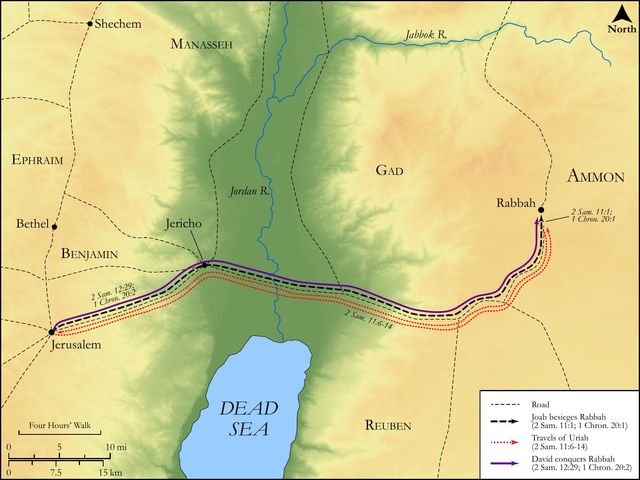
Here is, I. David's glory, in pursuing the war against the Ammonites, Sa2 11:1. We cannot take that pleasure in viewing this great action which hitherto we have taken in observing David's achievements, because the beauty of it was stained and sullied by sin; otherwise we might take notice of David's wisdom and bravery in following his blow. Having routed the army of the Ammonites in the field, as soon as ever the season of the year permitted he sent more forces to waste the country and further to avenge the quarrel of his ambassadors. Rabbah, their metropolis, made a stand, and held out a great while. To this city Joab laid close siege, and it was at the time of this siege that David fell into this sin.
II.David's shame, in being himself conquered, and led captive by his own lust.
The sin he was guilty of was adultery, against the letter of the seventh commandment, and (in the judgment of the patriarchal age) a heinous crime, and an iniquity to be punished by the judges (Job 31:11), a sin which takes away the heart, and gets a man a wound and dishonour, more than any other, and the reproach of which is not wiped away.
1.Observe the occasions which led to this sin.
(1.)Neglect of his business. When he should have been abroad with his army in the field, fighting the battles of the Lord, he devolved the care upon others, and he himself tarried still at Jerusalem, Sa2 11:1. To the war with the Syrians David went in person, Sa2 10:17. Had he been now at his post at the head of his forces, he would have been out of the way of this temptation. When we are out of the way of our duty we are in the way of temptation.
(2.)Love of ease, and the indulgence of a slothful temper: He came off his bed at evening-tide, Sa2 11:2. There he had dozed away the afternoon in idleness, which he should have spent in some exercise for his own improvement or the good of others. He used to pray, not only morning and evening, but at noon, in the day of his trouble: it is to be feared he had, this noon, omitted to do so. Idleness gives great advantage to the tempter. Standing waters gather filth. The bed of sloth often proves the bed of lust.
(3.)A wandering eye: He saw a woman washing herself, probably from some ceremonial pollution, according to the law. The sin came in at the eye, as Eve's did. Perhaps he sought to see her, at least he did not practise according to his own prayer, Turn away my eyes from beholding vanity, and his son's caution in a like case, Look not thou on the wine it is red. Either he had not, like Job, made a covenant with his eyes, or, at this time, he had forgotten it.
2.The steps of the sin. When he saw her, lust immediately conceived, and,
(1.)He enquired who she was (Sa2 11:3), perhaps intending only, if she were unmarried, to take her to wife, as he had taken several; but, if she were a wife, having no design upon her.
(2.)The corrupt desire growing more violent, though he was told she was a wife, and whose wife she was, yet he sent messengers for her, and then, it may be, intended only to please himself with her company and conversation. But,
(3.)When she came he lay with her, she too easily consenting, because he was a great man, and famed for his goodness too. Surely (thinks she) that can be no sin which such a man as David is the mover of. See how the way of sin is down-hill; when men begin to do evil they cannot soon stop themselves. The beginning of lust, as of strife, is like the letting forth of water; it is therefore wisdom to leave it off before it be meddled with. The foolish fly fires her wings, and fools away her life at last, by playing about the candle.
3.The aggravations of the sin.
(1.)He was now in years, fifty at least, some think more, when those lusts which are more properly youthful, one would think, should not have been violent in him,
(2.)He had many wives and concubines of his own; this is insisted on, Sa2 12:8.
(3.)Uriah, whom he wronged, was one of his own worthies, a person of honour and virtue, one that was now abroad in his service, hazarding his life in the high places of the field for the honour and safety of him and his kingdom, where he himself should have been.
(4.)Bath-sheba, whom he debauched, was a lady of good reputation, and, till she was drawn by him and his influence into this wickedness, had no doubt preserved her purity. Little did she think that ever she could have done so bad a thing as to forsake the guide of her youth, and forget the covenant of her God; nor perhaps could any one in the world but David have prevailed against her. The adulterer not only wrongs and ruins his own soul, but, as much as he can, another's soul too.
(5.)David was a king, whom God had entrusted with the sword of justice and the execution of the law upon other criminals, particularly upon adulterers, who were, by the law, to be put to death; for him therefore to be guilty of those crimes himself was to make himself a pattern, when he should have been a terror, to evil doers. With what face could he rebuke or punish that in others which he was conscious to himself of being guilty of? See Rom 2:22. Much more might be said to aggravate the sin; and I can think but of one excuse for it, which is that it was done but once; it was far from being his practice; it was by the surprise of a temptation that he was drawn into it. He was not one of those of whom the prophet complains that they were as fed horses, neighing every one after his neighbour's wife (Jer 5:8); but this once God left him to himself, as he did Hezekiah, that he might know what was in his heart, Ch2 32:31. Had he been told of it before, he would have said, as Hazael, What! is thy servant a dog? But by this instance we are taught what need we have to pray every day, Father, in heaven, lead us not into temptation, and to watch, that we enter not into it.
Continue studying 2 Samuel 11:1 across the web’s major study libraries — every link below opens this exact verse, chapter, or book on the destination site.
Read & Compare
 BibleGatewayThis verse in more than 200 translations and 70 languages.
 Bible.comThe YouVersion reader — hundreds of translations, reading plans, and highlights.
 ESV.orgCrossway's official English Standard Version reader.
 NET BibleThe NET translation with 60,000+ translators' notes on every rendering decision.
 STEP BibleTyndale House's free study tool — original text, vocabulary, and scholarly resources.
 BibliaLogos Bible Software's free web reader.
 USCCBThe New American Bible (Revised Edition) with the U.S. bishops' study notes.
Commentaries
 BibleHub CommentariesDozens of classic commentaries on this verse, gathered on one page.
 StudyLightMore than 100 commentary sets — the largest collection on the web.
 BibleRefPlain-English commentary on what this verse means, verse by verse.
 Enduring WordDavid Guzik's free commentary on this chapter, widely used by Bible teachers.
 Bible Study ToolsVerse commentary alongside Greek and Hebrew study aids.
Original Language & Research
- BibleHub InterlinearThe verse word by word — original language, transliteration, and English.
- BibleHub LexiconEvery word's original-language definition and Strong's entry.
 Blue Letter BibleDeep-study tools — Strong's numbers, concordance, and word studies.
 SefariaThe Hebrew text with Rashi and centuries of Jewish commentary.
Sermons, Hymns & Audio


TrulyRandomVerse is not affiliated with these sites and doesn’t control their content. They’re linked because they’re genuinely useful.
Summary
Second Samuel 11:1 marks a profound and tragic turning point in the life and reign of King David, initiating a period of moral failure and divine judgment that would plague his household. The verse sets the scene by noting the customary spring season, a time when kings were expected to lead their armies into battle, particularly against the Ammonites. However, in a stark deviation from this royal duty, David remains in Jerusalem while his general Joab, accompanied by the entire Israelite army, dutifully engages the enemy and lays siege to Rabbah. This act of idleness and neglect of responsibility directly precedes and creates the fertile ground for David's catastrophic sins of adultery with Bathsheba and the subsequent murder of Uriah the Hittite.
Context
ShowHideLiterary Context
This verse serves as a crucial narrative hinge, transitioning the reader from the triumphs and consolidation of David's kingdom (detailed in 2 Samuel 8 through 2 Samuel 10) to the devastating moral failures and subsequent divine discipline that define the latter half of his reign. The preceding chapters highlight David's military prowess and his establishment as a powerful monarch, culminating in the Ammonite conflict, which began due to their egregious insult to David's envoys (2 Samuel 10:1-5). The narrative deliberately places David's decision to "tarry" in Jerusalem immediately before the infamous account of his encounter with Bathsheba in 2 Samuel 11:2-5. This juxtaposition is not coincidental; it strongly implies a causal link between David's dereliction of duty and the subsequent cascade of sin, portraying his idleness as the direct narrative precursor to his moral downfall.
Historical & Cultural Context
The phrase "after the year was expired, at the time when kings go forth [to battle]" refers to the spring, typically after the winter rains had ceased, making the land traversable and suitable for military campaigns. This was the established custom for the kings of Israel and the nations round about, who were expected to personally lead their armies. For a warrior-king like David, who had built his reputation on military leadership and courage (e.g., 1 Samuel 17), this expectation was particularly strong. The conflict with the Ammonites was significant, involving the siege of their capital, Rabbah. David's choice to remain in Jerusalem, therefore, was not merely a personal preference but a conspicuous deviation from his kingly responsibilities and the prevailing cultural and military norms. This act of non-participation would have been unusual and potentially perceived as a dereliction of a king's primary duty.
Key Themes
ShowHideThis pivotal verse introduces or reinforces several profound themes crucial to understanding David's story and broader biblical theology. Firstly, it powerfully illustrates the peril of idleness and neglected duty. David's absence from his expected role as military leader creates a vacuum, an opportunity for temptation to take root, demonstrating that even strong leaders are vulnerable when they step outside their God-given responsibilities. Secondly, it marks the beginning of David's moral decline, serving as the catalyst for the subsequent egregious sins of adultery and murder. This moment signifies a tragic shift from the "man after God's own heart" (1 Samuel 13:14) to one who falls grievously, highlighting the universal human susceptibility to sin. Finally, it subtly introduces the theme of consequences for sin, foreshadowing the severe judgment and familial strife that would plague David's house, as later prophesied by Nathan in 2 Samuel 12:10-12.
Exposition and Analysis
ShowHideKey Word Analysis
ShowHideThis word (H8666) is derived from a root meaning "to return," and in this context, it signifies "the return of the year" or "the turn of the year." It precisely denotes the cyclical, annual return of spring, which was the customary and expected season for military campaigns. The phrase emphasizes that David's inaction was not due to an unusual or unfavorable circumstance, but a deliberate choice to deviate from a well-established and universally recognized norm for royal conduct.
The verb (H3318) literally means "to go out" or "to go forth" and is used here in the context of military deployment. It describes the active, expected duty of kings during this season – to personally lead their armies into battle. By contrasting David's subsequent "tarrying" with the active "going forth" of other kings, the text highlights David's conspicuous and fateful dereliction of duty, which sets the stage for the narrative of his sin.
This verb (H3427) means "to sit down," "to dwell," or "to remain." In this context, "and he tarried" (wayyešeb) conveys David's passive choice to stay in Jerusalem rather than actively engaging in the war. The simplicity of the word belies its profound significance, underscoring David's unique and fateful decision to be absent from his post, thereby creating the circumstances for his vulnerability and subsequent moral failures.
Verse Breakdown
ShowHide"And it came to pass, after the year was expired, at the time when kings go forth [to battle]"
This opening clause establishes the precise historical and cultural context for the unfolding events. It sets the scene by indicating the specific season—spring—which was universally recognized as the prime time for military campaigns. The phrase "when kings go forth to battle" underscores the expected behavior of monarchs, immediately creating a dramatic contrast with David's subsequent action (or inaction). This is the established norm against which David's deviation will be measured, highlighting his unusual choice.
"that David sent Joab, and his servants with him, and all Israel; and they destroyed the children of Ammon, and besieged Rabbah."
This part describes the military action that did take place, despite David's absence. David, though not personally present, still orchestrates the war effort by dispatching his loyal and capable general, Joab, along with the full might of Israel's army. The army successfully engages the Ammonites and lays siege to their capital, Rabbah, indicating that the military campaign was proceeding effectively under Joab's leadership. This highlights David's delegation of a duty that was traditionally his own, emphasizing his detachment from the front lines.
"But David tarried still at Jerusalem."
This final, short, and stark clause is the most crucial part of the verse, serving as the narrative's pivot point. The conjunction "But" signals a sharp contrast to the preceding actions and the expected norm. David's choice to "tarry" (remain) in Jerusalem, away from the battlefield, is presented as a deliberate and significant deviation from his kingly responsibilities. This seemingly minor act of idleness is the critical catalyst, creating the circumstances under which David becomes vulnerable to temptation, directly leading to the unfolding tragedy of his sin with Bathsheba and Uriah.
Literary Devices
ShowHideThe verse employs several potent literary devices to convey its profound message and foreshadow the ensuing narrative. Contrast is the most prominent, highlighted by David's inaction ("tarried still at Jerusalem") against the expected action of "kings go forth [to battle]" and the active engagement of Joab and the entire Israelite army. This stark opposition immediately signals David's deviation from his kingly duty and the established norm. The verse also utilizes Foreshadowing, as David's idleness and conspicuous absence from his post implicitly warn the reader that something negative or problematic is about to occur; it sets the stage for the moral failures that immediately follow. There is a subtle layer of Irony at play: David, renowned as a mighty warrior and courageous leader who famously defeated Goliath (1 Samuel 17:45-47), is now depicted as remaining in the comfort of his palace while his army fights a critical war. This verse functions as a clear Turning Point in David's narrative, marking the end of a period of unblemished success and the beginning of a dark chapter filled with sin and its devastating consequences.
Theological and Thematic Connections
ShowHideThis foundational verse underscores the profound spiritual danger of idleness and the neglect of one's God-given responsibilities. David, a man after God's own heart, demonstrates that even the most spiritually mature individuals are susceptible to temptation when they step outside their sphere of duty and allow complacency to set in. His decision to "tarry" was not inherently sinful, but it created the fertile ground for sin to germinate, illustrating that vulnerability often arises not in moments of intense struggle but in periods of ease and unfulfilled purpose. This serves as a timeless warning that spiritual vigilance is paramount, regardless of one's past faithfulness or position, highlighting that a lack of active engagement in one's calling can lead to spiritual compromise.
Reflection and Application
ShowHideDavid's decision to "tarry" in Jerusalem, a seemingly small deviation from his kingly duty, serves as a powerful cautionary tale for believers today. It highlights that neglecting our responsibilities, whether in our spiritual walk, family life, or professional calling, can create a dangerous void that makes us susceptible to temptation. Just as David was meant to be on the battlefield, we are called to be actively engaged in the "good fight of faith," vigilant against the schemes of the enemy, and diligent in fulfilling the purposes God has for us. Idleness, whether physical or spiritual, can lead to complacency, which in turn can open the door to compromises that seem minor at first but can escalate into significant moral failures. This verse compels us to honestly examine where we might be "tarrying" instead of "going forth" in our lives, urging us to remain purposeful, watchful, and committed to our God-given duties to safeguard our hearts and minds against the subtle encroachments of sin.
Questions for Reflection
ShowHideFAQ
ShowHideWhy is David's absence from battle so significant?
ShowHideDavid's absence is profoundly significant because it represents a critical deviation from his expected role as king and military leader during a customary time for war. In Israel, whose elders had asked for a king who would "go out before us, and fight our battles," kings were expected to personally lead their armies into battle, especially in major campaigns like the siege of Rabbah. By delegating this crucial duty and remaining in Jerusalem, David placed himself in a position of idleness and vulnerability. This idleness directly precedes and enables his subsequent catastrophic sins of adultery with Bathsheba and the murder of Uriah, making his decision to "tarry" the critical catalyst for his moral downfall. It underscores the spiritual danger of neglecting one's responsibilities and becoming complacent, even for a leader as great as David.
Was this the absolute beginning of David's moral decline, or were there earlier signs?
ShowHideWhile 2 Samuel 11:1 is widely considered the catalyst and turning point for David's public and catastrophic moral decline, the biblical text does not explicitly detail earlier moral failures that would foreshadow this moment. However, the immediate and severe nature of his subsequent sins suggests that seeds of pride, complacency, or an overreliance on his established power might have been subtly growing before this point. This verse, nevertheless, is undeniably the narrative hinge where David's actions directly lead to his most grievous transgressions, marking a clear and dramatic shift from his earlier character as a "man after God's own heart." It is the moment where his personal choices directly trigger a cascade of sin and its consequences.
What does "after the year was expired" mean in this context?
ShowHideThe phrase "after the year was expired" (KJV) or "at the turn of the year" (ESV, NIV) refers to the spring season. This was the traditional time for military campaigns among the nations, as the winter rains would have subsided, making travel and warfare more feasible and the ground suitable for armies. It emphasizes that David's decision to stay in Jerusalem was not due to an unusual or unfavorable circumstance, but a deliberate choice to deviate from the established custom and expectation for kings to lead their armies during this specific, annual period of warfare. It highlights his conscious departure from his kingly responsibilities.
Christ-Centered Fulfillment
ShowHideDavid's failure to "go forth to battle" and his decision to "tarry" in Jerusalem stands in stark contrast to the perfect obedience and unwavering commitment of Jesus Christ, the true King of Israel. Unlike David, who neglected his kingly duty and succumbed to temptation born of idleness, Christ consistently "went forth" to fulfill the will of His Father. From His active ministry of teaching and healing to His resolute journey towards Jerusalem and the cross, Jesus never "tarried" from His divine mission. He is the King who perfectly leads His people in the ultimate battle against sin and death, not by delegating but by personally engaging and conquering. Where David's idleness led to sin and judgment, Christ's active obedience, even to the point of death on a cross, secured salvation and eternal life for His people (Philippians 2:8). He is the High Priest who was "in all points tempted as we are, yet without sin" (Hebrews 4:15), demonstrating perfect vigilance and faithfulness in every moment. Jesus embodies the King who always fulfills His calling, whose "food is to do the will of Him who sent Me, and to finish His work" (John 4:34), providing the ultimate example and the only true hope for those who, like David, fall short.