


1 Chronicles 20:1
Bible text: King James Version (1769 Blayney text) · Public domain
Bible text: King James Version with Strong's numbers · Public domain
Bible text: Berean Standard Bible · Public domain
Bible text: American Standard Version (1901) · Public domain
Bible text: World English Bible, Messianic edition · Public domain
Bible text: Geneva Bible (1599) · Public domain
Bible text: Young's Literal Translation · Public domain
- וַיְהִיvay·Hiand it wasH1961Conj-w ¦ V-Qal-ConsecImperf-3msVerb Qal Consecutive Imperfect 3rd Singular Masculineוַandיְהִיit was
- לְעֵתle·'Etto [the] time ofH6256Prep-l ¦ N-cscNoun Singular common gender Constructלְtoעֵת[the] time of
- תְּשׁוּבַתte·shu·Vat[the] return ofH8666N-fscNoun Singular Feminine Construct
- הַשָּׁנָהha·sha·Nahthe yearH8141Art ¦ N-fsNoun Singular Feminine Absoluteהַtheשָּׁנָהyear
- לְעֵתle·'Etto [the] time ofH6256Prep-l ¦ N-cscNoun Singular common gender Constructלְtoעֵת[the] time of
- צֵאתtzet[the] going out ofH3318V-Qal-InfVerb Qal Infinitive Construct
- הַמְּלָכִיםha·me·la·Khim<the> kingsH4428Art ¦ N-mpNoun Plural Masculine Absoluteהַ<the>מְּלָכִיםkings
- וַיִּנְהַגvai·yin·Hagand he lead outH5090Conj-w ¦ V-Qal-ConsecImperf-3msVerb Qal Consecutive Imperfect 3rd Singular Masculineוַandיִּנְהַגhe lead out
- יוֹאָבyo·'AvJoabH3097N-proper-mNoun Proper Masculine
- אֶת'et<obj.>H853DirObjMParticle Object Indicator
- חֵילcheil[the] army ofH2428N-mscNoun Singular Masculine Construct
- הַצָּבָאha·tza·Va'<the> warH6635Art ¦ N-msNoun Singular Masculine Absoluteהַ<the>צָּבָאwar
- וַיַּשְׁחֵתvai·yash·Chetand he destroyedH7843Conj-w ¦ V-Hiphil-ConsecImperf-3msVerb Hiphil Consecutive Imperfect 3rd Singular Masculineוַandיַּשְׁחֵתhe destroyed
- אֶת'et<obj.>H853DirObjMParticle Object Indicator
- אֶרֶץ'E·retz[the] land ofH776N-fscNoun Singular Feminine Construct
- בְּנֵיbe·nei[the] people ofH1121N-mpcNoun Plural Masculine Construct
- עַמּוֹןa·MonAmmonH5983N-proper-mNoun Proper Masculine
- וַיָּבֹאvai·ya·Vo'and he wentH935Conj-w ¦ V-Qal-ConsecImperf-3msVerb Qal Consecutive Imperfect 3rd Singular Masculineוַandיָּבֹאhe went
- וַיָּצַרvai·Ya·tzarand he besiegedH6696Conj-w ¦ V-Qal-ConsecImperf-3msVerb Qal Consecutive Imperfect 3rd Singular Masculineוַandיָּצַרhe besieged
- אֶת'et<obj.>H853DirObjMParticle Object Indicator
- רַבָּהra·BahRabbahH7237N-properNoun Proper Location
- וְדָוִידve·da·Vidand DavidH1732Conj-w ¦ N-proper-mNoun Proper MasculineוְandדָוִידDavid
- יֹשֵׁבyo·Shev[was] remainingH3427V-Qal-Prtcpl-msVerb Qal Participle Singular Masculine Absolute
- בִּירוּשָׁלִָםbi·ru·sha·Limin JerusalemH3389Prep-b ¦ N-properNoun Proper LocationבִּinירוּשָׁלִָםJerusalem
- וַיַּךְvai·Yakhand he struckH5221Conj-w ¦ V-Hiphil-ConsecImperf-3msVerb Hiphil Consecutive Imperfect 3rd Singular Masculineוַandיַּךְhe struck
- יוֹאָבyo·'AvJoabH3097N-proper-mNoun Proper Masculine
- אֶת'et<obj.>H853DirObjMParticle Object Indicator
- רַבָּהra·BahRabbahH7237N-properNoun Proper Location
- וַיֶּהֶרְסֶהָvai·Ye·her·Se·haand he overthrew itH2040Conj-w ¦ V-Qal-ConsecImperf-3ms ¦ 3fsVerb Qal Consecutive Imperfect 3rd Singular Masculineוַandיֶּהֶרְסֶhe overthrewהָit
English is a literal word-by-word gloss of the Hebrew, not the KJV's wording. Why?
This is the original text the KJV's translators worked from — each Hebrew word with its own literal English meaning in this verse, prepared by scholars at Tyndale House, Cambridge. The KJV translates whole sentences, not word by word, so its wording differs: one Hebrew word can become several English words, and the KJV may choose “the LORD” where the gloss reads “Yahweh”. Both are faithful — they answer different questions. For the KJV's own rendering, switch to the KJV text.
Details
See on the biblical-era maps
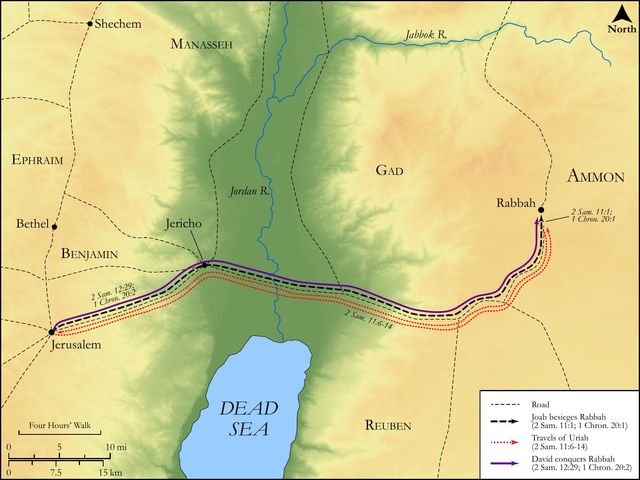
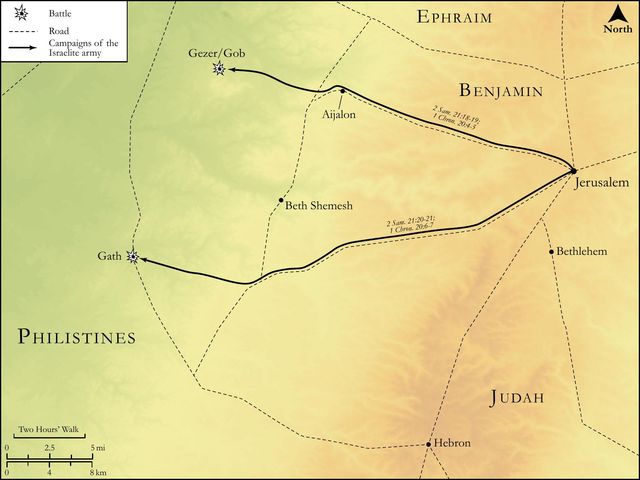
Study this verse
Public-domain commentary
Matthew Henry
From his Commentary on the Whole Bible. Henry comments on passages, not single verses — this entry covers 1 Chronicles 20:1–3.
How the army of the Ammonites and their allies was routed in the field we read in the foregoing chapters. Here we have the destruction of Rabbah, the metropolis of their kingdom (Ch1 20:1), the putting of their king's crown upon David's head (Ch1 20:2), and the great severity that was used towards the people, Ch1 20:3. Of this we had a more full account in 2 Sa. 11, 12, and cannot but remember it by this sad token, that while Joab was besieging Rabbah David fell into that great sin in the matter of Uriah. But it is observable that, though the rest of the story is repeated, that is not: a hint only is given of it, in those words which lie here in a parenthesis - But David tarried at Jerusalem. If he had been abroad with his army, he would have been out of the way of that temptation; but, indulging his ease, he fell into uncleanness. Now, as the relating of the sin David fell into is an instance of the impartiality and fidelity of the sacred writers, so the avoiding of the repetition of it here, when there was a fair occasion given to speak of it again, is designed to teach us that, though there may be a just occasion to speak of the faults and miscarriages of others, yet we should not take delight in the repetition of them. That should always be looked upon as an unpleasing subject which, though sometimes one cannot help falling upon, yet one would not choose to dwell upon, any more than we should love to rake in a dunghill. The persons, or actions, we can say no good of, we had best say nothing of.
Continue studying 1 Chronicles 20:1 across the web’s major study libraries — every link below opens this exact verse, chapter, or book on the destination site.
Read & Compare
 BibleGatewayThis verse in more than 200 translations and 70 languages.
 Bible.comThe YouVersion reader — hundreds of translations, reading plans, and highlights.
 ESV.orgCrossway's official English Standard Version reader.
 NET BibleThe NET translation with 60,000+ translators' notes on every rendering decision.
 STEP BibleTyndale House's free study tool — original text, vocabulary, and scholarly resources.
 BibliaLogos Bible Software's free web reader.
 USCCBThe New American Bible (Revised Edition) with the U.S. bishops' study notes.
Commentaries
 BibleHub CommentariesDozens of classic commentaries on this verse, gathered on one page.
 StudyLightMore than 100 commentary sets — the largest collection on the web.
 BibleRefPlain-English commentary on what this verse means, verse by verse.
 Enduring WordDavid Guzik's free commentary on this chapter, widely used by Bible teachers.
 Bible Study ToolsVerse commentary alongside Greek and Hebrew study aids.
Original Language & Research
- BibleHub InterlinearThe verse word by word — original language, transliteration, and English.
- BibleHub LexiconEvery word's original-language definition and Strong's entry.
 Blue Letter BibleDeep-study tools — Strong's numbers, concordance, and word studies.
 SefariaThe Hebrew text with Rashi and centuries of Jewish commentary.
Sermons, Hymns & Audio


TrulyRandomVerse is not affiliated with these sites and doesn’t control their content. They’re linked because they’re genuinely useful.
Summary
1 Chronicles 20:1 recounts a significant military campaign led by Joab, King David's commander, against the Ammonite capital, Rabbah, which culminated in its successful siege and destruction. This pivotal verse highlights Joab's effective military leadership and Israel's continued expansion and dominance in the region, while notably, and somewhat subtly, drawing attention to King David's unusual absence from the battlefield, as he remained in Jerusalem during a customary season for royal military engagement.
Context
ShowHideLiterary Context
This verse is strategically placed within the Chronicler's narrative, immediately following a series of accounts detailing David's extensive military victories and the consolidation of his kingdom (chapters 18-19). It serves as the concluding act of the Ammonite-Syrian war, which began due to the Ammonites' egregious insult to David's envoys. The preceding chapter, 1 Chronicles 19, describes the initial phases of this conflict, including Joab's strategic prowess in defeating the combined Ammonite and Aramean forces. Chapter 20, though remarkably concise, brings this major conflict to a decisive close with the capture of Rabbah. The Chronicler's overarching purpose throughout these chapters is to portray David as a divinely favored and successful king, emphasizing the growth and security of his kingdom, and crucially, setting the theological stage for the future building of the temple. The deliberate omission of David's personal moral failings, such as the Bathsheba incident detailed in 2 Samuel 11, is a characteristic feature of the Chronicler's theological agenda, which often streamlines narratives to underscore the positive aspects of David's reign, the lineage of Judah, and the establishment of true worship.
Historical & Cultural Context
The opening phrase, "after the year was expired, at the time that kings go out [to battle]," refers to the well-established custom of military campaigns among the kings of that day. This period, typically occurring in the spring, was chosen for practical reasons: winter rains had subsided, making roads and rivers more passable; the weather was conducive for troop movement and prolonged outdoor operations; and agricultural demands were less pressing, allowing for the mobilization and sustenance of large armies. Kings were generally expected to lead their armies personally, making David's decision to "tarry at Jerusalem" a significant deviation from royal protocol. Rabbah, the capital of Ammon (modern Amman, Jordan), held immense strategic importance due to its location on the King's Highway, a vital ancient trade route. Its capture represented a substantial expansion of Israelite dominion and control over a key geopolitical area. The "wasting of the country" before the siege was a common and brutal military tactic, designed to deplete the enemy's resources, destroy their infrastructure, and break their will to resist, thereby facilitating the final conquest.
Key Themes
ShowHideThis verse contributes to several profound themes woven throughout the book of Chronicles. Firstly, it highlights the theme of Military Leadership and Prowess, with Joab's effective command showcasing the formidable strength and organization of David's army. This success is implicitly presented as a reflection of God's blessing on Israel's military endeavors, securing the kingdom's borders and expanding its influence, a theme consistently found in passages like 1 Chronicles 18. Secondly, it subtly introduces the theme of King's Responsibility and Presence. While the Chronicler refrains from explicit condemnation, the stark contrast between Joab's active leadership and David's decision to remain in Jerusalem serves as a narrative marker. This absence, particularly when viewed in light of the parallel account in 2 Samuel 11:1, becomes a critical turning point in David's life, subtly hinting at the dangers of complacency and the neglect of one's divinely appointed duties. Lastly, the conquest of Rabbah reinforces the overarching theme of Conquest and Dominion, illustrating the continued expansion and consolidation of David's kingdom, thereby fulfilling God's promises regarding Israel's inheritance and secure borders.
Exposition and Analysis
ShowHideKey Word Analysis
ShowHideThis word denotes "a recurrence (of time or place)" or "return." In the phrase "after the year was expired," it refers to the annual cycle's return, specifically the spring season. This idiom marks the customary time when weather conditions became favorable for military campaigns, establishing the expected period for kings to lead their armies into battle, a custom David notably deviates from.
This term signifies "a force, whether of men, means or other resources; an army, wealth, virtue, valor, strength." When Joab "led forth the power of the army," it indicates that he mobilized the full military might and resources of Israel. This word emphasizes the formidable strength, valor, and organized force that Joab commanded, highlighting the effectiveness of David's military apparatus.
This verb primarily means "to sit down," but by implication, "to dwell," or "to remain." In this context, David's decision to "tarry" in Jerusalem underscores his choice to stay put, to remain inactive in the capital, rather than joining his army in the field. This word subtly highlights his departure from the expected active role of a warrior king, particularly when juxtaposed with Joab's decisive leadership.
Verse Breakdown
ShowHide"¶ And it came to pass, that after the year was expired, at the time that kings go out [to battle],"
This opening clause establishes the precise temporal and customary setting for the events that follow. "After the year was expired" refers to the arrival of spring, the traditional and most suitable season for military campaigns among the kings of that day. The subsequent phrase, "at the time that kings go out [to battle]," explicitly underscores this established custom, setting a clear expectation for the king's personal involvement and leadership in warfare. This sets up a subtle but significant contrast with David's subsequent actions.
"Joab led forth the power of the army, and wasted the country of the children of Ammon, and came and besieged Rabbah."
This segment details the decisive and comprehensive actions taken by Joab, King David's chief military commander. Joab takes the initiative, mobilizing the full strength and resources of the Israelite army. The phrase "wasted the country" describes the standard, destructive tactics employed to cripple the Ammonites' resources and break their will to resist. The ultimate objective, the siege of Rabbah, the Ammonite capital, signifies a well-planned and strategic military operation aimed at total conquest.
"But David tarried at Jerusalem."
This brief, yet profoundly significant, clause presents a stark contrast to Joab's active and aggressive leadership. David, the king, remains in the capital city of Jerusalem, deliberately choosing not to fulfill the expected role of leading his troops into battle. The Chronicler presents this fact without direct commentary or judgment, allowing the reader to perceive the deviation from the norm. For those familiar with the broader biblical narrative, this absence is the critical point of narrative divergence from the parallel account in 2 Samuel, which elaborates on the dire consequences of David's decision.
"And Joab smote Rabbah, and destroyed it."
This final clause reports the successful and conclusive outcome of the campaign. Joab, operating without David's direct participation, achieves a complete and decisive victory, conquering and utterly destroying the Ammonite capital. This highlights Joab's exceptional military competence and the overwhelming strength of the Israelite army, securing a significant triumph for David's kingdom and consolidating Israel's regional dominance.
Literary Devices
ShowHideThe Chronicler employs several key literary devices within this concise verse to convey its profound meaning. The most prominent is Juxtaposition, where the active, diligent, and ultimately successful leadership of Joab is placed in direct and pointed contrast with David's passive "tarrying at Jerusalem." This creates a subtle yet powerful narrative tension, especially for readers familiar with the broader biblical narrative of David's life. There is also a significant element of Narrative Economy or Selective Reporting, as the Chronicler deliberately chooses to present only the military outcome of the campaign, omitting the scandalous and morally compromising details of David's sin with Bathsheba and Uriah that occurred during this very same period, as extensively detailed in the parallel account of 2 Samuel 11. This selective reporting serves the Chronicler's theological purpose of highlighting David's positive contributions, his role in preparing for the temple, and the divine blessing on his reign, rather than dwelling on his personal moral failures. Finally, the phrase "at the time that kings go out [to battle]" functions as a subtle form of Foreshadowing, hinting at the profound significance and potential negative repercussions of David's deviation from this customary and expected practice, even if the direct consequences are not explicitly elaborated upon within this particular chapter of Chronicles.
Theological and Thematic Connections
ShowHide1 Chronicles 20:1, despite its brevity and the Chronicler's selective focus, offers profound theological insights into human responsibility, divine sovereignty, and the nature of biblical history. While the Chronicler's primary emphasis is on God's unwavering faithfulness to David and the ultimate success of his divinely ordained kingdom, David's absence from the battlefield subtly underscores the principle that even divinely appointed leaders remain accountable for their choices and actions. His decision to "tarry" was not merely a logistical choice but a moral one that, as revealed in the broader biblical narrative, opened the door to significant personal sin and national consequences. This highlights that God's overarching plan often unfolds through human agency, and human failures, even when omitted from one particular narrative, remain an integral part of the broader divine record and carry real-world implications. The decisive victory at Rabbah, achieved despite David's personal failure, ultimately testifies to God's overarching purpose for Israel and His steadfast commitment to establishing David's kingdom and ensuring its security.
Reflection and Application
ShowHide1 Chronicles 20:1 serves as a subtle yet potent reminder for believers today about the profound importance of diligence, presence, and accountability, particularly for those in positions of leadership or responsibility. David's decision to remain in Jerusalem, while seemingly innocuous in this specific account, was a significant departure from his expected duty as king and commander-in-chief. This seemingly small act of complacency ultimately created a vacuum that led to profound moral failure and significant national distress, as revealed elsewhere in Scripture. For us, this narrative highlights that complacency, procrastination, or the neglect of our God-given responsibilities—whether in our families, workplaces, churches, or personal spiritual lives—can open doors to temptation, vulnerability, and negative consequences. Our spiritual battles, much like physical ones, require our active participation, vigilance, and unwavering commitment. We cannot afford to "tarry" when the Lord calls us to action, to prayer, to service, or to stand firm against spiritual adversaries. This verse encourages us to be acutely mindful of our duties and to proactively engage with the challenges and opportunities God places before us, recognizing that our consistent presence, diligence, and faithfulness are vital for our flourishing, the well-being of those we influence, and ultimately, for honoring God.
Questions for Reflection
ShowHideFAQ
ShowHideWhy does 1 Chronicles 20:1 omit the story of David and Bathsheba, which occurred at the same time according to 2 Samuel 11?
ShowHideThe Chronicler's primary purpose in writing 1 Chronicles was not to provide a comprehensive biography of David, but rather to present a theological history of Israel, focusing on the legitimacy and divine appointment of the Davidic dynasty, the centrality of the temple, and the crucial role of the Levites and priests in Israel's worship. The Chronicler often streamlined or omitted details that did not directly serve this theological agenda, particularly those that might cast David in a negative light or distract from the central themes of God's covenant faithfulness and the preparations for the temple. By focusing solely on Joab's military success and simply noting David's absence, the Chronicler maintains a positive portrayal of David's reign as a whole, emphasizing his role as the founder of the kingdom and the one who prepared for the temple, rather than dwelling on his personal moral failures. This omission is a deliberate narrative choice, not an oversight, reflecting the Chronicler's specific theological and historical aims. For the full, unvarnished account, readers are directed to 2 Samuel 11.
Christ-Centered Fulfillment
ShowHideWhile 1 Chronicles 20:1 subtly reveals a moment of human failure and absence in King David, it ultimately points us to the perfect, ever-present, and fully engaged King, Jesus Christ. David "tarried at Jerusalem" when kings were expected to lead their armies, a decision that led to profound personal sin and national consequences. In stark contrast, Christ never "tarried" from His divine mission. He did not delegate the ultimate battle against sin, death, and the powers of darkness but personally "led forth the power" of His divine nature, humbling Himself to become human and engaging the enemy head-on. The true conquest of Rabbah, representing the triumph over spiritual strongholds, is found in Christ's decisive victory on the cross. He did not remain in a place of comfort or safety but willingly went to the spiritual battlefield, enduring the cross and conquering death, hell, and the grave (see Colossians 2:15). Unlike David, who failed to be present and vigilant, Jesus is the ever-present Shepherd, High Priest, and King, who is "touched with the feeling of our infirmities" because He was "in all points tempted like as we are, yet without sin" (Hebrews 4:15). His active obedience, perfect life, and ultimate atoning sacrifice fulfill the ideal of a King who perfectly leads and conquers, not through human armies, but through His own redemptive work, securing an eternal victory and an everlasting kingdom for His people (as celebrated in Revelation 5:9-10).