


1 Chronicles 20:2
Bible text: King James Version (1769 Blayney text) · Public domain
Bible text: King James Version with Strong's numbers · Public domain
Bible text: Berean Standard Bible · Public domain
Bible text: American Standard Version (1901) · Public domain
Bible text: World English Bible, Messianic edition · Public domain
Bible text: Geneva Bible (1599) · Public domain
Bible text: Young's Literal Translation · Public domain
- וַיִּקַּחvai·yi·Kachand he tookH3947Conj-w ¦ V-Qal-ConsecImperf-3msVerb Qal Consecutive Imperfect 3rd Singular Masculineוַandיִּקַּחhe took
- דָּוִידda·VidDavidH1732N-proper-mNoun Proper Masculine
- אֶת'et<obj.>H853DirObjMParticle Object Indicator
- עֲטֶרֶת'a·te·ret[the] crown ofH5850N-fscNoun Singular Feminine Construct
- מַלְכָּםmal·Kamtheir kingH4428N-msc ¦ 3mpNoun Singular Masculine Constructמַלְכָּkingםtheir
- מֵעַלme·'Alfrom onH5921Prep-m ¦ PrepPrepositionמֵfromעַלon
- רֹאשׁוֹro·Shohis headH7218N-msc ¦ 3msNoun Singular Masculine Constructרֹאשׁheadוֹhis
- וַיִּמְצָאָהּvai·yim·tza·'Ahand he found itH4672Conj-w ¦ V-Qal-ConsecImperf-3ms ¦ 3fsVerb Qal Consecutive Imperfect 3rd Singular Masculineוַandיִּמְצָאָhe foundהּit
- מִשְׁקַלmish·Kalweight ofH4948N-mscNoun Singular Masculine Construct
- כִּכַּרki·kara talent ofH3603N-fscNoun Singular Feminine Construct
- זָהָבza·HavgoldH2091N-msNoun Singular Masculine Absolute
- וּבָהּu·Vahand [was] in itConj-w ¦ Prep-b ¦ 3fsSuffix Personal 3rd Singular Feminineוּandבָ[was] inהּit
- אֶבֶן'E·vena stoneH68N-fsNoun Singular Feminine Absolute
- יְקָרָהye·ka·RahpreciousH3368Adj-fsAdjective Singular Feminine Absolute
- וַתְּהִיva·te·Hiand it wasH1961Conj-w ¦ V-Qal-ConsecImperf-3fsVerb Qal Consecutive Imperfect 3rd Singular Feminineוַandתְּהִיit was
- עַל'alonH5921PrepPreposition
- רֹאשׁrosh[the] head ofH7218N-mscNoun Singular Masculine Construct
- דָּוִידda·VidDavidH1732N-proper-mNoun Proper Masculine
- וּשְׁלַלu·she·Laland [the] plunder ofH7998Conj-w ¦ N-mscNoun Singular Masculine Constructוּandשְׁלַל[the] plunder of
- הָעִירha·'Irthe cityH5892Art ¦ N-fsNoun Singular Feminine Absoluteהָtheעִירcity
- הוֹצִיאho·Tzi'he brought outH3318V-Hiphil-Perf-3msVerb Hiphil Perfect 3rd Singular Masculine
- הַרְבֵּהhar·BehmuchH7235V-Hiphil-InfAbsVerb Hiphil Infinitive Absolute
- מְאֹדme·'OdveryH3966Adj-msAdjective Numerical Singular Masculine Absolute
English is a literal word-by-word gloss of the Hebrew, not the KJV's wording. Why?
This is the original text the KJV's translators worked from — each Hebrew word with its own literal English meaning in this verse, prepared by scholars at Tyndale House, Cambridge. The KJV translates whole sentences, not word by word, so its wording differs: one Hebrew word can become several English words, and the KJV may choose “the LORD” where the gloss reads “Yahweh”. Both are faithful — they answer different questions. For the KJV's own rendering, switch to the KJV text.
Details
See on the biblical-era maps
Study this verse
Public-domain commentary
Matthew Henry
From his Commentary on the Whole Bible. Henry comments on passages, not single verses — this entry covers 1 Chronicles 20:1–3.
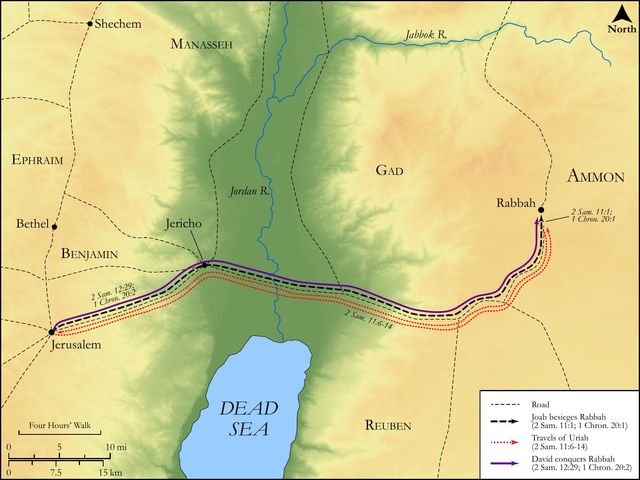
How the army of the Ammonites and their allies was routed in the field we read in the foregoing chapters. Here we have the destruction of Rabbah, the metropolis of their kingdom (Ch1 20:1), the putting of their king's crown upon David's head (Ch1 20:2), and the great severity that was used towards the people, Ch1 20:3. Of this we had a more full account in 2 Sa. 11, 12, and cannot but remember it by this sad token, that while Joab was besieging Rabbah David fell into that great sin in the matter of Uriah. But it is observable that, though the rest of the story is repeated, that is not: a hint only is given of it, in those words which lie here in a parenthesis - But David tarried at Jerusalem. If he had been abroad with his army, he would have been out of the way of that temptation; but, indulging his ease, he fell into uncleanness. Now, as the relating of the sin David fell into is an instance of the impartiality and fidelity of the sacred writers, so the avoiding of the repetition of it here, when there was a fair occasion given to speak of it again, is designed to teach us that, though there may be a just occasion to speak of the faults and miscarriages of others, yet we should not take delight in the repetition of them. That should always be looked upon as an unpleasing subject which, though sometimes one cannot help falling upon, yet one would not choose to dwell upon, any more than we should love to rake in a dunghill. The persons, or actions, we can say no good of, we had best say nothing of.
Continue studying 1 Chronicles 20:2 across the web’s major study libraries — every link below opens this exact verse, chapter, or book on the destination site.
Read & Compare
 BibleGatewayThis verse in more than 200 translations and 70 languages.
 Bible.comThe YouVersion reader — hundreds of translations, reading plans, and highlights.
 ESV.orgCrossway's official English Standard Version reader.
 NET BibleThe NET translation with 60,000+ translators' notes on every rendering decision.
 STEP BibleTyndale House's free study tool — original text, vocabulary, and scholarly resources.
 BibliaLogos Bible Software's free web reader.
 USCCBThe New American Bible (Revised Edition) with the U.S. bishops' study notes.
Commentaries
 BibleHub CommentariesDozens of classic commentaries on this verse, gathered on one page.
 StudyLightMore than 100 commentary sets — the largest collection on the web.
 BibleRefPlain-English commentary on what this verse means, verse by verse.
 Enduring WordDavid Guzik's free commentary on this chapter, widely used by Bible teachers.
 Bible Study ToolsVerse commentary alongside Greek and Hebrew study aids.
Original Language & Research
- BibleHub InterlinearThe verse word by word — original language, transliteration, and English.
- BibleHub LexiconEvery word's original-language definition and Strong's entry.
 Blue Letter BibleDeep-study tools — Strong's numbers, concordance, and word studies.
 SefariaThe Hebrew text with Rashi and centuries of Jewish commentary.
Sermons, Hymns & Audio


TrulyRandomVerse is not affiliated with these sites and doesn’t control their content. They’re linked because they’re genuinely useful.
Summary
1 Chronicles 20:2 encapsulates the decisive culmination of David's war against the Ammonites, specifically the capture of their capital, Rabbah. This verse powerfully illustrates David's personal triumph and the transfer of sovereign power, symbolized by his acquisition of the Ammonite king's crown—an object of immense value and weight—and its placement on his own head. This act unequivocally declares the complete subjugation of the enemy and the expansion of Israel's dominion, further underscored by the vast quantities of spoil brought from the city, signifying God's vindication of David and the prosperity of his kingdom.
Context
ShowHideLiterary Context
This verse serves as the climactic conclusion to the protracted conflict between Israel and Ammon, a war initiated by the Ammonite king Hanun's egregious insult to David's ambassadors, as detailed in 2 Samuel 10:4 and 1 Chronicles 19:4. The Chronicler's account, while paralleling 2 Samuel 12:26-31, is notably condensed. Unlike 2 Samuel, which elaborates on Joab's initial siege and subsequent summons for David to personally complete the conquest, 1 Chronicles 20:2 streamlines the narrative. This brevity emphasizes David's direct action in taking the crown and the spoils, thereby magnifying his kingship and highlighting the divine blessing upon his reign. The Chronicler frequently employs such narrative compression to underscore theological truths and the glory of David's divinely appointed rule, rather than providing exhaustive historical minutiae.
Historical & Cultural Context
Among the kings of that day, the capture of a capital city and the seizure of its king's regalia were the ultimate demonstrations of conquest and the symbolic transfer of power. Crowns were not mere ornaments but potent symbols embodying royal authority, the legitimacy of a ruler, and often the divine favor believed to be bestowed upon the king and his nation. The act of taking the crown from a defeated monarch and placing it on the victor's head was a profound public declaration of absolute dominion and the humiliation of the vanquished. Furthermore, the systematic collection of immense spoil was a standard practice in ancient warfare, serving not only to enrich the conquering nation but also to signify the complete economic and military ruin of the defeated. The specific mention of the crown's immense weight ("a talent of gold") and the "exceeding much spoil" would have communicated to contemporary audiences the overwhelming nature of Israel's victory and the vast wealth now accruing to David's kingdom, underscoring Israel's ascendant power in the region.
Key Themes
ShowHideThe events described in 1 Chronicles 20 and particularly in verse 2 powerfully reinforce several core themes prevalent throughout the books of Chronicles. Firstly, it underscores Divine Vindication and Victory, demonstrating God's unwavering faithfulness to His anointed king, David, by granting him a decisive triumph over those who scorned him and Israel. This victory serves as a testament to God's justice against those who oppose His chosen people, echoing the broader narrative where God consistently fights for Israel, as seen in David's earlier victories where God gives the command to attack (1 Chronicles 14:10). Secondly, David's act of placing the crown on his own head vividly symbolizes the Transfer of Sovereignty and the Expansion of Davidic Dominion. This act solidifies David's authority as God's chosen ruler (1 Chronicles 11:3) and illustrates the physical manifestation of God's kingdom through Israel's military success. Finally, the acquisition of Immense Spoil and Wealth highlights God's abundant blessing and provision for His people, transforming the resources of the defeated into tangible assets for Israel, which often contributed to the future construction of the temple.
Exposition and Analysis
ShowHideKey Word Analysis
ShowHideThis term refers to a royal diadem or crown, a potent symbol of kingship, authority, and glory. The act of taking the crown from the head of the defeated king and placing it on David's head is a profound symbolic gesture, signifying the transfer of sovereignty and the complete subjugation of the Ammonite kingdom. It represents the ultimate dethronement of the enemy and the enthronement of David's authority over them.
A "talent" was a significant unit of weight in Scripture, typically estimated to be between 75 to 125 pounds (approximately 34-57 kilograms). The sheer weight of the crown, described as a talent of gold, strongly suggests it was not intended for regular wear but was likely a ceremonial display piece, possibly a large idol's crown, or even a hyperbole emphasizing its immense value. Its capture and repurposing (or melting down) would have represented an enormous acquisition of wealth for Israel.
This term refers to the plunder or booty taken from a defeated enemy in warfare. The phrase "exceeding much spoil" (using H3966 mᵉʼôd and H7235 râbâh for emphasis) indicates a vast quantity of material wealth, including gold, silver, precious metals, and other valuables. The acquisition of spoil was a tangible sign of victory, economic gain, and the complete defeat of the enemy, often used to enrich the conquering nation and sometimes dedicated to the Lord's treasury.
Verse Breakdown
ShowHide"And David took the crown of their king from off his head"
This clause highlights David's direct and personal involvement in the culmination of the Ammonite war. The act of taking the crown directly from the defeated king's head (or from the idol it adorned, if it was a cultic crown) is a powerful symbolic gesture. It represents the complete subjugation of the Ammonite monarchy and the transfer of their royal authority and glory to David, the king of Israel.
"and found it to weigh a talent of gold"
This detail emphasizes the extraordinary value and perhaps the ceremonial or cultic nature of the crown. A talent of gold was an immense weight, suggesting it was not a crown for daily wear but a grand, perhaps cultic, centerpiece. This detail underscores the opulence of the Ammonite monarchy and the magnitude of the wealth acquired through this decisive victory.
"and [there were] precious stones in it"
This further enhances the description of the crown's immense value and splendor. The inclusion of precious stones indicates not only the material wealth but also the artistry and prestige associated with the Ammonite kingship, all of which now belonged to Israel, further solidifying the comprehensive nature of the conquest.
"and it was set upon David's head"
This is the pivotal symbolic act. While the literal wearing of such a heavy crown is highly improbable, this phrase signifies David's assumption of the Ammonite king's sovereignty and dominion. It could imply that the gold and stones were repurposed into a new, wearable crown for David, or it could be a metaphorical statement of David's expanded authority and his role as the supreme ruler in the region, now reigning over the defeated Ammonites.
"and he brought also exceeding much spoil out of the city"
This final clause confirms the comprehensive nature of the victory. Beyond the crown, vast quantities of wealth and resources were plundered from Rabbah. This "exceeding much spoil" signifies the economic benefits of the conquest, providing resources for Israel and further demonstrating the complete and devastating defeat of the Ammonites.
Literary Devices
ShowHide1 Chronicles 20:2 masterfully employs several Literary Devices to convey its profound message. Symbolism is paramount, with the crown serving as the central symbol of sovereignty, power, and national identity. David's act of taking and placing it on his head is a symbolic transfer of all these attributes from the defeated Ammonite king to himself, representing the complete subjugation of Ammon under Israel's dominion. The description of the crown's weight as "a talent of gold" likely utilizes Hyperbole, an exaggeration not meant to be taken literally as a wearable item, but rather to emphasize the extraordinary value and immense significance of the captured item and the wealth gained. Furthermore, the crown can be seen as an instance of Metonymy, where the "crown" stands in for the entire kingdom and the comprehensive sovereignty of the Ammonites. Finally, the verse itself is a prime example of Narrative Condensation, characteristic of the Chronicler's style, summarizing a more extensive account found in 2 Samuel to focus on the theological implications and David's glory rather than the military minutiae.
Theological and Thematic Connections
ShowHide1 Chronicles 20:2 powerfully illustrates God's active involvement in the affairs of His people, particularly in vindicating His anointed king and establishing His kingdom. The decisive victory over the Ammonites, culminating in the symbolic transfer of the crown and the acquisition of vast spoils, is a testament to God's justice against those who defy Him and His chosen servants. It underscores the principle that pride and opposition to God's plan ultimately lead to destruction, while obedience and faithfulness bring divine favor and prosperity. This narrative reinforces the theme of God's covenant with David, promising an enduring dynasty and success against his enemies, demonstrating that David's earthly reign was a tangible expression of God's sovereign rule. The wealth acquired was not merely for personal gain but often contributed to the resources for the future temple, connecting military victory to the advancement of God's worship and the establishment of His dwelling place among His people.
Reflection and Application
ShowHideThe account of David's decisive victory over the Ammonites and the symbolic taking of their king's crown offers profound lessons for believers today. Just as God vindicated David against his enemies and established his kingdom, we are reminded that God is ultimately sovereign over all earthly powers and that His justice will prevail. This narrative encourages us to trust in God's ultimate triumph over evil, both in the world and in our personal lives. While we do not engage in physical warfare for earthly crowns, we are called to participate in a spiritual battle against spiritual forces of darkness. The "crown" of the Ammonite king can symbolize any earthly power, idol, or stronghold that attempts to usurp God's rightful place in our lives or in the world. Our victory, achieved through Christ, involves surrendering such "crowns" to His dominion and recognizing His supreme authority. The "spoils" we gain are not material wealth but spiritual blessings: growth in character, wisdom, peace, and the expansion of God's kingdom through our lives. This passage calls us to live in light of God's ultimate victory, confidently engaging in our spiritual battles, knowing that He will bring about His purposes and vindicate His people, ultimately leading us to share in His eternal glory.
Questions for Reflection
ShowHideFAQ
ShowHideWas the crown described in 1 Chronicles 20:2 literally worn by David?
ShowHideIt is highly unlikely that David literally wore a crown weighing a talent of gold (approximately 75-125 pounds or 34-57 kilograms). Such a weight would be impossible to wear comfortably or practically. Scholars generally interpret this in one of two ways: either the "crown" was a large, ceremonial, or cultic object (perhaps an idol's crown) that was melted down and its gold repurposed into a new, wearable crown for David, or the phrase "it was set upon David's head" is a symbolic statement signifying the transfer of the Ammonite king's sovereignty and authority to David. The Chronicler's focus is on the symbolic act of dominion and the immense value of the spoils, rather than the literal wearing of an impossibly heavy object.
Why does the account in 1 Chronicles 20:2 appear so condensed compared to the parallel narrative in 2 Samuel?
ShowHideThe Chronicler's primary purpose in writing 1 and 2 Chronicles was not to provide a comprehensive historical record identical to Samuel and Kings, but rather to offer a theological history of Israel, particularly focusing on the Davidic dynasty, the temple, and the covenant with God. Therefore, the Chronicler often condenses or omits details that do not directly serve his theological agenda. In this case, by streamlining the account of the Ammonite war and highlighting David's personal role in taking the crown and spoil, the Chronicler emphasizes David's glory, God's vindication of His king, and the expansion of Israel's divinely blessed kingdom. The focus shifts from military strategy (as seen in 2 Samuel 12) to the triumphant outcome and its theological implications for David's reign and the establishment of God's kingdom.
Christ-Centered Fulfillment
ShowHideThe victory of David over the Ammonites and his taking of the king's crown in 1 Chronicles 20:2 serves as a powerful foreshadowing of Christ's ultimate and decisive triumph. David, as an earthly king, conquered a human enemy and took a physical crown, symbolizing the transfer of earthly dominion. However, Jesus Christ, the true Son of David and King of kings, achieved a far greater victory. He conquered not merely an earthly foe, but the spiritual powers of sin, death, and the devil through His sacrificial death and glorious resurrection. The "crown" He wears is not one taken from a defeated earthly monarch, but a crown of glory and honor bestowed upon Him by God, earned through His perfect obedience and redemptive work (Hebrews 2:9). Just as David brought "exceeding much spoil" into Israel, Christ, in His ascension, led captivity captive and distributed gifts to His people (Ephesians 4:8). His "spoils" are a redeemed humanity, a kingdom of light, and the spiritual blessings poured out upon those who believe. Ultimately, David's victory points to the Lamb of God, who is worthy to receive power, wealth, wisdom, strength, honor, glory, and praise, for He has conquered and reigns eternally (Revelation 5:12), and He will return to wear "many crowns" as the undisputed sovereign over all creation (Revelation 19:12).