


1 Chronicles 18:11
Bible text: King James Version (1769 Blayney text) · Public domain
Bible text: King James Version with Strong's numbers · Public domain
Bible text: Berean Standard Bible · Public domain
Bible text: American Standard Version (1901) · Public domain
Bible text: World English Bible, Messianic edition · Public domain
Bible text: Geneva Bible (1599) · Public domain
Bible text: Young's Literal Translation · Public domain
- גַּםgamalsoH1571AdvAdverb
- אֹתָם'o·Tam<obj.> themH853DirObjM ¦ 3mpParticle Object Indicatorאֹתָ<obj.>םthem
- הִקְדִּישׁhik·Dishhe consecratedH6942V-Hiphil-Perf-3msVerb Hiphil Perfect 3rd Singular Masculine
- הַמֶּלֶךְha·Me·lekhthe kingH4428Art ¦ N-msNoun Singular Masculine Absoluteהַtheמֶּלֶךְking
- דָּוִידda·VidDavidH1732N-proper-mNoun Proper Masculine
- לַיהוָהla·Yah·wehto YahwehH3068Prep-l ¦ N-properNoun Proper TitleלַtoיהוָהYahweh
- עִם'imwithH5973PrepPreposition
- הַכֶּסֶףha·Ke·sefthe silverH3701Art ¦ N-msNoun Singular Masculine Absoluteהַtheכֶּסֶףsilver
- וְהַזָּהָבve·ha·za·Havand the goldH2091Conj-w ¦ Art ¦ N-msNoun Singular Masculine Absoluteוְandהַtheזָּהָבgold
- אֲשֶׁר'a·SherwhichH834RelParticle Relative
- נָשָׂאna·Sa'he had taken awayH5375V-Qal-Perf-3msVerb Qal Perfect 3rd Singular Masculine
- מִכָּלmi·kolfrom allH3605Prep-m ¦ N-mscNoun Singular Masculine Constructמִfromכָּלall
- הַגּוֹיִםha·go·Yimthe nationsH1471Art ¦ N-mpNoun Plural Masculine Absoluteהַtheגּוֹיִםnations
- מֵאֱדוֹםme·'e·Domfrom EdomH123Prep-m ¦ N-proper-mNoun Proper MasculineמֵfromאֱדוֹםEdom
- וּמִמּוֹאָבu·mi·mo·'Avand from MoabH4124Conj-w ¦ Prep-m ¦ N-properNoun Proper LocationוּandמִfromמּוֹאָבMoab
- וּמִבְּנֵיu·mi·be·Neiand from [the] people ofH1121Conj-w ¦ Prep-m ¦ N-mpcNoun Plural Masculine Constructוּandמִfromבְּנֵי[the] people of
- עַמּוֹןa·MonAmmonH5983N-proper-mNoun Proper Masculine
- וּמִפְּלִשְׁתִּיםu·mi·pe·lish·Timand from [the] PhilistinesH6430Conj-w ¦ Prep-m ¦ N-mpNoun Gentilic Plural Masculine Absoluteוּandמִfromפְּלִשְׁתִּים[the] Philistines
- וּמֵעֲמָלֵקu·Me·'a·ma·Lekand from AmalekH6002Conj-w ¦ Prep-m ¦ N-properNoun Proper LocationוּandמֵfromעֲמָלֵקAmalek
English is a literal word-by-word gloss of the Hebrew, not the KJV's wording. Why?
This is the original text the KJV's translators worked from — each Hebrew word with its own literal English meaning in this verse, prepared by scholars at Tyndale House, Cambridge. The KJV translates whole sentences, not word by word, so its wording differs: one Hebrew word can become several English words, and the KJV may choose “the LORD” where the gloss reads “Yahweh”. Both are faithful — they answer different questions. For the KJV's own rendering, switch to the KJV text.
Details
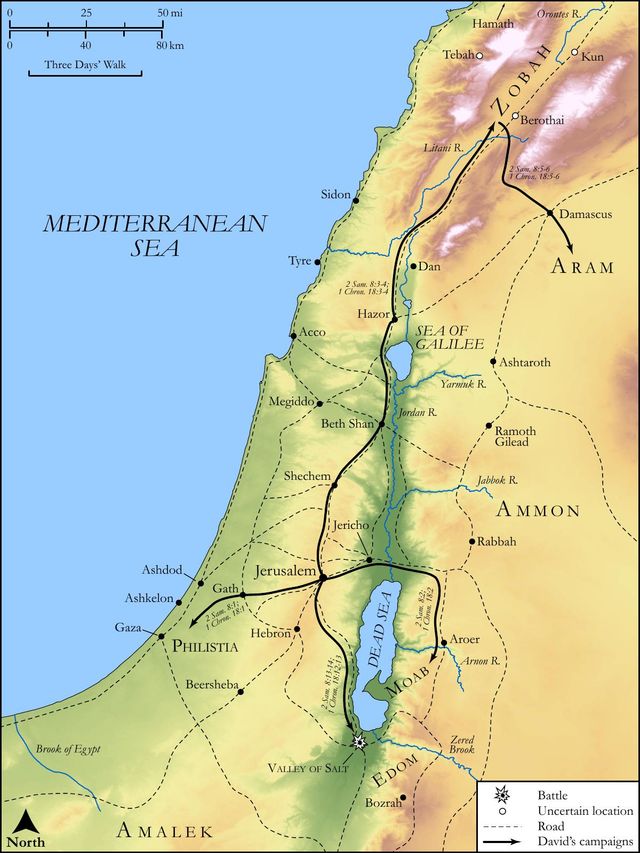
See on the biblical-era map
Study this verse
Public-domain commentary
Matthew Henry
From his Commentary on the Whole Bible. Henry comments on passages, not single verses — this entry covers 1 Chronicles 18:9–17.
Here let us learn, 1. That it is our interest to make those our friends who have the presence of God with them. The king of Hamath, hearing of David's great success, sent to congratulate him and to court his favour with a noble present, Ch1 18:9, Ch1 18:10. It is in vain to contend with the Son of David. Kiss the Son, therefore, lest he be angry; let the kings and judges of the earth, and all inferior people too, be thus wise, thus instructed. The presents we are to bring him are not vessels of gold and silver, as here (those shall be welcomed to him who have no such presents to bring), but our hearts and sincere affections, our whole selves, we must present to him as living sacrifices. 2. That what God blesses us with we must honour him with. The presents of his friends, as well as the spoils of his enemies, David dedicated unto the Lord (Ch1 18:11), that is, he laid them up towards the building and enriching of the temple. That is most truly and most comfortably our own which we have consecrated unto the Lord, and which we use for his glory. Let our merchandise and our hire be holiness to the Lord, Isa 23:18. 3. That those who take God along with them whithersoever they go may expect to prosper, and be preserved, whithersoever they go. It was said before (Ch1 18:6) and here it is repeated (Ch1 18:13) that the Lord preserved David whithersoever he went. Those are always under the eye of God that have God always in their eye. 4. God gives men power, not that they may look great with it, but that they may do good with it. When David reigned over all Israel he executed judgment and justice among all his people, and so answered the end of his elevation. He was not so intent on his conquests abroad as to neglect the administration of justice at home. Herein he served the purposes of the kingdom of providence, and of that God who sits in the throne judging right; and he was an eminent type of the Messiah, the sceptre of whose kingdom is a right sceptre.
Continue studying 1 Chronicles 18:11 across the web’s major study libraries — every link below opens this exact verse, chapter, or book on the destination site.
Read & Compare
 BibleGatewayThis verse in more than 200 translations and 70 languages.
 Bible.comThe YouVersion reader — hundreds of translations, reading plans, and highlights.
 ESV.orgCrossway's official English Standard Version reader.
 NET BibleThe NET translation with 60,000+ translators' notes on every rendering decision.
 STEP BibleTyndale House's free study tool — original text, vocabulary, and scholarly resources.
 BibliaLogos Bible Software's free web reader.
 USCCBThe New American Bible (Revised Edition) with the U.S. bishops' study notes.
Commentaries
 BibleHub CommentariesDozens of classic commentaries on this verse, gathered on one page.
 StudyLightMore than 100 commentary sets — the largest collection on the web.
 BibleRefPlain-English commentary on what this verse means, verse by verse.
 Enduring WordDavid Guzik's free commentary on this chapter, widely used by Bible teachers.
 Bible Study ToolsVerse commentary alongside Greek and Hebrew study aids.
Original Language & Research
- BibleHub InterlinearThe verse word by word — original language, transliteration, and English.
- BibleHub LexiconEvery word's original-language definition and Strong's entry.
 Blue Letter BibleDeep-study tools — Strong's numbers, concordance, and word studies.
 SefariaThe Hebrew text with Rashi and centuries of Jewish commentary.
Sermons, Hymns & Audio


TrulyRandomVerse is not affiliated with these sites and doesn’t control their content. They’re linked because they’re genuinely useful.
Summary
Following a series of divinely empowered military triumphs over long-standing adversaries, King David did not claim the immense spoils of silver and gold for his personal enrichment or the state treasury. Instead, in a profound act of worship and recognition of God's ultimate sovereignty, he consecrated these vast riches "unto the LORD." This dedication underscored David's understanding that all success and wealth derived solely from God, setting apart these resources for sacred purposes, particularly as foundational provisions for the future construction of the Temple in Jerusalem.
Context
ShowHideLiterary Context
This verse serves as the theological climax of the military campaigns meticulously detailed in 1 Chronicles 18:1-10. The preceding narrative recounts David's decisive subjugation of formidable enemies, including the Philistines, Moabites, Syrians (Hadadezer of Zobah), Edomites, Ammonites, and Amalekites. The Chronicler consistently emphasizes that "the LORD gave victory to David wherever he went" (1 Chronicles 18:6), framing these conquests not merely as human achievements but as divine blessings and fulfillments of covenant promises. David's subsequent act of dedicating the spoils to the LORD is presented as the appropriate and righteous response to God's faithfulness and power, establishing a precedent for future generations and laying the groundwork for the Temple's construction under Solomon. The parallel account in 2 Samuel 8 also details these triumphs, though 1 Chronicles typically highlights the theological implications and David's piety more explicitly.
Historical & Cultural Context
Among the kings of that day, it was customary for victorious monarchs to seize immense plunder from conquered nations. This wealth was typically used to enrich the king, fund royal projects, or adorn the temples of their patron deities. David's action, while fitting within the broader custom of dedicating spoils, profoundly distinguishes itself by its specific consecration "unto the LORD" (Yahweh). This was not merely a ceremonial offering but a formal act of setting apart, acknowledging the unique covenant relationship between Israel and its God. The nations listed—Edom, Moab, Ammon, Philistines, and Amalek—were long-standing, often oppressive, adversaries of Israel. David's decisive victories over them signified the establishment of Israel's secure borders and regional dominance, fulfilling ancient promises of land and rest. The sheer volume of silver and gold indicates the immense wealth and strategic importance of these defeated kingdoms, underscoring the magnitude of God's provision and David's faithful response.
Key Themes
ShowHideThis verse powerfully contributes to several overarching themes within 1 Chronicles and the broader biblical narrative. Firstly, it highlights Divine Sovereignty and Victory, reinforcing the Chronicler's consistent message that God is the true source of Israel's strength and success. David's military prowess is acknowledged, but the ultimate credit for his triumphs is attributed to the LORD, who "gave victory to David wherever he went" (1 Chronicles 18:6). Secondly, the act of "dedicating" underscores the theme of Dedication and Consecration. David's response stands in stark contrast to King Saul's disobedience regarding the spoils from the Amalekites in 1 Samuel 15:9, where Saul failed to fully consecrate the plunder to God, leading to his rejection as king. David's piety demonstrates a deep understanding of God's holiness and His rightful claim over all things. Finally, this dedication is intrinsically linked to the theme of Provision for God's House. While David was forbidden from building the Temple himself, he meticulously prepared for its construction by amassing vast resources. This act of dedicating the spoils in 1 Chronicles 18:11 is a foundational step in his comprehensive preparations, further elaborated in 1 Chronicles 29:2-9, showcasing David's fervent desire to honor God through worship and the establishment of a permanent dwelling for the Ark.
Exposition and Analysis
ShowHideKey Word Analysis
ShowHideThis verb means "to be clean (ceremonially or morally)," "to consecrate," "to hallow," or "to set apart for sacred use." It is a foundational term in biblical theology, signifying the act of rendering something or someone exclusively for God's possession and purpose. David's use of this term for the spoils of war elevates his action beyond a mere offering or tax; it was a solemn, theological declaration that these vast material resources were no longer common but were now holy, set apart for the LORD's service, particularly for the future Temple.
Referring to silver (from its pale color) and, by implication, money. This term, alongside gold, represents immense wealth and precious metals, signifying not just a token offering but a substantial portion of the total spoils. The mention of specific materials emphasizes the tangible and significant nature of David's dedication. Silver was a primary form of stored wealth and a crucial medium of exchange, essential for large-scale building projects.
Meaning gold, or figuratively, something gold-colored (i.e., yellow), like oil or a clear sky. Gold, the most precious of metals, signifies supreme value and purity. Its dedication alongside silver highlights the scale of God's blessing on David's reign and David's proportionate response in consecrating the most valuable of his gains to the LORD, underscoring the magnitude of the resources being set apart for God's holy purposes.
Verse Breakdown
ShowHide"Them also king David dedicated unto the LORD,"
This opening clause immediately establishes David's active role as the agent of dedication and the LORD as the ultimate recipient. "Them" refers to the spoils of war previously mentioned. The act of "dedicating" (qadash) signifies a profound spiritual act, not merely a transfer of ownership, but a setting apart for holy purposes, demonstrating David's deep piety and recognition of God's sovereignty over all things, including the outcome of battles.
"with the silver and the gold that he brought from all [these] nations;"
This specifies the nature of the dedicated "them" as valuable precious metals, emphasizing the immense wealth acquired through conquest. The phrase "that he brought from all these nations" highlights the source of this wealth—the successful military campaigns—and implicitly acknowledges that these victories were divinely granted, allowing David to obtain such spoils.
"from Edom, and from Moab, and from the children of Ammon, and from the Philistines, and from Amalek."
This final clause provides a detailed enumeration of the specific nations from whom the wealth was taken. This list serves to underscore the breadth and completeness of David's (and God's) victories over Israel's historical enemies. Each nation represents a significant triumph, and their collective mention reinforces the idea of comprehensive peace and security established under David's reign, all made possible by the LORD.
Literary Devices
ShowHideThe Chronicler employs several literary devices in this verse to emphasize its profound theological significance. Enumeration is prominently used through the explicit listing of the defeated nations (Edom, Moab, Ammon, Philistines, Amalek). This detailed list serves to highlight the comprehensive nature of David's victories and, by extension, the extent of God's blessing and power in establishing Israel's dominion and securing its borders. Furthermore, there is an implicit Contrast at play, particularly when read in the broader context of Israel's history. David's faithful dedication of the spoils stands in stark opposition to King Saul's earlier disobedience regarding the Amalekite plunder in 1 Samuel 15, where Saul failed to fully consecrate the spoils to God. This contrast subtly underscores David's righteousness and his suitability as God's chosen king. Finally, the dedicated "silver and the gold" function as powerful Symbolism, representing not just immense material wealth but the tangible outcome of divine favor and the consecrated resources set apart for the sacred purpose of building God's dwelling place, foreshadowing the Temple's future glory.
Theological and Thematic Connections
ShowHide1 Chronicles 18:11 powerfully articulates a core biblical principle: the recognition of God's ultimate ownership and the proper response of faithful stewardship. David's dedication of the spoils is more than a generous act; it is an act of profound worship, acknowledging that all victories, resources, and blessings originate from the LORD. This understanding counters the human tendency to claim credit for success or to hoard wealth for self-aggrandizement. Instead, David models a life lived in humble dependence and grateful consecration, demonstrating that true prosperity lies not in accumulation but in dedicating one's gains to God's purposes. This principle extends beyond material wealth to encompass all aspects of life, calling believers to consecrate their talents, time, and influence to God's glory, recognizing that everything we possess is ultimately a gift from Him to be used for His kingdom.
Reflection and Application
ShowHideKing David's exemplary act in 1 Chronicles 18:11 provides a timeless blueprint for how believers should approach their successes and resources. In a world that often measures worth by accumulation and personal gain, David reminds us that true prosperity is found in acknowledging God as the ultimate source of every blessing. Whether it's financial success, professional achievements, personal talents, or even moments of peace and security, all are ultimately gifts from God. Our response, like David's, should be one of grateful dedication. This means consciously setting apart a portion of our "spoils"—our time, talents, and treasure—for God's kingdom work. It challenges us to consider if our generosity is merely an afterthought or a foundational act of worship, reflecting our belief in God's sovereignty and our desire to see His purposes fulfilled. David's foresight in preparing for the Temple also teaches us about long-term vision and commitment to God's work, encouraging us to invest in initiatives that will glorify God for generations to come, building a legacy of faith that extends beyond our immediate needs and desires.
Questions for Reflection
ShowHideFAQ
ShowHideWhy did David dedicate the wealth to the LORD instead of keeping it for himself or the kingdom's general use?
ShowHideDavid's decision to dedicate the vast wealth (silver and gold) to the LORD, rather than retaining it for personal use or general state expenditures, was rooted in his profound piety and theological understanding. Firstly, David recognized that his military victories and the subsequent acquisition of wealth were not solely due to his own prowess but were divine blessings, as the Chronicler repeatedly emphasizes that "the LORD gave victory to David wherever he went" (1 Chronicles 18:6). Dedicating the spoils was an act of worship, acknowledging God's sovereignty and His rightful claim over all things. Secondly, this act served a specific, future-oriented purpose: to provide resources for the construction of the Temple in Jerusalem. Although David was not permitted to build the Temple himself, he passionately desired to see a permanent dwelling place for the Ark of the Covenant established. His dedication of these spoils was a crucial step in accumulating the necessary materials and funds for this monumental project, as further detailed in 1 Chronicles 29. This contrasts sharply with the common practice of the kings of the nations, who would typically keep such plunder for themselves, highlighting David's unique devotion to Yahweh and his commitment to God's kingdom purposes.
Christ-Centered Fulfillment
ShowHideDavid's dedication of the spoils of war to the LORD in 1 Chronicles 18:11 serves as a profound foreshadowing of Christ's ultimate and perfect dedication. David, as an earthly king, conquered physical enemies and dedicated material wealth; Jesus, the true and eternal King, conquered spiritual enemies—sin, death, and the devil—and dedicated Himself as the ultimate sacrifice. Just as David's victories brought peace and security to Israel, Christ's victory on the cross secured eternal peace and reconciliation for all who believe, triumphing over the powers of darkness (Colossians 2:15). The "spoils" of Christ's victory are not silver and gold, but a redeemed humanity, a people set apart and consecrated to God through His blood (Ephesians 1:7). He dedicated His very life, offering Himself as a spotless lamb "once for all" (Hebrews 10:10), thereby fulfilling the essence of "dedication" in its most profound sense. Through His perfect self-offering, Christ established the true spiritual Temple, His body, the Church, and continually presents His redeemed people as a holy offering to the Father, demonstrating a dedication far surpassing any earthly king's act and securing an eternal inheritance for His followers (Hebrews 9:12).